Complete the Pattern Worksheet: Ladybugs, Snails, and More!
Continuing a visual pattern like 'ladybug, snail, ladybug' asks preschoolers to notice a repeating rule and predict what comes next, an early form of the logical reasoning that later supports algebra and sequencing in reading. Because the pictures here are garden creatures, this worksheet also builds vocabulary and observation skills as children study small differences between the pieces before choosing the correct one.
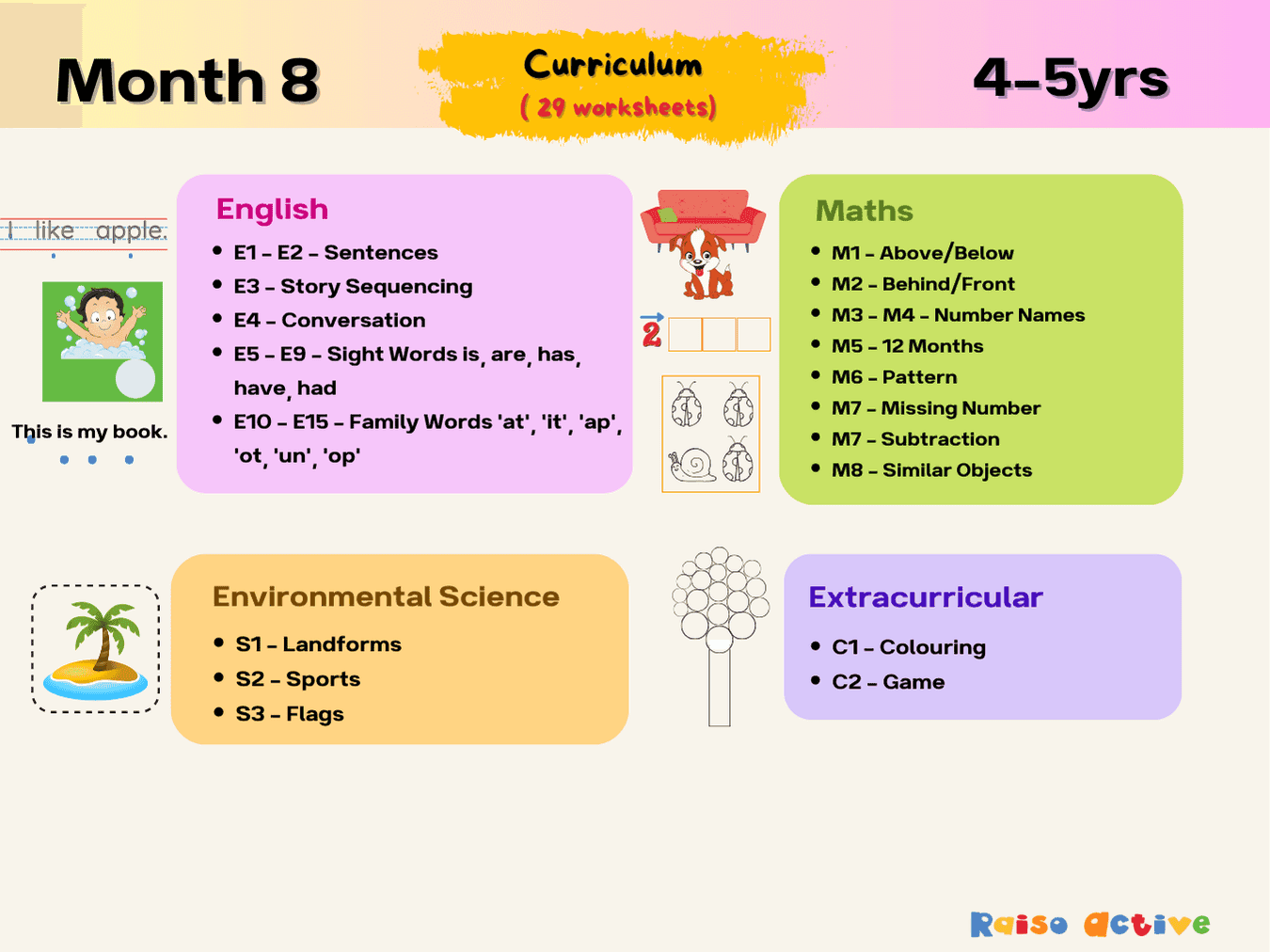
Part of the pack
Month 8: English, Math, Science Foundations | Ages 4-5
This is page 24 of the pack. Ages 4-5 · Pre-KAges 4-5 · ReceptionAges 4-5 · LKGAges 4-5
Curriculum
- Patterns > Patterns
How to use this worksheet
Before cutting anything, look at each row together and say the pattern out loud — 'ladybug, snail, ladybug, snail' — so your child hears the repeating rule. Have them cut out the picture pieces at the bottom of the page carefully along the lines. For each row, ask them to figure out which picture comes next in the sequence, then glue it into the empty box. Check each completed row together by saying the whole pattern aloud from the beginning.
Materials needed
- Scissors
- Glue Stick
- Pencil
Extension activities
- 1Line up real objects, like spoons and forks or two colors of blocks, in a repeating pattern and ask your child to add the next three items.
- 2Go outside and look for patterns in nature, like petals on a flower or stripes on a caterpillar.
- 3Create a wearable pattern by stringing beads or pasta in a repeating color sequence.
- 4Clap out a rhythm pattern (clap, clap, stomp) and have your child continue it.
- 5Draw a simple two-part pattern on paper and let your child extend it with crayons instead of cutting and pasting.

Written by
Hemsweta Jain · Teacher Cheena
MBA and Early Childhood Educator, teaching since 2014 · Founder of RaisoActive, Mumbai
Every RaisoActive worksheet is designed and checked by the founder before publishing.
Published · Last reviewed
More from Month 8: English, Math, Science Foundations | Ages 4-5

Above and Below Worksheet: Identifying Object Positions
Ages 3-5 · Preschool–Pre-KAges 3-5 · Nursery–ReceptionAges 3-5 · Nursery–LKGAges 3-5
Positional words like 'above' and 'below' give three-to-five-year-olds a vocabulary for describing where things are in space, a skill that underpins everything from map reading to following multi-step instructions later on. This activity page asks children to look closely at a scene and decide whether each object sits above or below a reference point, sharpening visual scanning and the ability to hold a spatial rule in mind while checking multiple items against it.

Counting Fun: Number Names Worksheet for Preschoolers!
Ages 4-5 · Pre-KAges 4-5 · ReceptionAges 4-5 · LKGAges 4-5
This number-names worksheet pushes children from simply counting objects to connecting a quantity with its written word, a step that bridges early numeracy with beginning literacy. Ages four and five are ready to start recognizing that 'three' is both a group of three dots and a specific string of letters, which strengthens both number sense and sight-word recognition.

Subtraction Game Worksheet for Kids: Fun Math Practice!
Ages 4-6 · Pre-K–KindergartenAges 4-6 · Reception–Year 1Ages 4-6 · LKG–UKGAges 4-6
This board-game style worksheet gives children ages 4-6 repeated, low-pressure practice solving subtraction problems as they move along a path with ladders and slides. Framing subtraction as a game keeps motivation high while children build fluency taking away from small numbers and reading the results instantly. The ladders and slides also add a playful lesson in following game rules and consequences.
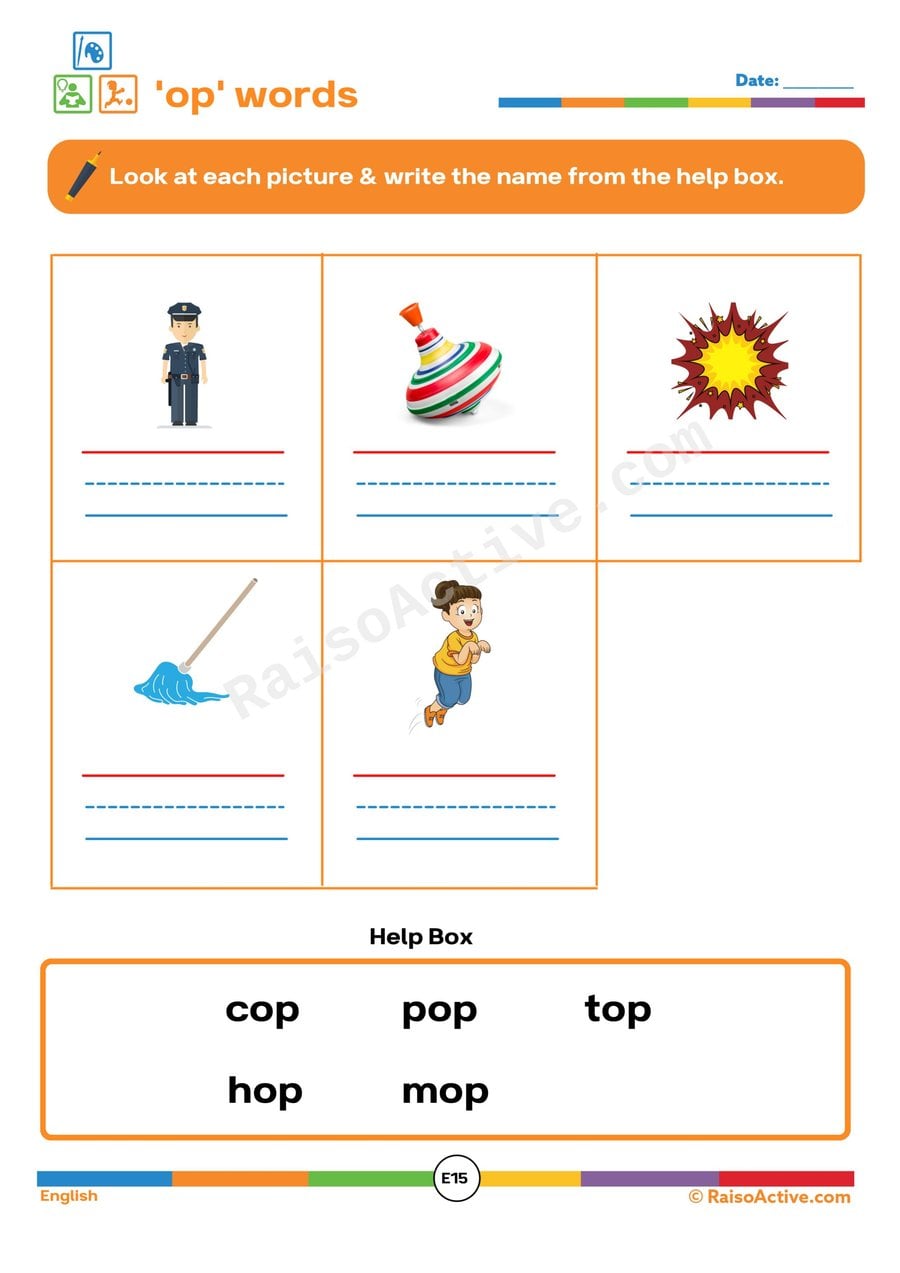
Op Word Worksheet: Read and Write 'op' Words!
Ages 4-5 · Pre-KAges 4-5 · ReceptionAges 4-5 · LKGAges 4-5
This worksheet gives children ages 4-5 focused practice reading and writing CVC words in the 'op' family, like 'top', 'hop', and 'mop'. Recognizing the consistent '-op' ending across multiple words builds the pattern-recognition skill that lets early readers decode unfamiliar words more quickly. Writing each word after finding it in the help box also reinforces correct spelling and letter formation.

Front and Behind Animals Worksheet: Identify Positions!
Ages 3-5 · Preschool–Pre-KAges 3-5 · Nursery–ReceptionAges 3-5 · Nursery–LKGAges 3-5
Preschoolers ages 3-5 build early spatial reasoning by identifying which pictured animals are positioned 'in front of' an object, a positional concept that requires comparing the relative location of two things in a scene. Understanding front-and-behind relationships lays groundwork for later concepts like map reading, following multi-step directions, and geometry. Circling only the correctly positioned animals also sharpens visual attention and careful looking.

Learn the Sight Word 'Has' - Fun Tracing and Matching Worksheet!
Ages 3-5 · Preschool–Pre-KAges 3-5 · Nursery–ReceptionAges 3-5 · Nursery–LKGAges 3-5
'Has' is a high-frequency verb that children ages 3-5 encounter constantly in early sentences describing possession, like 'the dog has a bone,' making it an important addition to their sight word vocabulary. This worksheet builds recognition of the word through coloring, tracing, word searching, and sentence completion, giving repeated exposure across formats that reinforces memory more effectively than a single repetition. Practicing 'has' inside complete sentences also helps children understand its grammatical role, connecting a subject to something it possesses.

Unlocking 'un' Words: A Fun Worksheet for Early Readers!
Ages 4-6 · Pre-K–KindergartenAges 4-6 · Reception–Year 1Ages 4-6 · LKG–UKGAges 4-6
Ages 4-6 practice decoding and spelling CVC words in the 'un' family, such as 'sun' and 'bun', by matching each picture to its written word. This picture-to-word matching strengthens the bridge between spoken vocabulary and printed text, a core early literacy skill. Writing the word afterward locks in correct letter sequencing and spelling memory.

I Like Sentences: Tracing and Reading Worksheet for Preschoolers
Ages 3-5 · Preschool–Pre-KAges 3-5 · Nursery–ReceptionAges 3-5 · Nursery–LKGAges 3-5
Tracing and reading simple 'I like' sentences gives children practice connecting handwriting motion with reading comprehension at the same time, since they trace the very words they're learning to recognize and say. For ages three to five, using a repeated sentence frame like 'I like ___' also builds confidence, since only the ending word changes from sentence to sentence.
Related worksheets
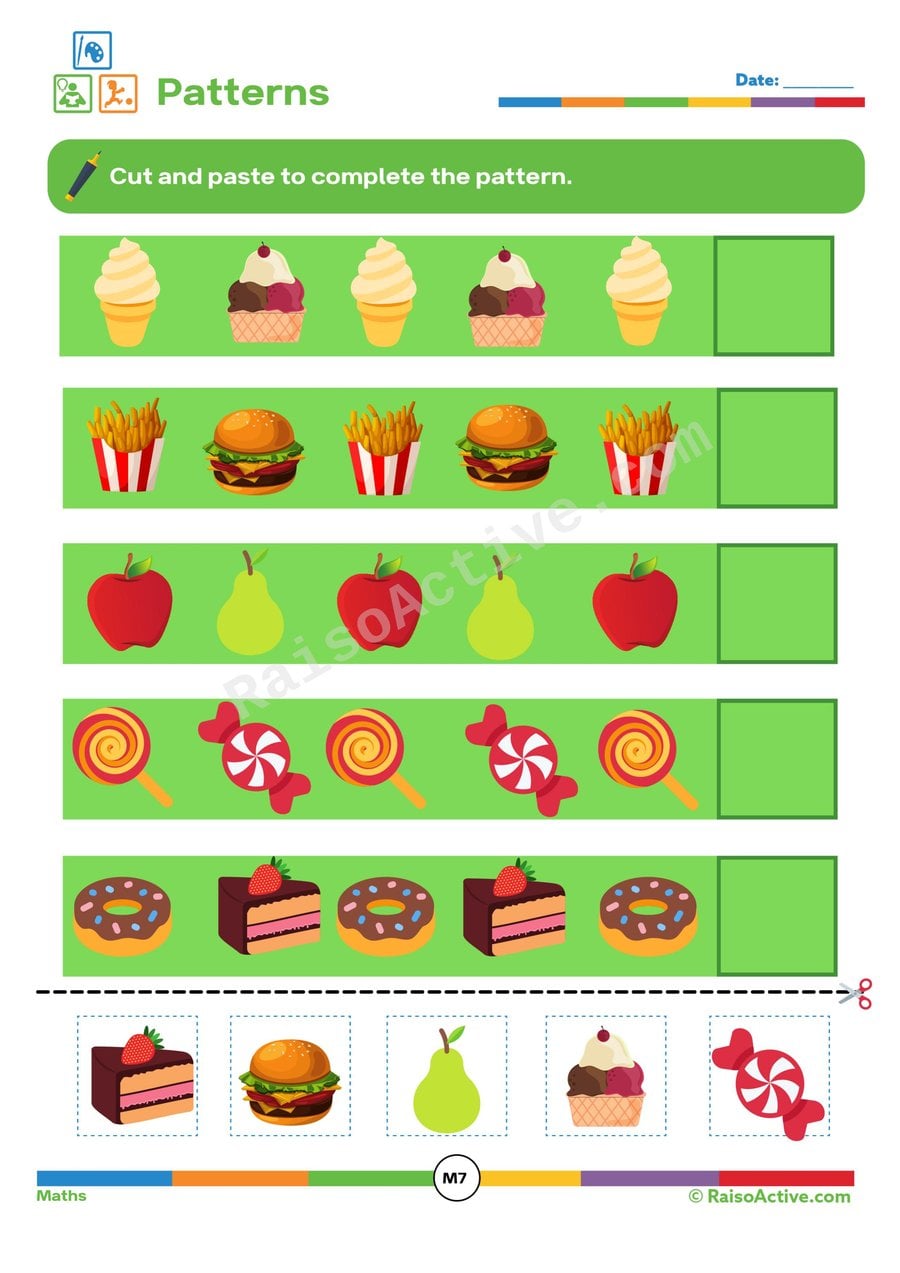
Yummy Food Patterns Worksheet for Preschoolers
Ages 3-5 · Preschool–Pre-KAges 3-5 · Nursery–ReceptionAges 3-5 · Nursery–LKGAges 3-5
This worksheet introduces pattern recognition — a core pre-math skill — by having children identify what food item comes next in a repeating sequence like apple-banana-apple-banana. Spotting and continuing patterns teaches children to predict what comes next based on a rule, an early form of the logical reasoning used later in math and science.
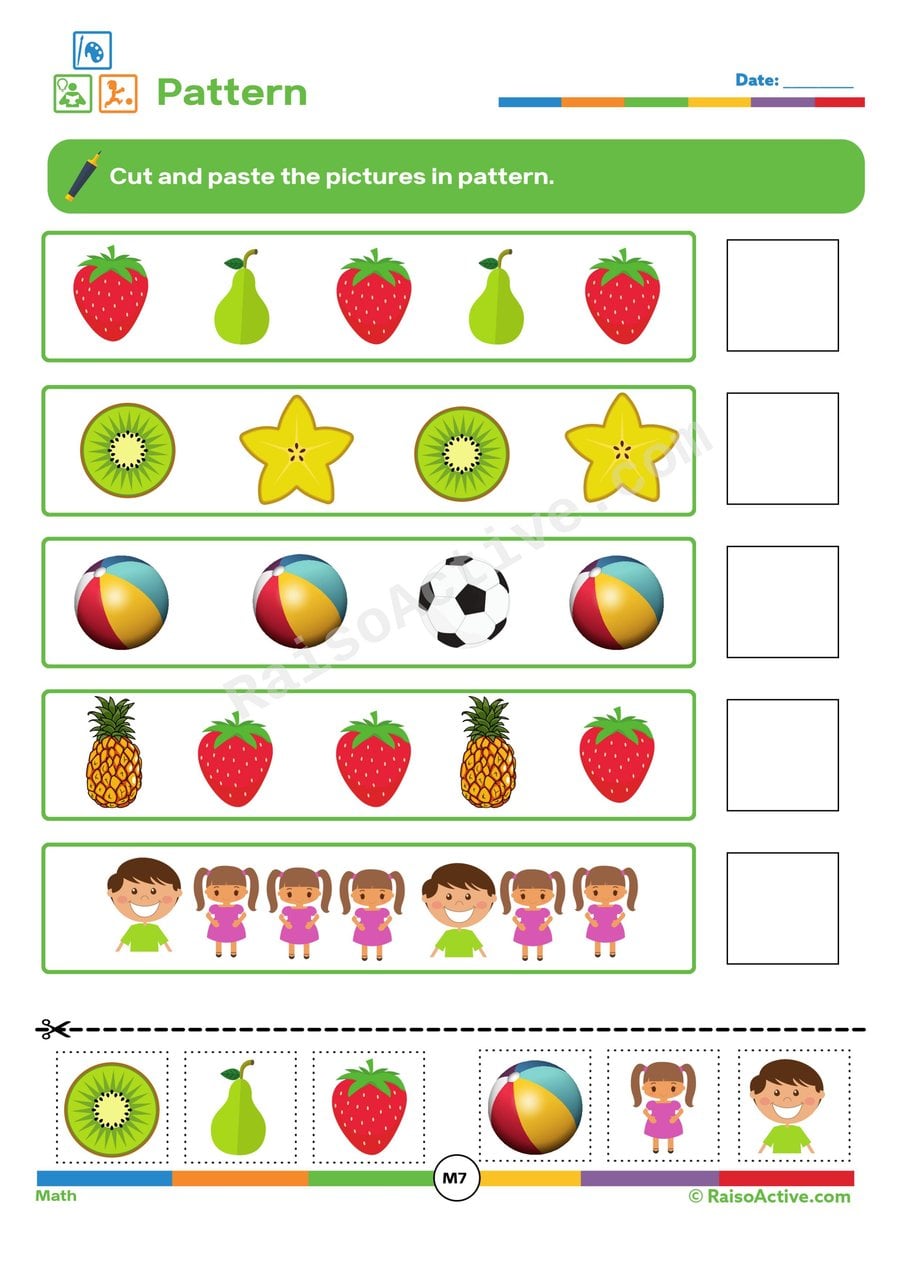
Fruit and Friends Pattern Worksheet
Ages 3-5 · Preschool–Pre-KAges 3-5 · Nursery–ReceptionAges 3-5 · Nursery–LKGAges 3-5
Identifying a repeating sequence of fruits or characters and choosing the correct picture to continue it builds pattern-recognition skills for children ages 3-5, an early form of logical reasoning that connects directly to later math concepts like skip counting.

Simple Pattern Worksheet for Preschoolers: Fill in the Sequence!
Ages 3-5 · Preschool–Pre-KAges 3-5 · Nursery–ReceptionAges 3-5 · Nursery–LKGAges 3-5
Recognizing and continuing a pattern is one of the earliest building blocks of mathematical and logical thinking for children ages 3-5, since it requires noticing a repeating rule and predicting what comes next based on that rule. This worksheet uses both shapes and numbers to build pattern awareness, asking children to fill in missing elements in a sequence and then match related number sequences together. Pattern recognition like this underpins later skills in math, reading, and even everyday problem-solving, since spotting repeating structures is a skill that transfers well beyond this one worksheet.
Egg Pattern Worksheet: Create and Match Patterns!
Ages 3-5 · Preschool–Pre-KAges 3-5 · Nursery–ReceptionAges 3-5 · Nursery–LKGAges 3-5
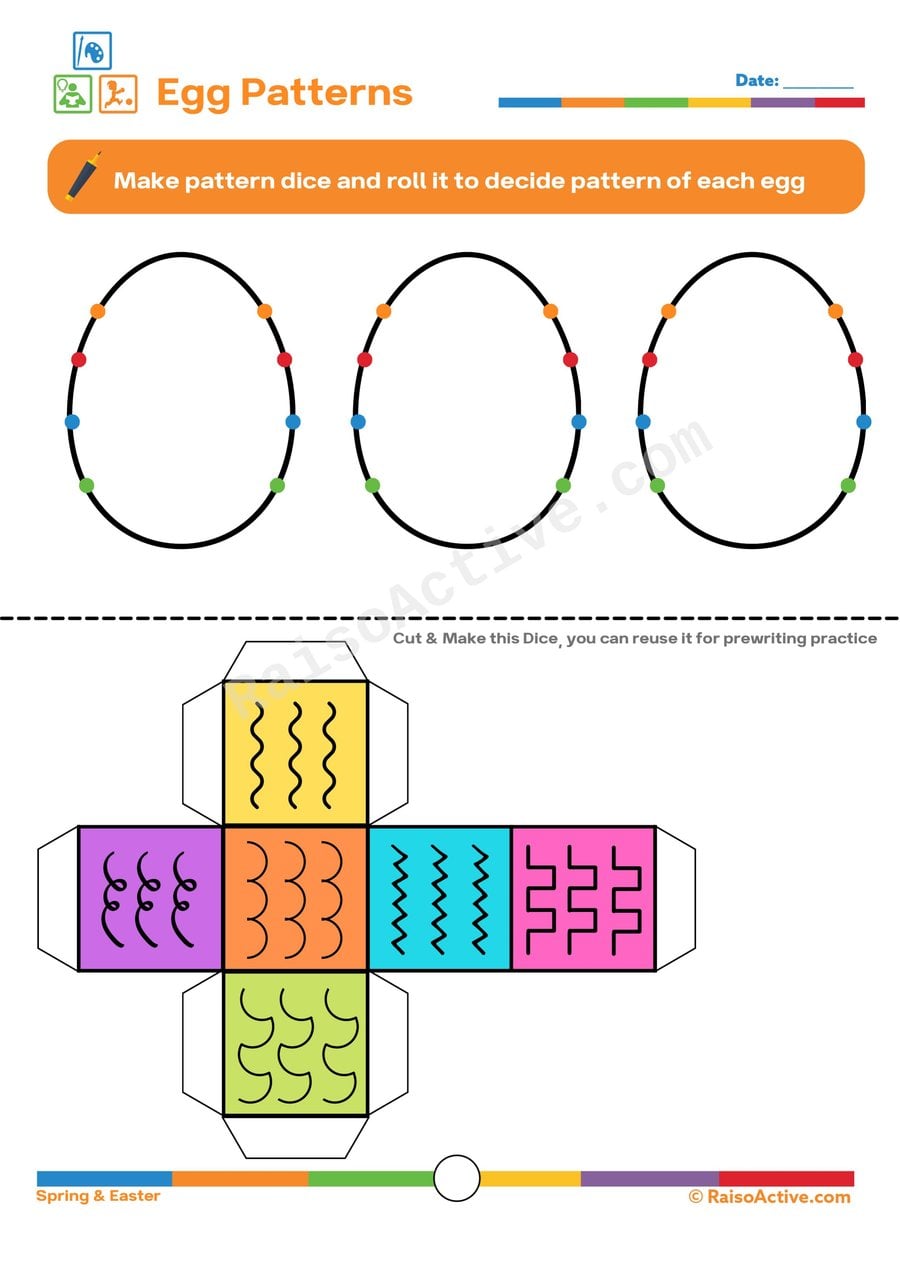
This egg-pattern activity has children ages 3-5 build a simple pattern dice and use it to generate and recreate repeating designs, developing pattern-recognition skills that underpin later math concepts like sequencing and multiplication. Rolling the dice and transferring the result onto each egg also connects a random outcome to a deliberate drawing action, strengthening cause-and-effect thinking.

Balloon Pattern Matching Worksheet for Preschoolers
Ages 3-5 · Preschool–Pre-KAges 3-5 · Nursery–ReceptionAges 3-5 · Nursery–LKGAges 3-5
This worksheet strengthens pattern recognition in children ages 3-5 by having them study a repeating sequence of colored balloons and locate the matching arrangement elsewhere on the page. Recognizing and reproducing a pattern is an early pre-algebra skill, laying groundwork for later number patterns and logical sequencing.

Pattern Recognition Worksheet: Cut and Paste the Next Picture!
Ages 3-5 · Preschool–Pre-KAges 3-5 · Nursery–ReceptionAges 3-5 · Nursery–LKGAges 3-5
This worksheet builds pattern recognition for children ages 3-5 by having them identify a repeating sequence in each row and then cut out and glue the picture that correctly continues it. Because the correct piece must be found among several distractor options, this task sharpens visual discrimination alongside the logical thinking needed to predict what comes next in a sequence.

Smiley Face Patterns Worksheet for Preschoolers
Ages 4-7 · Pre-K–Grade 1Ages 4-7 · Reception–Year 2Ages 4-7 · LKG–Class 1Ages 4-7
This worksheet helps children recognize and continue simple patterns using smiley faces. It encourages observation and logical thinking.

Balloon Pattern Matching Worksheet for Preschoolers
Ages 3-5 · Preschool–Pre-KAges 3-5 · Nursery–ReceptionAges 3-5 · Nursery–LKGAges 3-5
Children ages 3-5 build early pattern-recognition skills on this worksheet by studying a sequence of colored balloons and finding the matching set to complete it. Recognizing and continuing a repeating sequence is a foundational pre-math skill that later supports understanding of number patterns, skip counting, and simple algebraic thinking.
Guides for this topic

Pre-Writing Strokes in Order: From Standing Lines to Loops (With Printable Patterns)
The developmental order of pre-writing strokes, from vertical lines to loops, and why practicing them in sequence makes letter formation much easier to learn.

Age-Appropriate Problem-Solving Activities: Building Critical Thinkers from the Ground Up
Discover fun, age-appropriate problem-solving activities for children ages 1-8. Build critical thinking, logic, and reasoning skills through play-based learning.

Fostering Creativity in Structured Learning: The Perfect Balance for Young Minds
Learn how to blend creativity with structured learning for children ages 1-8. Practical strategies, activities, and printable worksheets for parents and teachers.
Reviews
Every worksheet for ages 3–5, no watermark
Members download the full library of 1,000+ worksheets and every activity pack without watermarks or daily limits. One year costs ₹999 in India or $20 elsewhere.
See membership plansOr download any worksheet free with a watermark (5 a day).