Unlocking 'un' Words: A Fun Worksheet for Early Readers!
Ages 4-6 practice decoding and spelling CVC words in the 'un' family, such as 'sun' and 'bun', by matching each picture to its written word. This picture-to-word matching strengthens the bridge between spoken vocabulary and printed text, a core early literacy skill. Writing the word afterward locks in correct letter sequencing and spelling memory.
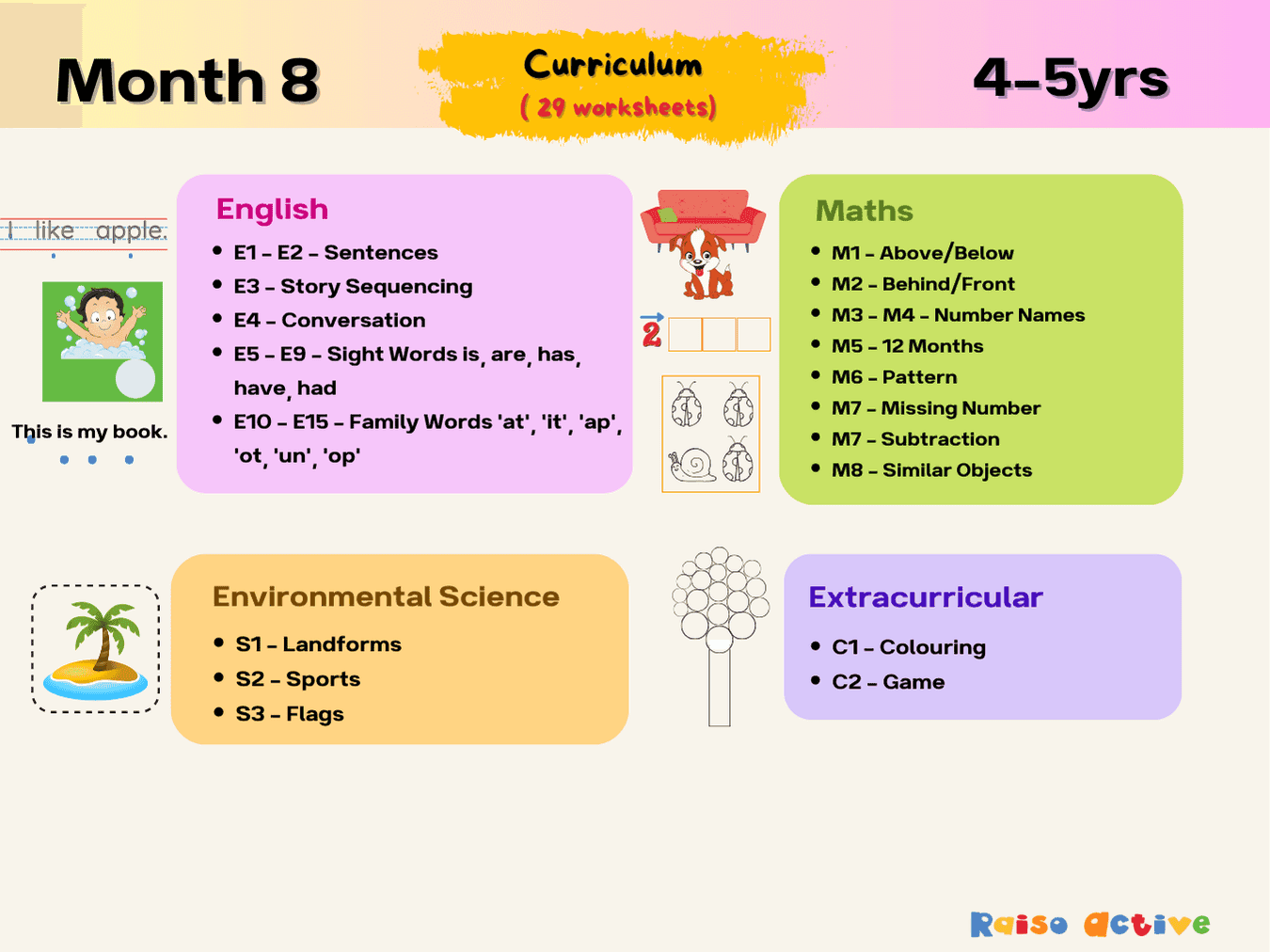
Part of the pack
Month 8: English, Math, Science Foundations | Ages 4-5
This is page 17 of the pack. Ages 4-5 · Pre-KAges 4-5 · ReceptionAges 4-5 · LKGAges 4-5
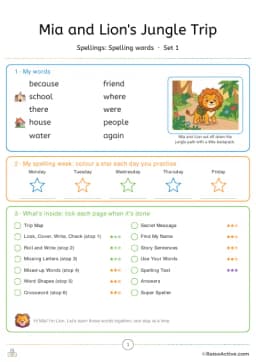
Made for your child
Spelling practice, made for your child
Their own spelling words turned into a pack: trace or look-cover-write-check, roll and write, a secret picture code, a word search, a crossword and a test, with their name in it.
Make a spelling packFree preview · free for members
Or start free: a word search with sight wordsCurriculum
- Phonics - CVC Words > CVC Short U Families
How to use this worksheet
Look at the first picture together and say the word slowly, stretching out each sound. Have your child scan the help box for the word that matches, then copy it onto the line beneath the picture, saying each letter as they write. Repeat this process for every picture on the page, checking each completed word against the picture before moving on. Finish by rereading all the 'un' words together in one sweep.
Materials needed
- Pencil
- Eraser
Extension activities
- 1Play 'I spy something that rhymes with sun' around the house or yard.
- 2Sort toy figures or blocks into a group labeled 'un' words your child names aloud.
- 3Have your child illustrate a comic strip using at least three 'un' words in speech bubbles.
- 4Practice writing the 'un' words in shaving cream or on a foggy window for tactile repetition.
- 5Create a simple 'un' word bingo card and call out words for your child to find.

Written by
Hemsweta Jain · Teacher Cheena
MBA and Early Childhood Educator, teaching since 2014 · Founder of RaisoActive, Mumbai
Every RaisoActive worksheet is designed and checked by the founder before publishing.
Published · Last reviewed
More from Month 8: English, Math, Science Foundations | Ages 4-5

Learn the Sight Word 'Has' - Fun Tracing and Matching Worksheet!
Ages 3-5 · Preschool–Pre-KAges 3-5 · Nursery–ReceptionAges 3-5 · Nursery–LKGAges 3-5
'Has' is a high-frequency verb that children ages 3-5 encounter constantly in early sentences describing possession, like 'the dog has a bone,' making it an important addition to their sight word vocabulary. This worksheet builds recognition of the word through coloring, tracing, word searching, and sentence completion, giving repeated exposure across formats that reinforces memory more effectively than a single repetition. Practicing 'has' inside complete sentences also helps children understand its grammatical role, connecting a subject to something it possesses.
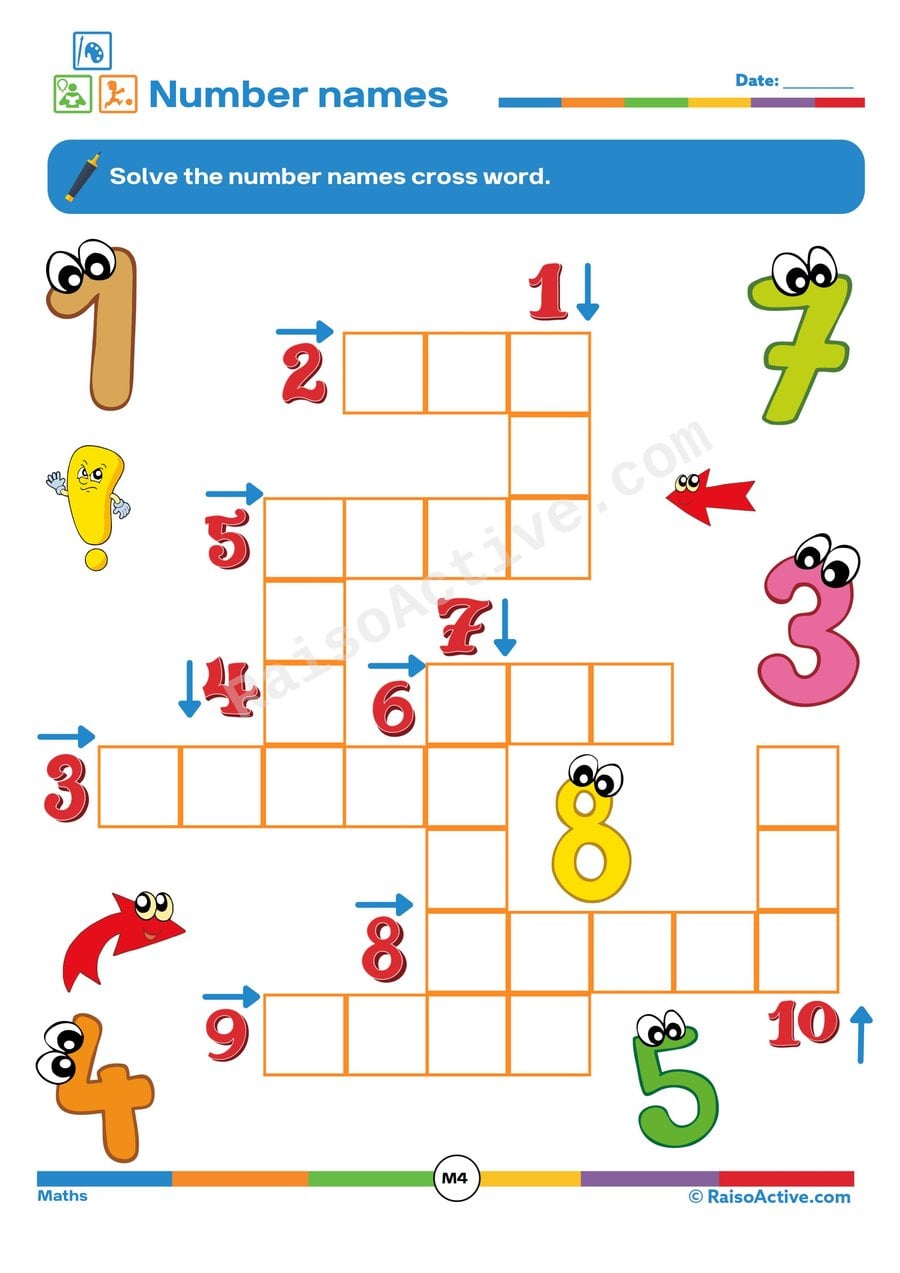
Number Names Crossword Worksheet for Kids
Ages 4-6 · Pre-K–KindergartenAges 4-6 · Reception–Year 1Ages 4-6 · LKG–UKGAges 4-6
Children ages 4-6 practice spelling number names — like 'five', 'twelve', or 'twenty' — by using numeral clues to fill in a crossword grid. This task bridges numeral recognition with word spelling, requiring children to think about both quantity and written vocabulary simultaneously. Fitting letters into the fixed crossword boxes also builds spatial planning and careful letter counting.
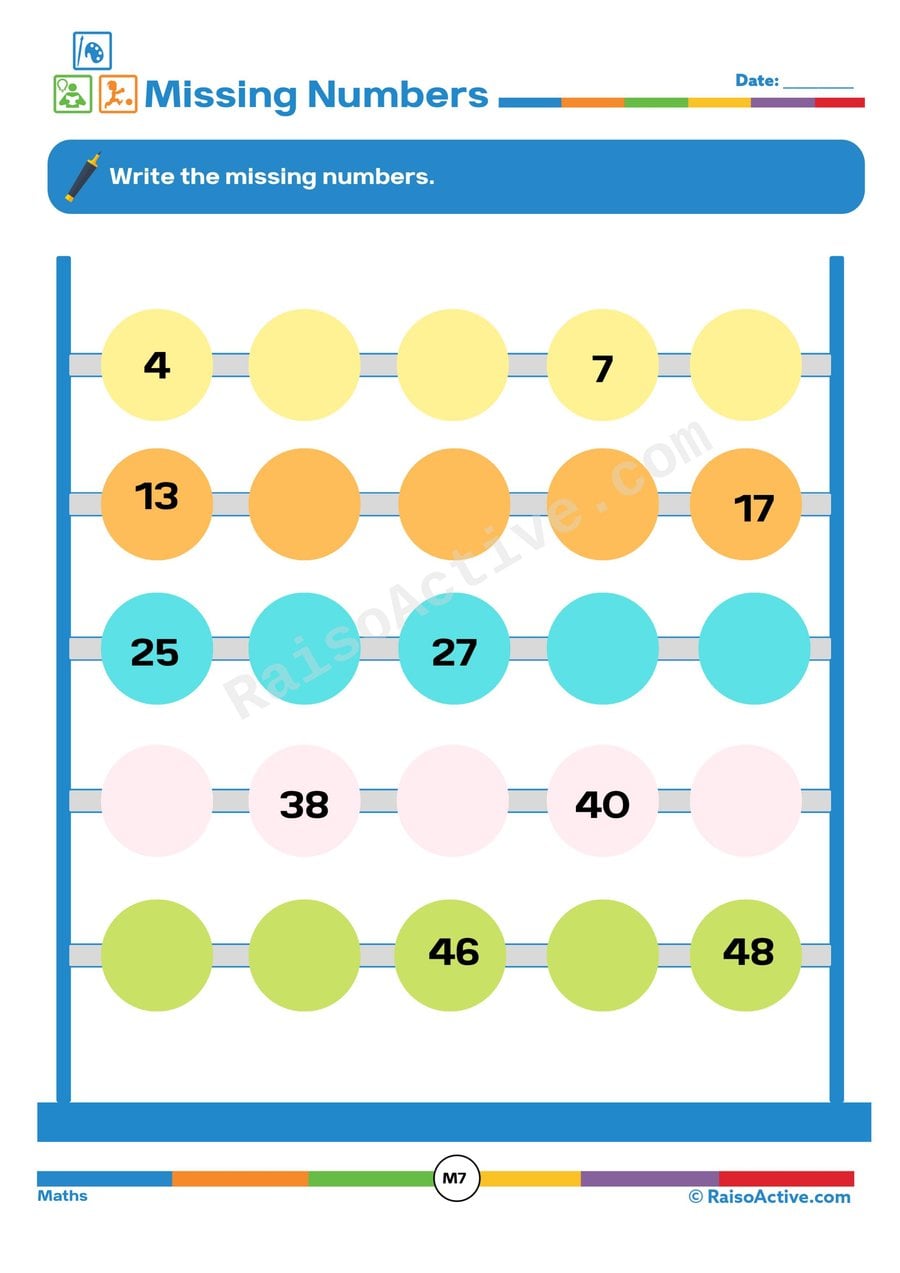
Missing Numbers Worksheet for Preschoolers
Ages 4-5 · Pre-KAges 4-5 · ReceptionAges 4-5 · LKGAges 4-5
Children ages 4-5 strengthen number sequencing by identifying which numbers are missing from a given sequence and filling in the gaps. This task requires understanding the pattern of counting forward by one, rather than simply reciting memorized numbers, which builds a deeper sense of how numbers relate to each other. Successfully finding each missing number also reinforces number formation as children write the answer themselves.
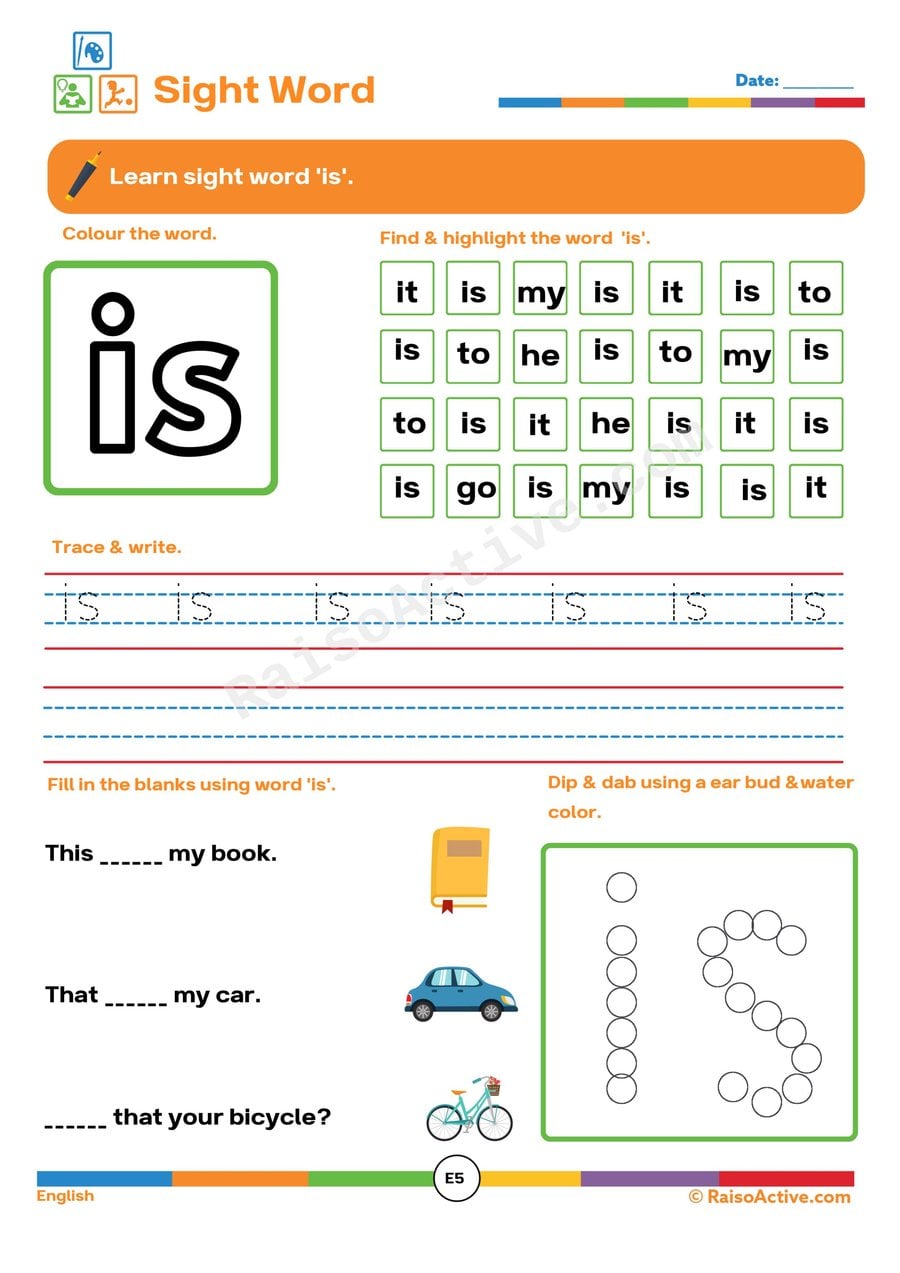
Sight Word 'is' Worksheet: Trace, Find, and Write!
Ages 3-5 · Preschool–Pre-KAges 3-5 · Nursery–ReceptionAges 3-5 · Nursery–LKGAges 3-5
Children ages 3-5 build instant recognition of the high-frequency sight word 'is', practicing it through coloring, tracing, searching, and writing for repeated exposure across multiple formats. As one of the earliest and most common words children encounter in print, quickly recognizing 'is' by sight significantly boosts early reading fluency. Completing fill-in-the-blank sentences also shows children how this small but essential word functions within everyday sentences.

Subtraction Worksheet: Practice Subtracting with Fun Pictures!
Ages 4-6 · Pre-K–KindergartenAges 4-6 · Reception–Year 1Ages 4-6 · LKG–UKGAges 4-6
Children ages 4-6 practice subtraction by looking at a set of pictured objects, crossing out or removing the indicated amount, and writing the resulting total. Seeing subtraction visually, rather than only as abstract numbers, helps children genuinely understand what 'taking away' means before relying on memorized facts. This visual approach builds a strong foundation for mental math strategies used in later grades.
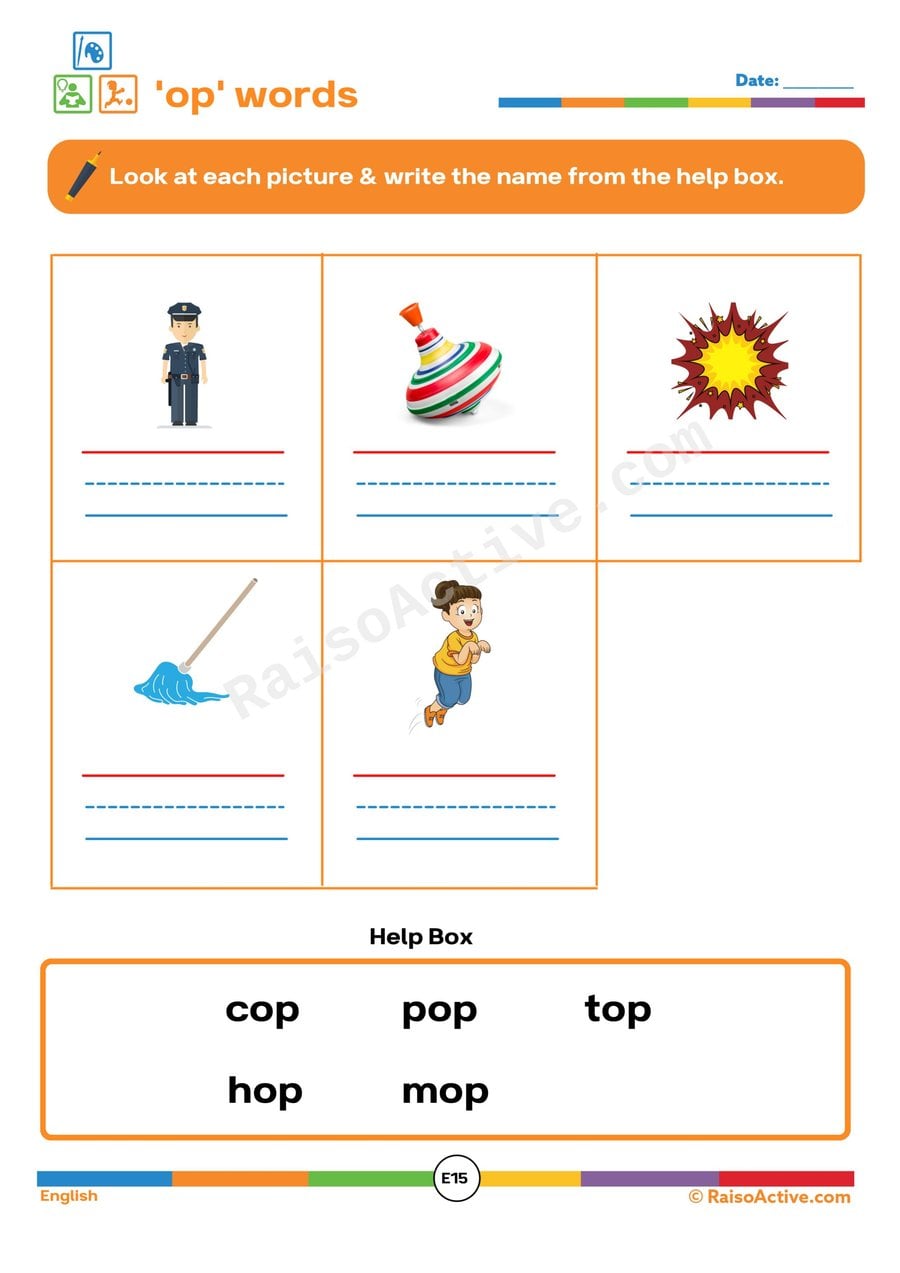
Op Word Worksheet: Read and Write 'op' Words!
Ages 4-5 · Pre-KAges 4-5 · ReceptionAges 4-5 · LKGAges 4-5
This worksheet gives children ages 4-5 focused practice reading and writing CVC words in the 'op' family, like 'top', 'hop', and 'mop'. Recognizing the consistent '-op' ending across multiple words builds the pattern-recognition skill that lets early readers decode unfamiliar words more quickly. Writing each word after finding it in the help box also reinforces correct spelling and letter formation.

Landforms Cut and Paste Worksheet for Preschoolers
Ages 3-5 · Preschool–Pre-KAges 3-5 · Nursery–ReceptionAges 3-5 · Nursery–LKGAges 3-5
This worksheet introduces preschoolers to the idea that the Earth's surface takes many different forms — mountains, beaches, islands — and asks them to match a picture of each landform to its name, an early step in geography and classification skills. Sorting pictures by category also reinforces visual discrimination, since children must notice defining features, like water on all sides for an island or a peak for a mountain, rather than relying on color or size alone.
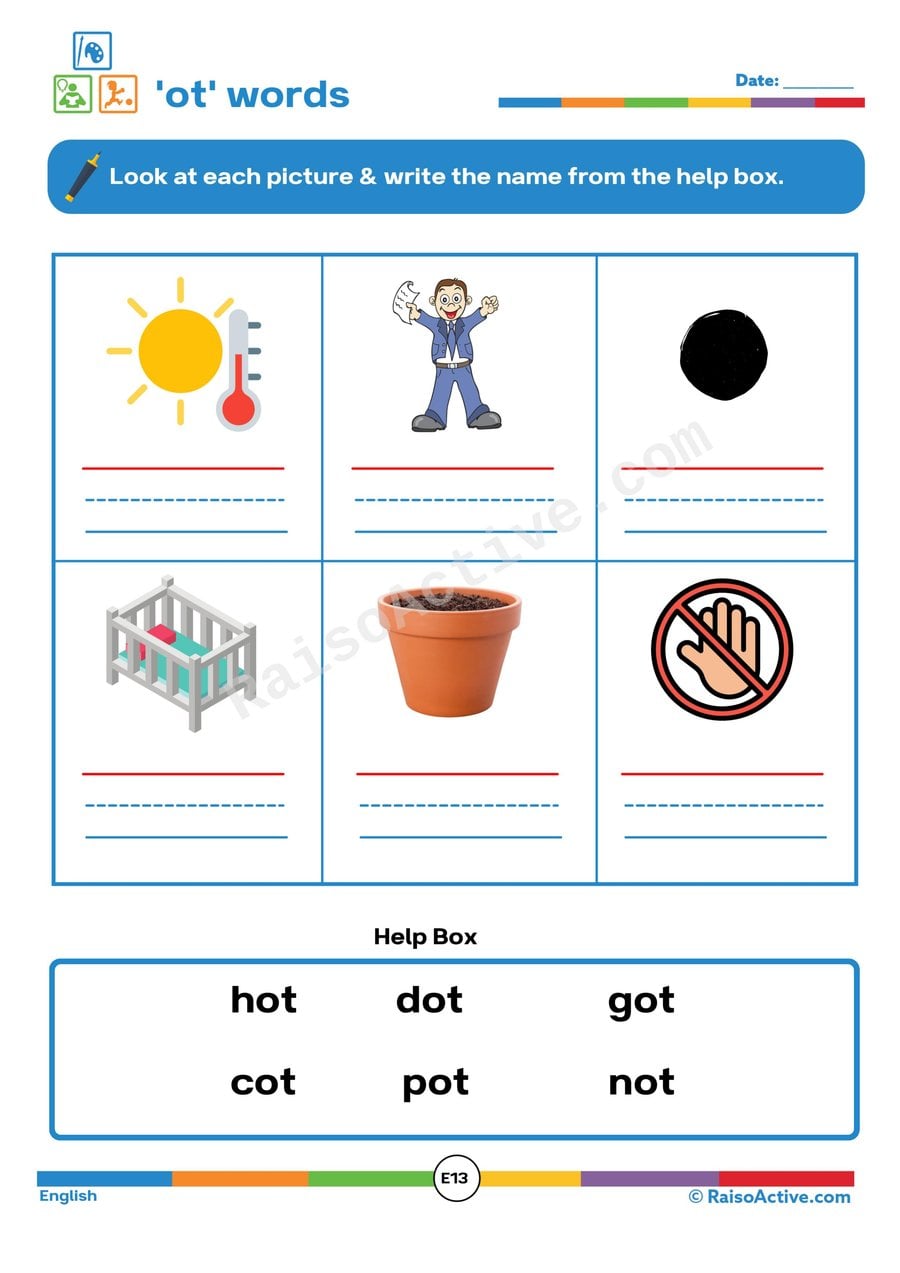
Ot Word Fun: 'ot' Word Worksheet for Early Readers
Ages 4-6 · Pre-K–KindergartenAges 4-6 · Reception–Year 1Ages 4-6 · LKG–UKGAges 4-6
Children ages 4-6 build phonics fluency by reading and writing CVC words in the 'ot' family, like 'pot', 'dot', and 'hot'. Recognizing this consistent letter pattern teaches early readers that groups of letters make predictable sounds, a key strategy for decoding unfamiliar words independently. Writing the words afterward reinforces the sound-to-letter connection needed for spelling.
Related worksheets

Silly Diwali Story and Doodles: Fill in the Funny Words
Ages 7-10 · Grade 2–Grade 3Ages 7-10 · Year 3–Year 4Ages 7-10 · Class 2–Class 3Ages 7-10
Children choose funny words such as an animal, a colour, a sweet and an action to complete a silly Diwali story, then read it aloud. They finish four started drawings: fireworks, a lantern pattern, a rangoli and a sweet box.
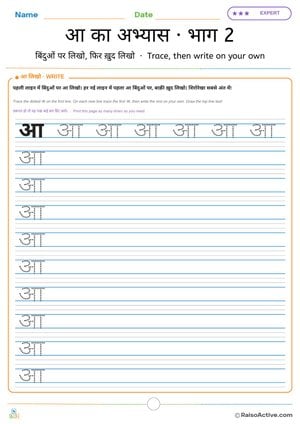
Hindi Letter आ Practice Part 2: Trace and Write on Your Own | आ का अभ्यास · भाग 2
Ages 3-7 · Preschool–Grade 1Ages 3-7 · Nursery–Year 2Ages 3-7 · Nursery–Class 1Ages 3-7
Children build writing fluency by tracing the dotted line आ on the first line and then writing the letter on their own, line after line, as the dotted help fades. The headline (शिरोरेखा) is drawn last, as in Hindi handwriting.
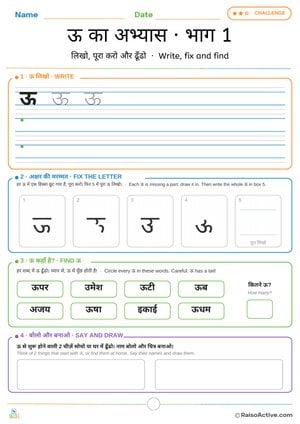
Hindi Letter ऊ Practice Part 1: Write, Fix and Find | ऊ का अभ्यास · भाग 1
Ages 3-7 · Preschool–Grade 1Ages 3-7 · Nursery–Year 2Ages 3-7 · Nursery–Class 1Ages 3-7
Children write ऊ on guide lines, complete four partly drawn letters, circle ऊ in eight words (while avoiding its look-alike उ), count how many they found, then think of two more words at home that start with ऊ and draw them.
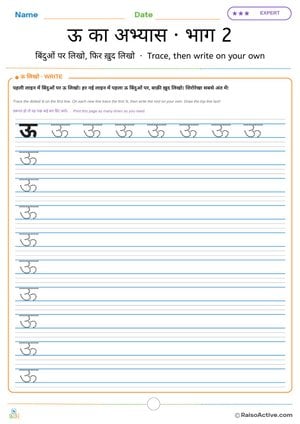
Hindi Letter ऊ Practice Part 2: Trace and Write on Your Own | ऊ का अभ्यास · भाग 2
Ages 3-7 · Preschool–Grade 1Ages 3-7 · Nursery–Year 2Ages 3-7 · Nursery–Class 1Ages 3-7
Children build writing fluency by tracing the dotted line ऊ on the first line and then writing the letter on their own, line after line, as the dotted help fades. The headline (शिरोरेखा) is drawn last, as in Hindi handwriting.

Phonics Level 2 Certificate of Achievement: Super Reader
Ages 4-7 · Pre-K–Grade 1Ages 4-7 · Reception–Year 2Ages 4-7 · LKG–Class 1Ages 4-7
Children celebrate reading and spelling words with blends and digraphs, and tick what they can read: CVC words, blends and digraphs.
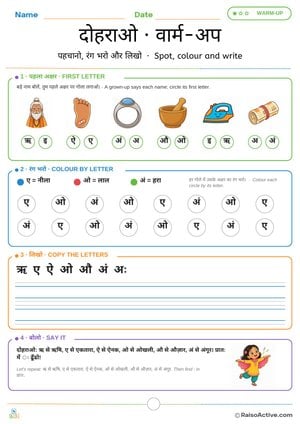
Hindi Vowels Part 2 Revision: Spot, Colour and Write | दोहराओ – वार्म-अप
Ages 3-7 · Preschool–Grade 1Ages 3-7 · Nursery–Year 2Ages 3-7 · Nursery–Class 1Ages 3-7
A warm-up revision: circle the first letter of each picture word, colour circles by letter (ए blue, ओ red, अं green), copy the seven letters and repeat the words ऋषि, एकतारा, ऐनक, ओखली, औज़ार and अंगूर.
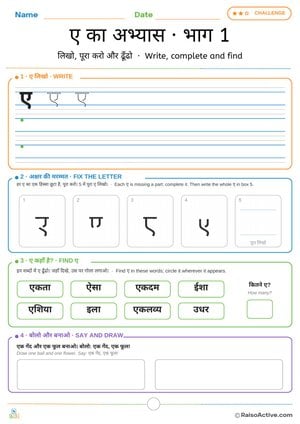
Hindi Letter ए (e) Practice 1: Write, Fix the Letter and Find | ए का अभ्यास · भाग 1
Ages 4-7 · Pre-K–Grade 1Ages 4-7 · Reception–Year 2Ages 4-7 · LKG–Class 1Ages 4-7
A challenge page: write ए between the lines, complete four letters that are each missing a part and then write the whole ए in box 5, find ए in words such as एकता, एकदम, एशिया and एकलव्य, and draw a picture. ए is not the short form of ऐ; the practice page keeps them apart.
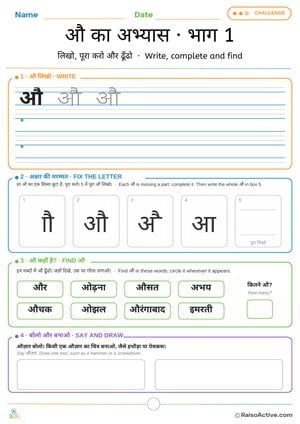
Hindi Letter औ (au) Practice 1: Write, Fix the Letter and Find | औ का अभ्यास · भाग 1
Ages 4-7 · Pre-K–Grade 1Ages 4-7 · Reception–Year 2Ages 4-7 · LKG–Class 1Ages 4-7
A challenge page: write औ between the lines, complete four letters that are each missing a part and then write the whole औ in box 5, find औ in words such as और, औसत, औचक and औरंगाबाद, and draw a picture. औ and ओ are different vowels; औ has two marks on top and ओ has one.
Guides for this topic

How to Teach CVC Blending: A Step-by-Step Method That Works in Two Weeks
A step-by-step method for teaching CVC blending, covering continuous sounds, word families, common errors, and a 14-day plan that most children finish reading CVC words.
Phase 2 Phonics at Home: Sound Order, Blending Games, Worksheets
Phase 2 phonics at home: the five sound sets in order, oral blending, tricky words, a two-week routine, common mistakes, and free worksheets.

Reception Year Explained: EYFS Learning and How to Help at Home
A teacher's plain-English guide to the Reception Year: the seven areas of learning, Early Learning Goals, Phase 2/3 phonics, the RBA and home routines.
Reviews
Every worksheet for ages 4–6, no watermark
Members download the full library of 1,000+ worksheets and every activity pack without watermarks or daily limits. One year costs ₹999 in India or $20 elsewhere.
See membership plansOr download any worksheet free with a watermark (5 a day).