
Complete the Pattern: Cut and Paste Worksheet for Preschoolers
Completing a simple visual pattern by cutting and pasting the next correct picture asks children ages 3-5 to notice a repeating rule, such as circle-square-circle-square, and predict what logically comes next — an early and important building block of mathematical and logical thinking. This skill underlies later concepts in math, coding, and even music, all of which rely on recognizing and extending sequences. The cut-and-paste format adds a fine motor and decision-making layer, since children must select the correct piece from several options rather than simply pointing to an answer.
Curriculum
How to use this worksheet
Look at the first pattern row together and say each shape or picture out loud in order, emphasizing the repeating rhythm. Ask your child what they think comes next in the sequence before looking at the answer choices. Have them cut out the small picture options at the bottom of the page and find the one that correctly continues the pattern. Glue that picture into the empty box, then repeat the process for each remaining pattern row on the worksheet.
Materials needed
- Scissors
- Glue
- Pencil
Extension activities
- •Create simple patterns using household items, like spoon-fork-spoon-fork, and ask your child to continue them.
- •Use colored blocks or beads to build a pattern and have your child add the next few pieces.
- •Clap out a rhythm pattern, like clap-clap-stomp, and ask your child to repeat and continue it.
- •Go on a pattern hunt around the house or outside, looking for repeating patterns in tiles, fabric, or fences.
- •Let your child create their own pattern using stickers or drawings for you to continue.
Tips for parents and teachers
Ask your child to say the pattern out loud before choosing an answer, since verbalizing the rule ('circle, square, circle, square...') makes the underlying logic much clearer than just looking at the pictures. If they guess incorrectly, point back to the beginning of the row and recount the sequence together rather than simply supplying the right answer. Patterns with three or more repeating elements are significantly harder than two-element ones, so it's fine to start with simpler patterns if this page feels too challenging.

Written by
Hemsweta Jain · Teacher Cheena
MBA and Early Childhood Educator, teaching since 2014 · Founder of RaisoActive, Mumbai
Every RaisoActive worksheet is designed and checked by the founder before publishing.
Published · Last reviewed
Related worksheets

Clothing Pattern Match Worksheet for Preschoolers
This worksheet has children ages 3-5 study repeating patterns on clothing items — stripes, polka dots, or checks — and match each item to its identical twin, building visual discrimination and early pattern-sequencing skills. Distinguishing between similar-looking patterns also sharpens attention to detail, a skill that later supports letter and word recognition.

Balloon Pattern Matching Worksheet for Preschoolers
Children ages 3-5 build early pattern-recognition skills on this worksheet by studying a sequence of colored balloons and finding the matching set to complete it. Recognizing and continuing a repeating sequence is a foundational pre-math skill that later supports understanding of number patterns, skip counting, and simple algebraic thinking.

Clothing Pattern Matching Worksheet for Preschoolers
By comparing clothing items and connecting each one to its pattern match, children ages 3-5 build visual discrimination skills, learning to notice fine differences in stripes, dots, or repeated shapes. This close-looking practice supports the same attention-to-detail children will later need to tell similar-looking letters and numbers apart.

Balloon Pattern Matching Worksheet for Preschoolers
This worksheet strengthens pattern recognition in children ages 3-5 by having them study a repeating sequence of colored balloons and locate the matching arrangement elsewhere on the page. Recognizing and reproducing a pattern is an early pre-algebra skill, laying groundwork for later number patterns and logical sequencing.
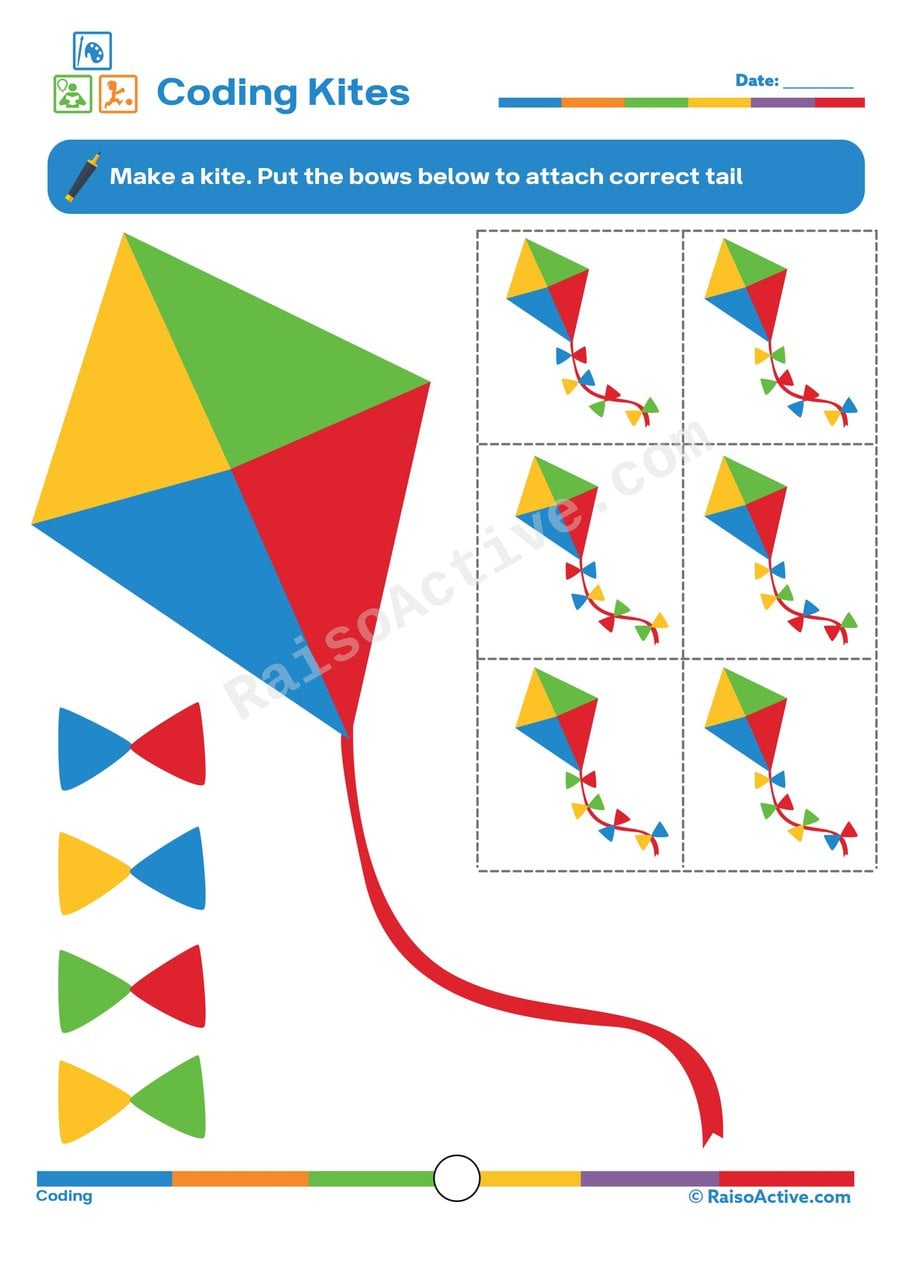
Coding Kites Worksheet: Match the Bows!
By matching each colorful bow to the kite sharing its color pattern, children ages 3-5 practice visual pattern recognition — an early form of the same logical sequencing used in beginner coding concepts. Cutting, matching, and gluing the correct bow also reinforces color-word vocabulary and precise hand-eye coordination.

Coding Shapes Worksheet for Preschoolers: Cut and Paste Patterns
This cut-and-paste activity has children ages 3-5 recreate shape sequences shown in sample boxes, combining shape recognition with the same ordered, step-by-step thinking used in beginner coding concepts. Cutting out individual shapes and arranging them in the correct sequence also builds fine motor precision and spatial planning.
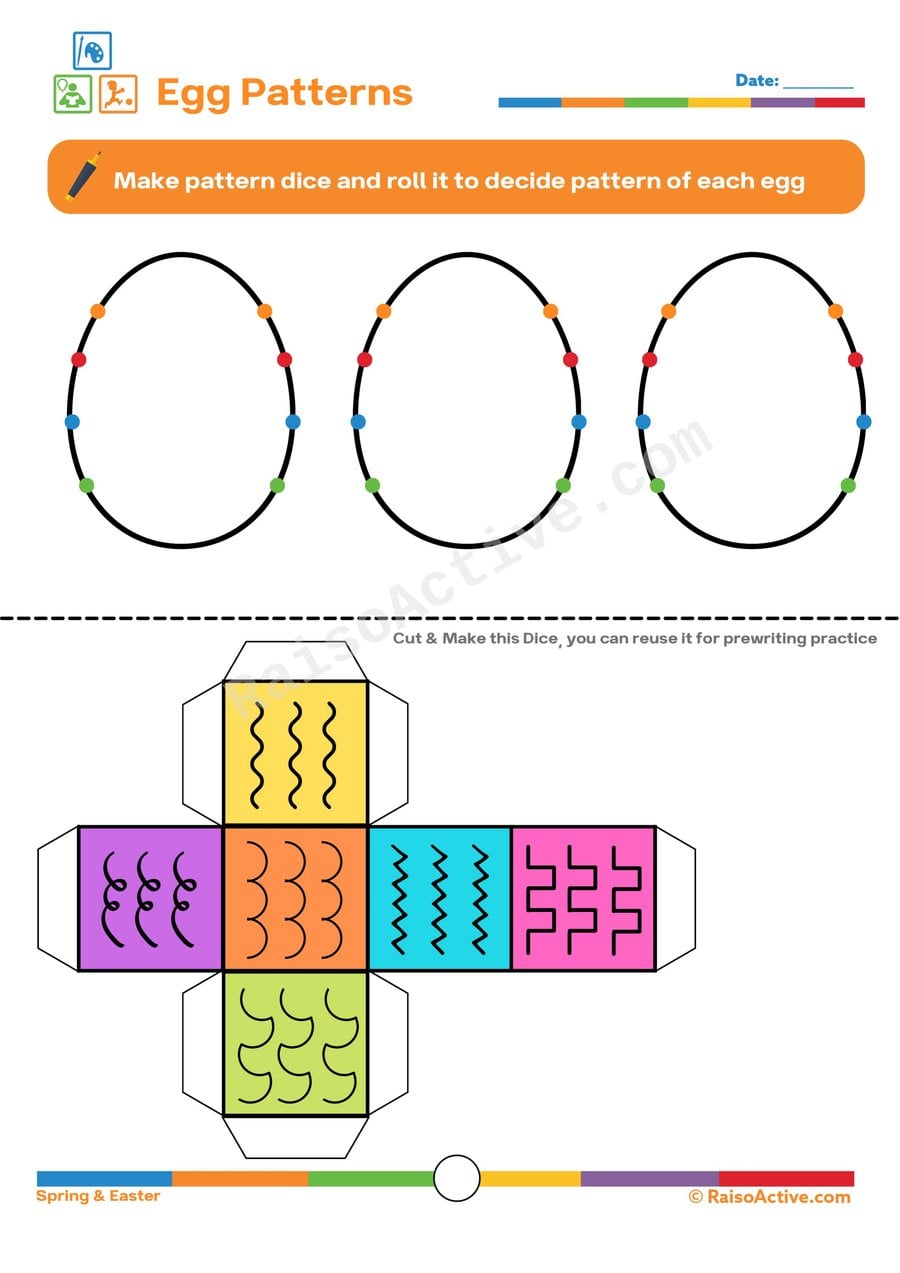
Egg Pattern Worksheet: Create and Match Patterns!
This egg-pattern activity has children ages 3-5 build a simple pattern dice and use it to generate and recreate repeating designs, developing pattern-recognition skills that underpin later math concepts like sequencing and multiplication. Rolling the dice and transferring the result onto each egg also connects a random outcome to a deliberate drawing action, strengthening cause-and-effect thinking.

Fall Leaf Patterns Matching Worksheet for Preschoolers
Children ages 3-5 build pattern recognition and logical reasoning skills by matching colored fall leaves to complete repeating patterns in a grid. Recognizing and continuing a pattern is an early algebraic thinking skill, teaching children to notice what comes next based on a repeating sequence — a foundation for later math concepts.
Guides for this topic
Pre-Writing Strokes in Order: From Standing Lines to Loops (With Printable Patterns)
The developmental order of pre-writing strokes, from vertical lines to loops, and why practicing them in sequence makes letter formation much easier to learn.
Age-Appropriate Problem-Solving Activities: Building Critical Thinkers from the Ground Up
Discover fun, age-appropriate problem-solving activities for children ages 1-8. Build critical thinking, logic, and reasoning skills through play-based learning.
Fostering Creativity in Structured Learning: The Perfect Balance for Young Minds
Learn how to blend creativity with structured learning for children ages 1-8. Practical strategies, activities, and printable worksheets for parents and teachers.
Reviews
Every worksheet for ages 3–5, no watermark
Members download the full library of 1,000+ worksheets and every activity pack without watermarks or daily limits. One year costs ₹1,000 in India or $20 elsewhere.
See membership plansOr download any worksheet free with a watermark (5 a day).