
Parent's Guide: Fun Activities for Early Learning!
This parent's guide compiles a set of short activities spanning early literacy, spatial reasoning, and problem-solving, giving caregivers ready-made ways to build foundational skills through everyday play. For ages 3-5, mixing activity types across one guide, like word games and puzzles, keeps a young child's attention while covering multiple developmental areas in a single session or across a week.
Curriculum
How to use this worksheet
Read through the full guide first to see the range of activities offered, from literacy games to spatial reasoning tasks. Choose one activity that matches your child's current interest or energy level, and gather any simple materials needed, like paper, pencils, or sorting objects. Walk your child through the activity's instructions step by step, adjusting the pace and difficulty based on how they respond. After each activity, talk with your child about what they did and enjoyed, reinforcing the skill in conversation.
Materials needed
- Paper
- Pencils
- Crayons
- Objects for sorting
Extension activities
- •Create additional word chain games using new CVC words your child is learning.
- •Try spatial awareness activities using different household objects, like arranging toys by size or shape.
- •Encourage your child to design their own simple puzzle for a family member to solve.
- •Rotate through a few of the guide's activities across the week rather than trying them all in one sitting.
- •Combine two activities into one longer play session, like a literacy game followed by a spatial reasoning task.
Tips for parents and teachers
Since this is a broad guide rather than a single worksheet, pick activities based on your child's mood and attention span that day rather than working through the list in strict order. Keep individual sessions short, five to ten minutes is often plenty for this age group, and stop while your child is still enjoying it rather than pushing until they lose interest. Praising effort and curiosity throughout, rather than focusing only on getting a 'right answer,' helps make early learning feel positive and low-pressure.

Written by
Hemsweta Jain · Teacher Cheena
MBA and Early Childhood Educator, teaching since 2014 · Founder of RaisoActive, Mumbai
Every RaisoActive worksheet is designed and checked by the founder before publishing.
Published · Last reviewed
Related worksheets

Parent's Guide: Fun Activities for Gross Motor Development and Emotional Learning
This parent guide equips caregivers of children ages 3-5 with activities spanning gross motor skills, emotional expression, family concepts, shape recognition, and calendar awareness, using role play, finger puppets, and simple games. Combining physical movement with emotional vocabulary practice, such as making different facial expressions, helps children build body awareness and feelings vocabulary side by side. Rotating through several distinct activity types in one guide also keeps a young child's attention across a longer play session.

Parent's Guide: Fun Activities for Early Readers and Number Learners!
This parent guide brings together a set of activity ideas that build two foundational skills at once for children ages 3-5: early reading, through short sentences and sight words, and early number sense, through counting, adding, and subtracting within a comfortable range. Rather than a single worksheet task, it gives caregivers a roadmap of small, achievable practice moments that fit naturally into daily routines. Following a guide like this helps parents pace learning appropriately instead of jumping into material that's too advanced too soon.

Parent's Guide: Fun Activities for Early Learning
This parent guide equips caregivers of children ages 3-5 with structured activity ideas around three early-learning concepts: recognizing the days of the week, identifying patterns, and practicing skip counting. Each activity translates an abstract concept into a hands-on or playful format, since young children learn these ideas best through repetition embedded in daily routines rather than worksheets alone. Covering multiple concepts in one guide also gives caregivers flexibility to pick the activity that fits their child's current interest.

Parent's Guide: Fun Revision Activities for Early Learners!
This revision guide pulls together several previously learned concepts — the butterfly life cycle, shadow drawing, simple coding logic, and art and craft skills — giving children ages 3-5 a chance to revisit and strengthen ideas rather than encounter them for the first time. Spaced repetition like this is proven to help young children retain concepts longer than a single exposure. Mixing very different skill types in one guide also keeps the review sessions varied and engaging rather than repetitive.

Parent's Guide: Fun Activities for Early Learners!
This parent's guide bundles several short, hands-on activities that build counting, shape recognition, fine motor control, and instruction-following in children ages 3-5. Rather than a single worksheet, it offers a menu of quick learning moments parents can use throughout the day, which suits the short attention spans typical of this age group. Rotating through different skill areas in one sitting also helps parents see which concepts their child grasps easily and which need more practice.

Parent's Guide: Fun Activities for Early Learning!
This parent's guide gathers a set of adaptable, no-worksheet activities that build early reading, science exploration, and creative thinking for children ages 3-5. Because the activities span different domains — from a family memory book to sink-or-float experiments — this guide supports well-rounded early learning that goes beyond pencil-and-paper practice into hands-on discovery.

Fun Activities for Kids: Puppet Shows, Lemonade, and More!
This parent's guide offers a set of varied hands-on activities for children ages 3-5, including a puppet show, an eye-hand coordination game, and homemade lemonade, that together build sentence framing, listening comprehension, and physical coordination. Combining storytelling, a sensory cooking task, and a physical game keeps learning active and multi-sensory rather than confined to a worksheet.
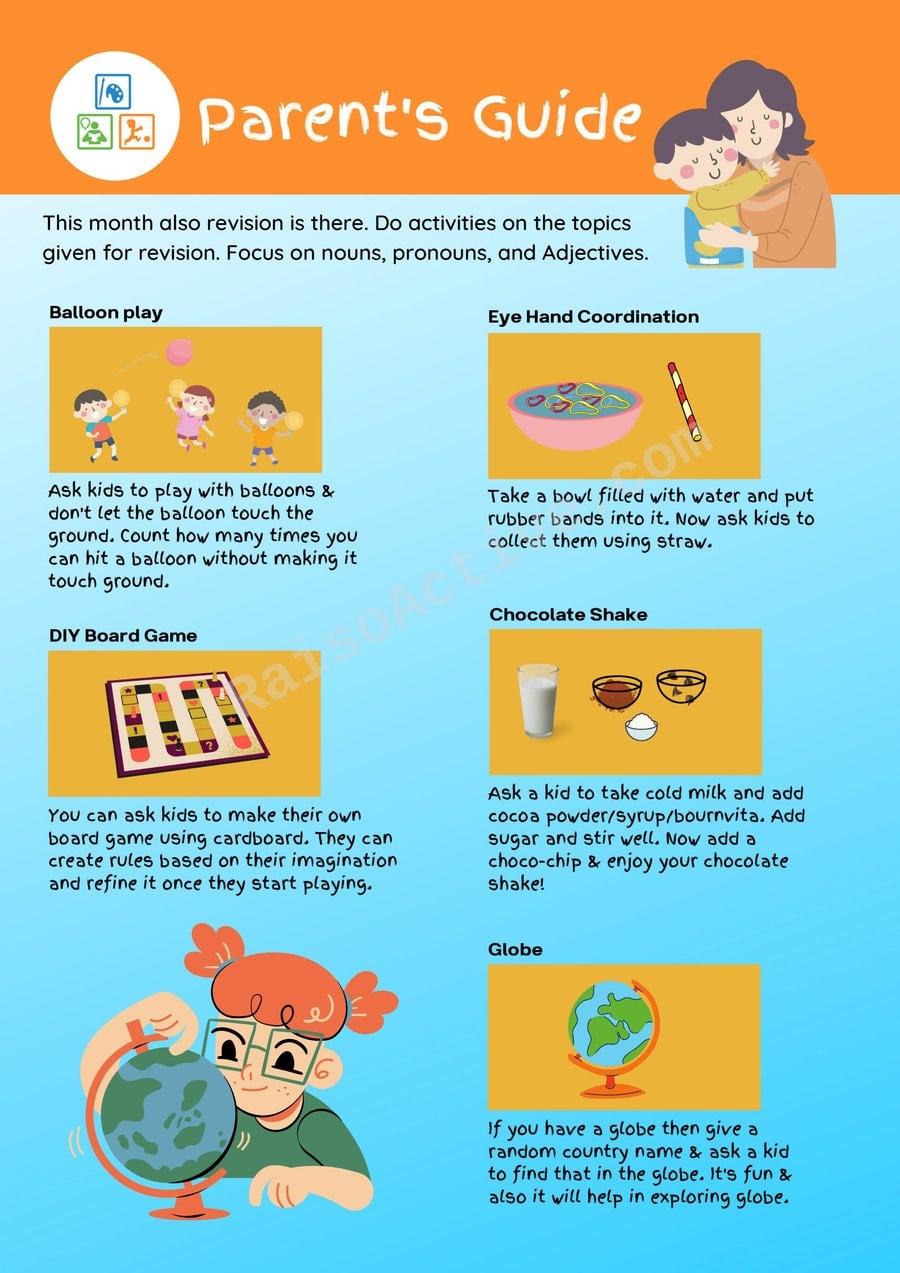
Fun Activities for Early Learners: Parent's Guide
This parent's guide walks through hands-on activities that introduce early grammar concepts — nouns, pronouns, and adjectives — through play rather than worksheets, helping children ages 3-5 absorb language structure naturally before they're ready for formal writing.
Guides for this topic
Documenting Learning Without Drowning in Data: A Practical Guide for Parents and Teachers
Learn practical ways to document your child's learning without overwhelm. Simple portfolios, observation tips, and printable trackers for ages 1-8.
When Should My Child Learn to Read? Is Kindergarten Too Early? A Complete Guide to Reading Readiness
Discover the research-backed optimal age for reading, key readiness signs, and why pushing too early can backfire. A complete guide for parents of children aged 3-8.
What Phonics Program Works Best for Homeschooling? A Complete Guide to Choosing the Right Approach
Compare top phonics programs for homeschooling — Jolly Phonics, Read Write Inc, Explode the Code — plus a DIY approach with worksheets. Find what works for your child.
Reviews
Every worksheet for ages 3–5, no watermark
Members download the full library of 1,000+ worksheets and every activity pack without watermarks or daily limits. One year costs ₹1,000 in India or $20 elsewhere.
See membership plansOr download any worksheet free with a watermark (5 a day).