
It Family Words Worksheet: Read, Trace, and Identify!
This worksheet builds phonics fluency around the 'it' word family, sit, bit, hit, fit, and similar words, teaching children that changing the first letter while keeping a shared ending creates a whole set of related, decodable words. For ages 3-5, word family practice like this is one of the most effective ways to build early reading skills, since it helps children decode new words by recognizing a familiar chunk rather than sounding out every letter individually.
Curriculum
How to use this worksheet
Read the first 'it' family word aloud together, emphasizing the shared 'it' ending, then have your child trace the word along its dotted letters. Ask your child to look at the accompanying pictures and identify which one matches the word they just read and traced. Have your child circle the picture that correctly matches the word, confirming the connection between the written word and its meaning. Continue through each remaining 'it' family word the same way, reading, tracing, and matching it to a picture.
Materials needed
- Pencil
- Crayons
Extension activities
- •Brainstorm other 'it' family words together, even silly made-up ones, to explore the pattern playfully.
- •Have your child write one or two 'it' words independently without tracing to check how well the pattern has been learned.
- •Use each 'it' word in a simple spoken sentence, like 'The cat can sit.'
- •Create a matching game with word cards and picture cards for all the 'it' family words on the page.
- •Cut apart printed copies of the words and pictures and use them for an independent matching activity later.
Tips for parents and teachers
Point out clearly that only the first letter changes across these words while the 'it' ending stays constant, since recognizing that shared pattern is the central skill this worksheet builds. If your child sounds out each word letter by letter instead of recognizing the familiar 'it' chunk, gently prompt them to look for the ending they've already read in a previous word. Practicing the full set of 'it' words together in one sitting reinforces the pattern far more effectively than spacing them across different days.

Written by
Hemsweta Jain · Teacher Cheena
MBA and Early Childhood Educator, teaching since 2014 · Founder of RaisoActive, Mumbai
Every RaisoActive worksheet is designed and checked by the founder before publishing.
Published · Last reviewed
Related worksheets
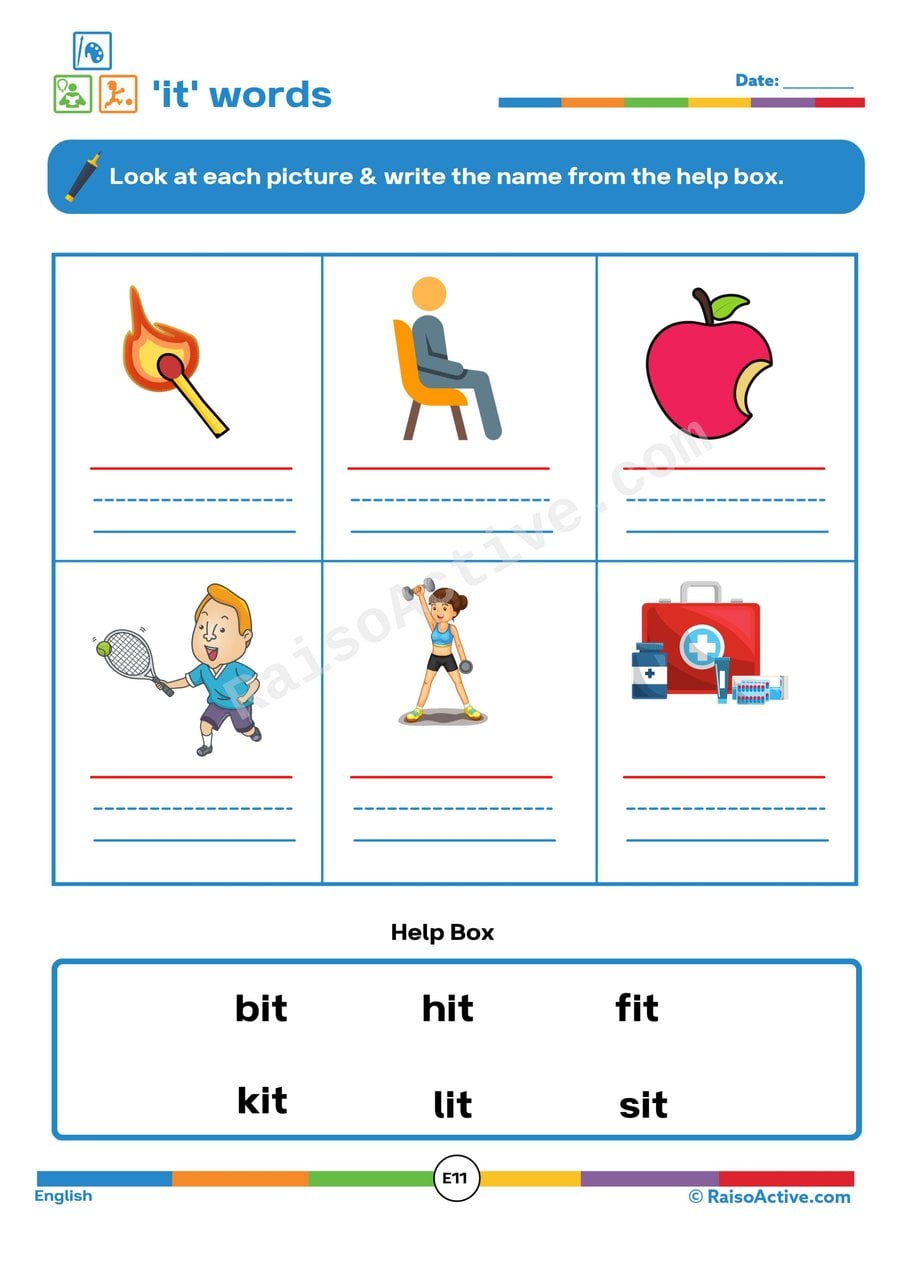
It Words Worksheet: Read and Write 'it' Words!
Children ages 4-6 build phonics fluency by reading and writing CVC words from the 'it' family, such as 'sit', 'bit', and 'fit'. Recognizing this word family pattern teaches children that groups of letters carry predictable, reusable sounds, which speeds up decoding of new words they encounter later. Writing each word after identifying it also reinforces correct spelling and letter sequencing.
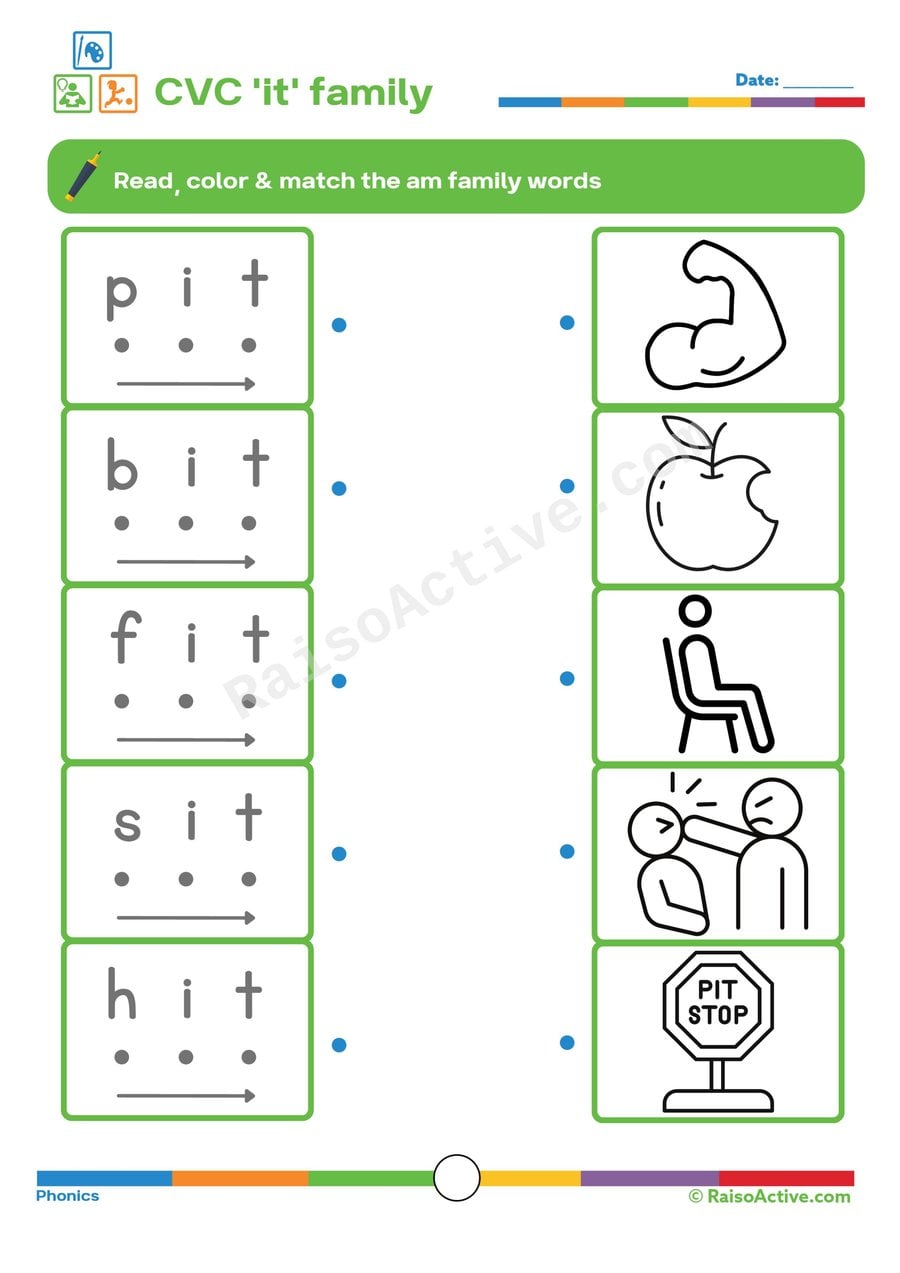
CVC 'it' Family Worksheet: Read, Color & Match!
Working through the 'it' word family (pit, bit, fit, sit, hit) gives children ages 4-5 hands-on practice with one of the most common short-vowel patterns in early reading, since so many beginner books rely on these simple rhyming words. Reading the word, coloring it, and then matching it to a picture asks a child to process the same word visually, orally, and semantically in one activity, which builds a much stronger memory trace than reading alone. This repetition-through-variety approach is especially effective for children who are just starting to decode independently.
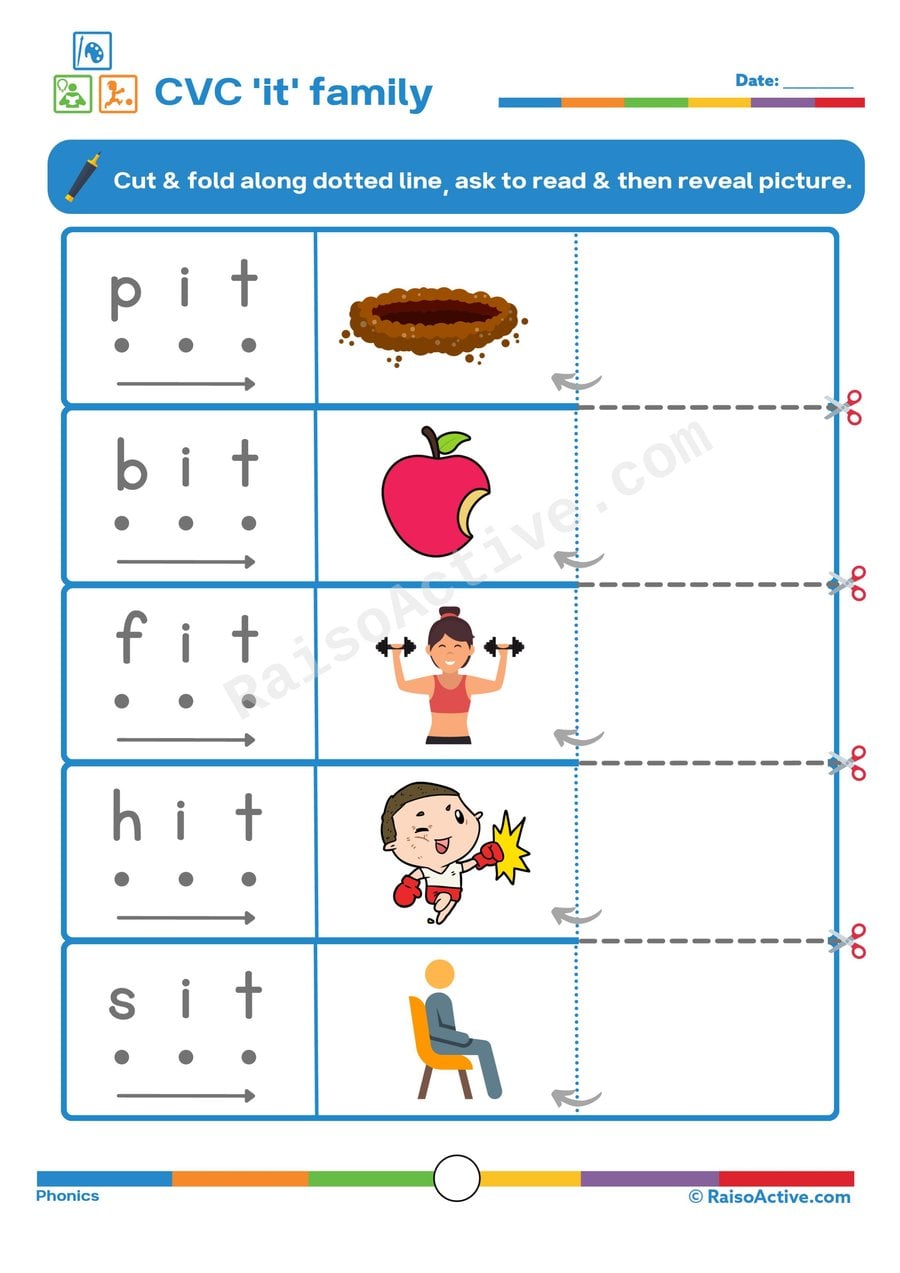
CVC 'it' Family Worksheet: Read, Cut, and Reveal!
The 'it' word family (sit, hit, bit) introduces children ages 3-5 to a short-vowel pattern using the letter i, giving them practice with a sound that's often trickier to hear than a/e because it's a shorter, less distinct vowel. Reading each word before revealing its hidden picture builds decoding confidence and gives an immediate self-check, which helps children trust their own reading rather than relying only on adult confirmation. Repeating the same ending across several words strengthens pattern recognition, a skill that speeds up reading fluency over time.
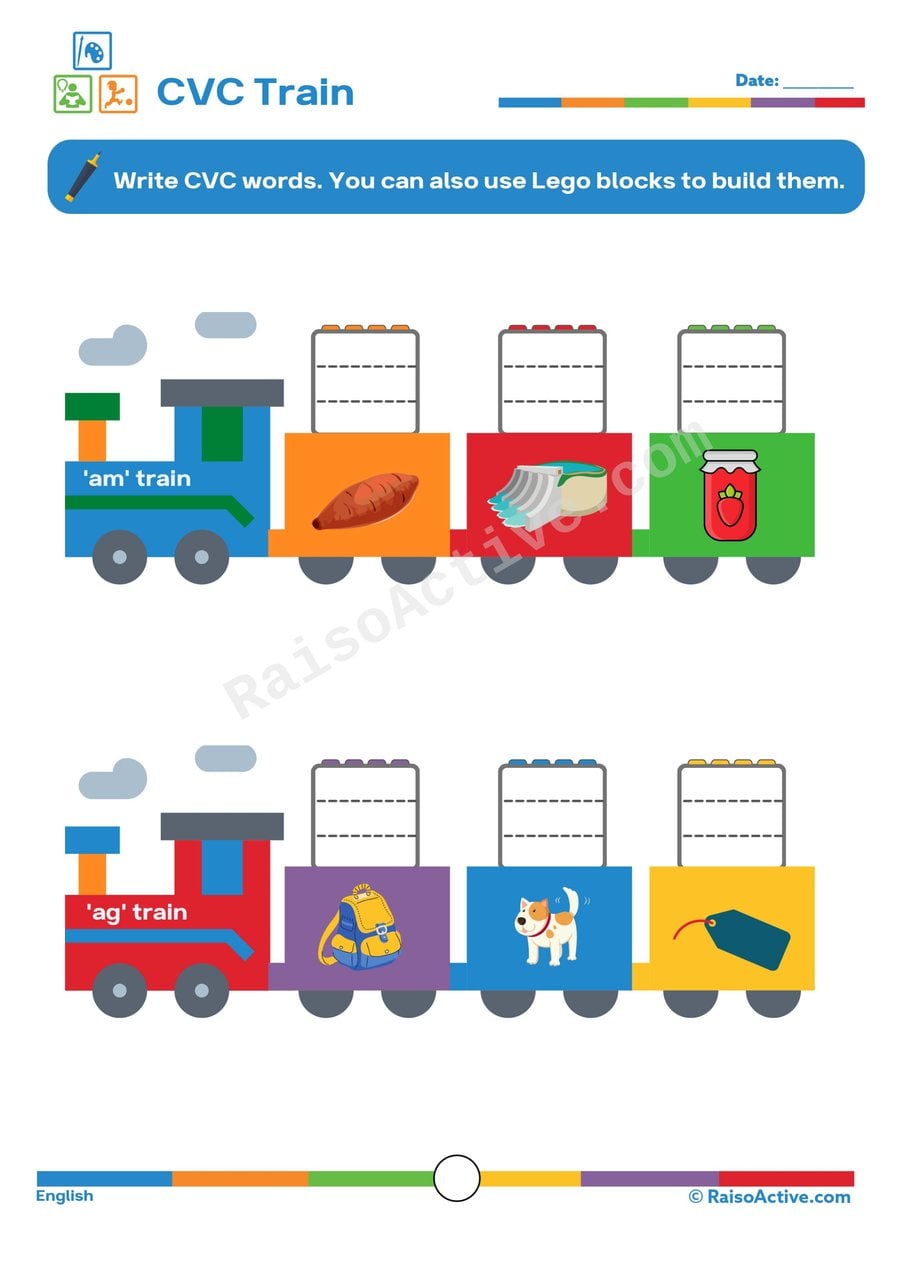
CVC Train Worksheet: Write and Build CVC Words!
This worksheet gives children ages 4-6 focused practice blending letter sounds into consonant-vowel-consonant words, using train-car pictures as clues for words like 'dog,' 'hen,' or 'cup.' Because children both write the word and can optionally build it with Lego blocks, this worksheet reinforces the same phonics skill through two different physical actions — handwriting and hands-on construction — which helps the spelling patterns stick.
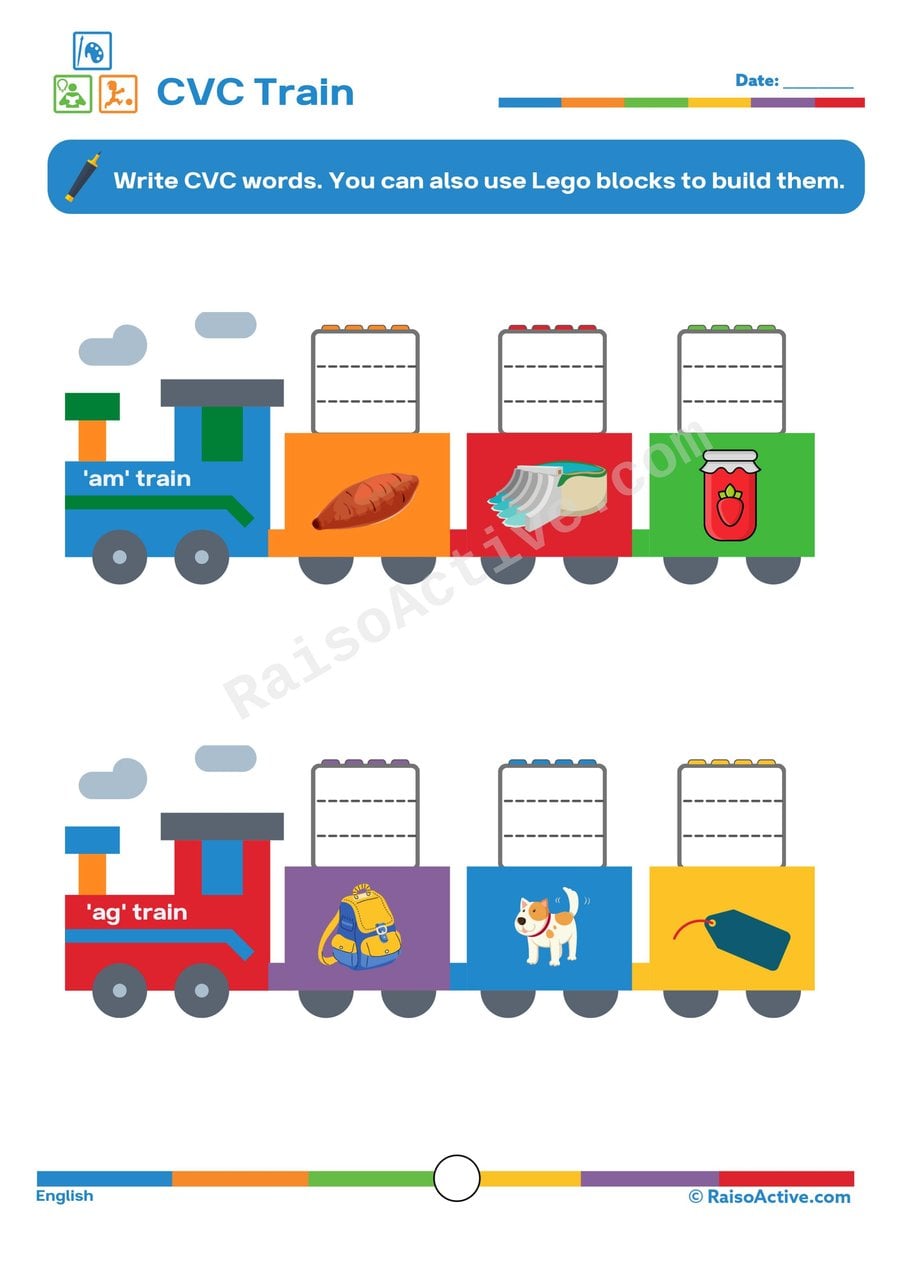
CVC Train Worksheet: Write CVC Words!
Writing consonant-vowel-consonant words like 'cat,' 'sun,' or 'pig' under matching pictures gives children ages 4-6 direct practice with letter-sound blending, a core phonics skill that underpins independent reading. Because each train car pairs a picture clue with a blank space, children also practice translating a spoken word they can sound out into its correctly spelled written form.

Easter Egg Color by Hints Worksheet for Preschoolers
This worksheet has children ages 3-5 listen to or read simple written hints describing shapes and colors, then apply that information correctly while coloring each Easter egg, building early reading comprehension and the ability to follow multi-step verbal instructions. Because the hints must be followed precisely rather than colored freely, children also practice patience and careful attention to detail.

Trace the Letter S Worksheet for Preschoolers
Tracing the curved strokes of the letter S helps children ages 3-5 build the specific hand movements needed for handwriting, since S requires a continuous curving motion that's different from the straight lines of letters like L or T. Repeated tracing also reinforces letter recognition, helping your child associate the shape of S with its name and sound. Because curves are harder to control than straight lines, this worksheet targets a slightly more advanced fine motor milestone than basic line tracing.
Spooky Skull Tracing Worksheet for Preschoolers
This tracing worksheet gives children ages 3-5 focused practice controlling a pencil or crayon along a curved outline, building the hand steadiness and pencil grip that come before independent handwriting. Repeating the same skull shape multiple times also reinforces motor memory, helping the movement feel more automatic with each pass.
Guides for this topic
How to Teach CVC Blending: A Step-by-Step Method That Works in Two Weeks
A step-by-step method for teaching CVC blending, covering continuous sounds, word families, common errors, and a 14-day plan that most children finish reading CVC words.
Phase 2 Phonics at Home: Sound Order, Blending Games, Worksheets
Phase 2 phonics at home: the five sound sets in order, oral blending, tricky words, a two-week routine, common mistakes, and free worksheets.
Reception Year Explained: EYFS Learning and How to Help at Home
A teacher's plain-English guide to the Reception Year: the seven areas of learning, Early Learning Goals, Phase 2/3 phonics, the RBA and home routines.
Reviews
Every worksheet for ages 3–5, no watermark
Members download the full library of 1,000+ worksheets and every activity pack without watermarks or daily limits. One year costs ₹1,000 in India or $20 elsewhere.
See membership plansOr download any worksheet free with a watermark (5 a day).