Landforms Worksheet: Identify and Circle the Correct Answer!
Reading a short description and circling the matching landform picture asks children ages 4-6 to connect written or spoken language directly to a visual feature of the natural world, strengthening both reading comprehension and early geography vocabulary. Because landforms like deserts, hills, and mountains can look somewhat similar in simple illustrations, this task also sharpens careful reading and visual comparison rather than quick guessing. Understanding these terms gives children language to describe landscapes they see in books, on trips, or in nature.
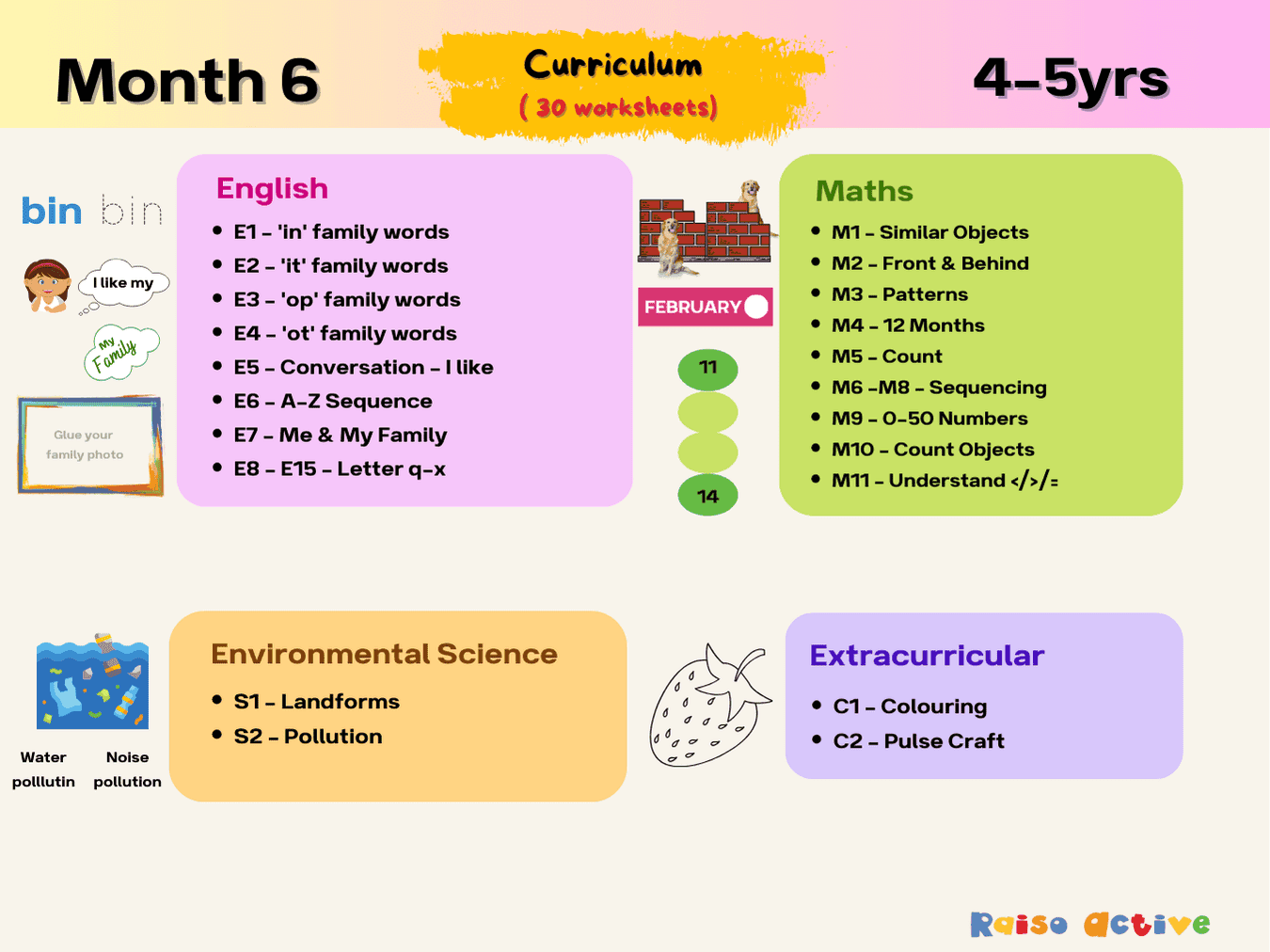
Part of the pack
Month 6: Preschool multi-subject foundational skills | Ages 4-5
This is page 30 of the pack. Ages 4-5 · Pre-KAges 4-5 · ReceptionAges 4-5 · LKGAges 4-5
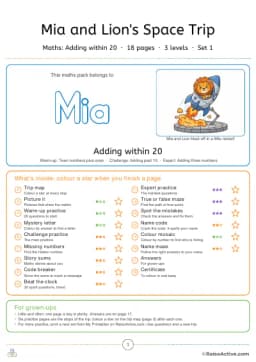
Made for your child
Numbers to 20, made for your child
A maths pack with your child's name in it: pictures that explain, practice at three levels, puzzles and story sums about them. Print a new set whenever they finish.
Make a maths packFree preview · free for members
Curriculum
- Earth & Environment > Landforms
How to use this worksheet
Read the description for the first landform aloud together, pausing on any key describing words like 'sandy,' 'tall,' or 'flat.' Ask your child to look at the picture choices and think about which one matches the description they just heard. Have them circle the picture that best fits the landform being described. Continue through the remaining descriptions on the page, encouraging your child to point out the specific detail in the picture that matches the words.
Materials needed
- Pencil
- Crayons
Extension activities
- 1Draw your own landform, like a desert or a mountain, and describe it out loud in your own words.
- 2Create a simple diorama of one landform using sand, rocks, or blue paper for water.
- 3Read a picture book or watch a short video about different landforms around the world.
- 4Go on a walk or drive and point out any real hills, valleys, or bodies of water you pass.
- 5Sort picture cards of different landforms into groups based on shared features, like 'has water' or 'is tall.'

Written by
Hemsweta Jain · Teacher Cheena
MBA and Early Childhood Educator, teaching since 2014 · Founder of RaisoActive, Mumbai
Every RaisoActive worksheet is designed and checked by the founder before publishing.
Published · Last reviewed
More from Month 6: Preschool multi-subject foundational skills | Ages 4-5

Parent's Guide: Fun Activities for Early Learning!
Ages 3-5 · Preschool–Pre-KAges 3-5 · Nursery–ReceptionAges 3-5 · Nursery–LKGAges 3-5
This parent's guide compiles a set of short activities spanning early literacy, spatial reasoning, and problem-solving, giving caregivers ready-made ways to build foundational skills through everyday play. For ages 3-5, mixing activity types across one guide, like word games and puzzles, keeps a young child's attention while covering multiple developmental areas in a single session or across a week.
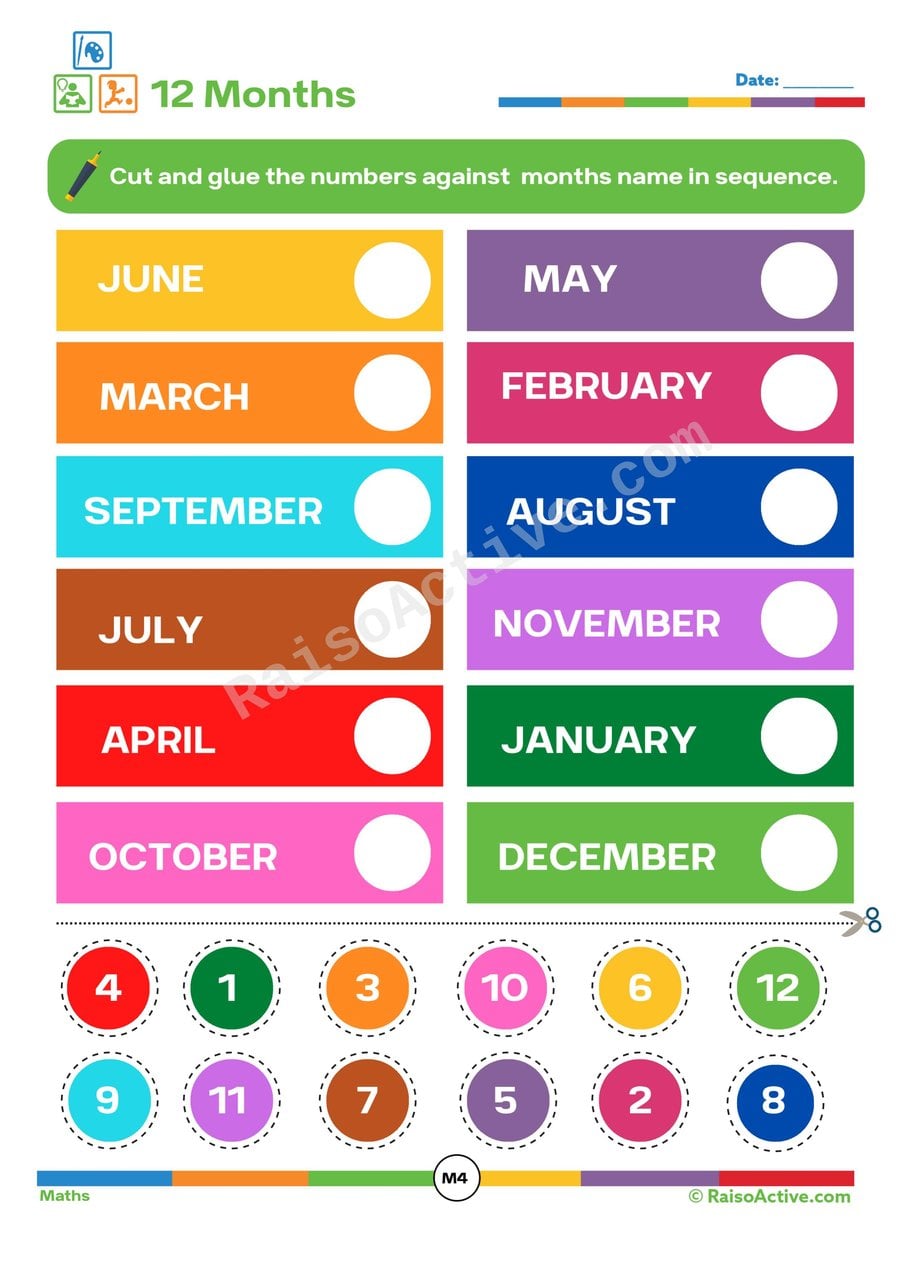
Months of the Year Matching Worksheet for Kids
Ages 4-5 · Pre-KAges 4-5 · ReceptionAges 4-5 · LKGAges 4-5
Matching numbers to month names introduces children ages 4-5 to the idea that the calendar has a fixed, meaningful order, which supports early time-concept development alongside their growing number recognition. This cut-and-paste format adds a fine motor and sequencing challenge, since children must locate the correct number piece among several options before gluing it into place. Learning the months by their order also lays groundwork for talking about birthdays, holidays, and seasons throughout the year.

In Family Words Worksheet: Read, Trace, and Identify the Pictures!
Ages 3-5 · Preschool–Pre-KAges 3-5 · Nursery–ReceptionAges 3-5 · Nursery–LKGAges 3-5
Reading, tracing, and matching words from the 'in' family — like pin, fin, and win — helps children ages 3-5 notice that changing just the first letter of a word while keeping the same ending creates a whole new word, a key phonics insight called word family recognition. Tracing each word alongside reading it builds handwriting muscle memory at the same time as reading fluency. Circling the picture that matches each traced word also checks true comprehension, not just the ability to sound out letters.
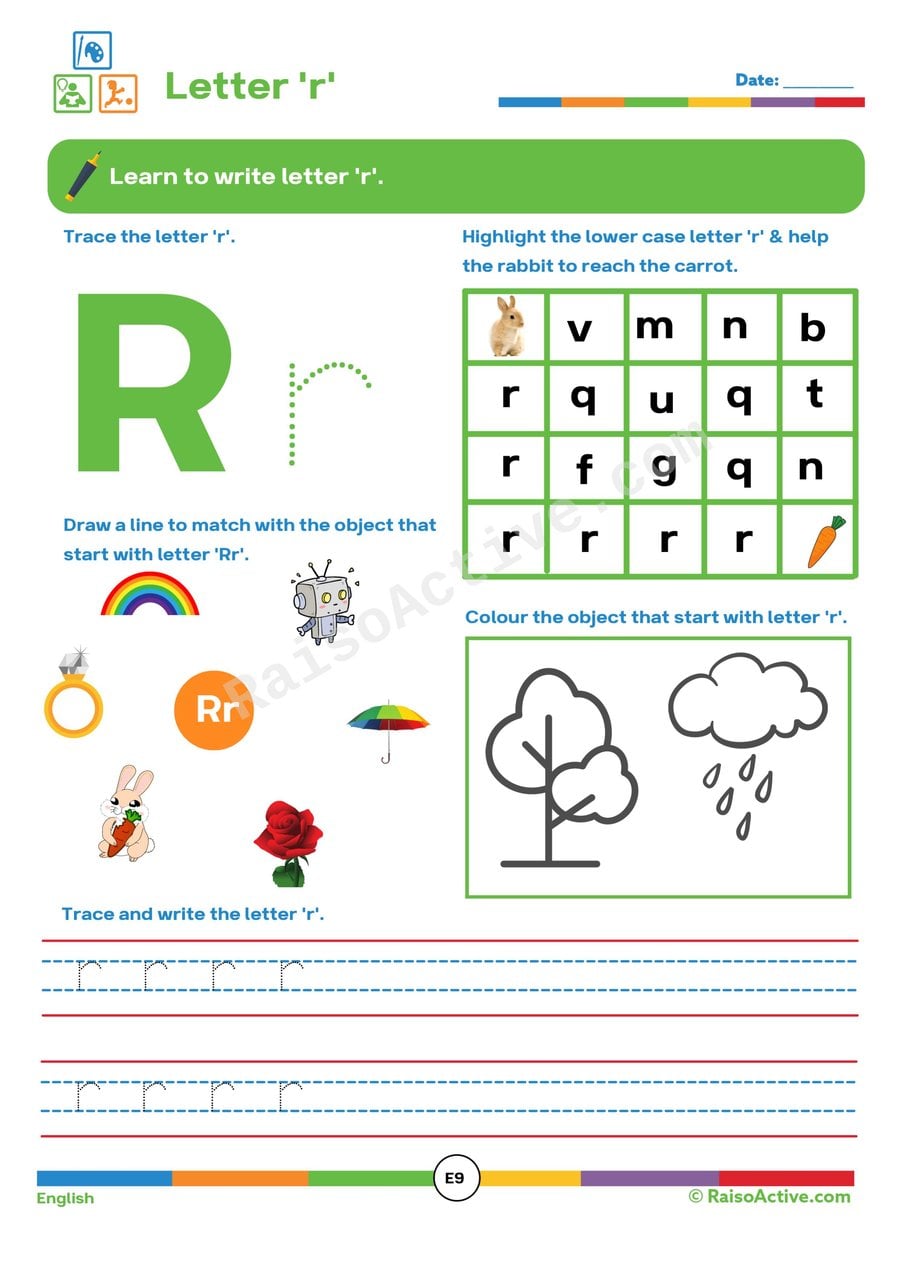
Letter 'r' Worksheet: Trace, Match, and Color!
Ages 3-5 · Preschool–Pre-KAges 3-5 · Nursery–ReceptionAges 3-5 · Nursery–LKGAges 3-5
This multi-part worksheet builds letter recognition for both uppercase and lowercase 'r' through tracing, while the matching and maze-style activities reinforce the beginning 'r' sound through picture identification. For ages 3-5, combining tracing with sound-based matching in one sitting strengthens the connection between a letter's shape and its sound from multiple angles.
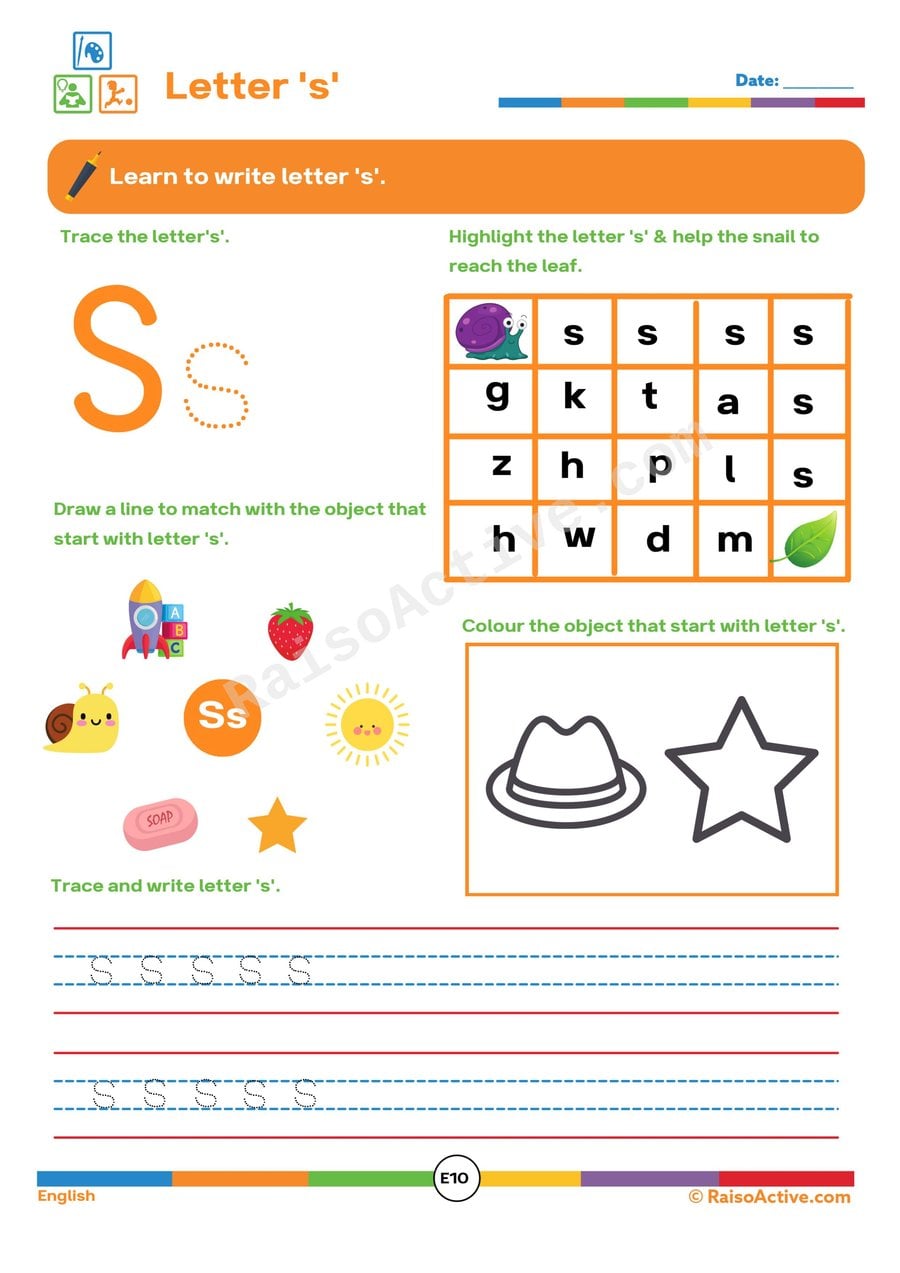
Letter 's' Worksheet: Trace, Match, and Color!
Ages 3-5 · Preschool–Pre-KAges 3-5 · Nursery–ReceptionAges 3-5 · Nursery–LKGAges 3-5
This worksheet gives children ages 3-5 focused practice forming the letter 's,' one of the trickier curved strokes for beginning writers to control with a pencil. Beyond handwriting, matching pictures to the letter and coloring only the 's' objects builds phonemic awareness by linking the letter shape to its /s/ sound at the start of words. Combining tracing, matching, and coloring in one page also keeps a young child's attention across multiple related tasks.
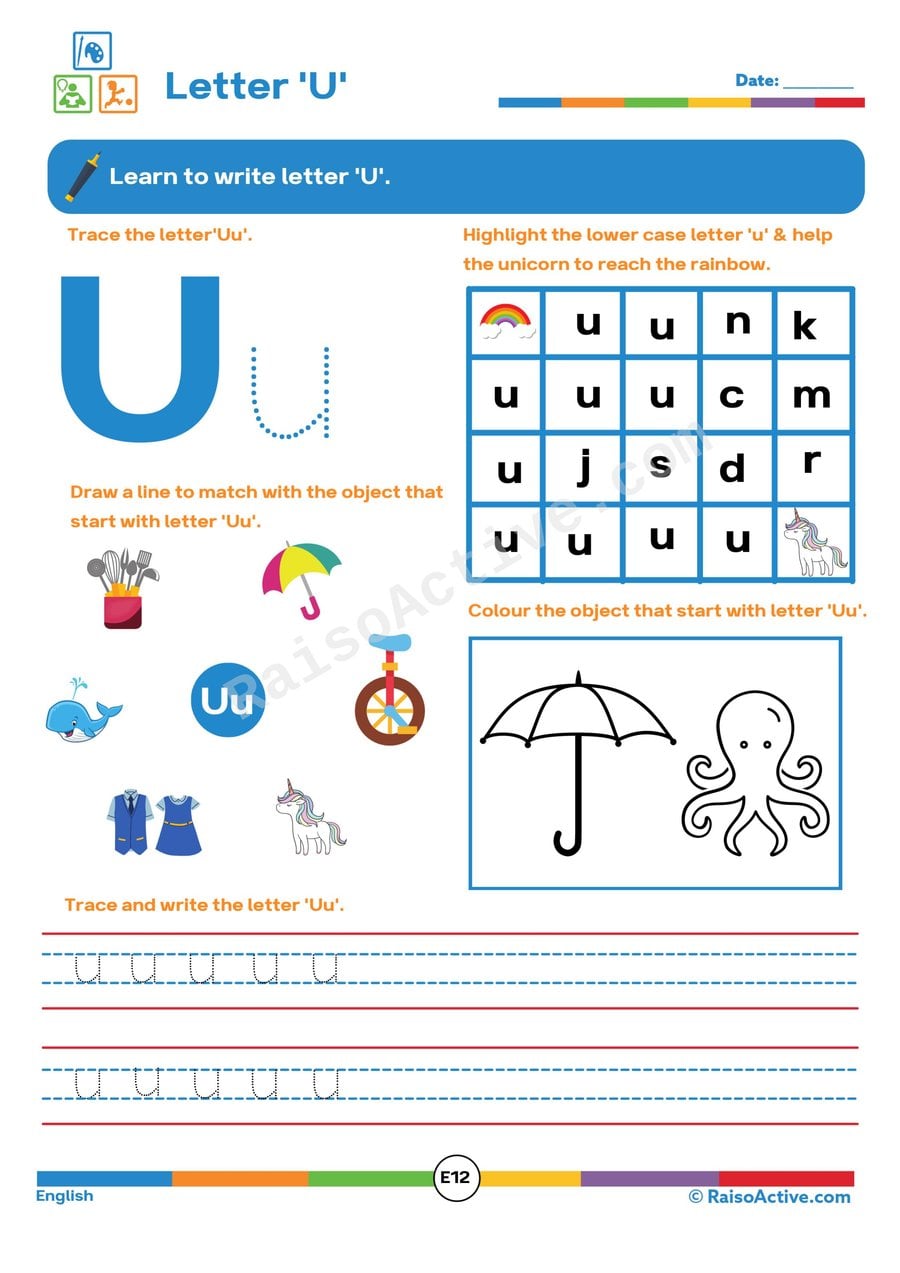
Letter 'U' Worksheet: Trace, Match, and Color!
Ages 3-5 · Preschool–Pre-KAges 3-5 · Nursery–ReceptionAges 3-5 · Nursery–LKGAges 3-5
Tracing, matching, and coloring the letter 'U' gives children ages 3-5 focused repetition on a rounded letter shape while building the sound-symbol connection for its short /u/ sound, as in 'umbrella' or 'up.' Matching pictures that start with 'U' to the letter reinforces recognition beyond the written form, tying it to real, familiar objects. Combining tracing, matching, and coloring in a single page suits a preschooler's need for varied, short activities rather than one long repetitive drill.

What Do You Like? Conversation Worksheet for Kids
Ages 3-5 · Preschool–Pre-KAges 3-5 · Nursery–ReceptionAges 3-5 · Nursery–LKGAges 3-5
Ages 3-5 are learning to move from single words to full thoughts, and this 'What Do You Like?' worksheet gives them structured practice putting a preference into words. Looking at a picture prompt and answering 'I like...' builds expressive vocabulary and the confidence to speak up in a group, both key pre-literacy and social-emotional milestones at this age. It also introduces the back-and-forth rhythm of real conversation rather than just naming objects.

Count the Owls and Chicks! A Fun Counting Worksheet for Preschoolers
Ages 3-5 · Preschool–Pre-KAges 3-5 · Nursery–ReceptionAges 3-5 · Nursery–LKGAges 3-5
Counting groups of owls and chicks and circling the matching number builds one-to-one correspondence for children ages 3-5, the core skill of touching or pointing to each item exactly once while counting. Working with two different characters in the same activity also teaches children to reset their count for each new group rather than carrying a total over, an easy mistake at this age. This repeated counting-and-matching format across the page builds both accuracy and counting stamina.
Related worksheets

Landforms Cut and Paste Worksheet for Preschoolers
Ages 3-5 · Preschool–Pre-KAges 3-5 · Nursery–ReceptionAges 3-5 · Nursery–LKGAges 3-5
This worksheet introduces preschoolers to the idea that the Earth's surface takes many different forms — mountains, beaches, islands — and asks them to match a picture of each landform to its name, an early step in geography and classification skills. Sorting pictures by category also reinforces visual discrimination, since children must notice defining features, like water on all sides for an island or a peak for a mountain, rather than relying on color or size alone.

Landforms Worksheet: Identify and Label the Pictures!
Ages 3-5 · Preschool–Pre-KAges 3-5 · Nursery–ReceptionAges 3-5 · Nursery–LKGAges 3-5
Writing the correct name for pictures of mountains, rivers, and other landforms from a word bank builds early science vocabulary and spelling practice for children ages 3-5, connecting a visual image to its written word.

Landforms Worksheet: Identify and Tick the Correct Answer!
Ages 3-5 · Preschool–Pre-KAges 3-5 · Nursery–ReceptionAges 3-5 · Nursery–LKGAges 3-5
Looking at pictures of landforms like volcanoes, glaciers, and islands and choosing the correct name from two options teaches children ages 3-5 early earth science vocabulary while building visual discrimination between different natural features. Because each landform has a distinct silhouette, shape, and texture, children practice careful observation of details, like noticing that a volcano has a cone shape while an island is surrounded by water. This worksheet introduces basic geography concepts in a way that's grounded in pictures rather than abstract explanation.

Find and Draw India's Major Rivers Worksheet for Kids
Ages 5-8 · Kindergarten–Grade 2Ages 5-8 · Year 1–Year 3Ages 5-8 · UKG–Class 2Ages 5-8
This activity teaches children ages 5-8 to locate and draw ten of India's major rivers on a blank map, building map-reading skills and geographic memory of the country's physical features. Translating a written list into hand-drawn lines on a map also strengthens the connection between abstract information (a river's name and rough course) and concrete spatial representation.

Landforms Cut and Paste Worksheet for Preschoolers
Ages 3-5 · Preschool–Pre-KAges 3-5 · Nursery–ReceptionAges 3-5 · Nursery–LKGAges 3-5
Sorting pictures into categories like mountains, oceans, and deserts introduces children ages 3-5 to the idea that the Earth's surface has distinct, recognizable features, an early building block of geography and earth science. The cut-and-paste format adds a fine motor challenge on top of the classification task, requiring children to physically separate and place each picture correctly rather than simply pointing. Matching an image to its labeled landform category also builds vocabulary specific to the natural world beyond everyday objects.
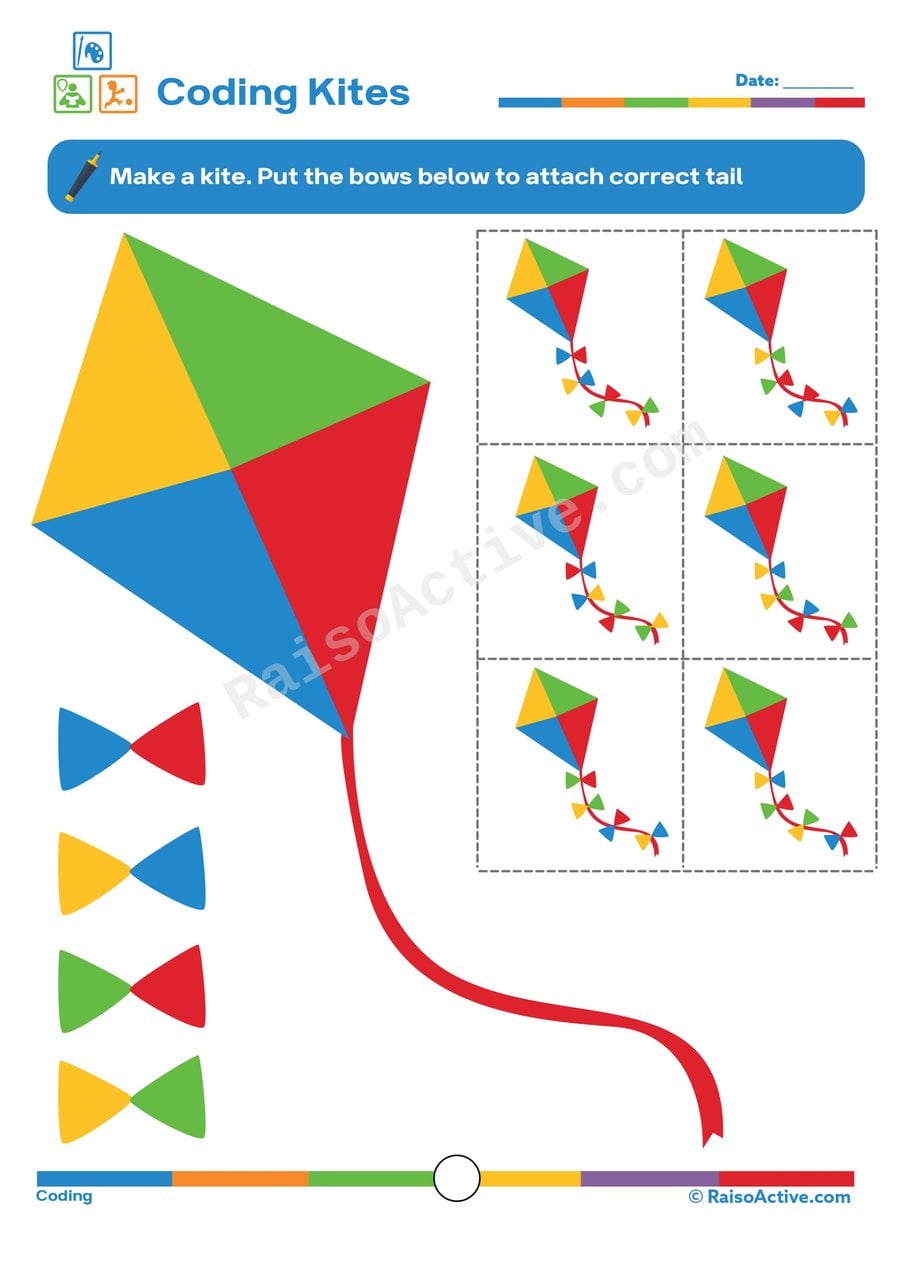
Coding Kites Worksheet: Match the Bows!
Ages 3-5 · Preschool–Pre-KAges 3-5 · Nursery–ReceptionAges 3-5 · Nursery–LKGAges 3-5
This activity sharpens visual observation in children ages 3-5 as they compare color sequences on each kite to a set of loose bows and find the exact match. Careful, systematic comparison — checking each color in order rather than glancing quickly — builds an attention-to-detail habit that transfers directly to early reading and number work.

Phonics Level 2 Certificate of Achievement: Super Reader
Ages 4-7 · Pre-K–Grade 1Ages 4-7 · Reception–Year 2Ages 4-7 · LKG–Class 1Ages 4-7
Children celebrate reading and spelling words with blends and digraphs, and tick what they can read: CVC words, blends and digraphs.
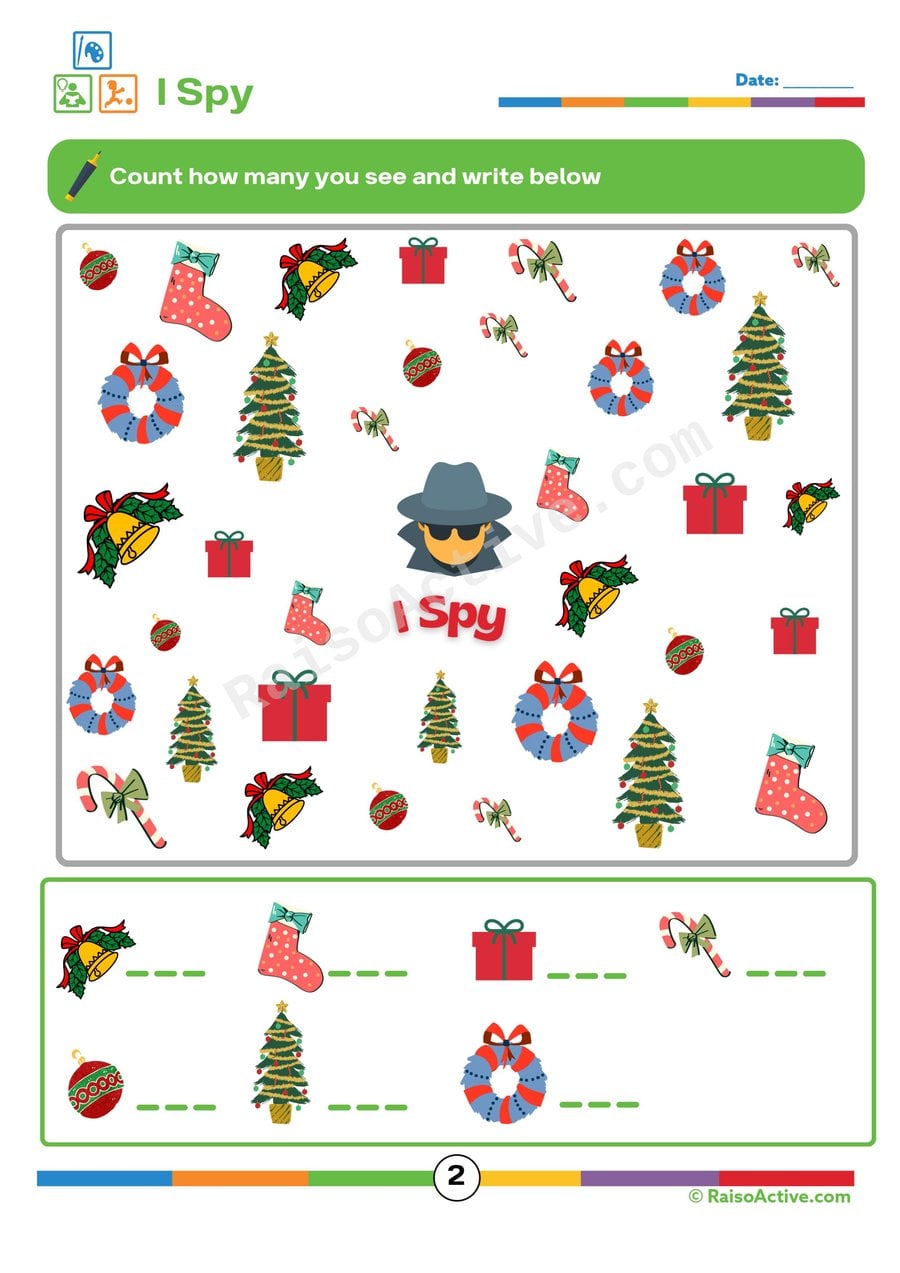
I Spy Christmas Worksheet: Count and Write!
Ages 3-5 · Preschool–Pre-KAges 3-5 · Nursery–ReceptionAges 3-5 · Nursery–LKGAges 3-5
This worksheet strengthens counting accuracy and number writing in children ages 3-5 as they search a busy Christmas scene for specific items and record how many they find. The 'I Spy' search format adds a visual scanning challenge on top of basic counting, since children must first locate every instance of an item scattered across the picture before counting it.
Guides for this topic

Documenting Learning Without Drowning in Data: A Practical Guide for Parents and Teachers
Learn practical ways to document your child's learning without overwhelm. Simple portfolios, observation tips, and printable trackers for ages 1-8.

Age-Appropriate Problem-Solving Activities: Building Critical Thinkers from the Ground Up
Discover fun, age-appropriate problem-solving activities for children ages 1-8. Build critical thinking, logic, and reasoning skills through play-based learning.
Critical Thinking Activities That Actually Work for Young Children: Building Tomorrow's Thinkers Today
Discover proven critical thinking activities for young children. Age-wise logic games, questioning techniques, and hands-on ideas to build thinking skills at home.
Reviews
Every worksheet for ages 4–6, no watermark
Members download the full library of 1,000+ worksheets and every activity pack without watermarks or daily limits. One year costs ₹999 in India or $20 elsewhere.
See membership plansOr download any worksheet free with a watermark (5 a day).