Landforms Cut and Paste Worksheet for Preschoolers
Sorting pictures into categories like mountains, oceans, and deserts introduces children ages 3-5 to the idea that the Earth's surface has distinct, recognizable features, an early building block of geography and earth science. The cut-and-paste format adds a fine motor challenge on top of the classification task, requiring children to physically separate and place each picture correctly rather than simply pointing. Matching an image to its labeled landform category also builds vocabulary specific to the natural world beyond everyday objects.
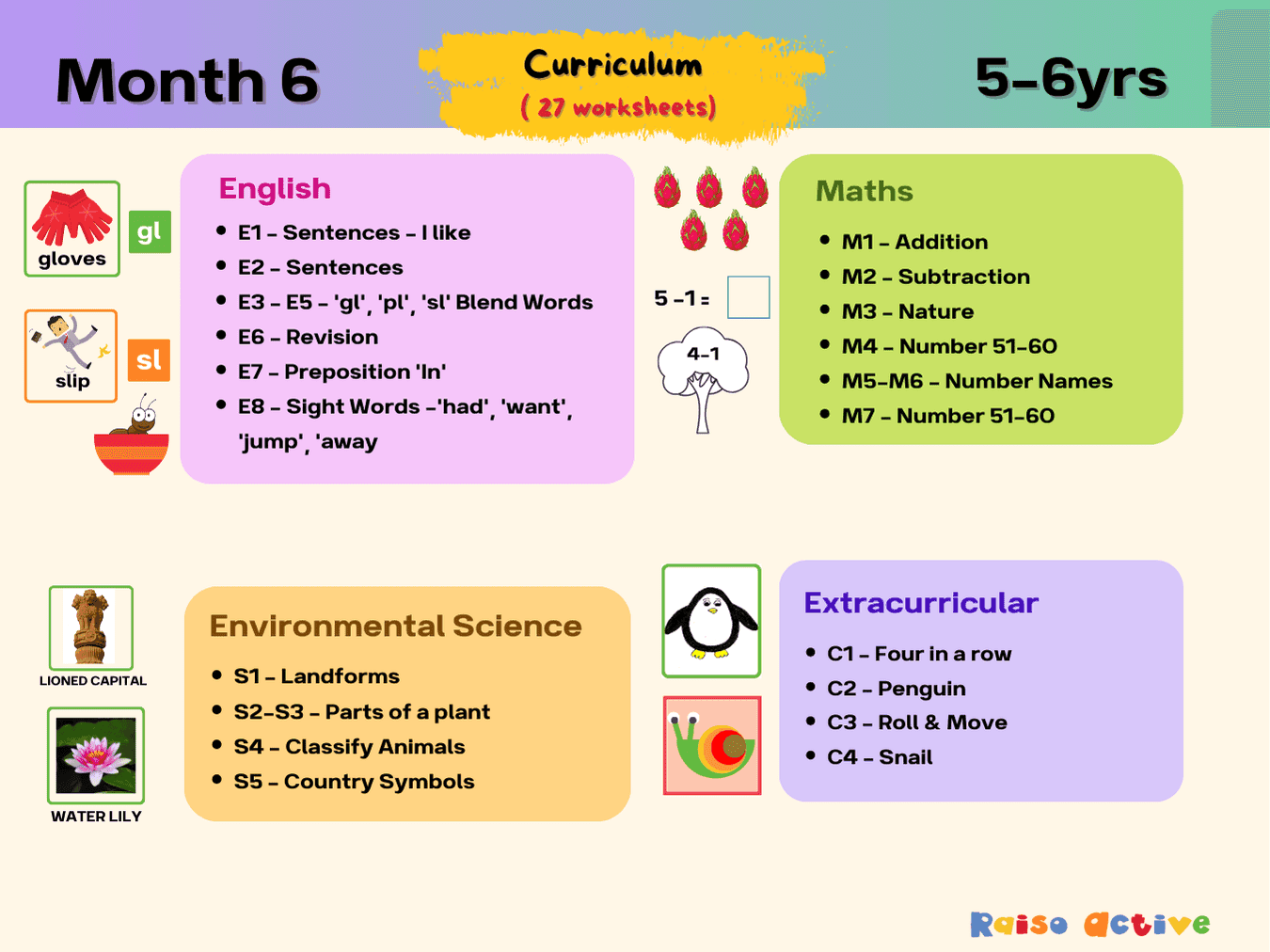
Part of the pack
Month 6: Holistic early learning activities | Ages 5-6
This is page 22 of the pack. Ages 5-6 · KindergartenAges 5-6 · Year 1Ages 5-6 · UKGAges 5-6
Curriculum
- Earth & Environment > Landforms
How to use this worksheet
Look at the landform labels on the page together and talk briefly about what each one looks like — a mountain is tall and pointed, an ocean is a big body of water, and so on. Have your child cut out the small pictures at the bottom of the page along the dotted lines. One at a time, ask them to identify which landform each picture matches and glue it into the correct labeled box. Review the finished page together, naming each landform and describing one feature of it.
Materials needed
- Scissors
- Glue
- Pencil
Extension activities
- 1Draw your own favorite landform and label it using the vocabulary from the worksheet.
- 2Look at photos or a globe together and find real-world examples of mountains, oceans, and deserts.
- 3Build a simple landform out of playdough or sand, like a mountain or a river, and talk about its features.
- 4Search for picture books or a short video about a specific landform your child found interesting.
- 5Create a landform matching game using magazine cutouts sorted into labeled categories.

Written by
Hemsweta Jain · Teacher Cheena
MBA and Early Childhood Educator, teaching since 2014 · Founder of RaisoActive, Mumbai
Every RaisoActive worksheet is designed and checked by the founder before publishing.
Published · Last reviewed
More from Month 6: Holistic early learning activities | Ages 5-6
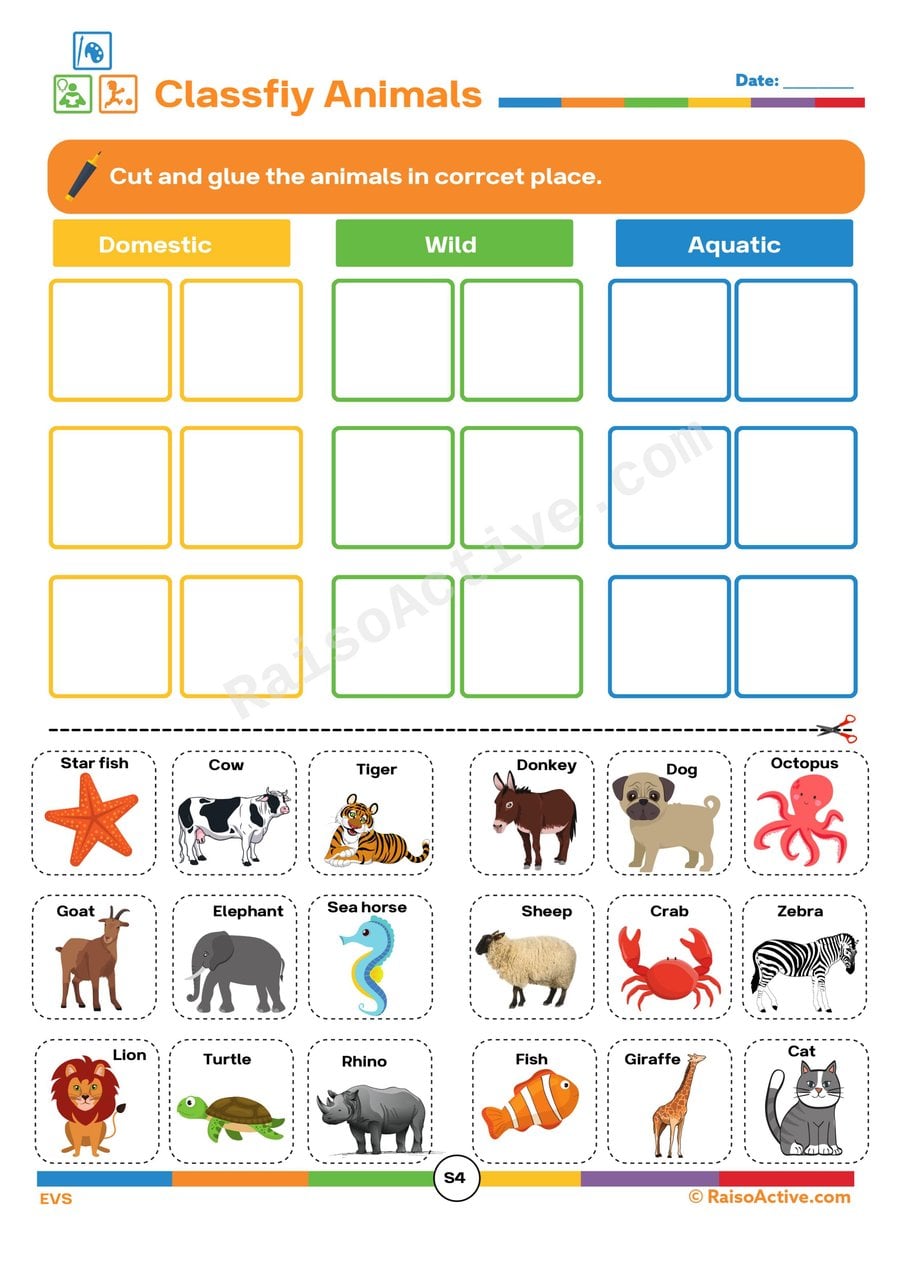
Classify Animals: Sorting Worksheet for Kids
Ages 4-6 · Pre-K–KindergartenAges 4-6 · Reception–Year 1Ages 4-6 · LKG–UKGAges 4-6
Sorting animals into domestic, wild, and aquatic categories asks children ages 4-6 to classify based on habitat and human relationship rather than just appearance, a more advanced kind of categorization than simple color or shape sorting. This builds early scientific thinking, since children must consider where an animal lives and how it behaves to decide where it belongs. The cut-and-paste format also reinforces the categories through repeated physical sorting rather than a single verbal answer.
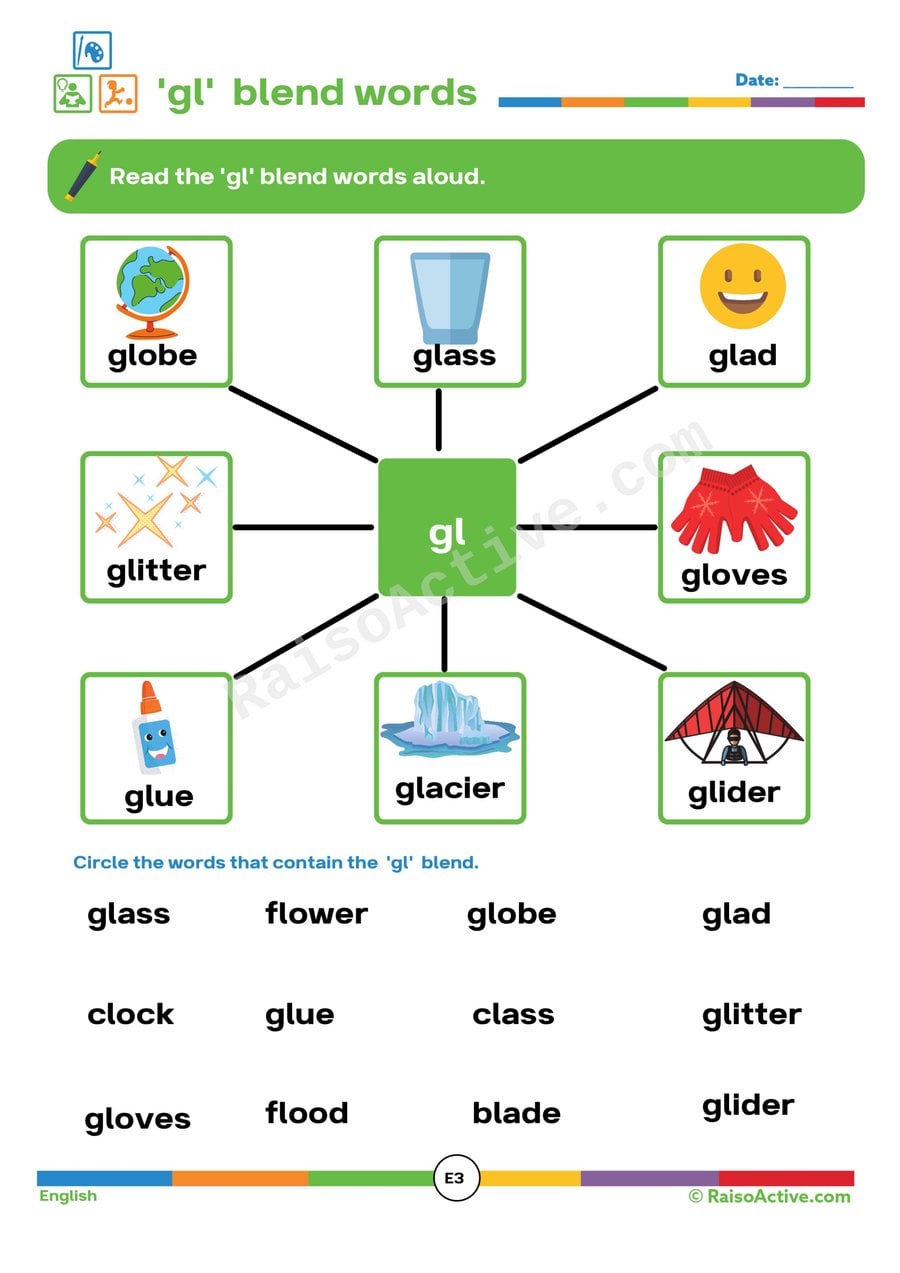
Gl Blend Words Worksheet: Read and Circle!
Ages 4-6 · Pre-K–KindergartenAges 4-6 · Reception–Year 1Ages 4-6 · LKG–UKGAges 4-6
This worksheet builds phonics skills around the 'gl' consonant blend, helping children recognize and read words like 'glass,' 'glue,' and 'glow' where the sounds of g and l combine at the start of a word. For ages 4-6, practicing blends like gl strengthens the sound-segmentation skills needed to decode increasingly complex words as reading develops.

Number Names Worksheet: Writing and Matching Numbers 51-60!
Ages 4-6 · Pre-K–KindergartenAges 4-6 · Reception–Year 1Ages 4-6 · LKG–UKGAges 4-6
Writing out number names like 'fifty-one' or 'fifty-eight' next to their numerals helps children ages 4-6 connect the spoken word for a number to both its written word form and its digit form, a three-way link that strengthens overall number sense in the 51-60 range. This worksheet also revisits missing-number sequencing and color-coding, giving repeated exposure to the same number range through several different tasks. Building fluency with two-digit number names prepares children for reading numbers in books, on clocks, and in everyday life.
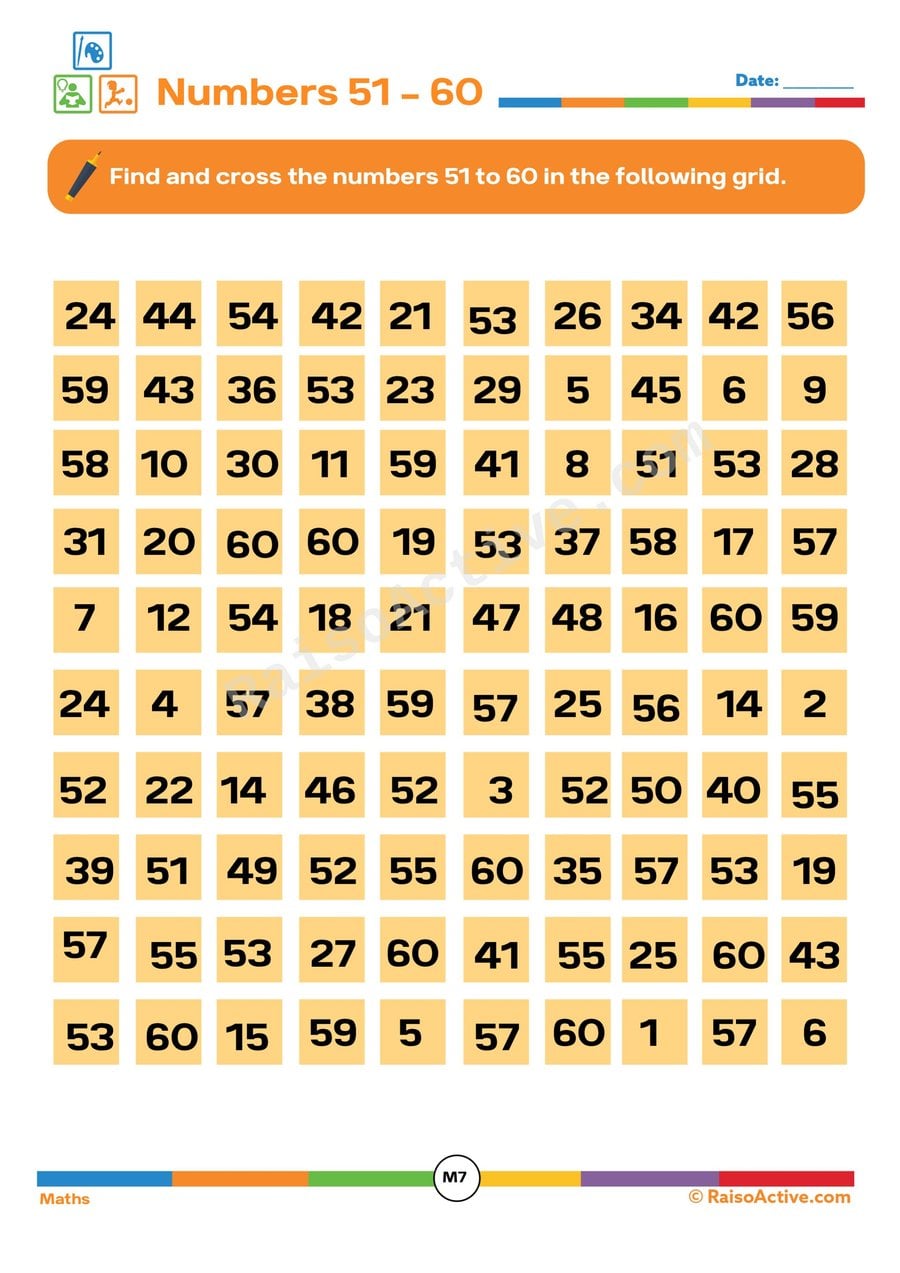
Find and Cross Numbers 51-60 Worksheet
Ages 4-5 · Pre-KAges 4-5 · ReceptionAges 4-5 · LKGAges 4-5
Hunting through a grid of numbers to find and cross out 51 through 60 trains children ages 4-5 to recognize specific two-digit numerals quickly among visually similar distractors, a scanning skill that supports both math fluency and reading readiness. This activity demands sustained visual attention, since the target numbers are scattered randomly rather than in order, unlike a simple sequencing task. It's also a fun, game-like way to reinforce number recognition without it feeling repetitive.
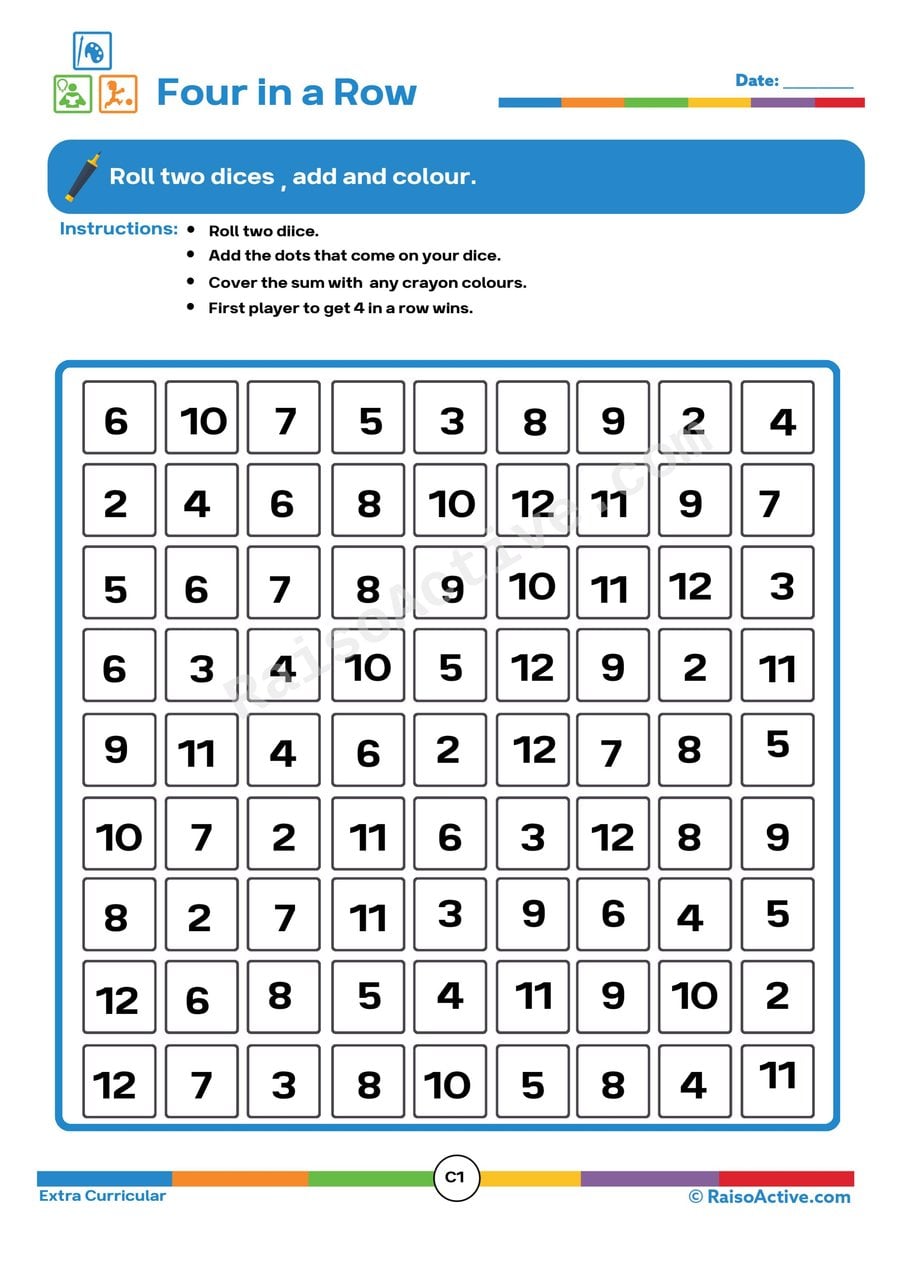
Four in a Row: Dice Game Worksheet for Kids
Ages 4-6 · Pre-K–KindergartenAges 4-6 · Reception–Year 1Ages 4-6 · LKG–UKGAges 4-6
Rolling two dice and adding the results together gives children ages 4-6 repeated, low-pressure practice with basic addition facts, since each turn presents a new combination to solve. Coloring the matching sum on a game grid turns arithmetic into an active, motivating game rather than a worksheet of isolated problems, and working toward four squares in a row adds a strategic element as children start to notice which sums appear more often. This game format also builds number recognition, since children must locate their calculated sum among many printed numbers on the grid.
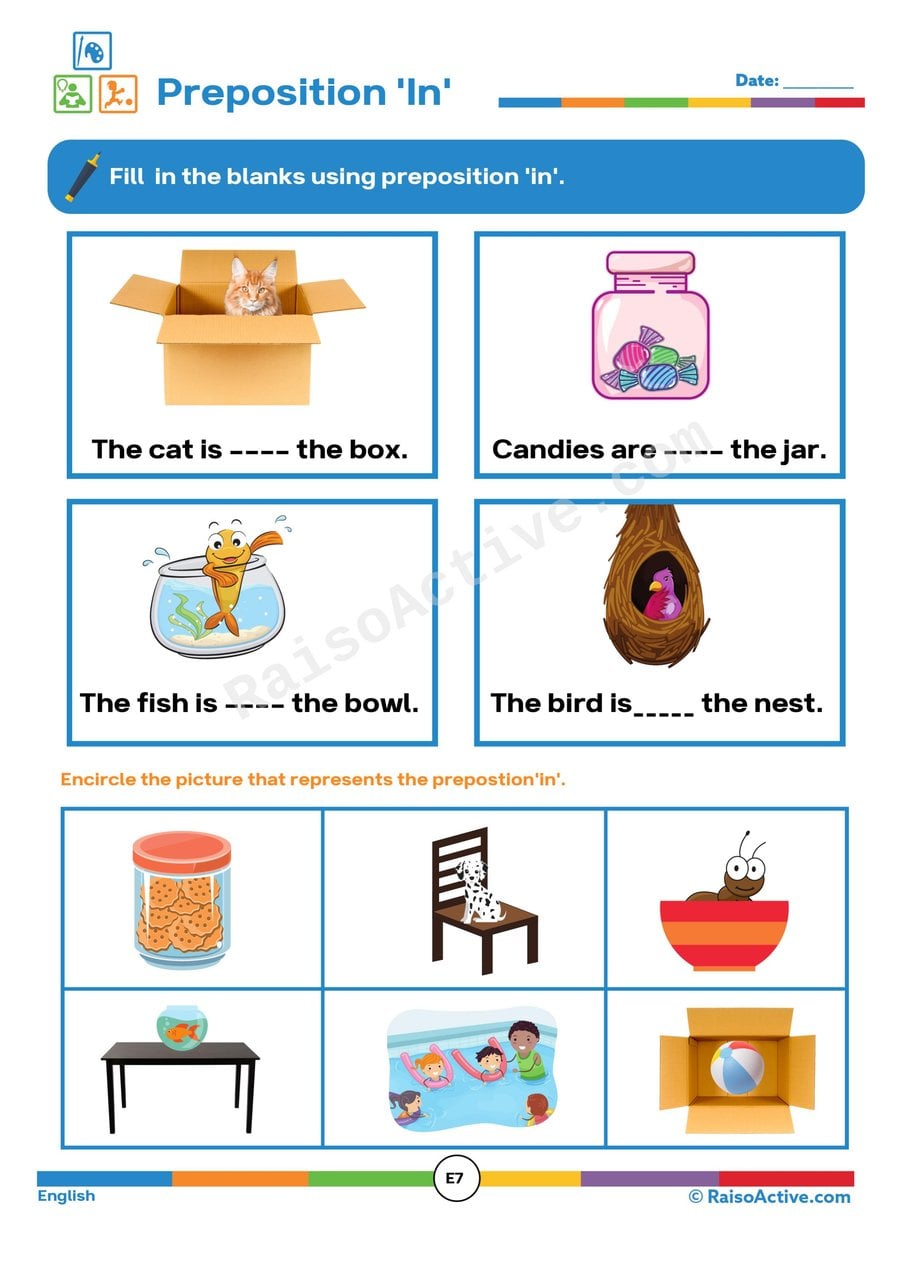
Preposition 'In' Worksheet: Fill-in-the-Blanks Fun!
Ages 4-6 · Pre-K–KindergartenAges 4-6 · Reception–Year 1Ages 4-6 · LKG–UKGAges 4-6
This worksheet introduces the preposition 'in' as a specific positional word describing something located inside another object, building both grammar knowledge and spatial vocabulary. For ages 4-6, understanding prepositions like 'in' is essential for constructing clear, descriptive sentences and following spatial directions in everyday life.

Jump into Learning: Sight Word 'Jump' Worksheet for Preschoolers
Ages 4-5 · Pre-KAges 4-5 · ReceptionAges 4-5 · LKGAges 4-5
This worksheet builds sight word recognition for the word 'jump' through several different activities, tracing, coloring, finding it in a list, connecting letters, and cutting and pasting, giving children multiple ways to encounter and memorize the same word. For ages 4-5, repeated exposure to a high-frequency word across varied formats is one of the most effective ways to build automatic word recognition, a key building block of fluent reading.

Parent's Guide: Fun Activities for Early Learners
Ages 3-5 · Preschool–Pre-KAges 3-5 · Nursery–ReceptionAges 3-5 · Nursery–LKGAges 3-5
This parent's guide offers a set of activities spanning literacy, sequencing, and early addition, giving caregivers several ready-to-use options for building foundational skills through everyday play. For ages 3-5, rotating between different skill areas, like rhyming games and simple math card games, keeps early learning varied and prevents any one skill from feeling repetitive or tedious.
Related worksheets

Landforms Cut and Paste Worksheet for Preschoolers
Ages 3-5 · Preschool–Pre-KAges 3-5 · Nursery–ReceptionAges 3-5 · Nursery–LKGAges 3-5
This worksheet introduces preschoolers to the idea that the Earth's surface takes many different forms — mountains, beaches, islands — and asks them to match a picture of each landform to its name, an early step in geography and classification skills. Sorting pictures by category also reinforces visual discrimination, since children must notice defining features, like water on all sides for an island or a peak for a mountain, rather than relying on color or size alone.

Find and Draw India's Major Rivers Worksheet for Kids
Ages 5-8 · Kindergarten–Grade 2Ages 5-8 · Year 1–Year 3Ages 5-8 · UKG–Class 2Ages 5-8
This activity teaches children ages 5-8 to locate and draw ten of India's major rivers on a blank map, building map-reading skills and geographic memory of the country's physical features. Translating a written list into hand-drawn lines on a map also strengthens the connection between abstract information (a river's name and rough course) and concrete spatial representation.

Landforms Worksheet: Identify and Label the Pictures!
Ages 3-5 · Preschool–Pre-KAges 3-5 · Nursery–ReceptionAges 3-5 · Nursery–LKGAges 3-5
Writing the correct name for pictures of mountains, rivers, and other landforms from a word bank builds early science vocabulary and spelling practice for children ages 3-5, connecting a visual image to its written word.

Landforms Worksheet: Identify and Circle the Correct Answer!
Ages 4-6 · Pre-K–KindergartenAges 4-6 · Reception–Year 1Ages 4-6 · LKG–UKGAges 4-6
Reading a short description and circling the matching landform picture asks children ages 4-6 to connect written or spoken language directly to a visual feature of the natural world, strengthening both reading comprehension and early geography vocabulary. Because landforms like deserts, hills, and mountains can look somewhat similar in simple illustrations, this task also sharpens careful reading and visual comparison rather than quick guessing. Understanding these terms gives children language to describe landscapes they see in books, on trips, or in nature.

Landforms Worksheet: Identify and Tick the Correct Answer!
Ages 3-5 · Preschool–Pre-KAges 3-5 · Nursery–ReceptionAges 3-5 · Nursery–LKGAges 3-5
Looking at pictures of landforms like volcanoes, glaciers, and islands and choosing the correct name from two options teaches children ages 3-5 early earth science vocabulary while building visual discrimination between different natural features. Because each landform has a distinct silhouette, shape, and texture, children practice careful observation of details, like noticing that a volcano has a cone shape while an island is surrounded by water. This worksheet introduces basic geography concepts in a way that's grounded in pictures rather than abstract explanation.

Spider Count Worksheet: Finger Painting Fun for Halloween!
Ages 3-5 · Preschool–Pre-KAges 3-5 · Nursery–ReceptionAges 3-5 · Nursery–LKGAges 3-5
Dabbing fingertips or Q-tips in paint to create the exact number of spiders shown on each web gives children ages 3-5 hands-on practice with one-to-one counting while also strengthening the small hand muscles needed for pencil control later on. Because each web has a target number, children must count as they paint rather than just decorating freely, which reinforces number recognition in a playful, low-pressure way. The messy, sensory nature of finger painting also supports focus and engagement at an age when seated paper-and-pencil tasks can be hard to sustain.

Learn India's National Symbols: A Dot-to-Dot Worksheet
Ages 3-5 · Preschool–Pre-KAges 3-5 · Nursery–ReceptionAges 3-5 · Nursery–LKGAges 3-5
Connecting numbered dots to reveal each national symbol builds fine motor control and number-sequence recognition in children ages 3-5, since they must find and connect dots in the correct numerical order to form a recognizable picture. As each symbol emerges from the dots, children also gain early familiarity with important national imagery and its name.
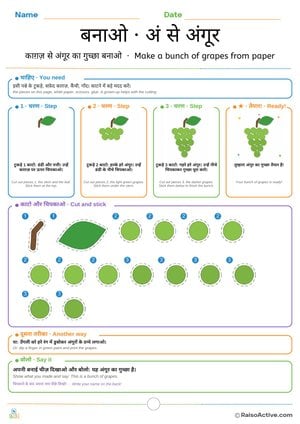
Make a Bunch of Paper Grapes: Hindi Letter अं (am) Cut and Stick Craft | बनाओ · अं से अंगूर
Ages 4-7 · Pre-K–Grade 1Ages 4-7 · Reception–Year 2Ages 4-7 · LKG–Class 1Ages 4-7
Children cut out the numbered pieces and stick them in order to make a bunch of grapes from light and dark green circles, then show it and say a full sentence about it. It links the letter अं with a real picture word, अंगूर, and practises scissor control and following steps.
Guides for this topic

How to Teach Cutting Skills to Your Preschooler: A Complete Guide for Parents and Teachers
Help your child master scissor skills safely. Expert guide covering readiness signs, scissor types, progression steps, pre-cutting exercises, and fun practice ideas for ages 2-6.
Christmas and Winter Activities That Combine Fun and Learning: Creating Magical Educational Experiences
Discover Christmas and winter activities that combine festive fun with real learning. Crafts, counting, literacy, and printable worksheets for ages 2 to 8 — perfect for home and school.
Age-Appropriate Halloween Learning Activities: Balancing Spooks and Skills for Young Learners
Discover fun, age-appropriate Halloween learning activities for young children. Spooky crafts, counting games, literacy ideas, and printable worksheets for ages 2 to 8.
Reviews
Every worksheet for ages 3–5, no watermark
Members download the full library of 1,000+ worksheets and every activity pack without watermarks or daily limits. One year costs ₹999 in India or $20 elsewhere.
See membership plansOr download any worksheet free with a watermark (5 a day).