Preposition 'In' Worksheet: Fill-in-the-Blanks Fun!
This worksheet introduces the preposition 'in' as a specific positional word describing something located inside another object, building both grammar knowledge and spatial vocabulary. For ages 4-6, understanding prepositions like 'in' is essential for constructing clear, descriptive sentences and following spatial directions in everyday life.
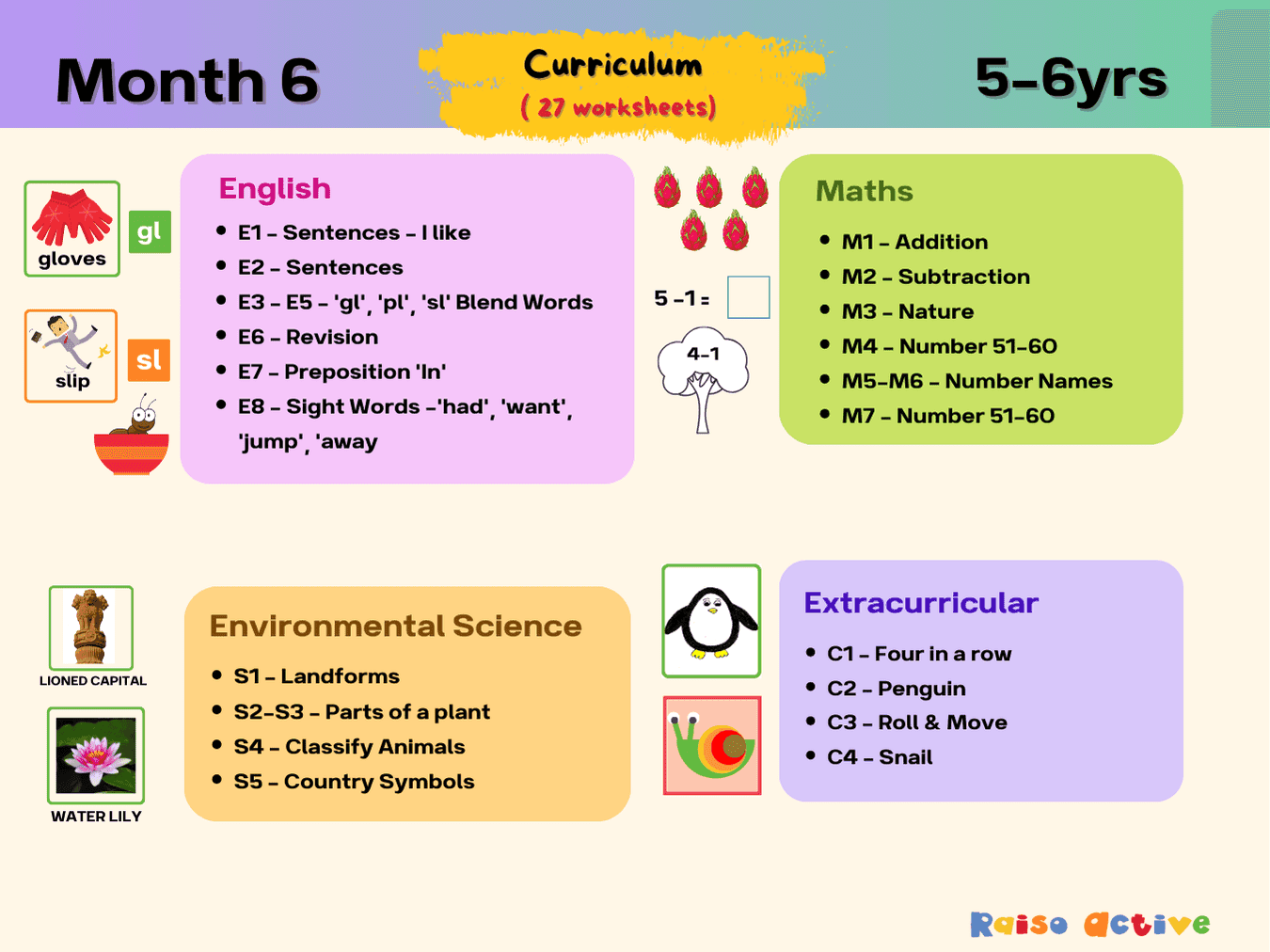
Part of the pack
Month 6: Holistic early learning activities | Ages 5-6
This is page 10 of the pack. Ages 5-6 · KindergartenAges 5-6 · Year 1Ages 5-6 · UKGAges 5-6
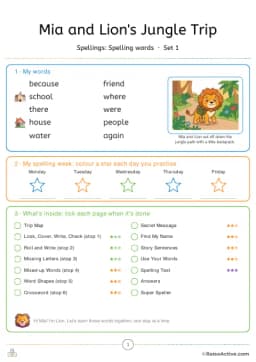
Made for your child
Spelling practice, made for your child
Their own spelling words turned into a pack: trace or look-cover-write-check, roll and write, a secret picture code, a word search, a crossword and a test, with their name in it.
Make a spelling packFree preview · free for members
Or start free: a word search with sight wordsCurriculum
- Grammar > Prepositions
How to use this worksheet
Read the first sentence aloud together, pausing at the blank space where the word 'in' belongs. Look at the picture accompanying the sentence, discussing what it shows to help your child understand the positional relationship being described. Have your child write the word 'in' in the blank to complete the sentence, then read the full sentence back aloud. For the picture identification section, have your child circle the picture that clearly shows something located 'in' something else, rather than beside or on top of it.
Materials needed
- Pencil
- Crayons
Extension activities
- 1Play a simple following-directions game at home, asking your child to put an object 'in' a box, drawer, or bag.
- 2Draw your own pictures of things that are 'in' something else, like toys in a basket or fish in a bowl.
- 3Create original sentences using the word 'in,' describing real objects around your home.
- 4Compare 'in' to other prepositions like 'on' or 'under' using the same set of objects to highlight the differences.
- 5Go on a preposition scavenger hunt, finding and naming several real examples of things that are 'in' something.

Written by
Hemsweta Jain · Teacher Cheena
MBA and Early Childhood Educator, teaching since 2014 · Founder of RaisoActive, Mumbai
Every RaisoActive worksheet is designed and checked by the founder before publishing.
Published · Last reviewed
More from Month 6: Holistic early learning activities | Ages 5-6
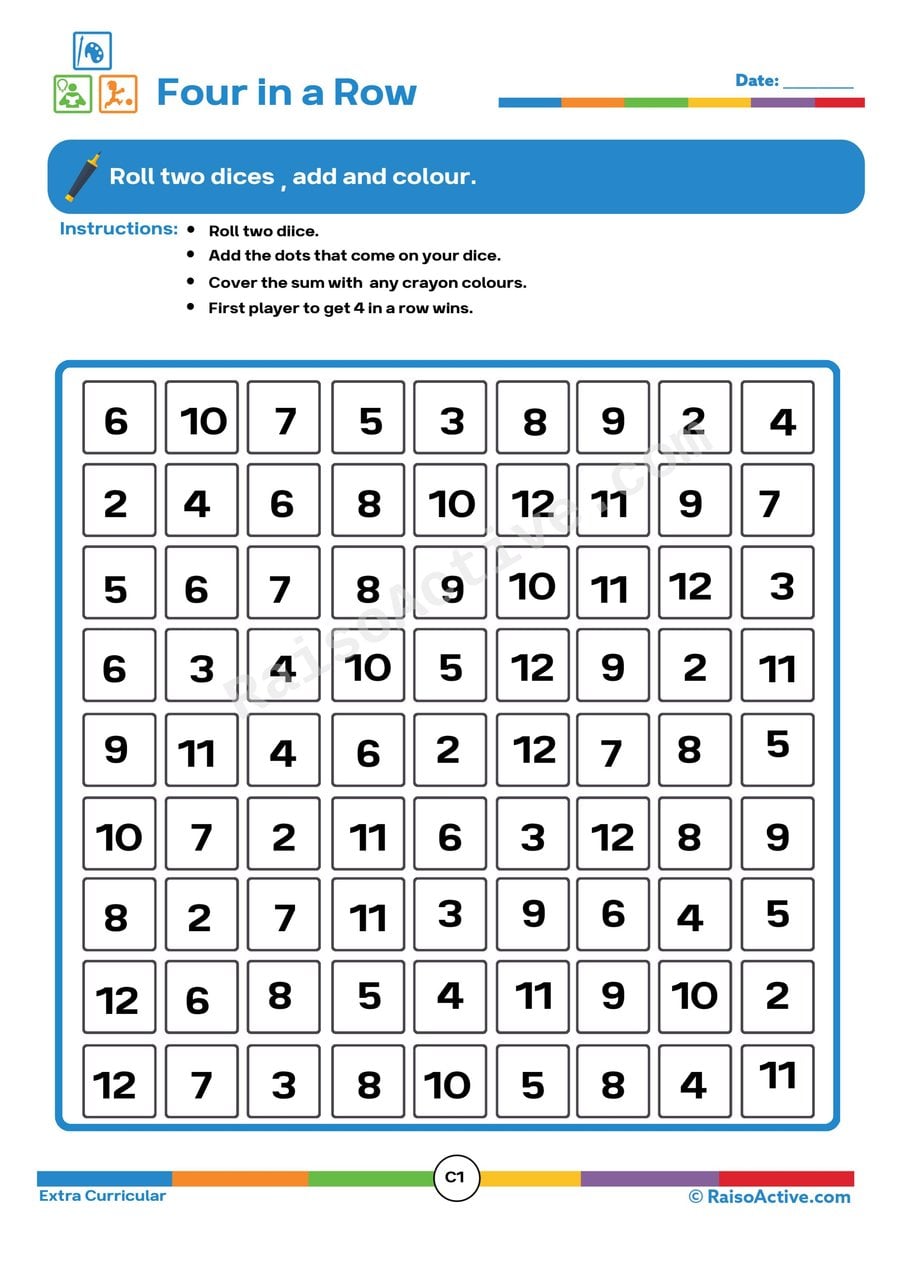
Four in a Row: Dice Game Worksheet for Kids
Ages 4-6 · Pre-K–KindergartenAges 4-6 · Reception–Year 1Ages 4-6 · LKG–UKGAges 4-6
Rolling two dice and adding the results together gives children ages 4-6 repeated, low-pressure practice with basic addition facts, since each turn presents a new combination to solve. Coloring the matching sum on a game grid turns arithmetic into an active, motivating game rather than a worksheet of isolated problems, and working toward four squares in a row adds a strategic element as children start to notice which sums appear more often. This game format also builds number recognition, since children must locate their calculated sum among many printed numbers on the grid.

Draw a Penguin! Step-by-Step Drawing Worksheet for Kids
Ages 3-5 · Preschool–Pre-KAges 3-5 · Nursery–ReceptionAges 3-5 · Nursery–LKGAges 3-5
This worksheet builds drawing confidence and fine motor control by breaking down how to draw a penguin into simple, sequential steps that a young child can follow one at a time. For ages 3-5, step-by-step drawing teaches children that a complex image can be built from a series of simple shapes, an approach that transfers to drawing other subjects later on.

Landforms Cut and Paste Worksheet for Preschoolers
Ages 3-5 · Preschool–Pre-KAges 3-5 · Nursery–ReceptionAges 3-5 · Nursery–LKGAges 3-5
Sorting pictures into categories like mountains, oceans, and deserts introduces children ages 3-5 to the idea that the Earth's surface has distinct, recognizable features, an early building block of geography and earth science. The cut-and-paste format adds a fine motor challenge on top of the classification task, requiring children to physically separate and place each picture correctly rather than simply pointing. Matching an image to its labeled landform category also builds vocabulary specific to the natural world beyond everyday objects.
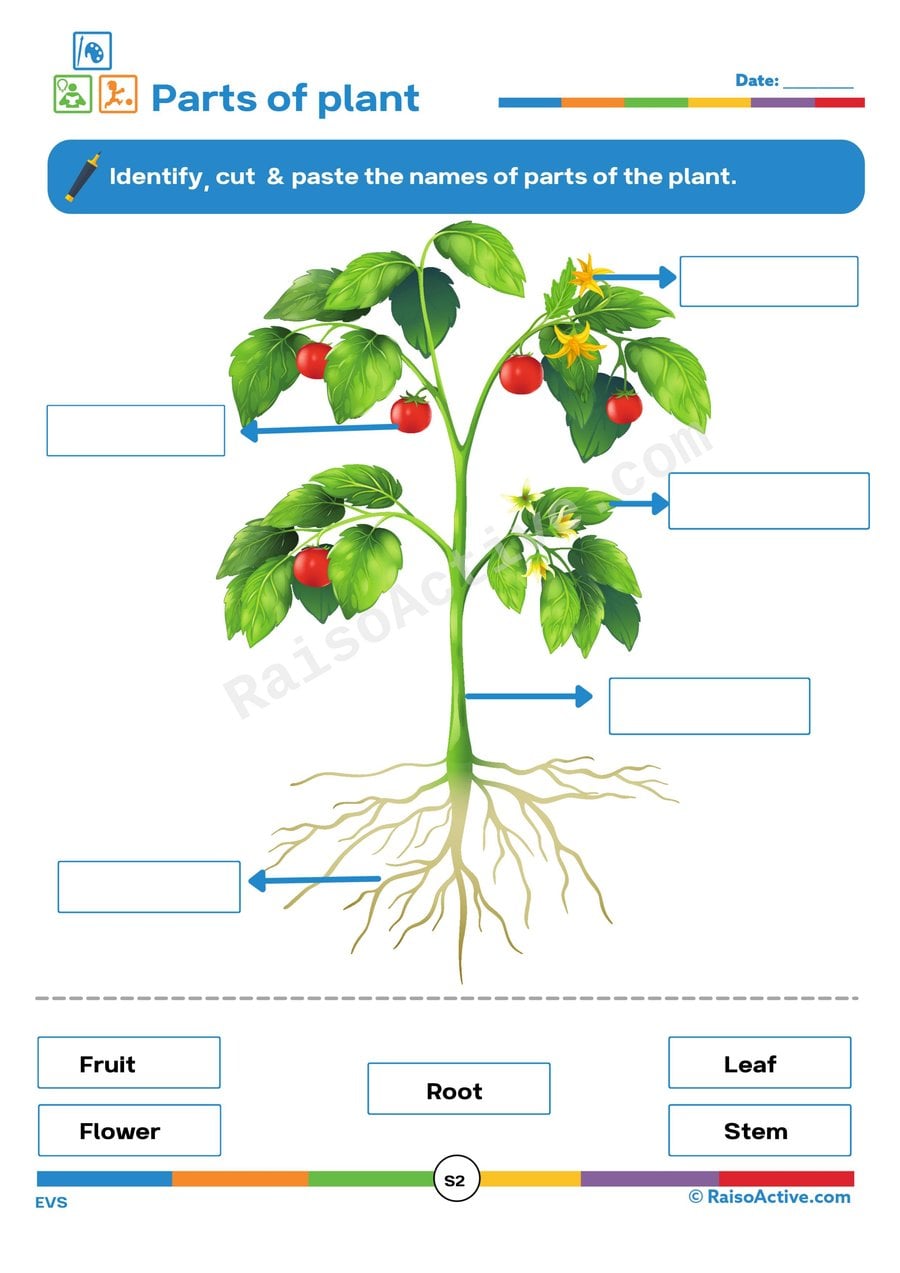
Parts of a Plant Worksheet: Identify and Label!
Ages 3-5 · Preschool–Pre-KAges 3-5 · Nursery–ReceptionAges 3-5 · Nursery–LKGAges 3-5
Labeling the root, stem, leaf, flower, and fruit of a plant teaches children ages 3-5 that living things are made of distinct parts that each serve a purpose, an early foundation for life science. The cut-and-paste labeling format requires children to match a written or pictured label to the correct location on a plant diagram, strengthening both vocabulary and visual mapping skills. Understanding plant anatomy also gives children language to describe the gardens, parks, and plants they encounter in daily life.
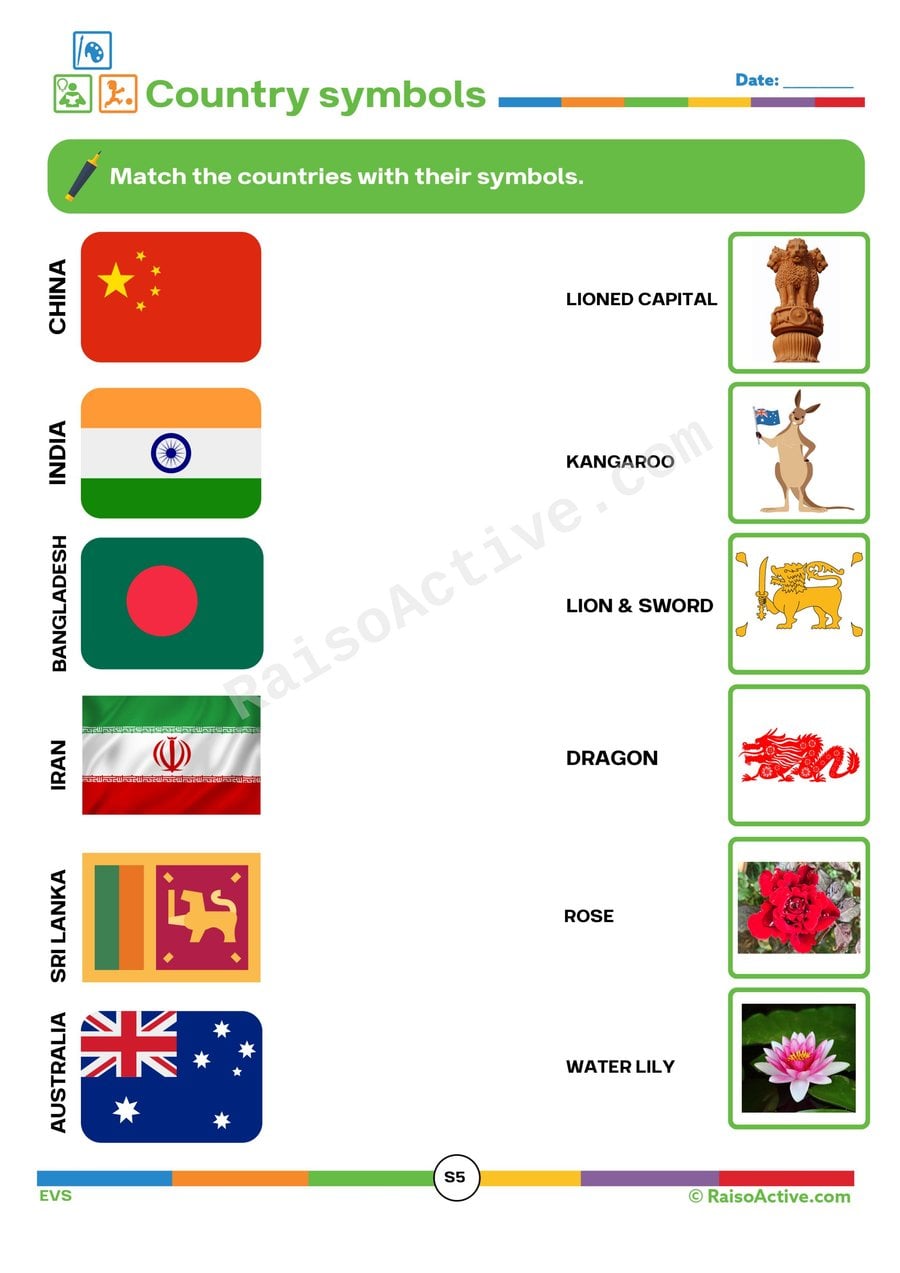
Match the Country Symbols Worksheet for Kids
Ages 4-6 · Pre-K–KindergartenAges 4-6 · Reception–Year 1Ages 4-6 · LKG–UKGAges 4-6
Matching country flags to their national symbols introduces children ages 4-6 to the idea that countries have their own distinct visual identities, an early and engaging entry point into geography and cultural awareness. This matching task builds visual discrimination, since flags and symbols can share similar colors or shapes that require careful comparison. Learning to associate a flag with a symbol also plants early vocabulary for talking about different countries and cultures around the world.
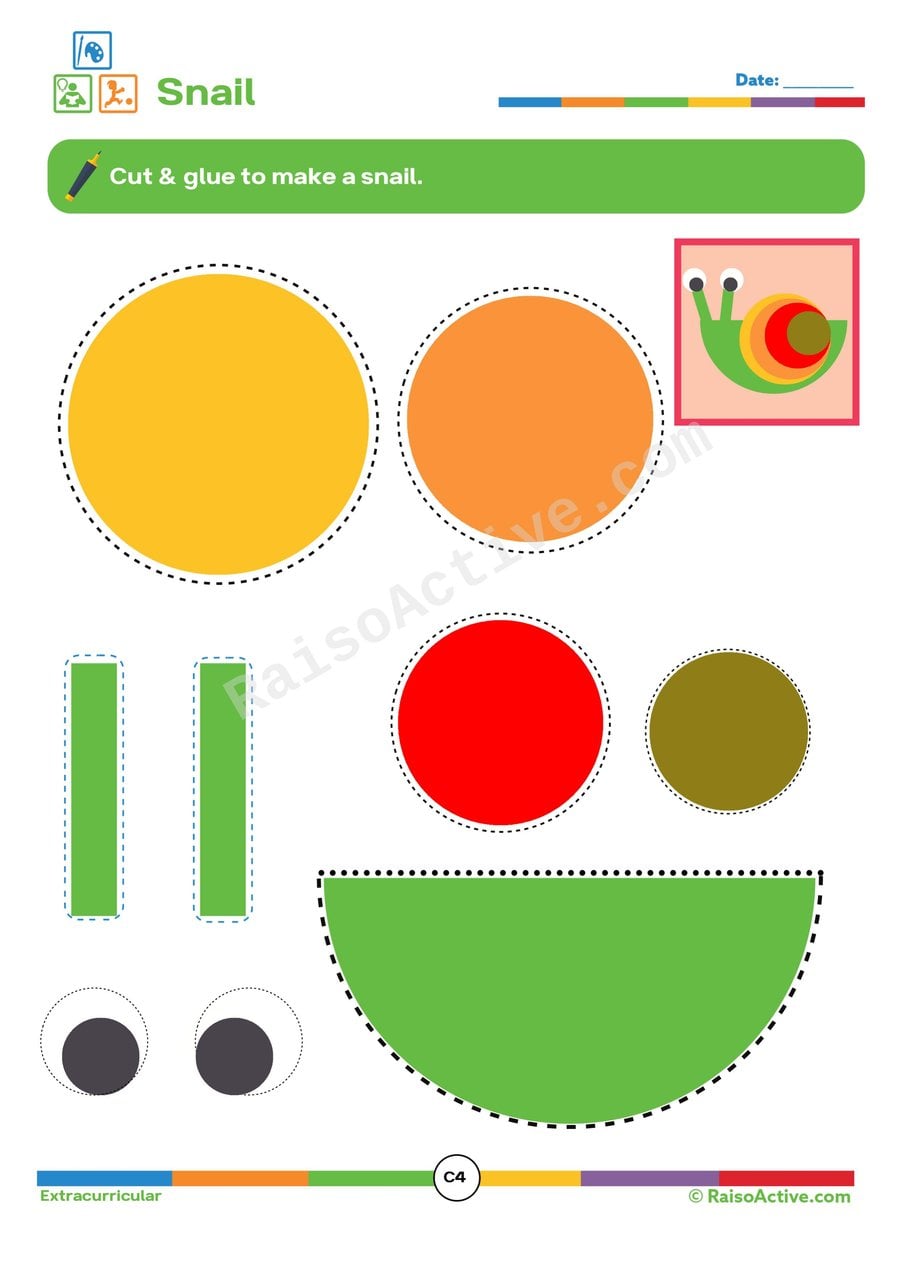
Snail Cut and Glue Worksheet for Preschoolers
Ages 3-5 · Preschool–Pre-KAges 3-5 · Nursery–ReceptionAges 3-5 · Nursery–LKGAges 3-5
Cutting out shapes and gluing them together in a specific arrangement to build a snail gives children ages 3-5 focused practice with scissor control and precise gluing placement, both demanding fine motor tasks at this age. Following a visual example to recreate the snail also builds early spatial reasoning, since children must match the size and position of each piece to the model rather than placing them randomly. This kind of guided craft bridges simple coloring pages and more independent creative projects.

Nature Color by Number Worksheet: Addition and Subtraction Fun!
Ages 4-6 · Pre-K–KindergartenAges 4-6 · Reception–Year 1Ages 4-6 · LKG–UKGAges 4-6
This worksheet combines addition and subtraction practice with a color-by-number format, requiring children to solve simple math problems and then use a color key to reveal a nature-themed picture. For ages 4-6, embedding math practice within a creative, rewarding coloring activity keeps motivation high through problems that might otherwise feel repetitive on their own.
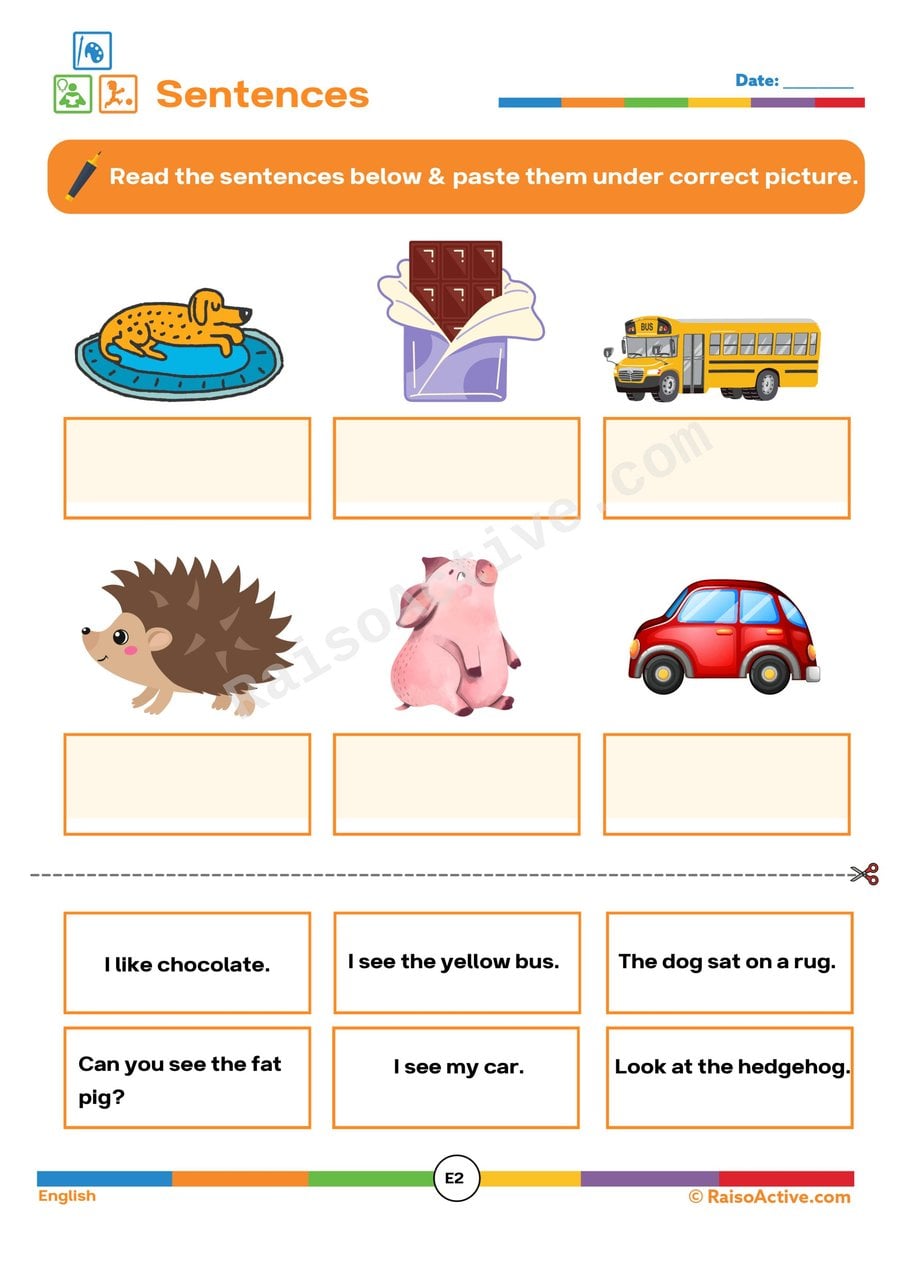
Sentence Matching Worksheet for Early Readers
Ages 4-5 · Pre-KAges 4-5 · ReceptionAges 4-5 · LKGAges 4-5
Matching a written sentence to the picture it describes asks children ages 4-5 to read for meaning rather than just decode individual words, an important step up from single-word reading toward true reading comprehension. This worksheet also builds fine motor and organizational skills through cutting and placing the sentence in the correct spot. Successfully pairing text with image confirms that a child understands what they're reading, not just that they can sound out letters.
Related worksheets
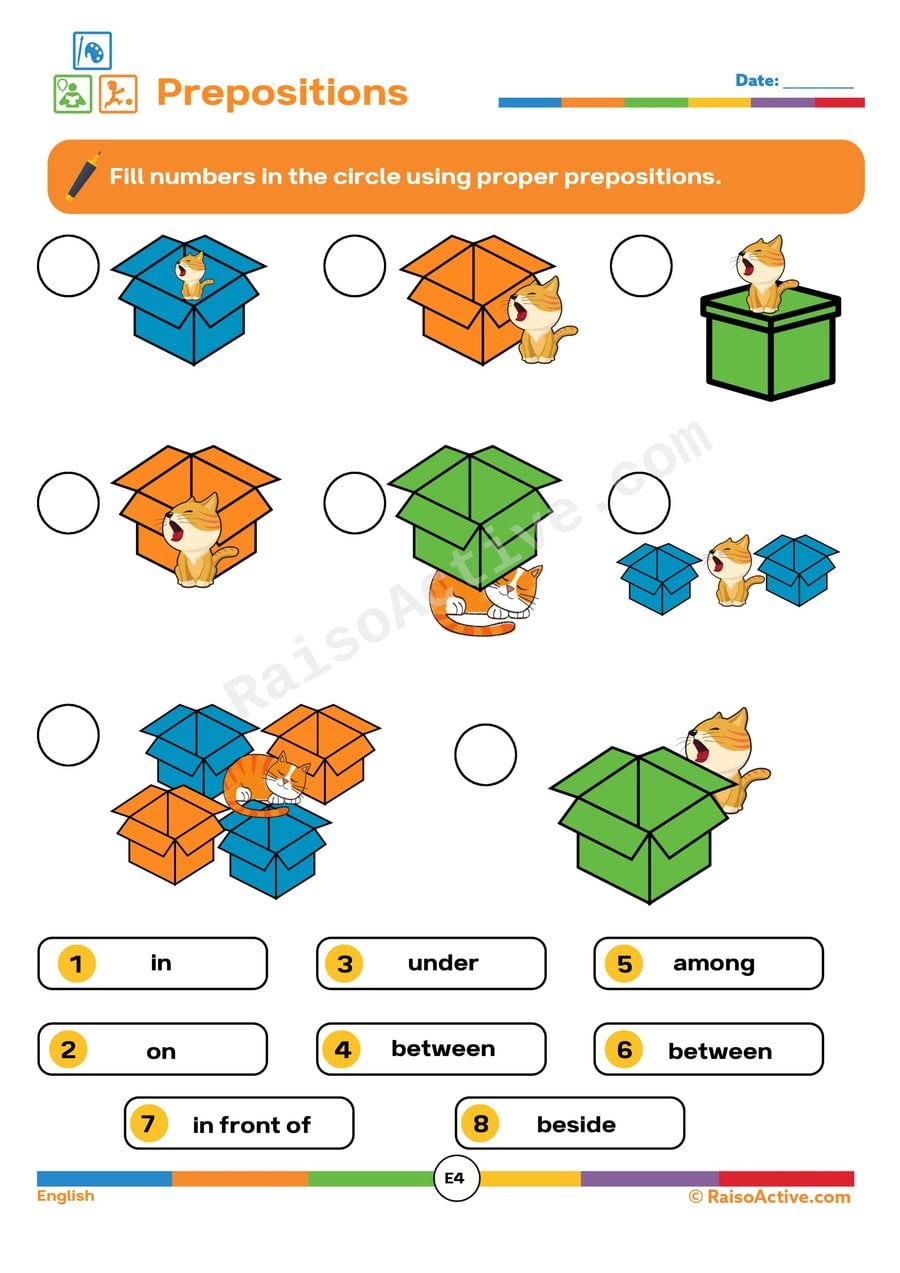
Prepositions Worksheet: Where Are the Cats?
Ages 3-5 · Preschool–Pre-KAges 3-5 · Nursery–ReceptionAges 3-5 · Nursery–LKGAges 3-5
This worksheet helps children ages 3-5 learn positional prepositions — words like 'under,' 'on,' 'behind,' and 'in' — by matching each word to a picture showing exactly where a cat is located. Understanding these small but essential words builds spatial vocabulary and comprehension skills that are used constantly in both everyday instructions and later reading comprehension.
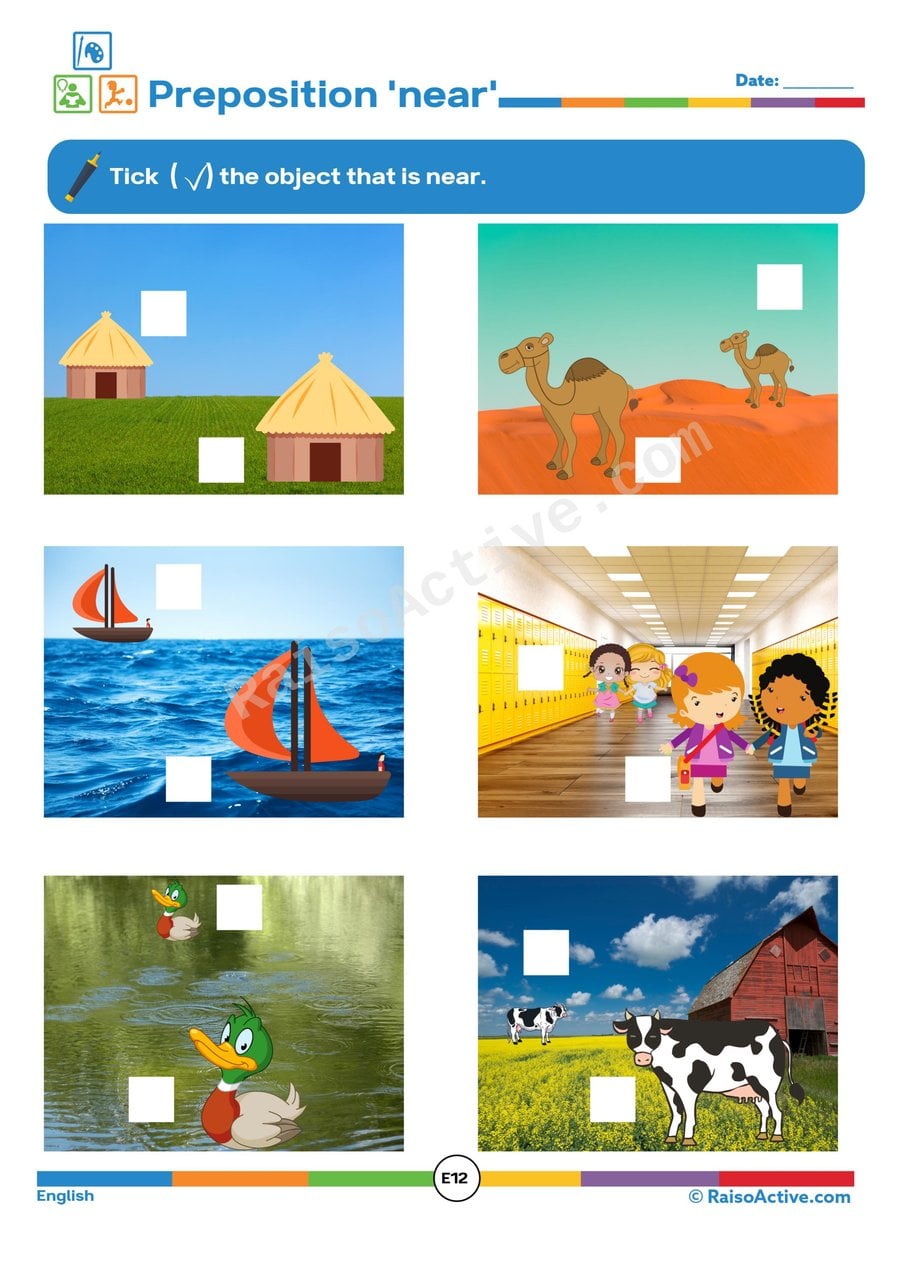
Near or Far? Preposition Worksheet for Kids
Ages 3-5 · Preschool–Pre-KAges 3-5 · Nursery–ReceptionAges 3-5 · Nursery–LKGAges 3-5
Preschoolers ages 3-5 build early spatial vocabulary by identifying which pictured object is positioned 'near' another, a comparative concept that requires judging relative distance between two things. Understanding 'near' versus 'far' lays groundwork for later spatial reasoning skills, like following directions and reading simple maps. Ticking the correct object also sharpens visual comparison and careful observation.

Preposition Worksheet: Circle the Correct Position!
Ages 3-5 · Preschool–Pre-KAges 3-5 · Nursery–ReceptionAges 3-5 · Nursery–LKGAges 3-5
Children ages 3-5 practice identifying prepositions like 'in,' 'on,' and 'under' by looking at a picture and circling the word that correctly describes where an object is positioned. This builds early spatial vocabulary that children use constantly in everyday communication, from describing where a toy is to following directions.

Preposition Worksheet: Identifying Where Things Are!
Ages 3-5 · Preschool–Pre-KAges 3-5 · Nursery–ReceptionAges 3-5 · Nursery–LKGAges 3-5
This worksheet asks children to identify the correct preposition, words like 'in,' 'on,' 'under,' or 'behind', that describes where an object is located in a picture, building spatial vocabulary that supports both everyday communication and following multi-step instructions. For ages three to five, prepositions are often used correctly in speech before children can identify them on paper, so this worksheet helps make that intuitive knowledge explicit.
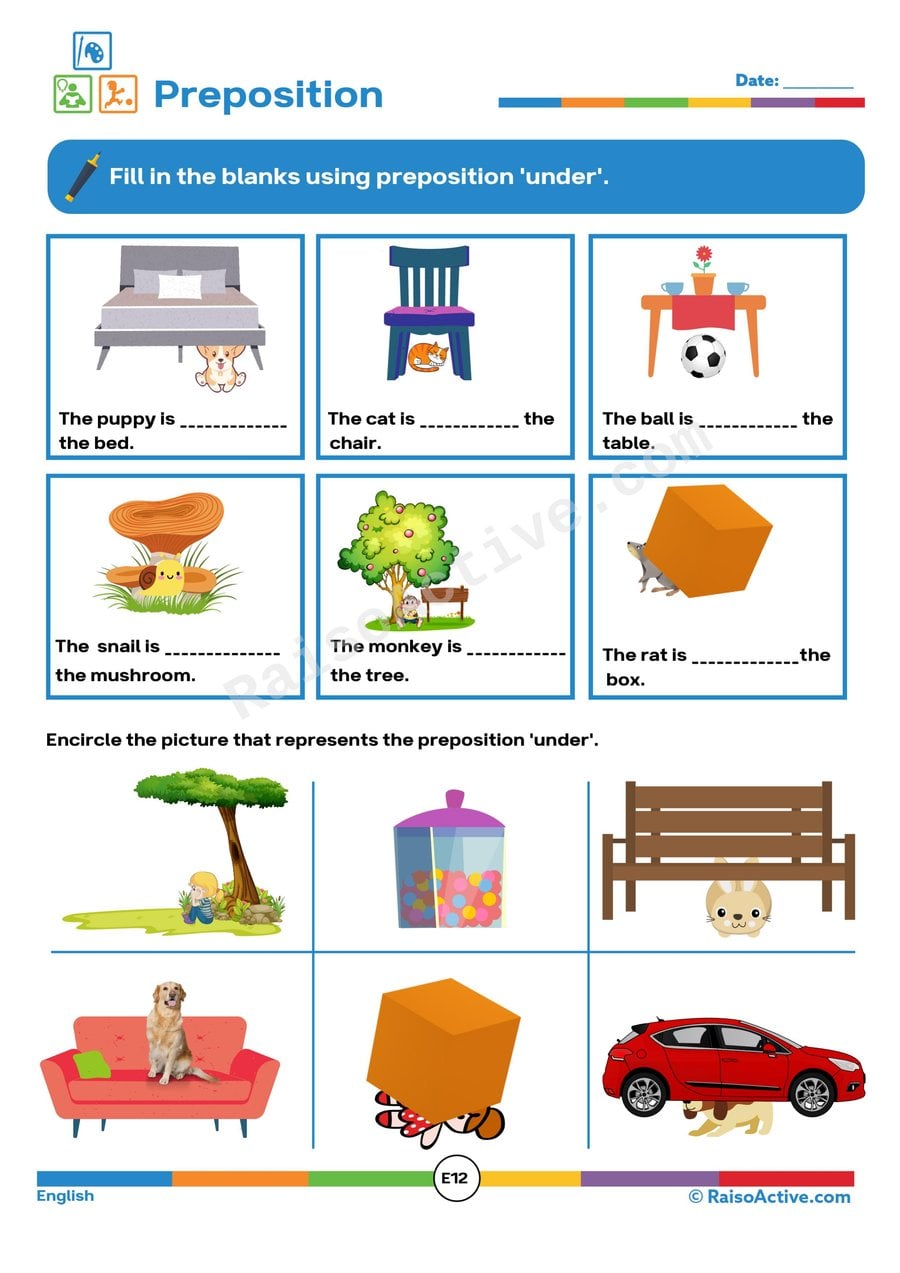
Preposition 'Under' Worksheet: Fun with Placement!
Ages 3-5 · Preschool–Pre-KAges 3-5 · Nursery–ReceptionAges 3-5 · Nursery–LKGAges 3-5
Practicing the preposition 'under' teaches children ages 3-5 to describe spatial relationships between objects, an early grammar concept closely tied to their developing understanding of physical space. Filling in the blank and then identifying pictures that show something under another object reinforces the word's meaning through both language and visual recognition.
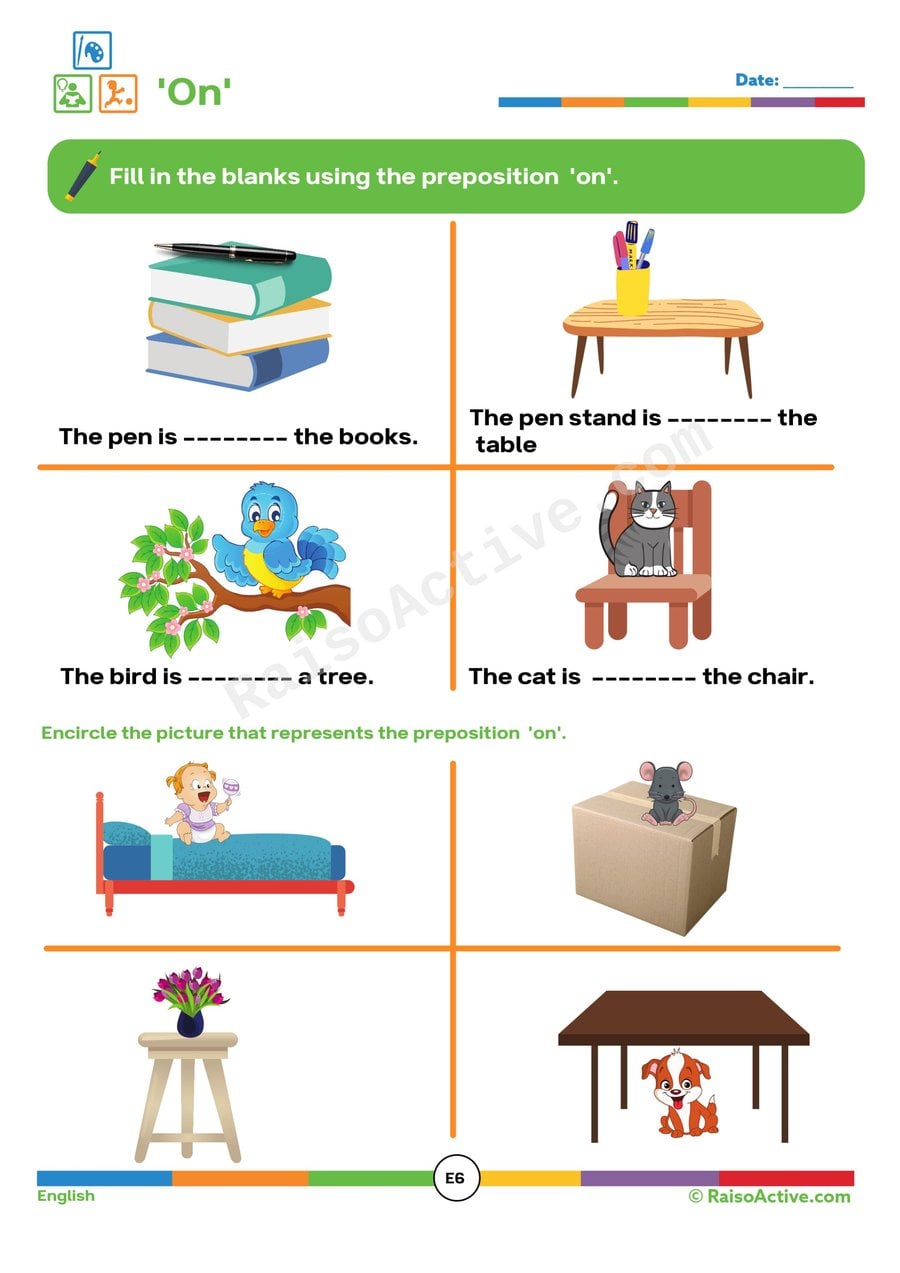
Preposition Fun: 'On' Worksheet for Early Learners
Ages 3-5 · Preschool–Pre-KAges 3-5 · Nursery–ReceptionAges 3-5 · Nursery–LKGAges 3-5
Practicing the preposition 'on' teaches children ages 3-5 how a small function word can precisely describe where one object sits in relation to another, an early and important step in building more complex, descriptive sentences. Filling in the blank with 'on' repeatedly across different sentences helps the word become automatic rather than something they have to think hard about each time. Circling the picture that correctly shows something 'on' another object also checks that your child truly understands the spatial meaning, not just the spelling of the word.

Logic Grid Puzzle for Kids: Sort by Two Rules
Ages 4-7 · Pre-K–Grade 1Ages 4-7 · Reception–Year 2Ages 4-7 · LKG–Class 1Ages 4-7
Children sort eight numbered objects by two rules at once (big or small, striped or plain) and then use clues in a simple logic grid to work out which child has which pet. This builds classification and deductive reasoning.

Phonics Level 2 Certificate of Achievement: Super Reader
Ages 4-7 · Pre-K–Grade 1Ages 4-7 · Reception–Year 2Ages 4-7 · LKG–Class 1Ages 4-7
Children celebrate reading and spelling words with blends and digraphs, and tick what they can read: CVC words, blends and digraphs.
Guides for this topic

Documenting Learning Without Drowning in Data: A Practical Guide for Parents and Teachers
Learn practical ways to document your child's learning without overwhelm. Simple portfolios, observation tips, and printable trackers for ages 1-8.

Age-Appropriate Problem-Solving Activities: Building Critical Thinkers from the Ground Up
Discover fun, age-appropriate problem-solving activities for children ages 1-8. Build critical thinking, logic, and reasoning skills through play-based learning.
Critical Thinking Activities That Actually Work for Young Children: Building Tomorrow's Thinkers Today
Discover proven critical thinking activities for young children. Age-wise logic games, questioning techniques, and hands-on ideas to build thinking skills at home.
Reviews
Every worksheet for ages 4–6, no watermark
Members download the full library of 1,000+ worksheets and every activity pack without watermarks or daily limits. One year costs ₹999 in India or $20 elsewhere.
See membership plansOr download any worksheet free with a watermark (5 a day).