Nature Color by Number Worksheet: Addition and Subtraction Fun!
This worksheet combines addition and subtraction practice with a color-by-number format, requiring children to solve simple math problems and then use a color key to reveal a nature-themed picture. For ages 4-6, embedding math practice within a creative, rewarding coloring activity keeps motivation high through problems that might otherwise feel repetitive on their own.
Part of the pack
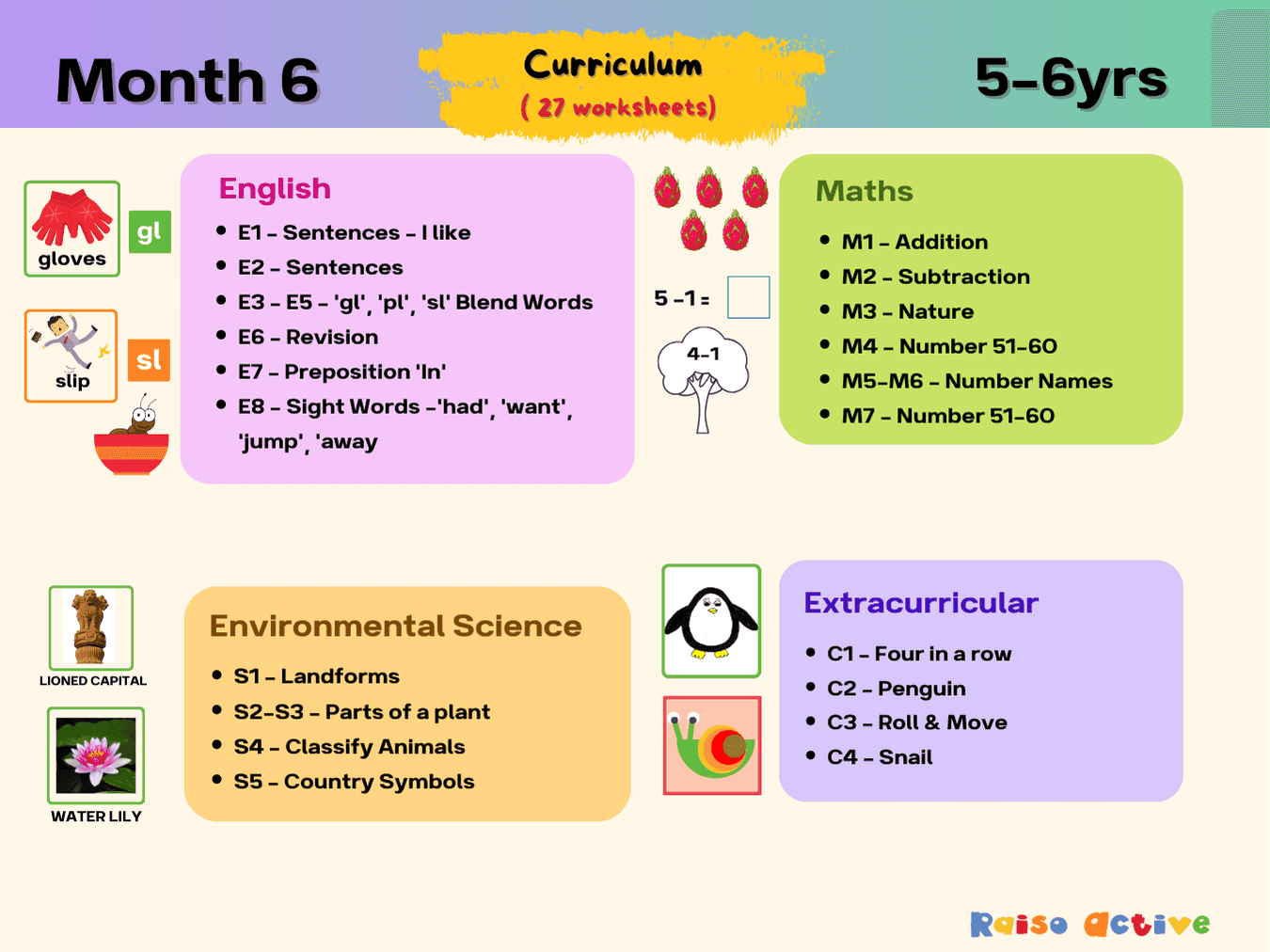
Month 6: Holistic early learning activities | Ages 5-6
This is page 17 of the pack. Ages 5-6 · KindergartenAges 5-6 · Year 1Ages 5-6 · UKGAges 5-6

Made for your child
Taking away within 10, made for your child
A maths pack with your child's name in it: pictures that explain, practice at three levels, puzzles and story sums about them. Print a new set whenever they finish.
Make a maths packFree preview · free for members
Curriculum
- Addition > Addition Basics
How to use this worksheet
Look at the color key together first, noting which color corresponds to each possible answer number. Have your child solve the first addition or subtraction problem in one of the picture's sections, writing or saying the answer before checking the key for the matching color. Have your child color that section with the correct color based on their answer, then move to the next problem and section. Continue through the entire picture, solving each math problem and coloring accordingly, until the full nature scene is revealed.
Materials needed
- Pencil
- Crayons or colored pencils
Extension activities
- 1Create a new color-by-number picture together with your own simple addition and subtraction problems.
- 2Talk about the nature scene once finished, discussing what plants or animals are shown.
- 3Practice the math problems separately on a whiteboard before returning to the coloring page, to build extra confidence.
- 4Time how long it takes to solve all the problems and try to improve on a later attempt.
- 5Use the finished picture as inspiration for a short story about the nature scene depicted.

Written by
Hemsweta Jain · Teacher Cheena
MBA and Early Childhood Educator, teaching since 2014 · Founder of RaisoActive, Mumbai
Every RaisoActive worksheet is designed and checked by the founder before publishing.
Published · Last reviewed
More from Month 6: Holistic early learning activities | Ages 5-6
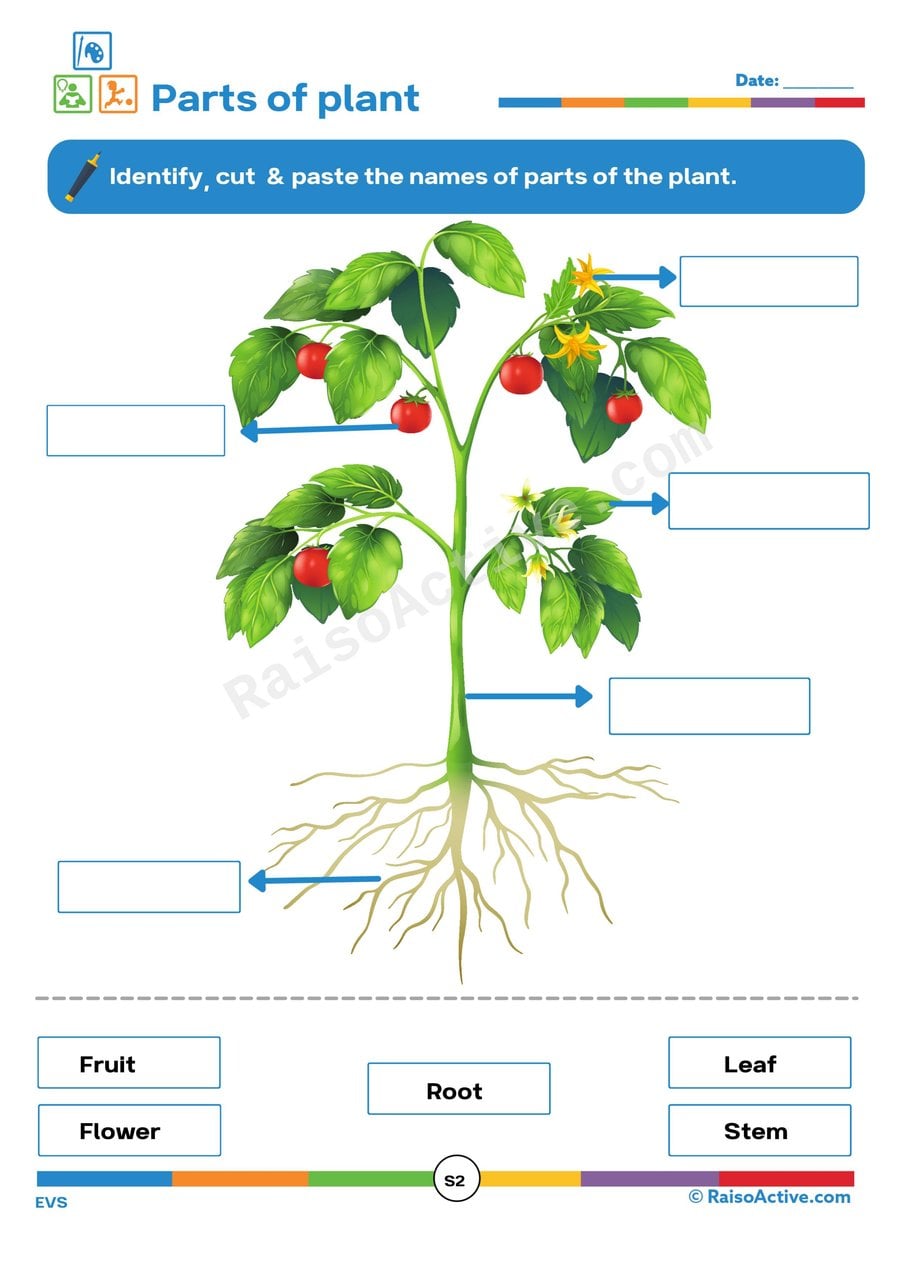
Parts of a Plant Worksheet: Identify and Label!
Ages 3-5 · Preschool–Pre-KAges 3-5 · Nursery–ReceptionAges 3-5 · Nursery–LKGAges 3-5
Labeling the root, stem, leaf, flower, and fruit of a plant teaches children ages 3-5 that living things are made of distinct parts that each serve a purpose, an early foundation for life science. The cut-and-paste labeling format requires children to match a written or pictured label to the correct location on a plant diagram, strengthening both vocabulary and visual mapping skills. Understanding plant anatomy also gives children language to describe the gardens, parks, and plants they encounter in daily life.

Subtraction Worksheet: Count and Subtract for Preschoolers
Ages 4-5 · Pre-KAges 4-5 · ReceptionAges 4-5 · LKGAges 4-5
This worksheet introduces basic subtraction by having children count a starting group of objects, remove or cross out a specified number, and count what remains to find the answer. For ages 4-5, grounding subtraction in physical counting rather than abstract numbers alone helps children understand that subtraction means 'taking away' a quantity, not just manipulating symbols.
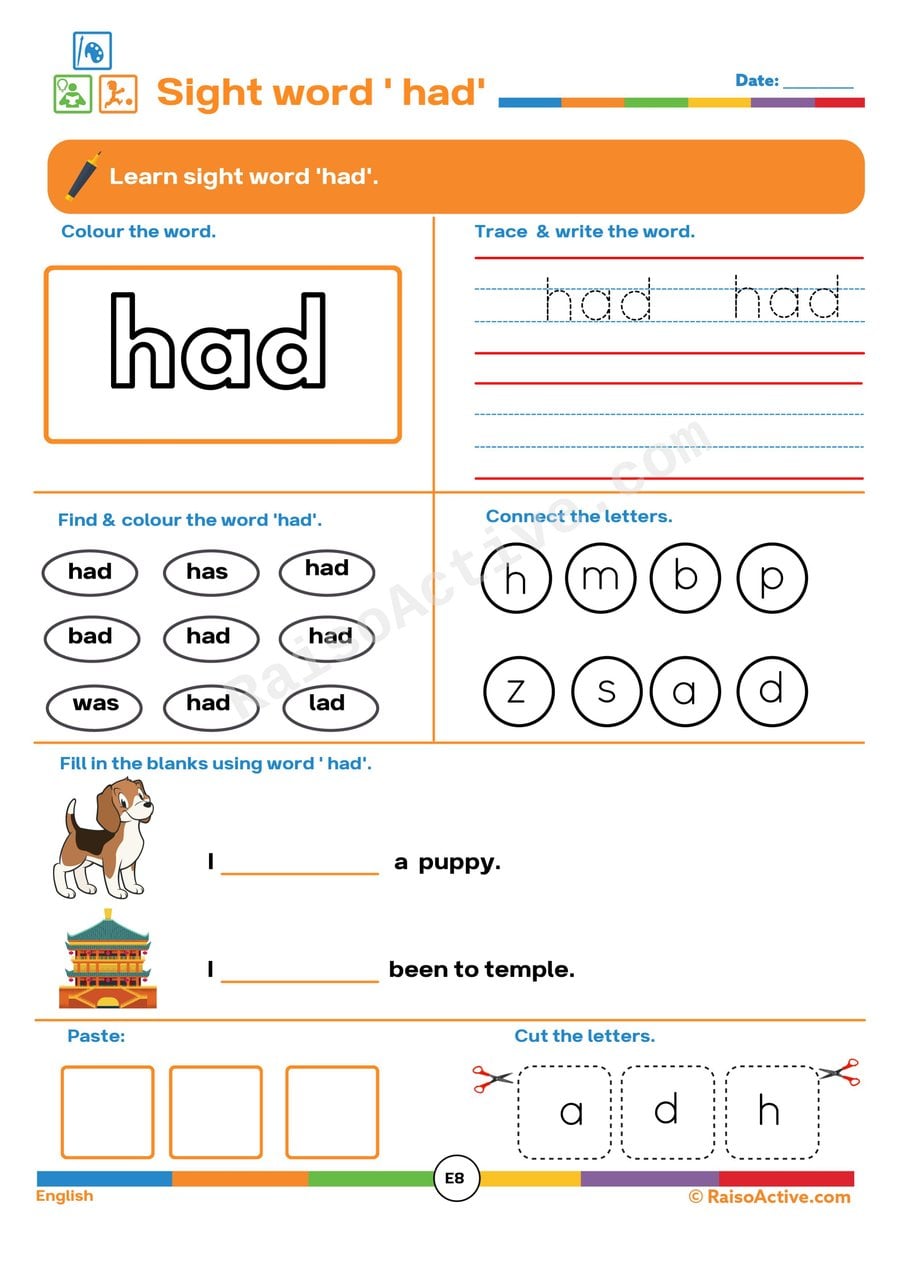
Sight Word 'had' Worksheet: Trace, Find, and Write!
Ages 3-5 · Preschool–Pre-KAges 3-5 · Nursery–ReceptionAges 3-5 · Nursery–LKGAges 3-5
This worksheet builds sight word recognition for the common word 'had' through multiple activities, tracing, finding it among similar words, connecting letters, and cutting and pasting, giving children repeated, varied exposure to the same high-frequency word. For ages 3-5, 'had' doesn't sound out in an entirely predictable way for beginning readers, so repeated whole-word recognition practice like this is especially valuable.

Roll & Move Activity: Fun Physical Activity Cube for Kids!
Ages 3-5 · Preschool–Pre-KAges 3-5 · Nursery–ReceptionAges 3-5 · Nursery–LKGAges 3-5
This cut-and-fold craft combines fine motor skills with gross motor movement, as children build a paper cube featuring different physical actions and then roll it to determine which activity to perform. For ages 3-5, following multi-step folding and gluing instructions builds spatial reasoning and sequencing, while the resulting game encourages active movement and following simple rules.
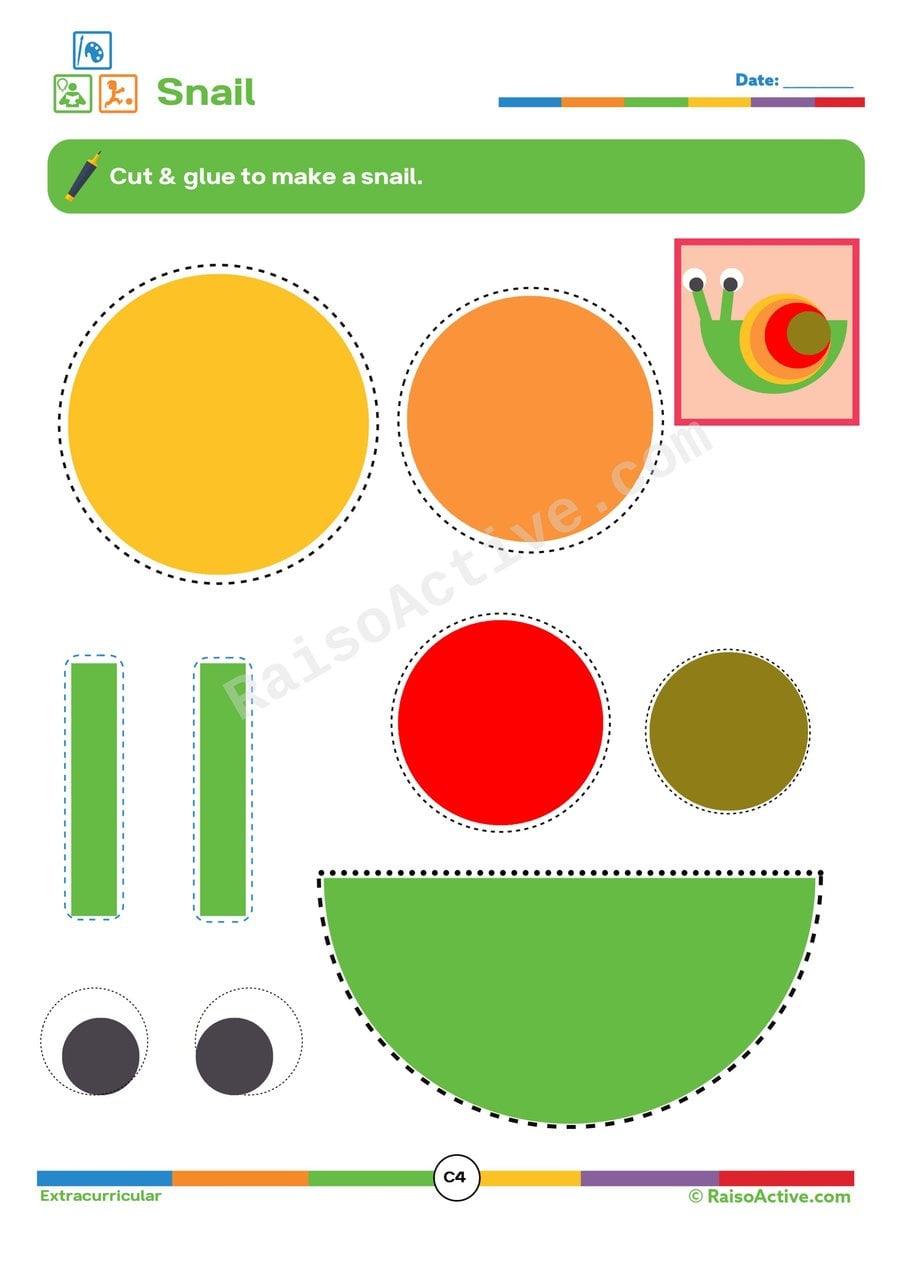
Snail Cut and Glue Worksheet for Preschoolers
Ages 3-5 · Preschool–Pre-KAges 3-5 · Nursery–ReceptionAges 3-5 · Nursery–LKGAges 3-5
Cutting out shapes and gluing them together in a specific arrangement to build a snail gives children ages 3-5 focused practice with scissor control and precise gluing placement, both demanding fine motor tasks at this age. Following a visual example to recreate the snail also builds early spatial reasoning, since children must match the size and position of each piece to the model rather than placing them randomly. This kind of guided craft bridges simple coloring pages and more independent creative projects.

Number Names Worksheet: Writing and Matching Numbers 51-60!
Ages 4-6 · Pre-K–KindergartenAges 4-6 · Reception–Year 1Ages 4-6 · LKG–UKGAges 4-6
Writing out number names like 'fifty-one' or 'fifty-eight' next to their numerals helps children ages 4-6 connect the spoken word for a number to both its written word form and its digit form, a three-way link that strengthens overall number sense in the 51-60 range. This worksheet also revisits missing-number sequencing and color-coding, giving repeated exposure to the same number range through several different tasks. Building fluency with two-digit number names prepares children for reading numbers in books, on clocks, and in everyday life.

Blends Revision Worksheet: Circle the Correct Blend!
Ages 4-6 · Pre-K–KindergartenAges 4-6 · Reception–Year 1Ages 4-6 · LKG–UKGAges 4-6
Choosing the correct consonant blend to match a picture asks children ages 4-6 to compare two similar-sounding options, like 'bl' versus 'br,' and decide which one truly matches the word they hear, a sharper phonics skill than recognizing a single blend in isolation. This side-by-side comparison format catches confusion between commonly mixed-up blends that simple flashcards might miss. Building this discrimination skill helps children read multisyllabic and blended words more accurately and confidently.
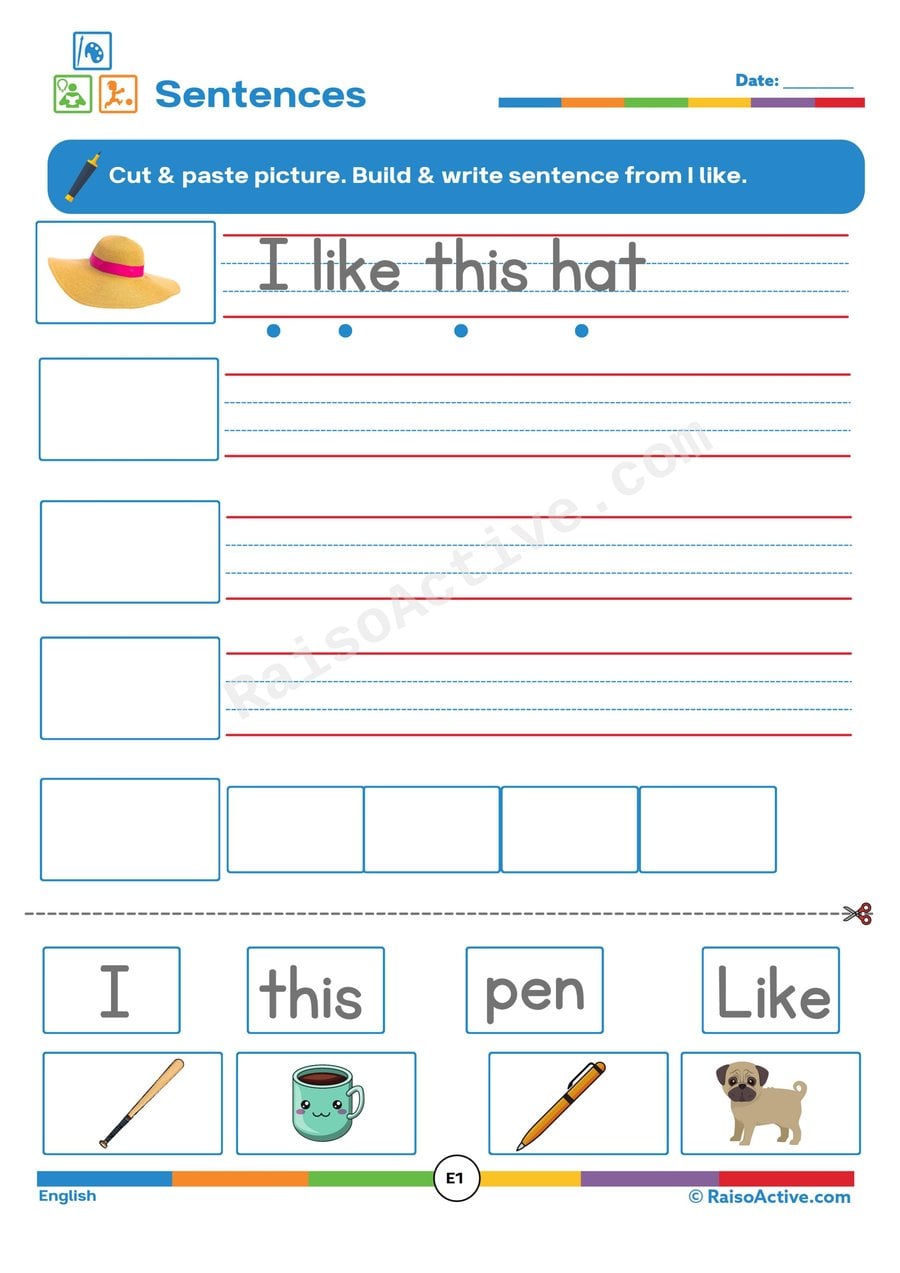
I Like Sentences Worksheet: Cut, Paste, and Write!
Ages 4-5 · Pre-KAges 4-5 · ReceptionAges 4-5 · LKGAges 4-5
This worksheet builds early sentence construction and fine motor skills together, having children cut out a picture and word cards, paste them into a simple 'I like ___' sentence frame, and then copy the full sentence in their own writing. For ages 4-5, physically assembling a sentence from separate word pieces before writing it independently helps children understand that sentences are built from individual words in a specific order.
Related worksheets

Solve & Color: Fun Addition and Subtraction Worksheet for Kids!
Ages 4-6 · Pre-K–KindergartenAges 4-6 · Reception–Year 1Ages 4-6 · LKG–UKGAges 4-6
This worksheet combines early arithmetic practice with a color-by-number format, as children ages 4-6 solve simple addition and subtraction problems and then use a color key to fill in each shape based on their answer. Because getting the coloring 'right' depends on solving the math correctly, children get built-in, self-checking feedback on their arithmetic while also practicing shape recognition and staying within lines.

Addition and Subtraction Sums Worksheet for Preschoolers
Ages 4-6 · Pre-K–KindergartenAges 4-6 · Reception–Year 1Ages 4-6 · LKG–UKGAges 4-6
Practicing addition and subtraction problems within 10 together, rather than in separate worksheets, helps children see the two operations as related, that subtraction can undo addition, which builds more flexible number sense than drilling each skill in isolation. For ages four to six, working within small numbers keeps the focus on understanding the operations rather than on managing large quantities.

Math Puzzle: Cut and Paste Addition and Subtraction Worksheet
Ages 4-6 · Pre-K–KindergartenAges 4-6 · Reception–Year 1Ages 4-6 · LKG–UKGAges 4-6
Solving addition and subtraction problems and matching each answer to its correct puzzle piece builds calculation fluency alongside visual matching skills for children ages 4-6, turning practice into a self-checking puzzle format.

Color the Reindeer! Christmas Coloring Worksheet for Kids
Ages 3-5 · Preschool–Pre-KAges 3-5 · Nursery–ReceptionAges 3-5 · Nursery–LKGAges 3-5
Coloring the reindeer and gift bag illustrations gives children ages 3-5 focused practice with crayon control and color selection, helping them build the hand strength and precision needed for later handwriting tasks. Choosing colors for a familiar character like a reindeer also encourages imaginative decision-making, since there's no single 'correct' color for a fictional animal's coat or a wrapped gift. The festive subject matter keeps a repetitive fine motor task feeling like a treat rather than a chore.

Holi Colour Mixing: Colour the Picture and Mix the Colours
Ages 4-8 · Pre-K–Grade 2Ages 4-8 · Reception–Year 3Ages 4-8 · LKG–Class 2Ages 4-8
Children learn that Holi is the festival of colours that welcomes spring, and discover which colours they get when they mix two primary colours.
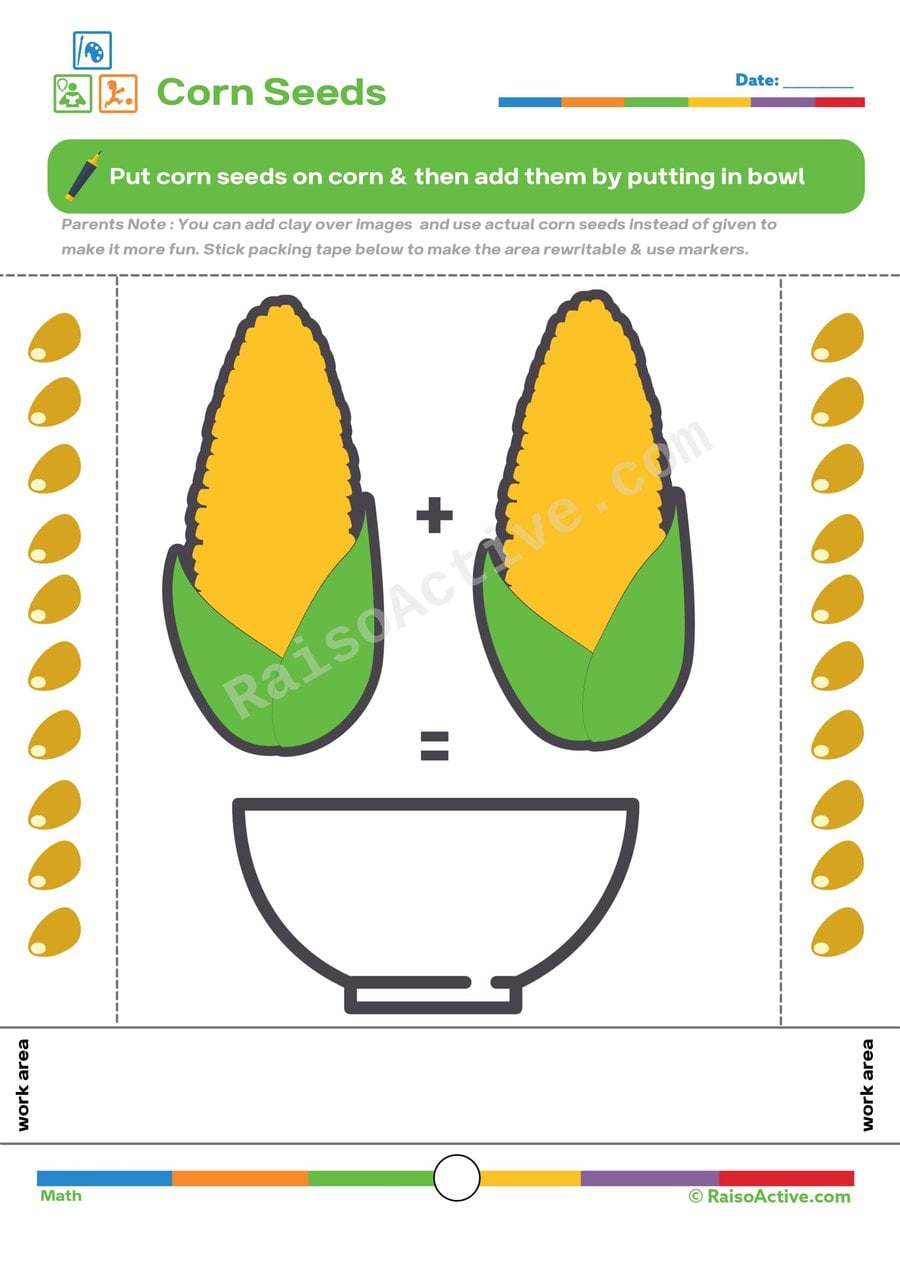
Corn Seed Addition Worksheet for Preschoolers
Ages 3-5 · Preschool–Pre-KAges 3-5 · Nursery–ReceptionAges 3-5 · Nursery–LKGAges 3-5
Counting corn seeds on two ears of corn and combining them into one total teaches children ages 3-5 the core concept of addition as joining groups together, using a concrete, countable image rather than abstract numerals alone. This worksheet also builds one-to-one correspondence, since accurate addition depends on touching or pointing to each seed exactly once while counting.
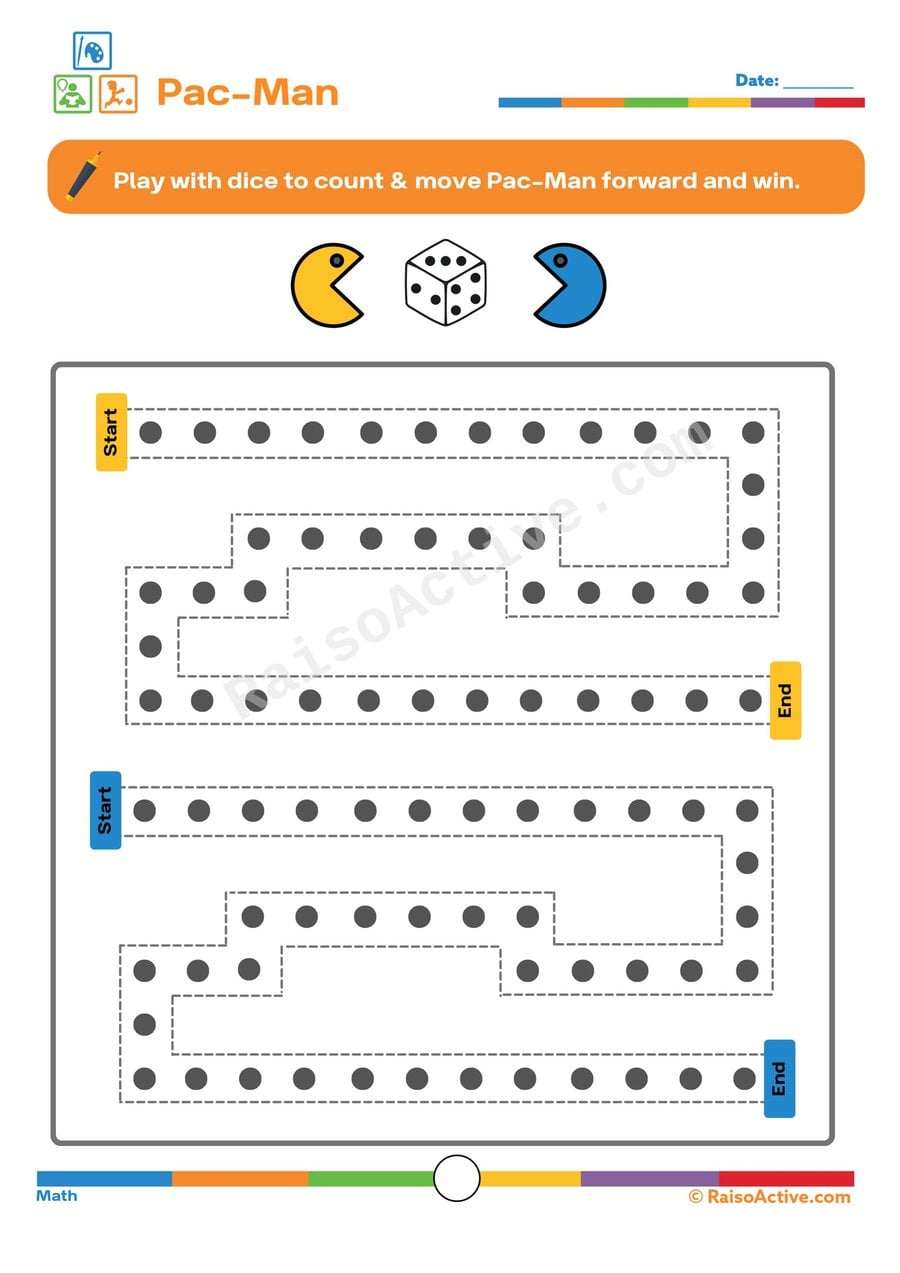
Pac-Man Maze Worksheet: Count and Move!
Ages 3-5 · Preschool–Pre-KAges 3-5 · Nursery–ReceptionAges 3-5 · Nursery–LKGAges 3-5
This dice-driven maze combines counting practice with path-following for children ages 3-5, since they must accurately count dots on a die before moving Pac-Man the matching number of spaces forward. Deciding how far to move and staying on the correct path also builds early strategic thinking, as children track their current position within the maze after each turn.

Squirrel's Acorn Maths: Addition, Comparing and Picture Sudoku Worksheet
Ages 4-8 · Pre-K–Grade 2Ages 4-8 · Reception–Year 3Ages 4-8 · LKG–Class 2Ages 4-8
Children add small groups, compare amounts with >, < and =, and use logic to complete a 4x4 picture sudoku.
Guides for this topic

Number Formation Rhymes 0–9 and How to Fix Reversals
Original number formation rhymes for 0–9, the correct stroke order for each digit, why 3, 5 and 7 get reversed most often, and multisensory fixes that work.

Best Worksheets for 3-Year-Olds: What Works and What to Avoid
What works on worksheets for 3-year-olds: short sessions, crayons, tracing lines, matching, cutting, a free weekly plan, and signs one is too advanced.
Fostering Creativity in Structured Learning: The Perfect Balance for Young Minds
Learn how to blend creativity with structured learning for children ages 1-8. Practical strategies, activities, and printable worksheets for parents and teachers.
Reviews
Every worksheet for ages 4–6, no watermark
Members download the full library of 1,000+ worksheets and every activity pack without watermarks or daily limits. One year costs ₹999 in India or $20 elsewhere.
See membership plansOr download any worksheet free with a watermark (5 a day).