I Like Sentences Worksheet: Cut, Paste, and Write!
This worksheet builds early sentence construction and fine motor skills together, having children cut out a picture and word cards, paste them into a simple 'I like ___' sentence frame, and then copy the full sentence in their own writing. For ages 4-5, physically assembling a sentence from separate word pieces before writing it independently helps children understand that sentences are built from individual words in a specific order.
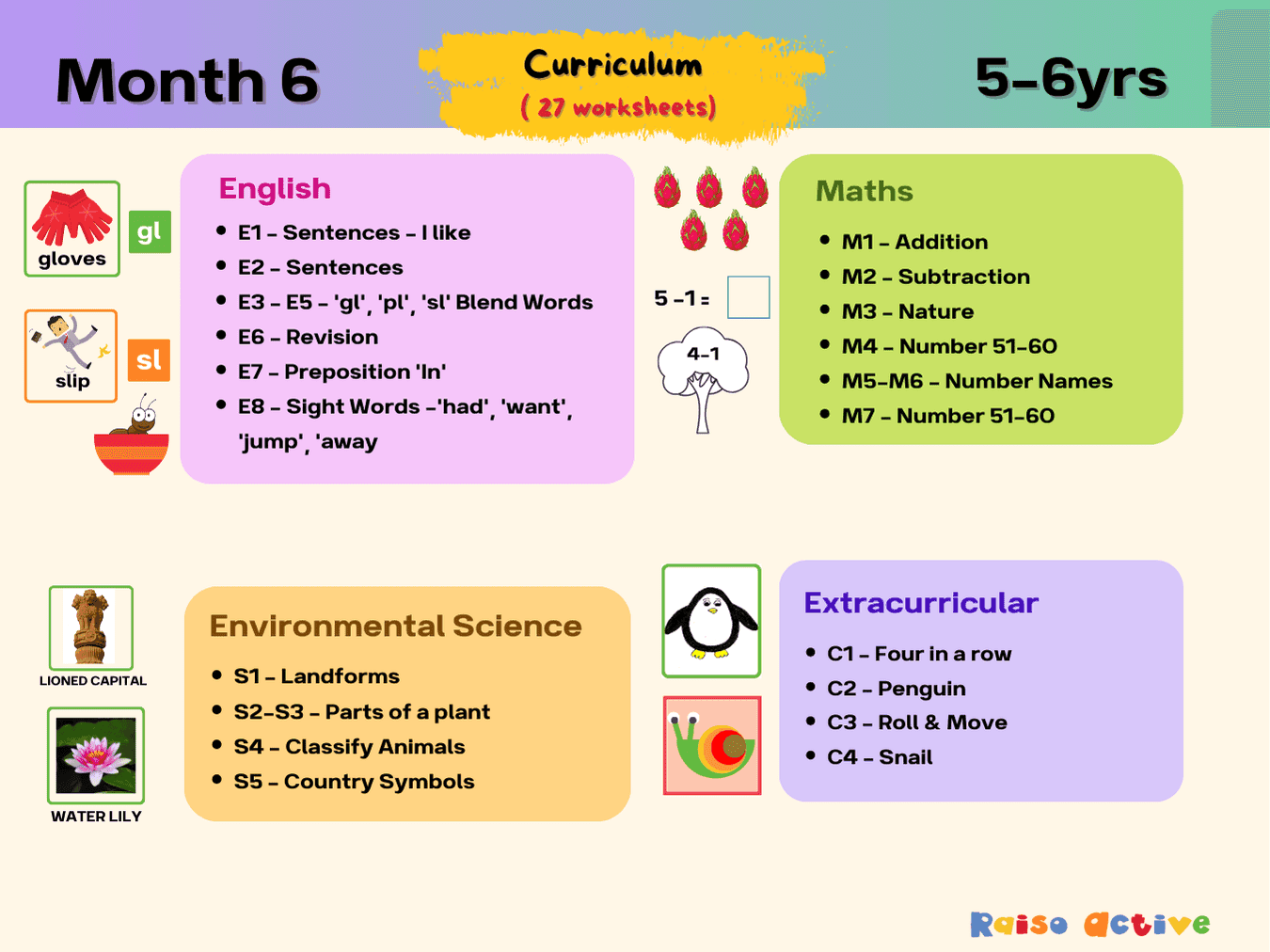
Part of the pack
Month 6: Holistic early learning activities | Ages 5-6
This is page 4 of the pack. Ages 5-6 · KindergartenAges 5-6 · Year 1Ages 5-6 · UKGAges 5-6
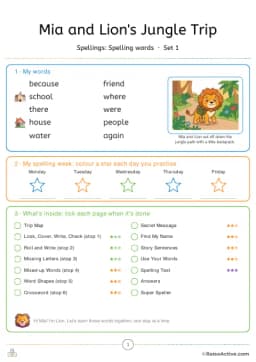
Made for your child
Spelling practice, made for your child
Their own spelling words turned into a pack: trace or look-cover-write-check, roll and write, a secret picture code, a word search, a crossword and a test, with their name in it.
Make a spelling packFree preview · free for members
Or start free: a word search with sight wordsCurriculum
- Fluency > Sentence Building
How to use this worksheet
Start by cutting out the picture and word cards at the bottom of the page together, offering help with scissors as needed. Have your child choose a picture they like and glue it into the box provided on the sentence frame. Guide your child to arrange the word cards in the correct order to complete the sentence 'I like ___,' gluing each word into place once the order is confirmed. Finally, have your child copy the completed sentence onto the writing lines provided, sounding out each word as they write.
Materials needed
- Scissors
- Glue
- Pencil or crayon
Extension activities
- 1Create additional 'I like ___' sentences using new pictures and words your child chooses.
- 2Have your child draw their own picture to match a sentence they've written.
- 3Practice reading the finished sentence aloud multiple times to build fluency.
- 4Make a simple book of 'I like' sentences about different things your child enjoys, one page per sentence.
- 5Play a game where you say an 'I like' sentence and your child has to guess what picture would match it.

Written by
Hemsweta Jain · Teacher Cheena
MBA and Early Childhood Educator, teaching since 2014 · Founder of RaisoActive, Mumbai
Every RaisoActive worksheet is designed and checked by the founder before publishing.
Published · Last reviewed
More from Month 6: Holistic early learning activities | Ages 5-6
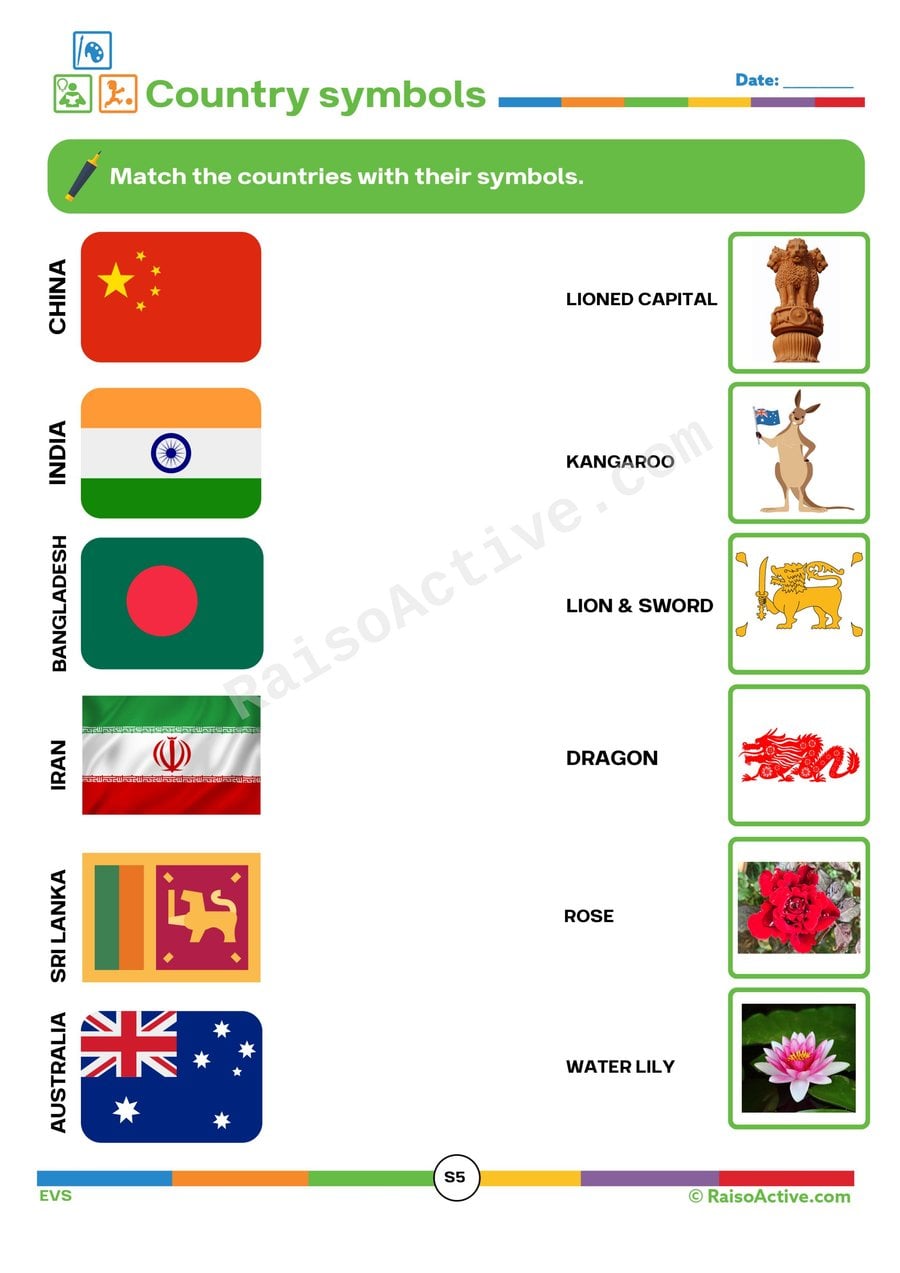
Match the Country Symbols Worksheet for Kids
Ages 4-6 · Pre-K–KindergartenAges 4-6 · Reception–Year 1Ages 4-6 · LKG–UKGAges 4-6
Matching country flags to their national symbols introduces children ages 4-6 to the idea that countries have their own distinct visual identities, an early and engaging entry point into geography and cultural awareness. This matching task builds visual discrimination, since flags and symbols can share similar colors or shapes that require careful comparison. Learning to associate a flag with a symbol also plants early vocabulary for talking about different countries and cultures around the world.
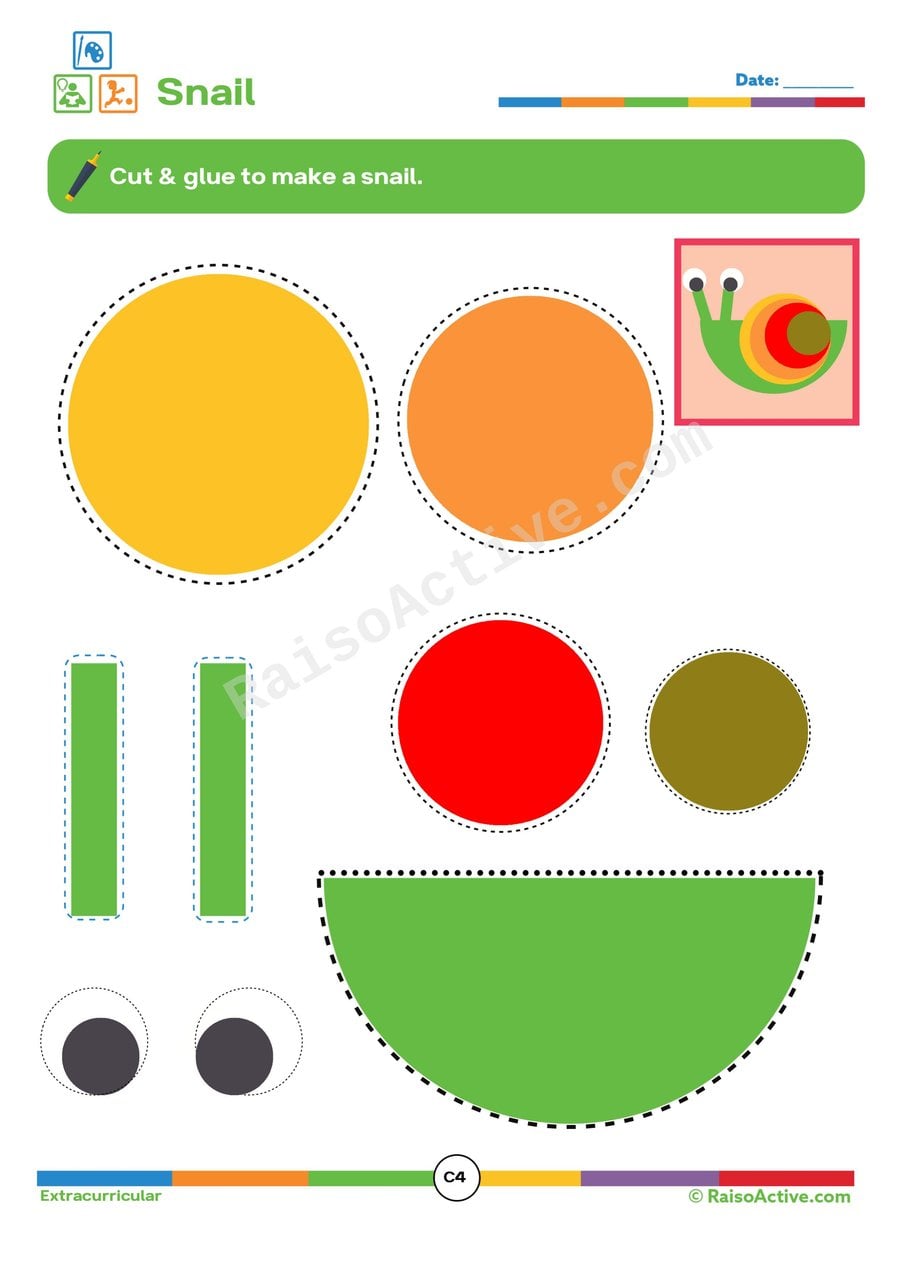
Snail Cut and Glue Worksheet for Preschoolers
Ages 3-5 · Preschool–Pre-KAges 3-5 · Nursery–ReceptionAges 3-5 · Nursery–LKGAges 3-5
Cutting out shapes and gluing them together in a specific arrangement to build a snail gives children ages 3-5 focused practice with scissor control and precise gluing placement, both demanding fine motor tasks at this age. Following a visual example to recreate the snail also builds early spatial reasoning, since children must match the size and position of each piece to the model rather than placing them randomly. This kind of guided craft bridges simple coloring pages and more independent creative projects.
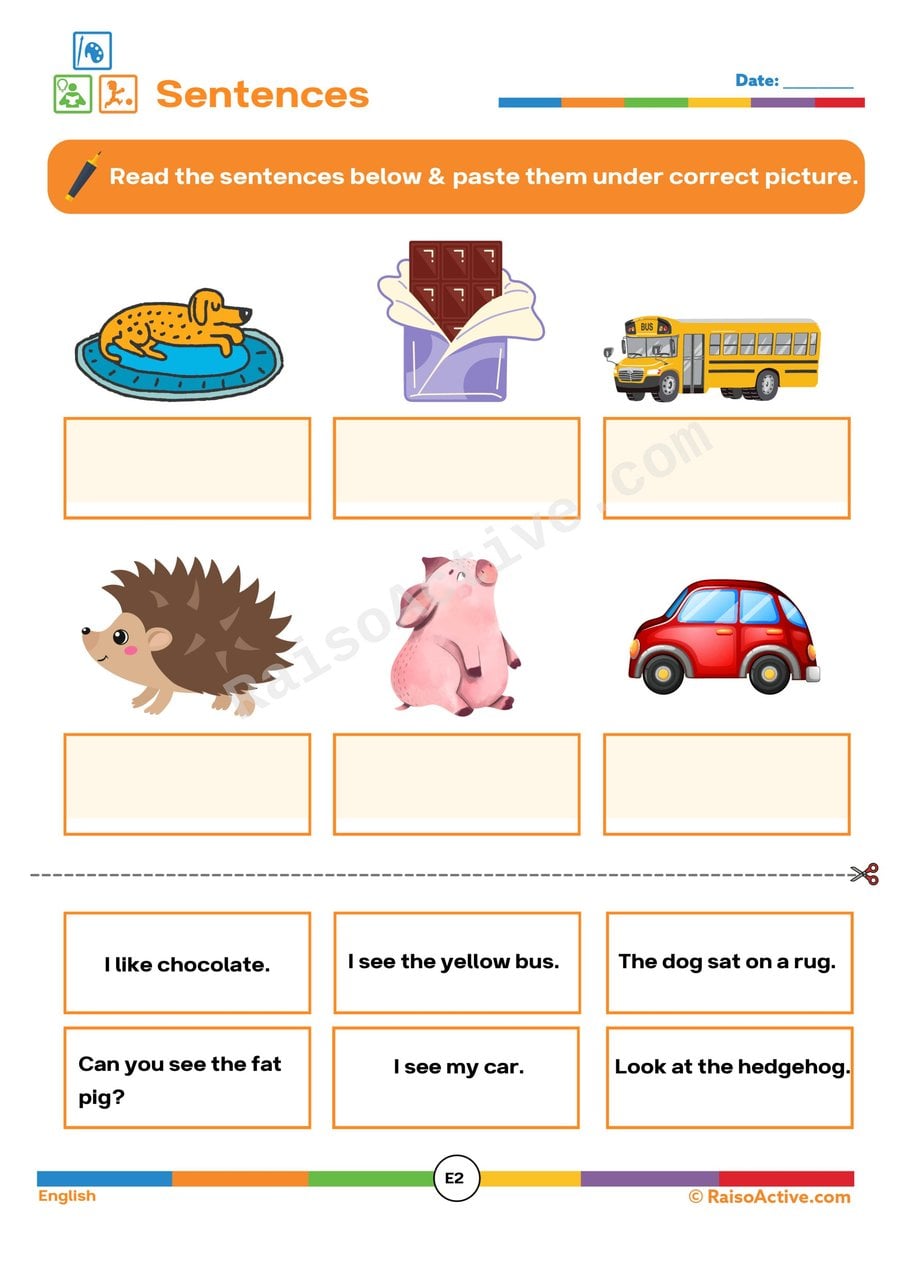
Sentence Matching Worksheet for Early Readers
Ages 4-5 · Pre-KAges 4-5 · ReceptionAges 4-5 · LKGAges 4-5
Matching a written sentence to the picture it describes asks children ages 4-5 to read for meaning rather than just decode individual words, an important step up from single-word reading toward true reading comprehension. This worksheet also builds fine motor and organizational skills through cutting and placing the sentence in the correct spot. Successfully pairing text with image confirms that a child understands what they're reading, not just that they can sound out letters.

Parent's Guide: Fun Activities for Early Learners
Ages 3-5 · Preschool–Pre-KAges 3-5 · Nursery–ReceptionAges 3-5 · Nursery–LKGAges 3-5
This parent's guide offers a set of activities spanning literacy, sequencing, and early addition, giving caregivers several ready-to-use options for building foundational skills through everyday play. For ages 3-5, rotating between different skill areas, like rhyming games and simple math card games, keeps early learning varied and prevents any one skill from feeling repetitive or tedious.

Learn the Sight Word 'Want' Worksheet for Preschoolers
Ages 3-5 · Preschool–Pre-KAges 3-5 · Nursery–ReceptionAges 3-5 · Nursery–LKGAges 3-5
The word 'want' doesn't sound out easily using regular phonics rules, which is exactly why children ages 3-5 need to memorize it by sight as a whole word — a core early reading strategy for high-frequency words. This worksheet builds that sight-word memory through several different tasks: tracing, finding the word among distractors, filling it into a sentence, and reassembling its letters, giving repeated exposure in varied formats rather than one repetitive drill. Mastering common sight words like 'want' dramatically speeds up early reading fluency since these words appear constantly in beginning books.
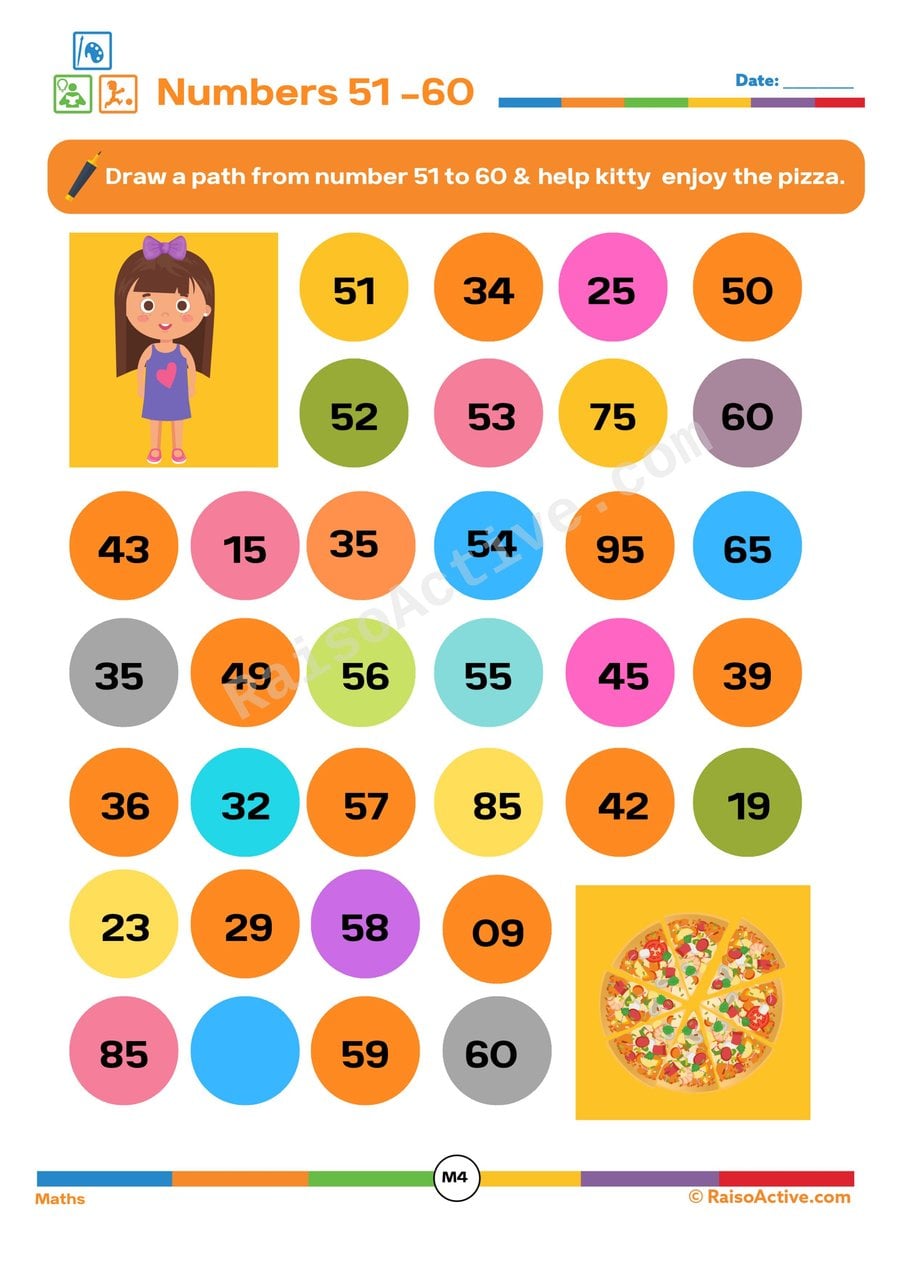
Pizza Path: Numbers 51-60 Worksheet for Kids
Ages 4-5 · Pre-KAges 4-5 · ReceptionAges 4-5 · LKGAges 4-5
Connecting the dots from 51 to 60 in order pushes children ages 4-5 beyond the more familiar 1-20 range, helping them recognize two-digit numbers and understand that counting sequences continue predictably into higher decades. This dot-to-dot format turns number recognition into a rewarding visual payoff, since a hidden pizza picture only appears once every number is found and connected correctly. It's a motivating way to practice number order without it feeling like repetitive drilling.
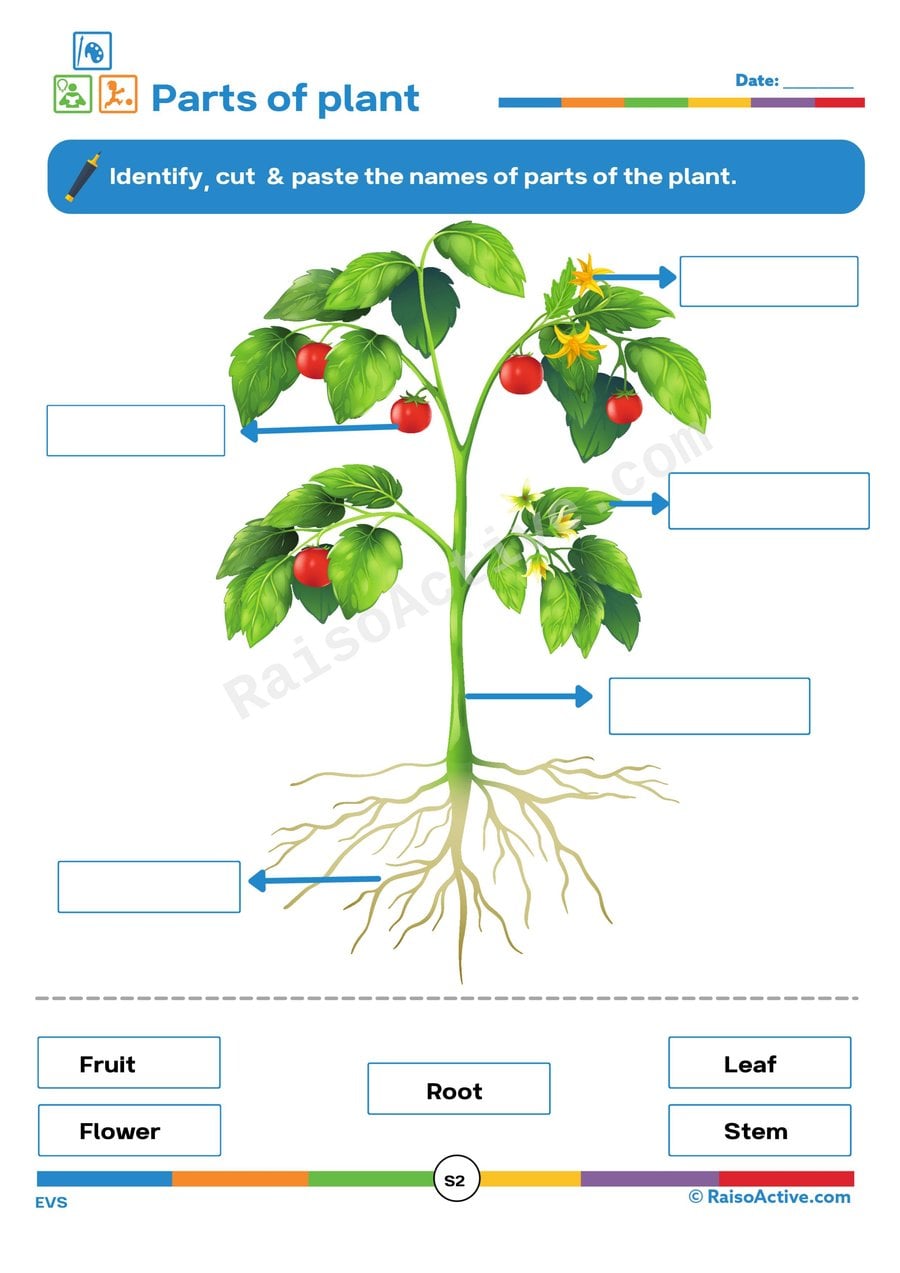
Parts of a Plant Worksheet: Identify and Label!
Ages 3-5 · Preschool–Pre-KAges 3-5 · Nursery–ReceptionAges 3-5 · Nursery–LKGAges 3-5
Labeling the root, stem, leaf, flower, and fruit of a plant teaches children ages 3-5 that living things are made of distinct parts that each serve a purpose, an early foundation for life science. The cut-and-paste labeling format requires children to match a written or pictured label to the correct location on a plant diagram, strengthening both vocabulary and visual mapping skills. Understanding plant anatomy also gives children language to describe the gardens, parks, and plants they encounter in daily life.

Roll & Move Activity: Fun Physical Activity Cube for Kids!
Ages 3-5 · Preschool–Pre-KAges 3-5 · Nursery–ReceptionAges 3-5 · Nursery–LKGAges 3-5
This cut-and-fold craft combines fine motor skills with gross motor movement, as children build a paper cube featuring different physical actions and then roll it to determine which activity to perform. For ages 3-5, following multi-step folding and gluing instructions builds spatial reasoning and sequencing, while the resulting game encourages active movement and following simple rules.
Related worksheets

Sentence Sorting Fun: Speak Sentences with Words! (Ages 3-5)
Ages 3-5 · Preschool–Pre-KAges 3-5 · Nursery–ReceptionAges 3-5 · Nursery–LKGAges 3-5
This worksheet builds oral sentence construction for children ages 3-5 by having them place a cutout Pacman piece on a word and then speak a full sentence using that word aloud. Because the task requires generating spoken language on the spot rather than selecting a pre-written answer, it strengthens expressive vocabulary and sentence-building skills in a playful, low-pressure format.

My Name is: Sentence Building Worksheet for Early Learners
Ages 3-5 · Preschool–Pre-KAges 3-5 · Nursery–ReceptionAges 3-5 · Nursery–LKGAges 3-5
This sentence-building activity asks children ages 3-5 to cut apart puzzle pieces of words and arrange them in the correct order to form a complete sentence, giving hands-on practice with sentence structure before they write full sentences independently. Physically manipulating word pieces lets children experiment with word order and self-correct by reading the sentence aloud, which is more forgiving than committing straight to writing. Copying the assembled sentence onto lines afterward then bridges the gap from arranging words to writing them from scratch.

Capitalization Worksheet: Practice Writing Sentences Correctly!
Ages 4-6 · Pre-K–KindergartenAges 4-6 · Reception–Year 1Ages 4-6 · LKG–UKGAges 4-6
This worksheet teaches children ages 4-6 the rule that sentences begin with a capital letter, along with an introduction to capitalizing proper nouns like names and places. Rewriting sentences correctly, rather than just circling errors, gives children active practice applying the capitalization rule themselves, which builds the habit more effectively than passive correction exercises.

Words Worksheet: Unscramble, Capitalize, and Choose the Best Word!
Ages 4-6 · Pre-K–KindergartenAges 4-6 · Reception–Year 1Ages 4-6 · LKG–UKGAges 4-6
This multi-part worksheet challenges children ages 4-6 to unscramble jumbled letters into real words, identify correctly capitalized sentences, and choose the most fitting word to complete a sentence. Combining these three tasks on one page builds spelling, sentence-level grammar awareness, and vocabulary precision together, pushing children to apply several early literacy skills in a single sitting rather than practicing them in isolation.
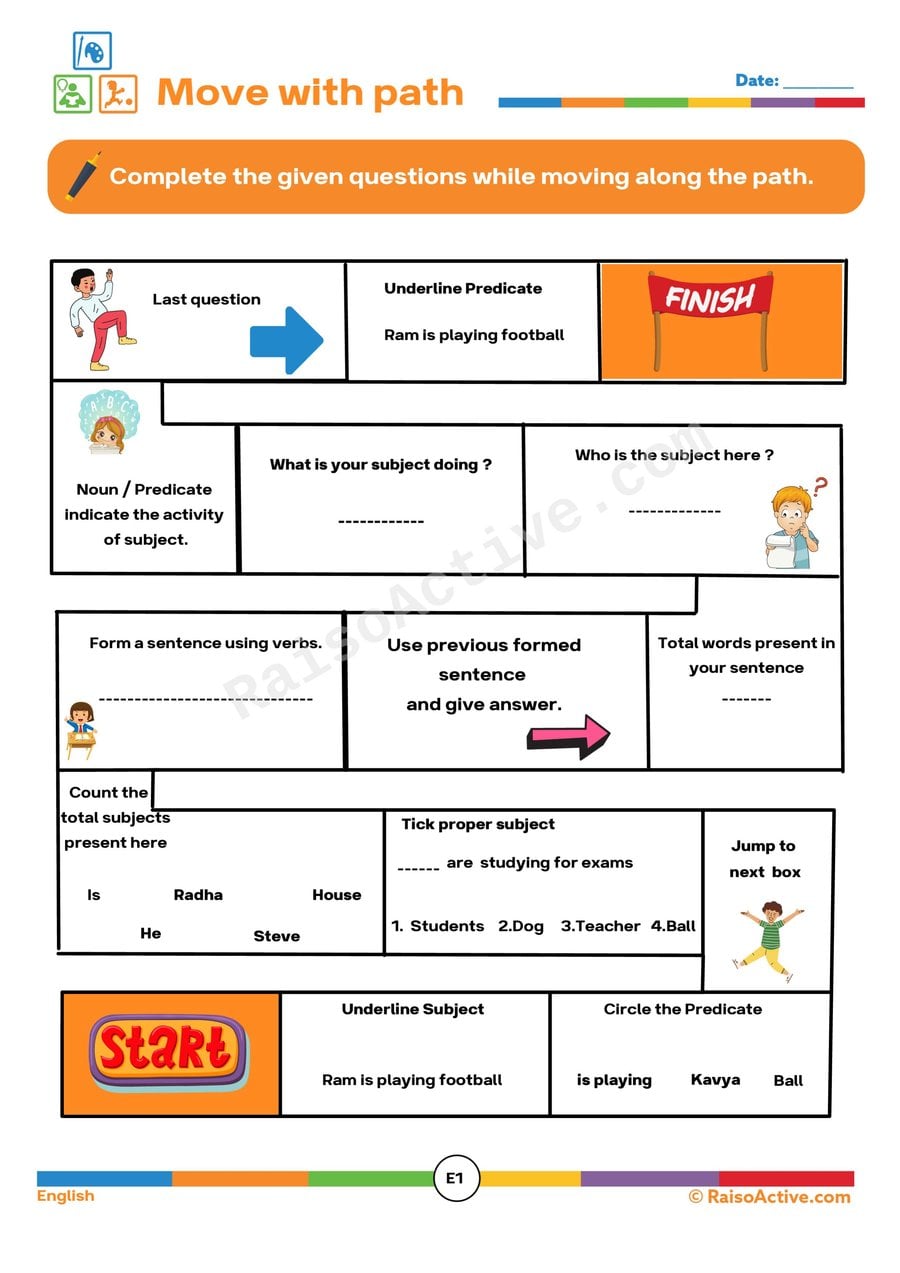
Move with Path Worksheet: Sentence Structure Fun!
Ages 4-6 · Pre-K–KindergartenAges 4-6 · Reception–Year 1Ages 4-6 · LKG–UKGAges 4-6
This path-based activity teaches children ages 4-6 the basic building blocks of a sentence — subject and predicate — by having them move through a series of boxes, underlining predicates and identifying subjects along the way. Framing grammar as a physical path to follow makes an abstract concept more concrete for early learners. By the end, children practice not just identifying sentence parts but also constructing new sentences of their own, moving from recognition to active use.

Punctuation Practice Worksheet for Early Learners
Ages 4-6 · Pre-K–KindergartenAges 4-6 · Reception–Year 1Ages 4-6 · LKG–UKGAges 4-6
Children ages 4-6 learn to distinguish between statements and questions by deciding whether each sentence needs a period or a question mark, an early step in understanding how punctuation changes meaning and tone. Recognizing the difference between a question and a statement also supports reading fluency, since readers naturally use rising or falling intonation depending on the punctuation at the end of a sentence.
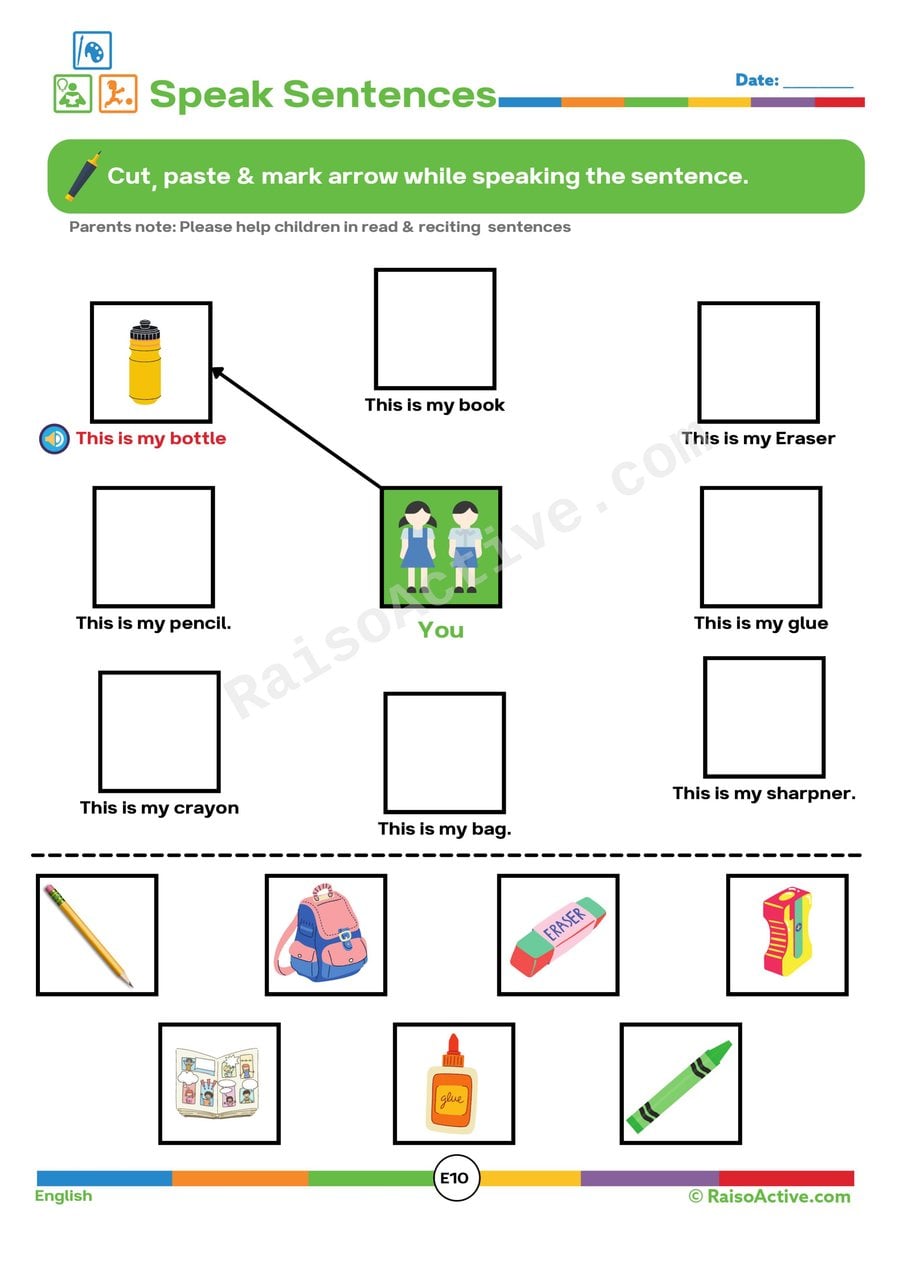
Speak Sentences Worksheet: Cut, Paste, and Match!
Ages 3-5 · Preschool–Pre-KAges 3-5 · Nursery–ReceptionAges 3-5 · Nursery–LKGAges 3-5
Children ages 3-5 practice matching spoken sentence meaning to pictures by cutting out images and pasting them next to the correct simple sentence, building early reading comprehension. This task requires connecting written or read-aloud words to real-world meaning, a critical step before children can read independently for understanding. The cutting and pasting also continues building the fine motor precision needed for handwriting and other classroom tasks.
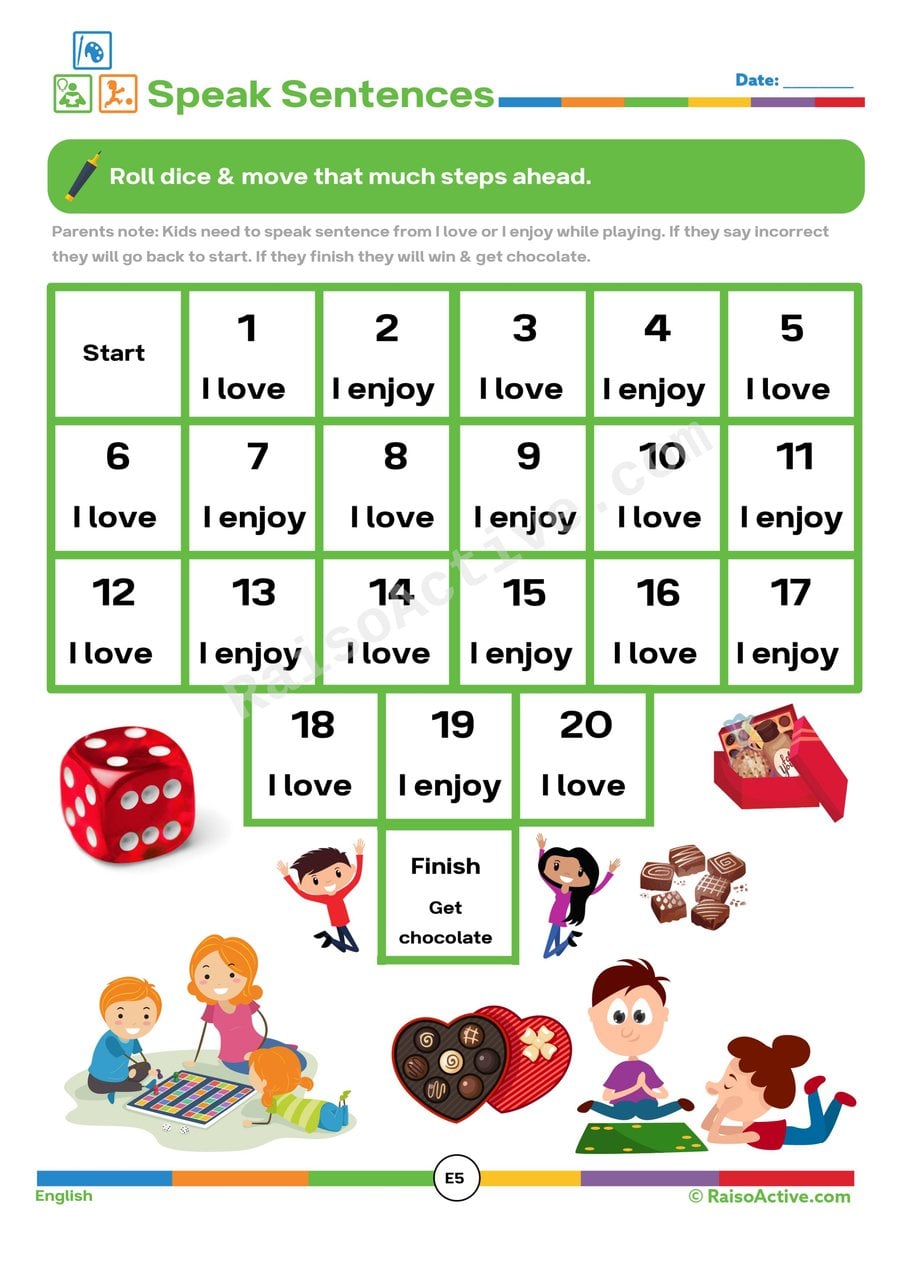
I Love or I Enjoy Sentences Worksheet for Kids
Ages 3-5 · Preschool–Pre-KAges 3-5 · Nursery–ReceptionAges 3-5 · Nursery–LKGAges 3-5
This board-game-style worksheet helps children ages 3-5 practice building and speaking simple sentences using the openers 'I love' or 'I enjoy', an early step toward oral sentence construction that later supports writing. Rolling a dice and moving along a path adds a playful, low-pressure format to what is otherwise a speaking exercise, keeping young children motivated through repetition. Saying a full sentence aloud, rather than just a single word, helps children practice sequencing subject, verb, and object in the correct order.
Guides for this topic

Documenting Learning Without Drowning in Data: A Practical Guide for Parents and Teachers
Learn practical ways to document your child's learning without overwhelm. Simple portfolios, observation tips, and printable trackers for ages 1-8.

How to Help Your Child with Letter Reversals: A Complete Guide for Parents and Teachers
Letter reversals are normal until age 7-8. Learn the best multisensory strategies, anchor letter tricks, and activities to help children write b, d, p, and q correctly.

Activities That Help with Pencil Grip Development: A Complete Guide for Parents and Teachers
Discover fun, research-backed activities to develop pencil grip in young children. Age-wise exercises, play ideas, and expert tips for parents and teachers.
Reviews
Every worksheet for ages 4–5, no watermark
Members download the full library of 1,000+ worksheets and every activity pack without watermarks or daily limits. One year costs ₹999 in India or $20 elsewhere.
See membership plansOr download any worksheet free with a watermark (5 a day).