Prepositions Worksheet: Where Are the Cats?
This worksheet helps children ages 3-5 learn positional prepositions — words like 'under,' 'on,' 'behind,' and 'in' — by matching each word to a picture showing exactly where a cat is located. Understanding these small but essential words builds spatial vocabulary and comprehension skills that are used constantly in both everyday instructions and later reading comprehension.
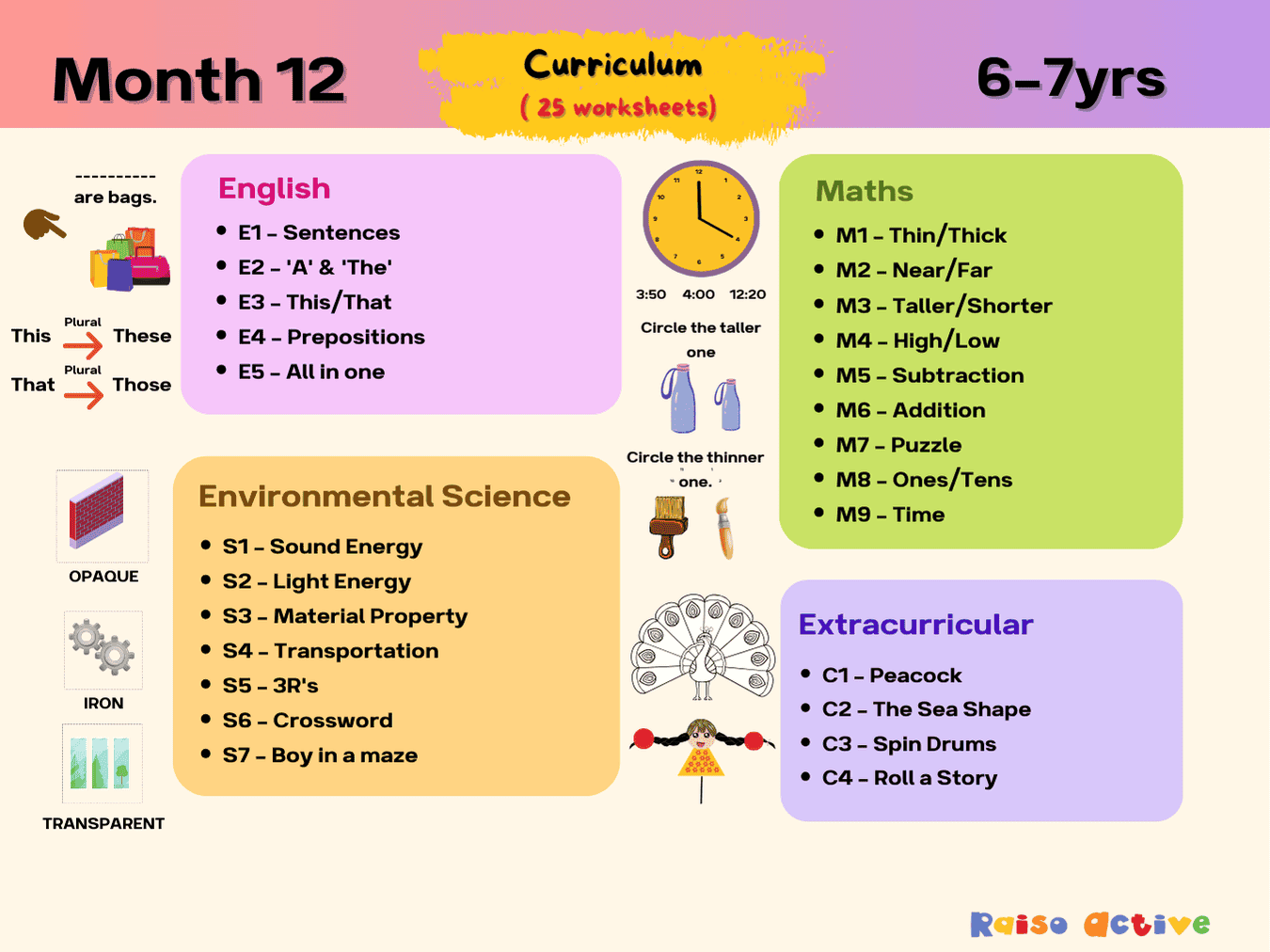
Part of the pack
Month 12: Learning & Development | Ages 6-7
This is page 7 of the pack. Ages 6-7 · Grade 1Ages 6-7 · Year 2Ages 6-7 · Class 1Ages 6-7
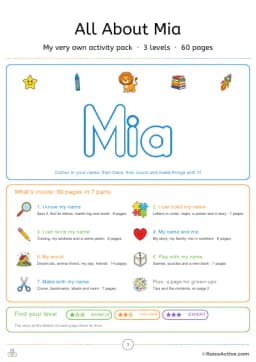
Made for your child
A whole activity pack made with their name
60 pages to spot, build, trace and write their own name, plus pages about their favourites, feelings and family. See a free preview with their name.
Make an All About Me packFree preview · free for members
Or start free: a name tracing sheet with their nameCurriculum
- Grammar > Prepositions
How to use this worksheet
Look at the picture of the cat in a particular position and the list of preposition word choices together. Ask your child to describe where the cat is in their own words first, then compare that description to the word options given. Have them write the number matching the correct preposition in the circle next to the picture. Continue through each picture the same way, saying the full sentence aloud, like 'the cat is under the table,' once each answer is chosen.
Materials needed
- Pencil
Extension activities
- 1Have your child create their own sentences describing where objects are using prepositions.
- 2Use a small toy and different household objects to physically act out each preposition, like putting the toy 'behind' a cushion.
- 3Play a game of 'Simon Says' using positional instructions, like 'stand behind the chair.'
- 4Look through a picture book and describe where different characters or objects are using prepositions.

Written by
Hemsweta Jain · Teacher Cheena
MBA and Early Childhood Educator, teaching since 2014 · Founder of RaisoActive, Mumbai
Every RaisoActive worksheet is designed and checked by the founder before publishing.
Published · Last reviewed
More from Month 12: Learning & Development | Ages 6-7

Subtraction Adventure: A Fun Math Worksheet for Kids!
Ages 4-6 · Pre-K–KindergartenAges 4-6 · Reception–Year 1Ages 4-6 · LKG–UKGAges 4-6
This worksheet gives children ages 4-6 varied practice with basic subtraction by solving simple equations across several different boxes, each with its own themed instruction to follow, like circling remaining items. Mixing subtraction problems with small follow-up tasks keeps the page engaging while reinforcing that subtraction means finding what's left after some amount is taken away.

Roll a Story Worksheet: Create Fun Stories with Dice!
Ages 4-7 · Pre-K–Grade 1Ages 4-7 · Reception–Year 2Ages 4-7 · LKG–Class 1Ages 4-7
This dice-based storytelling worksheet helps children ages 4-7 practice narrative construction by rolling dice to randomly select a character, setting, and prop, then weaving those elements into an original story. Because the combination is different every time, children must think flexibly and creatively rather than relying on a memorized story, which builds oral language, sequencing, and imaginative reasoning skills that underpin later creative writing.
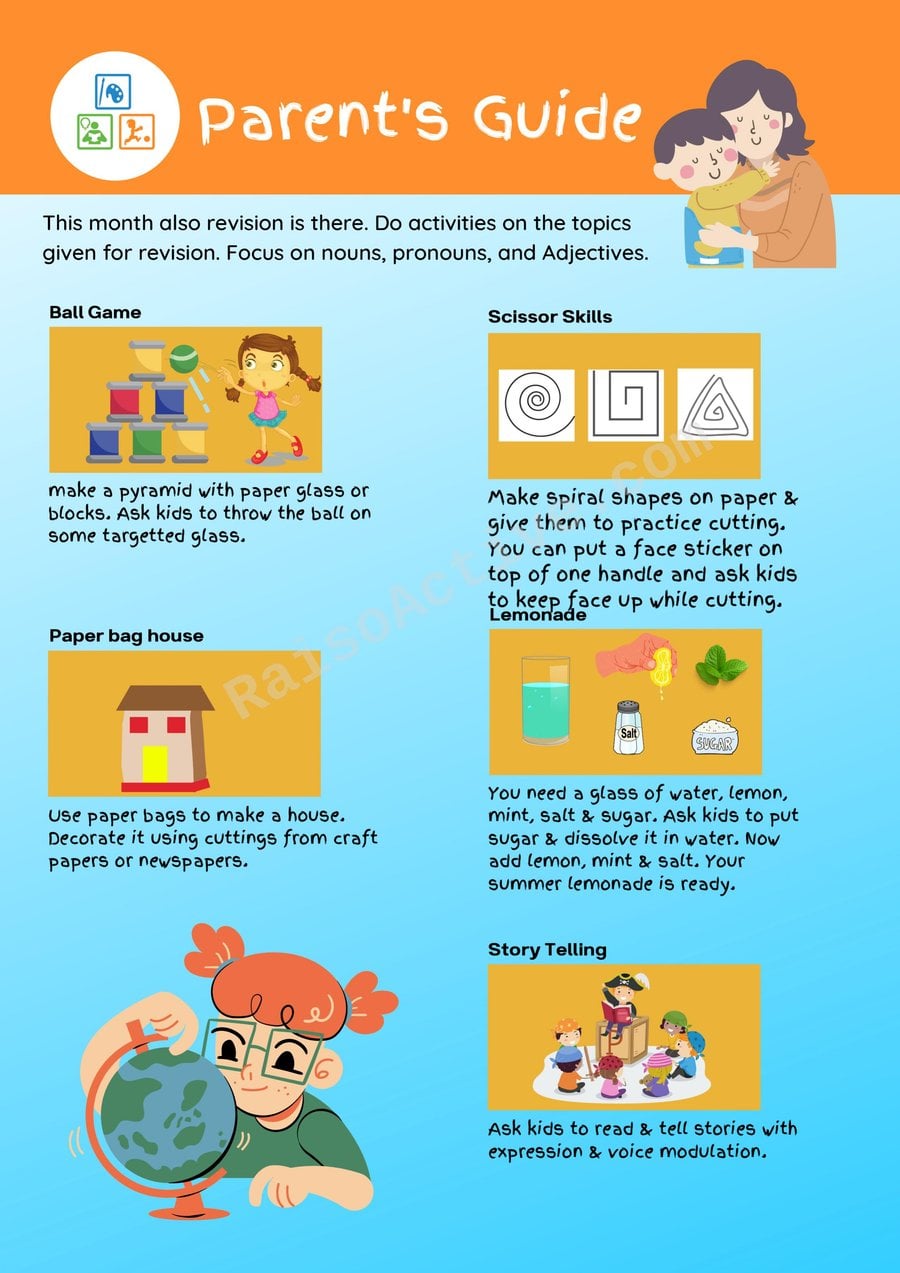
Parent's Guide: Fun Activities for Preschoolers!
Ages 3-5 · Preschool–Pre-KAges 3-5 · Nursery–ReceptionAges 3-5 · Nursery–LKGAges 3-5
This parent's guide offers a set of hands-on activities for children ages 3-5 that build early grammar awareness — recognizing nouns, pronouns, and adjectives — through play-based games and simple crafts rather than worksheets alone. Embedding grammar into games and sensory activities like lemonade-making keeps abstract language concepts concrete and memorable for young children.
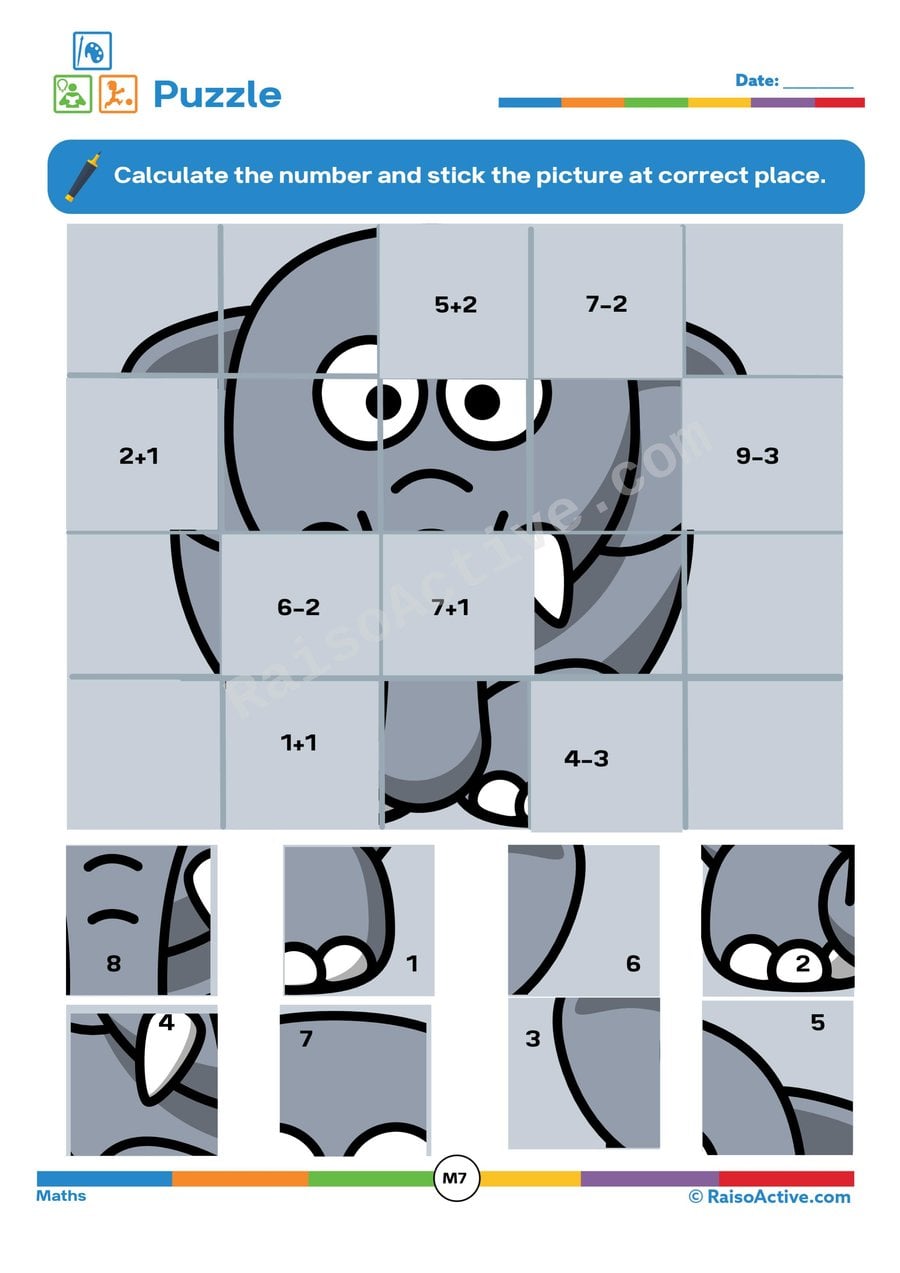
Elephant Puzzle: Math Worksheet for Preschoolers
Ages 4-5 · Pre-KAges 4-5 · ReceptionAges 4-5 · LKGAges 4-5
Children ages 4-5 practice solving simple addition problems and then use those answers to solve a picture puzzle, matching each answer to the correct puzzle piece to complete an elephant. This turns basic addition fact practice into a satisfying hands-on challenge with a visual reward at the end.
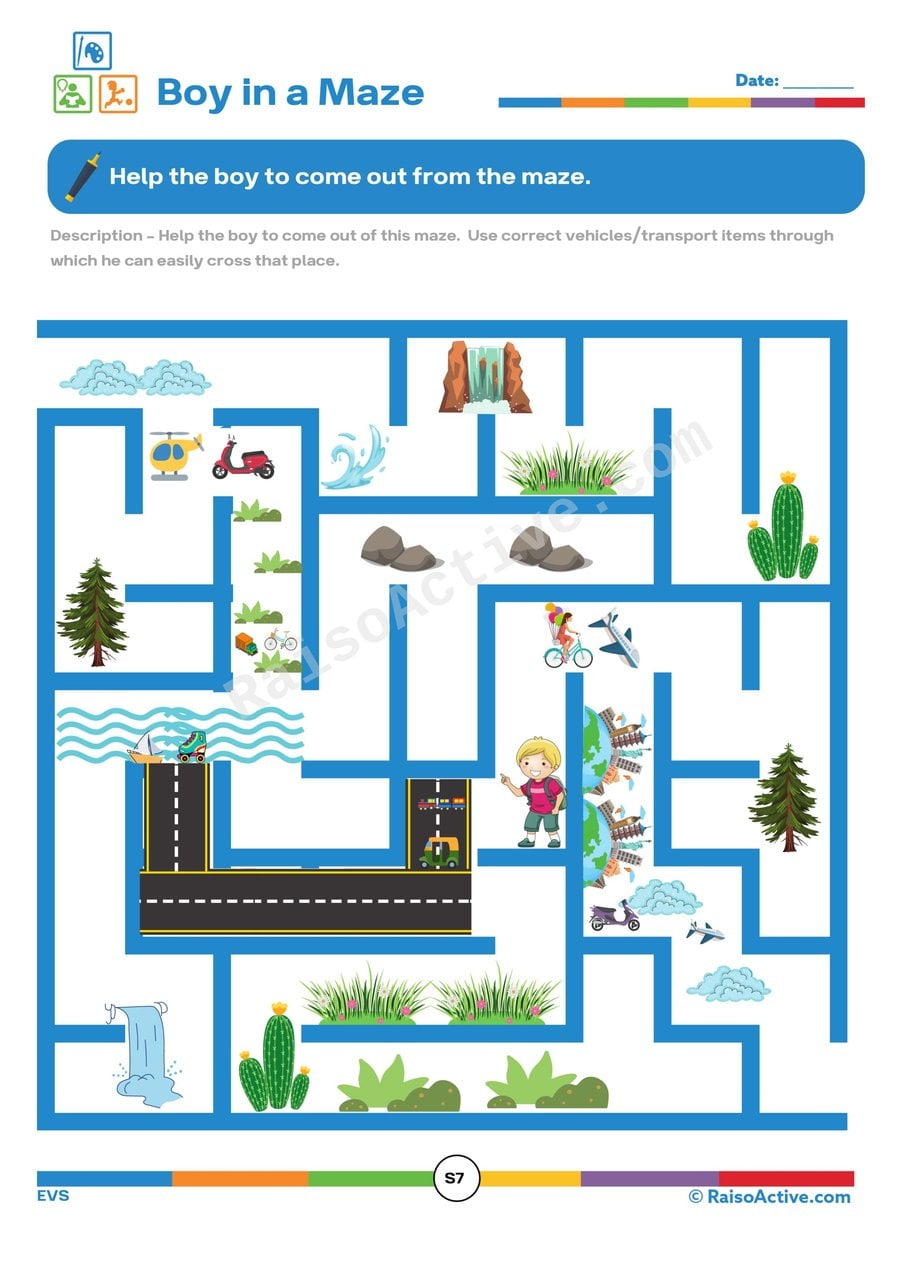
Help the Boy Escape the Maze Worksheet
Ages 3-5 · Preschool–Pre-KAges 3-5 · Nursery–ReceptionAges 3-5 · Nursery–LKGAges 3-5
This maze worksheet builds visual tracking, planning, and fine motor control as children ages 3-5 trace a path for a boy to escape, using different vehicles to get past obstacles along the way. Scanning ahead to choose a workable route before committing to a path develops early problem-solving and forward-planning skills, while the pencil control needed to stay within the maze lines strengthens hand strength for later handwriting.

All in One Worksheet: Following Instructions and Sentence Building
Ages 4-6 · Pre-K–KindergartenAges 4-6 · Reception–Year 1Ages 4-6 · LKG–UKGAges 4-6
Children ages 4-6 practice reading and following short written instructions across several small tasks while also building basic sentence construction skills, combining early reading comprehension with beginning grammar practice. Learning to read a direction and complete exactly what it asks is a skill that carries directly into classroom worksheets and tests.
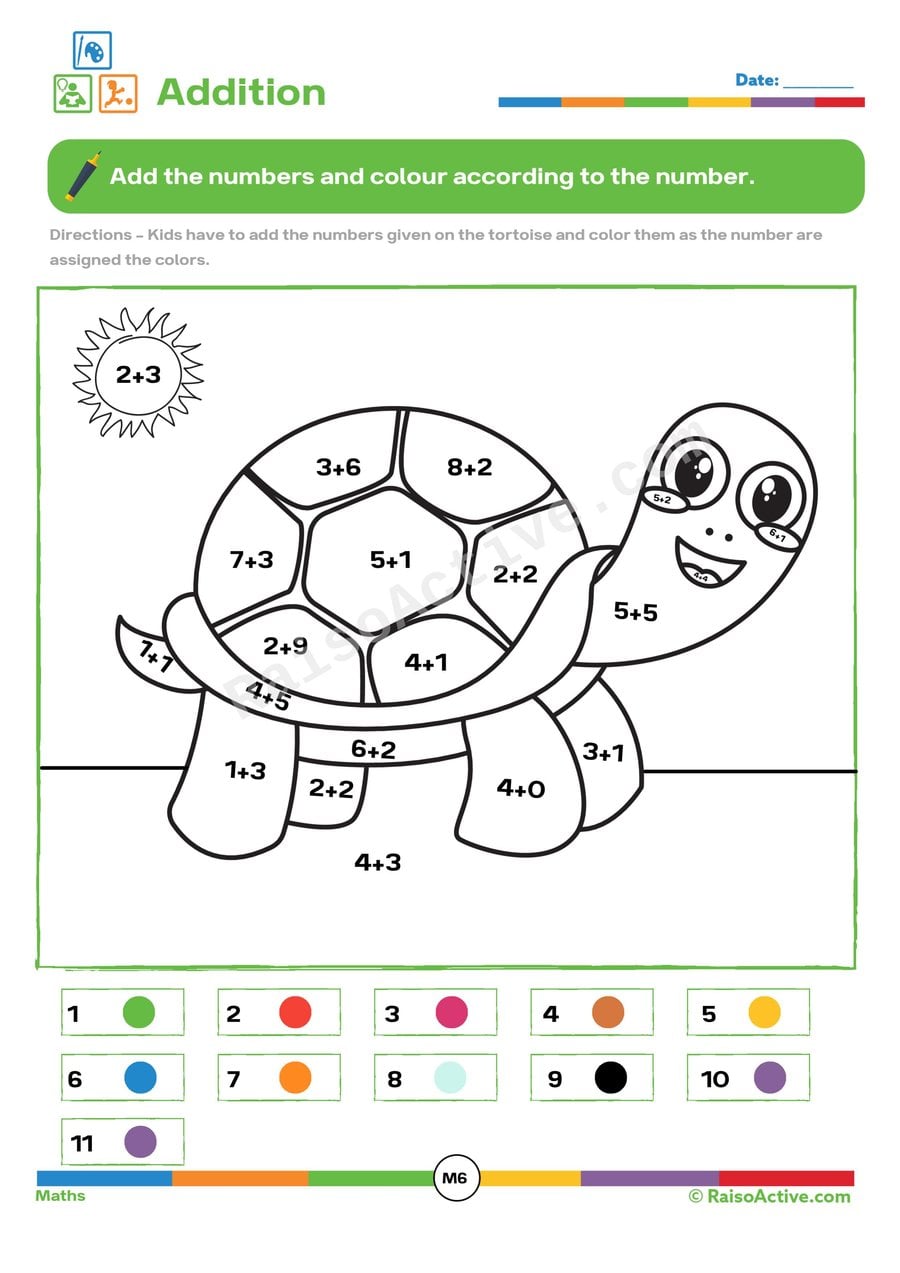
Color by Number Addition Worksheet: The Turtle!
Ages 4-6 · Pre-K–KindergartenAges 4-6 · Reception–Year 1Ages 4-6 · LKG–UKGAges 4-6
Children ages 4-6 practice single-digit addition facts and then apply a color key to their answers, combining math fluency with careful visual matching as the turtle picture is revealed. The immediate visual payoff of a colored picture gives children a clear, motivating way to check whether their addition was correct.

Thin vs. Thick Worksheet: Circle the Thinner and Thicker Objects!
Ages 3-5 · Preschool–Pre-KAges 3-5 · Nursery–ReceptionAges 3-5 · Nursery–LKGAges 3-5
This worksheet develops early measurement vocabulary as children ages 3-5 compare pairs of objects and decide which is thinner or thicker. Because thickness must be judged visually rather than counted, this task sharpens visual discrimination and comparative reasoning — skills that later support understanding of size, width, and other measurement concepts. Circling the correct object also reinforces the vocabulary words 'thin' and 'thick' through repeated, hands-on use.
Related worksheets
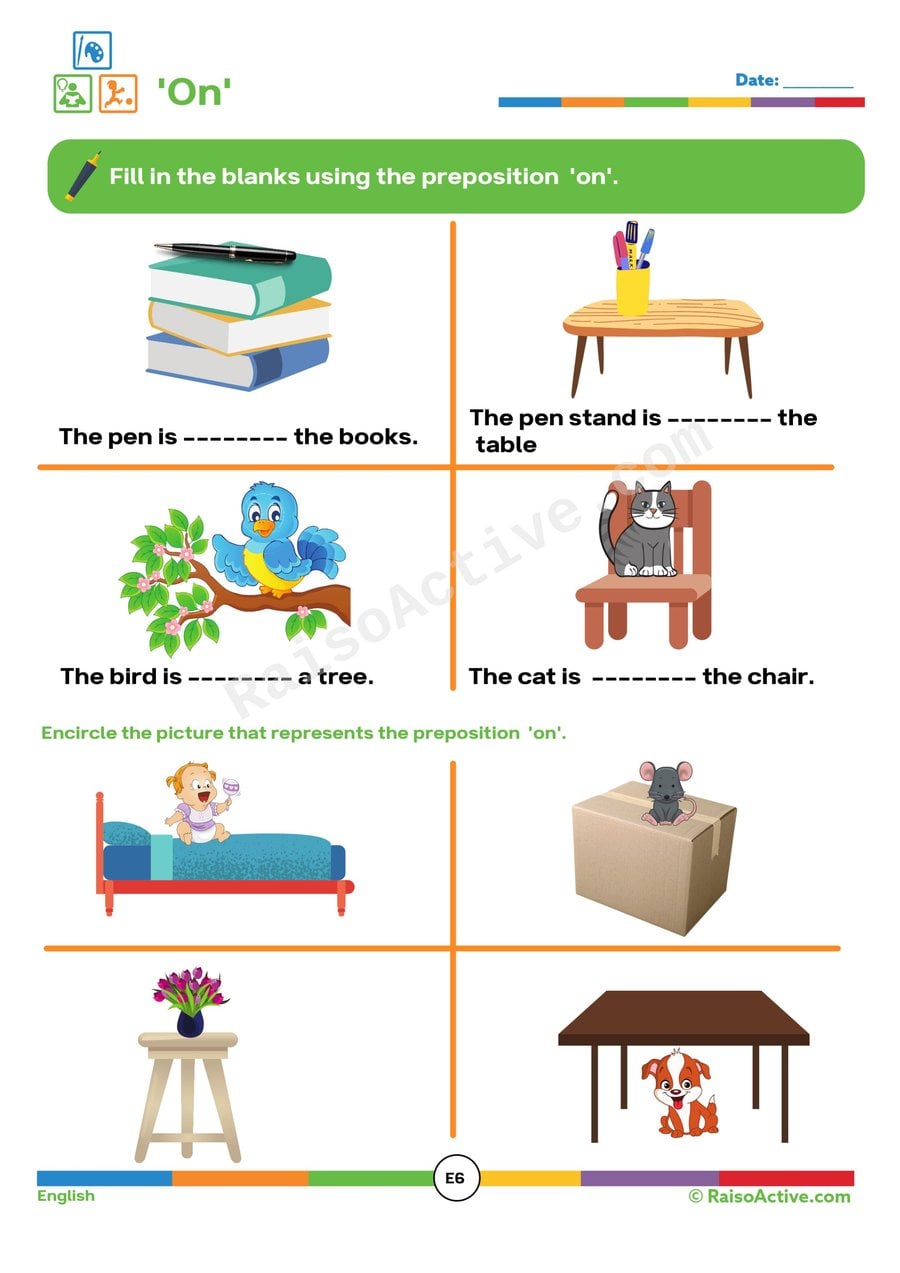
Preposition Fun: 'On' Worksheet for Early Learners
Ages 3-5 · Preschool–Pre-KAges 3-5 · Nursery–ReceptionAges 3-5 · Nursery–LKGAges 3-5
Practicing the preposition 'on' teaches children ages 3-5 how a small function word can precisely describe where one object sits in relation to another, an early and important step in building more complex, descriptive sentences. Filling in the blank with 'on' repeatedly across different sentences helps the word become automatic rather than something they have to think hard about each time. Circling the picture that correctly shows something 'on' another object also checks that your child truly understands the spatial meaning, not just the spelling of the word.

Preposition Worksheet: Identifying Where Things Are!
Ages 3-5 · Preschool–Pre-KAges 3-5 · Nursery–ReceptionAges 3-5 · Nursery–LKGAges 3-5
This worksheet asks children to identify the correct preposition, words like 'in,' 'on,' 'under,' or 'behind', that describes where an object is located in a picture, building spatial vocabulary that supports both everyday communication and following multi-step instructions. For ages three to five, prepositions are often used correctly in speech before children can identify them on paper, so this worksheet helps make that intuitive knowledge explicit.
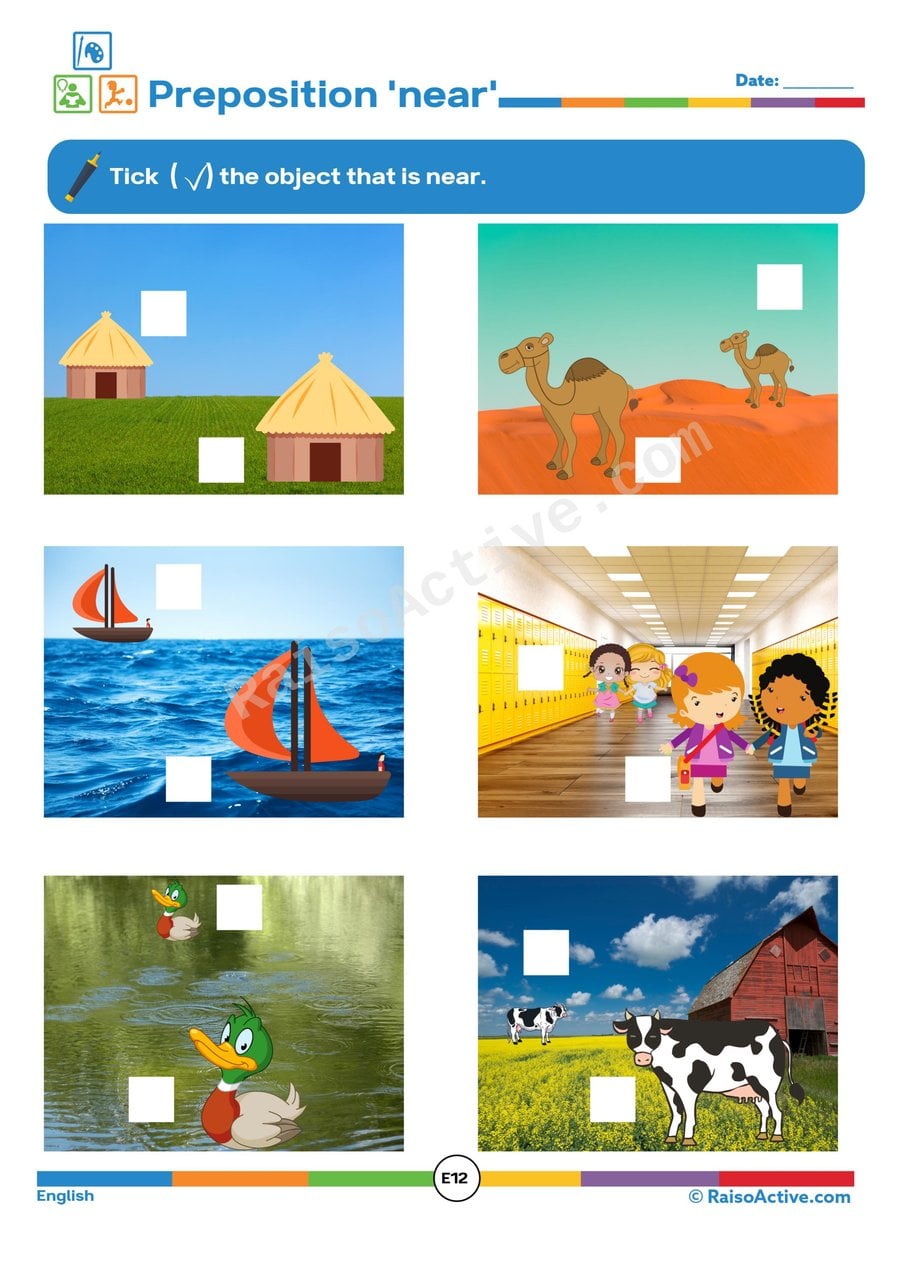
Near or Far? Preposition Worksheet for Kids
Ages 3-5 · Preschool–Pre-KAges 3-5 · Nursery–ReceptionAges 3-5 · Nursery–LKGAges 3-5
Preschoolers ages 3-5 build early spatial vocabulary by identifying which pictured object is positioned 'near' another, a comparative concept that requires judging relative distance between two things. Understanding 'near' versus 'far' lays groundwork for later spatial reasoning skills, like following directions and reading simple maps. Ticking the correct object also sharpens visual comparison and careful observation.
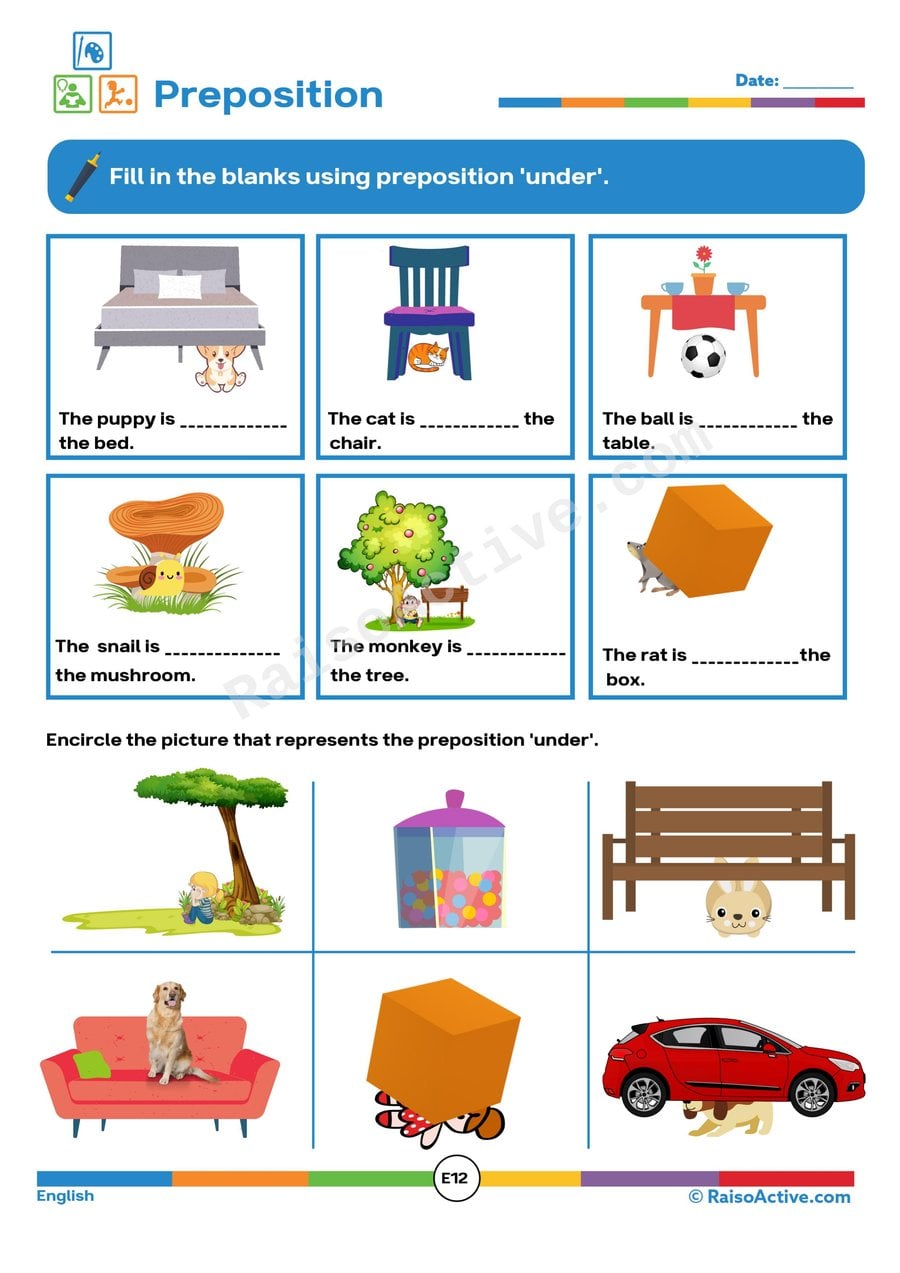
Preposition 'Under' Worksheet: Fun with Placement!
Ages 3-5 · Preschool–Pre-KAges 3-5 · Nursery–ReceptionAges 3-5 · Nursery–LKGAges 3-5
Practicing the preposition 'under' teaches children ages 3-5 to describe spatial relationships between objects, an early grammar concept closely tied to their developing understanding of physical space. Filling in the blank and then identifying pictures that show something under another object reinforces the word's meaning through both language and visual recognition.

Preposition Worksheet: Circle the Correct Position!
Ages 3-5 · Preschool–Pre-KAges 3-5 · Nursery–ReceptionAges 3-5 · Nursery–LKGAges 3-5
Children ages 3-5 practice identifying prepositions like 'in,' 'on,' and 'under' by looking at a picture and circling the word that correctly describes where an object is positioned. This builds early spatial vocabulary that children use constantly in everyday communication, from describing where a toy is to following directions.
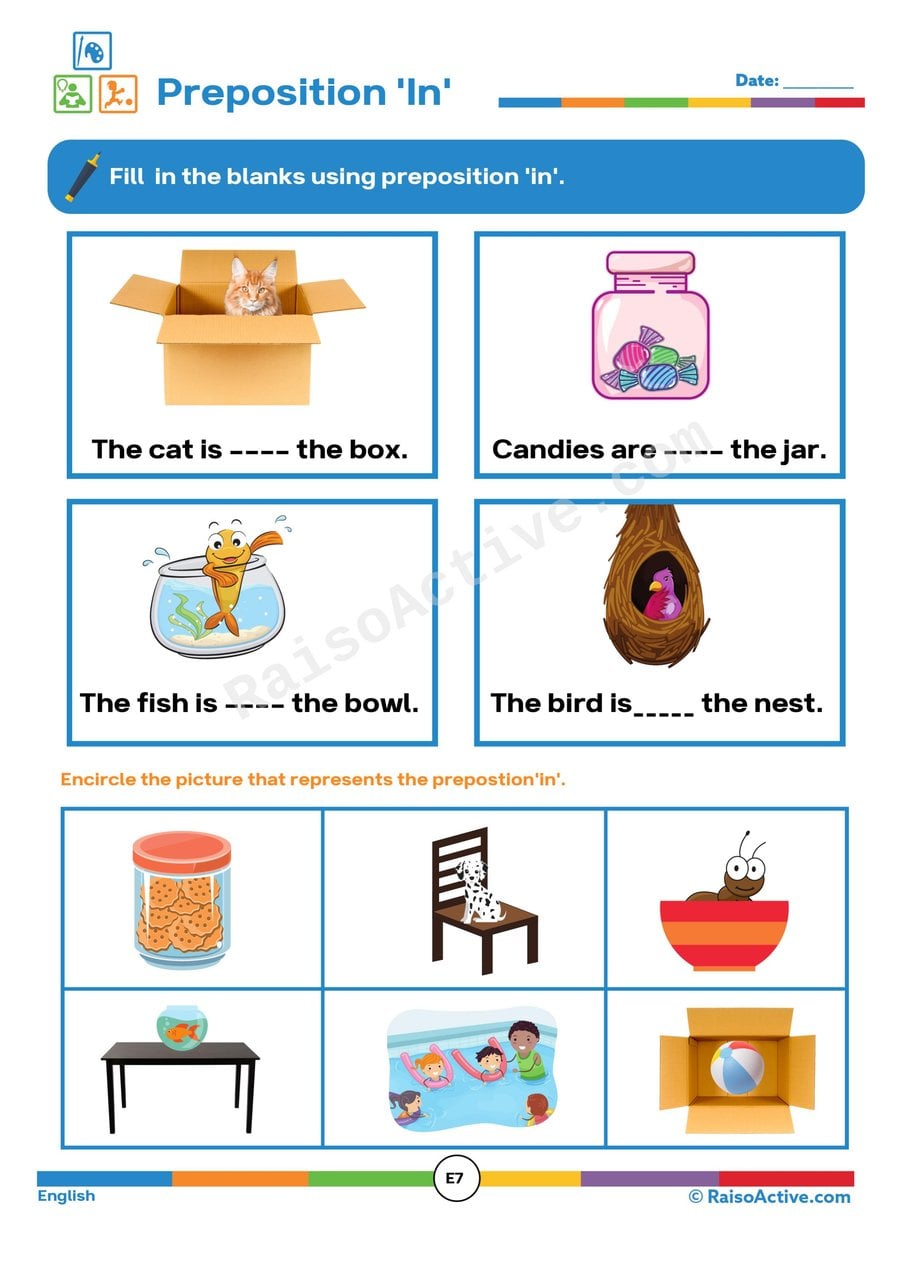
Preposition 'In' Worksheet: Fill-in-the-Blanks Fun!
Ages 4-6 · Pre-K–KindergartenAges 4-6 · Reception–Year 1Ages 4-6 · LKG–UKGAges 4-6
This worksheet introduces the preposition 'in' as a specific positional word describing something located inside another object, building both grammar knowledge and spatial vocabulary. For ages 4-6, understanding prepositions like 'in' is essential for constructing clear, descriptive sentences and following spatial directions in everyday life.

Christmas Fill-in-the-Blanks Worksheet for Preschoolers
Ages 3-5 · Preschool–Pre-KAges 3-5 · Nursery–ReceptionAges 3-5 · Nursery–LKGAges 3-5
Filling in missing letters of Christmas words like 'S_ _W' or 'TR_ _' helps children ages 3-5 connect letter sounds to their written form, an essential early step toward independent spelling. Using the accompanying picture as a clue also teaches them to cross-check visual and phonetic information — a strategy they'll rely on throughout early reading.
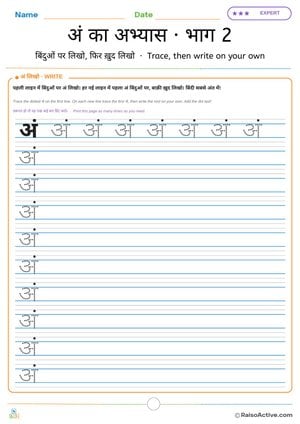
Hindi Letter अं (am) Practice 2: Trace, then Write on Your Own | अं का अभ्यास · भाग 2
Ages 5-7 · Kindergarten–Grade 1Ages 5-7 · Year 1–Year 2Ages 5-7 · UKG–Class 1Ages 5-7
An expert page for confident writers: trace the dotted अं on the first line, then on each new line trace the first अं and write the rest on your own, adding the dot last.
Guides for this topic

Documenting Learning Without Drowning in Data: A Practical Guide for Parents and Teachers
Learn practical ways to document your child's learning without overwhelm. Simple portfolios, observation tips, and printable trackers for ages 1-8.

How to Help Your Child with Letter Reversals: A Complete Guide for Parents and Teachers
Letter reversals are normal until age 7-8. Learn the best multisensory strategies, anchor letter tricks, and activities to help children write b, d, p, and q correctly.

Activities That Help with Pencil Grip Development: A Complete Guide for Parents and Teachers
Discover fun, research-backed activities to develop pencil grip in young children. Age-wise exercises, play ideas, and expert tips for parents and teachers.
Reviews
Every worksheet for ages 3–5, no watermark
Members download the full library of 1,000+ worksheets and every activity pack without watermarks or daily limits. One year costs ₹999 in India or $20 elsewhere.
See membership plansOr download any worksheet free with a watermark (5 a day).