Thin vs. Thick Worksheet: Circle the Thinner and Thicker Objects!
This worksheet develops early measurement vocabulary as children ages 3-5 compare pairs of objects and decide which is thinner or thicker. Because thickness must be judged visually rather than counted, this task sharpens visual discrimination and comparative reasoning — skills that later support understanding of size, width, and other measurement concepts. Circling the correct object also reinforces the vocabulary words 'thin' and 'thick' through repeated, hands-on use.
Part of the pack
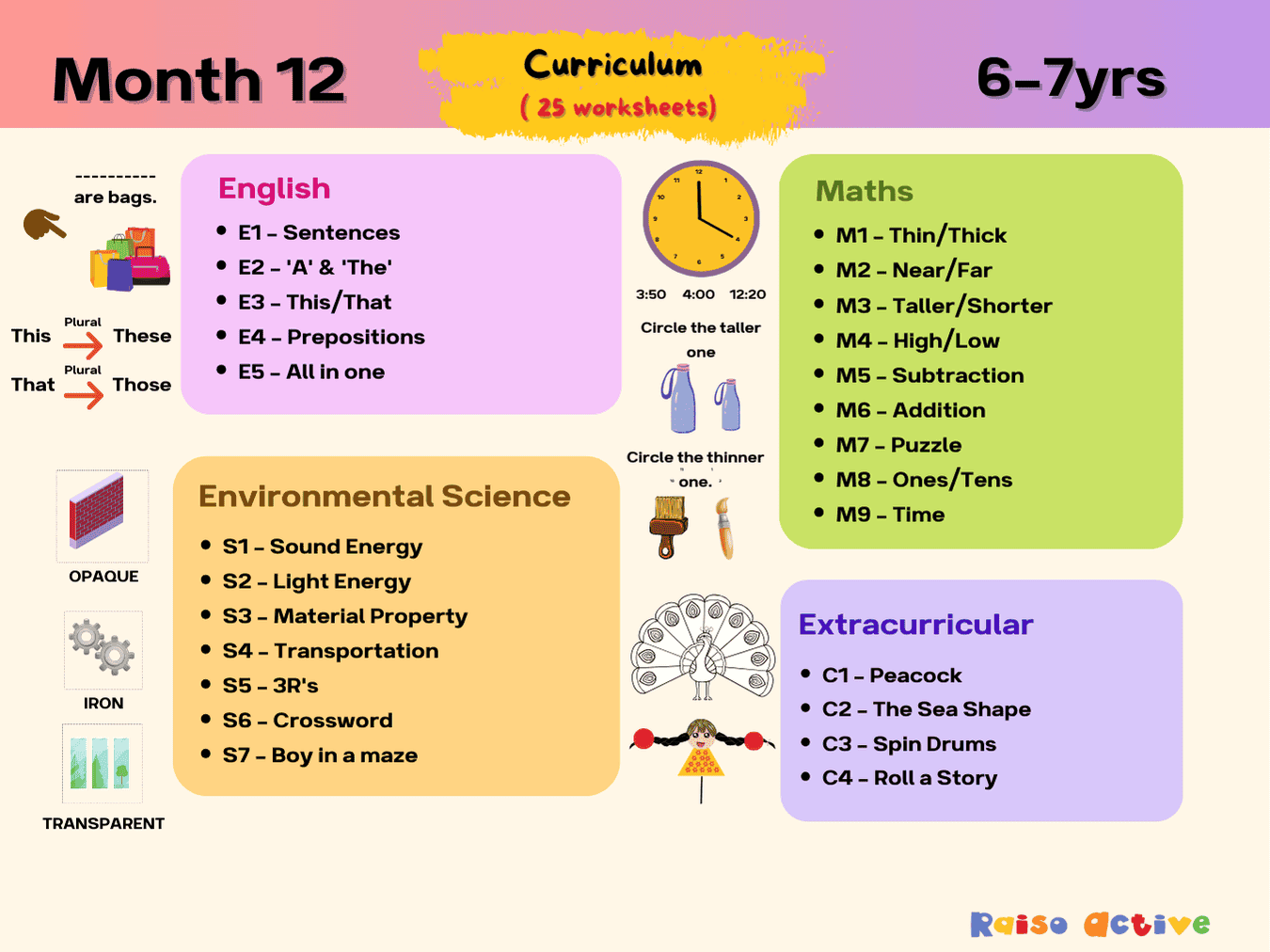
Month 12: Learning & Development | Ages 6-7
This is page 9 of the pack. Ages 6-7 · Grade 1Ages 6-7 · Year 2Ages 6-7 · Class 1Ages 6-7
Made for your child
Counting to 10, made for your child
A maths pack with your child's name in it: pictures that explain, practice at three levels, puzzles and story sums about them. Print a new set whenever they finish.
Make a maths packFree preview · free for members
Curriculum
- Measurement - Length > Measurement Basics
How to use this worksheet
Look at the first pair of objects together and ask your child to point to the one that looks thinner and the one that looks thicker. Read the instruction for that row aloud — whether it asks for the thin or thick object — and have your child circle their choice. Move through each remaining pair the same way, pausing to ask why they chose a particular object. When the page is complete, review the circled answers together and talk about what made each object thin or thick.
Materials needed
- Pencil
- Crayons
Extension activities
- 1Go on a 'thin and thick' hunt around the house, comparing items like a pencil and a rolling pin.
- 2Roll out playdough snakes of different thicknesses and line them up from thinnest to thickest.
- 3Compare the thickness of different books on a shelf and put them in order.
- 4Draw your own pair of thin and thick objects and label each one.

Written by
Hemsweta Jain · Teacher Cheena
MBA and Early Childhood Educator, teaching since 2014 · Founder of RaisoActive, Mumbai
Every RaisoActive worksheet is designed and checked by the founder before publishing.
Published · Last reviewed
More from Month 12: Learning & Development | Ages 6-7
Time Telling Worksheet: Circle the Correct Time!
Ages 5-7 · Kindergarten–Grade 1Ages 5-7 · Year 1–Year 2Ages 5-7 · UKG–Class 1Ages 5-7
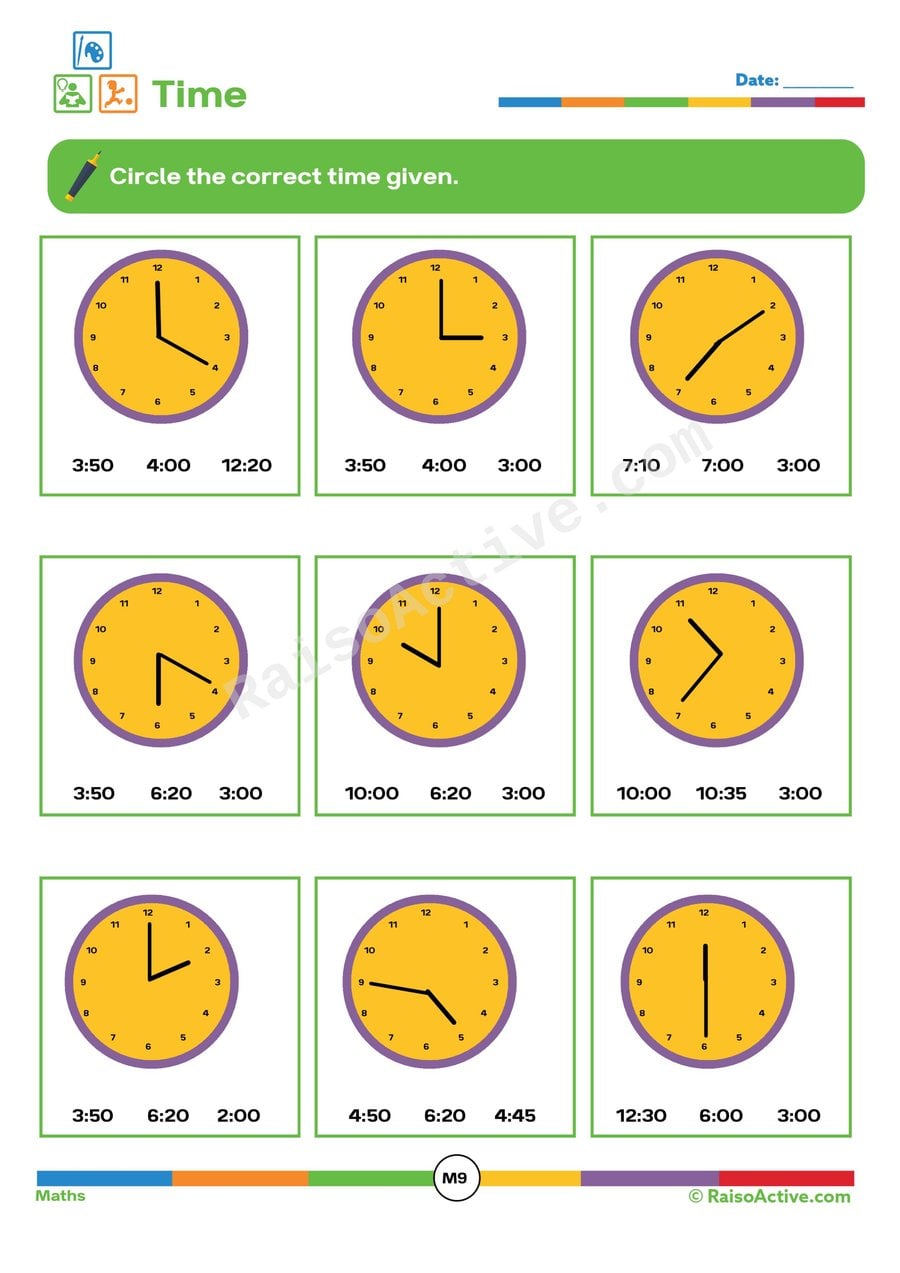
Reading an analog clock face and choosing the matching time from three written options builds clock-reading fluency for children ages 5-7, requiring them to interpret both the hour and minute hands together rather than guessing from a single hand.

Near and Far Worksheet: Identifying Distance for Preschoolers
Ages 3-5 · Preschool–Pre-KAges 3-5 · Nursery–ReceptionAges 3-5 · Nursery–LKGAges 3-5
Judging whether an object is near or far and connecting objects based on that positional relationship builds spatial vocabulary for children ages 3-5, an early skill that supports understanding distance, maps, and following directional instructions.
Help the Boy Escape the Maze Worksheet
Ages 3-5 · Preschool–Pre-KAges 3-5 · Nursery–ReceptionAges 3-5 · Nursery–LKGAges 3-5
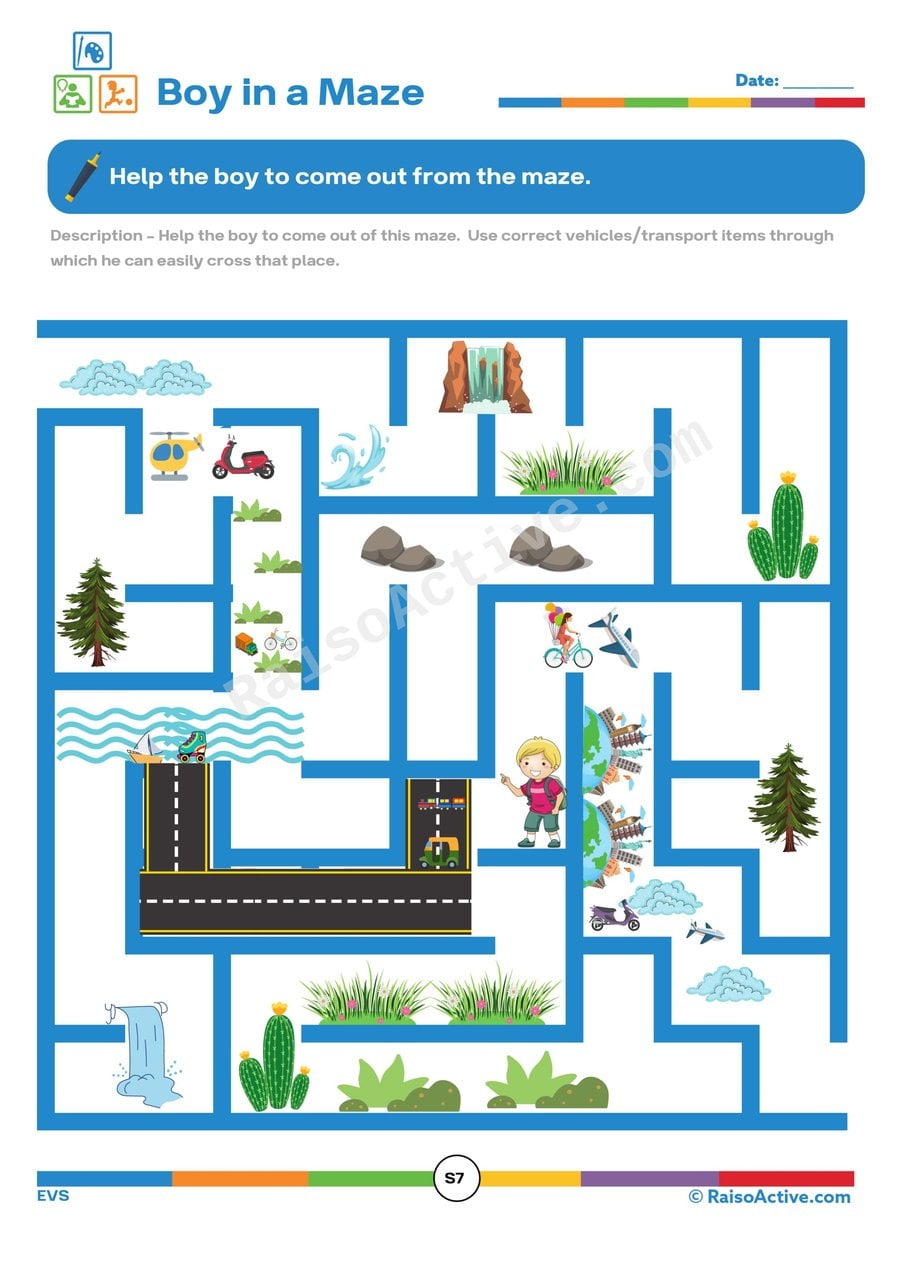
This maze worksheet builds visual tracking, planning, and fine motor control as children ages 3-5 trace a path for a boy to escape, using different vehicles to get past obstacles along the way. Scanning ahead to choose a workable route before committing to a path develops early problem-solving and forward-planning skills, while the pencil control needed to stay within the maze lines strengthens hand strength for later handwriting.

Material Properties Sorting Worksheet for Preschoolers
Ages 3-5 · Preschool–Pre-KAges 3-5 · Nursery–ReceptionAges 3-5 · Nursery–LKGAges 3-5
Children ages 3-5 practice identifying basic material properties, like hard, soft, rough, or smooth, and sorting everyday objects accordingly, an early science observation skill that builds the foundation for later lessons on states of matter and physical properties. Describing why an object belongs in a category also strengthens descriptive vocabulary.
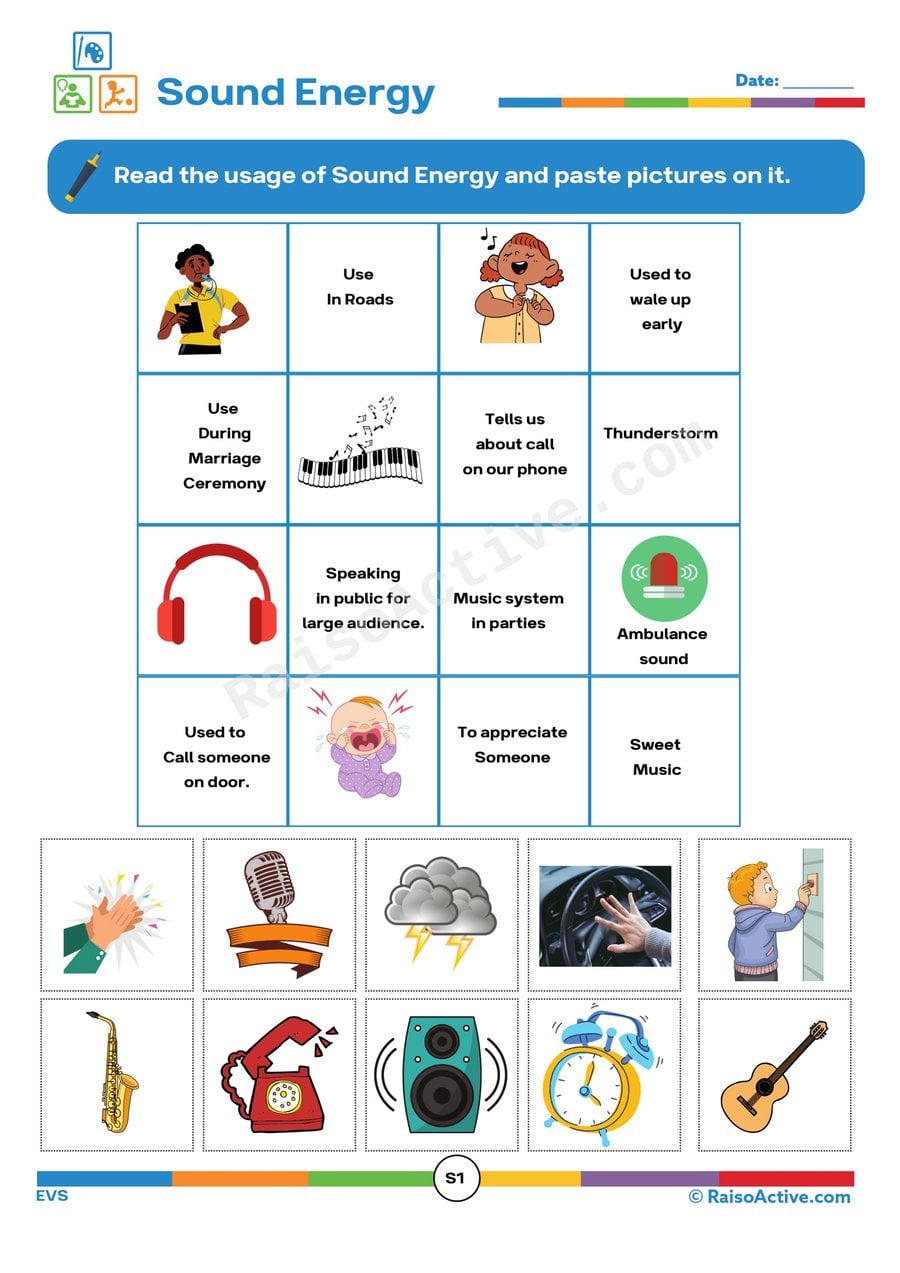
Sound Energy Matching Worksheet for Kids
Ages 4-6 · Pre-K–KindergartenAges 4-6 · Reception–Year 1Ages 4-6 · LKG–UKGAges 4-6
This worksheet introduces children ages 4-6 to the science concept of sound energy by having them match short descriptions of sound sources to the correct picture. Reading or listening to a description and then identifying the matching image builds comprehension alongside early science reasoning, helping children understand that sound is produced by different actions and objects in the world around them.

Light Energy Worksheet: Connect the Sun to Light Sources!
Ages 3-5 · Preschool–Pre-KAges 3-5 · Nursery–ReceptionAges 3-5 · Nursery–LKGAges 3-5
Connecting the sun to other objects that produce light builds early science reasoning for children ages 3-5, introducing the concept that light comes from specific sources rather than simply existing everywhere.

A and The Worksheet: Practice with Nouns and Articles
Ages 3-5 · Preschool–Pre-KAges 3-5 · Nursery–ReceptionAges 3-5 · Nursery–LKGAges 3-5
Choosing between the articles 'a' and 'the' before a noun builds early grammar awareness for children ages 3-5, helping them notice a small but important word choice that changes how a sentence sounds and reads.
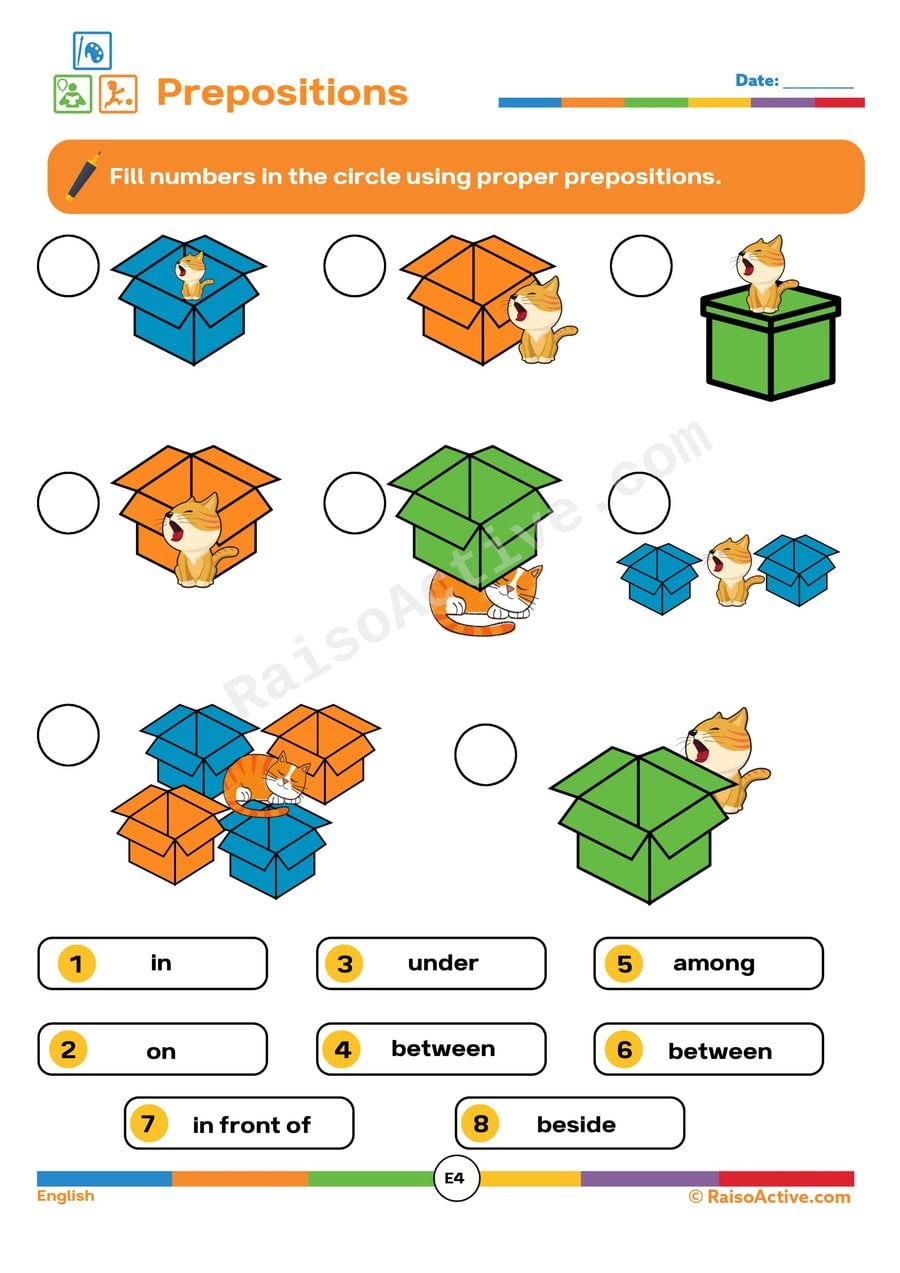
Prepositions Worksheet: Where Are the Cats?
Ages 3-5 · Preschool–Pre-KAges 3-5 · Nursery–ReceptionAges 3-5 · Nursery–LKGAges 3-5
This worksheet helps children ages 3-5 learn positional prepositions — words like 'under,' 'on,' 'behind,' and 'in' — by matching each word to a picture showing exactly where a cat is located. Understanding these small but essential words builds spatial vocabulary and comprehension skills that are used constantly in both everyday instructions and later reading comprehension.
Related worksheets
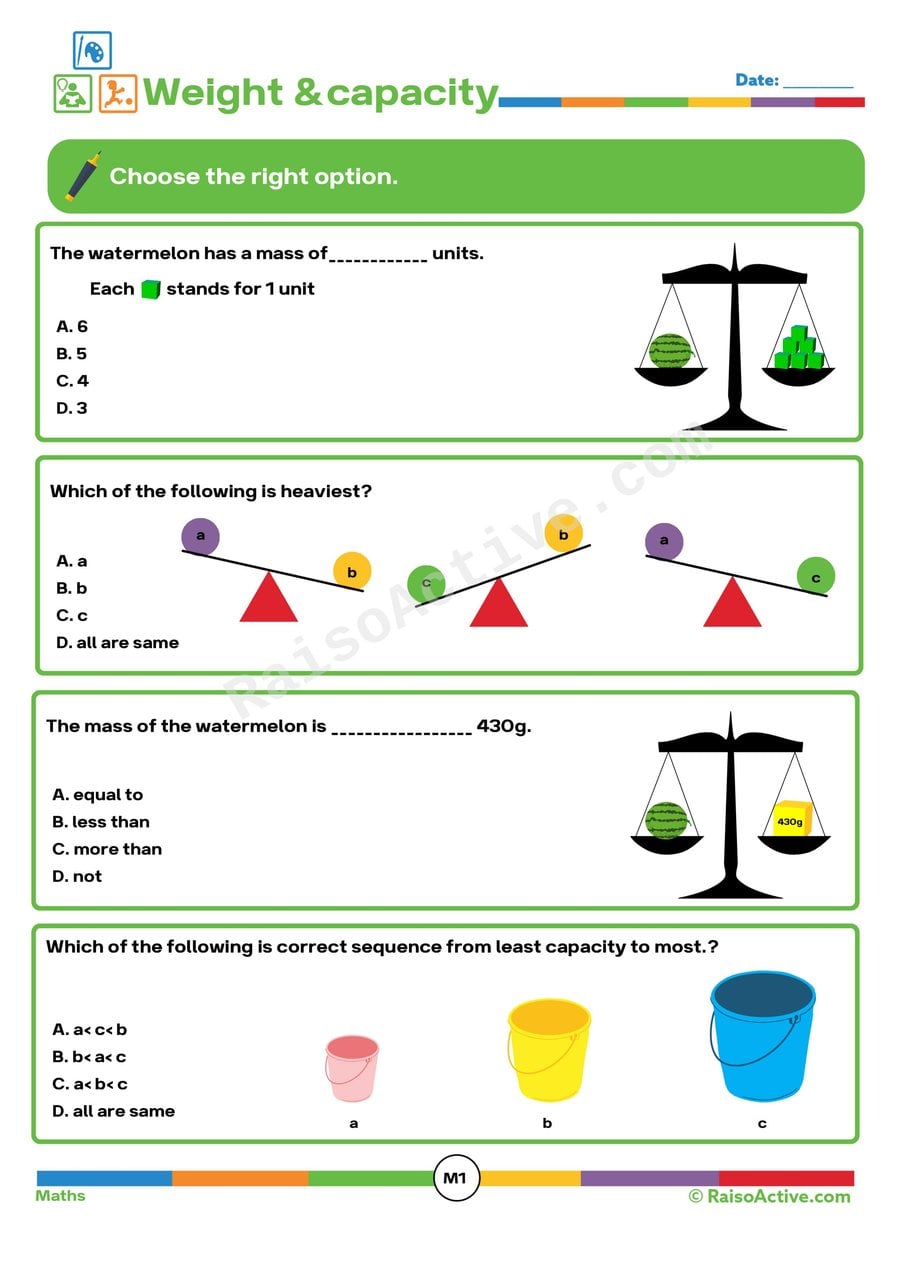
Weight and Capacity Worksheet for Preschoolers
Ages 4-6 · Pre-K–KindergartenAges 4-6 · Reception–Year 1Ages 4-6 · LKG–UKGAges 4-6
Comparing objects visually to judge which is heavier or holds more introduces children ages 4-6 to early measurement concepts, building the comparative reasoning that underlies later formal measurement with scales and measuring cups.
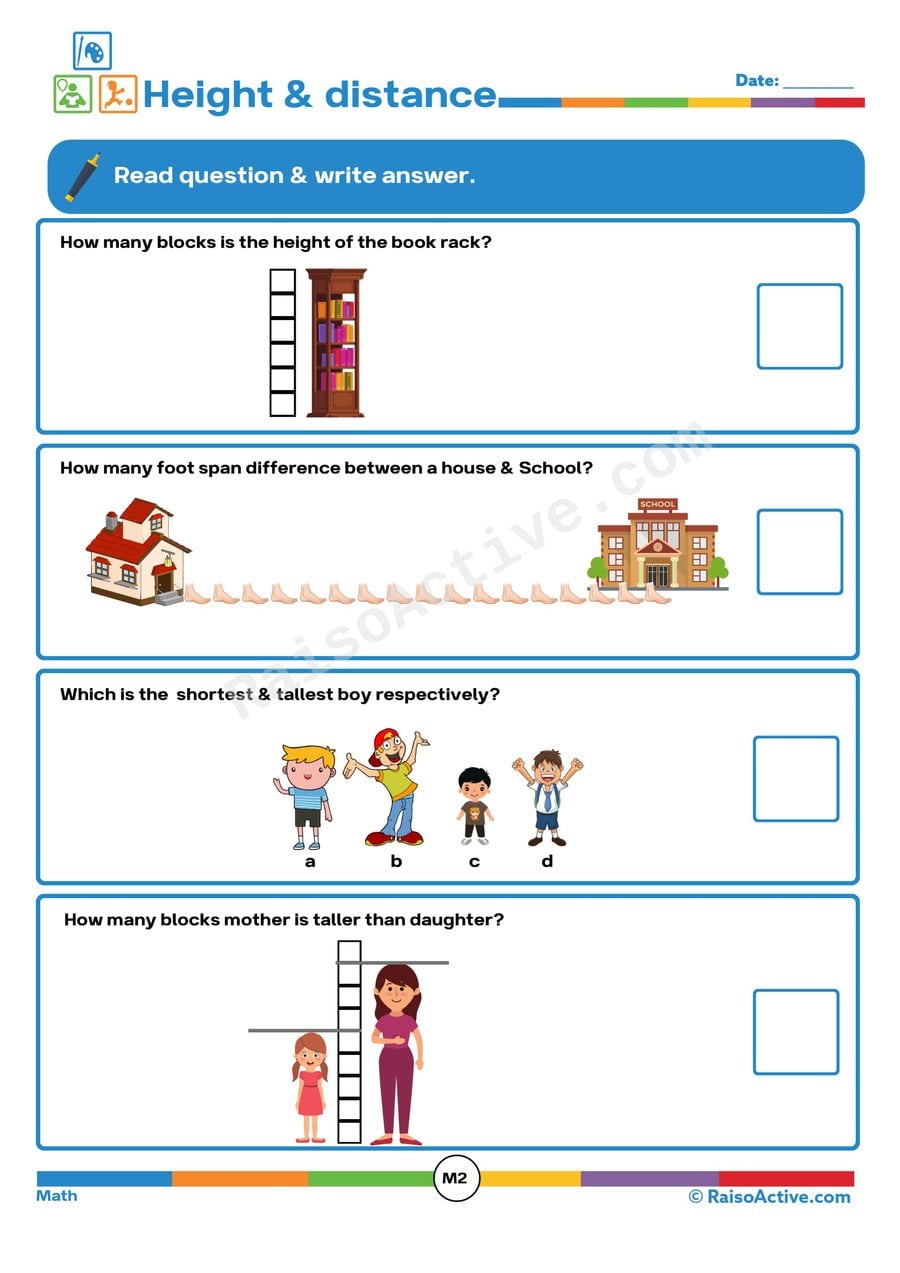
Height and Distance Worksheet for Kids
Ages 4-6 · Pre-K–KindergartenAges 4-6 · Reception–Year 1Ages 4-6 · LKG–UKGAges 4-6
Children ages 4-6 practice comparing height and distance using visual examples, building early measurement and comparison skills that form the basis for later lessons in math involving length and size. Learning to compare 'taller,' 'shorter,' 'closer,' and 'farther' helps children describe the physical world with more precise language.

Measurement Worksheet: Matching and Measuring Objects!
Ages 4-6 · Pre-K–KindergartenAges 4-6 · Reception–Year 1Ages 4-6 · LKG–UKGAges 4-6
This worksheet moves children from an intuitive sense of size toward the more formal skill of using a ruler to measure length in units, bridging estimation with actual measurement. For ages four to six, matching objects to an approximate number of units first, then confirming with a ruler, helps them see measurement as something they can predict and then verify rather than an arbitrary number.

Measuring Objects: A Fun Measurement Worksheet for Preschoolers!
Ages 3-5 · Preschool–Pre-KAges 3-5 · Nursery–ReceptionAges 3-5 · Nursery–LKGAges 3-5
Preschoolers ages 3-5 explore early measurement concepts by using a given reference item to figure out how many of that item it takes to span the length of different objects. This non-standard measurement approach — counting units rather than reading a ruler — is exactly how measurement is first introduced in early math curricula, building intuition before formal units are taught. Comparing object sizes this way also strengthens counting accuracy under a real, purposeful task.

Measurement Worksheet: Big to Small & Hand Measurement Fun!
Ages 3-5 · Preschool–Pre-KAges 3-5 · Nursery–ReceptionAges 3-5 · Nursery–LKGAges 3-5
Ranking objects from biggest to smallest teaches children to make and justify comparative judgments, while the hand-measurement activity introduces the idea of using a non-standard unit, their own hand, to measure length, both foundational concepts before children move on to rulers and standardized units. This combination suits ages three to five well, since it keeps measurement concrete and physical rather than abstract.

Lock and Key Matching Worksheet for Preschoolers
Ages 3-5 · Preschool–Pre-KAges 3-5 · Nursery–ReceptionAges 3-5 · Nursery–LKGAges 3-5
Matching each key to the lock sharing the same letter helps children ages 3-5 practice letter recognition in a playful, puzzle-like context rather than rote drilling. Because each key must be checked against several similar-looking locks before finding the right match, this worksheet also builds visual scanning and careful comparison skills that support problem-solving.

Sequencing Worksheet for Kids: First, Next, Last
Ages 4-7 · Pre-K–Grade 1Ages 4-7 · Reception–Year 2Ages 4-7 · LKG–Class 1Ages 4-7
Children put three-step stories in order using first, next and last, then work backwards to find what came before a picture. This builds sequencing, time vocabulary and cause and effect thinking.

Halloween Shadow Match Worksheet for Preschoolers
Ages 3-5 · Preschool–Pre-KAges 3-5 · Nursery–ReceptionAges 3-5 · Nursery–LKGAges 3-5
This shadow-matching worksheet sharpens visual discrimination in children ages 3-5 as they compare the outline of each Halloween object to its silhouette and identify the correct match. Because shadows strip away color and detail, children must focus purely on shape, which builds a skill that transfers directly to letter and shape recognition later on.
Guides for this topic

Age-Appropriate Problem-Solving Activities: Building Critical Thinkers from the Ground Up
Discover fun, age-appropriate problem-solving activities for children ages 1-8. Build critical thinking, logic, and reasoning skills through play-based learning.
Critical Thinking Activities That Actually Work for Young Children: Building Tomorrow's Thinkers Today
Discover proven critical thinking activities for young children. Age-wise logic games, questioning techniques, and hands-on ideas to build thinking skills at home.

Preparing Your Child for a Rapidly Changing World: Essential Skills for Future Success
Discover the essential 21st century skills your child needs for future success. Practical tips on creativity, critical thinking, digital literacy & emotional intelligence for ages 1-8.
Reviews
Every worksheet for ages 3–5, no watermark
Members download the full library of 1,000+ worksheets and every activity pack without watermarks or daily limits. One year costs ₹999 in India or $20 elsewhere.
See membership plansOr download any worksheet free with a watermark (5 a day).