Material Properties Sorting Worksheet for Preschoolers
Children ages 3-5 practice identifying basic material properties, like hard, soft, rough, or smooth, and sorting everyday objects accordingly, an early science observation skill that builds the foundation for later lessons on states of matter and physical properties. Describing why an object belongs in a category also strengthens descriptive vocabulary.
Part of the pack
Month 12: Learning & Development | Ages 6-7
This is page 20 of the pack. Ages 6-7 · Grade 1Ages 6-7 · Year 2Ages 6-7 · Class 1Ages 6-7
Made for your child
Counting to 10, made for your child
A maths pack with your child's name in it: pictures that explain, practice at three levels, puzzles and story sums about them. Print a new set whenever they finish.
Make a maths packFree preview · free for members
Curriculum
- Earth & Environment > Material Properties
How to use this worksheet
Read each material property listed on the page together, like 'hard' or 'soft,' and talk about what that word means using an example your child already knows. Cut out the object pictures at the bottom of the page, then have your child decide which property each object matches. Have them glue each picture into the correct box, describing out loud why that object fits the property as they paste it in.
Materials needed
- Scissors
- Glue
- Pencil
Extension activities
- 1Go on a material hunt around the house, touching and sorting objects by whether they feel hard, soft, rough, or smooth.
- 2Create a texture collage by gluing different materials, like cotton, sandpaper, and foil, onto a page.
- 3Play a blindfolded touch-and-guess game, describing an object's texture before naming what it might be.
- 4Compare two similar objects, like a cotton ball and a rock, and discuss how their properties differ.

Written by
Hemsweta Jain · Teacher Cheena
MBA and Early Childhood Educator, teaching since 2014 · Founder of RaisoActive, Mumbai
Every RaisoActive worksheet is designed and checked by the founder before publishing.
Published · Last reviewed
More from Month 12: Learning & Development | Ages 6-7

Peacock Coloring Worksheet for Kids: Fun Facts and Colors!
Ages 3-5 · Preschool–Pre-KAges 3-5 · Nursery–ReceptionAges 3-5 · Nursery–LKGAges 3-5
This worksheet combines creative coloring practice with early science learning for children ages 3-5, as they color a detailed peacock illustration and then read fun facts about this colorful bird. Beyond fine motor and color skills, exposure to real animal facts in a low-pressure, playful format builds curiosity and early nonfiction reading interest.
Sound Energy Matching Worksheet for Kids
Ages 4-6 · Pre-K–KindergartenAges 4-6 · Reception–Year 1Ages 4-6 · LKG–UKGAges 4-6
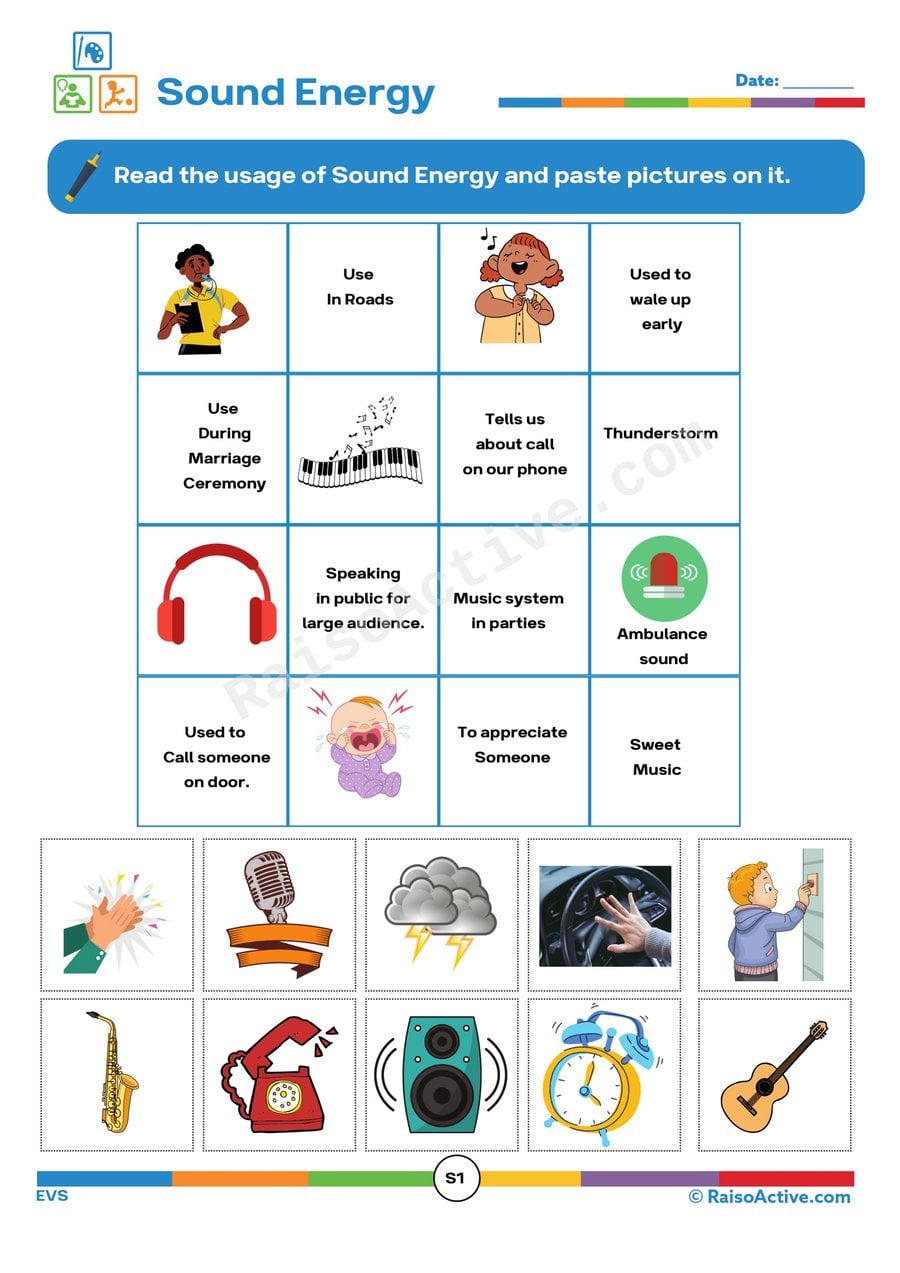
This worksheet introduces children ages 4-6 to the science concept of sound energy by having them match short descriptions of sound sources to the correct picture. Reading or listening to a description and then identifying the matching image builds comprehension alongside early science reasoning, helping children understand that sound is produced by different actions and objects in the world around them.

All in One Worksheet: Following Instructions and Sentence Building
Ages 4-6 · Pre-K–KindergartenAges 4-6 · Reception–Year 1Ages 4-6 · LKG–UKGAges 4-6
Children ages 4-6 practice reading and following short written instructions across several small tasks while also building basic sentence construction skills, combining early reading comprehension with beginning grammar practice. Learning to read a direction and complete exactly what it asks is a skill that carries directly into classroom worksheets and tests.

A and The Worksheet: Practice with Nouns and Articles
Ages 3-5 · Preschool–Pre-KAges 3-5 · Nursery–ReceptionAges 3-5 · Nursery–LKGAges 3-5
Choosing between the articles 'a' and 'the' before a noun builds early grammar awareness for children ages 3-5, helping them notice a small but important word choice that changes how a sentence sounds and reads.

Spin Drum Craft: Fun Following Instructions Worksheet for Kids
Ages 3-5 · Preschool–Pre-KAges 3-5 · Nursery–ReceptionAges 3-5 · Nursery–LKGAges 3-5
This craft worksheet helps children ages 3-5 build fine motor skills and the ability to follow multi-step instructions as they construct their own working spin drum from cardboard, string, and beads. Because each step depends on the one before it — cutting, assembling, attaching the string and beads — this project strengthens sequencing and sustained attention in a way that a single-step activity cannot.

Taller or Shorter? Comparing Heights Worksheet for Preschoolers
Ages 3-5 · Preschool–Pre-KAges 3-5 · Nursery–ReceptionAges 3-5 · Nursery–LKGAges 3-5
This worksheet builds early measurement vocabulary for children ages 3-5 as they compare the heights of pictured objects and people, circling the taller or shorter one as instructed. Beyond simple height comparison, the final section asks your child to identify both the tallest and smallest in a group, requiring them to compare more than two items at once, a step up in reasoning from simple pairwise comparison.
Color by Number Addition Worksheet: The Turtle!
Ages 4-6 · Pre-K–KindergartenAges 4-6 · Reception–Year 1Ages 4-6 · LKG–UKGAges 4-6
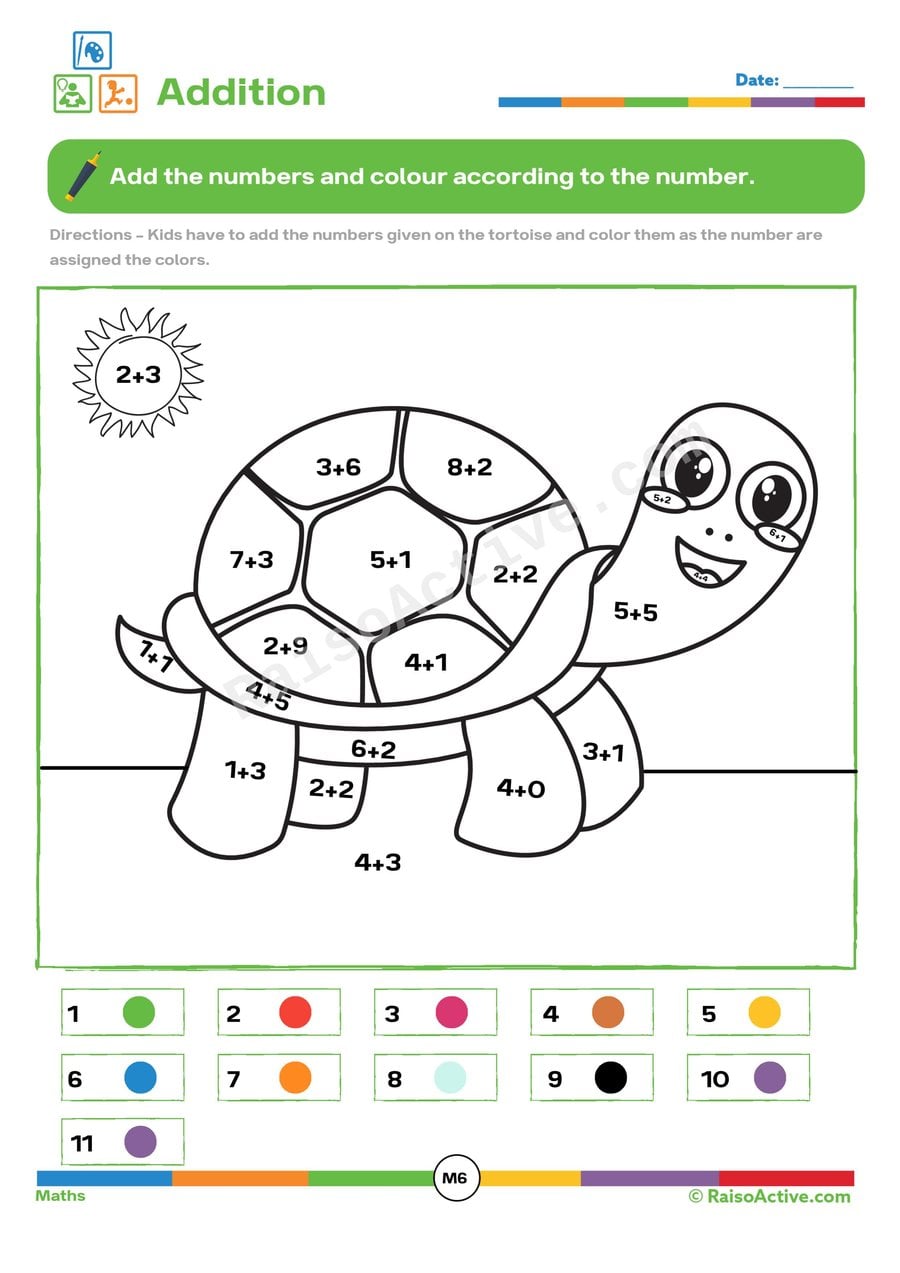
Children ages 4-6 practice single-digit addition facts and then apply a color key to their answers, combining math fluency with careful visual matching as the turtle picture is revealed. The immediate visual payoff of a colored picture gives children a clear, motivating way to check whether their addition was correct.

Roll a Story Worksheet: Create Fun Stories with Dice!
Ages 4-7 · Pre-K–Grade 1Ages 4-7 · Reception–Year 2Ages 4-7 · LKG–Class 1Ages 4-7
This dice-based storytelling worksheet helps children ages 4-7 practice narrative construction by rolling dice to randomly select a character, setting, and prop, then weaving those elements into an original story. Because the combination is different every time, children must think flexibly and creatively rather than relying on a memorized story, which builds oral language, sequencing, and imaginative reasoning skills that underpin later creative writing.
Related worksheets

Material Properties Worksheet for Kids: Matching and Identifying
Ages 3-5 · Preschool–Pre-KAges 3-5 · Nursery–ReceptionAges 3-5 · Nursery–LKGAges 3-5
This early science worksheet introduces children ages 3-5 to the idea that materials have distinct physical properties — like hardness, brittleness, or elasticity — and that everyday objects can be grouped based on how they look, feel, or behave. Matching objects to their correct property builds observational and classification skills, which are foundational scientific thinking tools long before formal science instruction begins. Talking through why a rubber band stretches while a plate breaks helps children start noticing cause-and-effect patterns in the physical world around them.

Float or Sink: Cut and Paste Worksheet for Preschoolers
Ages 3-5 · Preschool–Pre-KAges 3-5 · Nursery–ReceptionAges 3-5 · Nursery–LKGAges 3-5
This worksheet introduces children ages 3-5 to a basic science concept — that different materials and objects behave differently in water — by having them sort pictures into 'float' and 'sink' categories. Making a prediction and then physically sorting an object reinforces early scientific reasoning, since children must think about an object's properties, like weight or material, before deciding where it belongs. This kind of hands-on categorizing builds observation and classification skills that are foundational to all later science learning.

Energy Sources Worksheet: Circle the Energy Sources!
Ages 4-6 · Pre-K–KindergartenAges 4-6 · Reception–Year 1Ages 4-6 · LKG–UKGAges 4-6
This worksheet introduces children ages 4-6 to the basic science concept that certain objects and phenomena — like the sun, batteries, or wind — are sources of energy, while other everyday objects are not. Asking children to circle only the true energy sources from a mixed set of pictures builds early categorization and critical thinking skills, since they must apply a definition rather than just recognize familiar objects. Writing numbers stepwise afterward adds a light sequencing task that keeps the page varied rather than focused on a single skill.

Rough vs. Smooth Worksheet: Sorting and Counting Objects
Ages 3-5 · Preschool–Pre-KAges 3-5 · Nursery–ReceptionAges 3-5 · Nursery–LKGAges 3-5
Rough and smooth are texture words a 3-5 year old usually understands through touch long before they can reliably identify them just by looking at a picture, so this worksheet bridges that gap by pairing the visual sorting task with counting practice. Counting how many rough versus smooth objects appear afterward layers basic data skills — 'which group has more?' — on top of the classification.

Energy Sources Worksheet for Kids: Identifying Light and Heat
Ages 3-5 · Preschool–Pre-KAges 3-5 · Nursery–ReceptionAges 3-5 · Nursery–LKGAges 3-5
Children ages 3-5 learn to identify sources of light and heat energy, like the sun, a lamp, or a fire, by ticking the correct option for each pictured scene. Distinguishing natural sources of heat, like the sun, from artificial ones, like a stove, introduces early scientific classification of energy in the world around them. This awareness lays groundwork for later science topics about energy, weather, and how everyday objects work.

Elephant Shapes: Fun Sorting Worksheet for Preschoolers!
Ages 3-5 · Preschool–Pre-KAges 3-5 · Nursery–ReceptionAges 3-5 · Nursery–LKGAges 3-5
This playful sorting worksheet has children ages 3-5 use an elephant's 'trunk' (their own hand reaching through a cut circle) to pick and sort shapes, building both shape recognition and simple classification skills. Physically selecting and grouping shapes by type, rather than just naming them on sight, helps solidify the concept that shapes can share a category even when their size or color differs.

Parts of a Leaf Worksheet for Preschoolers: Learn and Play!
Ages 3-5 · Preschool–Pre-KAges 3-5 · Nursery–ReceptionAges 3-5 · Nursery–LKGAges 3-5
This hands-on activity teaches children ages 3-5 the parts of a leaf — tip, blade, veins, midrib, petiole, and stem — by having them shape a leaf from playdough while comparing it to a real leaf. Building a physical model alongside a real specimen helps children connect abstract vocabulary to tangible features they can see and touch, which is especially effective for this age group.
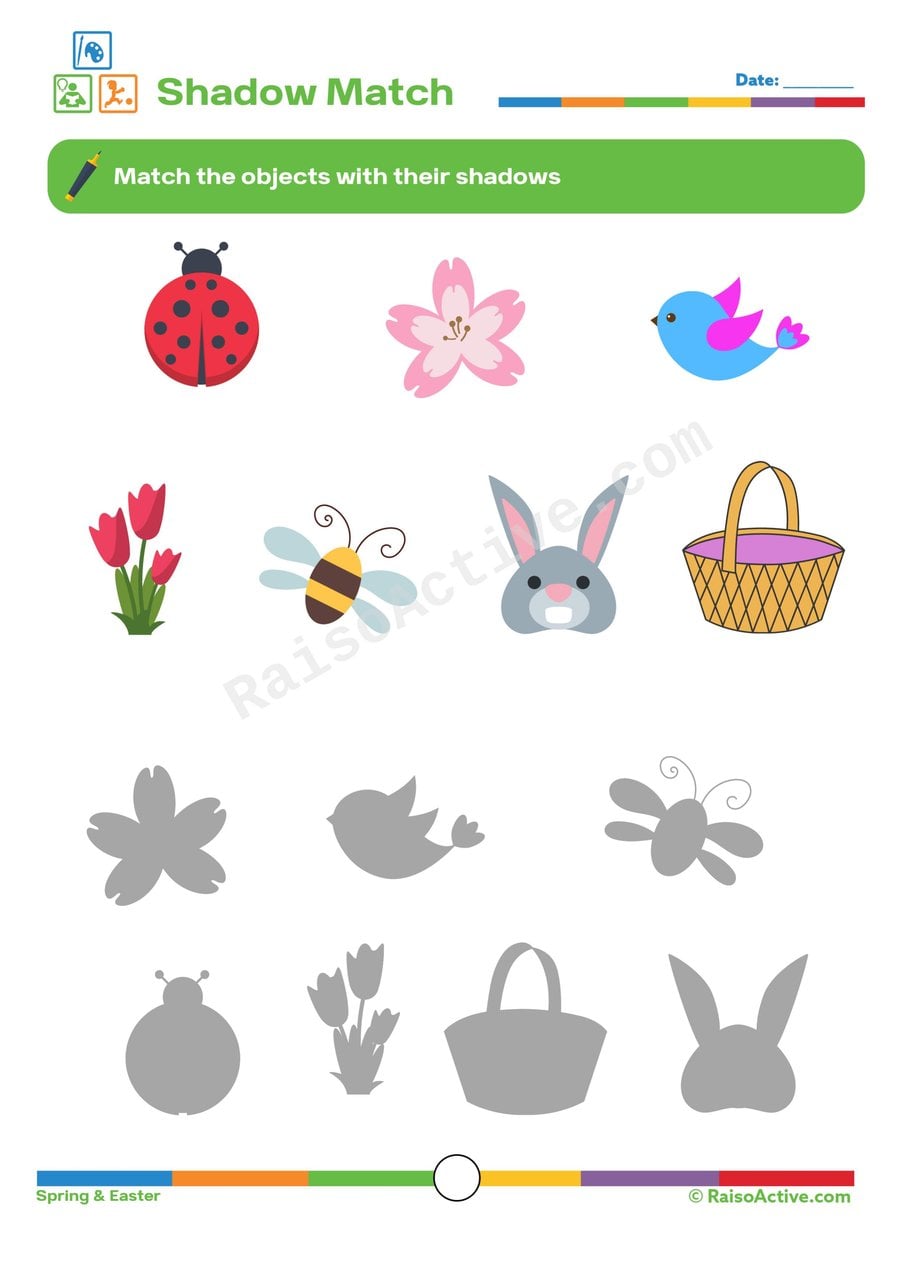
Spring Shadow Match Worksheet for Preschoolers
Ages 3-5 · Preschool–Pre-KAges 3-5 · Nursery–ReceptionAges 3-5 · Nursery–LKGAges 3-5
Children ages 3-5 practice visual discrimination by matching spring-themed objects to their correct silhouette shadows. Because shadows strip away color and detail, leaving only outline shape, this activity sharpens a child's ability to focus on form alone — a more advanced visual skill than matching by color or pattern.
Guides for this topic

Age-Appropriate Problem-Solving Activities: Building Critical Thinkers from the Ground Up
Discover fun, age-appropriate problem-solving activities for children ages 1-8. Build critical thinking, logic, and reasoning skills through play-based learning.

Discovering Wonder: Nature-Based Learning Activities That Captivate Young Children
Explore nature-based learning activities for children ages 2–7 — leaf rubbings, bug hunts, nature journals, and seasonal Indian outdoor ideas that spark wonder.
Hands-On Science Fun: Age-Appropriate Science Activities That Spark Curiosity in Preschoolers
Discover 10+ easy science experiments for preschoolers using Indian household items. Spark curiosity in children ages 2-6 with safe, play-based STEM activities.
Reviews
Every worksheet for ages 3–5, no watermark
Members download the full library of 1,000+ worksheets and every activity pack without watermarks or daily limits. One year costs ₹999 in India or $20 elsewhere.
See membership plansOr download any worksheet free with a watermark (5 a day).