Spring Shadow Match Worksheet for Preschoolers
Children ages 3-5 practice visual discrimination by matching spring-themed objects to their correct silhouette shadows. Because shadows strip away color and detail, leaving only outline shape, this activity sharpens a child's ability to focus on form alone — a more advanced visual skill than matching by color or pattern.
Part of the pack
Spring & Easter Activity Book: Counting, Patterns, & Mazes for Preschool & Kindergarten
This is page 6 of the pack. Ages 3-7 · Preschool–Grade 1Ages 3-7 · Nursery–Year 2Ages 3-7 · Nursery–Class 1Ages 3-7
Made for your child
Counting to 10, made for your child
A maths pack with your child's name in it: pictures that explain, practice at three levels, puzzles and story sums about them. Print a new set whenever they finish.
Make a maths packFree preview · free for members
Curriculum
- Cognitive - Attention > Observation Skills
How to use this worksheet
Look at the objects at the top of the page together and name each one. Then look at the shadows at the bottom and ask your child to study their shapes carefully before matching. Have them draw a line connecting each object to its correct shadow, encouraging them to look at distinguishing outline features like ears, stems, or wings. Once finished, review each match and talk about what shape clue helped them decide.
Materials needed
- Pencil
- Crayons
Extension activities
- 1Go on a shadow hunt outside on a sunny day and observe the shapes objects cast.
- 2Use a flashlight indoors to make shadow puppets with hands or toys.
- 3Have your child draw their own shadow outline for a favorite spring object, like a flower or bird.
- 4Trace a toy's shadow on paper using a flashlight and compare it to the toy itself.
- 5Play a shadow guessing game, showing only a silhouette and asking your child to name the object.

Written by
Hemsweta Jain · Teacher Cheena
MBA and Early Childhood Educator, teaching since 2014 · Founder of RaisoActive, Mumbai
Every RaisoActive worksheet is designed and checked by the founder before publishing.
Published · Last reviewed
More from Spring & Easter Activity Book: Counting, Patterns, & Mazes for Preschool & Kindergarten

Spring Table Color by Number Worksheet for Preschoolers
Ages 3-5 · Preschool–Pre-KAges 3-5 · Nursery–ReceptionAges 3-5 · Nursery–LKGAges 3-5
This color-by-number worksheet has children ages 3-5 practice matching numerals to a specific color key and then applying that color accurately across a picture, reinforcing both number recognition and one-to-one correspondence between a symbol and an action. Rolling a dice to determine which color to use next also adds an element of chance that keeps the repetitive coloring task engaging.
Easter Egg Patterns Worksheet for Preschoolers
Ages 3-5 · Preschool–Pre-KAges 3-5 · Nursery–ReceptionAges 3-5 · Nursery–LKGAges 3-5
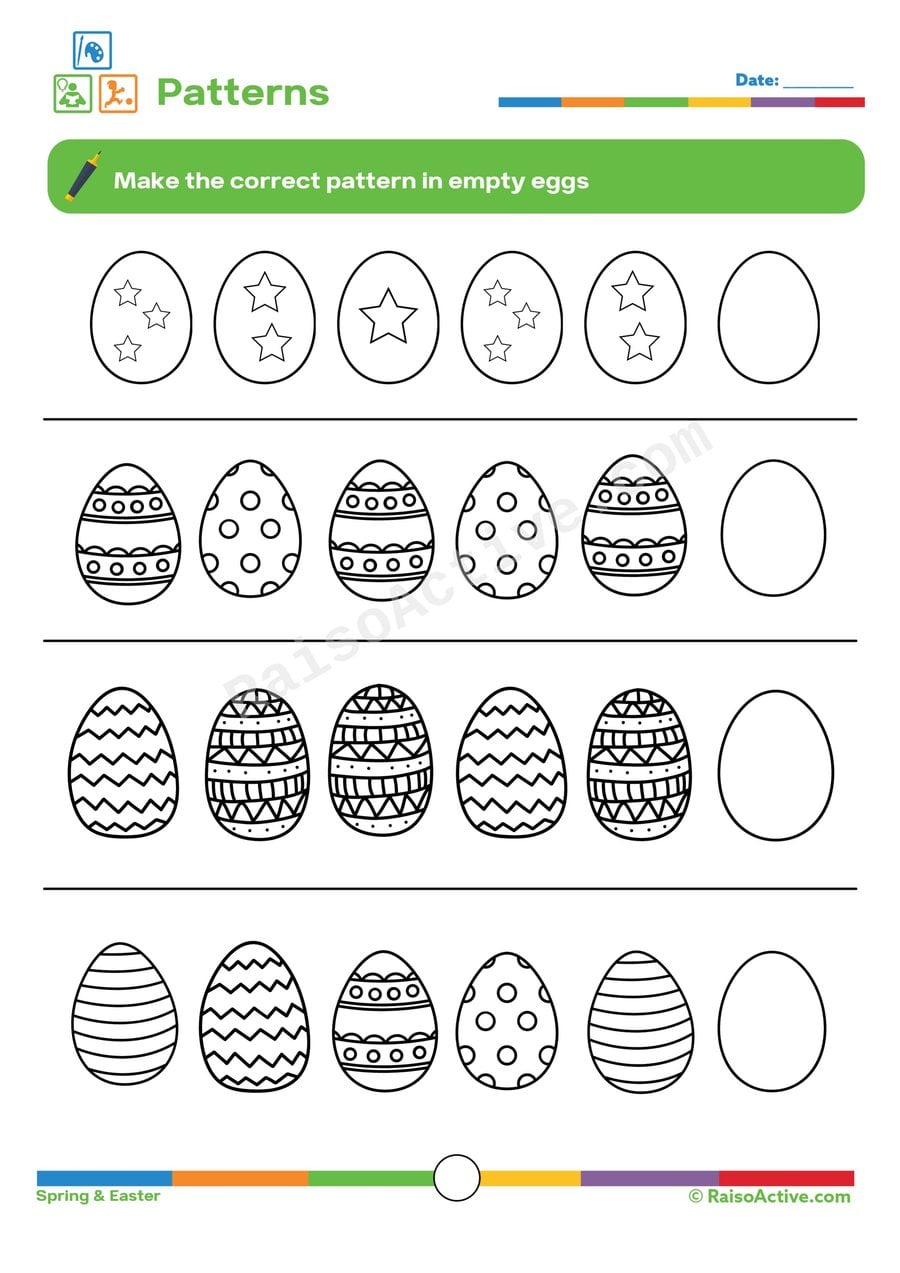
This worksheet asks children ages 3-5 to study a sequence of patterned Easter eggs and figure out what design should come next, then draw it into the empty egg themselves. Predicting and completing a pattern, rather than just matching an existing one, pushes children a step further into the kind of what-comes-next reasoning that underlies early math and logic.

Easter Egg Color Code Worksheet for Preschoolers
Ages 3-5 · Preschool–Pre-KAges 3-5 · Nursery–ReceptionAges 3-5 · Nursery–LKGAges 3-5
Matching numbers on each Easter egg section to a color key builds number recognition and color-word association in children ages 3-5, since they must hold both a numeral and its assigned color in mind while coloring. This kind of coded coloring activity also strengthens visual scanning, as children need to locate the small numbers printed inside each egg section before choosing the right crayon. Completing the code correctly gives an immediate, visible reward when a colorful, patterned egg emerges from the numbered outline.

Happy Easter Coloring Card Worksheet for Preschoolers
Ages 3-5 · Preschool–Pre-KAges 3-5 · Nursery–ReceptionAges 3-5 · Nursery–LKGAges 3-5
Coloring the Easter egg and bunny images on this fold-into-a-card worksheet gives children ages 3-5 practice with controlled crayon strokes and color choice, while the act of turning their artwork into a card for someone else introduces an early sense of purpose and gift-giving. Because the finished piece becomes a keepsake rather than just a worksheet, children also build pride and motivation to complete their coloring carefully. This blends fine motor practice with a first taste of creating something meaningful for another person.

Spot the Spots! Spring Coloring Worksheet for Preschoolers
Ages 3-5 · Preschool–Pre-KAges 3-5 · Nursery–ReceptionAges 3-5 · Nursery–LKGAges 3-5
This worksheet pairs counting practice with coloring as children ages 3-5 look at a number written beside each picture and color exactly that many spots onto it, reinforcing one-to-one correspondence between a numeral and a matching quantity. Because the target number changes from picture to picture, children must check the number freshly each time rather than coloring on autopilot.

Easter Pattern Match Worksheet: Bunny, Basket, and Egg Fun!
Ages 3-5 · Preschool–Pre-KAges 3-5 · Nursery–ReceptionAges 3-5 · Nursery–LKGAges 3-5
This worksheet has children ages 3-5 study a repeating pattern shown across a set of bunny, basket, and egg images, then identify which item on the right continues or matches that same pattern. Recognizing a pattern by its color or design sequence builds early algebraic thinking, since spotting what comes next is a skill children will rely on throughout math.

Spring Sudoku Worksheet: Cut and Paste Puzzle for Kids
Ages 4-6 · Pre-K–KindergartenAges 4-6 · Reception–Year 1Ages 4-6 · LKG–UKGAges 4-6
Placing cut-out pictures into a sudoku-style grid so that no image repeats in any row, column, or box teaches children ages 4-6 early logical reasoning and systematic thinking, since they must check multiple directions before deciding where each piece belongs. Cutting out the small picture squares beforehand also builds scissor control and hand-eye coordination. Together, this combines a pre-math logic puzzle with fine motor practice in a single spring-themed activity.
I Spy Spring Worksheet: Count and Write!
Ages 3-5 · Preschool–Pre-KAges 3-5 · Nursery–ReceptionAges 3-5 · Nursery–LKGAges 3-5
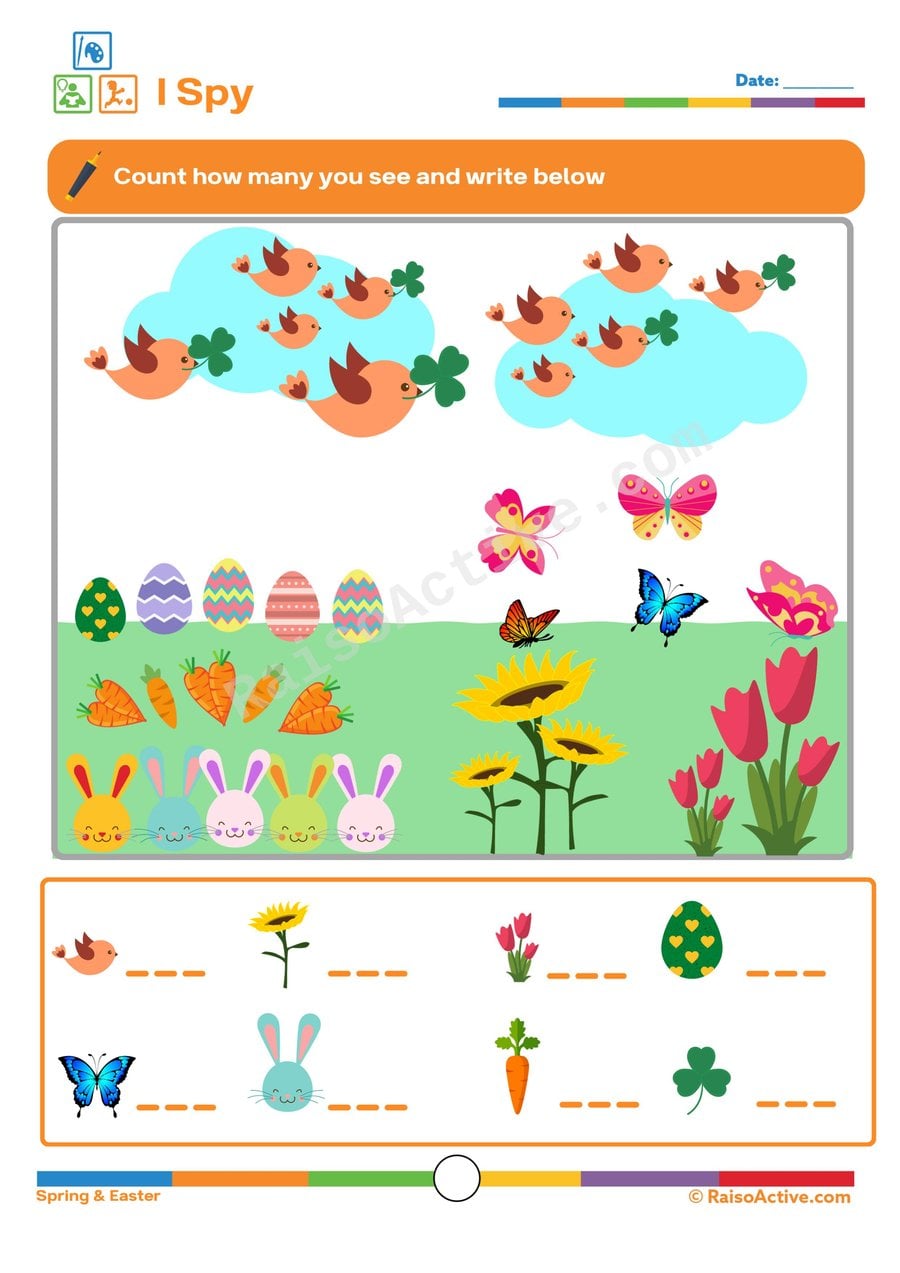
Spotting and tallying spring-themed pictures, like flowers, bees, or raindrops, gives children ages 3-5 practice with one-to-one counting and then translating that count into a written numeral. Because the items are scattered across the page rather than lined up neatly, children also build visual scanning skills as they search each section carefully before counting. Writing the final number afterward connects the physical act of counting to abstract number symbols, a key early numeracy milestone.
Related worksheets
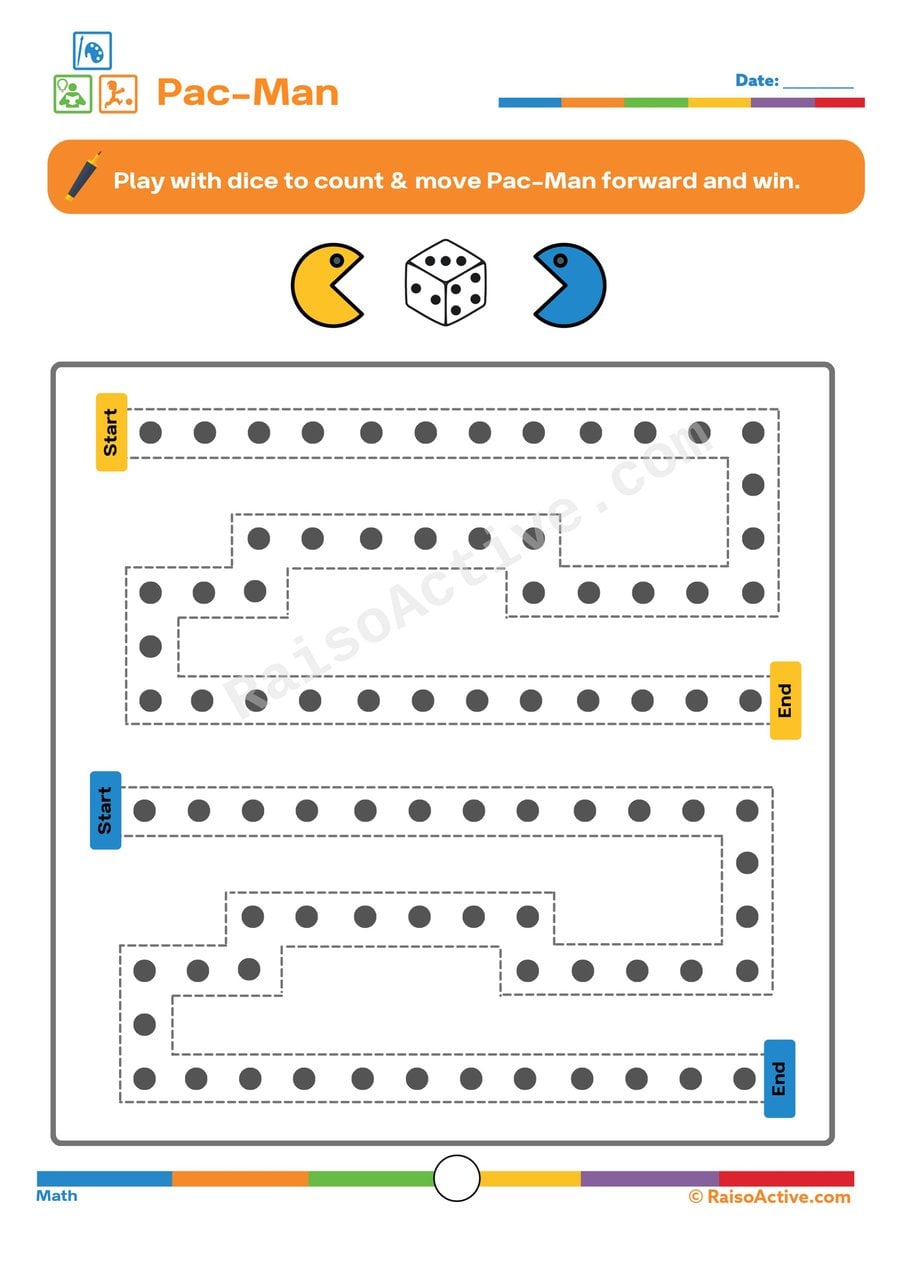
Pac-Man Maze Worksheet: Count and Move!
Ages 3-5 · Preschool–Pre-KAges 3-5 · Nursery–ReceptionAges 3-5 · Nursery–LKGAges 3-5
This dice-counting maze gives children ages 3-5 repeated practice matching a rolled number to the correct number of moves, reinforcing accurate counting under a bit of playful pressure. Tracking Pac-Man's current position after each roll also builds short-term spatial memory, since children must remember where they left off before moving again.

Stick Man Emotions Worksheet: Happy, Sad, Angry, and Surprised!
Ages 4-6 · Pre-K–KindergartenAges 4-6 · Reception–Year 1Ages 4-6 · LKG–UKGAges 4-6
Children ages 4-6 practice reading facial expressions on this worksheet, matching stick-figure faces to their correct emotion labels by noticing details like mouth shape and eyebrow position. This strengthens emotional literacy — the ability to name and recognize feelings in others — which supports empathy and smoother social interactions as children move into more group play and classroom settings.

Balloon Pattern Matching Worksheet for Preschoolers
Ages 3-5 · Preschool–Pre-KAges 3-5 · Nursery–ReceptionAges 3-5 · Nursery–LKGAges 3-5
This worksheet strengthens pattern recognition in children ages 3-5 by having them study a repeating sequence of colored balloons and locate the matching arrangement elsewhere on the page. Recognizing and reproducing a pattern is an early pre-algebra skill, laying groundwork for later number patterns and logical sequencing.
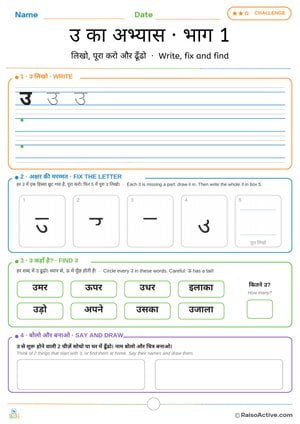
Hindi Letter उ Practice Part 1: Write, Fix and Find | उ का अभ्यास · भाग 1
Ages 3-7 · Preschool–Grade 1Ages 3-7 · Nursery–Year 2Ages 3-7 · Nursery–Class 1Ages 3-7
Children write उ on guide lines, complete four partly drawn letters, circle उ in eight words (while avoiding its look-alike ऊ), count how many they found, then think of two more words at home that start with उ and draw them.

Festivals of Many Faiths: Places of Worship and Greetings
Ages 4-8 · Pre-K–Grade 2Ages 4-8 · Reception–Year 3Ages 4-8 · LKG–Class 2Ages 4-8
Children learn that India is home to many faiths, each with its own festivals, places of worship and festival greetings.

Soap & Pepper Science Experiment Worksheet for Preschoolers
Ages 3-5 · Preschool–Pre-KAges 3-5 · Nursery–ReceptionAges 3-5 · Nursery–LKGAges 3-5
This hands-on demonstration shows children ages 3-5 how soap disrupts water's surface tension, using floating pepper as a simple, visible indicator of the change. Because the reaction happens instantly and dramatically, it gives young children a strong, memorable first experience with predicting an outcome and then observing whether their prediction was right.
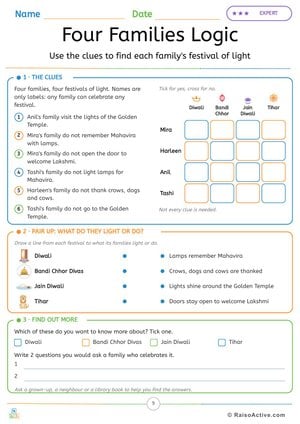
Four Families Logic: Diwali Festivals Logic Grid Puzzle
Ages 7-10 · Grade 2–Grade 3Ages 7-10 · Year 3–Year 4Ages 7-10 · Class 2–Class 3Ages 7-10
Children use six clues to solve a logic grid with four families and four festivals of light, then draw lines to match each festival to what its families light or do and write two questions to ask.

Navratri Look Closely: Spot the Difference and Shadow Match
Ages 4-6 · Pre-K–KindergartenAges 4-6 · Reception–Year 1Ages 4-6 · LKG–UKGAges 4-6
Children compare two pictures carefully to find what is different and match objects to their shadows by looking at shape.
Guides for this topic

Best Worksheets for 3-Year-Olds: What Works and What to Avoid
What works on worksheets for 3-year-olds: short sessions, crayons, tracing lines, matching, cutting, a free weekly plan, and signs one is too advanced.

Age-Appropriate Problem-Solving Activities: Building Critical Thinkers from the Ground Up
Discover fun, age-appropriate problem-solving activities for children ages 1-8. Build critical thinking, logic, and reasoning skills through play-based learning.
Critical Thinking Activities That Actually Work for Young Children: Building Tomorrow's Thinkers Today
Discover proven critical thinking activities for young children. Age-wise logic games, questioning techniques, and hands-on ideas to build thinking skills at home.
Reviews
Every worksheet for ages 3–5, no watermark
Members download the full library of 1,000+ worksheets and every activity pack without watermarks or daily limits. One year costs ₹999 in India or $20 elsewhere.
See membership plansOr download any worksheet free with a watermark (5 a day).