Happy Easter Coloring Card Worksheet for Preschoolers
Coloring the Easter egg and bunny images on this fold-into-a-card worksheet gives children ages 3-5 practice with controlled crayon strokes and color choice, while the act of turning their artwork into a card for someone else introduces an early sense of purpose and gift-giving. Because the finished piece becomes a keepsake rather than just a worksheet, children also build pride and motivation to complete their coloring carefully. This blends fine motor practice with a first taste of creating something meaningful for another person.
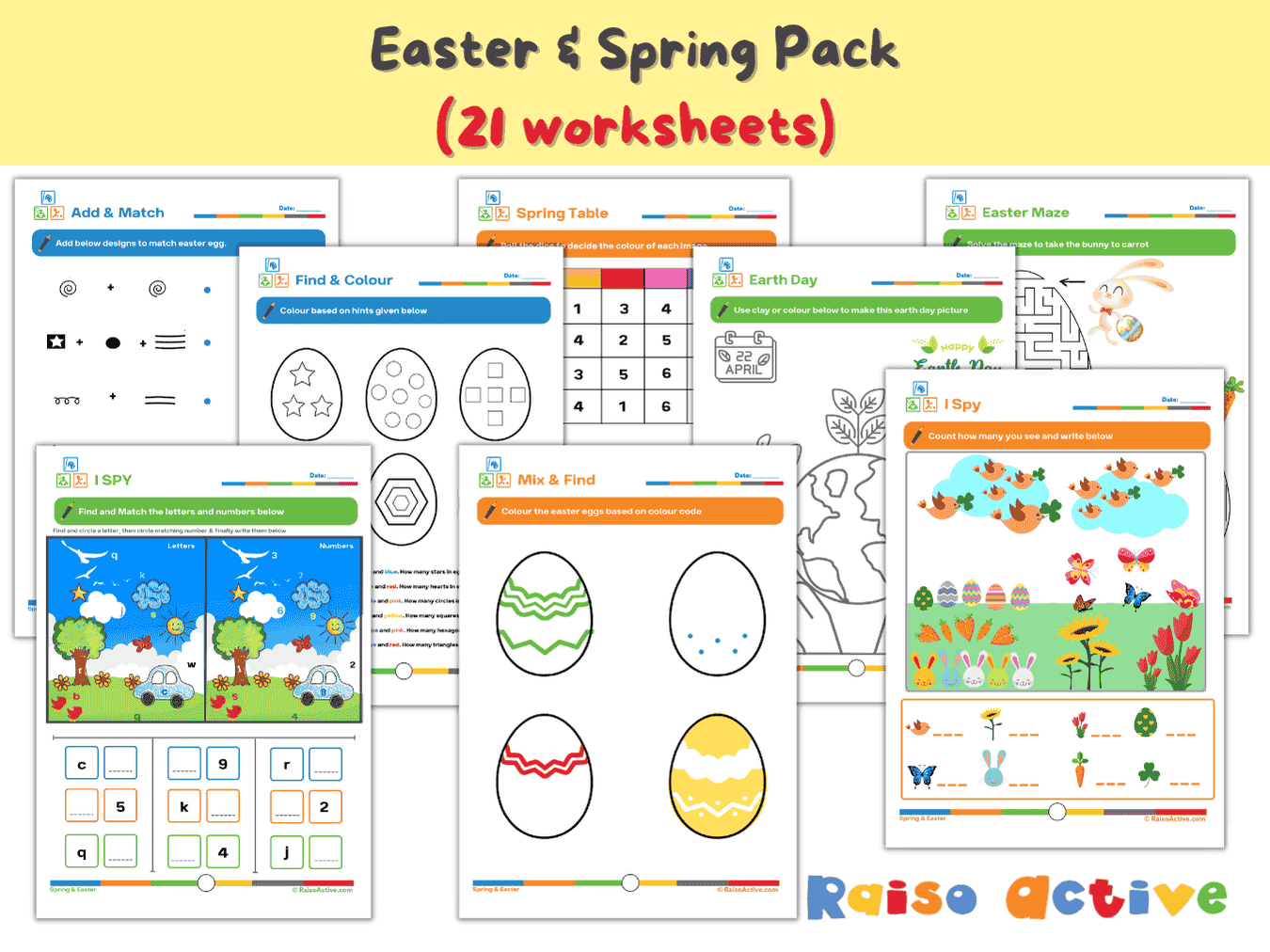
Part of the pack
Spring & Easter Activity Book: Counting, Patterns, & Mazes for Preschool & Kindergarten
This is page 16 of the pack. Ages 3-7 · Preschool–Grade 1Ages 3-7 · Nursery–Year 2Ages 3-7 · Nursery–Class 1Ages 3-7
Made for your child
A whole activity pack made with their name
60 pages to spot, build, trace and write their own name, plus pages about their favourites, feelings and family. See a free preview with their name.
Make an All About Me packFree preview · free for members
Or start free: a name tracing sheet with their nameCurriculum
- Art & Craft > Arts & Crafts
How to use this worksheet
Give your child crayons or markers and let them choose colors for the Easter egg and bunny images, encouraging them to fill in each section rather than leaving large blank spaces. Once the coloring is finished, help them fold the paper along the middle to form a greeting card shape. Open the card together and help your child write or dictate a short Easter message on the inside. Decide together who the card is for and talk about how that person might feel receiving it.
Materials needed
- Crayons
- Markers
- Pencil
Extension activities
- 1Add stickers, glitter glue, or cut-paper decorations to the front of the finished card.
- 2Make a second card for a grandparent, neighbor, or friend using leftover craft supplies.
- 3Practice writing the recipient's name on the envelope alongside the card.
- 4Deliver the card in person and talk about how it feels to give a handmade gift.
- 5Create a matching drawing of an Easter bunny or egg on a separate sheet using a different color palette.

Written by
Hemsweta Jain · Teacher Cheena
MBA and Early Childhood Educator, teaching since 2014 · Founder of RaisoActive, Mumbai
Every RaisoActive worksheet is designed and checked by the founder before publishing.
Published · Last reviewed
More from Spring & Easter Activity Book: Counting, Patterns, & Mazes for Preschool & Kindergarten

Easter Egg Color Code Worksheet for Preschoolers
Ages 3-5 · Preschool–Pre-KAges 3-5 · Nursery–ReceptionAges 3-5 · Nursery–LKGAges 3-5
Matching numbers on each Easter egg section to a color key builds number recognition and color-word association in children ages 3-5, since they must hold both a numeral and its assigned color in mind while coloring. This kind of coded coloring activity also strengthens visual scanning, as children need to locate the small numbers printed inside each egg section before choosing the right crayon. Completing the code correctly gives an immediate, visible reward when a colorful, patterned egg emerges from the numbered outline.

I Spy Letters and Numbers Worksheet: Find, Match, and Write!
Ages 4-5 · Pre-KAges 4-5 · ReceptionAges 4-5 · LKGAges 4-5
This worksheet blends letter and number recognition for children ages 4-5, asking them to spot a hidden letter within a picture, find its matching number, and then write both symbols down, combining visual search with early literacy and numeracy in a single activity. Working with letters and numbers side by side reinforces that both are symbols that carry specific meaning and can be found, matched, and recorded.

Easter Maze Adventure: Help the Bunny Find the Carrot!
Ages 3-5 · Preschool–Pre-KAges 3-5 · Nursery–ReceptionAges 3-5 · Nursery–LKGAges 3-5
Tracing a path from the bunny to the carrot builds fine motor control and pencil steadiness in children ages 3-5, since staying within the maze's narrow lines requires more precision than open coloring. Navigating around dead ends also develops early problem-solving and planning skills, as children learn to look ahead and backtrack when a path doesn't work out. This kind of visual-spatial puzzle strengthens the ability to plan a route mentally before committing it to paper, a skill that supports later map-reading and logical thinking.
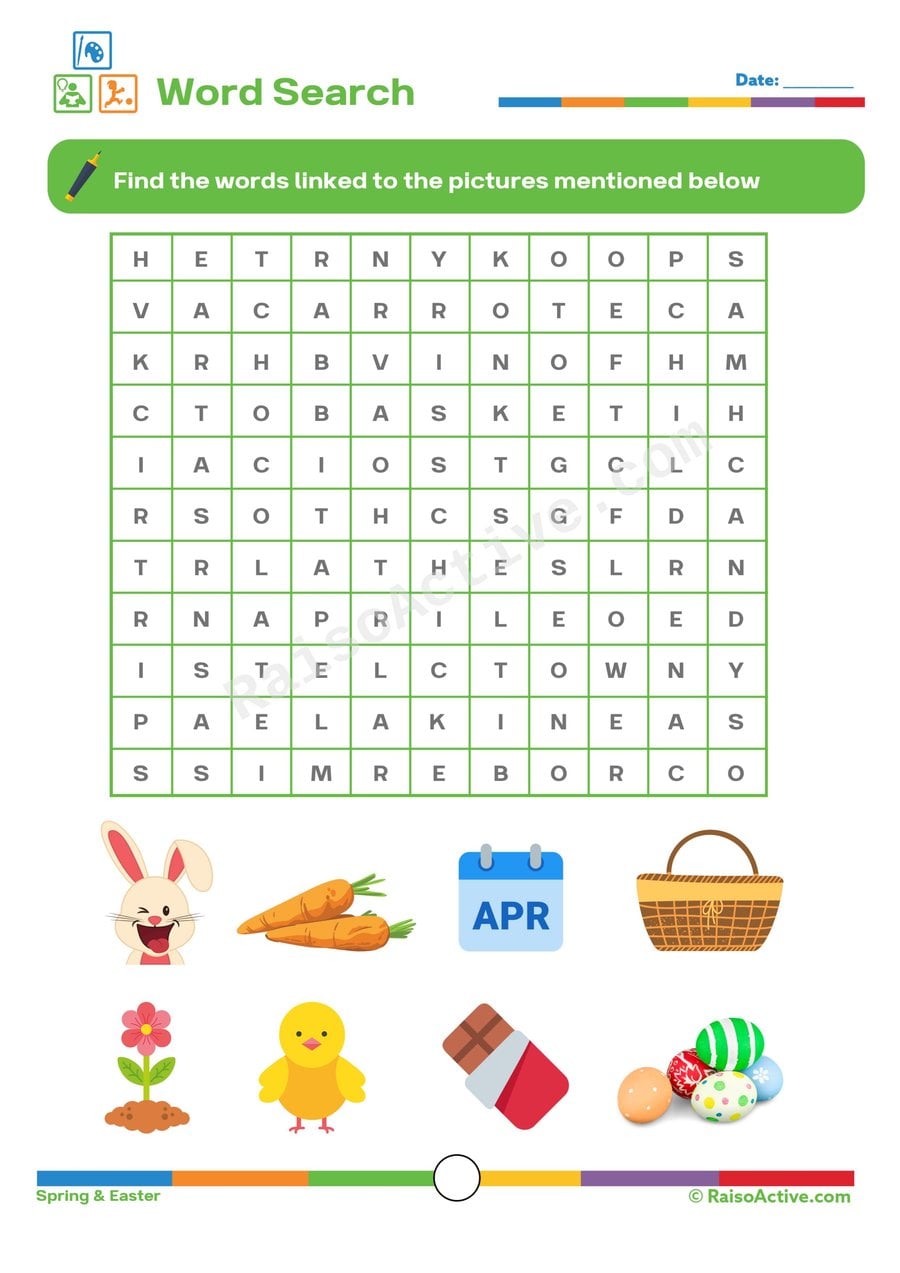
Spring Word Search Worksheet for Preschoolers
Ages 3-5 · Preschool–Pre-KAges 3-5 · Nursery–ReceptionAges 3-5 · Nursery–LKGAges 3-5
This Spring Word Search sharpens visual scanning and letter-tracking skills for children ages 3-5 as they hunt for season words hidden inside a grid of letters. Searching row by row and diagonally builds the same left-to-right tracking habit needed for reading, while recognizing whole words like 'FLOWER' or 'RAIN' strengthens early sight-word memory and spring vocabulary.
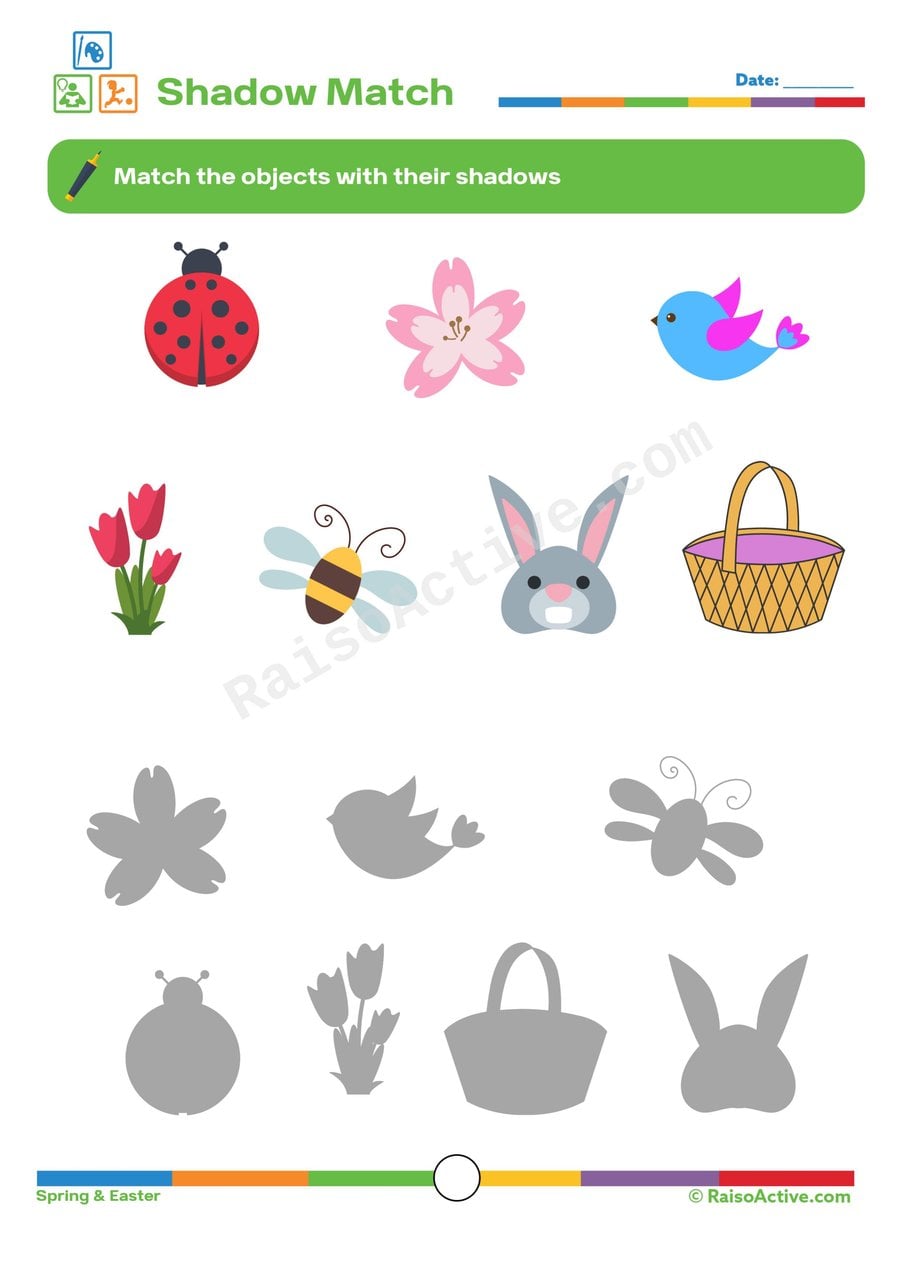
Spring Shadow Match Worksheet for Preschoolers
Ages 3-5 · Preschool–Pre-KAges 3-5 · Nursery–ReceptionAges 3-5 · Nursery–LKGAges 3-5
Children ages 3-5 practice visual discrimination by matching spring-themed objects to their correct silhouette shadows. Because shadows strip away color and detail, leaving only outline shape, this activity sharpens a child's ability to focus on form alone — a more advanced visual skill than matching by color or pattern.

Spot the Spots! Spring Coloring Worksheet for Preschoolers
Ages 3-5 · Preschool–Pre-KAges 3-5 · Nursery–ReceptionAges 3-5 · Nursery–LKGAges 3-5
This worksheet pairs counting practice with coloring as children ages 3-5 look at a number written beside each picture and color exactly that many spots onto it, reinforcing one-to-one correspondence between a numeral and a matching quantity. Because the target number changes from picture to picture, children must check the number freshly each time rather than coloring on autopilot.
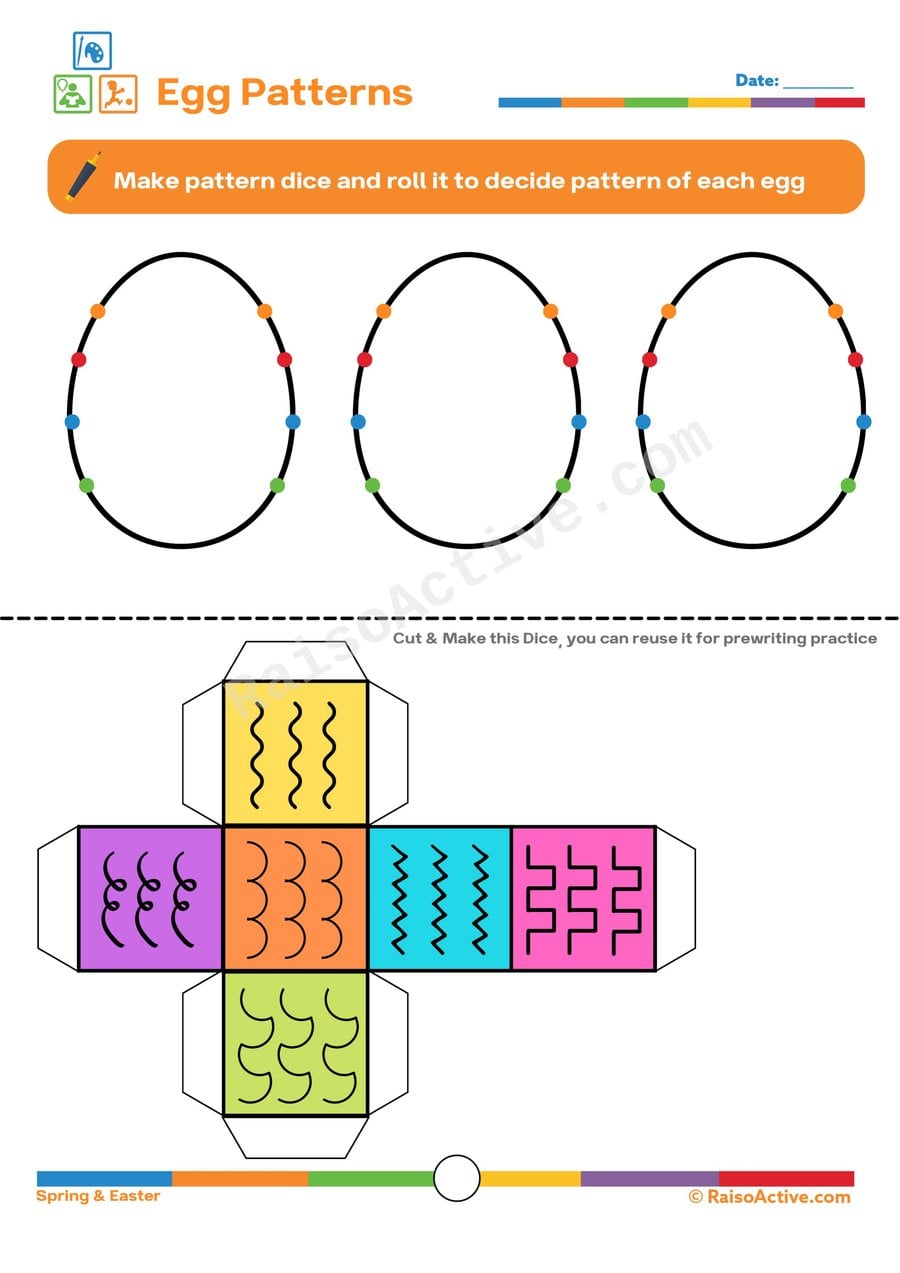
Egg Pattern Worksheet: Create and Match Patterns!
Ages 3-5 · Preschool–Pre-KAges 3-5 · Nursery–ReceptionAges 3-5 · Nursery–LKGAges 3-5
This egg-pattern activity has children ages 3-5 build a simple pattern dice and use it to generate and recreate repeating designs, developing pattern-recognition skills that underpin later math concepts like sequencing and multiplication. Rolling the dice and transferring the result onto each egg also connects a random outcome to a deliberate drawing action, strengthening cause-and-effect thinking.
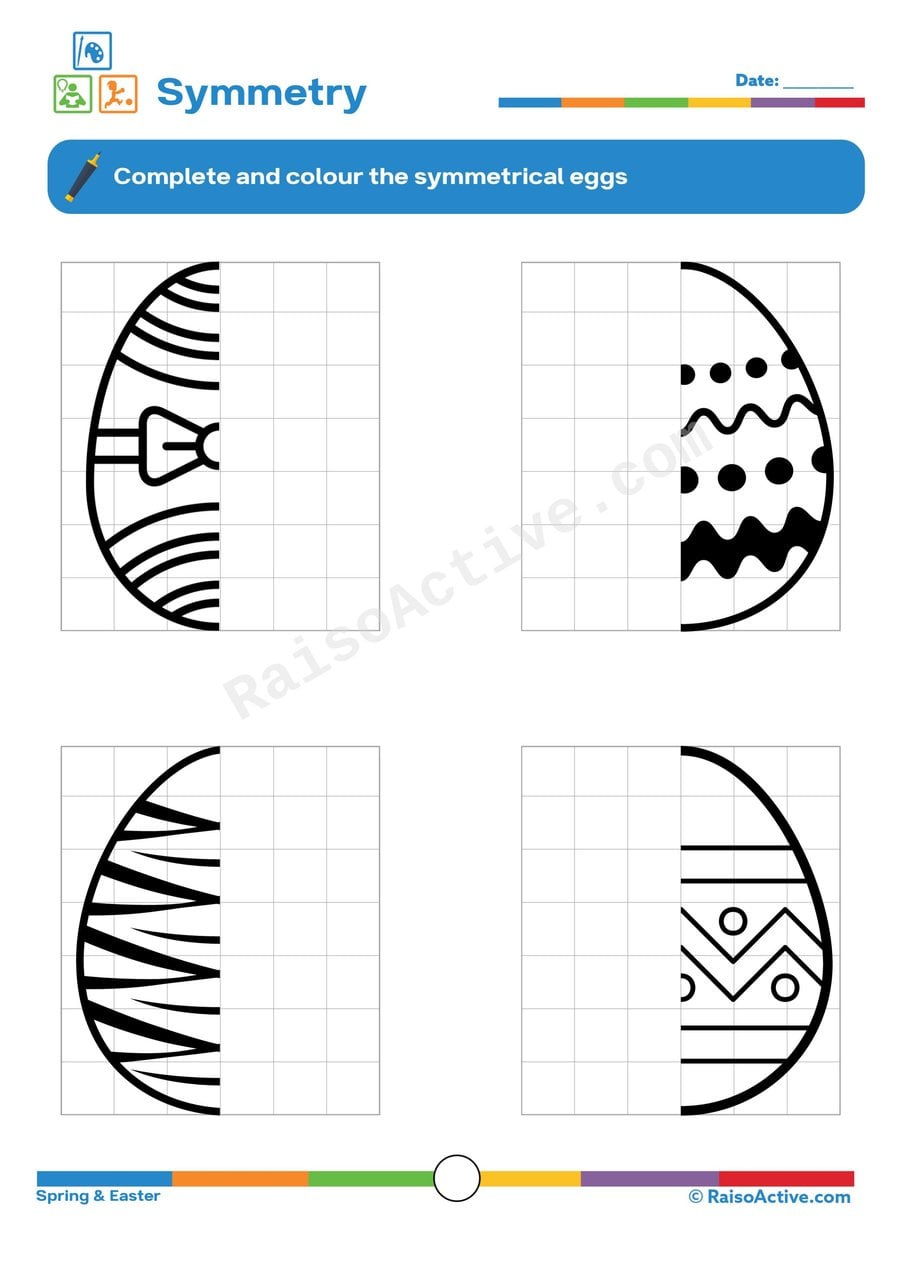
Symmetry Eggs Worksheet for Preschoolers
Ages 4-6 · Pre-K–KindergartenAges 4-6 · Reception–Year 1Ages 4-6 · LKG–UKGAges 4-6
This worksheet introduces children ages 4-6 to the concept of symmetry by having them complete the missing mirrored half of an egg design. Drawing a matching reflection requires children to closely observe shape, size, and placement on one side and reproduce it accurately on the other — an early geometry skill that also sharpens visual attention to detail.
Related worksheets
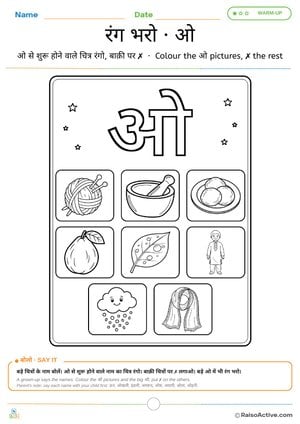
Colour the ओ Words – Hindi Letter ओ (o) Colouring Worksheet | ओ वाली चीज़ों में रंग भरो
Ages 3-7 · Preschool–Grade 1Ages 3-7 · Nursery–Year 2Ages 3-7 · Nursery–Class 1Ages 3-7
Children say each picture name aloud, decide whether it starts with ओ, colour the matching pictures (ओखली, ओस, ओला and ओढ़नी) and the big outline letter, and put a cross on the rest. Sorting by first sound trains the ear and colouring builds hand control.

Ganesha Colouring Page for Ganesh Chaturthi
Ages 4-8 · Pre-K–Grade 2Ages 4-8 · Reception–Year 3Ages 4-8 · LKG–Class 2Ages 4-8
Children learn that Ganesh Chaturthi celebrates the arrival of Lord Ganesha and that people offer him modaks, his favourite sweet.

Navratri Nine Colours Colouring Page: Colour the Garba Dancers
Ages 4-6 · Pre-K–KindergartenAges 4-6 · Reception–Year 1Ages 4-6 · LKG–UKGAges 4-6
Children learn the colour linked with each of the nine days of Navratri 2026 and practise colouring inside the lines.
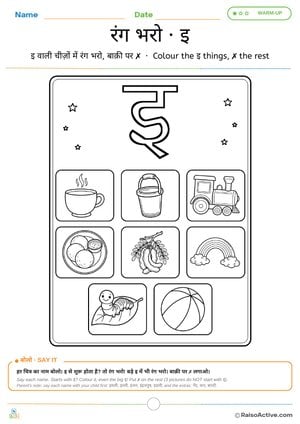
Colour the इ Things: Hindi Letter इ Colouring Page | रंग भरो · इ
Ages 3-7 · Preschool–Grade 1Ages 3-7 · Nursery–Year 2Ages 3-7 · Nursery–Class 1Ages 3-7
Children listen for the first sound of each picture name and decide whether it starts with इ. They colour the इ pictures, cross out the others and colour the big letter.
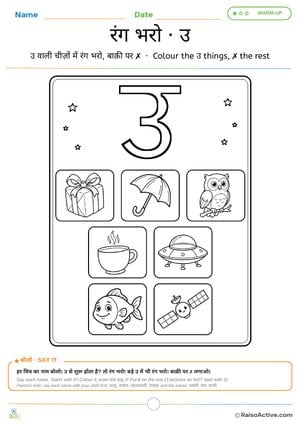
Colour the उ Things: Hindi Letter उ Colouring Page | रंग भरो · उ
Ages 3-7 · Preschool–Grade 1Ages 3-7 · Nursery–Year 2Ages 3-7 · Nursery–Class 1Ages 3-7
Children listen for the first sound of each picture name and decide whether it starts with उ. They colour the उ pictures, cross out the others and colour the big letter.

Symmetry Fun Worksheet for Kids: Complete and Color!
Ages 3-5 · Preschool–Pre-KAges 3-5 · Nursery–ReceptionAges 3-5 · Nursery–LKGAges 3-5
This symmetry worksheet challenges children ages 3-5 to study a half-drawn Christmas picture and draw the missing mirror-image half, introducing the early geometry concept that two sides of a shape can match exactly. Completing and then coloring the picture also builds visual comparison skills, since children must check their drawn half against the original before filling it in with color.

Spider Count Worksheet: Finger Painting Fun for Halloween!
Ages 3-5 · Preschool–Pre-KAges 3-5 · Nursery–ReceptionAges 3-5 · Nursery–LKGAges 3-5
Dabbing fingertips or Q-tips in paint to create the exact number of spiders shown on each web gives children ages 3-5 hands-on practice with one-to-one counting while also strengthening the small hand muscles needed for pencil control later on. Because each web has a target number, children must count as they paint rather than just decorating freely, which reinforces number recognition in a playful, low-pressure way. The messy, sensory nature of finger painting also supports focus and engagement at an age when seated paper-and-pencil tasks can be hard to sustain.

Spooky Fun Coloring Worksheet for Preschoolers
Ages 3-5 · Preschool–Pre-KAges 3-5 · Nursery–ReceptionAges 3-5 · Nursery–LKGAges 3-5
This Halloween-themed coloring page gives children ages 3-5 practice with crayon grip, color choice, and staying within outlines as they bring a collection of spooky objects to life. Naming each object as they color, like a ghost, a pumpkin, or a bat, also builds seasonal vocabulary tied directly to what they're seeing and creating.
Guides for this topic

Best Worksheets for 3-Year-Olds: What Works and What to Avoid
What works on worksheets for 3-year-olds: short sessions, crayons, tracing lines, matching, cutting, a free weekly plan, and signs one is too advanced.
Fostering Creativity in Structured Learning: The Perfect Balance for Young Minds
Learn how to blend creativity with structured learning for children ages 1-8. Practical strategies, activities, and printable worksheets for parents and teachers.
Celebrating Diversity: How to Incorporate Cultural Awareness in Learning Activities for Young Children
Practical cultural awareness activities for young children aged 2-8. Explore Indian festivals, world cultures, food, music, and crafts to teach diversity and inclusion.
Reviews
Every worksheet for ages 3–5, no watermark
Members download the full library of 1,000+ worksheets and every activity pack without watermarks or daily limits. One year costs ₹999 in India or $20 elsewhere.
See membership plansOr download any worksheet free with a watermark (5 a day).