Material Properties Worksheet for Kids: Matching and Identifying
This early science worksheet introduces children ages 3-5 to the idea that materials have distinct physical properties — like hardness, brittleness, or elasticity — and that everyday objects can be grouped based on how they look, feel, or behave. Matching objects to their correct property builds observational and classification skills, which are foundational scientific thinking tools long before formal science instruction begins. Talking through why a rubber band stretches while a plate breaks helps children start noticing cause-and-effect patterns in the physical world around them.
Part of the pack
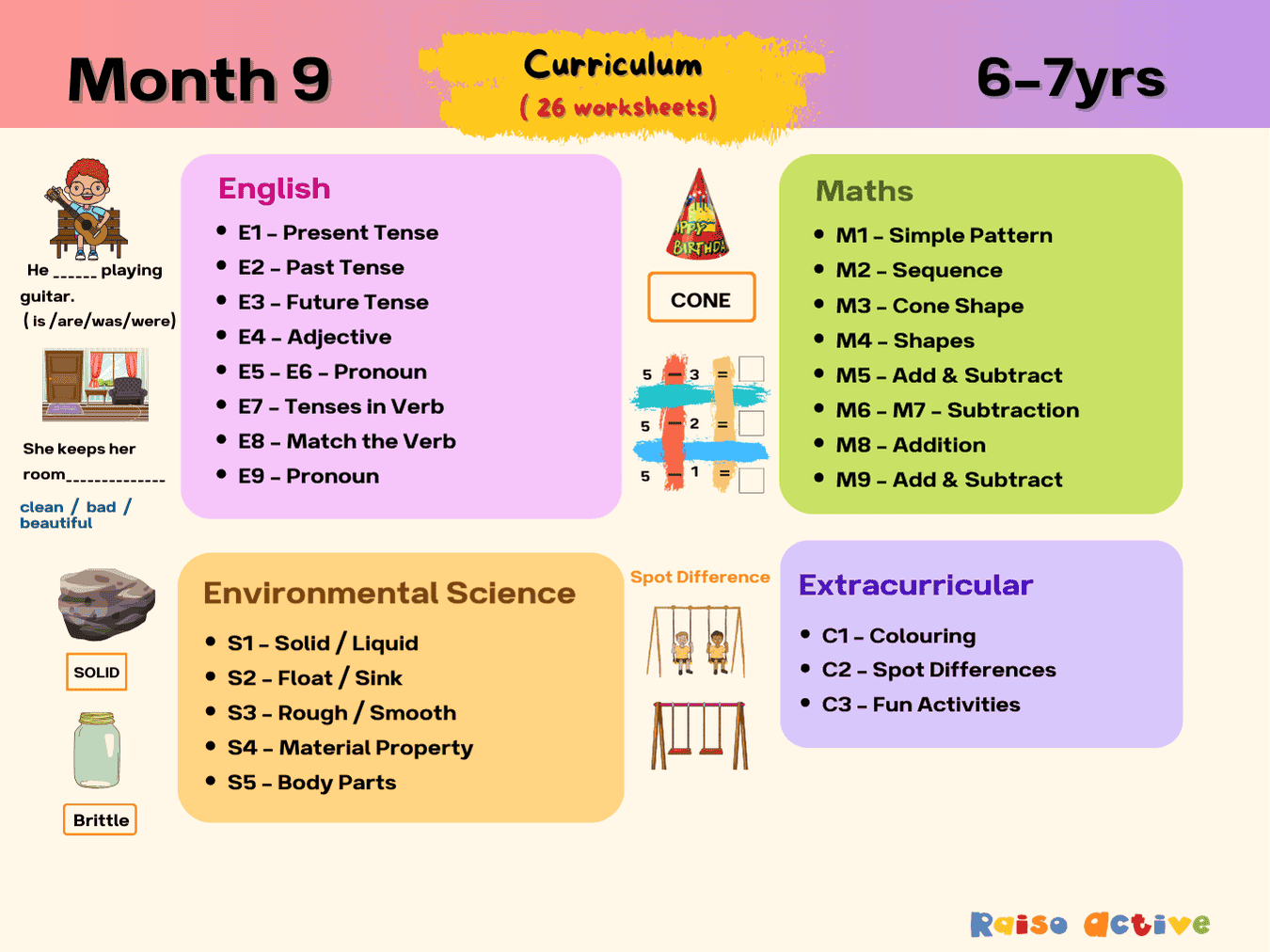
Month 9: Multi-Subject Early Learning | Ages 6-7
This is page 25 of the pack. Ages 6-7 · Grade 1Ages 6-7 · Year 2Ages 6-7 · Class 1Ages 6-7
Made for your child
Counting to 10, made for your child
A maths pack with your child's name in it: pictures that explain, practice at three levels, puzzles and story sums about them. Print a new set whenever they finish.
Make a maths packFree preview · free for members
Curriculum
- Earth & Environment > Material Properties
How to use this worksheet
Look at each picture and read its description together, talking about what that object is like to touch or how it behaves when you interact with it. Ask your child which property matches each object, such as whether something is hard, bendy, or likely to break. Have them draw a line connecting each object to its correct property description. Work through the whole page this way, discussing real examples from home whenever possible to make the properties more concrete.
Materials needed
- Pencil
- Eraser
Extension activities
- 1Walk around the house together and find real objects that demonstrate each property, like something hard and something stretchy.
- 2Create a simple chart listing different materials and their properties as you discover them together.
- 3Do a hands-on test, gently bending or pressing safe household objects to observe their properties firsthand.
- 4Sort a basket of toys or objects into groups based on shared material properties.
- 5Talk about what material something is made from and why that material was chosen, like why cups are often hard and not stretchy.

Written by
Hemsweta Jain · Teacher Cheena
MBA and Early Childhood Educator, teaching since 2014 · Founder of RaisoActive, Mumbai
Every RaisoActive worksheet is designed and checked by the founder before publishing.
Published · Last reviewed
More from Month 9: Multi-Subject Early Learning | Ages 6-7
Solid vs. Liquid Worksheet: Color and Learn!
Ages 3-5 · Preschool–Pre-KAges 3-5 · Nursery–ReceptionAges 3-5 · Nursery–LKGAges 3-5
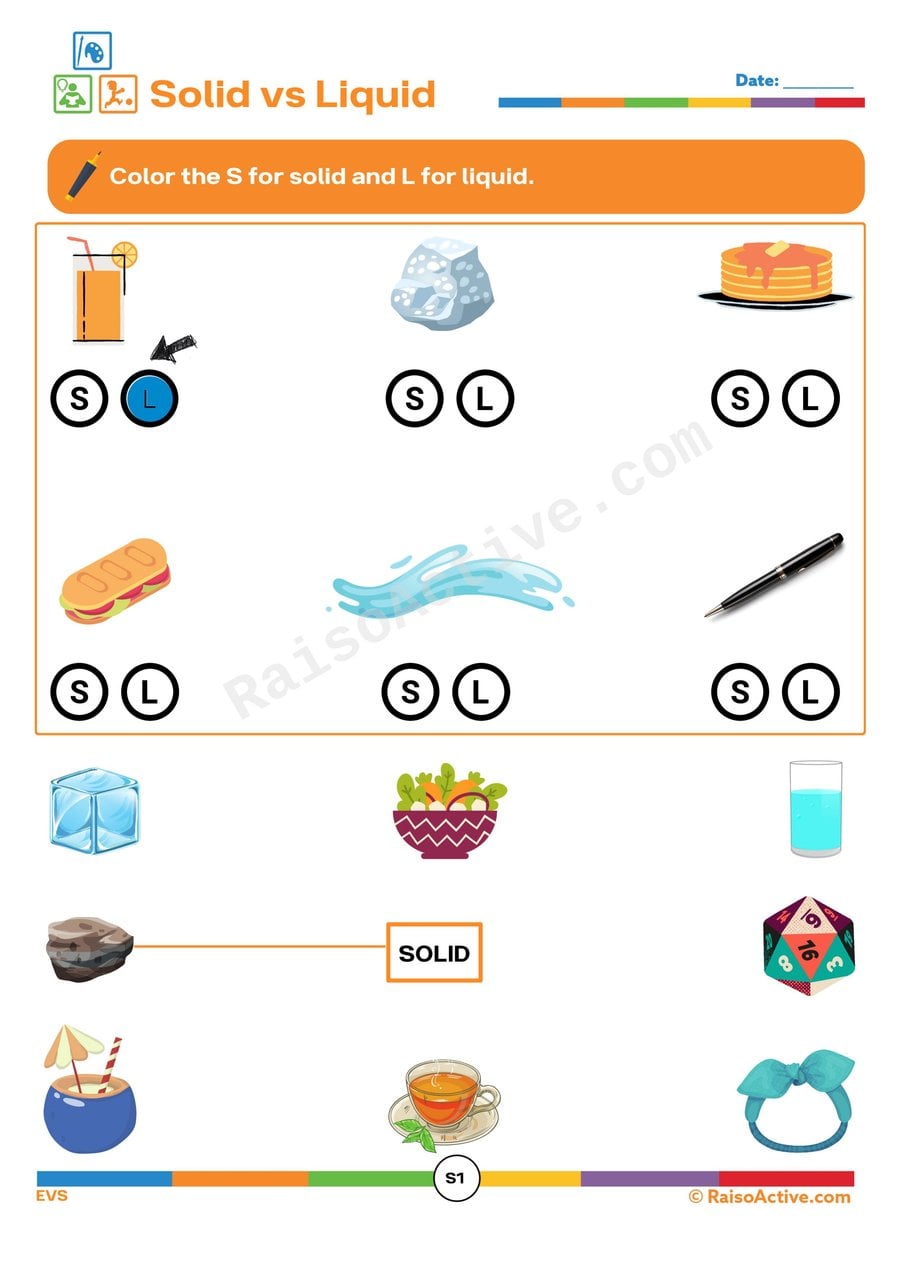
This worksheet introduces children ages 3-5 to the basic science concept of states of matter by having them sort pictured items into solids and liquids and color a corresponding letter, 'S' or 'L'. Early classification of the physical world — noticing that some things hold their shape while others flow and take the shape of their container — is an important first step in scientific thinking and observation.

Cut and Paste Body Parts Worksheet for Preschoolers
Ages 4-6 · Pre-K–KindergartenAges 4-6 · Reception–Year 1Ages 4-6 · LKG–UKGAges 4-6
This worksheet helps children ages 4-6 learn to name and correctly place major body parts by cutting them out and pasting each one onto the right location on a body outline. Physically assembling a body diagram builds body awareness and vocabulary at the same time, while the cutting and gluing sharpens fine motor precision that supports later handwriting.
Past Tense Verbs Worksheet for Kids
Ages 4-6 · Pre-K–KindergartenAges 4-6 · Reception–Year 1Ages 4-6 · LKG–UKGAges 4-6
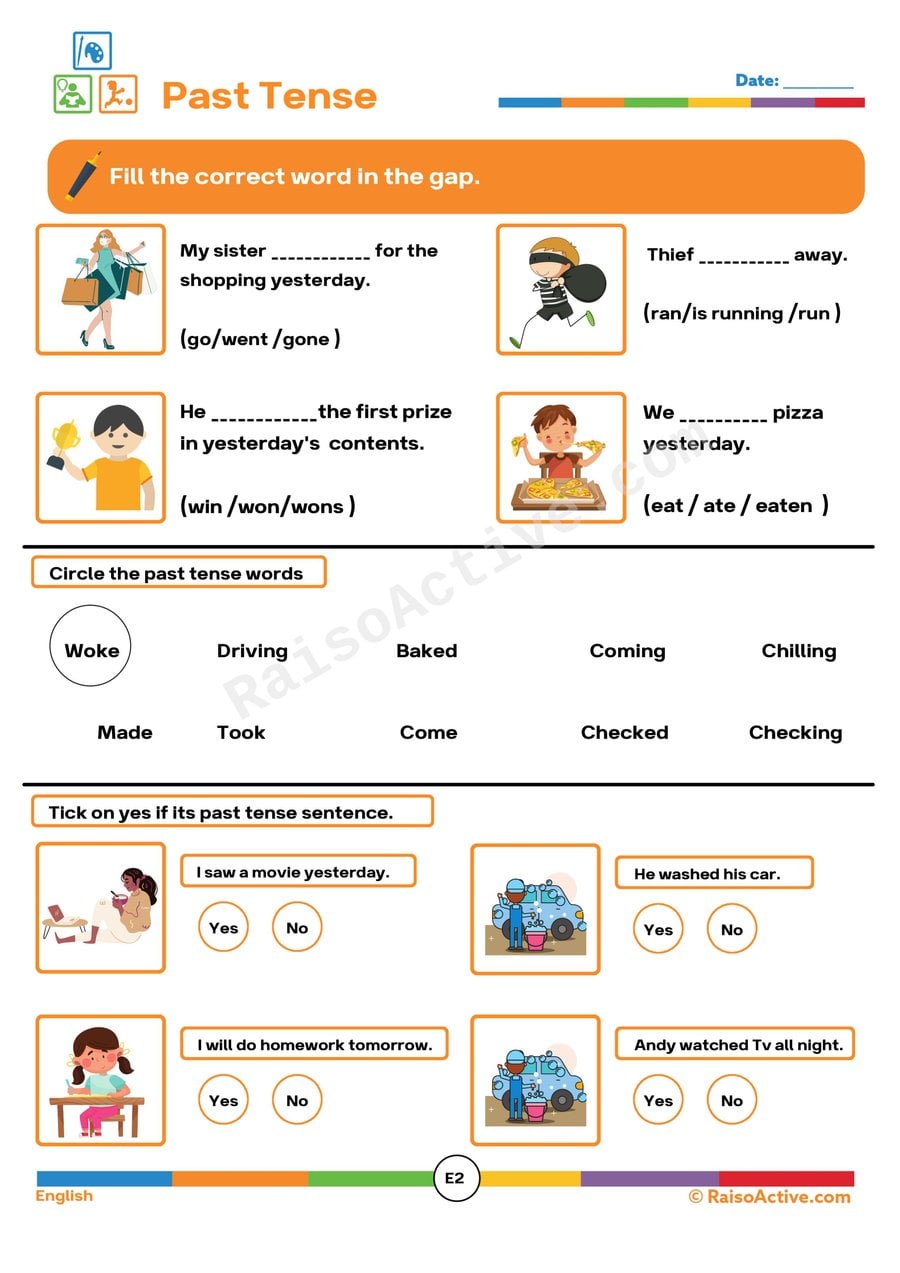
Understanding that verbs change form to show when an action happened is an important grammar concept for children ages 4-6, and this worksheet gives them focused practice recognizing and using past tense verbs in context. Filling in blanks with the correct past tense form, circling past tense words, and judging whether a sentence is already in the past tense all approach the same grammar skill from different angles, which helps solidify the pattern. This kind of grammar awareness supports both clearer spoken language and more accurate writing as children begin composing their own sentences.

Spot the Differences! Fun Picture Puzzle Worksheet for Kids
Ages 3-5 · Preschool–Pre-KAges 3-5 · Nursery–ReceptionAges 3-5 · Nursery–LKGAges 3-5
This spot-the-differences puzzle sharpens visual discrimination in children ages 3-5 by requiring them to compare two nearly identical pictures and notice small changes in detail, color, or position. Scanning systematically for differences also builds sustained visual attention and patience, both important pre-academic skills that support later tasks like proofreading and careful reading.

Simple Pattern Worksheet for Preschoolers: Fill in the Sequence!
Ages 3-5 · Preschool–Pre-KAges 3-5 · Nursery–ReceptionAges 3-5 · Nursery–LKGAges 3-5
Recognizing and continuing a pattern is one of the earliest building blocks of mathematical and logical thinking for children ages 3-5, since it requires noticing a repeating rule and predicting what comes next based on that rule. This worksheet uses both shapes and numbers to build pattern awareness, asking children to fill in missing elements in a sequence and then match related number sequences together. Pattern recognition like this underpins later skills in math, reading, and even everyday problem-solving, since spotting repeating structures is a skill that transfers well beyond this one worksheet.

Rough vs. Smooth Worksheet: Sorting and Counting Objects
Ages 3-5 · Preschool–Pre-KAges 3-5 · Nursery–ReceptionAges 3-5 · Nursery–LKGAges 3-5
Rough and smooth are texture words a 3-5 year old usually understands through touch long before they can reliably identify them just by looking at a picture, so this worksheet bridges that gap by pairing the visual sorting task with counting practice. Counting how many rough versus smooth objects appear afterward layers basic data skills — 'which group has more?' — on top of the classification.

Add and Subtract Worksheet: Fun Math Practice for Kids!
Ages 4-6 · Pre-K–KindergartenAges 4-6 · Reception–Year 1Ages 4-6 · LKG–UKGAges 4-6
This worksheet pairs addition and subtraction practice with a cut-and-paste answer selection, asking children ages 4-6 to solve simple equations using pictured objects and then find and paste the matching numeral from a set of options. Choosing the correct answer from several options, rather than writing it freehand, adds a layer of number recognition practice alongside the arithmetic itself.
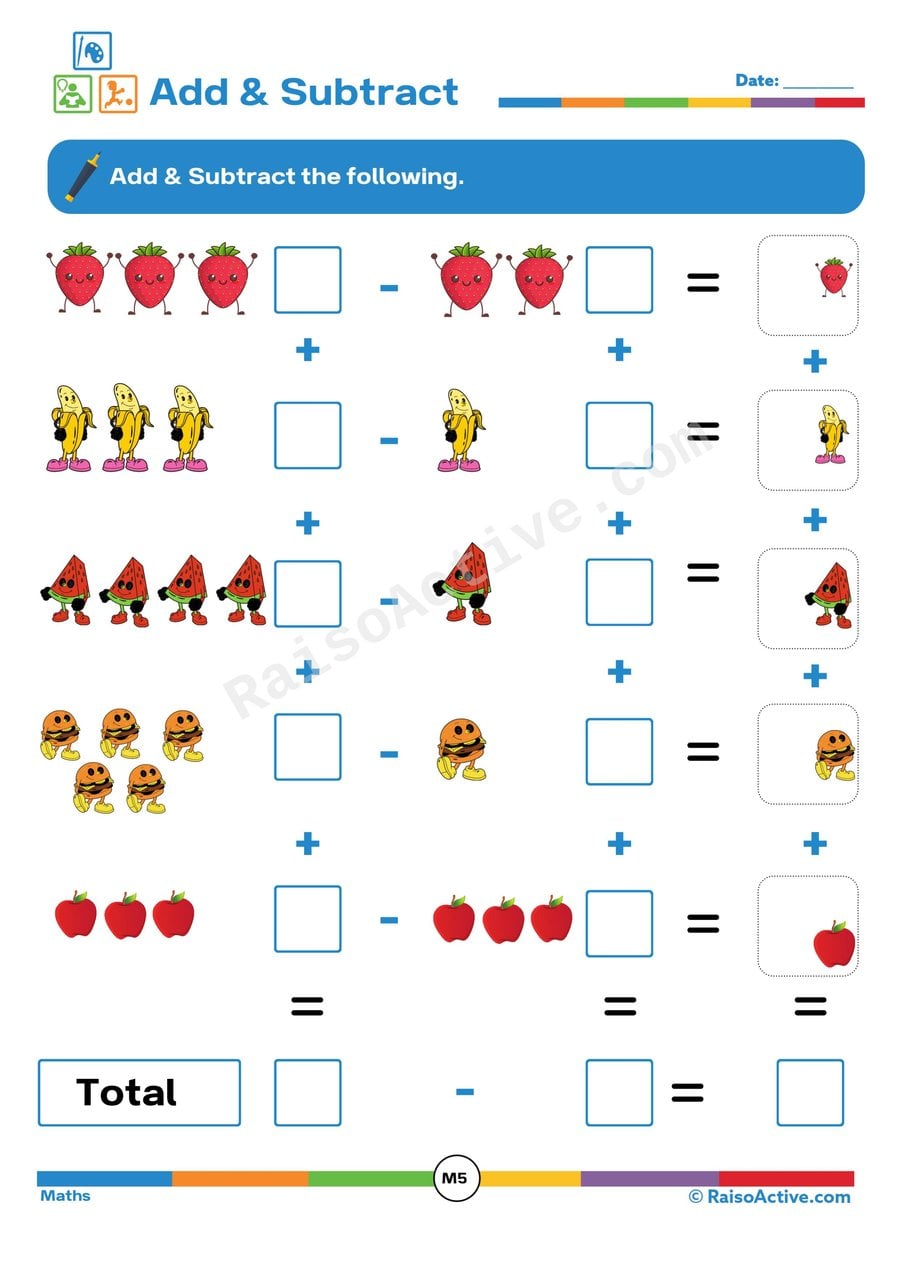
Fun Add & Subtract Worksheet for Preschoolers!
Ages 4-6 · Pre-K–KindergartenAges 4-6 · Reception–Year 1Ages 4-6 · LKG–UKGAges 4-6
This worksheet introduces children ages 4-6 to the basics of addition and subtraction by having them count pictured objects, record the quantities, and then combine or take away groups to find a total. Working with visual objects rather than abstract numbers alone helps children build a concrete understanding of what addition and subtraction actually mean before they're expected to solve equations using numbers only.
Related worksheets

Energy Sources Worksheet for Kids: Identifying Light and Heat
Ages 3-5 · Preschool–Pre-KAges 3-5 · Nursery–ReceptionAges 3-5 · Nursery–LKGAges 3-5
Children ages 3-5 learn to identify sources of light and heat energy, like the sun, a lamp, or a fire, by ticking the correct option for each pictured scene. Distinguishing natural sources of heat, like the sun, from artificial ones, like a stove, introduces early scientific classification of energy in the world around them. This awareness lays groundwork for later science topics about energy, weather, and how everyday objects work.

Material Properties Sorting Worksheet for Preschoolers
Ages 3-5 · Preschool–Pre-KAges 3-5 · Nursery–ReceptionAges 3-5 · Nursery–LKGAges 3-5
Children ages 3-5 practice identifying basic material properties, like hard, soft, rough, or smooth, and sorting everyday objects accordingly, an early science observation skill that builds the foundation for later lessons on states of matter and physical properties. Describing why an object belongs in a category also strengthens descriptive vocabulary.

Energy Sources Worksheet: Circle the Energy Sources!
Ages 4-6 · Pre-K–KindergartenAges 4-6 · Reception–Year 1Ages 4-6 · LKG–UKGAges 4-6
This worksheet introduces children ages 4-6 to the basic science concept that certain objects and phenomena — like the sun, batteries, or wind — are sources of energy, while other everyday objects are not. Asking children to circle only the true energy sources from a mixed set of pictures builds early categorization and critical thinking skills, since they must apply a definition rather than just recognize familiar objects. Writing numbers stepwise afterward adds a light sequencing task that keeps the page varied rather than focused on a single skill.
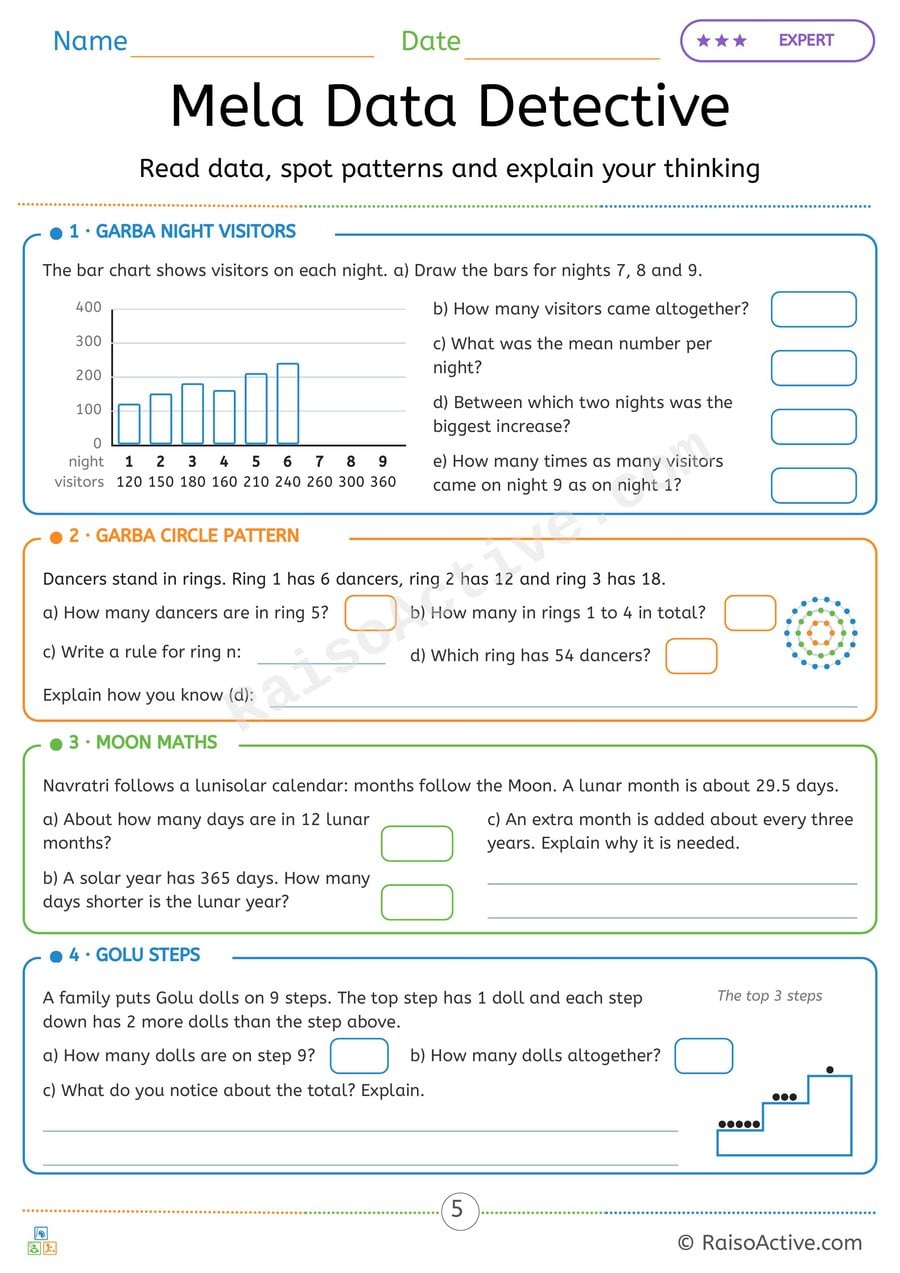
Mela Data Detective: Navratri Bar Chart, Patterns and Moon Maths
Ages 7-11 · Grade 2–Grade 3Ages 7-11 · Year 3–Year 4Ages 7-11 · Class 2–Class 3Ages 7-11
Children complete a bar chart of nine nights of visitors, find the total, the mean and the biggest increase, find and explain the rule for a growing pattern of dancers, compare a lunar year with a solar year, and add the dolls on nine Golu steps to discover a square number.
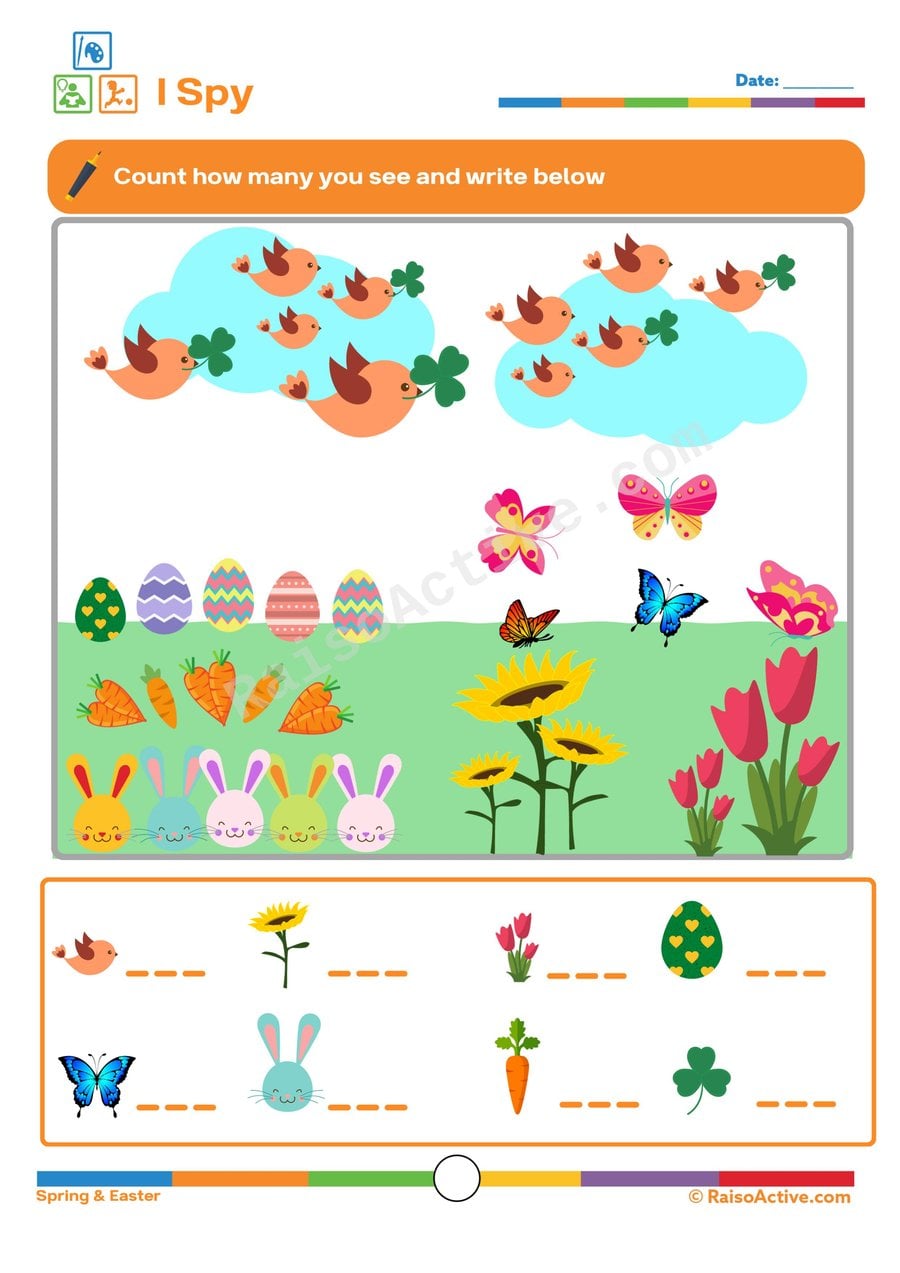
I Spy Spring Worksheet: Count and Write!
Ages 3-5 · Preschool–Pre-KAges 3-5 · Nursery–ReceptionAges 3-5 · Nursery–LKGAges 3-5
Spotting and tallying spring-themed pictures, like flowers, bees, or raindrops, gives children ages 3-5 practice with one-to-one counting and then translating that count into a written numeral. Because the items are scattered across the page rather than lined up neatly, children also build visual scanning skills as they search each section carefully before counting. Writing the final number afterward connects the physical act of counting to abstract number symbols, a key early numeracy milestone.
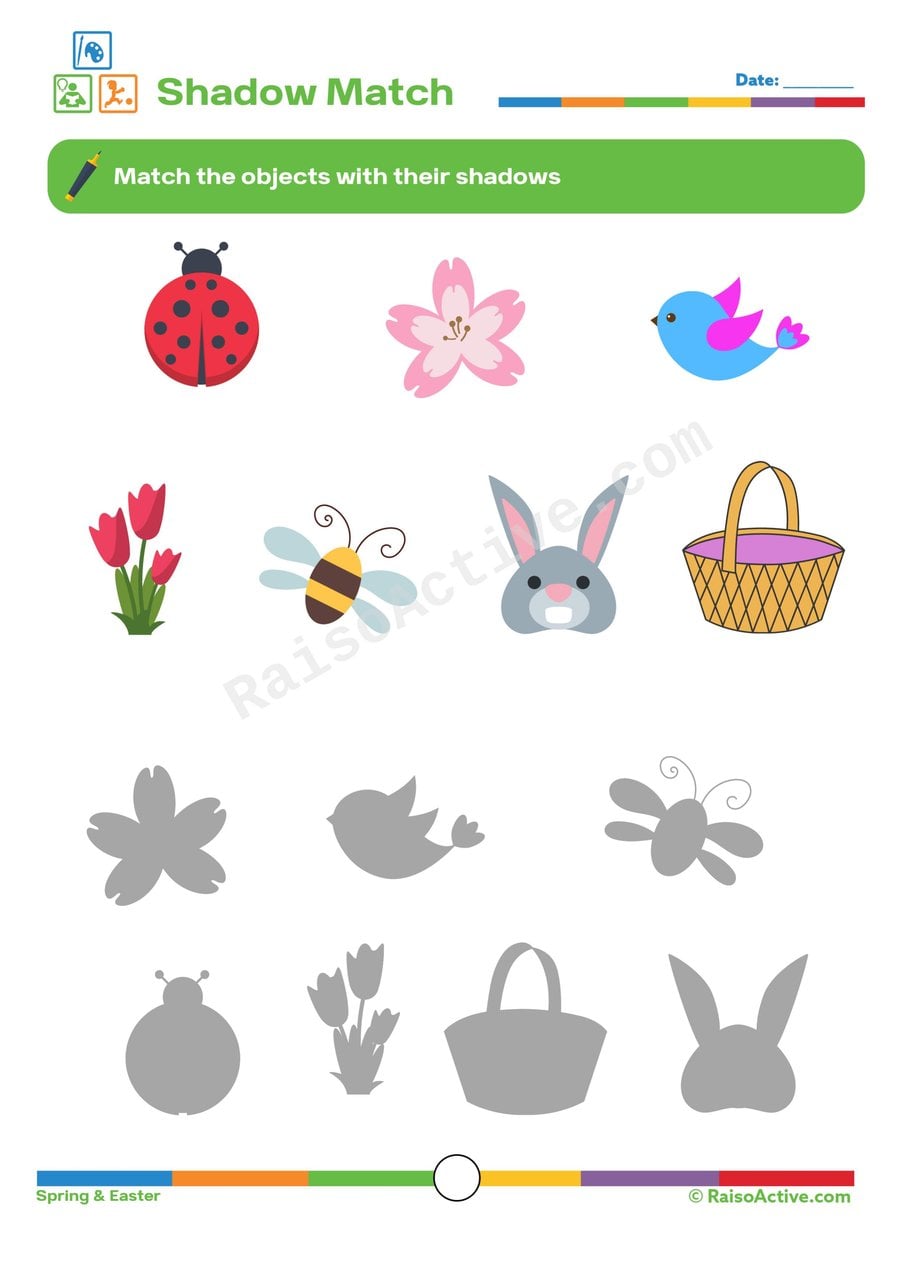
Spring Shadow Match Worksheet for Preschoolers
Ages 3-5 · Preschool–Pre-KAges 3-5 · Nursery–ReceptionAges 3-5 · Nursery–LKGAges 3-5
Children ages 3-5 practice visual discrimination by matching spring-themed objects to their correct silhouette shadows. Because shadows strip away color and detail, leaving only outline shape, this activity sharpens a child's ability to focus on form alone — a more advanced visual skill than matching by color or pattern.
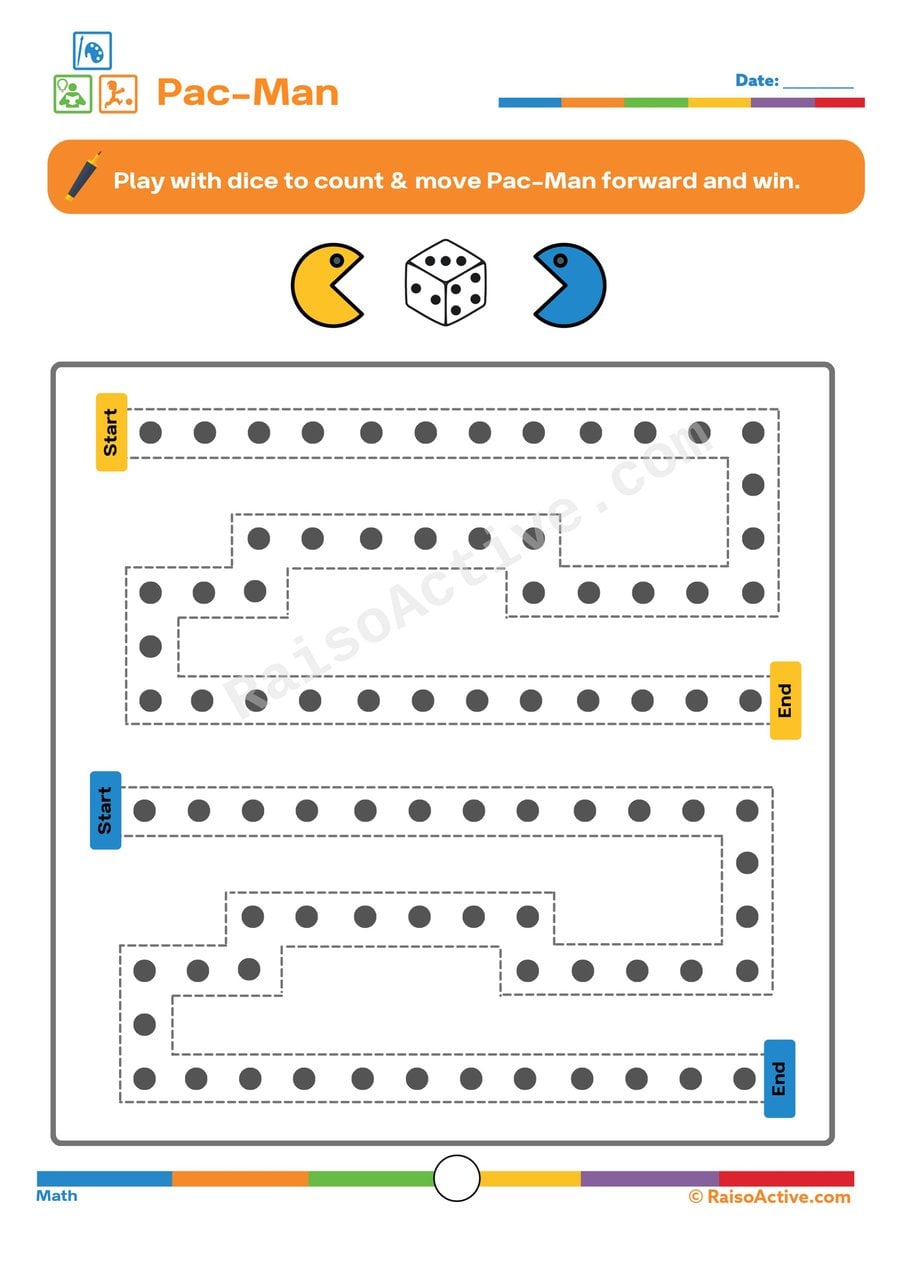
Pac-Man Maze Worksheet: Count and Move!
Ages 3-5 · Preschool–Pre-KAges 3-5 · Nursery–ReceptionAges 3-5 · Nursery–LKGAges 3-5
This dice-counting maze gives children ages 3-5 repeated practice matching a rolled number to the correct number of moves, reinforcing accurate counting under a bit of playful pressure. Tracking Pac-Man's current position after each roll also builds short-term spatial memory, since children must remember where they left off before moving again.

Harvests & New Years: One Harvest, Many Names Across India
Ages 4-8 · Pre-K–Grade 2Ages 4-8 · Reception–Year 3Ages 4-8 · LKG–Class 2Ages 4-8
Children learn that the same winter harvest is celebrated with different names across India, and that many states have their own New Year festival.
Guides for this topic

Best Worksheets for 3-Year-Olds: What Works and What to Avoid
What works on worksheets for 3-year-olds: short sessions, crayons, tracing lines, matching, cutting, a free weekly plan, and signs one is too advanced.

Age-Appropriate Problem-Solving Activities: Building Critical Thinkers from the Ground Up
Discover fun, age-appropriate problem-solving activities for children ages 1-8. Build critical thinking, logic, and reasoning skills through play-based learning.
Critical Thinking Activities That Actually Work for Young Children: Building Tomorrow's Thinkers Today
Discover proven critical thinking activities for young children. Age-wise logic games, questioning techniques, and hands-on ideas to build thinking skills at home.
Reviews
Every worksheet for ages 3–5, no watermark
Members download the full library of 1,000+ worksheets and every activity pack without watermarks or daily limits. One year costs ₹999 in India or $20 elsewhere.
See membership plansOr download any worksheet free with a watermark (5 a day).