Preposition Worksheet: Identifying Where Things Are!
This worksheet asks children to identify the correct preposition, words like 'in,' 'on,' 'under,' or 'behind', that describes where an object is located in a picture, building spatial vocabulary that supports both everyday communication and following multi-step instructions. For ages three to five, prepositions are often used correctly in speech before children can identify them on paper, so this worksheet helps make that intuitive knowledge explicit.
Part of the pack
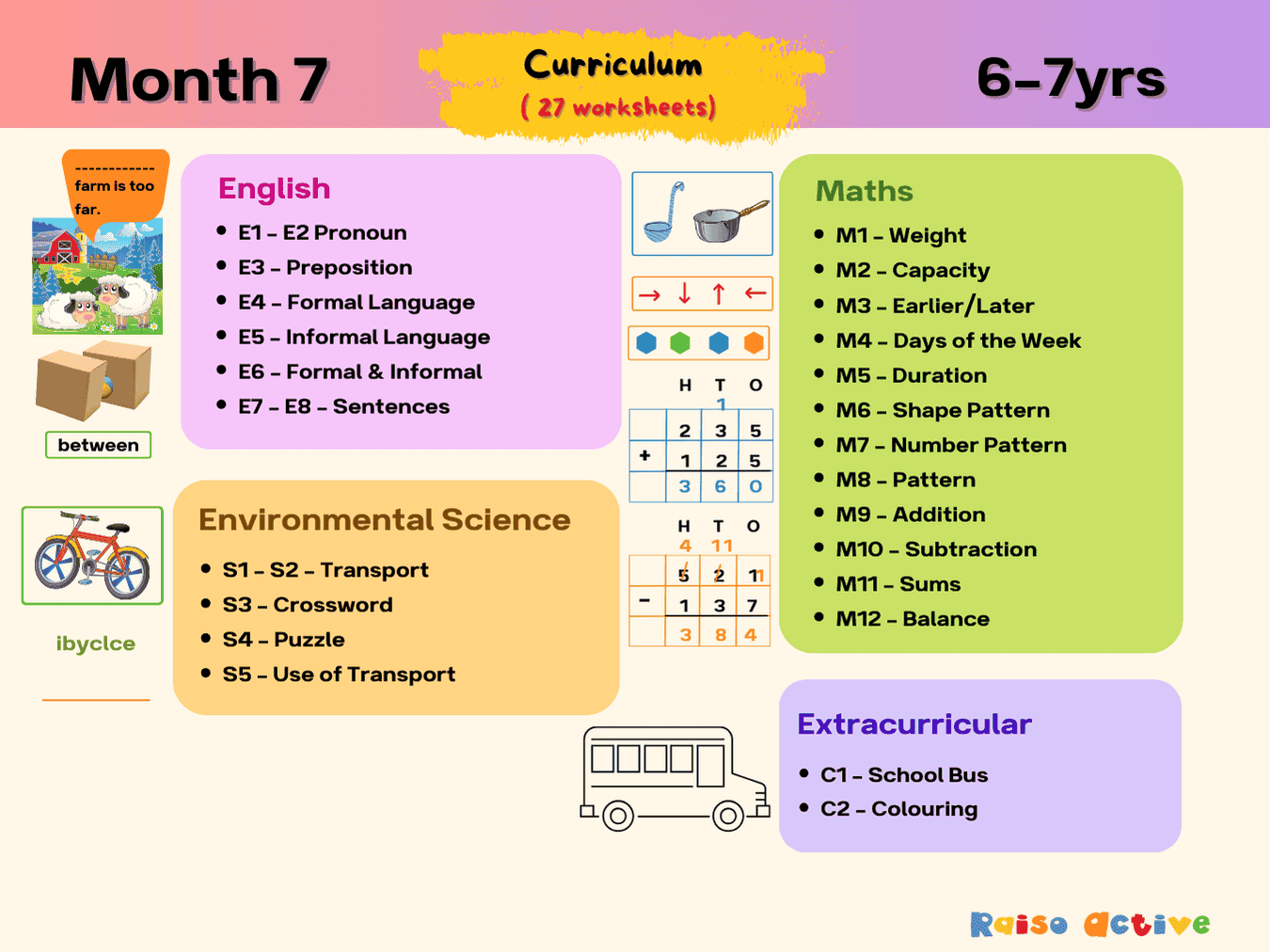
Month 7: Foundational English Math Science | Ages 6-7
This is page 6 of the pack. Ages 6-7 · Grade 1Ages 6-7 · Year 2Ages 6-7 · Class 1Ages 6-7
Made for your child
A whole activity pack made with their name
60 pages to spot, build, trace and write their own name, plus pages about their favourites, feelings and family. See a free preview with their name.
Make an All About Me packFree preview · free for members
Or start free: a name tracing sheet with their nameCurriculum
- Grammar > Prepositions
How to use this worksheet
Look at each picture together first and describe out loud where the object is located, using natural language before checking the worksheet's word choices. Read the sentence beneath the picture together, pausing at the blank to consider which preposition fits. Have your child choose the correct word from the options provided and write it into the blank space. Continue through each picture and sentence, reading the completed sentence aloud together once the blank is filled in.
Materials needed
- Pencil
- Eraser
Extension activities
- 1Have your child point out real objects in their environment and describe their location using prepositions.
- 2Create your own sentences using prepositions about objects in your home, like 'the cat is under the table.'
- 3Play a preposition game where you give instructions like 'put the ball behind the chair' and your child follows along.
- 4Look through a picture book and ask your child to describe where different characters or objects are using preposition words.

Written by
Hemsweta Jain · Teacher Cheena
MBA and Early Childhood Educator, teaching since 2014 · Founder of RaisoActive, Mumbai
Every RaisoActive worksheet is designed and checked by the founder before publishing.
Published · Last reviewed
More from Month 7: Foundational English Math Science | Ages 6-7

Complex or Compound Sentences Worksheet for Kids
Ages 4-6 · Pre-K–KindergartenAges 4-6 · Reception–Year 1Ages 4-6 · LKG–UKGAges 4-6
This worksheet narrows the focus to just two sentence types, compound and complex, asking children to tell them apart by identifying the connecting word that joins the clauses. For ages four to six, distinguishing these two structures specifically builds on earlier simple-sentence recognition and prepares them to eventually write more varied, interesting sentences of their own.
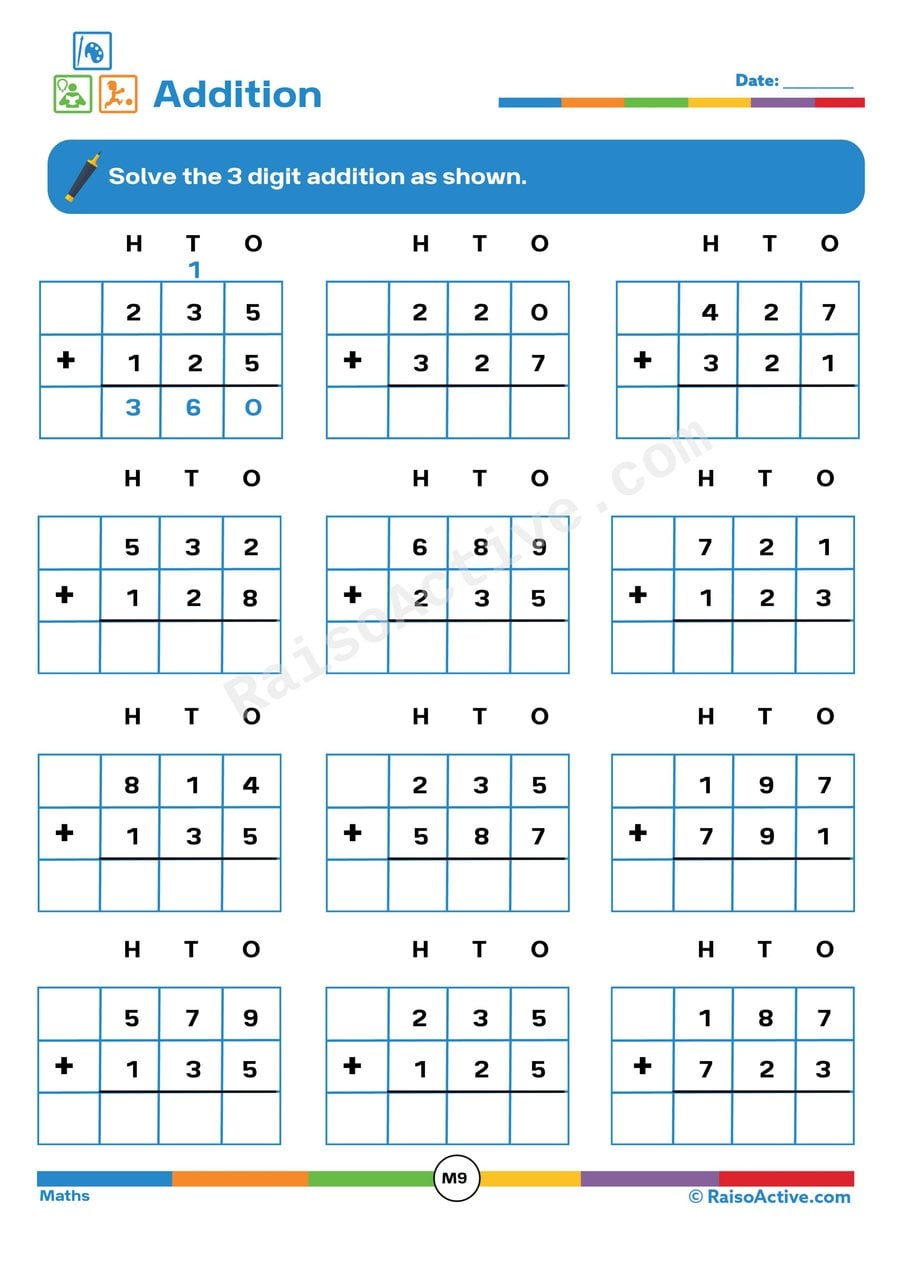
3-Digit Addition Worksheet for Kids
Ages 6-8 · Grade 1–Grade 2Ages 6-8 · Year 2–Year 3Ages 6-8 · Class 1–Class 2Ages 6-8
Adding two three-digit numbers requires children to work through the ones, tens, and hundreds columns in order and understand how a sum in one column can carry over into the next, a significant step up from single-digit addition. For ages six to eight, mastering this column-based process builds the procedural fluency needed for all future multi-digit arithmetic.
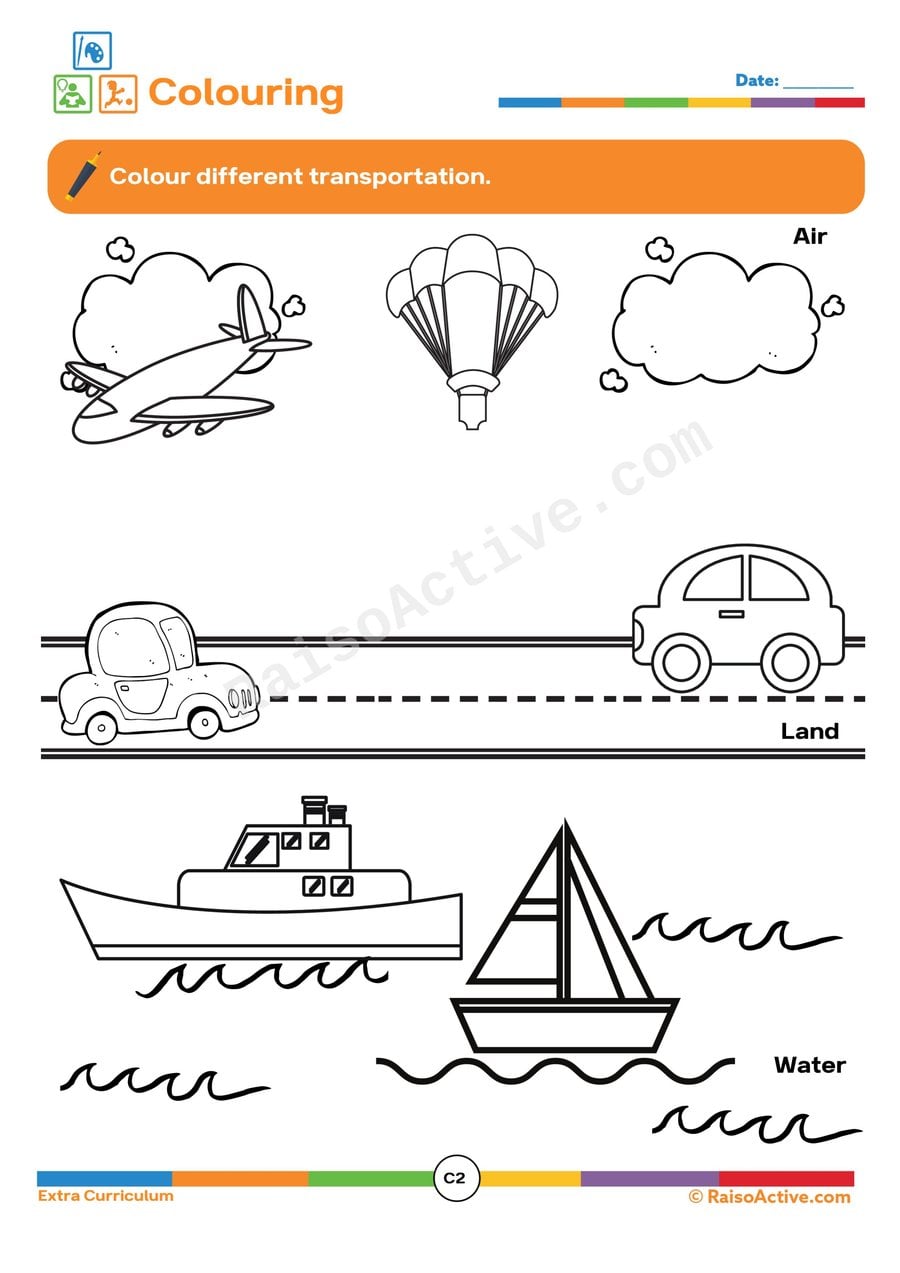
Color the Transportation Worksheet for Kids
Ages 3-5 · Preschool–Pre-KAges 3-5 · Nursery–ReceptionAges 3-5 · Nursery–LKGAges 3-5
Coloring vehicles that travel by air, land, and water helps children ages 3-5 build an early classification system for how transportation is grouped by environment, not just by shape or size. Naming where each vehicle travels while coloring also reinforces vocabulary and observation skills, since children must look closely at each picture's features to decide its category.

Demonstrative Pronoun Fun: Farm Animals Worksheet for Kids
Ages 3-5 · Preschool–Pre-KAges 3-5 · Nursery–ReceptionAges 3-5 · Nursery–LKGAges 3-5
Using farm animal pictures as the context, children ages 3-5 practice choosing the right demonstrative pronoun — this, that, these, or those — based on how close or how many animals are shown. Anchoring the grammar concept in familiar, engaging farm animals makes an otherwise abstract idea about proximity and number much easier for young children to grasp.

Transport Worksheet: Cut and Paste the Correct Mode of Transport!
Ages 4-6 · Pre-K–KindergartenAges 4-6 · Reception–Year 1Ages 4-6 · LKG–UKGAges 4-6
Reading a sentence and choosing the correct vehicle to complete it teaches children ages 4-6 to use context clues from text to guide a decision, an early reading comprehension skill that goes beyond simple word recognition. The cutting and pasting also reinforces vocabulary for different modes of transportation as children physically match each picture to its described purpose.

Addition and Subtraction Sums Worksheet for Preschoolers
Ages 4-6 · Pre-K–KindergartenAges 4-6 · Reception–Year 1Ages 4-6 · LKG–UKGAges 4-6
Practicing addition and subtraction problems within 10 together, rather than in separate worksheets, helps children see the two operations as related, that subtraction can undo addition, which builds more flexible number sense than drilling each skill in isolation. For ages four to six, working within small numbers keeps the focus on understanding the operations rather than on managing large quantities.

Capacity Worksheet: Circle the Object with More Capacity!
Ages 3-5 · Preschool–Pre-KAges 3-5 · Nursery–ReceptionAges 3-5 · Nursery–LKGAges 3-5
Comparing pairs of containers teaches children ages 3-5 the early measurement concept of capacity — how much space is inside an object for holding something — which is distinct from simply judging an object's overall size. Making a choice and explaining it also builds early reasoning skills, since children must connect what they see to an invisible property, the amount something can hold.
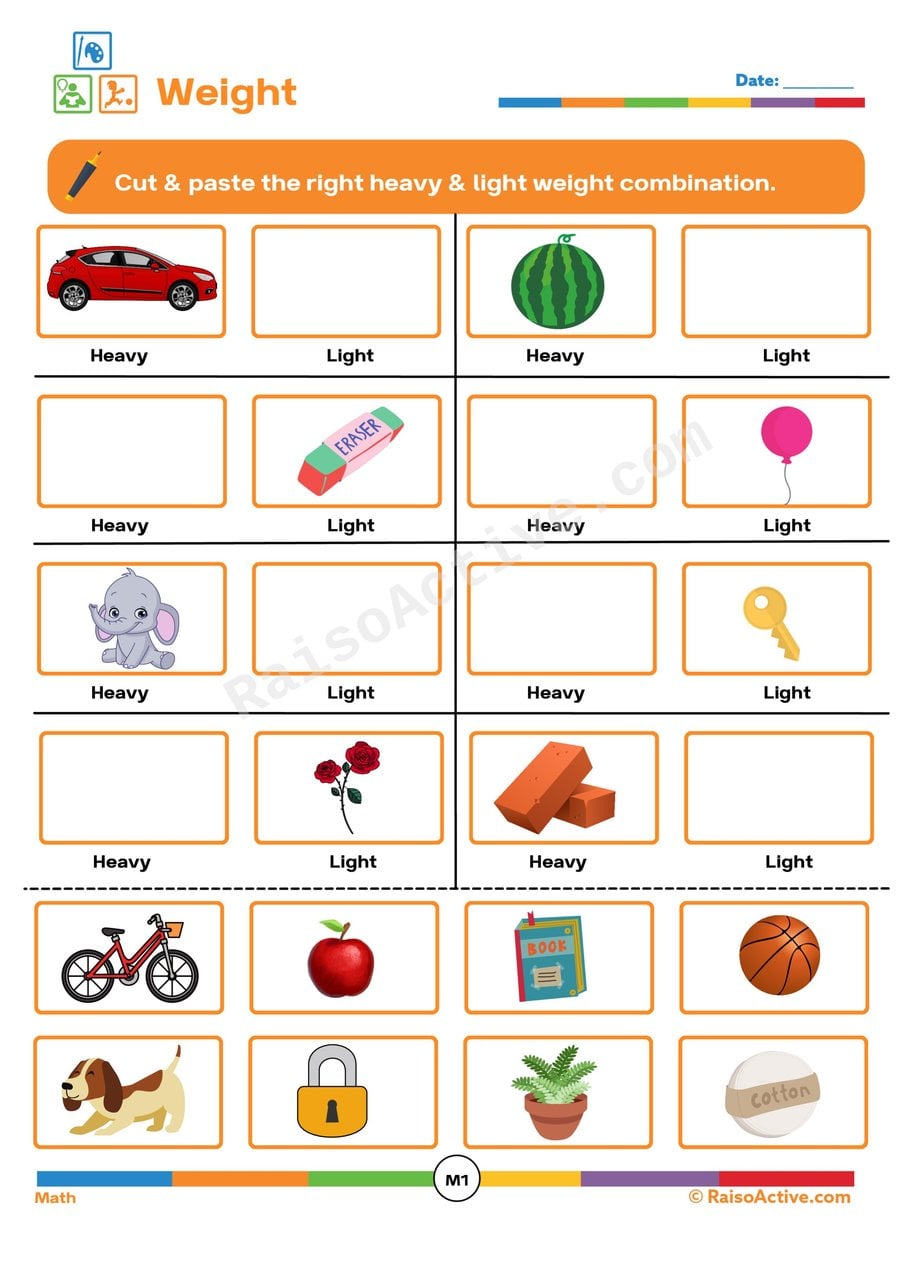
Weight Sorting Worksheet: Heavy vs. Light!
Ages 3-5 · Preschool–Pre-KAges 3-5 · Nursery–ReceptionAges 3-5 · Nursery–LKGAges 3-5
Sorting pictures into 'heavy' and 'light' categories introduces children to comparative reasoning about weight, a physical property they can't always judge from a picture alone, which pushes them to rely on real-world knowledge of the objects shown rather than visual size alone. For ages three to five, this distinction is an early step toward measurement concepts they'll formalize later with scales and standard units.
Related worksheets

Preposition Worksheet: Circle the Correct Position!
Ages 3-5 · Preschool–Pre-KAges 3-5 · Nursery–ReceptionAges 3-5 · Nursery–LKGAges 3-5
Children ages 3-5 practice identifying prepositions like 'in,' 'on,' and 'under' by looking at a picture and circling the word that correctly describes where an object is positioned. This builds early spatial vocabulary that children use constantly in everyday communication, from describing where a toy is to following directions.
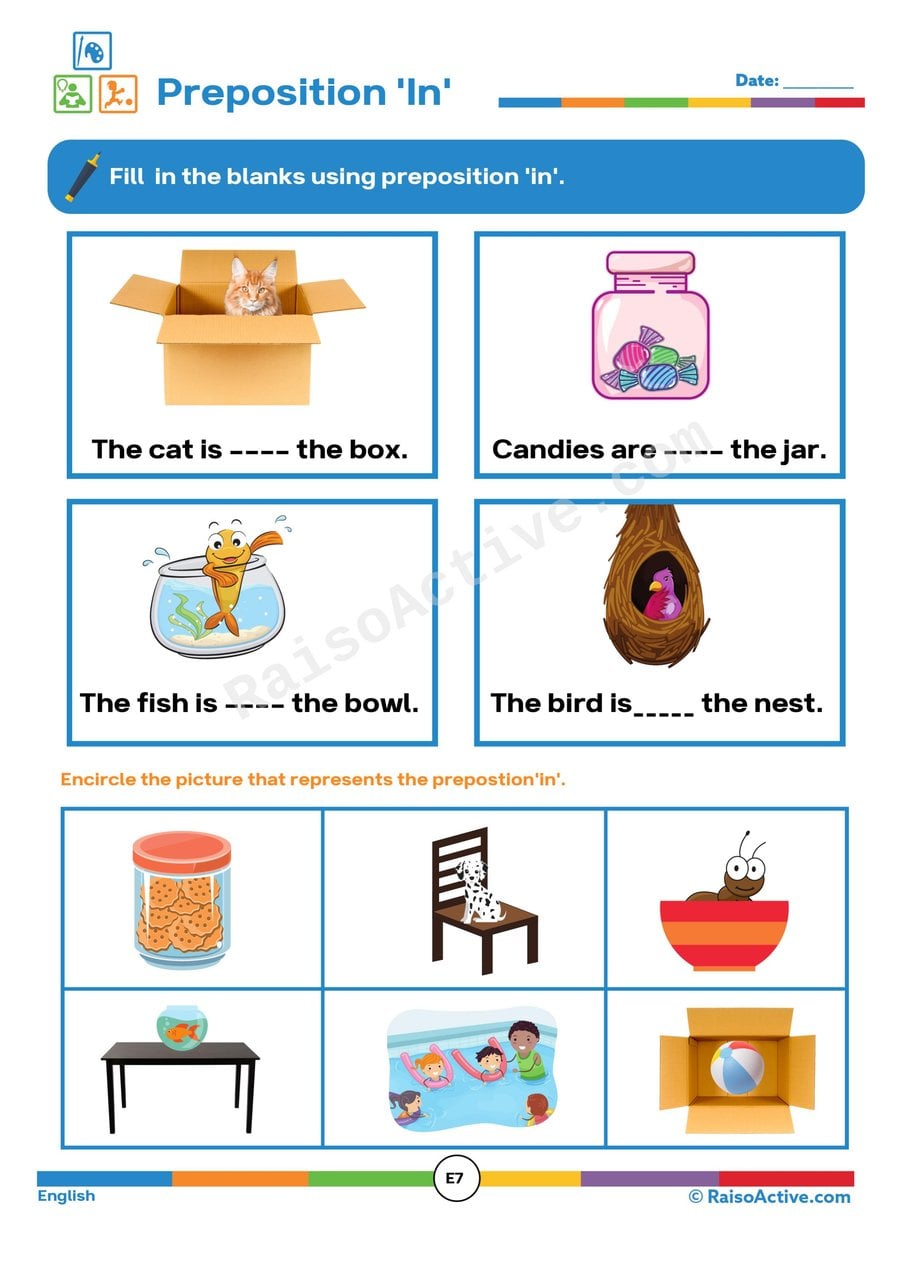
Preposition 'In' Worksheet: Fill-in-the-Blanks Fun!
Ages 4-6 · Pre-K–KindergartenAges 4-6 · Reception–Year 1Ages 4-6 · LKG–UKGAges 4-6
This worksheet introduces the preposition 'in' as a specific positional word describing something located inside another object, building both grammar knowledge and spatial vocabulary. For ages 4-6, understanding prepositions like 'in' is essential for constructing clear, descriptive sentences and following spatial directions in everyday life.
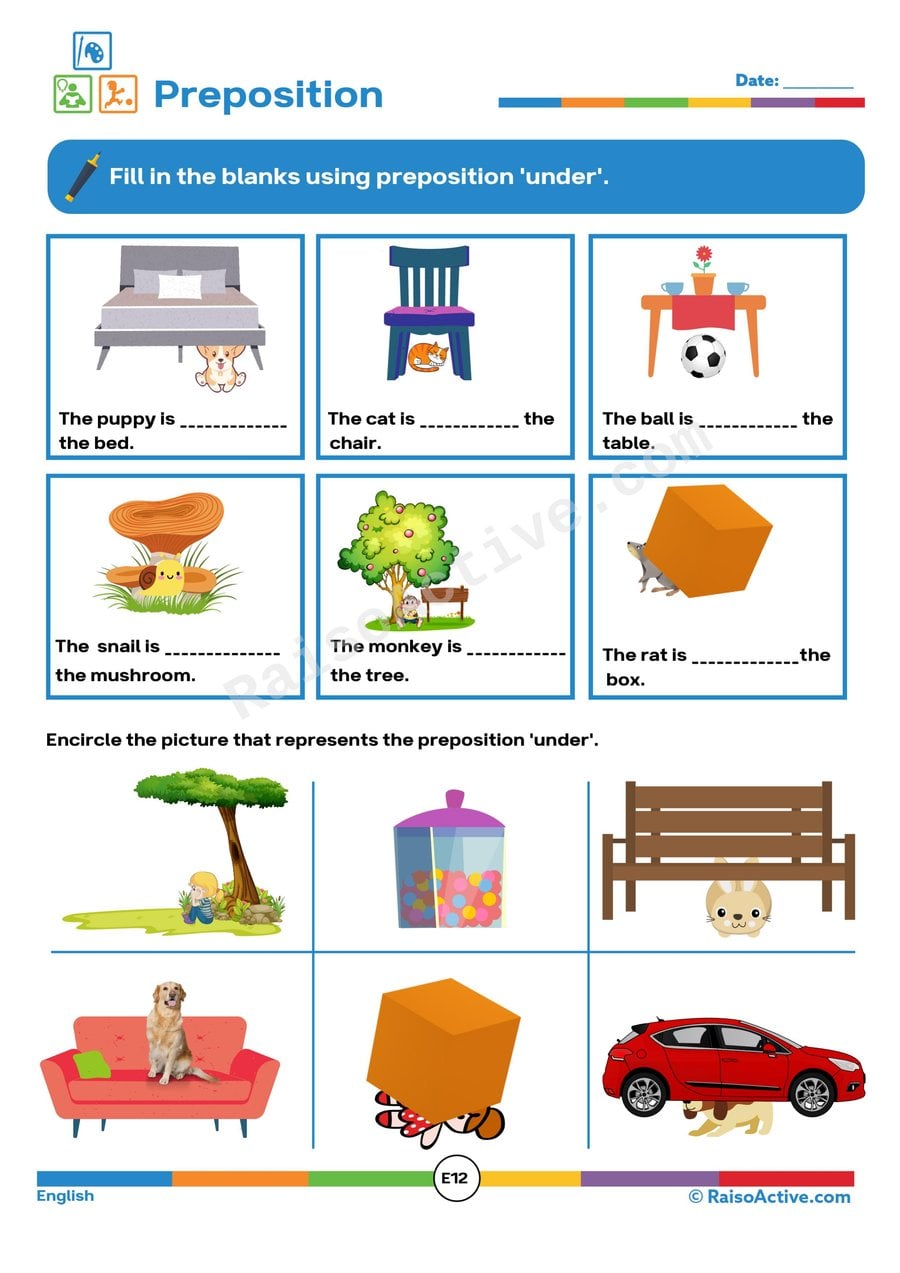
Preposition 'Under' Worksheet: Fun with Placement!
Ages 3-5 · Preschool–Pre-KAges 3-5 · Nursery–ReceptionAges 3-5 · Nursery–LKGAges 3-5
Practicing the preposition 'under' teaches children ages 3-5 to describe spatial relationships between objects, an early grammar concept closely tied to their developing understanding of physical space. Filling in the blank and then identifying pictures that show something under another object reinforces the word's meaning through both language and visual recognition.
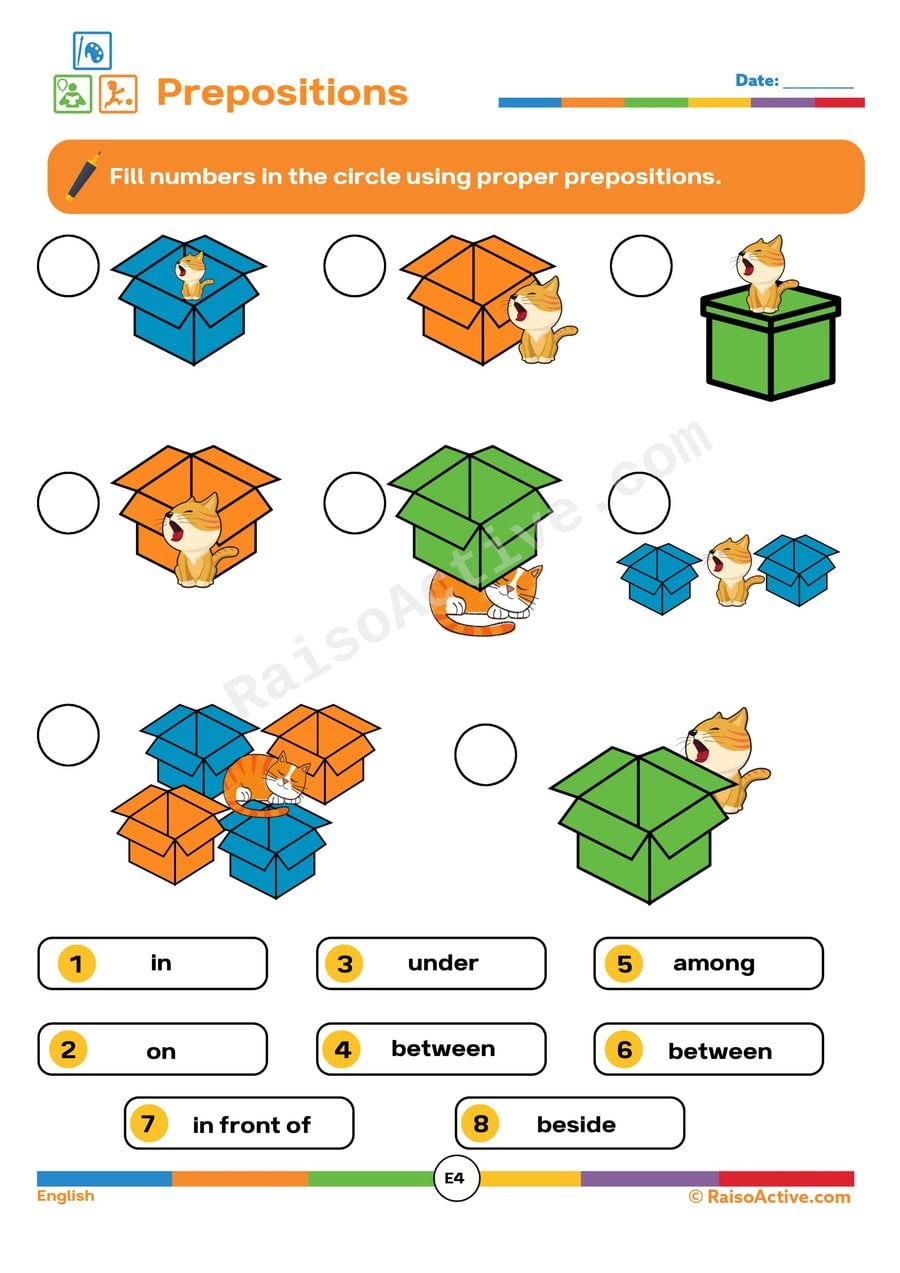
Prepositions Worksheet: Where Are the Cats?
Ages 3-5 · Preschool–Pre-KAges 3-5 · Nursery–ReceptionAges 3-5 · Nursery–LKGAges 3-5
This worksheet helps children ages 3-5 learn positional prepositions — words like 'under,' 'on,' 'behind,' and 'in' — by matching each word to a picture showing exactly where a cat is located. Understanding these small but essential words builds spatial vocabulary and comprehension skills that are used constantly in both everyday instructions and later reading comprehension.
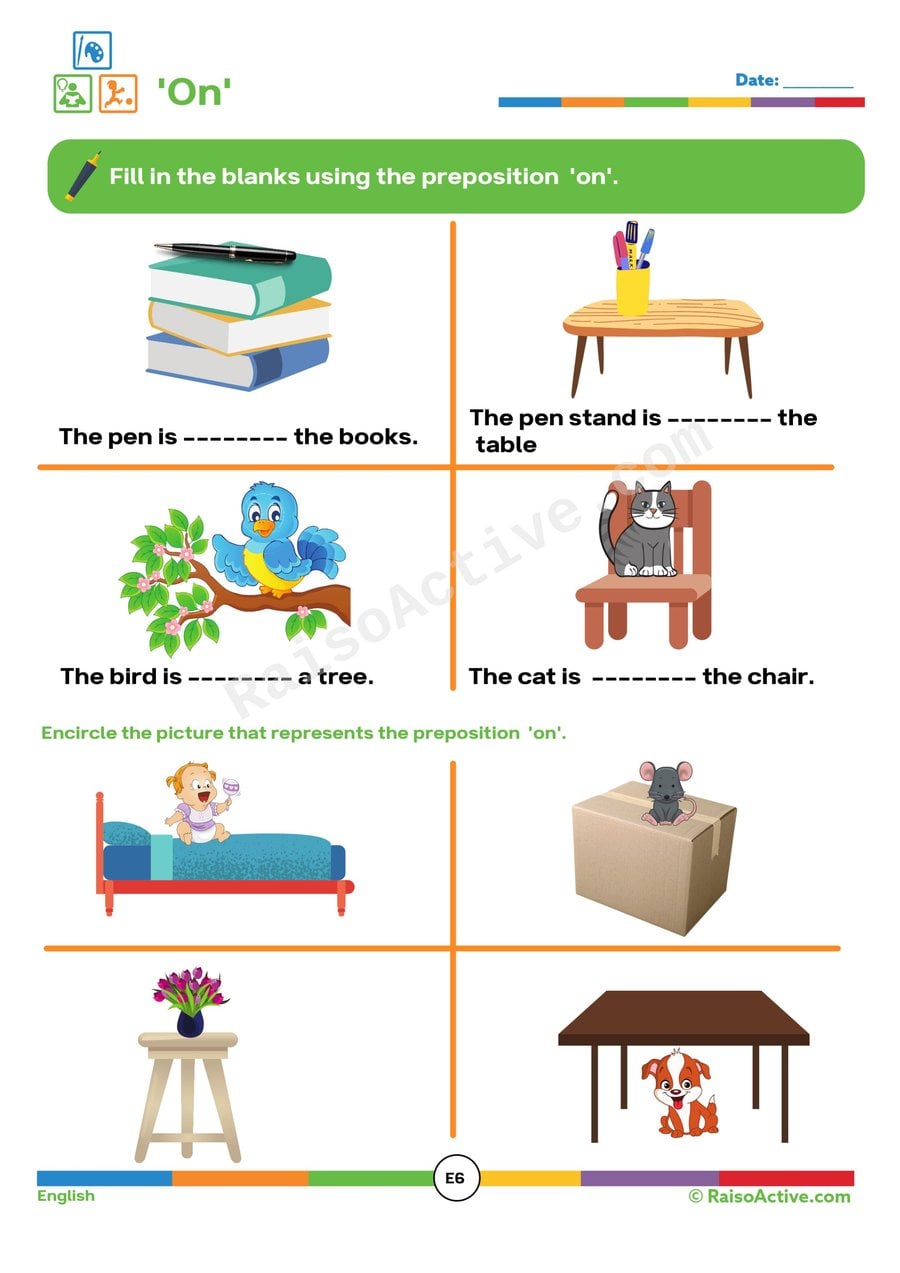
Preposition Fun: 'On' Worksheet for Early Learners
Ages 3-5 · Preschool–Pre-KAges 3-5 · Nursery–ReceptionAges 3-5 · Nursery–LKGAges 3-5
Practicing the preposition 'on' teaches children ages 3-5 how a small function word can precisely describe where one object sits in relation to another, an early and important step in building more complex, descriptive sentences. Filling in the blank with 'on' repeatedly across different sentences helps the word become automatic rather than something they have to think hard about each time. Circling the picture that correctly shows something 'on' another object also checks that your child truly understands the spatial meaning, not just the spelling of the word.
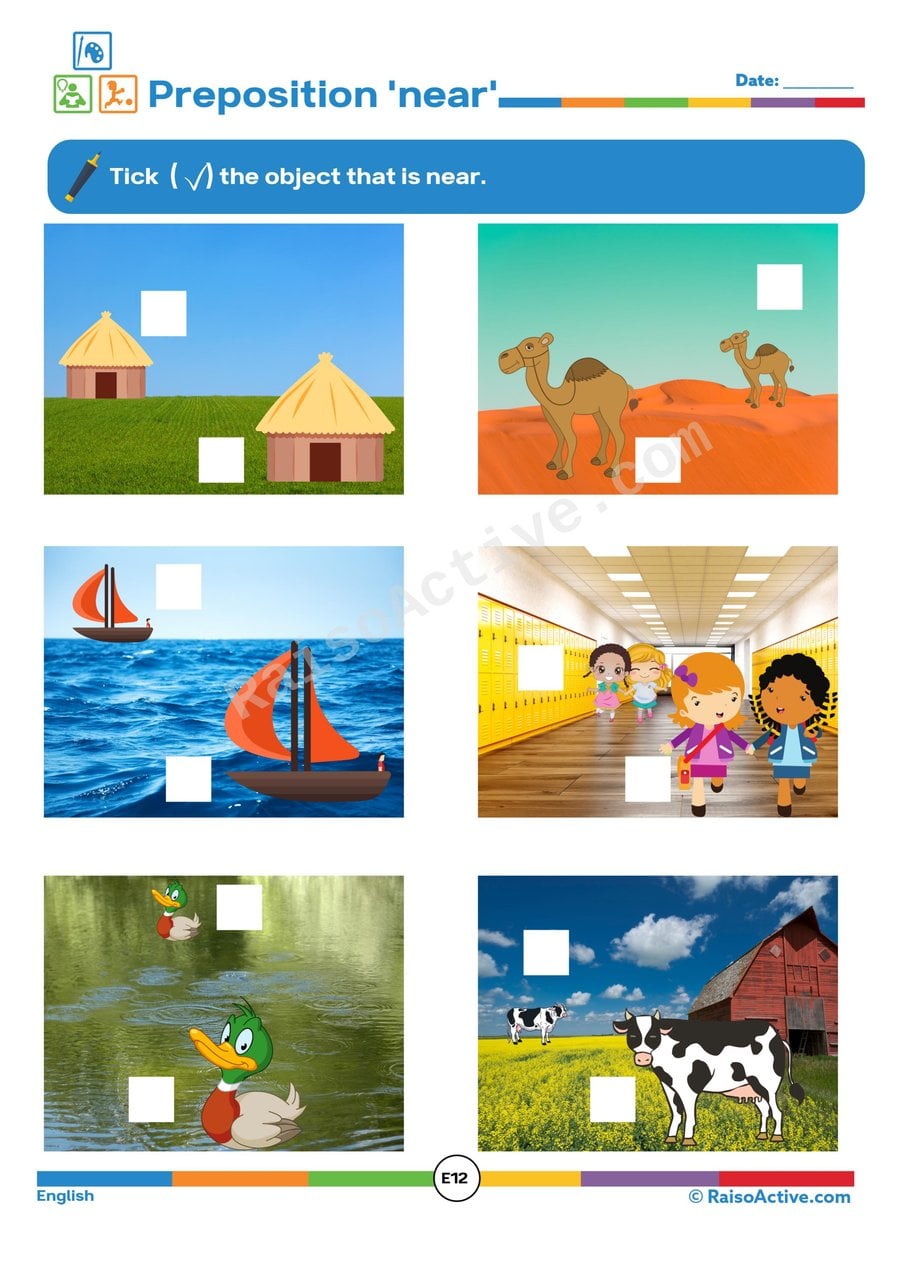
Near or Far? Preposition Worksheet for Kids
Ages 3-5 · Preschool–Pre-KAges 3-5 · Nursery–ReceptionAges 3-5 · Nursery–LKGAges 3-5
Preschoolers ages 3-5 build early spatial vocabulary by identifying which pictured object is positioned 'near' another, a comparative concept that requires judging relative distance between two things. Understanding 'near' versus 'far' lays groundwork for later spatial reasoning skills, like following directions and reading simple maps. Ticking the correct object also sharpens visual comparison and careful observation.
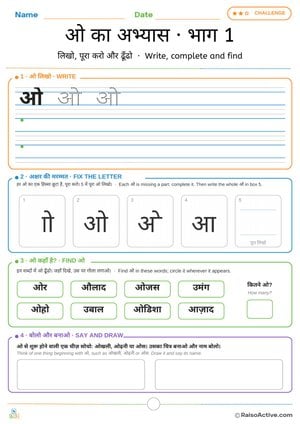
Hindi Letter ओ (o) Practice 1: Write, Fix the Letter and Find | ओ का अभ्यास · भाग 1
Ages 4-7 · Pre-K–Grade 1Ages 4-7 · Reception–Year 2Ages 4-7 · LKG–Class 1Ages 4-7
A challenge page: write ओ between the lines, complete four letters that are each missing a part and then write the whole ओ in box 5, find ओ in words such as ओर, ओजस, ओहो and ओडिशा, and draw a picture. ओ and औ are different vowels; औ has two marks on top and ओ has one.

Lock and Key Matching Worksheet for Preschoolers
Ages 3-5 · Preschool–Pre-KAges 3-5 · Nursery–ReceptionAges 3-5 · Nursery–LKGAges 3-5
Matching each key to the lock sharing the same letter helps children ages 3-5 practice letter recognition in a playful, puzzle-like context rather than rote drilling. Because each key must be checked against several similar-looking locks before finding the right match, this worksheet also builds visual scanning and careful comparison skills that support problem-solving.
Guides for this topic

Documenting Learning Without Drowning in Data: A Practical Guide for Parents and Teachers
Learn practical ways to document your child's learning without overwhelm. Simple portfolios, observation tips, and printable trackers for ages 1-8.

Discovering Wonder: Nature-Based Learning Activities That Captivate Young Children
Explore nature-based learning activities for children ages 2–7 — leaf rubbings, bug hunts, nature journals, and seasonal Indian outdoor ideas that spark wonder.

How to Help Your Child with Letter Reversals: A Complete Guide for Parents and Teachers
Letter reversals are normal until age 7-8. Learn the best multisensory strategies, anchor letter tricks, and activities to help children write b, d, p, and q correctly.
Reviews
Every worksheet for ages 3–5, no watermark
Members download the full library of 1,000+ worksheets and every activity pack without watermarks or daily limits. One year costs ₹999 in India or $20 elsewhere.
See membership plansOr download any worksheet free with a watermark (5 a day).