Color the Transportation Worksheet for Kids
Coloring vehicles that travel by air, land, and water helps children ages 3-5 build an early classification system for how transportation is grouped by environment, not just by shape or size. Naming where each vehicle travels while coloring also reinforces vocabulary and observation skills, since children must look closely at each picture's features to decide its category.
Part of the pack
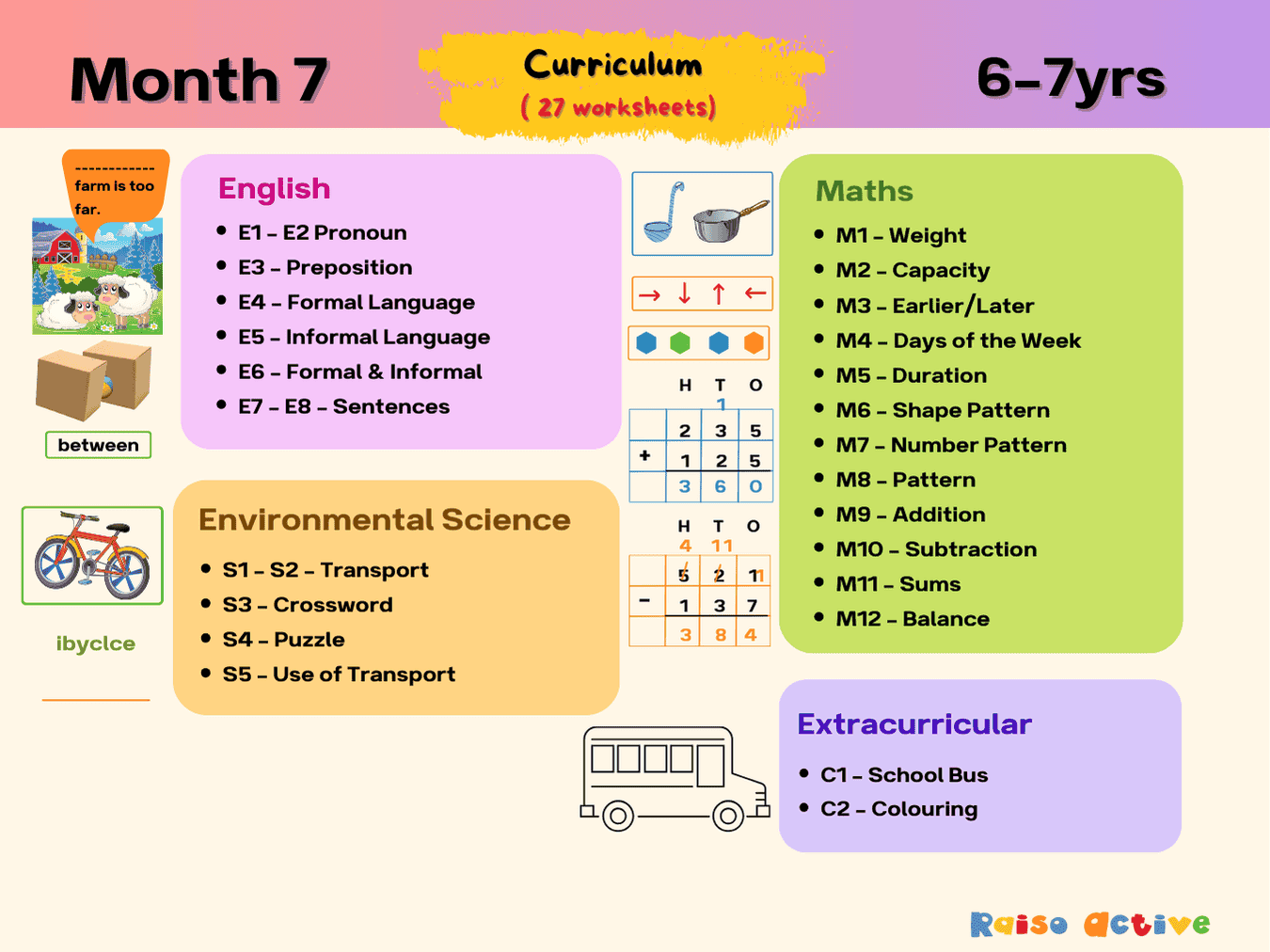
Month 7: Foundational English Math Science | Ages 6-7
This is page 30 of the pack. Ages 6-7 · Grade 1Ages 6-7 · Year 2Ages 6-7 · Class 1Ages 6-7

Made for your child
A whole activity pack made with their name
60 pages to spot, build, trace and write their own name, plus pages about their favourites, feelings and family. See a free preview with their name.
Make an All About Me packFree preview · free for members
Or start free: a name tracing sheet with their nameCurriculum
- Transportation > Transportation
How to use this worksheet
Look at each picture — the airplane, parachute, car, boat, and sailboat — and name it together before picking up a crayon. Ask your child where they think each vehicle travels: through the air, on land, or in the water. As they color each picture, have them say its travel category out loud, like 'the boat goes in the water.' Once all the pictures are colored, review the page together and group the vehicles by category, either by pointing or by saying them in three separate lists.
Materials needed
- Crayons
- Colored Pencils
- Pencil
Extension activities
- 1Sort toy vehicles at home into three piles — air, land, and water — and explain the reasoning for each.
- 2Draw your favorite mode of transportation and label whether it travels by air, land, or water.
- 3Make a simple three-section poster with the headings Air, Land, and Water, and add magazine cutouts of matching vehicles.
- 4Go on a walk or drive and spot real vehicles, calling out which category each one belongs to.
- 5Act out moving like different vehicles — flying arms for a plane, rolling for a car, swimming strokes for a boat.

Written by
Hemsweta Jain · Teacher Cheena
MBA and Early Childhood Educator, teaching since 2014 · Founder of RaisoActive, Mumbai
Every RaisoActive worksheet is designed and checked by the founder before publishing.
Published · Last reviewed
More from Month 7: Foundational English Math Science | Ages 6-7
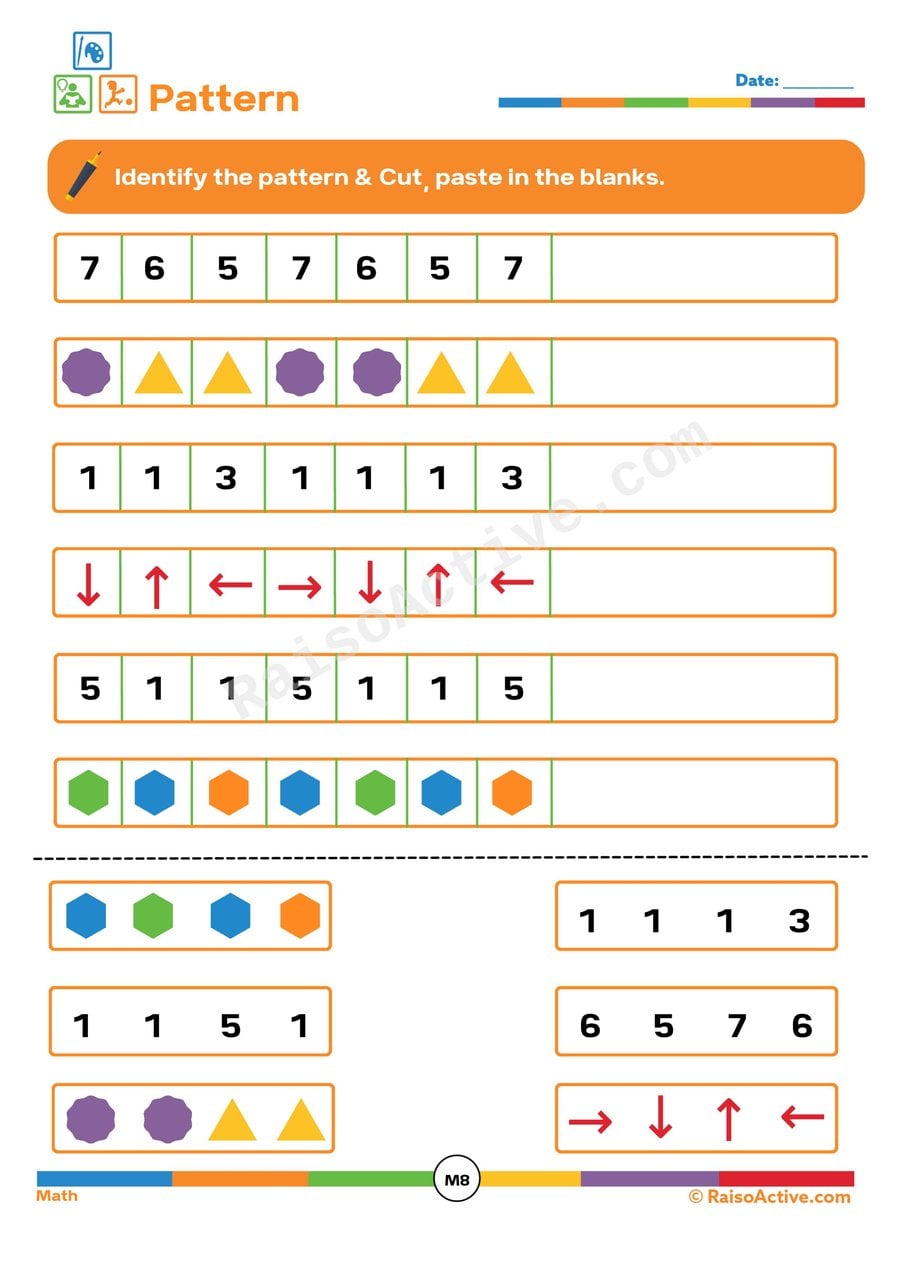
Pattern Fun: Identify and Complete the Sequences!
Ages 4-6 · Pre-K–KindergartenAges 4-6 · Reception–Year 1Ages 4-6 · LKG–UKGAges 4-6
This worksheet mixes numbers, shapes, and symbols across different pattern types, pushing children to apply the same pattern-recognition logic flexibly rather than to just one familiar format. For ages four to six, practicing across varied pattern types builds a more transferable understanding of sequences, which will support both math and reading skills that rely on recognizing regular structures.

Which is Faster? Duration Worksheet for Preschoolers
Ages 4-6 · Pre-K–KindergartenAges 4-6 · Reception–Year 1Ages 4-6 · LKG–UKGAges 4-6
Comparing which of two vehicles or activities would take less time introduces children to the concept of duration, how long something takes, without requiring them to read a clock yet, making it an accessible first step toward understanding time as a measurable quantity. For ages four to six, reasoning about speed and duration together also builds early scientific thinking about cause and effect.
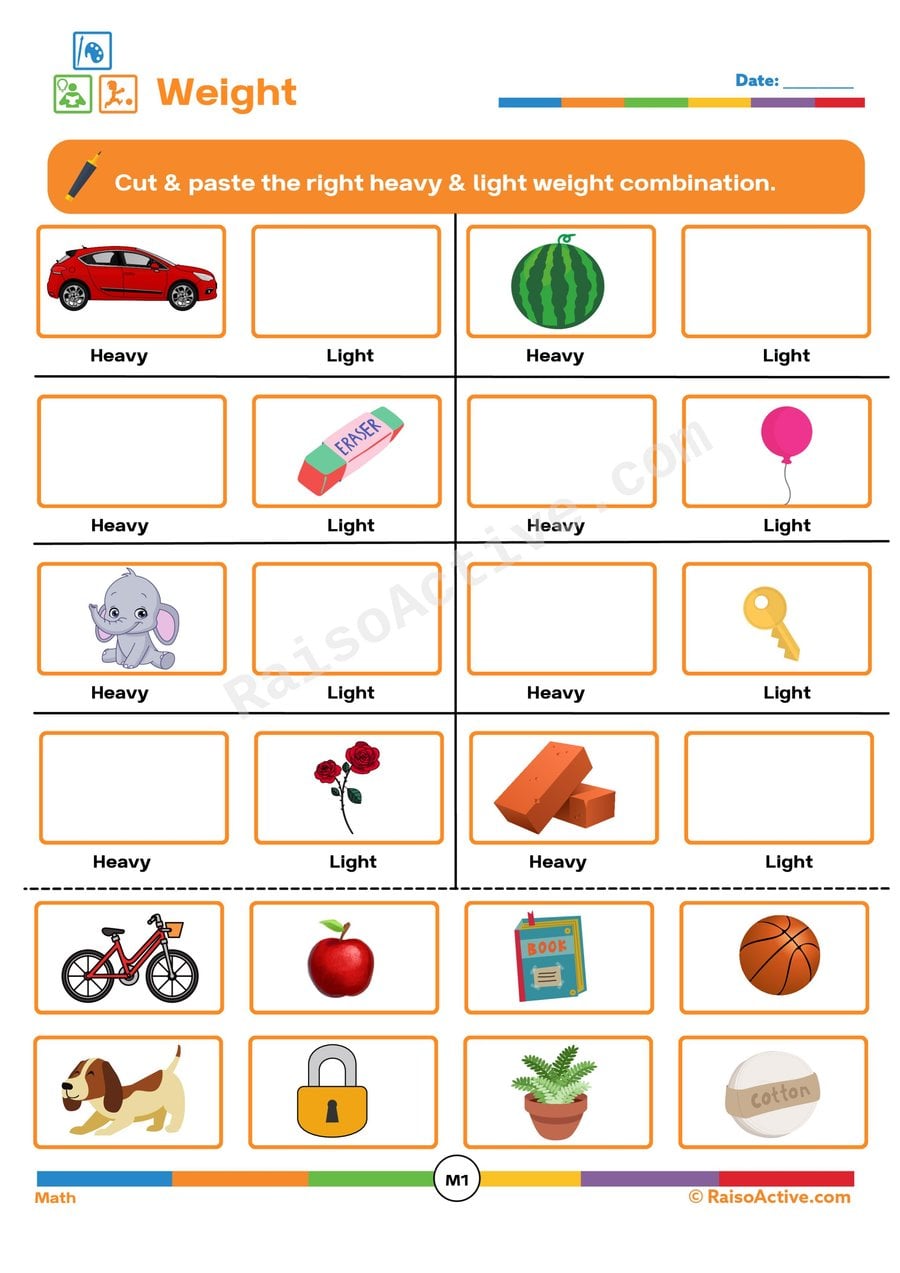
Weight Sorting Worksheet: Heavy vs. Light!
Ages 3-5 · Preschool–Pre-KAges 3-5 · Nursery–ReceptionAges 3-5 · Nursery–LKGAges 3-5
Sorting pictures into 'heavy' and 'light' categories introduces children to comparative reasoning about weight, a physical property they can't always judge from a picture alone, which pushes them to rely on real-world knowledge of the objects shown rather than visual size alone. For ages three to five, this distinction is an early step toward measurement concepts they'll formalize later with scales and standard units.

Transport Unscramble and Match Worksheet for Preschoolers
Ages 3-5 · Preschool–Pre-KAges 3-5 · Nursery–ReceptionAges 3-5 · Nursery–LKGAges 3-5
Unscrambling vehicle names strengthens letter-order awareness and spelling patterns for children ages 3-5, while matching each unscrambled word to its picture connects the written word to a real object they can recognize. Together, these two steps build vocabulary and an early sense that letters must appear in a specific sequence to form a meaningful word.

Addition and Subtraction Sums Worksheet for Preschoolers
Ages 4-6 · Pre-K–KindergartenAges 4-6 · Reception–Year 1Ages 4-6 · LKG–UKGAges 4-6
Practicing addition and subtraction problems within 10 together, rather than in separate worksheets, helps children see the two operations as related, that subtraction can undo addition, which builds more flexible number sense than drilling each skill in isolation. For ages four to six, working within small numbers keeps the focus on understanding the operations rather than on managing large quantities.
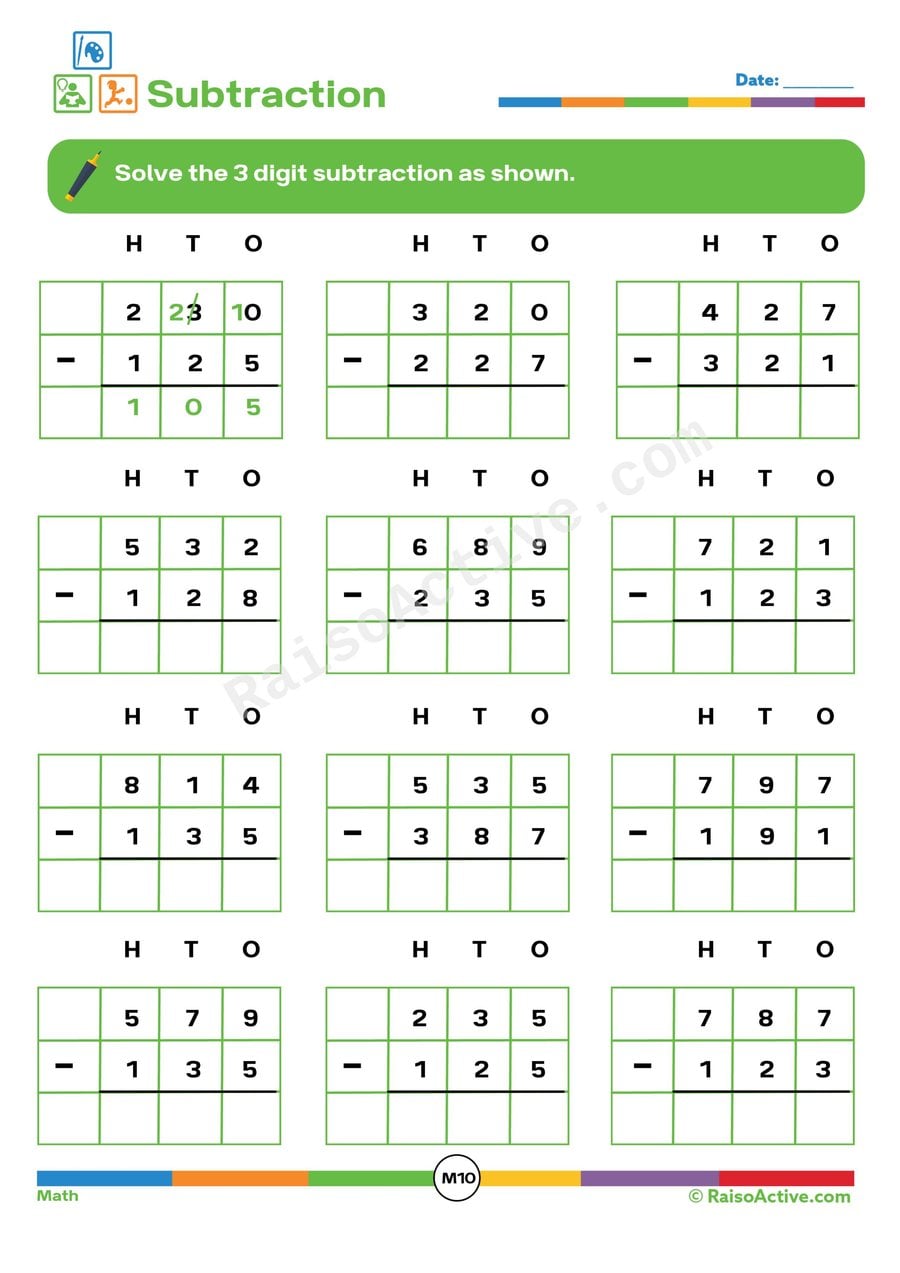
3-Digit Subtraction Worksheet for Kids
Ages 5-7 · Kindergarten–Grade 1Ages 5-7 · Year 1–Year 2Ages 5-7 · UKG–Class 1Ages 5-7
Subtracting three-digit numbers introduces children to borrowing, or regrouping, across place value columns, a more demanding skill than simple subtraction since it requires understanding that a ten can be 'broken' into ones when a column doesn't have enough to subtract from. For ages five to seven, this worksheet builds the procedural foundation for confident multi-digit subtraction going forward.

Capacity Worksheet: Circle the Object with More Capacity!
Ages 3-5 · Preschool–Pre-KAges 3-5 · Nursery–ReceptionAges 3-5 · Nursery–LKGAges 3-5
Comparing pairs of containers teaches children ages 3-5 the early measurement concept of capacity — how much space is inside an object for holding something — which is distinct from simply judging an object's overall size. Making a choice and explaining it also builds early reasoning skills, since children must connect what they see to an invisible property, the amount something can hold.

Formal vs. Informal Language Worksheet: Practice with Sentences!
Ages 4-6 · Pre-K–KindergartenAges 4-6 · Reception–Year 1Ages 4-6 · LKG–UKGAges 4-6
Rewriting sentences between formal and informal versions teaches children ages 4-6 that the same message can be expressed differently depending on the audience, an early step toward social and register awareness in language. Because the task also involves matching a picture to each sentence, children practice connecting tone of language to context and setting, not just memorizing rules.
Related worksheets

Water Transport Matching Worksheet for Preschoolers
Ages 3-5 · Preschool–Pre-KAges 3-5 · Nursery–ReceptionAges 3-5 · Nursery–LKGAges 3-5
This worksheet builds visual matching and vocabulary skills as children connect the two halves of different water vehicles — like a boat, ship, or submarine — and learn their names. Piecing together a whole object from its parts also sharpens visual discrimination, helping children notice small differences in shape and detail that matter for later reading skills.
Odd One Out: Transportation Worksheet for Kids
Ages 3-5 · Preschool–Pre-KAges 3-5 · Nursery–ReceptionAges 3-5 · Nursery–LKGAges 3-5
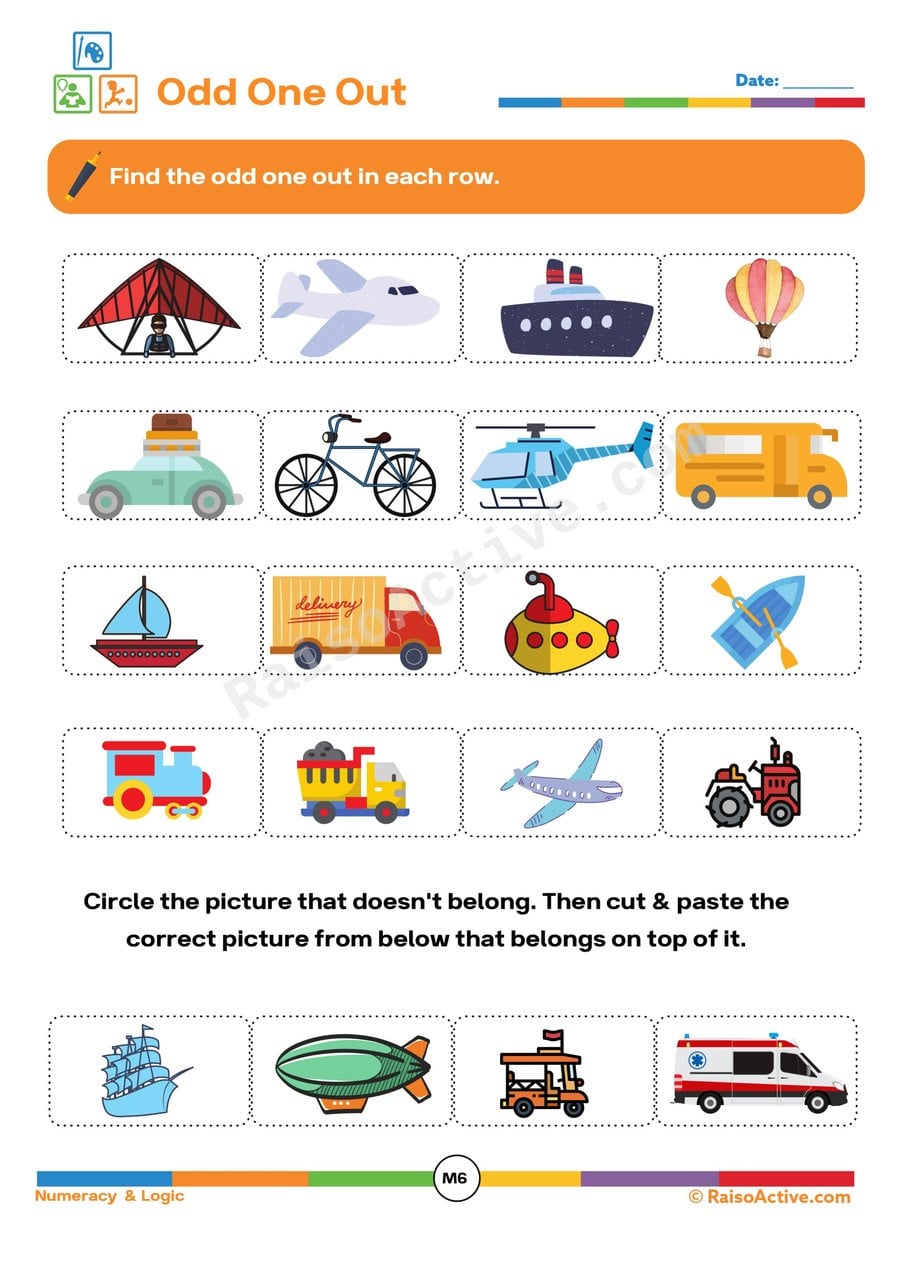
This worksheet sharpens visual discrimination and categorization skills as children ages 3-5 study a row of transportation pictures and identify the one that doesn't belong with the others, then replace it with a correct match cut from the bottom of the page. Explaining why an item is the 'odd one out' builds early critical-thinking and reasoning skills that go beyond simple picture recognition.

Transportation Fun: Identify Land, Water, and Air Vehicles!
Ages 3-5 · Preschool–Pre-KAges 3-5 · Nursery–ReceptionAges 3-5 · Nursery–LKGAges 3-5
This worksheet helps children ages 3-5 classify different vehicles by where they travel — land, water, or air — building early categorization skills alongside transportation vocabulary. Writing the correct letter (L, W, or A) for each picture requires children to think about a vehicle's purpose and environment, not just recognize what it is, adding a layer of reasoning beyond simple naming.

Land Transport Vehicles Worksheet for Preschoolers
Ages 3-5 · Preschool–Pre-KAges 3-5 · Nursery–ReceptionAges 3-5 · Nursery–LKGAges 3-5
This worksheet asks children ages 3-5 to look at a busy scene and identify land transport vehicles — cars, trucks, buses, bicycles — by circling them, building visual discrimination skills alongside transportation vocabulary. Picking specific vehicles out of a larger picture also trains children's ability to filter relevant details from a busy visual field, a useful skill well beyond this worksheet's topic.

Transport Cut and Paste Worksheet for Preschoolers
Ages 3-5 · Preschool–Pre-KAges 3-5 · Nursery–ReceptionAges 3-5 · Nursery–LKGAges 3-5
This cut-and-paste worksheet asks children ages 3-5 to sort vehicle pictures into air, water, and land categories, building classification skills alongside scissor control and glue placement. Sorting by transport type is an early exercise in the broader thinking skill of grouping objects by a shared property, which underlies later science and math reasoning.

Transport Vehicles Cut and Paste Worksheet for Preschoolers
Ages 3-5 · Preschool–Pre-KAges 3-5 · Nursery–ReceptionAges 3-5 · Nursery–LKGAges 3-5
This worksheet has children ages 3-5 sort transport vehicles by cutting them out and pasting each one onto the correct scene — road, water, or sky — building early classification skills alongside vocabulary about how different vehicles travel. Sorting by category, rather than just naming objects, is an important thinking skill that helps children organize new knowledge as they learn about the world.

Transportation Worksheet: Match the Vehicles! (Ages 3-5)
Ages 3-5 · Preschool–Pre-KAges 3-5 · Nursery–ReceptionAges 3-5 · Nursery–LKGAges 3-5
This worksheet asks children ages 3-5 to sort vehicles into four transportation categories — road, track, air, and water — which builds classification skills beyond simple pairs. Because kids must decide which of four groups a vehicle belongs to instead of just two, it stretches their reasoning a level further than basic matching. It also grows vocabulary around trains and tracks, a category many transportation worksheets skip.

Color the Air Transport Vehicles Worksheet for Preschoolers
Ages 3-5 · Preschool–Pre-KAges 3-5 · Nursery–ReceptionAges 3-5 · Nursery–LKGAges 3-5
This coloring worksheet builds vocabulary and visual recognition around air transport — planes, helicopters, and other flying vehicles — while giving children ages 3-5 sustained practice with crayon control and staying within outlines. Naming each vehicle as they color it also strengthens category thinking, helping children understand 'air transport' as a group distinct from things that travel by road or water.
Guides for this topic

Best Worksheets for 3-Year-Olds: What Works and What to Avoid
What works on worksheets for 3-year-olds: short sessions, crayons, tracing lines, matching, cutting, a free weekly plan, and signs one is too advanced.
Fostering Creativity in Structured Learning: The Perfect Balance for Young Minds
Learn how to blend creativity with structured learning for children ages 1-8. Practical strategies, activities, and printable worksheets for parents and teachers.

Discovering Wonder: Nature-Based Learning Activities That Captivate Young Children
Explore nature-based learning activities for children ages 2–7 — leaf rubbings, bug hunts, nature journals, and seasonal Indian outdoor ideas that spark wonder.
Reviews
Every worksheet for ages 3–5, no watermark
Members download the full library of 1,000+ worksheets and every activity pack without watermarks or daily limits. One year costs ₹999 in India or $20 elsewhere.
See membership plansOr download any worksheet free with a watermark (5 a day).