Land Transport Vehicles Worksheet for Preschoolers
This worksheet asks children ages 3-5 to look at a busy scene and identify land transport vehicles — cars, trucks, buses, bicycles — by circling them, building visual discrimination skills alongside transportation vocabulary. Picking specific vehicles out of a larger picture also trains children's ability to filter relevant details from a busy visual field, a useful skill well beyond this worksheet's topic.
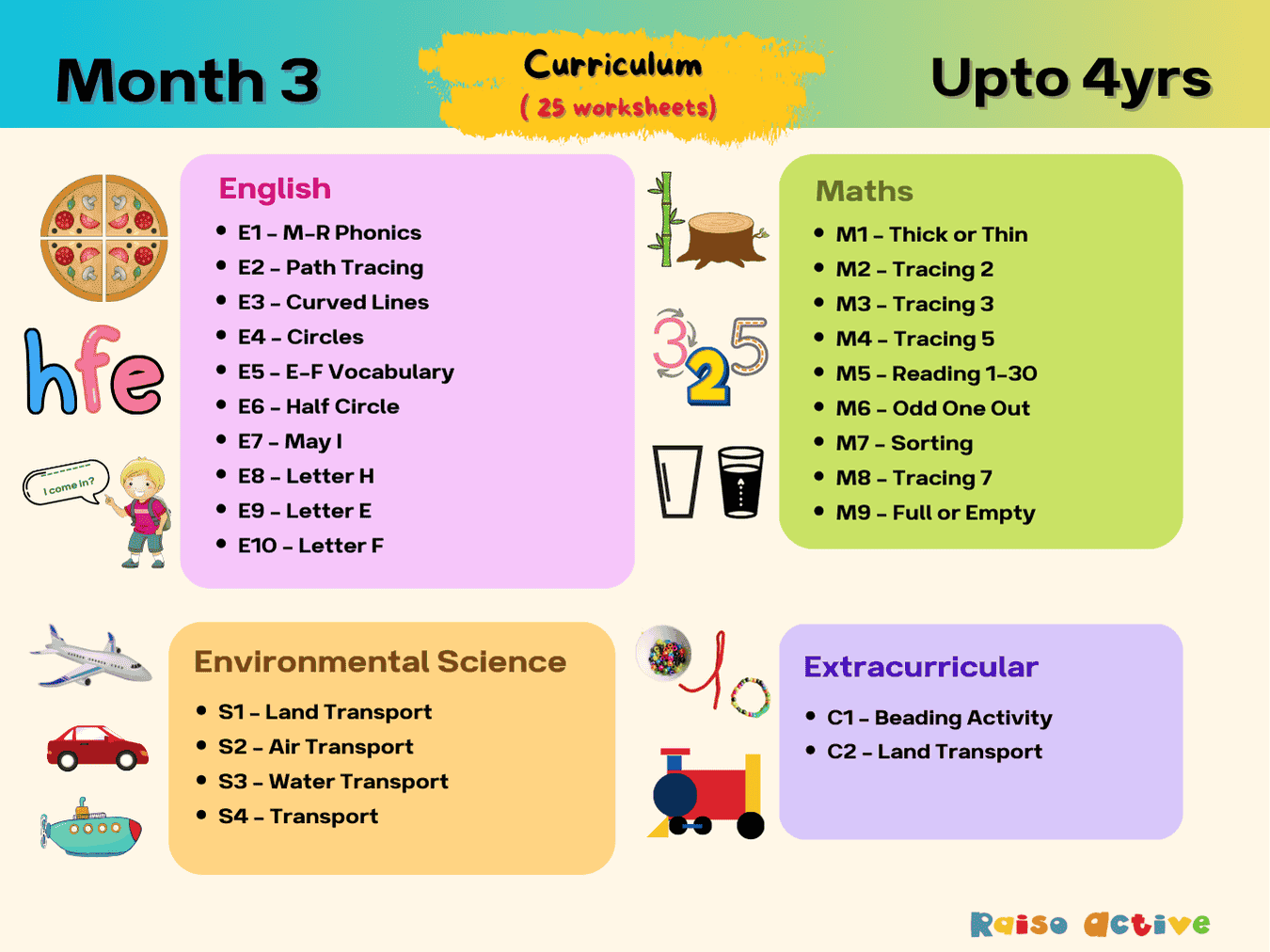
Part of the pack
Month 3: Learning & Development | Ages Up to 4
This is page 23 of the pack. Ages 3-4 · PreschoolAges 3-4 · NurseryAges 3-4
Made for your child
Spelling practice, made for your child
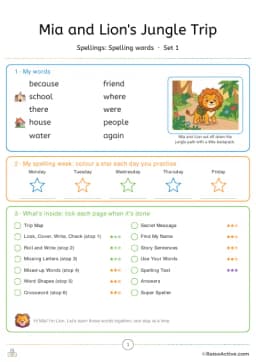
Their own spelling words turned into a pack: trace or look-cover-write-check, roll and write, a secret picture code, a word search, a crossword and a test, with their name in it.
Make a spelling packFree preview · free for members
Or start free: a word search with sight wordsCurriculum
- Cognitive - Attention > Observation Skills
How to use this worksheet
Look at the picture together first and talk about all the different things you see. Ask your child to point out anything that travels on land, naming each vehicle as they spot it — car, bus, bicycle, and so on. Have them circle every land vehicle they find in the picture. Once finished, count together how many land vehicles were circled.
Materials needed
- Pencil
- Crayons
Extension activities
- 1Look out the window or go for a walk and count how many land vehicles you see pass by.
- 2Draw your favorite land vehicle and describe what job it does, like carrying passengers or delivering packages.
- 3Sort toy vehicles at home into land, air, and water piles.
- 4Make simple vehicle sound effects and have your child guess which land vehicle makes that sound.
- 5Build a road out of tape on the floor and drive toy land vehicles along it, naming each one.

Written by
Hemsweta Jain · Teacher Cheena
MBA and Early Childhood Educator, teaching since 2014 · Founder of RaisoActive, Mumbai
Every RaisoActive worksheet is designed and checked by the founder before publishing.
Published · Last reviewed
More from Month 3: Learning & Development | Ages Up to 4
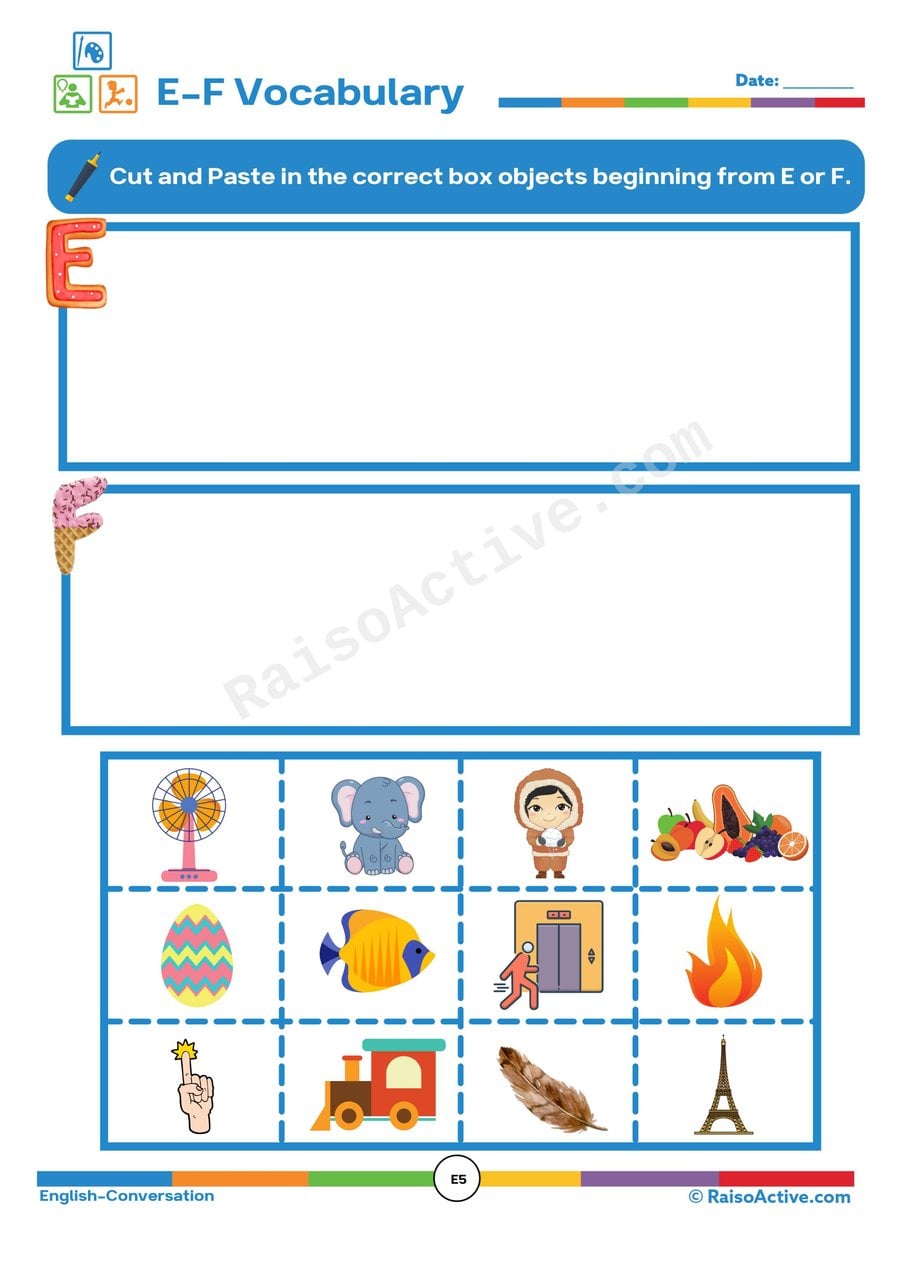
E-F Vocabulary Worksheet: Cut and Paste Fun!
Ages 3-5 · Preschool–Pre-KAges 3-5 · Nursery–ReceptionAges 3-5 · Nursery–LKGAges 3-5
This worksheet builds phonemic awareness and vocabulary as children ages 3-5 sort pictures by their beginning sound, deciding whether each object starts with the letter E or F. Practicing this kind of sound-sorting strengthens the auditory discrimination skills children need before they can reliably match letters to sounds in reading.
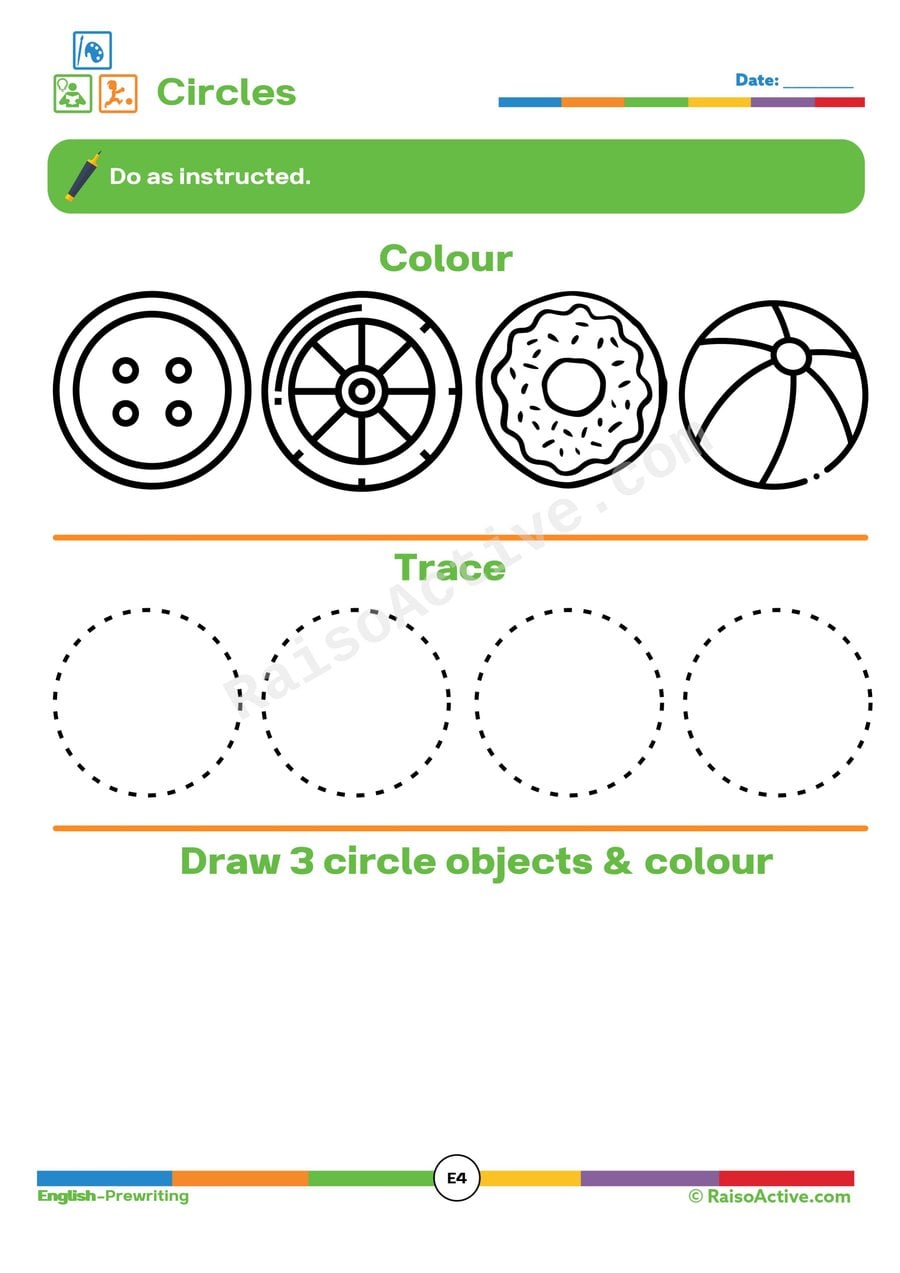
Circle Shapes Worksheet: Trace, Color, and Draw!
Ages 3-5 · Preschool–Pre-KAges 3-5 · Nursery–ReceptionAges 3-5 · Nursery–LKGAges 3-5
This worksheet builds shape recognition and drawing skills as children ages 3-5 trace dotted circles, color pictures of circular objects, and then draw three circle-shaped objects entirely on their own. Moving from tracing to independent drawing tracks a real developmental progression — first following a guide, then applying the shape from memory — which builds true shape mastery rather than just copying.

M-R Phonic Beginning Sound Worksheet: Circle the Correct Letter!
Ages 4-6 · Pre-K–KindergartenAges 4-6 · Reception–Year 1Ages 4-6 · LKG–UKGAges 4-6
This phonics worksheet focuses children ages 4-6 on distinguishing between five similar beginning sounds — M, P, O, R, and N — by having them look at a picture, say its name, and circle the correct starting letter from those choices. Including several letters as answer options, rather than just one, makes this a meaningfully harder discrimination task than a single-letter worksheet, since children must rule out close-sounding alternatives.

Full and Empty Worksheet: Matching Activity for Preschoolers
Ages 3-5 · Preschool–Pre-KAges 3-5 · Nursery–ReceptionAges 3-5 · Nursery–LKGAges 3-5
This matching worksheet has children ages 3-5 draw lines connecting pictures to the labels 'Full' or 'Empty,' building comparative vocabulary around volume and quantity that goes beyond counting into descriptive reasoning about how much of something is present. Understanding full and empty as opposites is an early step toward later concepts like more, less, and measurement.

Letter E Tracing Worksheet for Preschoolers: Learn to Write!
Ages 3-5 · Preschool–Pre-KAges 3-5 · Nursery–ReceptionAges 3-5 · Nursery–LKGAges 3-5
Children ages 3-5 use this worksheet to build the specific motor pattern for capital E — three horizontal strokes branching off one vertical line — while reinforcing the /e/ sound through picture recognition. Repeated tracing in a dashed-box format also trains children to keep letters a consistent size, an important pre-writing skill before they move to unlined paper.

Color the Air Transport Vehicles Worksheet for Preschoolers
Ages 3-5 · Preschool–Pre-KAges 3-5 · Nursery–ReceptionAges 3-5 · Nursery–LKGAges 3-5
This coloring worksheet builds vocabulary and visual recognition around air transport — planes, helicopters, and other flying vehicles — while giving children ages 3-5 sustained practice with crayon control and staying within outlines. Naming each vehicle as they color it also strengthens category thinking, helping children understand 'air transport' as a group distinct from things that travel by road or water.

Trace the Paths: A Fun Path Tracing Worksheet for Preschoolers!
Ages 3-5 · Preschool–Pre-KAges 3-5 · Nursery–ReceptionAges 3-5 · Nursery–LKGAges 3-5
This worksheet develops fine motor control and hand-eye coordination as children ages 3-5 trace a variety of dotted paths from a starting point to an end point, an essential pre-writing skill that builds the pencil control needed for forming letters. Following a winding line with steady pressure also strengthens visual tracking, which supports reading readiness.

Parent's Guide: Fine Motor Skills and Early Concepts Worksheet
Ages 3-5 · Preschool–Pre-KAges 3-5 · Nursery–ReceptionAges 3-5 · Nursery–LKGAges 3-5
This parent-led guide combines fine motor skill development with early concept learning for children ages 3-5, covering ideas like full/empty and thick/thin alongside pre-writing practice using everyday materials like water, shaving foam, and small objects. Bundling sensory, motor, and conceptual learning together gives children multiple entry points into the same ideas, which builds understanding more thoroughly than a single worksheet page.
Related worksheets

Transportation Match-Up Worksheet for Preschoolers
Ages 4-6 · Pre-K–KindergartenAges 4-6 · Reception–Year 1Ages 4-6 · LKG–UKGAges 4-6
Matching a written description to the correct vehicle picture builds reading comprehension for children ages 4-6, requiring them to connect specific details, like where a vehicle travels or what it carries, to a visual image. This strengthens both transportation vocabulary and the broader skill of using descriptive clues to identify something, which supports comprehension in future reading tasks.
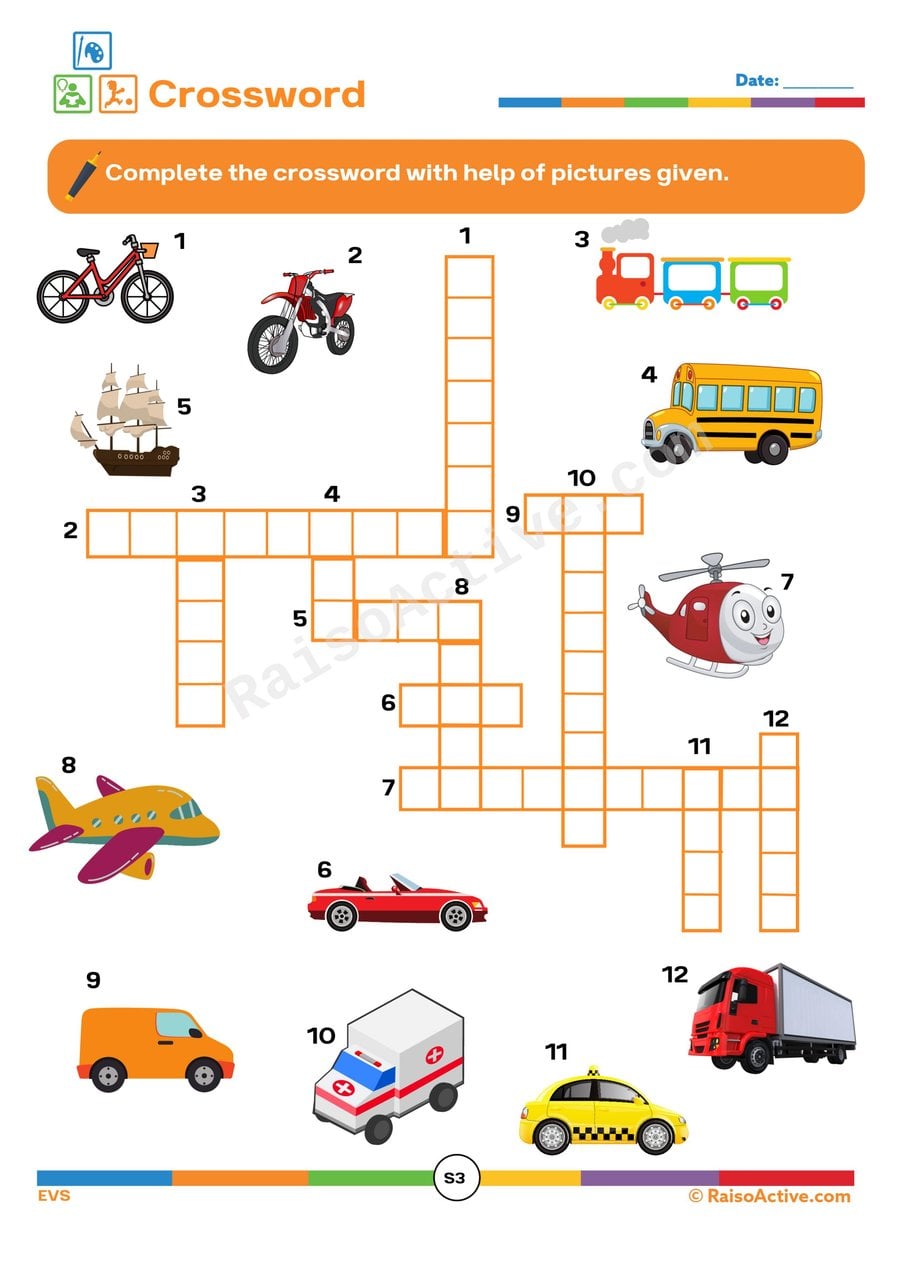
Crossword Puzzle: Vehicles Worksheet for Kids
Ages 4-6 · Pre-K–KindergartenAges 4-6 · Reception–Year 1Ages 4-6 · LKG–UKGAges 4-6
Solving a crossword using vehicle pictures challenges children ages 4-6 to connect an image to its written spelling while also introducing the logic of a crossword grid, where letters must fit both across and down. This combination builds vocabulary, spelling awareness, and early problem-solving persistence as children work through clues that intersect with one another.

Transport Worksheet: Cut and Paste the Correct Mode of Transport!
Ages 4-6 · Pre-K–KindergartenAges 4-6 · Reception–Year 1Ages 4-6 · LKG–UKGAges 4-6
Reading a sentence and choosing the correct vehicle to complete it teaches children ages 4-6 to use context clues from text to guide a decision, an early reading comprehension skill that goes beyond simple word recognition. The cutting and pasting also reinforces vocabulary for different modes of transportation as children physically match each picture to its described purpose.

Transportation Fun: Identify Land, Water, and Air Vehicles!
Ages 3-5 · Preschool–Pre-KAges 3-5 · Nursery–ReceptionAges 3-5 · Nursery–LKGAges 3-5
This worksheet helps children ages 3-5 classify different vehicles by where they travel — land, water, or air — building early categorization skills alongside transportation vocabulary. Writing the correct letter (L, W, or A) for each picture requires children to think about a vehicle's purpose and environment, not just recognize what it is, adding a layer of reasoning beyond simple naming.

Transport Worksheet: Circle and Count the Transport Items!
Ages 3-5 · Preschool–Pre-KAges 3-5 · Nursery–ReceptionAges 3-5 · Nursery–LKGAges 3-5
This worksheet combines two skills for children ages 3-5: visually identifying which pictures represent transportation versus other objects, and then counting a separate group of transport items and recording the total as a number. Circling only the correct category first requires categorization and attention to detail, while the counting section that follows builds one-to-one correspondence with a real-world, kid-friendly theme that most children find naturally engaging. Vehicles are also a great vocabulary-building topic, since children often already know many transport names from daily life.

Transport Unscramble and Match Worksheet for Preschoolers
Ages 3-5 · Preschool–Pre-KAges 3-5 · Nursery–ReceptionAges 3-5 · Nursery–LKGAges 3-5
Unscrambling vehicle names strengthens letter-order awareness and spelling patterns for children ages 3-5, while matching each unscrambled word to its picture connects the written word to a real object they can recognize. Together, these two steps build vocabulary and an early sense that letters must appear in a specific sequence to form a meaningful word.
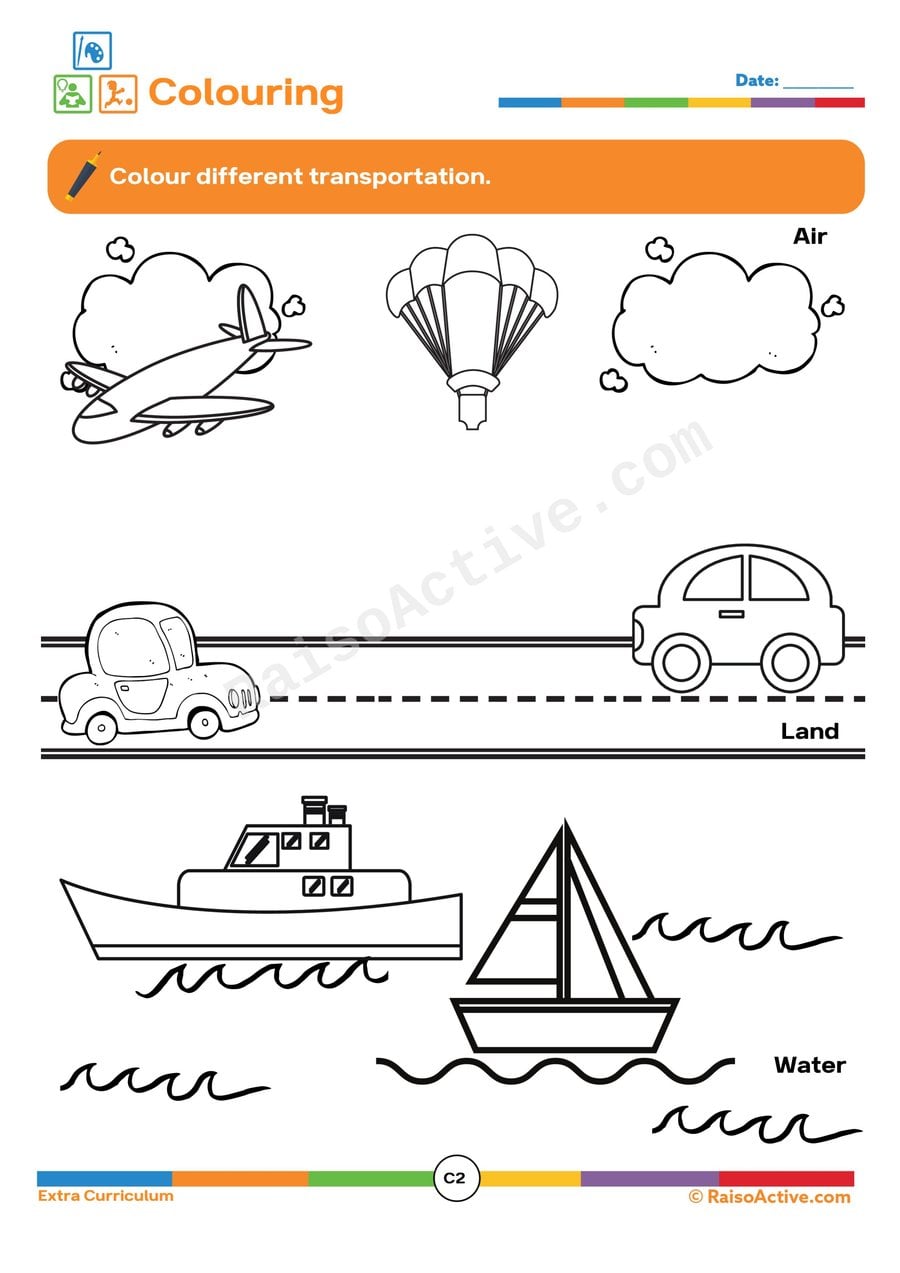
Color the Transportation Worksheet for Kids
Ages 3-5 · Preschool–Pre-KAges 3-5 · Nursery–ReceptionAges 3-5 · Nursery–LKGAges 3-5
Coloring vehicles that travel by air, land, and water helps children ages 3-5 build an early classification system for how transportation is grouped by environment, not just by shape or size. Naming where each vehicle travels while coloring also reinforces vocabulary and observation skills, since children must look closely at each picture's features to decide its category.
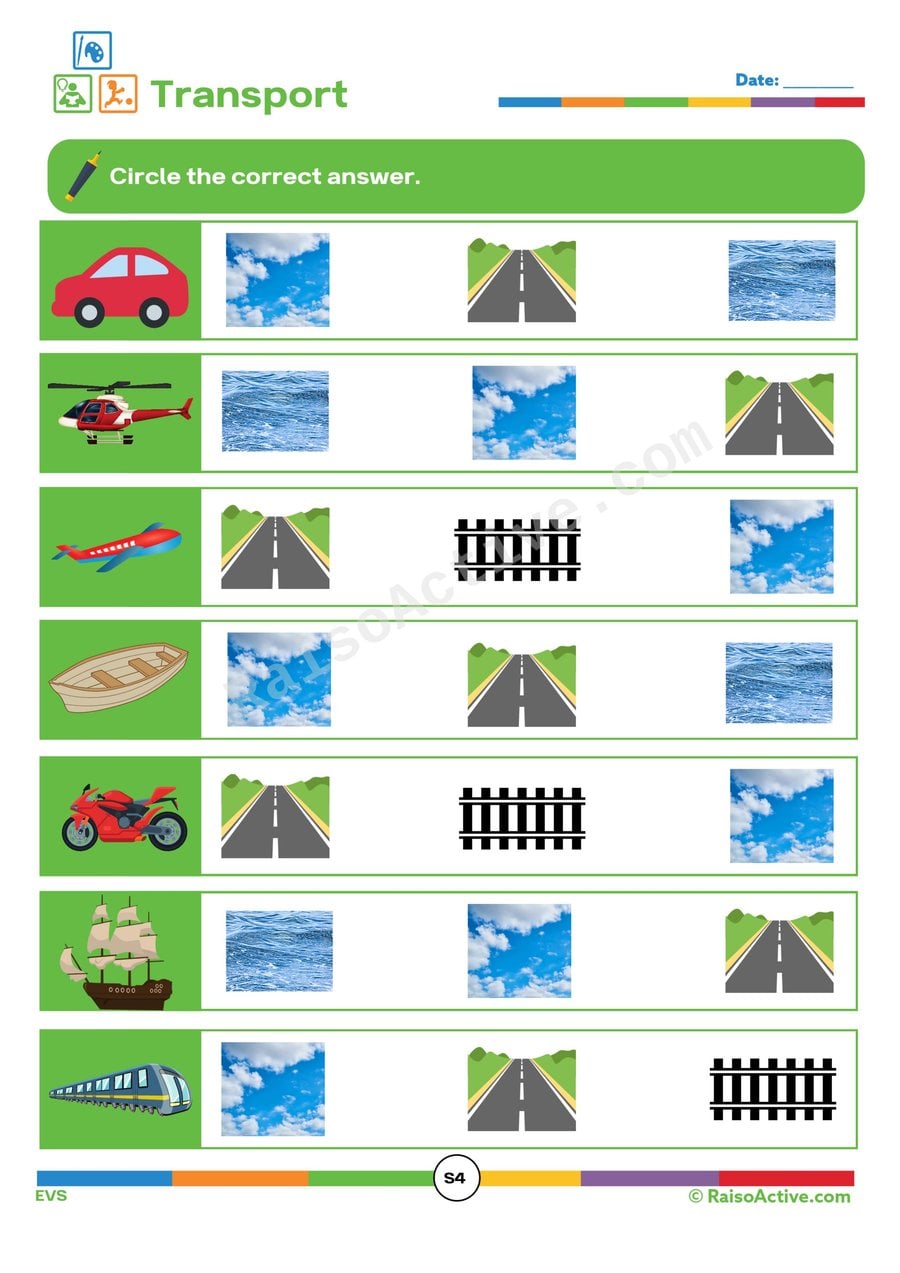
Transport Matching Worksheet for Preschoolers
Ages 3-5 · Preschool–Pre-KAges 3-5 · Nursery–ReceptionAges 3-5 · Nursery–LKGAges 3-5
Preschoolers ages 3-5 build categorization and vocabulary skills as they connect each vehicle picture to the environment where it actually travels. Sorting vehicles by where they go strengthens early classification thinking, a skill children rely on later when grouping objects by other shared properties. It also introduces transportation vocabulary that expands their spoken language.
Guides for this topic

Sight Words by Age: The First 50 Words and How to Teach Them Without Flashcard Fatigue
Which sight words to teach first and why, the heart-word method, a read-trace-write-find routine, games, and a by-age table of typical sight-word progress.
How to Teach CVC Blending: A Step-by-Step Method That Works in Two Weeks
A step-by-step method for teaching CVC blending, covering continuous sounds, word families, common errors, and a 14-day plan that most children finish reading CVC words.

Best Worksheets for 3-Year-Olds: What Works and What to Avoid
What works on worksheets for 3-year-olds: short sessions, crayons, tracing lines, matching, cutting, a free weekly plan, and signs one is too advanced.
Reviews
Every worksheet for ages 3–5, no watermark
Members download the full library of 1,000+ worksheets and every activity pack without watermarks or daily limits. One year costs ₹999 in India or $20 elsewhere.
See membership plansOr download any worksheet free with a watermark (5 a day).