Transportation Match-Up Worksheet for Preschoolers
Matching a written description to the correct vehicle picture builds reading comprehension for children ages 4-6, requiring them to connect specific details, like where a vehicle travels or what it carries, to a visual image. This strengthens both transportation vocabulary and the broader skill of using descriptive clues to identify something, which supports comprehension in future reading tasks.
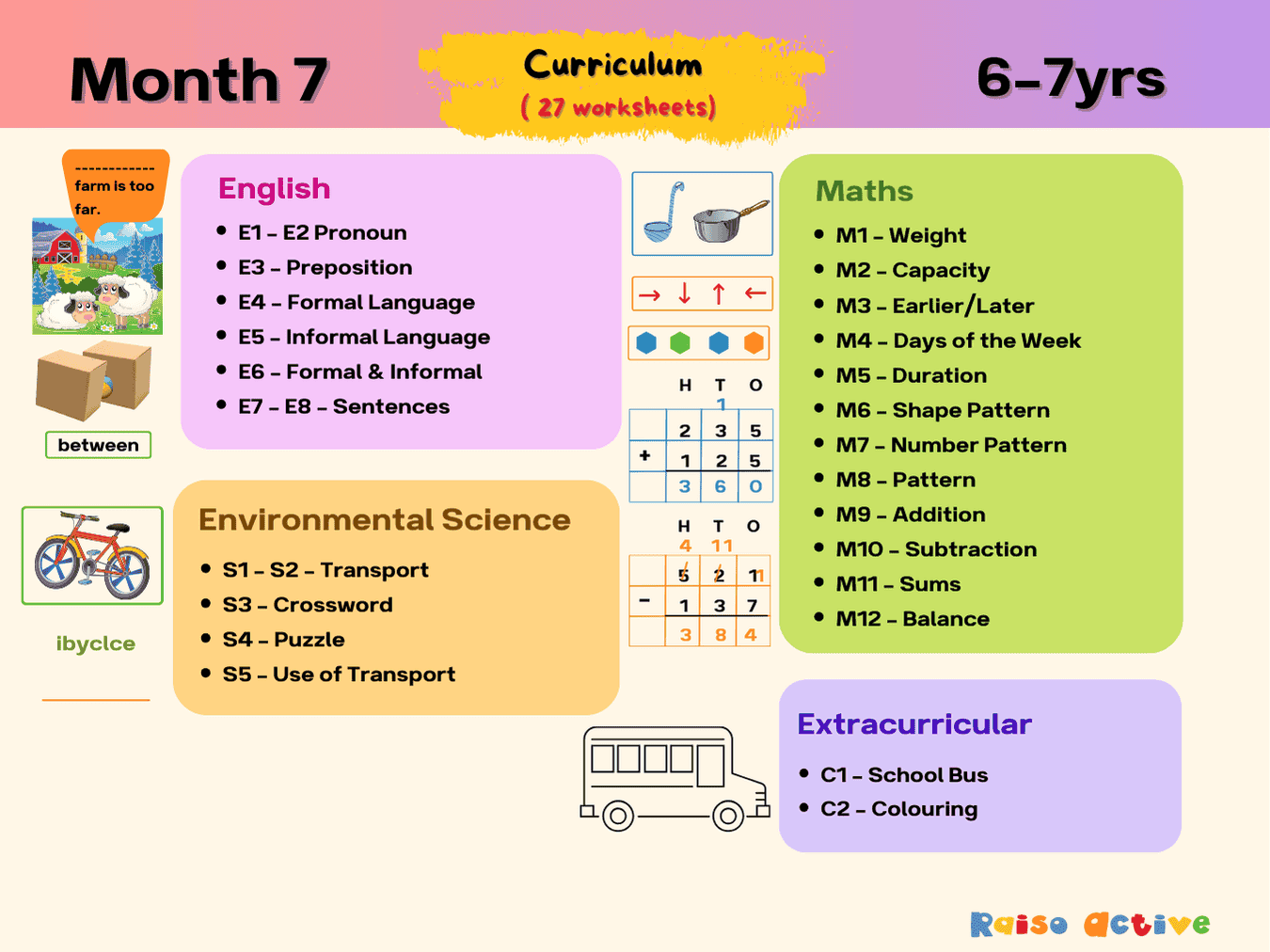
Part of the pack
Month 7: Foundational English Math Science | Ages 6-7
This is page 28 of the pack. Ages 6-7 · Grade 1Ages 6-7 · Year 2Ages 6-7 · Class 1Ages 6-7

Made for your child
Numbers to 20, made for your child
A maths pack with your child's name in it: pictures that explain, practice at three levels, puzzles and story sums about them. Print a new set whenever they finish.
Make a maths packFree preview · free for members
Curriculum
- Transportation > Transportation
How to use this worksheet
Read the first description aloud together, emphasizing key details like the vehicle's purpose or where it travels. Ask your child to scan the pictures and think about which one matches all the clues in the sentence. Have them draw a line or circle connecting the description to the correct picture. Continue reading and matching each remaining description, then review the completed page together, rereading each description alongside its picture.
Materials needed
- Pencil
- Crayons
Extension activities
- 1Draw your favorite mode of transportation and describe it out loud using at least two details, like color and where it travels.
- 2Play a describe-and-guess game where you give clues about a vehicle and your child names it.
- 3Talk about real situations where each type of transportation would be used, like a fire truck during an emergency.
- 4Make simple flashcards with a vehicle picture on one side and a written description on the other to quiz each other.
- 5Look through a picture book about vehicles and practice describing each one in a full sentence.

Written by
Hemsweta Jain · Teacher Cheena
MBA and Early Childhood Educator, teaching since 2014 · Founder of RaisoActive, Mumbai
Every RaisoActive worksheet is designed and checked by the founder before publishing.
Published · Last reviewed
More from Month 7: Foundational English Math Science | Ages 6-7

Shape Pattern Worksheet for Preschoolers: Color the Correct Pattern!
Ages 3-5 · Preschool–Pre-KAges 3-5 · Nursery–ReceptionAges 3-5 · Nursery–LKGAges 3-5
This worksheet asks children to study a repeating shape pattern and identify which shape logically comes next, then color the correct answer choice, combining pattern recognition with a decision-making step rather than simply continuing the pattern by hand. For ages three to five, recognizing shape patterns builds the same underlying logical reasoning skill used later in number patterns and early algebra.

Transport Unscramble and Match Worksheet for Preschoolers
Ages 3-5 · Preschool–Pre-KAges 3-5 · Nursery–ReceptionAges 3-5 · Nursery–LKGAges 3-5
Unscrambling vehicle names strengthens letter-order awareness and spelling patterns for children ages 3-5, while matching each unscrambled word to its picture connects the written word to a real object they can recognize. Together, these two steps build vocabulary and an early sense that letters must appear in a specific sequence to form a meaningful word.
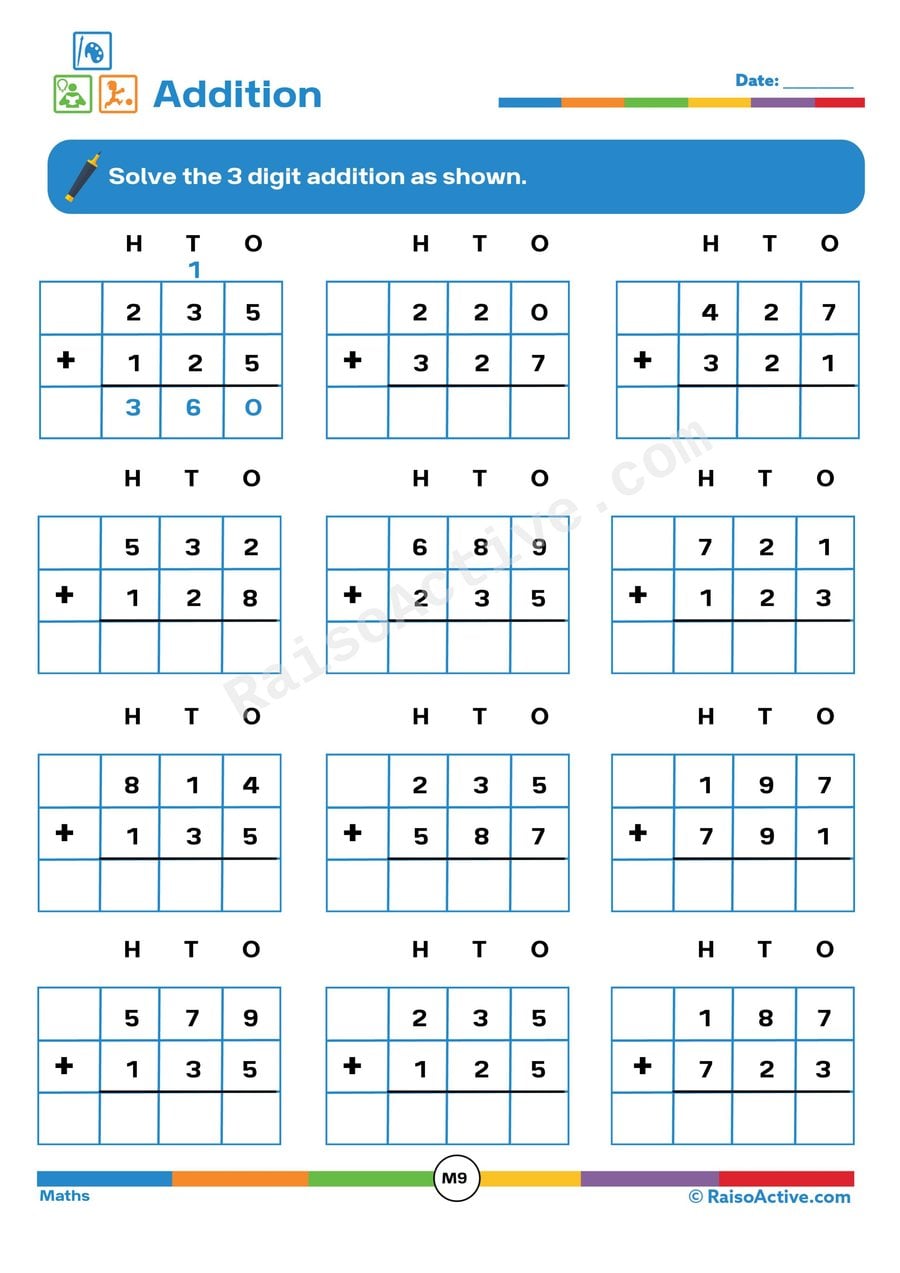
3-Digit Addition Worksheet for Kids
Ages 6-8 · Grade 1–Grade 2Ages 6-8 · Year 2–Year 3Ages 6-8 · Class 1–Class 2Ages 6-8
Adding two three-digit numbers requires children to work through the ones, tens, and hundreds columns in order and understand how a sum in one column can carry over into the next, a significant step up from single-digit addition. For ages six to eight, mastering this column-based process builds the procedural fluency needed for all future multi-digit arithmetic.

Sentence Detective: Simple, Compound, or Complex Sentences Worksheet for Kids
Ages 4-6 · Pre-K–KindergartenAges 4-6 · Reception–Year 1Ages 4-6 · LKG–UKGAges 4-6
This worksheet introduces children to three different sentence structures, simple, compound, and complex, teaching them to notice how conjunctions and clause combinations change a sentence's complexity, a more advanced grammar concept appropriate for ages four to six who are already reading independently. Recognizing these structures also improves reading fluency, since children start to anticipate pauses and connections within longer sentences.

Capacity Worksheet: Circle the Object with More Capacity!
Ages 3-5 · Preschool–Pre-KAges 3-5 · Nursery–ReceptionAges 3-5 · Nursery–LKGAges 3-5
Comparing pairs of containers teaches children ages 3-5 the early measurement concept of capacity — how much space is inside an object for holding something — which is distinct from simply judging an object's overall size. Making a choice and explaining it also builds early reasoning skills, since children must connect what they see to an invisible property, the amount something can hold.

School Bus Coloring and Cutting Worksheet for Preschoolers
Ages 3-5 · Preschool–Pre-KAges 3-5 · Nursery–ReceptionAges 3-5 · Nursery–LKGAges 3-5
Coloring, cutting, and assembling a school bus gives children ages 3-5 practice with precise scissor control, since cutting small shapes like windows and wheels demands more accuracy than cutting along a straight edge. The activity also introduces a familiar, comforting topic — the school bus — which can help ease transportation-related anxieties for children starting or continuing school.
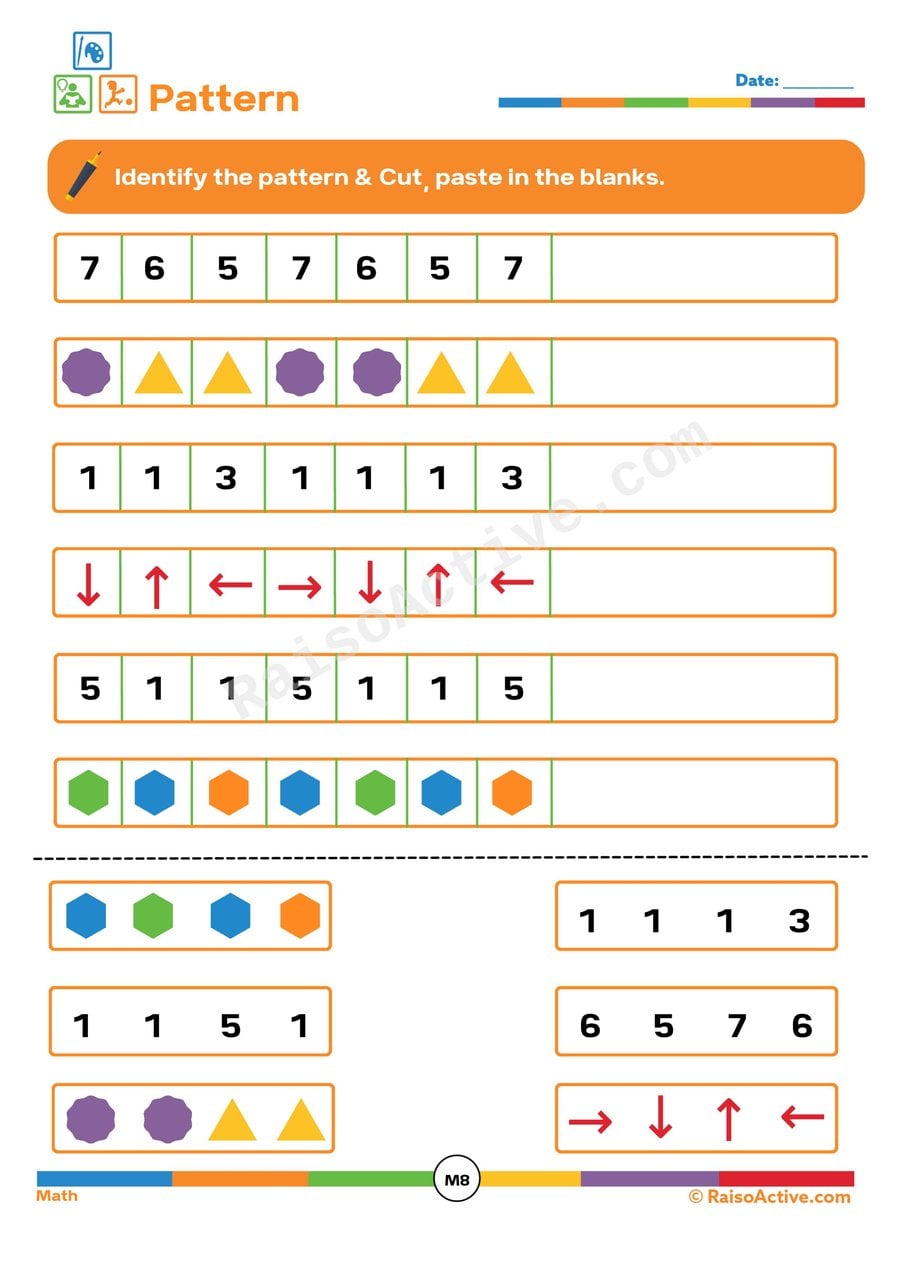
Pattern Fun: Identify and Complete the Sequences!
Ages 4-6 · Pre-K–KindergartenAges 4-6 · Reception–Year 1Ages 4-6 · LKG–UKGAges 4-6
This worksheet mixes numbers, shapes, and symbols across different pattern types, pushing children to apply the same pattern-recognition logic flexibly rather than to just one familiar format. For ages four to six, practicing across varied pattern types builds a more transferable understanding of sequences, which will support both math and reading skills that rely on recognizing regular structures.

Preposition Worksheet: Identifying Where Things Are!
Ages 3-5 · Preschool–Pre-KAges 3-5 · Nursery–ReceptionAges 3-5 · Nursery–LKGAges 3-5
This worksheet asks children to identify the correct preposition, words like 'in,' 'on,' 'under,' or 'behind', that describes where an object is located in a picture, building spatial vocabulary that supports both everyday communication and following multi-step instructions. For ages three to five, prepositions are often used correctly in speech before children can identify them on paper, so this worksheet helps make that intuitive knowledge explicit.
Related worksheets
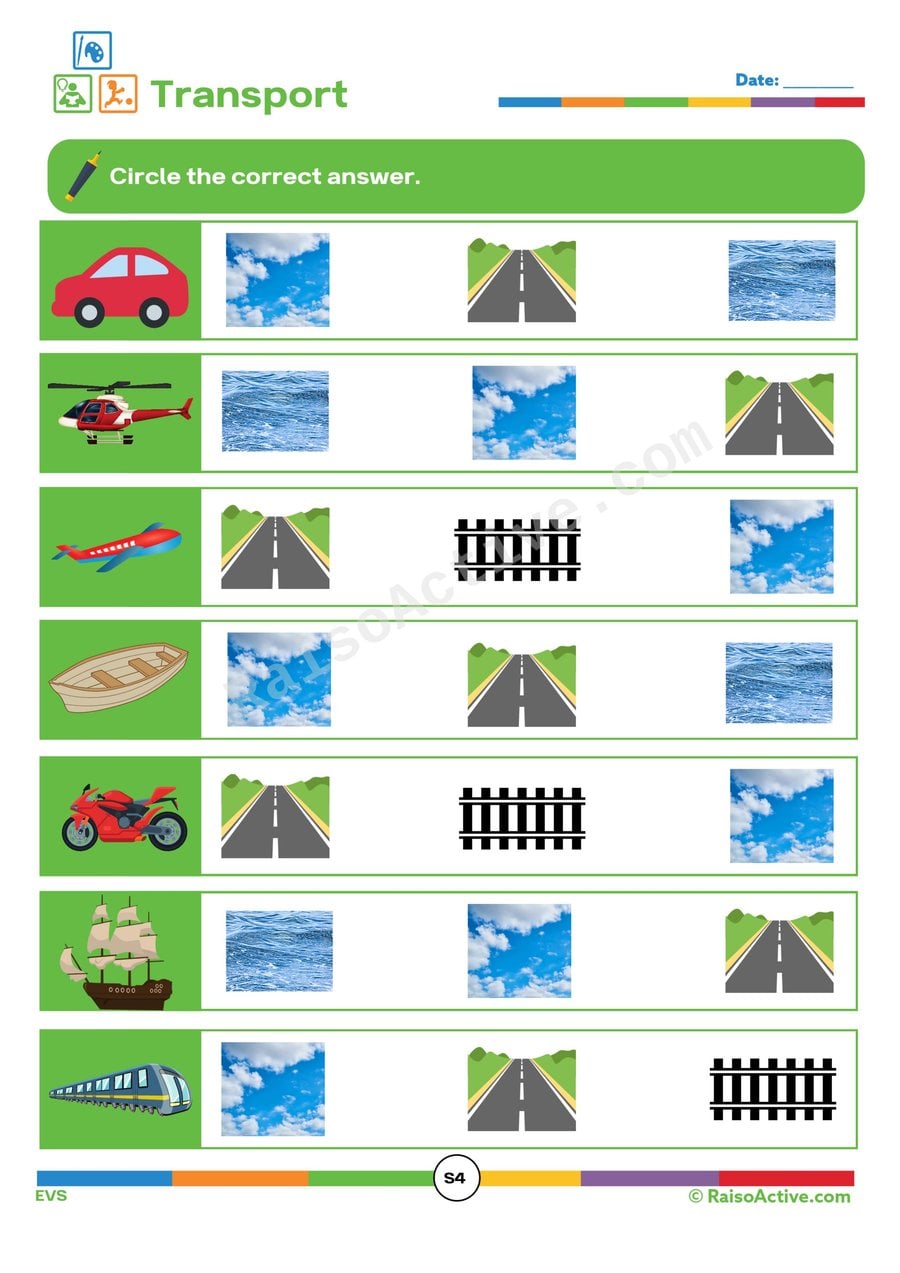
Transport Matching Worksheet for Preschoolers
Ages 3-5 · Preschool–Pre-KAges 3-5 · Nursery–ReceptionAges 3-5 · Nursery–LKGAges 3-5
Preschoolers ages 3-5 build categorization and vocabulary skills as they connect each vehicle picture to the environment where it actually travels. Sorting vehicles by where they go strengthens early classification thinking, a skill children rely on later when grouping objects by other shared properties. It also introduces transportation vocabulary that expands their spoken language.

Transportation Fun: Identify Land, Water, and Air Vehicles!
Ages 3-5 · Preschool–Pre-KAges 3-5 · Nursery–ReceptionAges 3-5 · Nursery–LKGAges 3-5
This worksheet helps children ages 3-5 classify different vehicles by where they travel — land, water, or air — building early categorization skills alongside transportation vocabulary. Writing the correct letter (L, W, or A) for each picture requires children to think about a vehicle's purpose and environment, not just recognize what it is, adding a layer of reasoning beyond simple naming.

Transport Vehicles Cut and Paste Worksheet for Preschoolers
Ages 3-5 · Preschool–Pre-KAges 3-5 · Nursery–ReceptionAges 3-5 · Nursery–LKGAges 3-5
This worksheet has children ages 3-5 sort transport vehicles by cutting them out and pasting each one onto the correct scene — road, water, or sky — building early classification skills alongside vocabulary about how different vehicles travel. Sorting by category, rather than just naming objects, is an important thinking skill that helps children organize new knowledge as they learn about the world.

Transport Cut and Paste Worksheet for Preschoolers
Ages 3-5 · Preschool–Pre-KAges 3-5 · Nursery–ReceptionAges 3-5 · Nursery–LKGAges 3-5
This cut-and-paste worksheet asks children ages 3-5 to sort vehicle pictures into air, water, and land categories, building classification skills alongside scissor control and glue placement. Sorting by transport type is an early exercise in the broader thinking skill of grouping objects by a shared property, which underlies later science and math reasoning.

Transportation Worksheet: Match the Vehicles! (Ages 3-5)
Ages 3-5 · Preschool–Pre-KAges 3-5 · Nursery–ReceptionAges 3-5 · Nursery–LKGAges 3-5
This worksheet asks children ages 3-5 to sort vehicles into four transportation categories — road, track, air, and water — which builds classification skills beyond simple pairs. Because kids must decide which of four groups a vehicle belongs to instead of just two, it stretches their reasoning a level further than basic matching. It also grows vocabulary around trains and tracks, a category many transportation worksheets skip.

Land Transport Vehicles Worksheet for Preschoolers
Ages 3-5 · Preschool–Pre-KAges 3-5 · Nursery–ReceptionAges 3-5 · Nursery–LKGAges 3-5
This worksheet asks children ages 3-5 to look at a busy scene and identify land transport vehicles — cars, trucks, buses, bicycles — by circling them, building visual discrimination skills alongside transportation vocabulary. Picking specific vehicles out of a larger picture also trains children's ability to filter relevant details from a busy visual field, a useful skill well beyond this worksheet's topic.

Train Engine Craft: Cut and Paste Worksheet for Preschoolers
Ages 3-5 · Preschool–Pre-KAges 3-5 · Nursery–ReceptionAges 3-5 · Nursery–LKGAges 3-5
Children ages 3-5 practice following a multi-step visual sequence and build fine motor precision as they cut out individual shapes and assemble them into a complete train engine picture. Beyond cutting and gluing practice, this craft introduces basic engineering thinking — understanding how separate parts combine to form one recognizable whole.
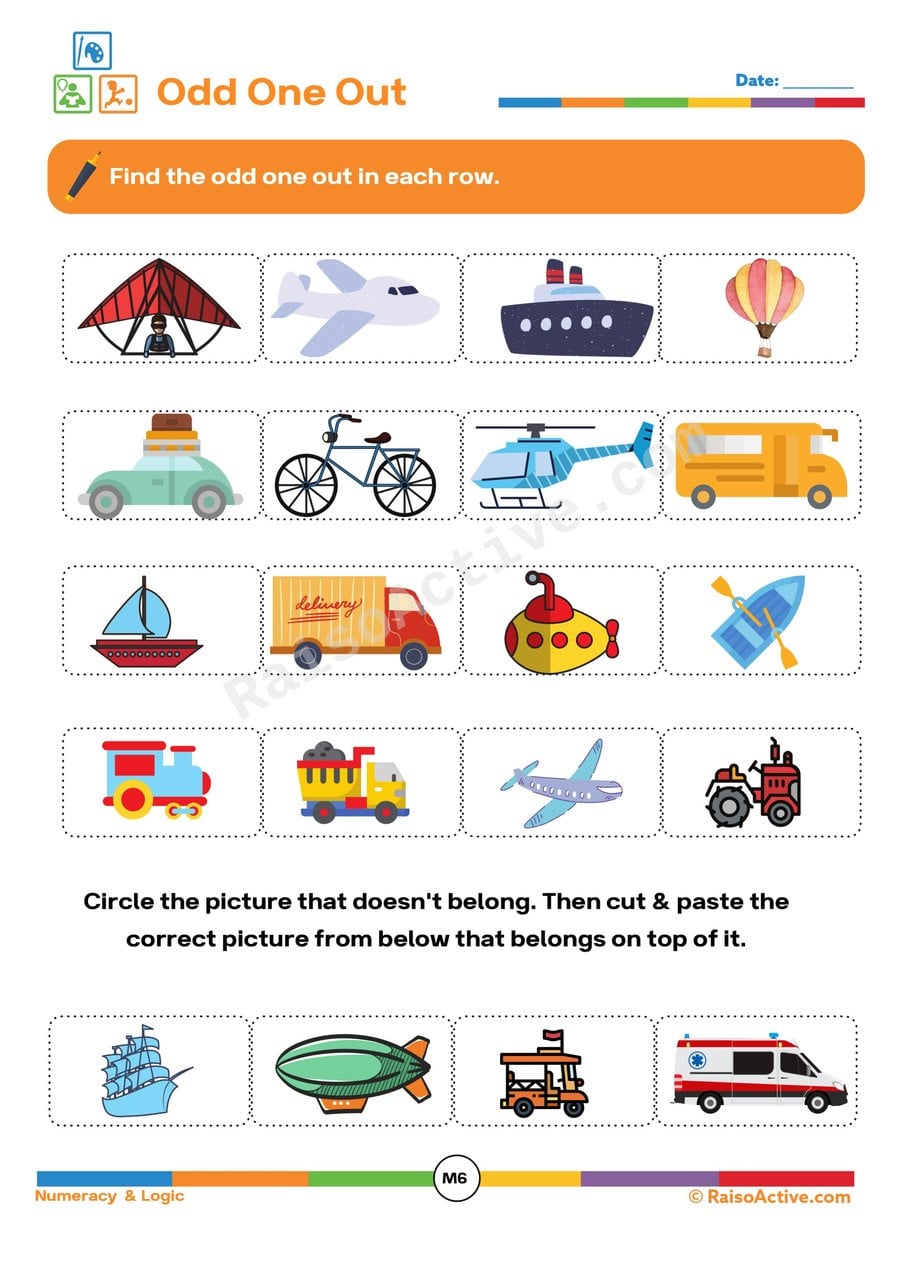
Odd One Out: Transportation Worksheet for Kids
Ages 3-5 · Preschool–Pre-KAges 3-5 · Nursery–ReceptionAges 3-5 · Nursery–LKGAges 3-5
This worksheet sharpens visual discrimination and categorization skills as children ages 3-5 study a row of transportation pictures and identify the one that doesn't belong with the others, then replace it with a correct match cut from the bottom of the page. Explaining why an item is the 'odd one out' builds early critical-thinking and reasoning skills that go beyond simple picture recognition.
Guides for this topic

Sight Words by Age: The First 50 Words and How to Teach Them Without Flashcard Fatigue
Which sight words to teach first and why, the heart-word method, a read-trace-write-find routine, games, and a by-age table of typical sight-word progress.
How to Teach CVC Blending: A Step-by-Step Method That Works in Two Weeks
A step-by-step method for teaching CVC blending, covering continuous sounds, word families, common errors, and a 14-day plan that most children finish reading CVC words.

Best Worksheets for 3-Year-Olds: What Works and What to Avoid
What works on worksheets for 3-year-olds: short sessions, crayons, tracing lines, matching, cutting, a free weekly plan, and signs one is too advanced.
Reviews
Every worksheet for ages 4–6, no watermark
Members download the full library of 1,000+ worksheets and every activity pack without watermarks or daily limits. One year costs ₹999 in India or $20 elsewhere.
See membership plansOr download any worksheet free with a watermark (5 a day).