Sentence Detective: Simple, Compound, or Complex Sentences Worksheet for Kids
This worksheet introduces children to three different sentence structures, simple, compound, and complex, teaching them to notice how conjunctions and clause combinations change a sentence's complexity, a more advanced grammar concept appropriate for ages four to six who are already reading independently. Recognizing these structures also improves reading fluency, since children start to anticipate pauses and connections within longer sentences.
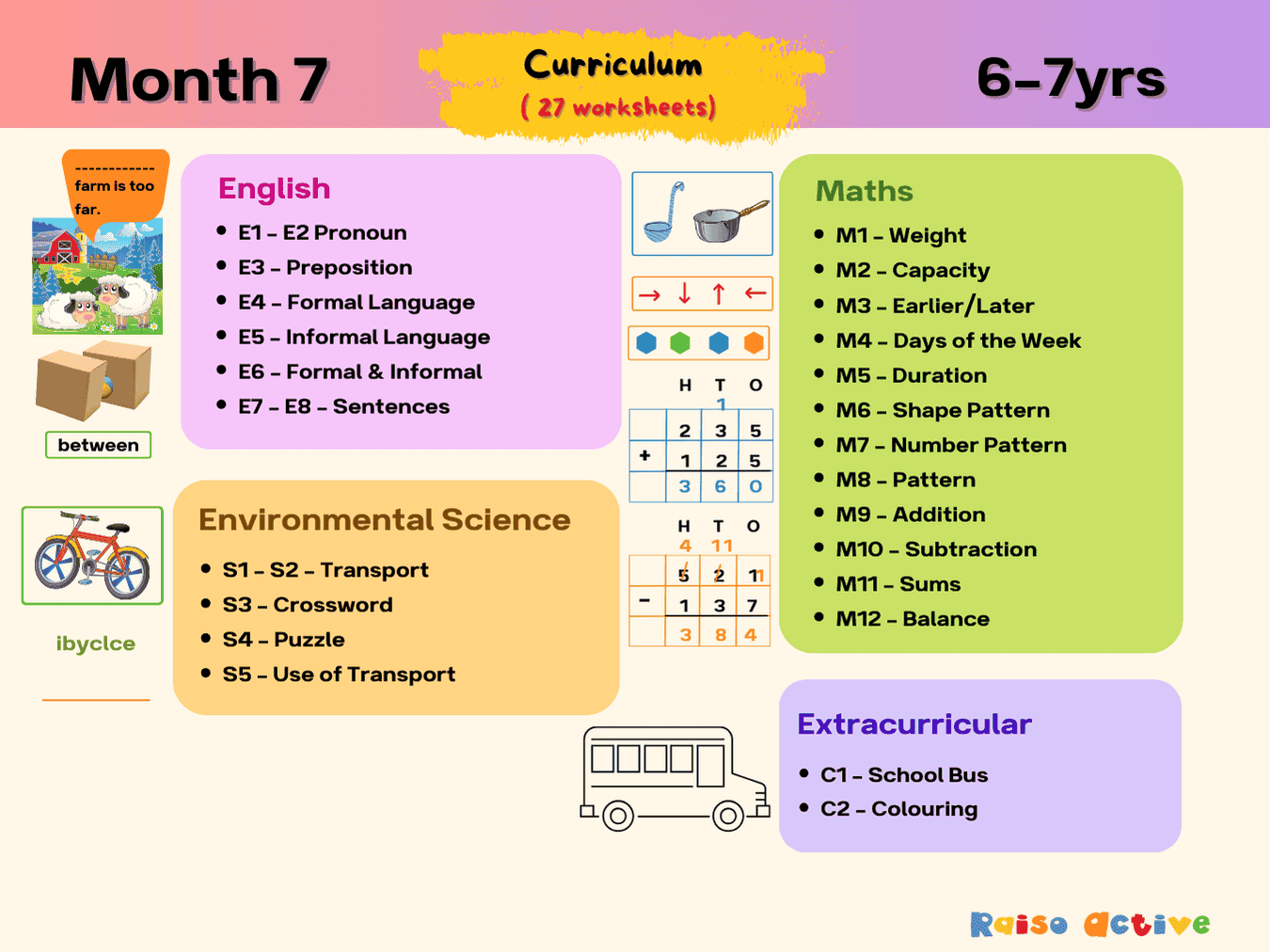
Part of the pack
Month 7: Foundational English Math Science | Ages 6-7
This is page 10 of the pack. Ages 6-7 · Grade 1Ages 6-7 · Year 2Ages 6-7 · Class 1Ages 6-7
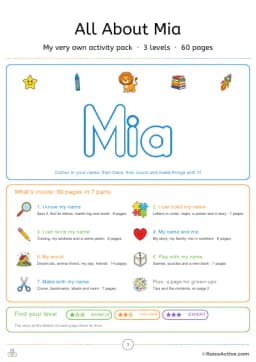
Made for your child
A whole activity pack made with their name
60 pages to spot, build, trace and write their own name, plus pages about their favourites, feelings and family. See a free preview with their name.
Make an All About Me packFree preview · free for members
Or start free: a name tracing sheet with their nameCurriculum
- Fluency > Sentence Building
How to use this worksheet
Read the example sentences at the top of the page together first, discussing what makes each one simple, compound, or complex. Read each practice sentence aloud with your child, looking for clues like conjunctions ('and,' 'but,' 'because') that signal a compound or complex structure. Have your child write their answer, simple, compound, or complex, on the line provided for each sentence. Review their answers together, asking them to point out the specific word or clause that helped them decide.
Materials needed
- Pencil
Extension activities
- 1Create your own sentences using the different sentence types and quiz each other on which type they are.
- 2Find examples of each sentence type in a book you are reading together and read them aloud.
- 3Practice combining two simple sentences into one compound sentence using 'and' or 'but.'
- 4Play a sentence-building game using word cards, assembling a simple sentence and then expanding it into a complex one.

Written by
Hemsweta Jain · Teacher Cheena
MBA and Early Childhood Educator, teaching since 2014 · Founder of RaisoActive, Mumbai
Every RaisoActive worksheet is designed and checked by the founder before publishing.
Published · Last reviewed
More from Month 7: Foundational English Math Science | Ages 6-7
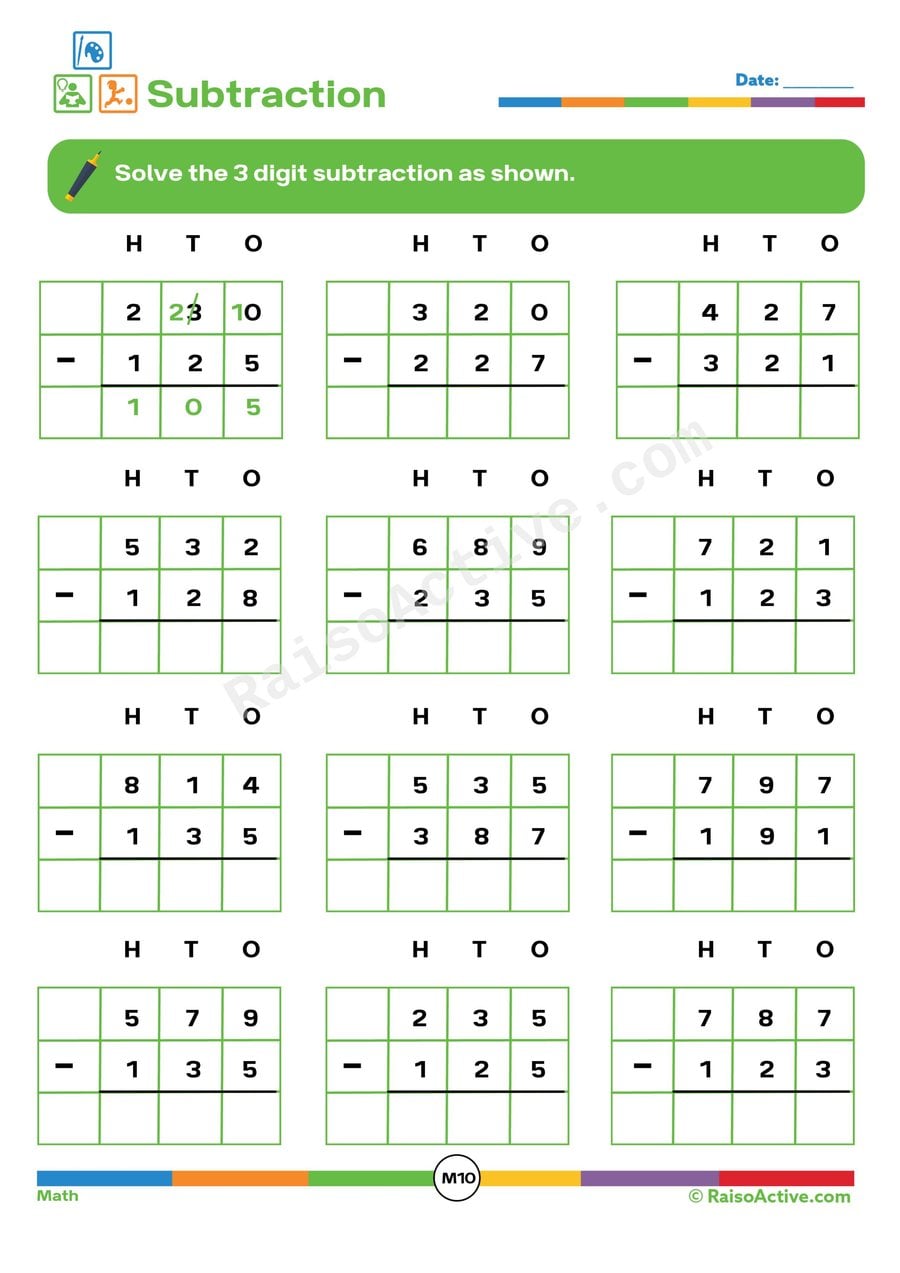
3-Digit Subtraction Worksheet for Kids
Ages 5-7 · Kindergarten–Grade 1Ages 5-7 · Year 1–Year 2Ages 5-7 · UKG–Class 1Ages 5-7
Subtracting three-digit numbers introduces children to borrowing, or regrouping, across place value columns, a more demanding skill than simple subtraction since it requires understanding that a ten can be 'broken' into ones when a column doesn't have enough to subtract from. For ages five to seven, this worksheet builds the procedural foundation for confident multi-digit subtraction going forward.
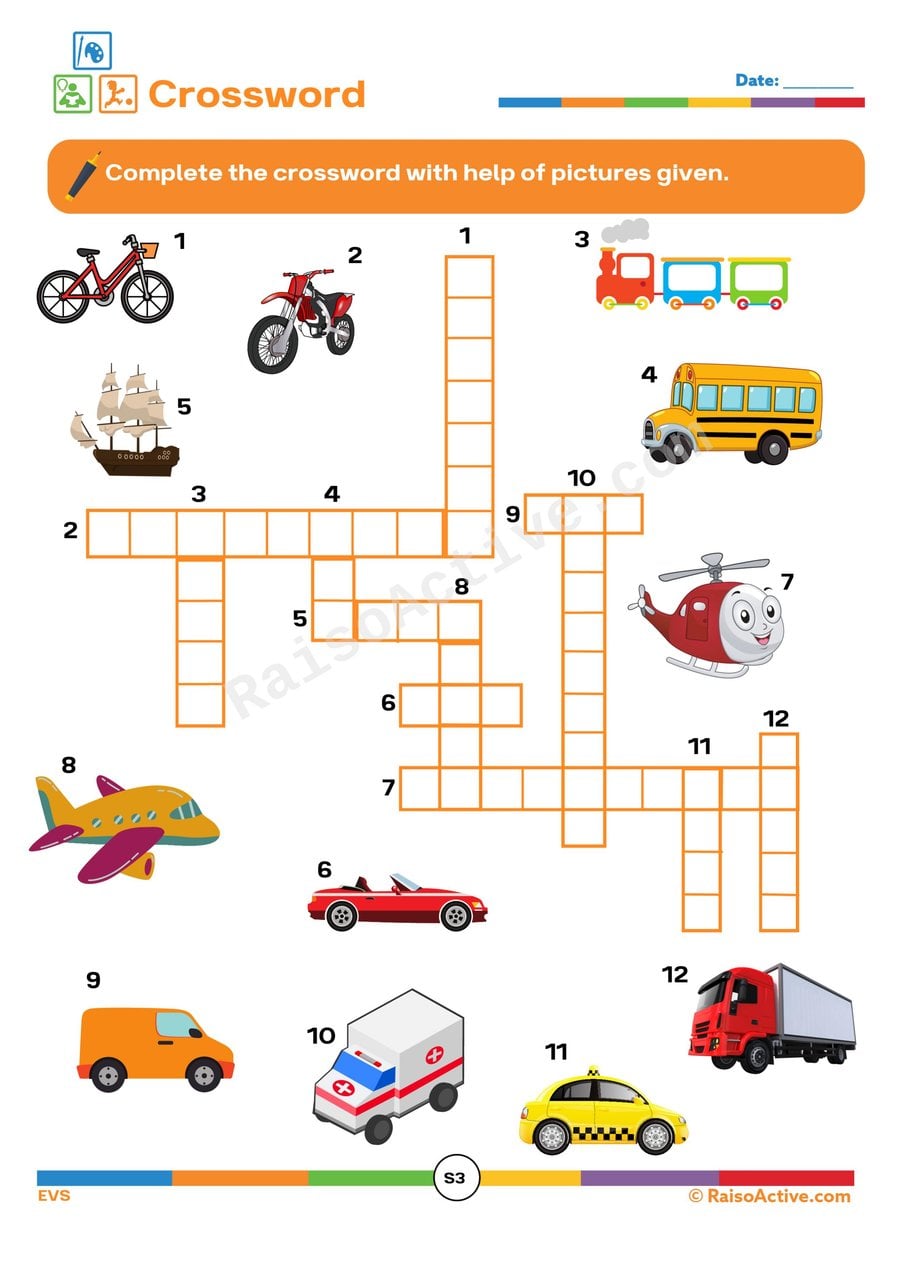
Crossword Puzzle: Vehicles Worksheet for Kids
Ages 4-6 · Pre-K–KindergartenAges 4-6 · Reception–Year 1Ages 4-6 · LKG–UKGAges 4-6
Solving a crossword using vehicle pictures challenges children ages 4-6 to connect an image to its written spelling while also introducing the logic of a crossword grid, where letters must fit both across and down. This combination builds vocabulary, spelling awareness, and early problem-solving persistence as children work through clues that intersect with one another.

Complex or Compound Sentences Worksheet for Kids
Ages 4-6 · Pre-K–KindergartenAges 4-6 · Reception–Year 1Ages 4-6 · LKG–UKGAges 4-6
This worksheet narrows the focus to just two sentence types, compound and complex, asking children to tell them apart by identifying the connecting word that joins the clauses. For ages four to six, distinguishing these two structures specifically builds on earlier simple-sentence recognition and prepares them to eventually write more varied, interesting sentences of their own.

Formal Language Worksheet: Cut and Paste Sentences
Ages 4-6 · Pre-K–KindergartenAges 4-6 · Reception–Year 1Ages 4-6 · LKG–UKGAges 4-6
This worksheet introduces the idea that language changes depending on context, that we speak or write differently to a teacher than to a close friend, by asking children to sort sentences into formal and informal categories. For ages four to six, recognizing this distinction is an early step toward the social and communication awareness they'll need throughout school and beyond.

School Bus Coloring and Cutting Worksheet for Preschoolers
Ages 3-5 · Preschool–Pre-KAges 3-5 · Nursery–ReceptionAges 3-5 · Nursery–LKGAges 3-5
Coloring, cutting, and assembling a school bus gives children ages 3-5 practice with precise scissor control, since cutting small shapes like windows and wheels demands more accuracy than cutting along a straight edge. The activity also introduces a familiar, comforting topic — the school bus — which can help ease transportation-related anxieties for children starting or continuing school.
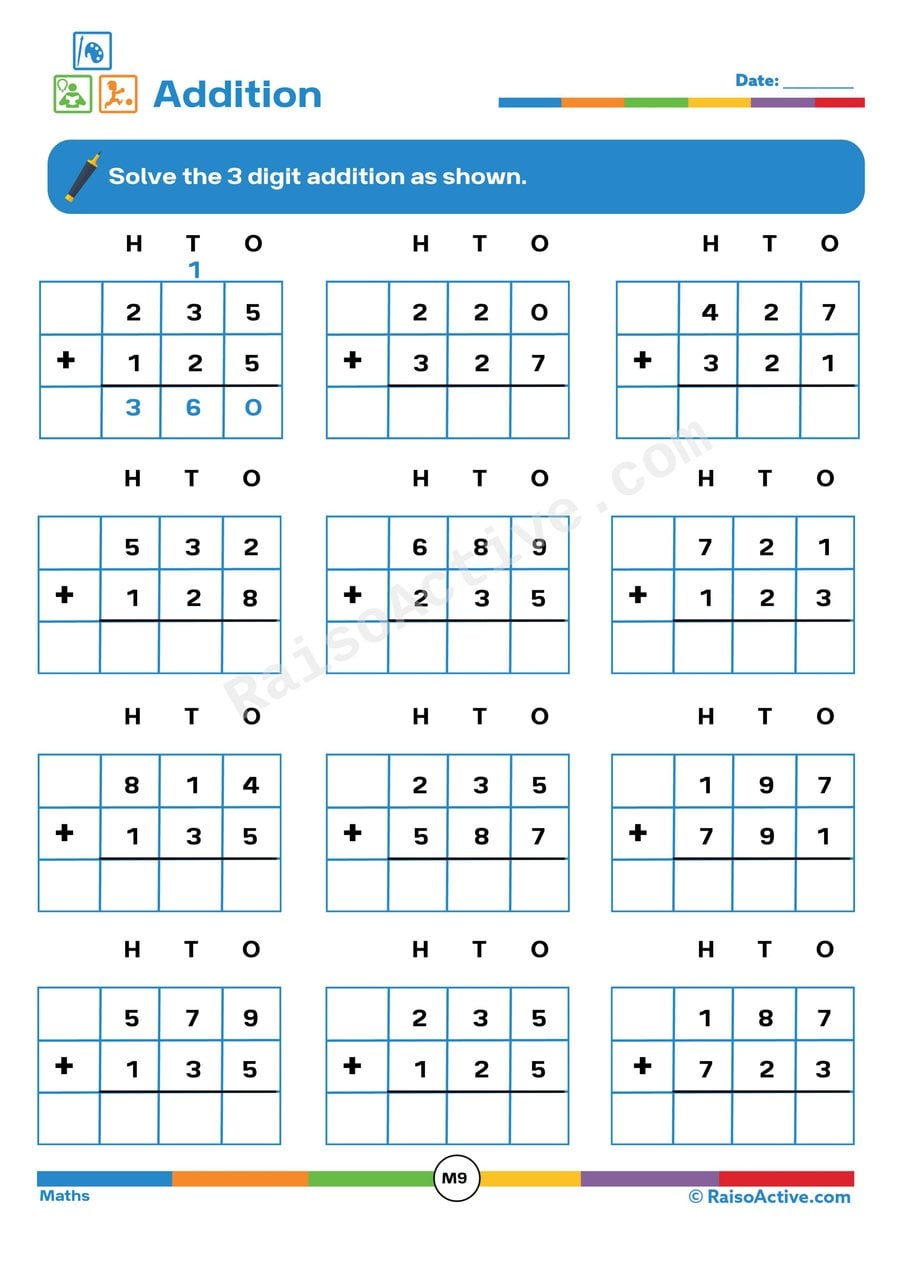
3-Digit Addition Worksheet for Kids
Ages 6-8 · Grade 1–Grade 2Ages 6-8 · Year 2–Year 3Ages 6-8 · Class 1–Class 2Ages 6-8
Adding two three-digit numbers requires children to work through the ones, tens, and hundreds columns in order and understand how a sum in one column can carry over into the next, a significant step up from single-digit addition. For ages six to eight, mastering this column-based process builds the procedural fluency needed for all future multi-digit arithmetic.

Addition and Subtraction Sums Worksheet for Preschoolers
Ages 4-6 · Pre-K–KindergartenAges 4-6 · Reception–Year 1Ages 4-6 · LKG–UKGAges 4-6
Practicing addition and subtraction problems within 10 together, rather than in separate worksheets, helps children see the two operations as related, that subtraction can undo addition, which builds more flexible number sense than drilling each skill in isolation. For ages four to six, working within small numbers keeps the focus on understanding the operations rather than on managing large quantities.
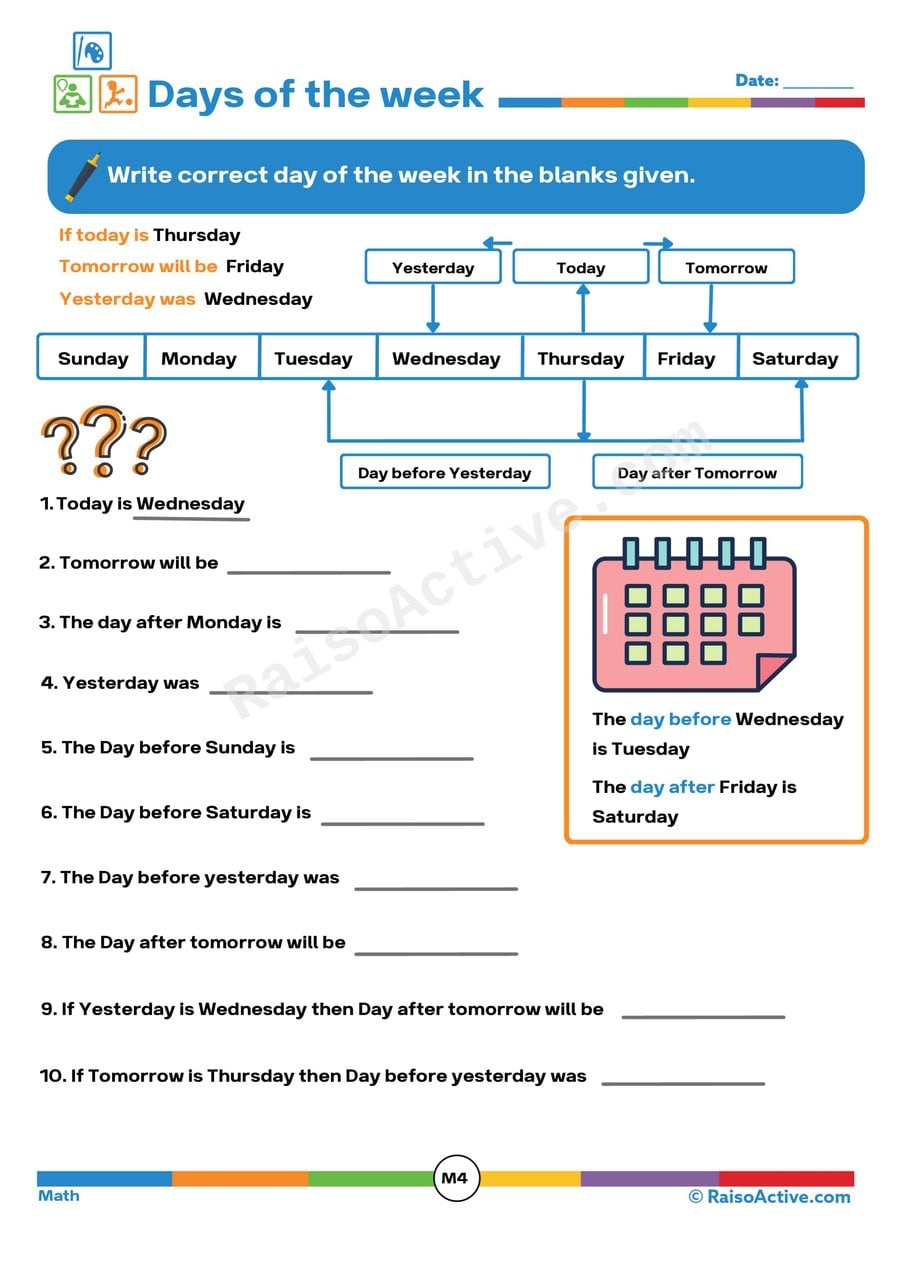
Days of the Week Worksheet: Learn the Days!
Ages 4-6 · Pre-K–KindergartenAges 4-6 · Reception–Year 1Ages 4-6 · LKG–UKGAges 4-6
Learning the days of the week in order gives children a framework for understanding time, routines, and scheduling that they'll use for the rest of their lives, from knowing when school happens to planning a weekend. For ages four to six, practicing the correct sequence, Monday through Sunday, also builds the same kind of ordered-list memory skill used for the alphabet and counting.
Related worksheets

Frame Sentences Worksheet: Fill-in-the-Blanks with Pictures!
Ages 4-5 · Pre-KAges 4-5 · ReceptionAges 4-5 · LKGAges 4-5
Children ages 4-5 practice connecting spoken vocabulary to written words as they use picture clues to fill in missing words within a sentence frame. This builds early sentence construction and reinforces that a sentence needs the right word in the right place to make sense, a stepping stone toward independent writing.

Frame Sentences Worksheet: Read and Tick the Correct Sentence!
Ages 4-6 · Pre-K–KindergartenAges 4-6 · Reception–Year 1Ages 4-6 · LKG–UKGAges 4-6
This worksheet strengthens early grammar awareness in children ages 4-6 by having them compare two or more versions of a sentence and judge which one is written correctly. Spotting the difference between a correct and incorrect sentence builds the same skimming and comparing skills that support later spelling and editing work.

Simple Sentences Worksheet: Rewriting Sentences for Early Readers
Ages 4-6 · Pre-K–KindergartenAges 4-6 · Reception–Year 1Ages 4-6 · LKG–UKGAges 4-6
Children ages 4-6 practice sentence construction by rearranging scrambled words into a grammatically correct, meaningful sentence, building an understanding of proper word order in English. This hands-on rearranging task teaches children to recognize where a sentence's subject, action, and details belong, a skill they'll use in all future writing.
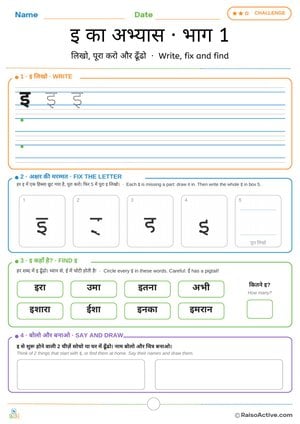
Hindi Letter इ Practice Part 1: Write, Fix and Find | इ का अभ्यास · भाग 1
Ages 3-7 · Preschool–Grade 1Ages 3-7 · Nursery–Year 2Ages 3-7 · Nursery–Class 1Ages 3-7
Children write इ on guide lines, complete four partly drawn letters, circle इ in eight words (while avoiding its look-alike ई), count how many they found, then think of two more words at home that start with इ and draw them.
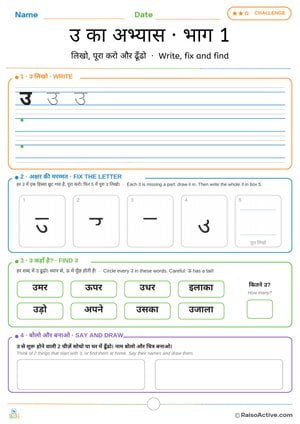
Hindi Letter उ Practice Part 1: Write, Fix and Find | उ का अभ्यास · भाग 1
Ages 3-7 · Preschool–Grade 1Ages 3-7 · Nursery–Year 2Ages 3-7 · Nursery–Class 1Ages 3-7
Children write उ on guide lines, complete four partly drawn letters, circle उ in eight words (while avoiding its look-alike ऊ), count how many they found, then think of two more words at home that start with उ and draw them.
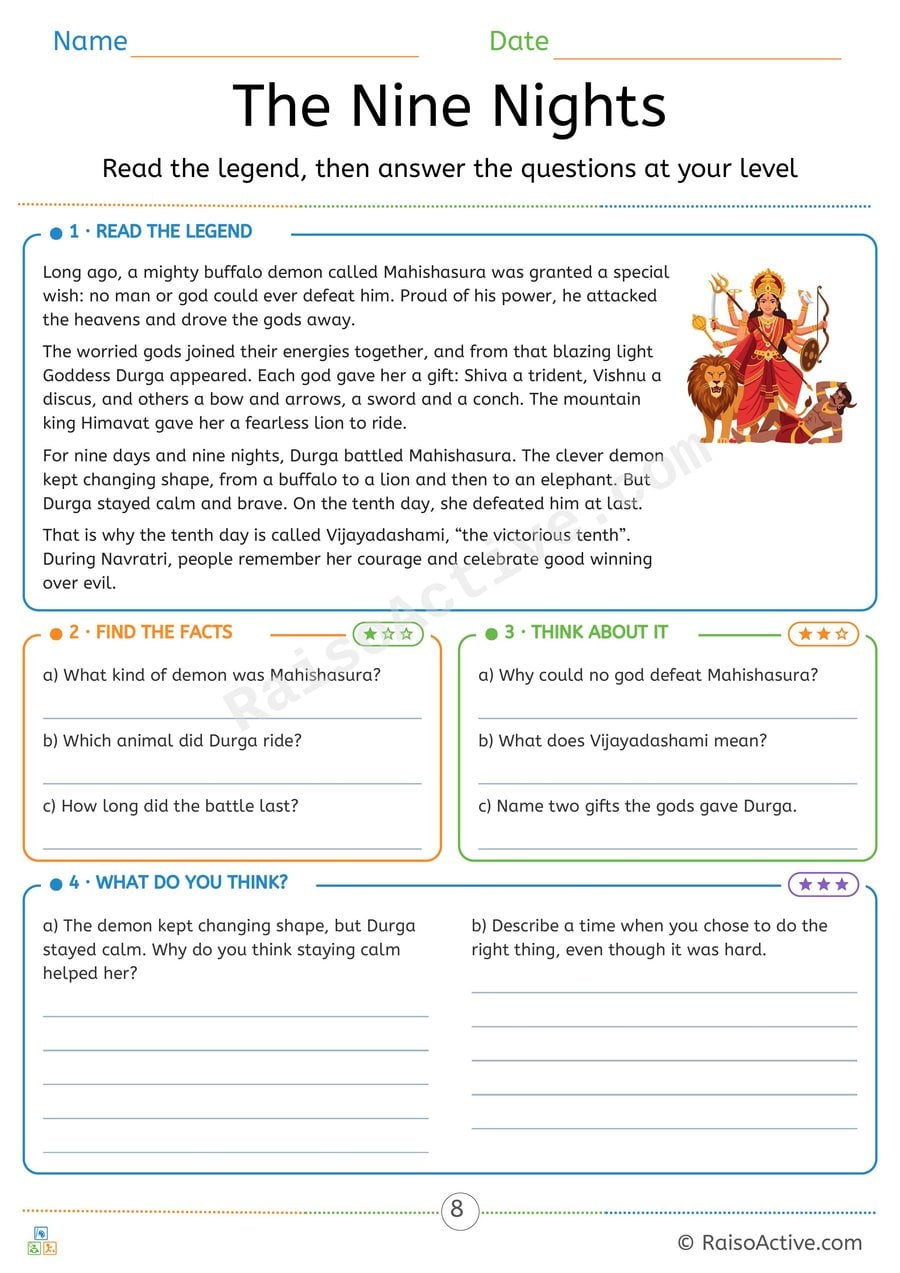
The Nine Nights: Durga and Mahishasura Reading Comprehension
Ages 7-11 · Grade 2–Grade 3Ages 7-11 · Year 3–Year 4Ages 7-11 · Class 2–Class 3Ages 7-11
Children read a retelling of the legend of Durga and Mahishasura, find facts in the text, answer inference questions about why things happened, and write their own opinion about staying calm and doing the right thing.
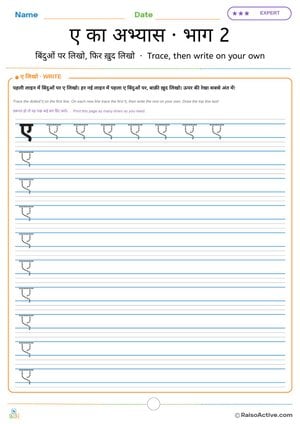
Hindi Letter ए (e) Practice 2: Trace, then Write on Your Own | ए का अभ्यास · भाग 2
Ages 5-7 · Kindergarten–Grade 1Ages 5-7 · Year 1–Year 2Ages 5-7 · UKG–Class 1Ages 5-7
An expert page for confident writers: trace the dotted ए on the first line, then on each new line trace the first ए and write the rest on your own, adding the top line last.
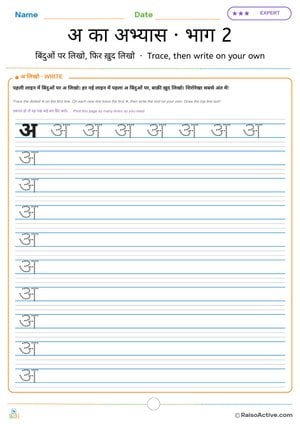
Hindi Letter अ Practice Part 2: Trace and Write on Your Own | अ का अभ्यास · भाग 2
Ages 3-7 · Preschool–Grade 1Ages 3-7 · Nursery–Year 2Ages 3-7 · Nursery–Class 1Ages 3-7
Children build writing fluency by tracing the dotted line अ on the first line and then writing the letter on their own, line after line, as the dotted help fades. The headline (शिरोरेखा) is drawn last, as in Hindi handwriting.
Guides for this topic

Documenting Learning Without Drowning in Data: A Practical Guide for Parents and Teachers
Learn practical ways to document your child's learning without overwhelm. Simple portfolios, observation tips, and printable trackers for ages 1-8.

Age-Appropriate Problem-Solving Activities: Building Critical Thinkers from the Ground Up
Discover fun, age-appropriate problem-solving activities for children ages 1-8. Build critical thinking, logic, and reasoning skills through play-based learning.
Critical Thinking Activities That Actually Work for Young Children: Building Tomorrow's Thinkers Today
Discover proven critical thinking activities for young children. Age-wise logic games, questioning techniques, and hands-on ideas to build thinking skills at home.
Reviews
Every worksheet for ages 4–6, no watermark
Members download the full library of 1,000+ worksheets and every activity pack without watermarks or daily limits. One year costs ₹999 in India or $20 elsewhere.
See membership plansOr download any worksheet free with a watermark (5 a day).