Days of the Week Worksheet: Learn the Days!
Learning the days of the week in order gives children a framework for understanding time, routines, and scheduling that they'll use for the rest of their lives, from knowing when school happens to planning a weekend. For ages four to six, practicing the correct sequence, Monday through Sunday, also builds the same kind of ordered-list memory skill used for the alphabet and counting.
Part of the pack
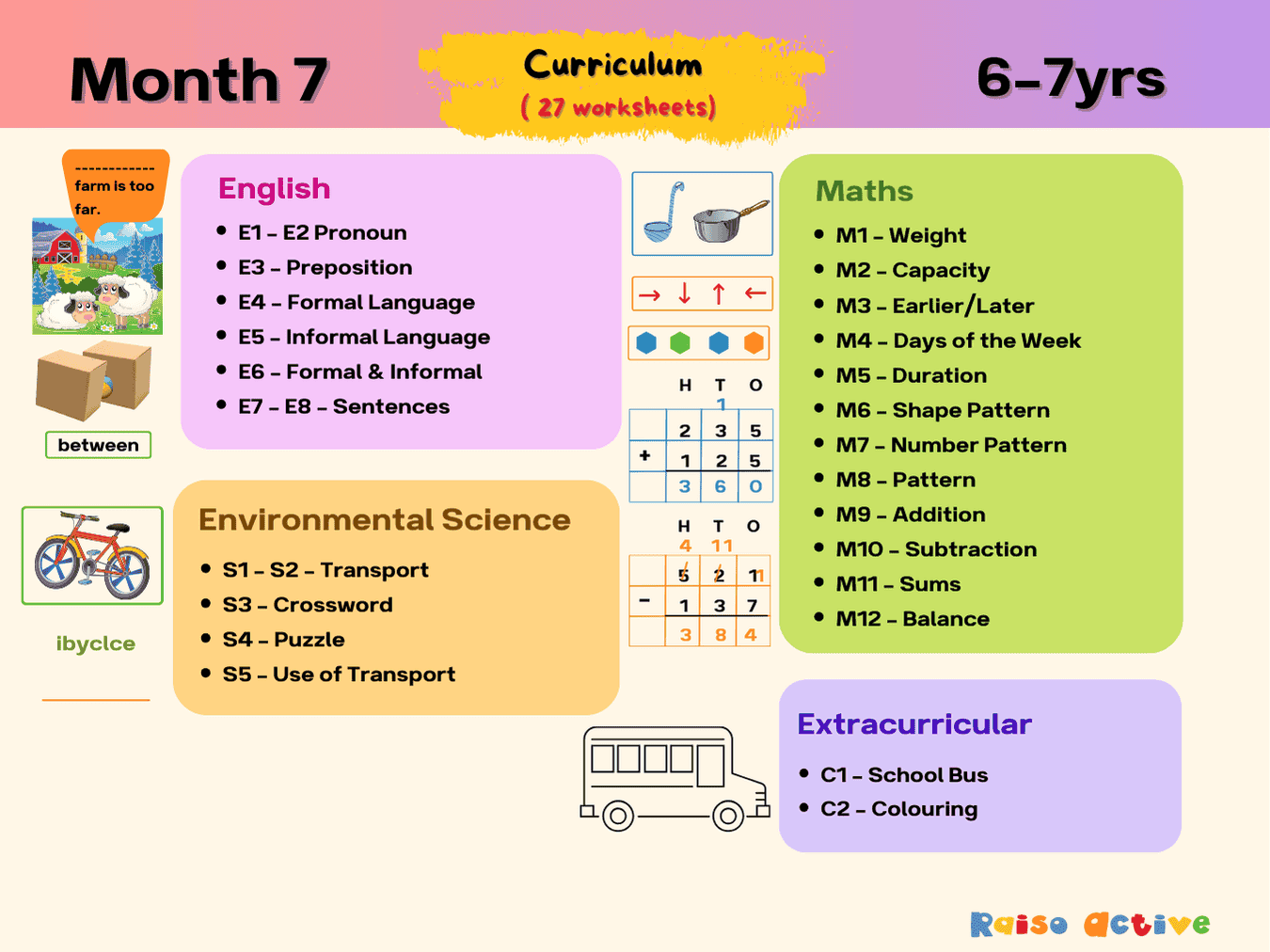
Month 7: Foundational English Math Science | Ages 6-7
This is page 15 of the pack. Ages 6-7 · Grade 1Ages 6-7 · Year 2Ages 6-7 · Class 1Ages 6-7

Made for your child
Counting to 10, made for your child
A maths pack with your child's name in it: pictures that explain, practice at three levels, puzzles and story sums about them. Print a new set whenever they finish.
Make a maths packFree preview · free for members
Curriculum
- Time > Days of the Week
How to use this worksheet
Read through the days of the week together first, in order, so your child hears the full sequence before attempting the worksheet. Read each instruction or sentence on the page and have your child fill in the blank with the correct day of the week. Check each answer together by reciting the days in order up to the one they wrote, confirming it falls in the right place. Continue through the remaining blanks on the page, encouraging your child to try each one independently before you offer help.
Materials needed
- Pencil
Extension activities
- 1Create a simple calendar together and mark off each day as it passes throughout the week.
- 2Sing the days of the week song together to help the order become automatic.
- 3Discuss what activities happen on each day, like 'we go to the park on Saturday.'
- 4Make a daily weather and mood chart, writing the day of the week at the top each morning.

Written by
Hemsweta Jain · Teacher Cheena
MBA and Early Childhood Educator, teaching since 2014 · Founder of RaisoActive, Mumbai
Every RaisoActive worksheet is designed and checked by the founder before publishing.
Published · Last reviewed
More from Month 7: Foundational English Math Science | Ages 6-7

Balance Worksheet: Counting and Matching for Preschoolers
Ages 4-5 · Pre-KAges 4-5 · ReceptionAges 4-5 · LKGAges 4-5
This worksheet introduces the concept of balance and equality by asking children to fill in a missing number so that both sides of a scale match, an early, concrete version of the idea behind an equal sign in later math. For ages four to five, reasoning about what number makes two sides 'balance' builds number sense and problem-solving skills beyond simple counting.

Preposition Worksheet: Identifying Where Things Are!
Ages 3-5 · Preschool–Pre-KAges 3-5 · Nursery–ReceptionAges 3-5 · Nursery–LKGAges 3-5
This worksheet asks children to identify the correct preposition, words like 'in,' 'on,' 'under,' or 'behind', that describes where an object is located in a picture, building spatial vocabulary that supports both everyday communication and following multi-step instructions. For ages three to five, prepositions are often used correctly in speech before children can identify them on paper, so this worksheet helps make that intuitive knowledge explicit.

Sentence Detective: Simple, Compound, or Complex Sentences Worksheet for Kids
Ages 4-6 · Pre-K–KindergartenAges 4-6 · Reception–Year 1Ages 4-6 · LKG–UKGAges 4-6
This worksheet introduces children to three different sentence structures, simple, compound, and complex, teaching them to notice how conjunctions and clause combinations change a sentence's complexity, a more advanced grammar concept appropriate for ages four to six who are already reading independently. Recognizing these structures also improves reading fluency, since children start to anticipate pauses and connections within longer sentences.

Transport Worksheet: Cut and Paste the Correct Mode of Transport!
Ages 4-6 · Pre-K–KindergartenAges 4-6 · Reception–Year 1Ages 4-6 · LKG–UKGAges 4-6
Reading a sentence and choosing the correct vehicle to complete it teaches children ages 4-6 to use context clues from text to guide a decision, an early reading comprehension skill that goes beyond simple word recognition. The cutting and pasting also reinforces vocabulary for different modes of transportation as children physically match each picture to its described purpose.
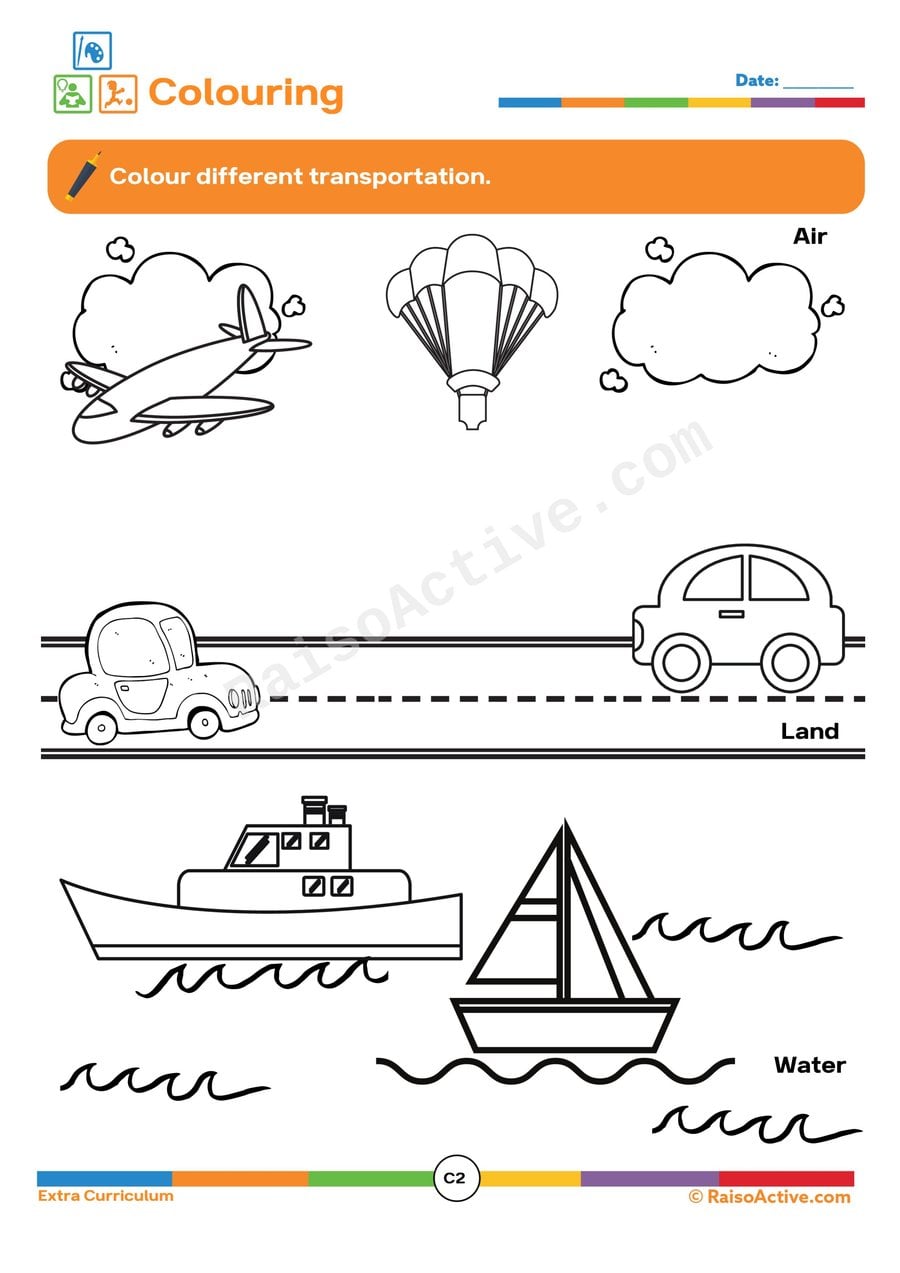
Color the Transportation Worksheet for Kids
Ages 3-5 · Preschool–Pre-KAges 3-5 · Nursery–ReceptionAges 3-5 · Nursery–LKGAges 3-5
Coloring vehicles that travel by air, land, and water helps children ages 3-5 build an early classification system for how transportation is grouped by environment, not just by shape or size. Naming where each vehicle travels while coloring also reinforces vocabulary and observation skills, since children must look closely at each picture's features to decide its category.

Demonstrative Pronouns Worksheet for Preschoolers
Ages 3-5 · Preschool–Pre-KAges 3-5 · Nursery–ReceptionAges 3-5 · Nursery–LKGAges 3-5
Choosing between 'this,' 'that,' 'these,' and 'those' teaches children ages 3-5 an early grammar concept tied directly to physical space — near versus far, and one item versus many. Because this distinction depends on perspective, practicing it helps children connect spoken language to what they actually see and point to, strengthening both vocabulary and spatial reasoning.

Informal Language Fun: Cut and Paste Worksheet for Kids
Ages 4-6 · Pre-K–KindergartenAges 4-6 · Reception–Year 1Ages 4-6 · LKG–UKGAges 4-6
Sorting sentences as informal helps children ages 4-6 begin to notice that the same idea can be expressed differently depending on who's listening — a friend versus a teacher, for example — which is an early step toward social and audience awareness in language. The cutting and pasting also reinforces this recognition kinesthetically, since children must physically place each sentence where it belongs rather than just circling an answer.

Capacity Worksheet: Circle the Object with More Capacity!
Ages 3-5 · Preschool–Pre-KAges 3-5 · Nursery–ReceptionAges 3-5 · Nursery–LKGAges 3-5
Comparing pairs of containers teaches children ages 3-5 the early measurement concept of capacity — how much space is inside an object for holding something — which is distinct from simply judging an object's overall size. Making a choice and explaining it also builds early reasoning skills, since children must connect what they see to an invisible property, the amount something can hold.
Related worksheets

Days of the Week Cut and Paste Worksheet for Preschoolers
Ages 3-5 · Preschool–Pre-KAges 3-5 · Nursery–ReceptionAges 3-5 · Nursery–LKGAges 3-5
This worksheet teaches children ages 3-5 the order of the days of the week by having them cut out day names and paste them correctly under 'Yesterday', 'Today', and 'Tomorrow'. Understanding this relative time sequence is an important early step in developing time concepts, and the physical cut-and-paste format makes an abstract idea like 'yesterday' more concrete and hands-on.

Days of the Week Cut and Paste Worksheet for Preschoolers
Ages 3-5 · Preschool–Pre-KAges 3-5 · Nursery–ReceptionAges 3-5 · Nursery–LKGAges 3-5
This worksheet builds sequencing skills by asking children to place the seven days of the week in their correct order, a concept that lays the groundwork for understanding calendars, routines, and time. For preschoolers, memorizing a fixed sequence like Sunday through Saturday also strengthens verbal memory and the idea that some things always happen in the same order.

Days of the Week Sequencing Worksheet for Preschoolers
Ages 3-5 · Preschool–Pre-KAges 3-5 · Nursery–ReceptionAges 3-5 · Nursery–LKGAges 3-5
This worksheet builds sequencing skills for children ages 3-5 as they work with the days of the week in order, first filling in a missing day and then cutting and gluing days into the correct sequence. Understanding that days follow a fixed, repeating order is an early step toward time concepts like yesterday, today, and tomorrow, and this hands-on repetition helps cement a sequence that isn't visually obvious the way counting objects is.

Days of the Week Cut and Paste Worksheet for Preschoolers
Ages 4-6 · Pre-K–KindergartenAges 4-6 · Reception–Year 1Ages 4-6 · LKG–UKGAges 4-6
Cutting out the seven day names and gluing them into the correct sequence teaches children ages 4-6 the fixed order of the days of the week, a foundational piece of time-concept knowledge they'll rely on for calendars, schedules, and daily routines. Because this activity requires both reading the day names and remembering their correct order, it strengthens sight-word recognition alongside sequencing skills. The hands-on cutting and pasting also gives fine motor practice within a literacy and time-concept task.

Days of the Week Cut and Paste Worksheet for Kids
Ages 3-5 · Preschool–Pre-KAges 3-5 · Nursery–ReceptionAges 3-5 · Nursery–LKGAges 3-5
This worksheet reinforces the names and order of the days of the week by having children cut out each day and glue it into its correct place in the weekly sequence. For three- to five-year-olds, physically handling and arranging each day as a separate piece — rather than just reciting the order — gives them a concrete way to check and correct their own understanding of the sequence.
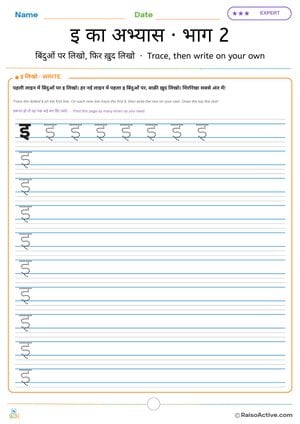
Hindi Letter इ Practice Part 2: Trace and Write on Your Own | इ का अभ्यास · भाग 2
Ages 3-7 · Preschool–Grade 1Ages 3-7 · Nursery–Year 2Ages 3-7 · Nursery–Class 1Ages 3-7
Children build writing fluency by tracing the dotted line इ on the first line and then writing the letter on their own, line after line, as the dotted help fades. The headline (शिरोरेखा) is drawn last, as in Hindi handwriting.
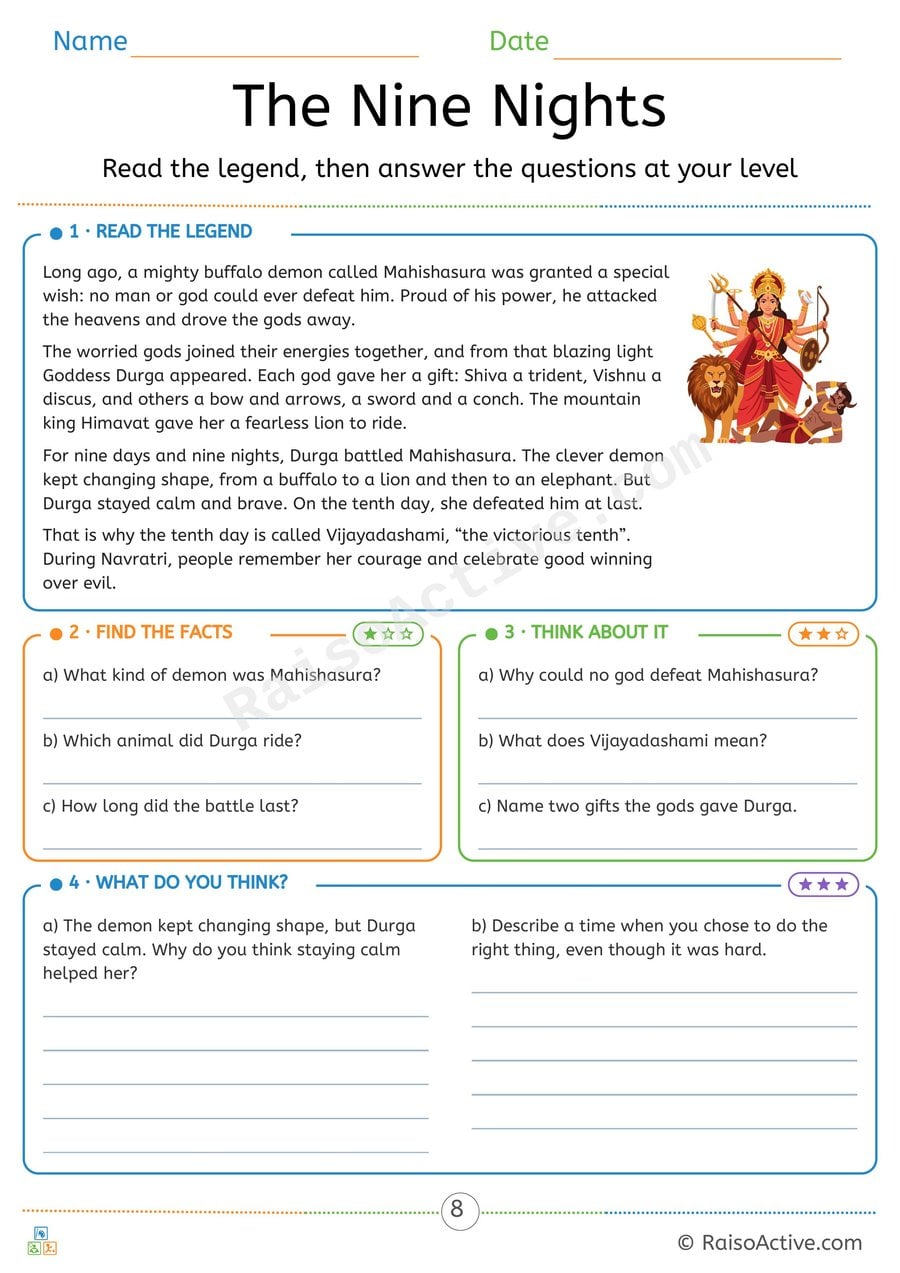
The Nine Nights: Durga and Mahishasura Reading Comprehension
Ages 7-11 · Grade 2–Grade 3Ages 7-11 · Year 3–Year 4Ages 7-11 · Class 2–Class 3Ages 7-11
Children read a retelling of the legend of Durga and Mahishasura, find facts in the text, answer inference questions about why things happened, and write their own opinion about staying calm and doing the right thing.
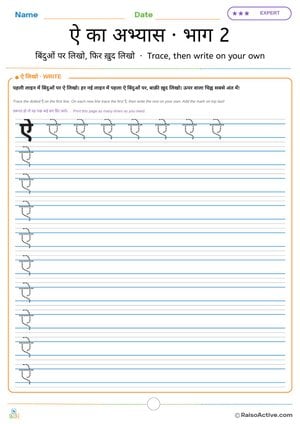
Hindi Letter ऐ (ai) Practice 2: Trace, then Write on Your Own | ऐ का अभ्यास · भाग 2
Ages 5-7 · Kindergarten–Grade 1Ages 5-7 · Year 1–Year 2Ages 5-7 · UKG–Class 1Ages 5-7
An expert page for confident writers: trace the dotted ऐ on the first line, then on each new line trace the first ऐ and write the rest on your own, adding the mark on top last.
Guides for this topic

Number Formation Rhymes 0–9 and How to Fix Reversals
Original number formation rhymes for 0–9, the correct stroke order for each digit, why 3, 5 and 7 get reversed most often, and multisensory fixes that work.

Documenting Learning Without Drowning in Data: A Practical Guide for Parents and Teachers
Learn practical ways to document your child's learning without overwhelm. Simple portfolios, observation tips, and printable trackers for ages 1-8.

How to Help Your Child with Letter Reversals: A Complete Guide for Parents and Teachers
Letter reversals are normal until age 7-8. Learn the best multisensory strategies, anchor letter tricks, and activities to help children write b, d, p, and q correctly.
Reviews
Every worksheet for ages 4–6, no watermark
Members download the full library of 1,000+ worksheets and every activity pack without watermarks or daily limits. One year costs ₹999 in India or $20 elsewhere.
See membership plansOr download any worksheet free with a watermark (5 a day).