Days of the Week Cut and Paste Worksheet for Preschoolers
Cutting out the seven day names and gluing them into the correct sequence teaches children ages 4-6 the fixed order of the days of the week, a foundational piece of time-concept knowledge they'll rely on for calendars, schedules, and daily routines. Because this activity requires both reading the day names and remembering their correct order, it strengthens sight-word recognition alongside sequencing skills. The hands-on cutting and pasting also gives fine motor practice within a literacy and time-concept task.
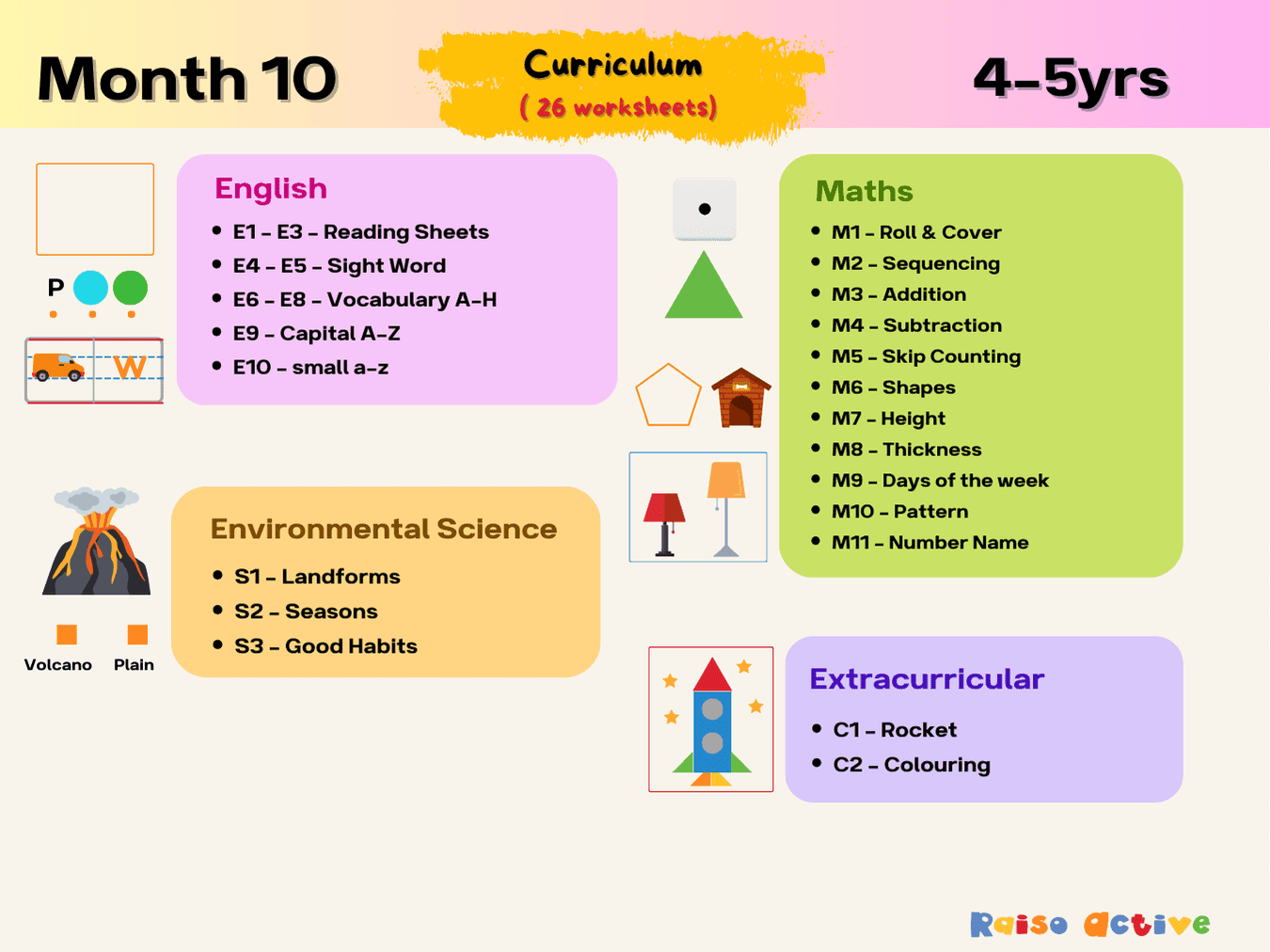
Part of the pack
Month 10: Learning & Development | Ages 4-5
This is page 22 of the pack. Ages 4-5 · Pre-KAges 4-5 · ReceptionAges 4-5 · LKGAges 4-5
Curriculum
- Time > Days of the Week
How to use this worksheet
Have your child cut out each day-of-the-week card along the dotted lines, keeping them loose in front of them. Say the days of the week together in order, from Sunday or Monday through to the end, so your child hears the correct sequence before placing the cards. Ask your child to find the card for the first day and glue it into the first box, continuing through the remaining days one at a time, checking each one against the spoken order. Once all seven boxes are filled, read the completed sequence aloud together to confirm it's correct.
Materials needed
- Scissors
- Glue
- Pencil or Marker
Extension activities
- 1Sing a days-of-the-week song together during the activity or as a follow-up during the car ride or bath time.
- 2Create a simple weekly calendar at home and mark what special activity happens on each day.
- 3Practice writing each day's name from memory on a blank sheet after the cut and paste is complete.
- 4Talk about what day it is today, what day it was yesterday, and what day comes tomorrow.
- 5Make a paper chain with seven links, each labeled with a day, to count down to a special event.

Written by
Hemsweta Jain · Teacher Cheena
MBA and Early Childhood Educator, teaching since 2014 · Founder of RaisoActive, Mumbai
Every RaisoActive worksheet is designed and checked by the founder before publishing.
Published · Last reviewed
More from Month 10: Learning & Development | Ages 4-5

Cut and Paste Reading Worksheet: Matching Sentences with Pictures
Ages 4-5 · Pre-KAges 4-5 · ReceptionAges 4-5 · LKGAges 4-5
This worksheet gives children ages 4-5 practice reading short simple sentences and connecting the meaning of the words to a matching picture, an essential bridge between decoding words and comprehending what they say. Cutting and pasting the correct picture next to its sentence, rather than just answering verbally, requires children to hold the sentence's meaning in mind while searching for a visual match. This strengthens both reading comprehension and vocabulary at once.
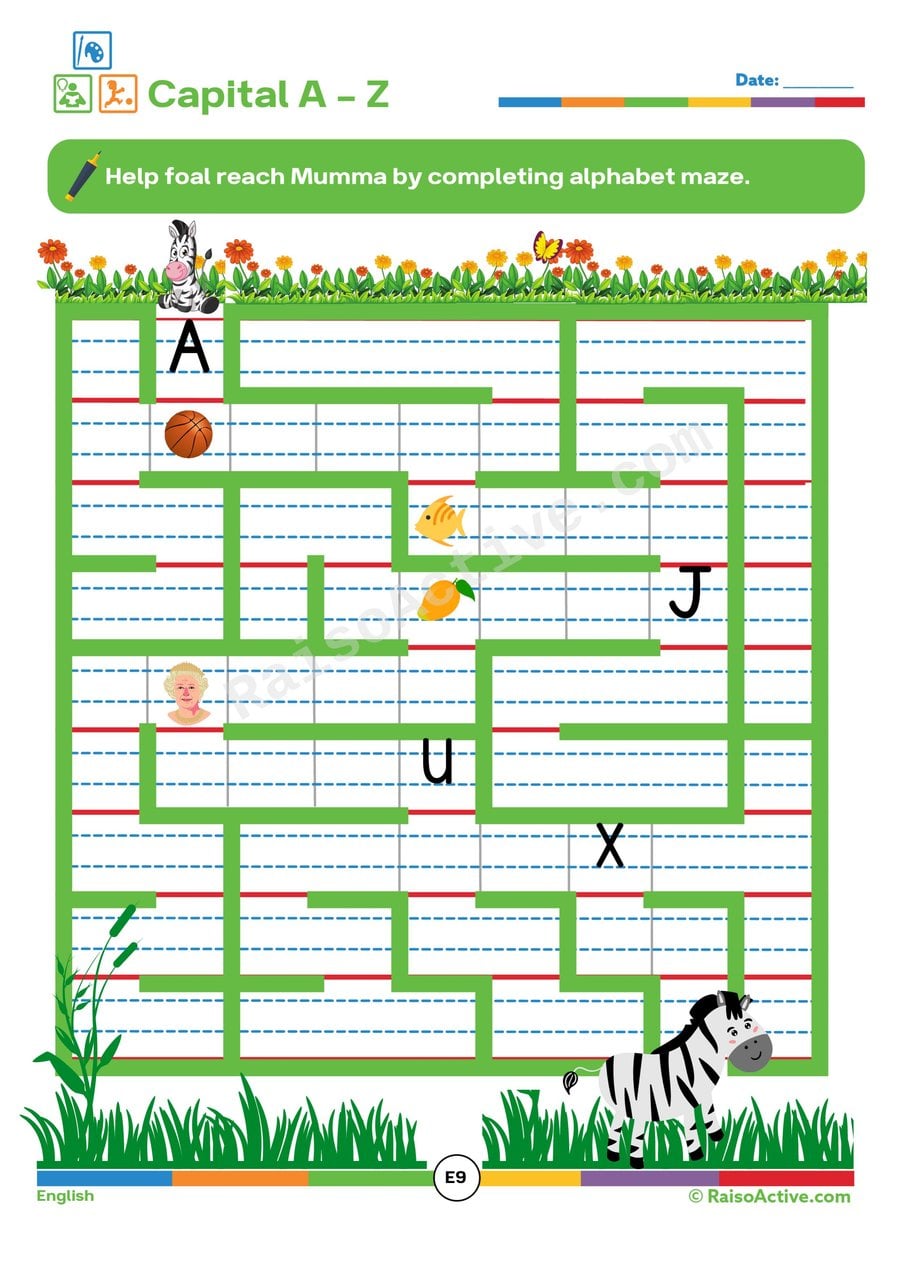
Capital Letter Maze: Help the Foal Find Mumma!
Ages 3-5 · Preschool–Pre-KAges 3-5 · Nursery–ReceptionAges 3-5 · Nursery–LKGAges 3-5
This maze worksheet combines fine motor tracing practice with capital letter recognition for children ages 3-5, as they navigate a path from letter to letter to reunite the foal with its mother. Following a maze path while simultaneously identifying letters along the way builds sustained visual attention and reinforces that letters appear in a meaningful, recognizable sequence. The storyline element also adds emotional motivation that keeps children engaged through a longer tracing task.

Alphabet Adventures: 'A' and 'B' Picture Sorting Worksheet
Ages 4-5 · Pre-KAges 4-5 · ReceptionAges 4-5 · LKGAges 4-5
This worksheet strengthens phonemic awareness in children ages 4-5 by having them listen for and identify pictures whose names begin with the letters 'A' or 'B,' then sort them accordingly. Focusing on just two letters at a time, rather than the whole alphabet, gives children a manageable, focused way to practice isolating beginning sounds before tackling more letters.

Sight Words Coloring Worksheet: 'His', 'My', and 'Her' Fun!
Ages 3-5 · Preschool–Pre-KAges 3-5 · Nursery–ReceptionAges 3-5 · Nursery–LKGAges 3-5
This coloring activity helps children ages 3-5 recognize and internalize the common sight words 'his,' 'my,' and 'her' by following a color-coded key, an approach that builds sight word memory through repeated visual association rather than isolated flashcard drilling. Because sight words like these don't sound out easily using phonics rules, repeated exposure in a fun context like coloring is one of the most effective ways for young children to memorize them. The activity also reinforces fine motor control as children carefully color within the lines of each labeled section.

Parent's Guide: Fun Activities for Early Learning
Ages 3-5 · Preschool–Pre-KAges 3-5 · Nursery–ReceptionAges 3-5 · Nursery–LKGAges 3-5
This parent guide equips caregivers of children ages 3-5 with structured activity ideas around three early-learning concepts: recognizing the days of the week, identifying patterns, and practicing skip counting. Each activity translates an abstract concept into a hands-on or playful format, since young children learn these ideas best through repetition embedded in daily routines rather than worksheets alone. Covering multiple concepts in one guide also gives caregivers flexibility to pick the activity that fits their child's current interest.

Landforms Worksheet: Identify and Tick the Correct Answer!
Ages 3-5 · Preschool–Pre-KAges 3-5 · Nursery–ReceptionAges 3-5 · Nursery–LKGAges 3-5
Looking at pictures of landforms like volcanoes, glaciers, and islands and choosing the correct name from two options teaches children ages 3-5 early earth science vocabulary while building visual discrimination between different natural features. Because each landform has a distinct silhouette, shape, and texture, children practice careful observation of details, like noticing that a volcano has a cone shape while an island is surrounded by water. This worksheet introduces basic geography concepts in a way that's grounded in pictures rather than abstract explanation.

Cut and Paste the Word: Fun Reading Worksheet for Kids!
Ages 4-5 · Pre-KAges 4-5 · ReceptionAges 4-5 · LKGAges 4-5
This cut-and-paste decoding activity has children ages 4-5 sound out simple CVC (consonant-vowel-consonant) words like 'cat' or 'sun' and match the missing picture to complete each word, directly practicing the phonics blending skills that underpin early reading fluency. Because the word is partly built from letters already on the page, children must connect individual letter sounds to a whole word rather than just recognizing a picture in isolation. This bridges the gap between knowing individual letter sounds and reading complete three-letter words independently.

Christmas Pattern Worksheet: Circle the Next Picture!
Ages 4-6 · Pre-K–KindergartenAges 4-6 · Reception–Year 1Ages 4-6 · LKG–UKGAges 4-6
This seasonal worksheet gives children ages 4-6 practice identifying a repeating pattern using Christmas-themed pictures and predicting which picture logically comes next. Pattern prediction requires children to notice a repeating rule and apply it forward, a skill that underlies later math concepts like skip counting and multiplication tables. The festive imagery adds seasonal excitement that can make repeated pattern practice feel like a holiday game.
Related worksheets

Days of the Week Cut and Paste Worksheet for Preschoolers
Ages 3-5 · Preschool–Pre-KAges 3-5 · Nursery–ReceptionAges 3-5 · Nursery–LKGAges 3-5
This worksheet builds sequencing skills by asking children to place the seven days of the week in their correct order, a concept that lays the groundwork for understanding calendars, routines, and time. For preschoolers, memorizing a fixed sequence like Sunday through Saturday also strengthens verbal memory and the idea that some things always happen in the same order.

Days of the Week Cut and Paste Worksheet for Kids
Ages 3-5 · Preschool–Pre-KAges 3-5 · Nursery–ReceptionAges 3-5 · Nursery–LKGAges 3-5
This worksheet reinforces the names and order of the days of the week by having children cut out each day and glue it into its correct place in the weekly sequence. For three- to five-year-olds, physically handling and arranging each day as a separate piece — rather than just reciting the order — gives them a concrete way to check and correct their own understanding of the sequence.

Days of the Week Cut and Paste Worksheet for Preschoolers
Ages 3-5 · Preschool–Pre-KAges 3-5 · Nursery–ReceptionAges 3-5 · Nursery–LKGAges 3-5
This worksheet teaches children ages 3-5 the order of the days of the week by having them cut out day names and paste them correctly under 'Yesterday', 'Today', and 'Tomorrow'. Understanding this relative time sequence is an important early step in developing time concepts, and the physical cut-and-paste format makes an abstract idea like 'yesterday' more concrete and hands-on.
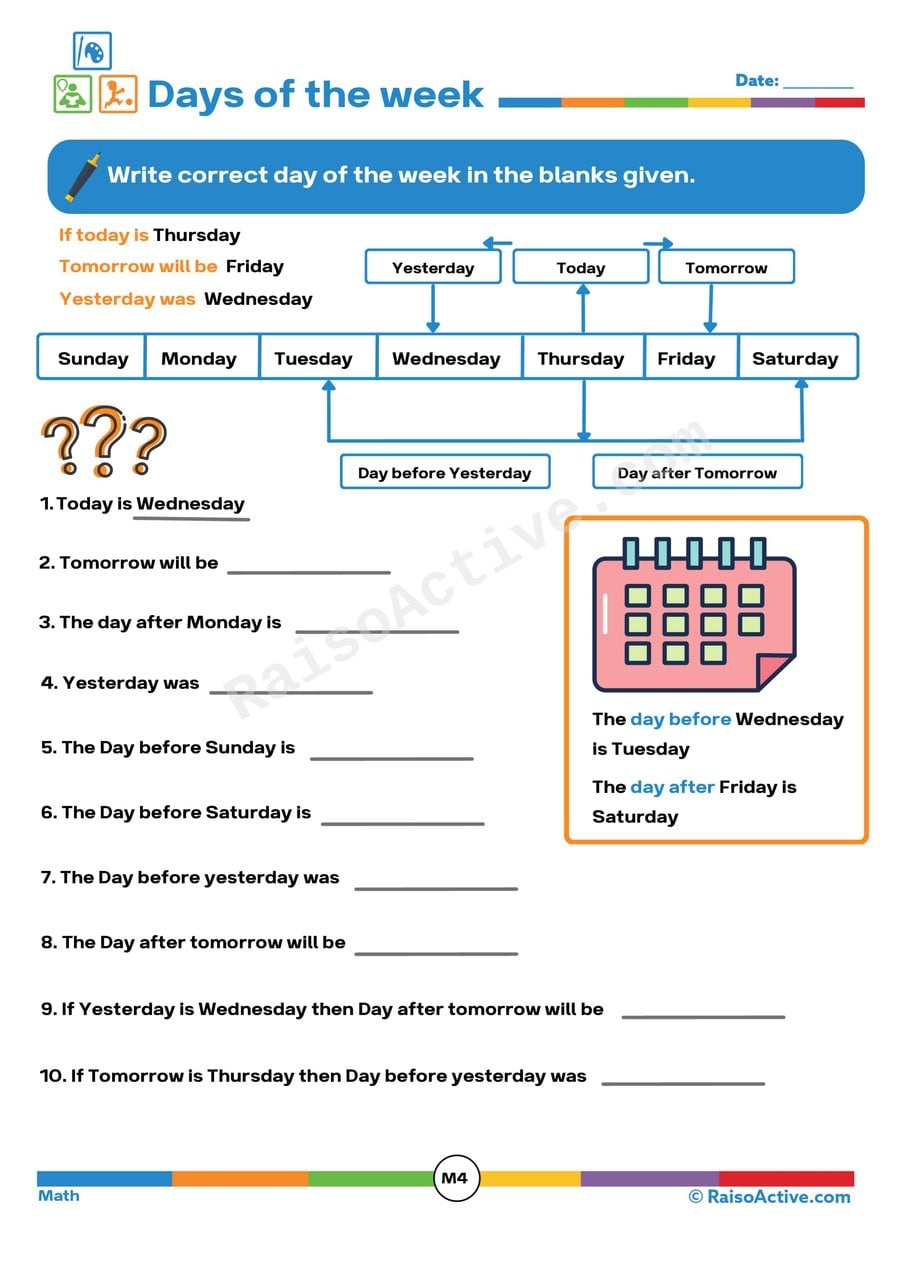
Days of the Week Worksheet: Learn the Days!
Ages 4-6 · Pre-K–KindergartenAges 4-6 · Reception–Year 1Ages 4-6 · LKG–UKGAges 4-6
Learning the days of the week in order gives children a framework for understanding time, routines, and scheduling that they'll use for the rest of their lives, from knowing when school happens to planning a weekend. For ages four to six, practicing the correct sequence, Monday through Sunday, also builds the same kind of ordered-list memory skill used for the alphabet and counting.

Days of the Week Sequencing Worksheet for Preschoolers
Ages 3-5 · Preschool–Pre-KAges 3-5 · Nursery–ReceptionAges 3-5 · Nursery–LKGAges 3-5
This worksheet builds sequencing skills for children ages 3-5 as they work with the days of the week in order, first filling in a missing day and then cutting and gluing days into the correct sequence. Understanding that days follow a fixed, repeating order is an early step toward time concepts like yesterday, today, and tomorrow, and this hands-on repetition helps cement a sequence that isn't visually obvious the way counting objects is.
Make a Paper Owl: Hindi Letter उ Craft | बनाओ · उ से उल्लू
Ages 3-7 · Preschool–Grade 1Ages 3-7 · Nursery–Year 2Ages 3-7 · Nursery–Class 1Ages 3-7
Children cut out the pieces, put them together following three step pictures and make a paper owl. Saying the word उल्लू as they make it links the sound उ to something they built themselves.

Akash Kandil Craft: Make a Paper Lantern for Diwali
Ages 4-8 · Pre-K–Grade 2Ages 4-8 · Reception–Year 3Ages 4-8 · LKG–Class 2Ages 4-8
Children learn that families in Maharashtra and Goa hang an akash kandil sky lantern at Diwali, and that many festivals have their own special light.

Merry Christmas Coloring Worksheet for Preschoolers
Ages 3-5 · Preschool–Pre-KAges 3-5 · Nursery–ReceptionAges 3-5 · Nursery–LKGAges 3-5
Filling in Christmas-themed pictures with crayons or colored pencils helps children ages 3-5 refine their pencil grip and hand control while practicing the concept of staying within a defined boundary. Because the pictures include multiple familiar holiday objects, this worksheet also gives children a chance to build vocabulary by naming each item as they color it. Repeated coloring practice at this age steadily improves the wrist and finger strength needed for later writing tasks.
Guides for this topic

Coding Activities for Preschoolers: Building Tomorrow's Thinkers Today
Discover 15+ unplugged and screen-based coding activities for preschoolers that build sequencing, logic, and problem-solving skills through play. NEP 2020 aligned.

How to Teach Cutting Skills to Your Preschooler: A Complete Guide for Parents and Teachers
Help your child master scissor skills safely. Expert guide covering readiness signs, scissor types, progression steps, pre-cutting exercises, and fun practice ideas for ages 2-6.
Christmas and Winter Activities That Combine Fun and Learning: Creating Magical Educational Experiences
Discover Christmas and winter activities that combine festive fun with real learning. Crafts, counting, literacy, and printable worksheets for ages 2 to 8 — perfect for home and school.
Reviews
Every worksheet for ages 4–6, no watermark
Members download the full library of 1,000+ worksheets and every activity pack without watermarks or daily limits. One year costs ₹999 in India or $20 elsewhere.
See membership plansOr download any worksheet free with a watermark (5 a day).