Days of the Week Cut and Paste Worksheet for Preschoolers
This worksheet builds sequencing skills by asking children to place the seven days of the week in their correct order, a concept that lays the groundwork for understanding calendars, routines, and time. For preschoolers, memorizing a fixed sequence like Sunday through Saturday also strengthens verbal memory and the idea that some things always happen in the same order.
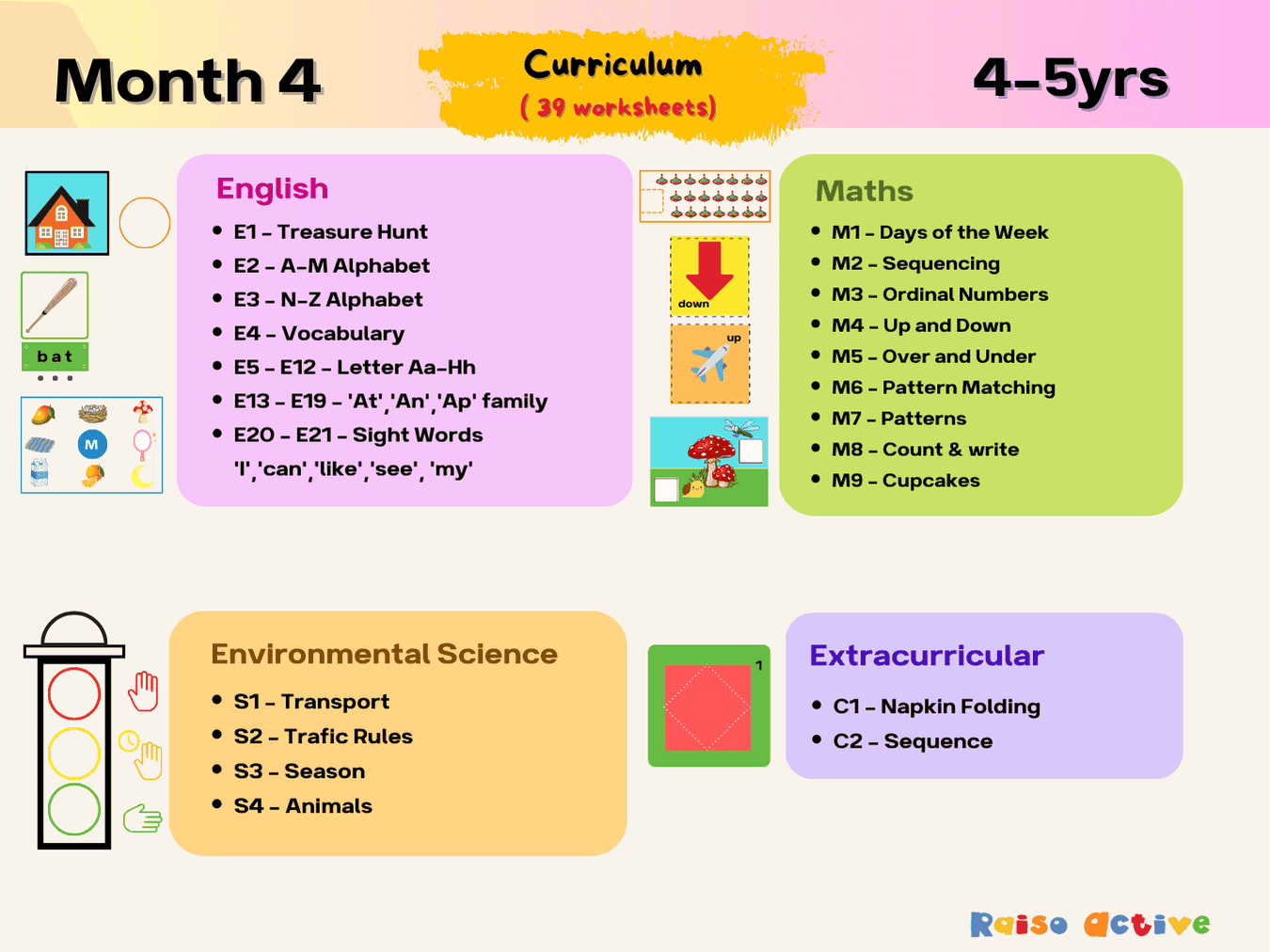
Part of the pack
Month 4: Learning & Development | Ages 4-5
This is page 28 of the pack. Ages 4-5 · Pre-KAges 4-5 · ReceptionAges 4-5 · LKGAges 4-5

Made for your child
Counting to 10, made for your child
A maths pack with your child's name in it: pictures that explain, practice at three levels, puzzles and story sums about them. Print a new set whenever they finish.
Make a maths packFree preview · free for members
Curriculum
- Number Sense > Counting 1-20
How to use this worksheet
Begin by reading the days of the week aloud together in order a few times so your child hears the pattern before starting. Have them cut out each day card at the bottom of the page. Then, working left to right, ask them to find 'Sunday' first and paste it into the first box, continuing through the week one card at a time while saying each day out loud as it's placed. Once finished, read the completed sequence together to check the order.
Materials needed
- Scissors
- Glue
- Pencil
Extension activities
- 1Sing a days-of-the-week song together each morning until the order becomes automatic.
- 2Make a simple paper calendar and have your child mark off each day as it passes.
- 3Ask your child what special activity happens on each day, like 'What do we do on Saturday?'
- 4Create a set of day cards and practice putting them in order as a timed game.
- 5Point to today's day on a real calendar each morning and ask what day comes next.

Written by
Hemsweta Jain · Teacher Cheena
MBA and Early Childhood Educator, teaching since 2014 · Founder of RaisoActive, Mumbai
Every RaisoActive worksheet is designed and checked by the founder before publishing.
Published · Last reviewed
More from Month 4: Learning & Development | Ages 4-5

Letter Aa Tracing and Matching Worksheet for Preschoolers
Ages 3-5 · Preschool–Pre-KAges 3-5 · Nursery–ReceptionAges 3-5 · Nursery–LKGAges 3-5
This worksheet combines tracing practice for the letter Aa with a letter-hunt task, where children ages 3-5 scan a grid to circle every instance of Aa before also identifying pictures that start with the letter. Practicing both uppercase and lowercase forms together, alongside visual search and picture matching, builds a rounded understanding of what the letter A looks like in its different appearances.

Gg Letter Tracing and Recognition Worksheet for Preschoolers
Ages 3-5 · Preschool–Pre-KAges 3-5 · Nursery–ReceptionAges 3-5 · Nursery–LKGAges 3-5
This worksheet helps children ages 3-5 practice writing both uppercase and lowercase Gg while training them to recognize the letter in different fonts and contexts, an important skill since printed letters don't always look identical to handwritten ones. Identifying pictures that start with Gg also builds phonemic awareness, linking the letter's shape to its 'guh' sound.

Letter Dd Tracing and Matching Worksheet for Preschoolers
Ages 3-5 · Preschool–Pre-KAges 3-5 · Nursery–ReceptionAges 3-5 · Nursery–LKGAges 3-5
Children ages 3-5 practice writing the letter Dd through guided tracing, then apply that recognition by finding Dd hidden in a letter grid and identifying pictures that start with the sound. Moving from writing the letter to spotting it among other letters, and then to hearing it at the start of real words, builds a well-rounded, multi-sense understanding of the letter D.

Learn to Write the Sight Word 'I' Worksheet for Preschoolers
Ages 3-5 · Preschool–Pre-KAges 3-5 · Nursery–ReceptionAges 3-5 · Nursery–LKGAges 3-5
This worksheet gives children ages 3-5 focused, repeated practice recognizing, tracing, and writing the sight word 'I,' one of the very first words most children learn to read and write since it appears constantly in their own speech. Because 'I' is a single letter that stands for a whole word, it's also a gentle introduction to the idea that capitalization carries meaning.
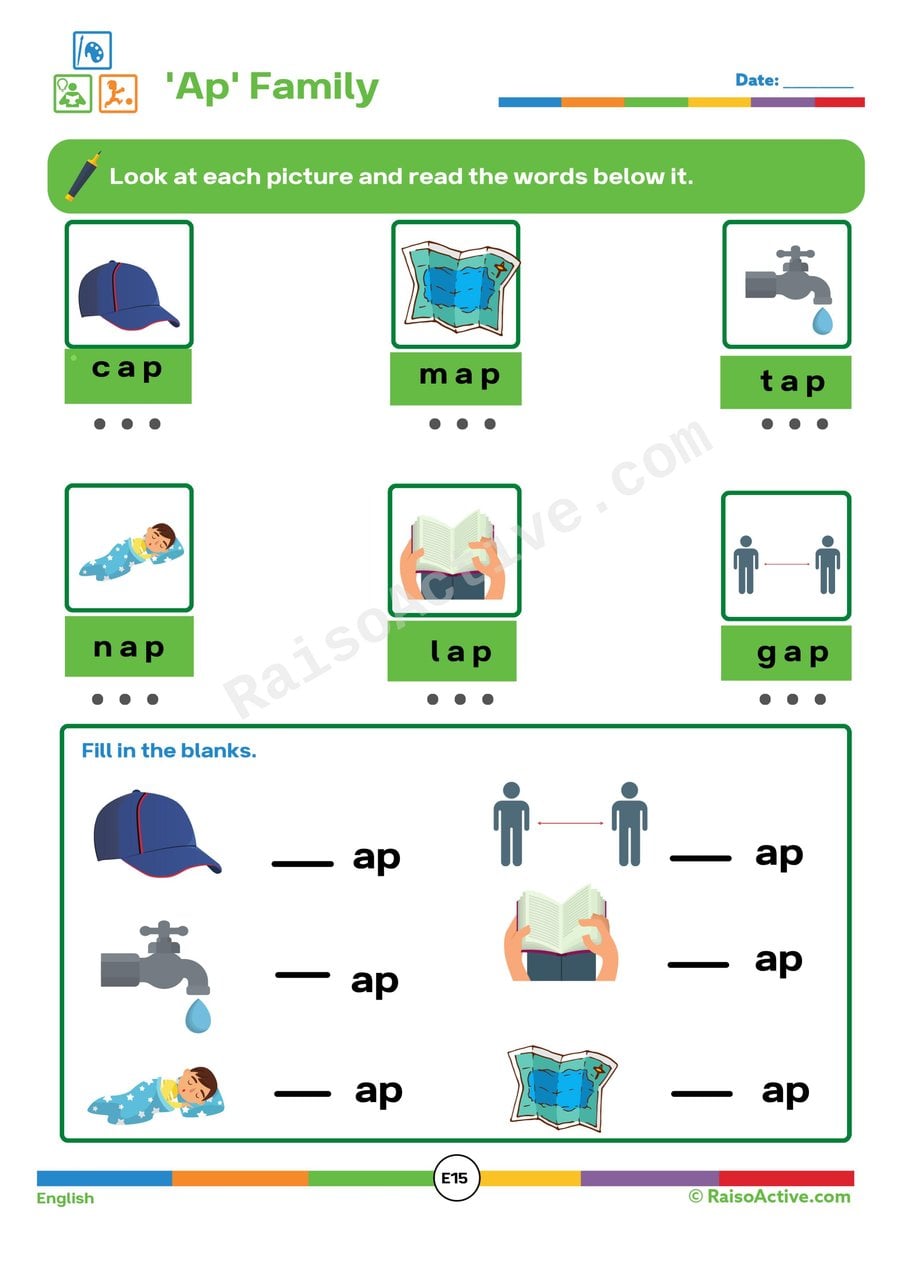
Ap Family Worksheet: Read and Fill in the Blanks!
Ages 4-5 · Pre-KAges 4-5 · ReceptionAges 4-5 · LKGAges 4-5
Continuing the word-family approach, this worksheet helps children ages 4-5 read and complete 'ap' words such as cap, map, and tap by filling in a missing letter, reinforcing the pattern that a shared ending sound can appear across many different words. This kind of practice builds decoding speed and phonics confidence ahead of more independent reading.
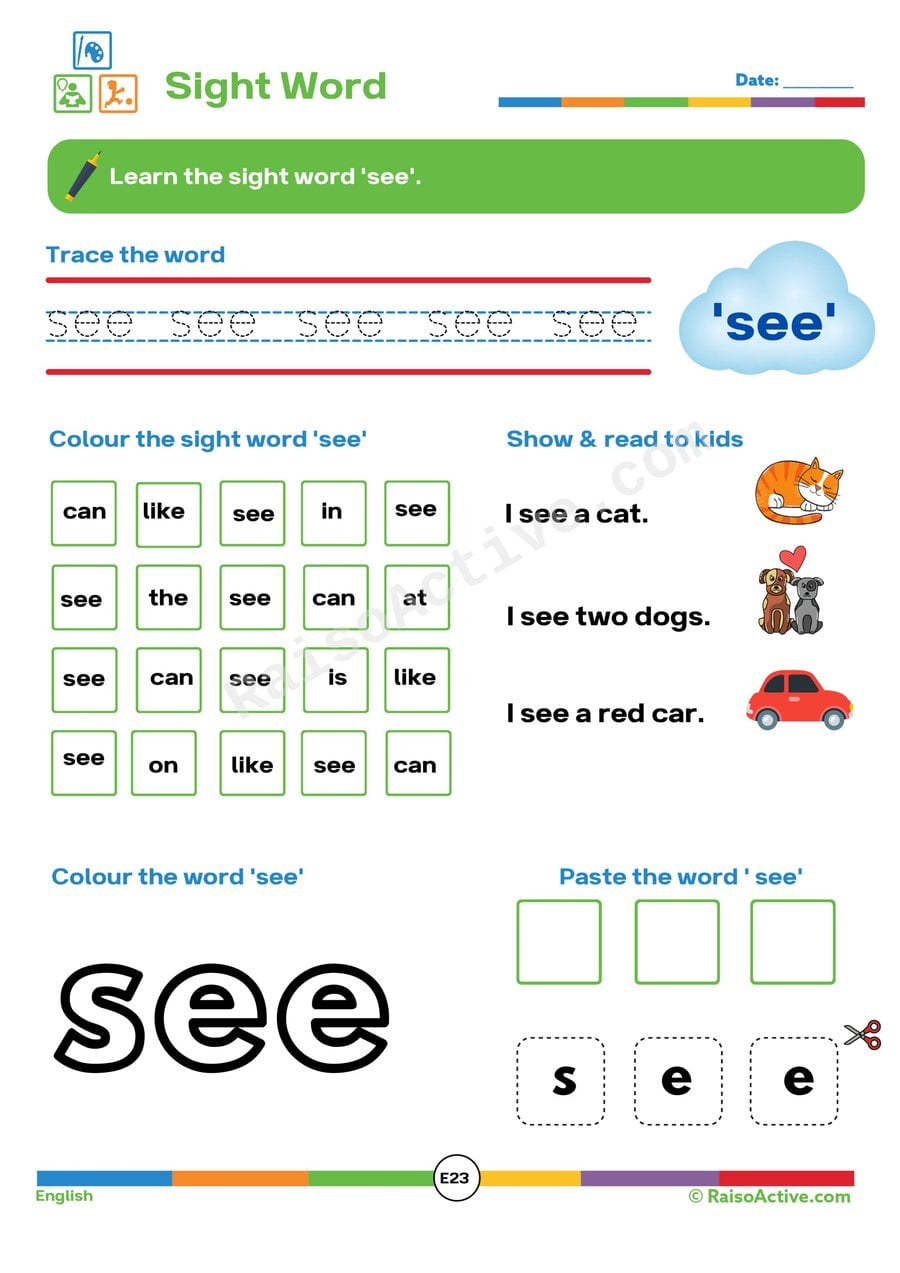
See Sight Word Worksheet: Trace, Color, and Paste!
Ages 3-5 · Preschool–Pre-KAges 3-5 · Nursery–ReceptionAges 3-5 · Nursery–LKGAges 3-5
Children ages 3-5 get repeated, varied practice with the high-frequency sight word 'see' through tracing, coloring, sentence reading, and a cut-and-paste spelling activity, building the instant word recognition that fluent reading depends on. Reading the accompanying sentences also gives early exposure to how the word functions in context, not just in isolation.

Fun with Letter F: Tracing, Finding, and Coloring Worksheet
Ages 3-5 · Preschool–Pre-KAges 3-5 · Nursery–ReceptionAges 3-5 · Nursery–LKGAges 3-5
Children ages 3-5 reinforce letter recognition and pencil control as they trace the letter F, search for it among other letters, and identify a picture starting with the F sound. Working through the same letter in multiple formats — writing, spotting, and sound-matching — helps move the letter from simple recognition toward automatic recall, an important pre-reading skill.

Count and Write: Fun Counting Worksheet for Preschoolers
Ages 3-5 · Preschool–Pre-KAges 3-5 · Nursery–ReceptionAges 3-5 · Nursery–LKGAges 3-5
This counting worksheet has children ages 3-5 count small groups of objects and write the matching numeral in a box, directly linking the physical act of counting to the written symbol that represents a quantity. Writing the number immediately after counting — rather than just counting aloud — reinforces that numerals are a shorthand for real, countable amounts.
Related worksheets

Days of the Week Cut and Paste Worksheet for Preschoolers
Ages 3-5 · Preschool–Pre-KAges 3-5 · Nursery–ReceptionAges 3-5 · Nursery–LKGAges 3-5
This worksheet teaches children ages 3-5 the order of the days of the week by having them cut out day names and paste them correctly under 'Yesterday', 'Today', and 'Tomorrow'. Understanding this relative time sequence is an important early step in developing time concepts, and the physical cut-and-paste format makes an abstract idea like 'yesterday' more concrete and hands-on.

Days of the Week Sequencing Worksheet for Preschoolers
Ages 3-5 · Preschool–Pre-KAges 3-5 · Nursery–ReceptionAges 3-5 · Nursery–LKGAges 3-5
This worksheet builds sequencing skills for children ages 3-5 as they work with the days of the week in order, first filling in a missing day and then cutting and gluing days into the correct sequence. Understanding that days follow a fixed, repeating order is an early step toward time concepts like yesterday, today, and tomorrow, and this hands-on repetition helps cement a sequence that isn't visually obvious the way counting objects is.

Days of the Week Cut and Paste Worksheet for Kids
Ages 3-5 · Preschool–Pre-KAges 3-5 · Nursery–ReceptionAges 3-5 · Nursery–LKGAges 3-5
This worksheet reinforces the names and order of the days of the week by having children cut out each day and glue it into its correct place in the weekly sequence. For three- to five-year-olds, physically handling and arranging each day as a separate piece — rather than just reciting the order — gives them a concrete way to check and correct their own understanding of the sequence.
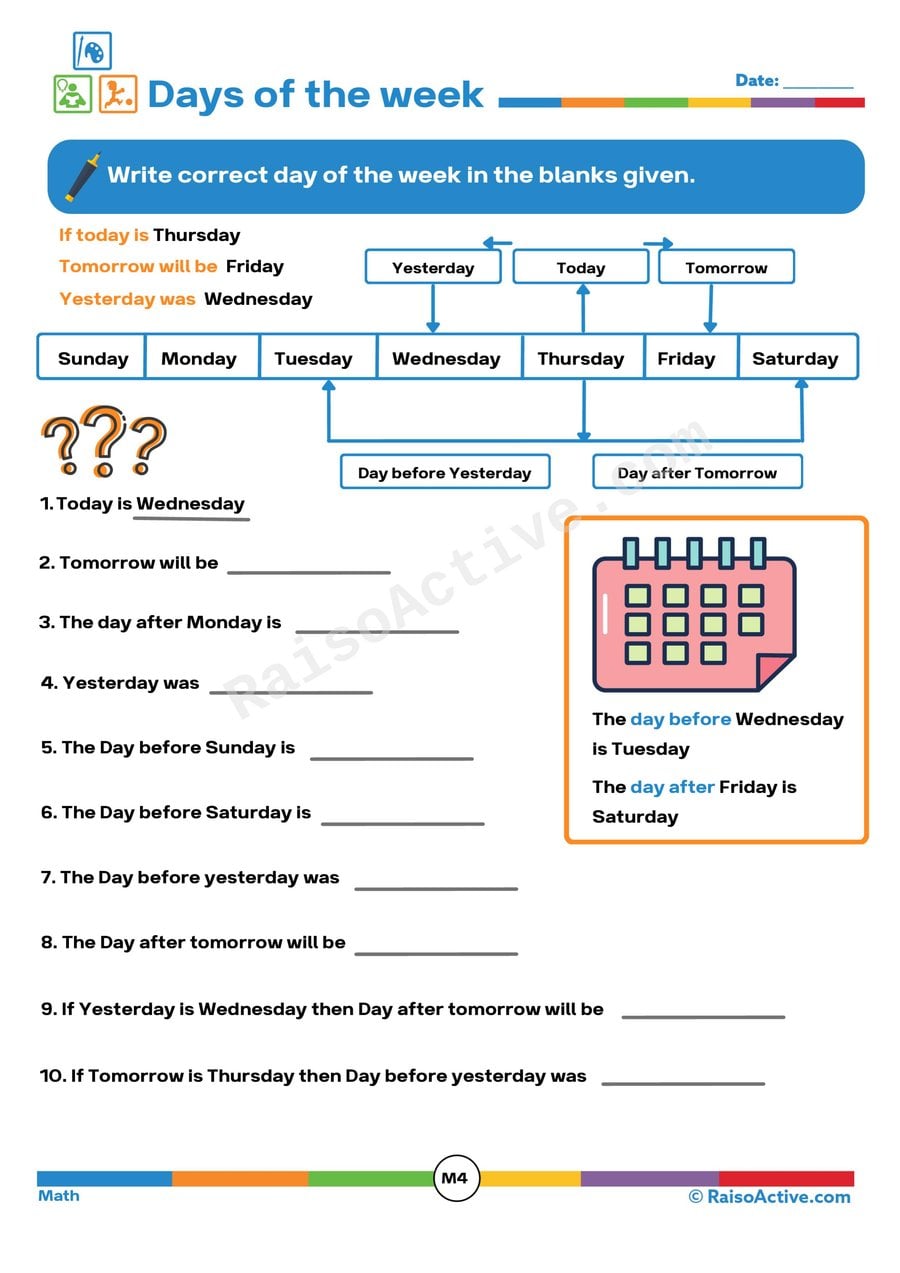
Days of the Week Worksheet: Learn the Days!
Ages 4-6 · Pre-K–KindergartenAges 4-6 · Reception–Year 1Ages 4-6 · LKG–UKGAges 4-6
Learning the days of the week in order gives children a framework for understanding time, routines, and scheduling that they'll use for the rest of their lives, from knowing when school happens to planning a weekend. For ages four to six, practicing the correct sequence, Monday through Sunday, also builds the same kind of ordered-list memory skill used for the alphabet and counting.

Days of the Week Cut and Paste Worksheet for Preschoolers
Ages 4-6 · Pre-K–KindergartenAges 4-6 · Reception–Year 1Ages 4-6 · LKG–UKGAges 4-6
Cutting out the seven day names and gluing them into the correct sequence teaches children ages 4-6 the fixed order of the days of the week, a foundational piece of time-concept knowledge they'll rely on for calendars, schedules, and daily routines. Because this activity requires both reading the day names and remembering their correct order, it strengthens sight-word recognition alongside sequencing skills. The hands-on cutting and pasting also gives fine motor practice within a literacy and time-concept task.

Decorate the Christmas Tree! Cut and Paste Worksheet
Ages 3-5 · Preschool–Pre-KAges 3-5 · Nursery–ReceptionAges 3-5 · Nursery–LKGAges 3-5
This cut-and-paste activity builds scissor control and hand strength in children ages 3-5 as they snip out ornaments, stars, and lights to decorate their own Christmas tree. Deciding where each decoration goes also develops spatial planning and following a visual guide, since children compare their tree to the sample image while placing pieces.

Easter Egg Color by Hints Worksheet for Preschoolers
Ages 3-5 · Preschool–Pre-KAges 3-5 · Nursery–ReceptionAges 3-5 · Nursery–LKGAges 3-5
This worksheet has children ages 3-5 listen to or read simple written hints describing shapes and colors, then apply that information correctly while coloring each Easter egg, building early reading comprehension and the ability to follow multi-step verbal instructions. Because the hints must be followed precisely rather than colored freely, children also practice patience and careful attention to detail.
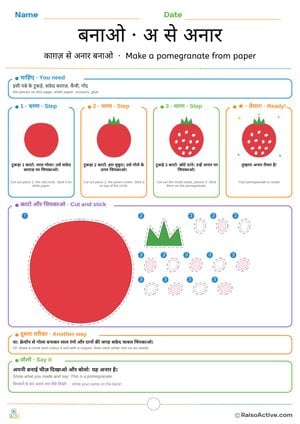
Make a Paper Pomegranate: Hindi Letter अ Craft | बनाओ · अ से अनार
Ages 3-7 · Preschool–Grade 1Ages 3-7 · Nursery–Year 2Ages 3-7 · Nursery–Class 1Ages 3-7
Children cut out the pieces, put them together following three step pictures and make a paper pomegranate. Saying the word अनार as they make it links the sound अ to something they built themselves.
Guides for this topic

Documenting Learning Without Drowning in Data: A Practical Guide for Parents and Teachers
Learn practical ways to document your child's learning without overwhelm. Simple portfolios, observation tips, and printable trackers for ages 1-8.

Coding Activities for Preschoolers: Building Tomorrow's Thinkers Today
Discover 15+ unplugged and screen-based coding activities for preschoolers that build sequencing, logic, and problem-solving skills through play. NEP 2020 aligned.
Christmas and Winter Activities That Combine Fun and Learning: Creating Magical Educational Experiences
Discover Christmas and winter activities that combine festive fun with real learning. Crafts, counting, literacy, and printable worksheets for ages 2 to 8 — perfect for home and school.
Reviews
Every worksheet for ages 3–5, no watermark
Members download the full library of 1,000+ worksheets and every activity pack without watermarks or daily limits. One year costs ₹999 in India or $20 elsewhere.
See membership plansOr download any worksheet free with a watermark (5 a day).