Ap Family Worksheet: Read and Fill in the Blanks!
Continuing the word-family approach, this worksheet helps children ages 4-5 read and complete 'ap' words such as cap, map, and tap by filling in a missing letter, reinforcing the pattern that a shared ending sound can appear across many different words. This kind of practice builds decoding speed and phonics confidence ahead of more independent reading.
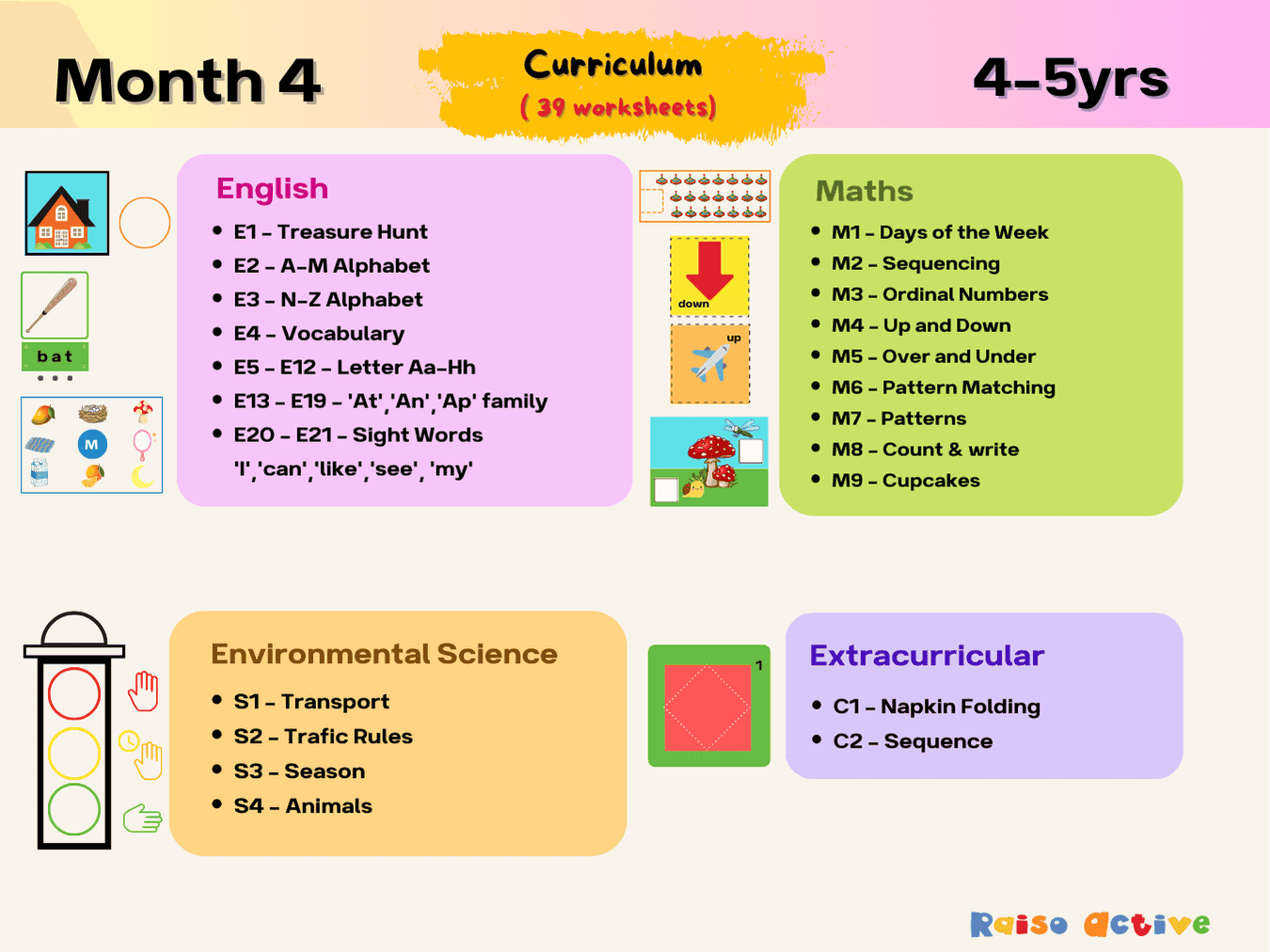
Part of the pack
Month 4: Learning & Development | Ages 4-5
This is page 18 of the pack. Ages 4-5 · Pre-KAges 4-5 · ReceptionAges 4-5 · LKGAges 4-5
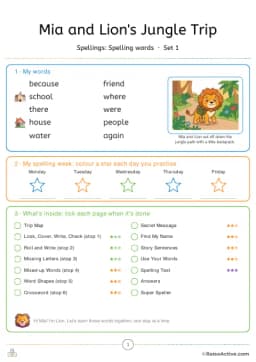
Made for your child
Spelling practice, made for your child
Their own spelling words turned into a pack: trace or look-cover-write-check, roll and write, a secret picture code, a word search, a crossword and a test, with their name in it.
Make a spelling packFree preview · free for members
Or start free: a word search with sight wordsCurriculum
- Phonics - CVC Words > CVC Short A Families
How to use this worksheet
Look at each picture together and say its name slowly, stretching out the sounds to hear the 'ap' ending clearly. Have your child identify the missing letter needed to complete the word and write it in the blank. Read the finished word aloud together to confirm it's correct, then move to the next picture. Finish by rereading the whole list of completed words in order.
Materials needed
- Pencil
- Eraser
Extension activities
- 1Make up silly sentences using multiple 'ap' words, like 'The cat wears a cap and taps a map.'
- 2Play an 'ap' word scavenger hunt, spotting objects like a cap, map, or tap around the house.
- 3Build 'ap' words with letter tiles or magnetic letters, changing just the first letter each time.
- 4Draw a picture to match each completed 'ap' word.

Written by
Hemsweta Jain · Teacher Cheena
MBA and Early Childhood Educator, teaching since 2014 · Founder of RaisoActive, Mumbai
Every RaisoActive worksheet is designed and checked by the founder before publishing.
Published · Last reviewed
More from Month 4: Learning & Development | Ages 4-5
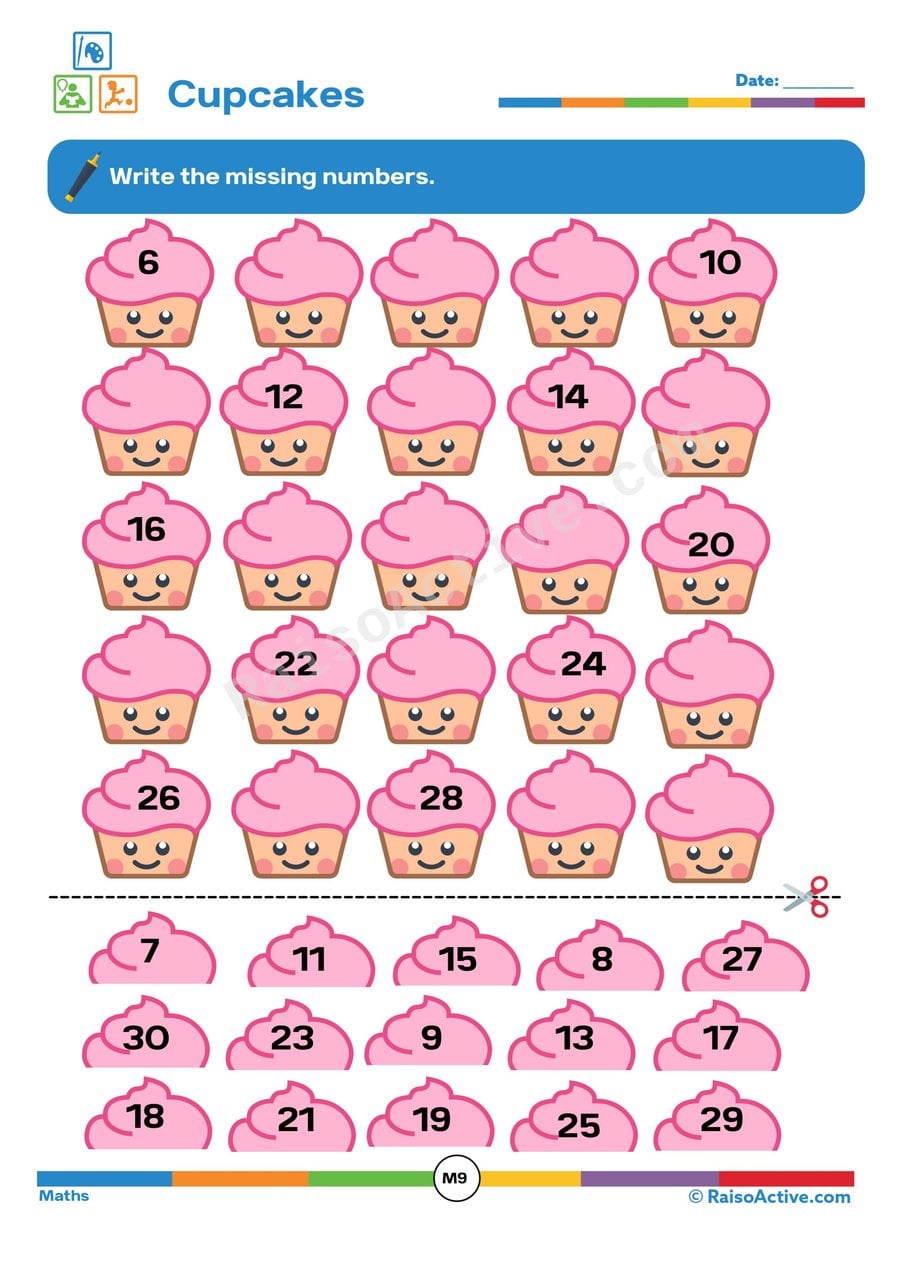
Cupcake Counting Worksheet: Missing Numbers!
Ages 4-6 · Pre-K–KindergartenAges 4-6 · Reception–Year 1Ages 4-6 · LKG–UKGAges 4-6
This worksheet strengthens number sequencing for children ages 4-6 as they study a row of numbered cupcakes and figure out which numbers are missing from the sequence, then write them in. Identifying a gap in a number sequence requires understanding the pattern of counting well enough to predict what's missing, a step beyond simply counting forward.
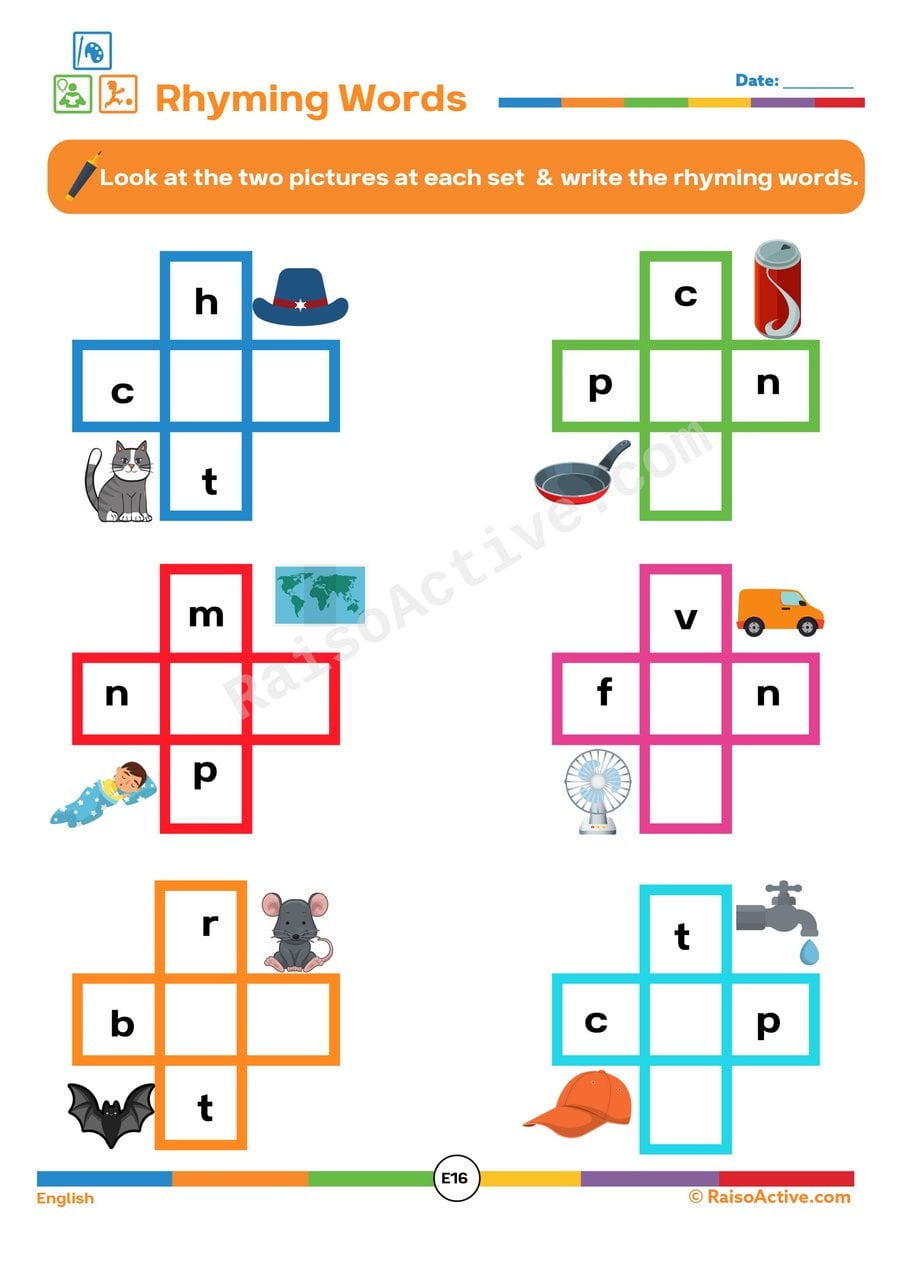
Rhyming Words Worksheet: Fun with Sounds!
Ages 4-5 · Pre-KAges 4-5 · ReceptionAges 4-5 · LKGAges 4-5
This worksheet has children ages 4-5 look at paired pictures, say the words aloud, and write the word that rhymes with its partner, building phonological awareness by focusing on matching ending sounds rather than beginning ones. Recognizing rhymes is one of the strongest early predictors of later reading success, since it trains children's ears to notice and manipulate the sounds within words.

Cut and Paste 'An' Family Worksheet for Preschoolers
Ages 4-5 · Pre-KAges 4-5 · ReceptionAges 4-5 · LKGAges 4-5
This cut-and-paste worksheet has children ages 4-5 build simple 'an' family words, like 'can,' 'man,' and 'pan,' by gluing the correct beginning letter in front of the shared 'an' ending. Practicing a word family this way teaches children that changing just one letter creates a whole new word — a foundational pattern-recognition skill in early reading known as rhyming or word-family instruction.

Learn the Sight Word 'Can' - Fun Tracing and Coloring Worksheet
Ages 3-5 · Preschool–Pre-KAges 3-5 · Nursery–ReceptionAges 3-5 · Nursery–LKGAges 3-5
This worksheet gives children ages 3-5 repeated, multi-format practice with the sight word 'can,' a common verb that appears frequently in early reading, through tracing, coloring, and a cut-and-paste spelling activity. Because 'can' is a short, high-frequency word that shows up constantly in beginning readers, building instant recognition of it now pays off across nearly every book your child picks up next.

Sequencing Worksheet: Count, Write, and Paste Numbers!
Ages 4-6 · Pre-K–KindergartenAges 4-6 · Reception–Year 1Ages 4-6 · LKG–UKGAges 4-6
This worksheet combines three numeracy skills in one activity: counting a group of objects, writing the matching numeral, and then physically arranging number sets in the correct sequence. For four- to six-year-olds, connecting a quantity to its written symbol and then to its place in order builds the number sense that underlies later addition and subtraction work.

Duckling's Number Path: Connect the Dots Worksheet
Ages 3-5 · Preschool–Pre-KAges 3-5 · Nursery–ReceptionAges 3-5 · Nursery–LKGAges 3-5
Children ages 3-5 practice number sequencing and counting up to 30 as they connect numbered dots in order to draw the duckling's path back to its mother, reinforcing number recognition while completing a satisfying, story-driven picture. Following numbers in strict order without skipping builds the counting fluency children need before tackling addition and more advanced number work.
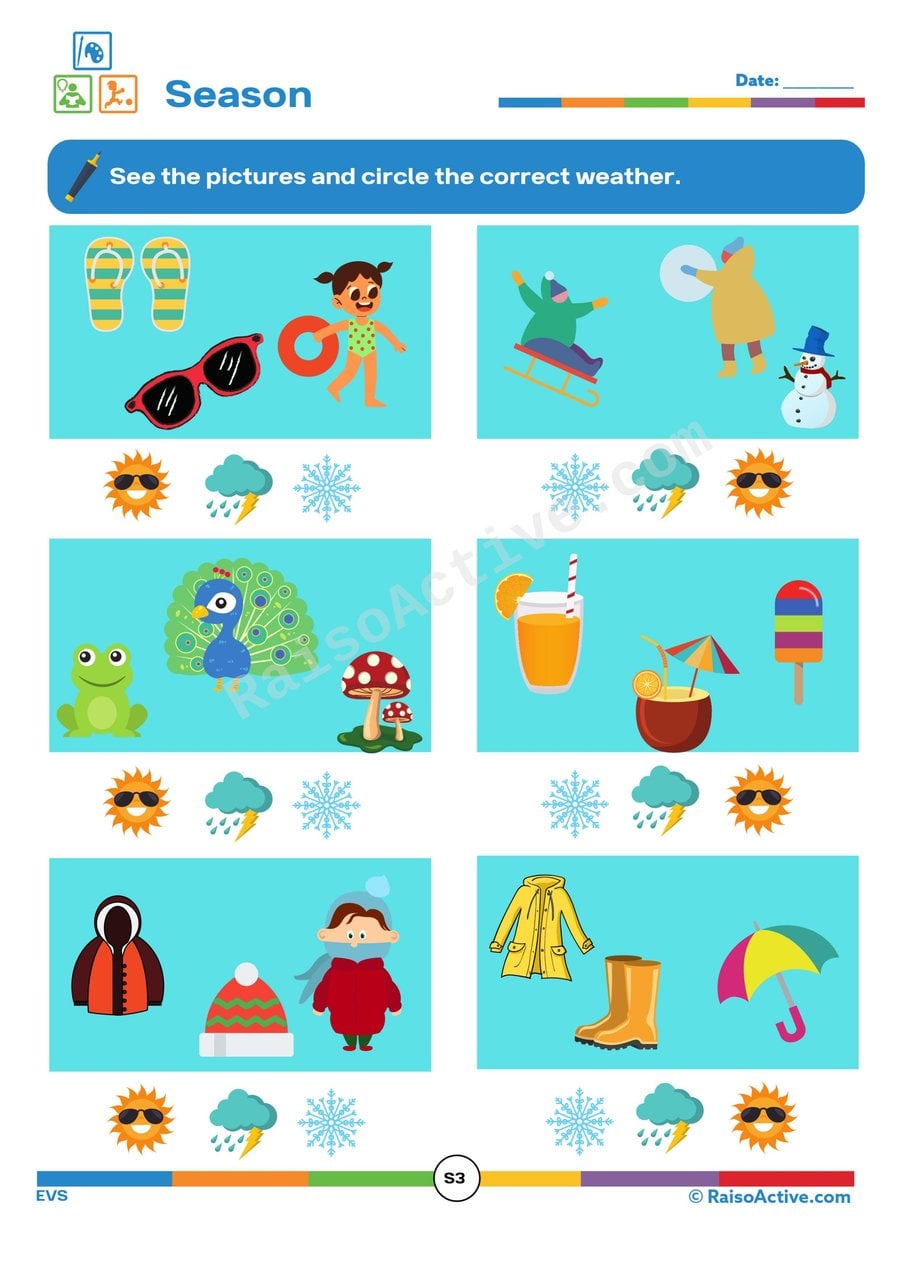
Seasons Worksheet: Circle the Correct Weather!
Ages 3-5 · Preschool–Pre-KAges 3-5 · Nursery–ReceptionAges 3-5 · Nursery–LKGAges 3-5
This worksheet asks children ages 3-5 to look at a seasonal scene and circle the weather that correctly matches it, building an early understanding of how seasons connect to specific weather patterns like snow, rain, or sunshine. Making this connection between a season and its typical weather is an early science concept that also supports vocabulary growth around weather and clothing.

Letter Dd Tracing and Matching Worksheet for Preschoolers
Ages 3-5 · Preschool–Pre-KAges 3-5 · Nursery–ReceptionAges 3-5 · Nursery–LKGAges 3-5
Children ages 3-5 practice writing the letter Dd through guided tracing, then apply that recognition by finding Dd hidden in a letter grid and identifying pictures that start with the sound. Moving from writing the letter to spotting it among other letters, and then to hearing it at the start of real words, builds a well-rounded, multi-sense understanding of the letter D.
Related worksheets

Find the 'ap' Words! A Fun Worksheet for Early Readers
Ages 4-5 · Pre-KAges 4-5 · ReceptionAges 4-5 · LKGAges 4-5
Children ages 4-5 build phonics fluency by reading and writing CVC words in the 'ap' family, like 'cap', 'map', and 'nap'. Recognizing this consistent letter pattern teaches early readers to decode groups of letters as a chunk rather than sounding out every letter individually, speeding up reading over time. Writing each word after finding it also reinforces correct spelling and letter sequencing for early literacy.

Phonics Level 3 Long Vowels Answer Key for Grown-ups
Ages 5-7 · Kindergarten–Grade 1Ages 5-7 · Year 1–Year 2Ages 5-7 · UKG–Class 1Ages 5-7
Grown-ups get every answer for the long a, e, i, o and u pages and the long-or-short sorting pages, including word search positions by row and column.
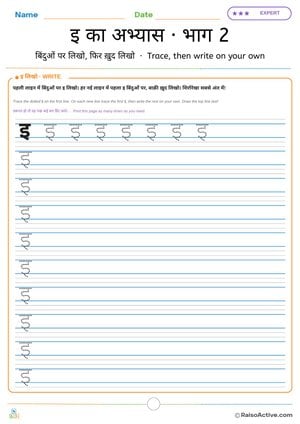
Hindi Letter इ Practice Part 2: Trace and Write on Your Own | इ का अभ्यास · भाग 2
Ages 3-7 · Preschool–Grade 1Ages 3-7 · Nursery–Year 2Ages 3-7 · Nursery–Class 1Ages 3-7
Children build writing fluency by tracing the dotted line इ on the first line and then writing the letter on their own, line after line, as the dotted help fades. The headline (शिरोरेखा) is drawn last, as in Hindi handwriting.

Phonics Level 2 Certificate of Achievement: Super Reader
Ages 4-7 · Pre-K–Grade 1Ages 4-7 · Reception–Year 2Ages 4-7 · LKG–Class 1Ages 4-7
Children celebrate reading and spelling words with blends and digraphs, and tick what they can read: CVC words, blends and digraphs.
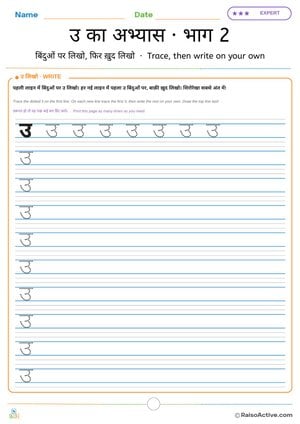
Hindi Letter उ Practice Part 2: Trace and Write on Your Own | उ का अभ्यास · भाग 2
Ages 3-7 · Preschool–Grade 1Ages 3-7 · Nursery–Year 2Ages 3-7 · Nursery–Class 1Ages 3-7
Children build writing fluency by tracing the dotted line उ on the first line and then writing the letter on their own, line after line, as the dotted help fades. The headline (शिरोरेखा) is drawn last, as in Hindi handwriting.
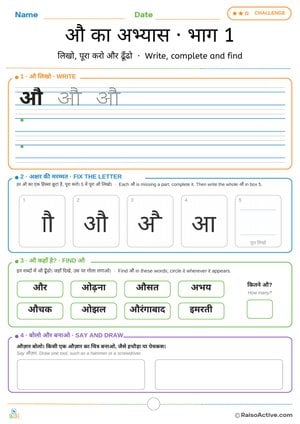
Hindi Letter औ (au) Practice 1: Write, Fix the Letter and Find | औ का अभ्यास · भाग 1
Ages 4-7 · Pre-K–Grade 1Ages 4-7 · Reception–Year 2Ages 4-7 · LKG–Class 1Ages 4-7
A challenge page: write औ between the lines, complete four letters that are each missing a part and then write the whole औ in box 5, find औ in words such as और, औसत, औचक and औरंगाबाद, and draw a picture. औ and ओ are different vowels; औ has two marks on top and ओ has one.

Phonics Level 1 Certificate of Achievement
Ages 3-6 · Preschool–KindergartenAges 3-6 · Nursery–Year 1Ages 3-6 · Nursery–UKGAges 3-6
Children celebrate finishing Phonics Level 1 and tick the CVC word families they can now read, from at to ut.
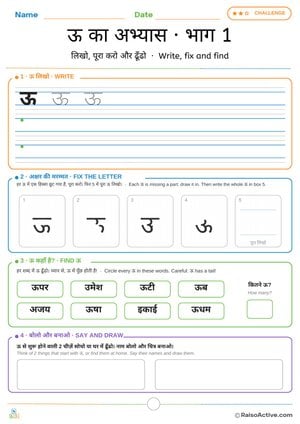
Hindi Letter ऊ Practice Part 1: Write, Fix and Find | ऊ का अभ्यास · भाग 1
Ages 3-7 · Preschool–Grade 1Ages 3-7 · Nursery–Year 2Ages 3-7 · Nursery–Class 1Ages 3-7
Children write ऊ on guide lines, complete four partly drawn letters, circle ऊ in eight words (while avoiding its look-alike उ), count how many they found, then think of two more words at home that start with ऊ and draw them.
Guides for this topic

How to Teach CVC Blending: A Step-by-Step Method That Works in Two Weeks
A step-by-step method for teaching CVC blending, covering continuous sounds, word families, common errors, and a 14-day plan that most children finish reading CVC words.
Phase 2 Phonics at Home: Sound Order, Blending Games, Worksheets
Phase 2 phonics at home: the five sound sets in order, oral blending, tricky words, a two-week routine, common mistakes, and free worksheets.

Reception Year Explained: EYFS Learning and How to Help at Home
A teacher's plain-English guide to the Reception Year: the seven areas of learning, Early Learning Goals, Phase 2/3 phonics, the RBA and home routines.
Reviews
Every worksheet for ages 4–5, no watermark
Members download the full library of 1,000+ worksheets and every activity pack without watermarks or daily limits. One year costs ₹999 in India or $20 elsewhere.
See membership plansOr download any worksheet free with a watermark (5 a day).