Rhyming Words Worksheet: Fun with Sounds!
This worksheet has children ages 4-5 look at paired pictures, say the words aloud, and write the word that rhymes with its partner, building phonological awareness by focusing on matching ending sounds rather than beginning ones. Recognizing rhymes is one of the strongest early predictors of later reading success, since it trains children's ears to notice and manipulate the sounds within words.
Part of the pack
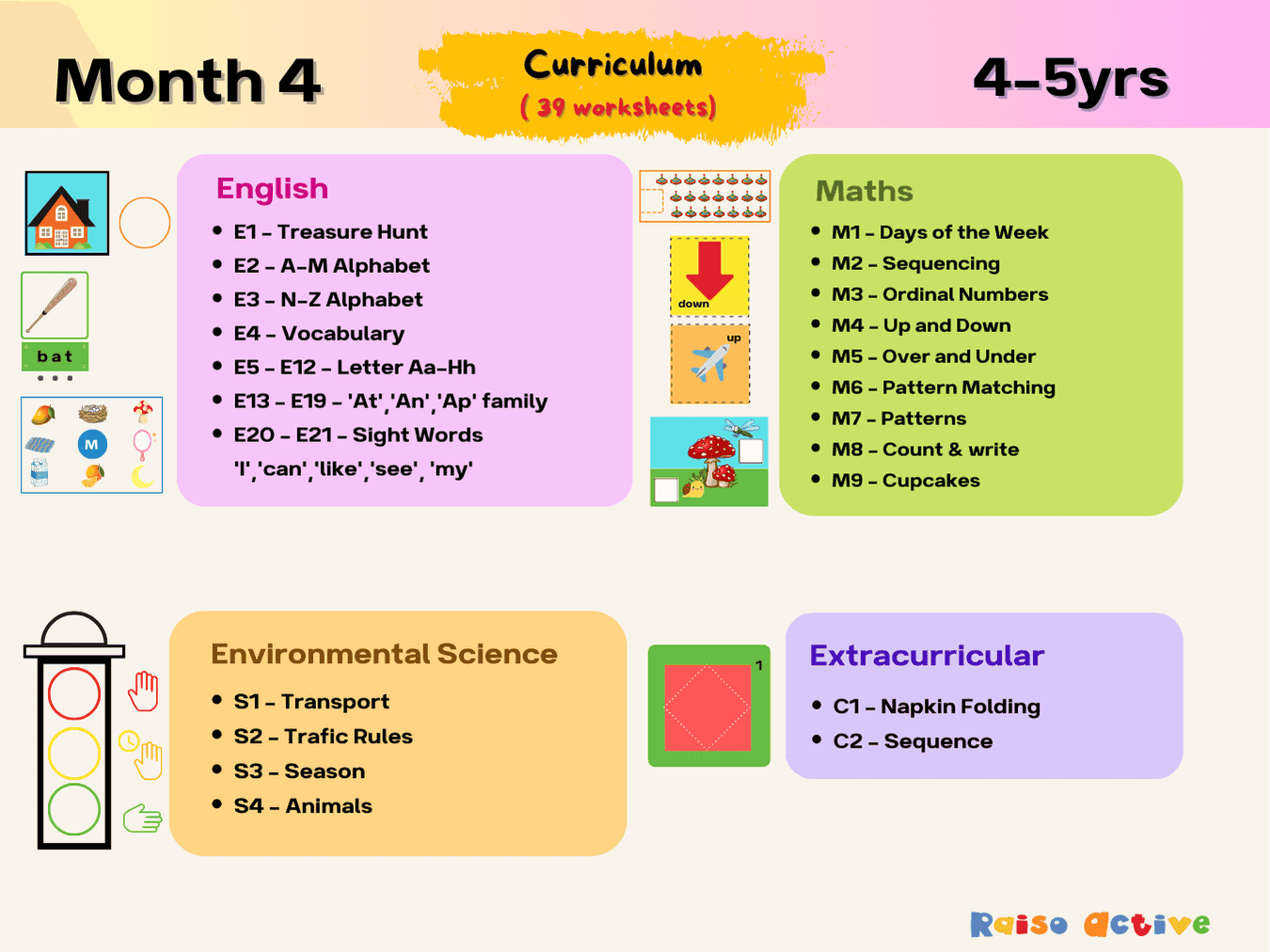
Month 4: Learning & Development | Ages 4-5
This is page 19 of the pack. Ages 4-5 · Pre-KAges 4-5 · ReceptionAges 4-5 · LKGAges 4-5
Made for your child
Spelling practice, made for your child
Their own spelling words turned into a pack: trace or look-cover-write-check, roll and write, a secret picture code, a word search, a crossword and a test, with their name in it.
Make a spelling packFree preview · free for members
Or start free: a word search with sight wordsCurriculum
- Phonological Awareness > Rhyming Words
How to use this worksheet
Look at the first picture pair together and say both words slowly and clearly, listening for the matching ending sound. Ask your child to confirm that the two words rhyme before writing the rhyming word in the box provided. Repeat this process for each picture pair on the page, always saying the words aloud before writing. Once finished, read through all the completed rhyming pairs together.
Materials needed
- Pencil
- Eraser
Extension activities
- 1Draw your own pictures of rhyming words, like cat and hat, and label them together.
- 2Find rhyming words in a favorite book, pausing while reading to point out any you spot.
- 3Play a rhyming clapping game, taking turns saying a word and a word that rhymes with it.
- 4Make up silly rhyming sentences together, like 'the cat sat on a mat.'
- 5Sort picture cards into rhyming pairs as a matching game.

Written by
Hemsweta Jain · Teacher Cheena
MBA and Early Childhood Educator, teaching since 2014 · Founder of RaisoActive, Mumbai
Every RaisoActive worksheet is designed and checked by the founder before publishing.
Published · Last reviewed
More from Month 4: Learning & Development | Ages 4-5

Learn to Read and Write the Sight Word 'Like' - Fun Worksheet for Kids!
Ages 3-5 · Preschool–Pre-KAges 3-5 · Nursery–ReceptionAges 3-5 · Nursery–LKGAges 3-5
Children ages 3-5 build sight-word fluency with the word 'like,' a common word used to express preference, through tracing, coloring, a word search, and sentence reading. Because 'like' doesn't follow simple phonics rules and appears constantly in early books and everyday speech, repeated multi-format exposure like this worksheet provides is exactly how young readers commit it to memory.

Learn to Write the Sight Word 'I' Worksheet for Preschoolers
Ages 3-5 · Preschool–Pre-KAges 3-5 · Nursery–ReceptionAges 3-5 · Nursery–LKGAges 3-5
This worksheet gives children ages 3-5 focused, repeated practice recognizing, tracing, and writing the sight word 'I,' one of the very first words most children learn to read and write since it appears constantly in their own speech. Because 'I' is a single letter that stands for a whole word, it's also a gentle introduction to the idea that capitalization carries meaning.

Napkin Folding Fun: Following Instructions Worksheet for Kids
Ages 3-5 · Preschool–Pre-KAges 3-5 · Nursery–ReceptionAges 3-5 · Nursery–LKGAges 3-5
This activity builds sequential following-directions skills and fine motor control as children fold a napkin step by step into a new shape. Because each fold depends on the one before it, children practice holding a multi-step instruction in mind and executing it in order — a skill that transfers directly to following recipes, craft instructions, and classroom directions later on.

Learn the Sight Word 'Can' - Fun Tracing and Coloring Worksheet
Ages 3-5 · Preschool–Pre-KAges 3-5 · Nursery–ReceptionAges 3-5 · Nursery–LKGAges 3-5
This worksheet gives children ages 3-5 repeated, multi-format practice with the sight word 'can,' a common verb that appears frequently in early reading, through tracing, coloring, and a cut-and-paste spelling activity. Because 'can' is a short, high-frequency word that shows up constantly in beginning readers, building instant recognition of it now pays off across nearly every book your child picks up next.

Parent's Guide: Sight Words, Colors, and Traffic Rules Activities!
Ages 3-5 · Preschool–Pre-KAges 3-5 · Nursery–ReceptionAges 3-5 · Nursery–LKGAges 3-5
This parent-led guide combines three important early-learning areas for children ages 3-5 — sight word recognition, color identification, and basic traffic safety — through a set of hands-on activities using simple household materials. Covering multiple skill areas in one session helps busy families fit varied learning into a single sitting while keeping activities playful and physical rather than worksheet-only.
Transport Sorting Worksheet for Preschoolers
Ages 3-5 · Preschool–Pre-KAges 3-5 · Nursery–ReceptionAges 3-5 · Nursery–LKGAges 3-5
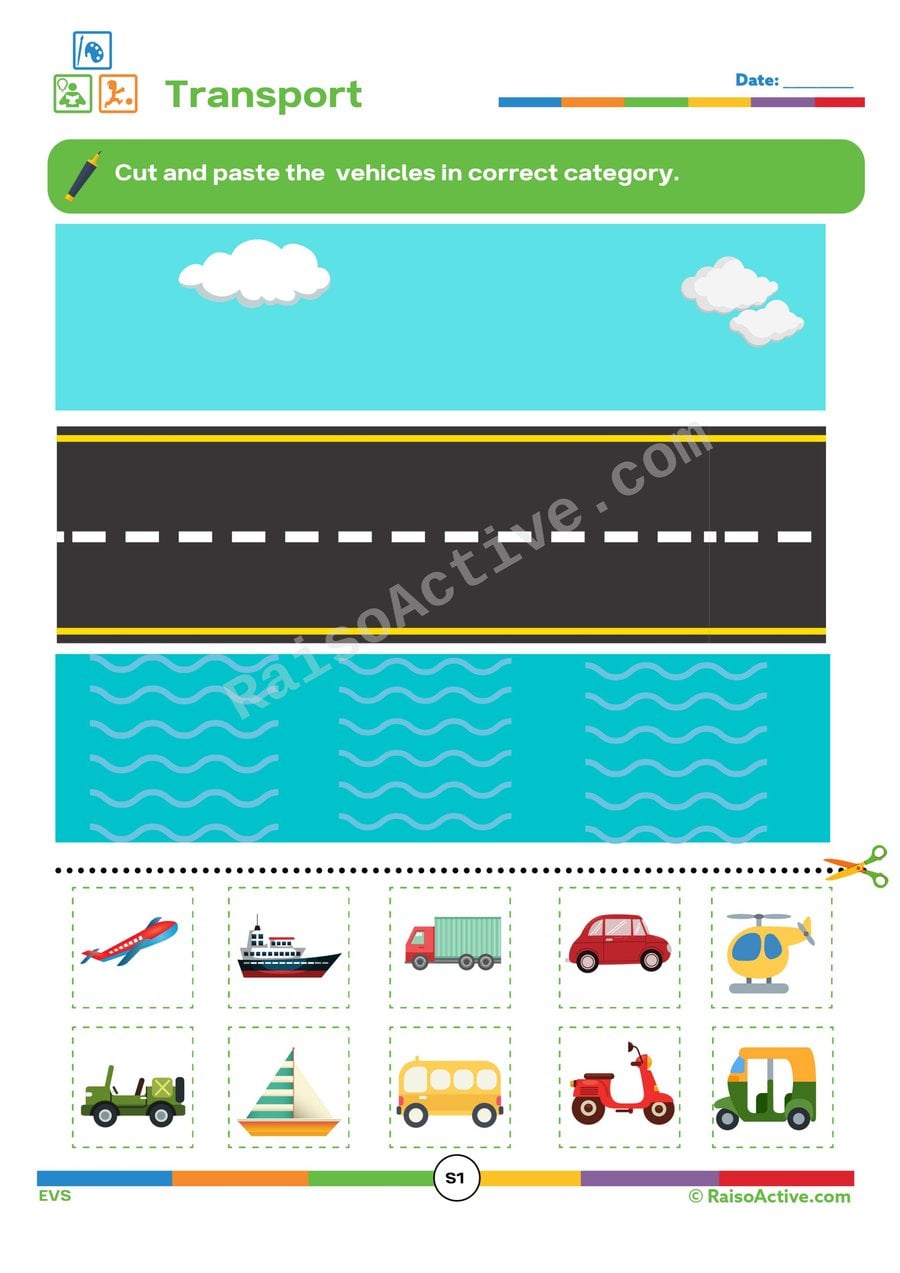
Children ages 3-5 practice classification and vocabulary as they sort vehicle pictures into three categories — air, road, and water — based on how each one travels. This kind of sorting task builds early logical reasoning, since children must identify a shared property among different pictures rather than just naming each vehicle individually.

Gg Letter Tracing and Recognition Worksheet for Preschoolers
Ages 3-5 · Preschool–Pre-KAges 3-5 · Nursery–ReceptionAges 3-5 · Nursery–LKGAges 3-5
This worksheet helps children ages 3-5 practice writing both uppercase and lowercase Gg while training them to recognize the letter in different fonts and contexts, an important skill since printed letters don't always look identical to handwritten ones. Identifying pictures that start with Gg also builds phonemic awareness, linking the letter's shape to its 'guh' sound.

Letter Dd Tracing and Matching Worksheet for Preschoolers
Ages 3-5 · Preschool–Pre-KAges 3-5 · Nursery–ReceptionAges 3-5 · Nursery–LKGAges 3-5
Children ages 3-5 practice writing the letter Dd through guided tracing, then apply that recognition by finding Dd hidden in a letter grid and identifying pictures that start with the sound. Moving from writing the letter to spotting it among other letters, and then to hearing it at the start of real words, builds a well-rounded, multi-sense understanding of the letter D.
Related worksheets
Hindi Letter ओ (o) Practice 1: Write, Fix the Letter and Find | ओ का अभ्यास · भाग 1
Ages 4-7 · Pre-K–Grade 1Ages 4-7 · Reception–Year 2Ages 4-7 · LKG–Class 1Ages 4-7
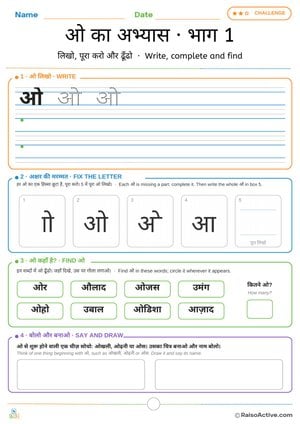
A challenge page: write ओ between the lines, complete four letters that are each missing a part and then write the whole ओ in box 5, find ओ in words such as ओर, ओजस, ओहो and ओडिशा, and draw a picture. ओ and औ are different vowels; औ has two marks on top and ओ has one.
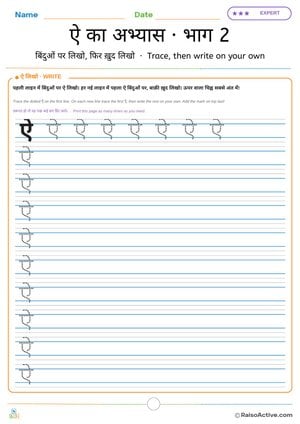
Hindi Letter ऐ (ai) Practice 2: Trace, then Write on Your Own | ऐ का अभ्यास · भाग 2
Ages 5-7 · Kindergarten–Grade 1Ages 5-7 · Year 1–Year 2Ages 5-7 · UKG–Class 1Ages 5-7
An expert page for confident writers: trace the dotted ऐ on the first line, then on each new line trace the first ऐ and write the rest on your own, adding the mark on top last.
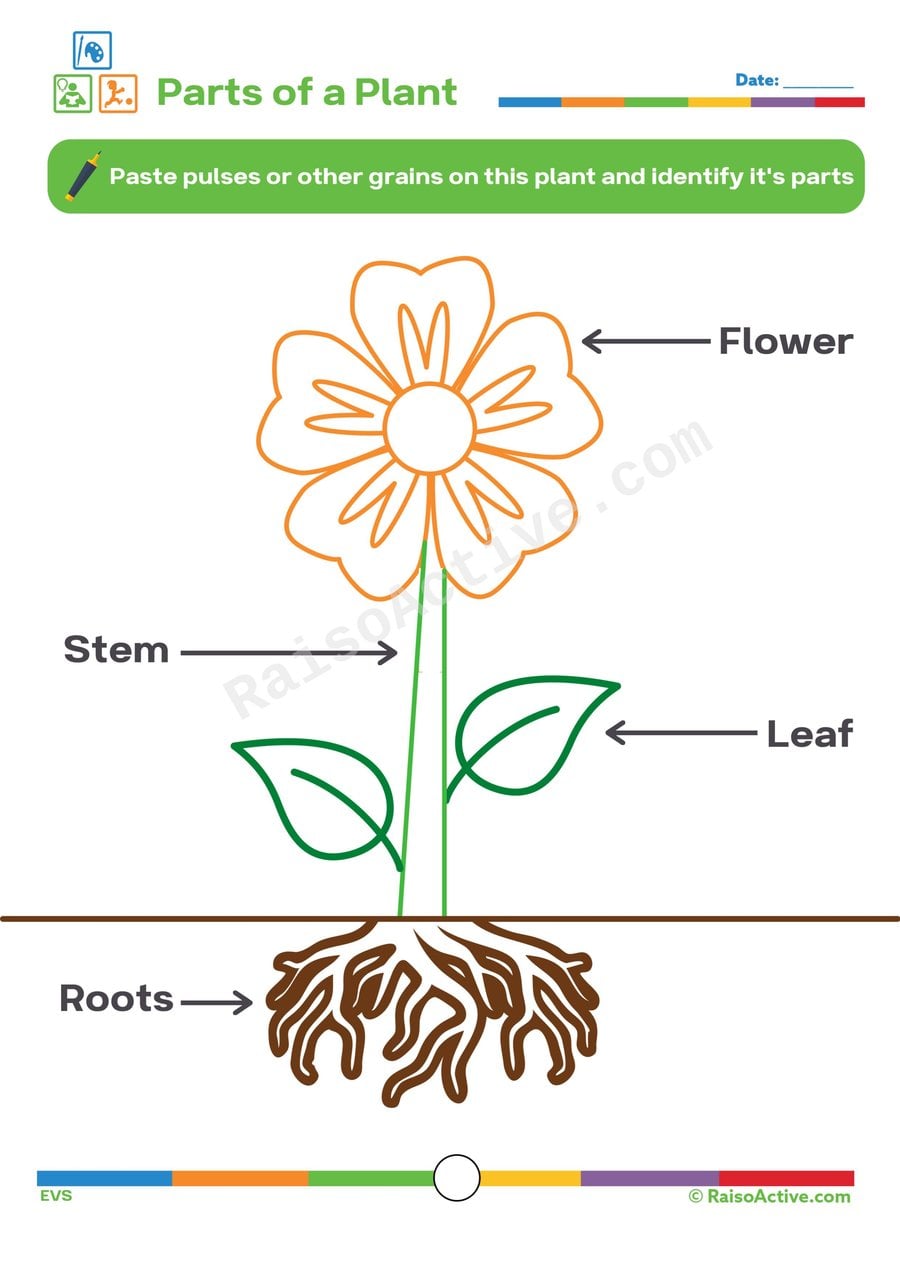
Parts of a Plant Worksheet: Identify and Label!
Ages 3-5 · Preschool–Pre-KAges 3-5 · Nursery–ReceptionAges 3-5 · Nursery–LKGAges 3-5
This activity teaches children ages 3-5 the basic parts of a plant — flower, stem, leaf, and roots — by having them label a diagram and add texture using real pulses or grains glued onto the plant shape. Combining a tactile material with each labeled part helps young children retain the vocabulary better than labeling alone, since touch and sight reinforce the same information.
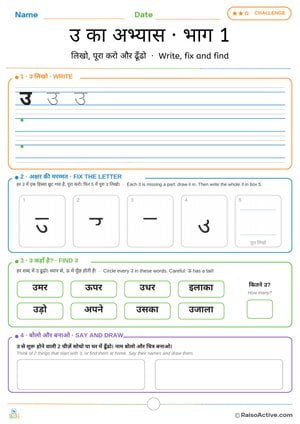
Hindi Letter उ Practice Part 1: Write, Fix and Find | उ का अभ्यास · भाग 1
Ages 3-7 · Preschool–Grade 1Ages 3-7 · Nursery–Year 2Ages 3-7 · Nursery–Class 1Ages 3-7
Children write उ on guide lines, complete four partly drawn letters, circle उ in eight words (while avoiding its look-alike ऊ), count how many they found, then think of two more words at home that start with उ and draw them.
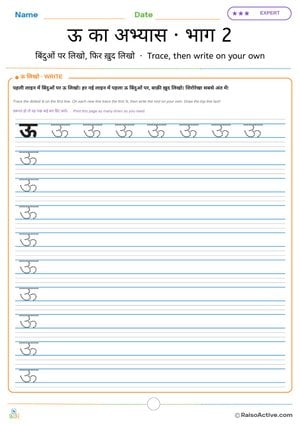
Hindi Letter ऊ Practice Part 2: Trace and Write on Your Own | ऊ का अभ्यास · भाग 2
Ages 3-7 · Preschool–Grade 1Ages 3-7 · Nursery–Year 2Ages 3-7 · Nursery–Class 1Ages 3-7
Children build writing fluency by tracing the dotted line ऊ on the first line and then writing the letter on their own, line after line, as the dotted help fades. The headline (शिरोरेखा) is drawn last, as in Hindi handwriting.
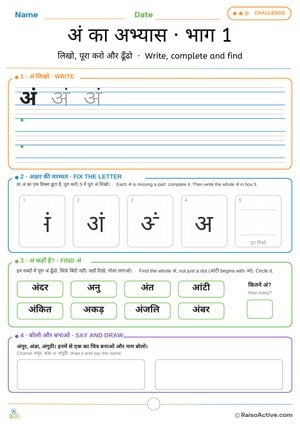
Hindi Letter अं (am) Practice 1: Write, Fix the Letter and Find | अं का अभ्यास · भाग 1
Ages 4-7 · Pre-K–Grade 1Ages 4-7 · Reception–Year 2Ages 4-7 · LKG–Class 1Ages 4-7
A challenge page: write अं between the lines, complete four letters that are each missing a part and then write the whole अं in box 5, find अं in words such as अंदर, अंत, अंकित, अंजलि and अंबर, and draw a picture. Children find the whole अं, not just a dot: आंटी begins with आं, not अं.
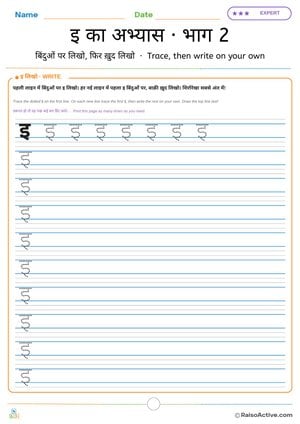
Hindi Letter इ Practice Part 2: Trace and Write on Your Own | इ का अभ्यास · भाग 2
Ages 3-7 · Preschool–Grade 1Ages 3-7 · Nursery–Year 2Ages 3-7 · Nursery–Class 1Ages 3-7
Children build writing fluency by tracing the dotted line इ on the first line and then writing the letter on their own, line after line, as the dotted help fades. The headline (शिरोरेखा) is drawn last, as in Hindi handwriting.
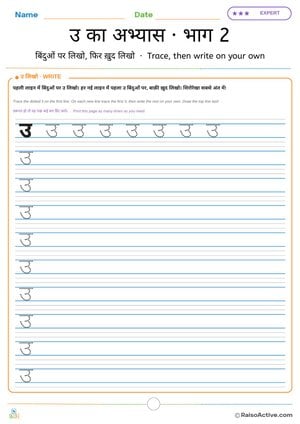
Hindi Letter उ Practice Part 2: Trace and Write on Your Own | उ का अभ्यास · भाग 2
Ages 3-7 · Preschool–Grade 1Ages 3-7 · Nursery–Year 2Ages 3-7 · Nursery–Class 1Ages 3-7
Children build writing fluency by tracing the dotted line उ on the first line and then writing the letter on their own, line after line, as the dotted help fades. The headline (शिरोरेखा) is drawn last, as in Hindi handwriting.
Guides for this topic

How to Teach CVC Blending: A Step-by-Step Method That Works in Two Weeks
A step-by-step method for teaching CVC blending, covering continuous sounds, word families, common errors, and a 14-day plan that most children finish reading CVC words.
Phase 2 Phonics at Home: Sound Order, Blending Games, Worksheets
Phase 2 phonics at home: the five sound sets in order, oral blending, tricky words, a two-week routine, common mistakes, and free worksheets.

Reception Year Explained: EYFS Learning and How to Help at Home
A teacher's plain-English guide to the Reception Year: the seven areas of learning, Early Learning Goals, Phase 2/3 phonics, the RBA and home routines.
Reviews
Every worksheet for ages 4–5, no watermark
Members download the full library of 1,000+ worksheets and every activity pack without watermarks or daily limits. One year costs ₹999 in India or $20 elsewhere.
See membership plansOr download any worksheet free with a watermark (5 a day).