Transport Sorting Worksheet for Preschoolers
Children ages 3-5 practice classification and vocabulary as they sort vehicle pictures into three categories — air, road, and water — based on how each one travels. This kind of sorting task builds early logical reasoning, since children must identify a shared property among different pictures rather than just naming each vehicle individually.
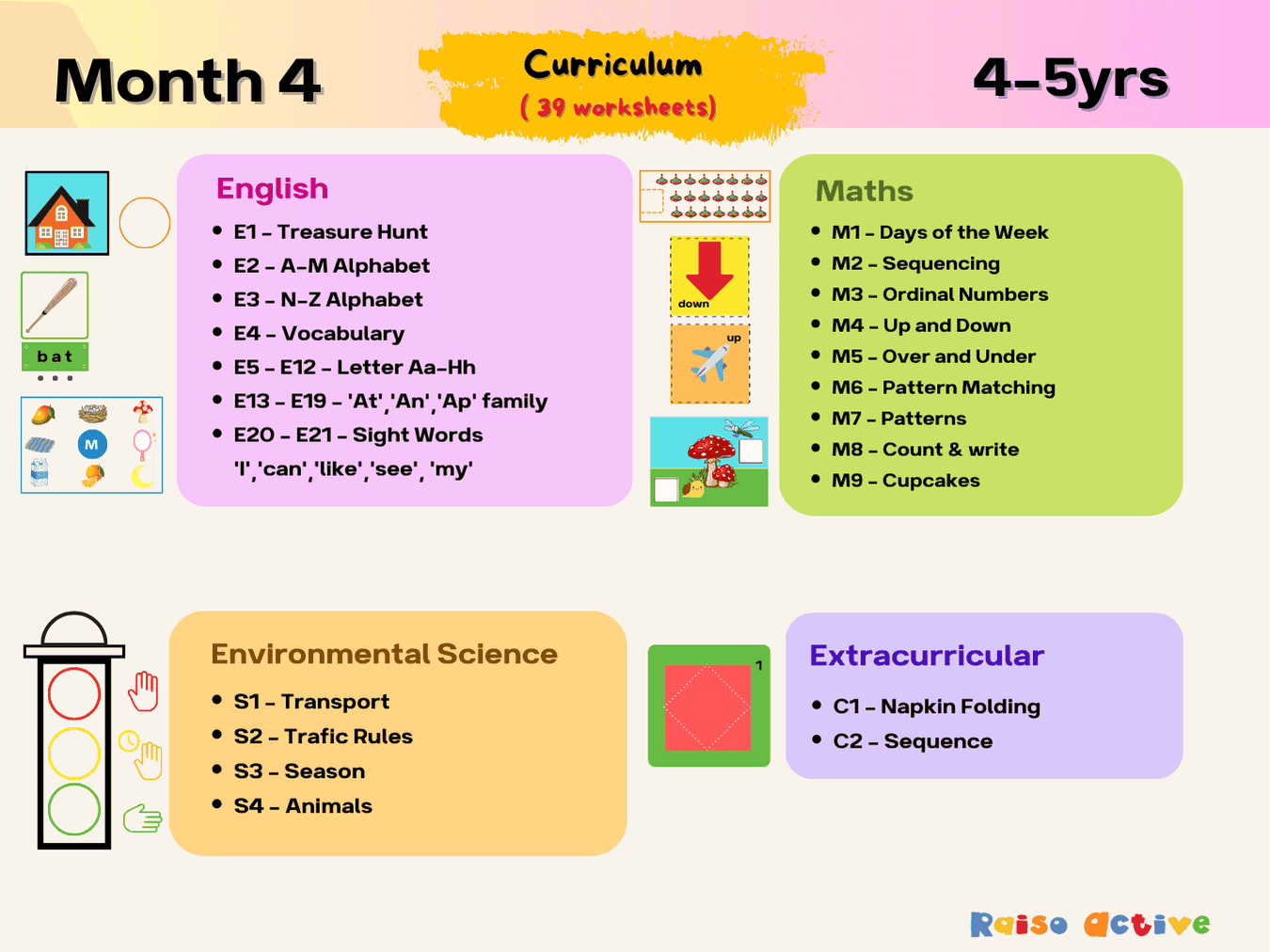
Part of the pack
Month 4: Learning & Development | Ages 4-5
This is page 37 of the pack. Ages 4-5 · Pre-KAges 4-5 · ReceptionAges 4-5 · LKGAges 4-5
Curriculum
- Safety > Road Safety
How to use this worksheet
Look at each vehicle picture together and talk about how it moves and where you'd typically see it. Have your child cut out the vehicle pictures from the page. Ask your child to decide whether each vehicle travels by air, road, or water, then have them glue it into the correct category box. Review the three completed groups together, naming each vehicle and its category.
Materials needed
- Scissors
- Glue stick
- Pencil
Extension activities
- 1Draw your favorite mode of transport and explain which category it belongs to.
- 2Talk about the different places each vehicle can go and why it's suited to that environment.
- 3Sort toy vehicles at home into air, road, and water groups.
- 4Take a walk or drive and count how many different types of transportation you spot in each category.

Written by
Hemsweta Jain · Teacher Cheena
MBA and Early Childhood Educator, teaching since 2014 · Founder of RaisoActive, Mumbai
Every RaisoActive worksheet is designed and checked by the founder before publishing.
Published · Last reviewed
More from Month 4: Learning & Development | Ages 4-5

Treasure Hunt: Alphabetical Order Worksheet for Preschoolers
Ages 3-5 · Preschool–Pre-KAges 3-5 · Nursery–ReceptionAges 3-5 · Nursery–LKGAges 3-5
This connect-the-letters worksheet has children ages 3-5 trace a path from A to Z in strict alphabetical order to help a character find hidden treasure, combining full alphabet sequencing practice with sustained fine motor control as they draw one long connected line. Successfully sequencing the entire alphabet in order, rather than just naming letters individually, is a meaningful milestone in early literacy.

Animal Skin Pattern Matching Worksheet for Preschoolers
Ages 3-5 · Preschool–Pre-KAges 3-5 · Nursery–ReceptionAges 3-5 · Nursery–LKGAges 3-5
Children ages 3-5 build visual discrimination and early biology awareness as they match animals to their distinctive skin patterns, like stripes on a zebra or spots on a leopard. Noticing and matching these patterns helps children practice careful visual comparison, a skill closely related to letter and word recognition, while also introducing the science idea that patterns serve a purpose for animals in the wild.

Letter Aa Tracing and Matching Worksheet for Preschoolers
Ages 3-5 · Preschool–Pre-KAges 3-5 · Nursery–ReceptionAges 3-5 · Nursery–LKGAges 3-5
This worksheet combines tracing practice for the letter Aa with a letter-hunt task, where children ages 3-5 scan a grid to circle every instance of Aa before also identifying pictures that start with the letter. Practicing both uppercase and lowercase forms together, alongside visual search and picture matching, builds a rounded understanding of what the letter A looks like in its different appearances.
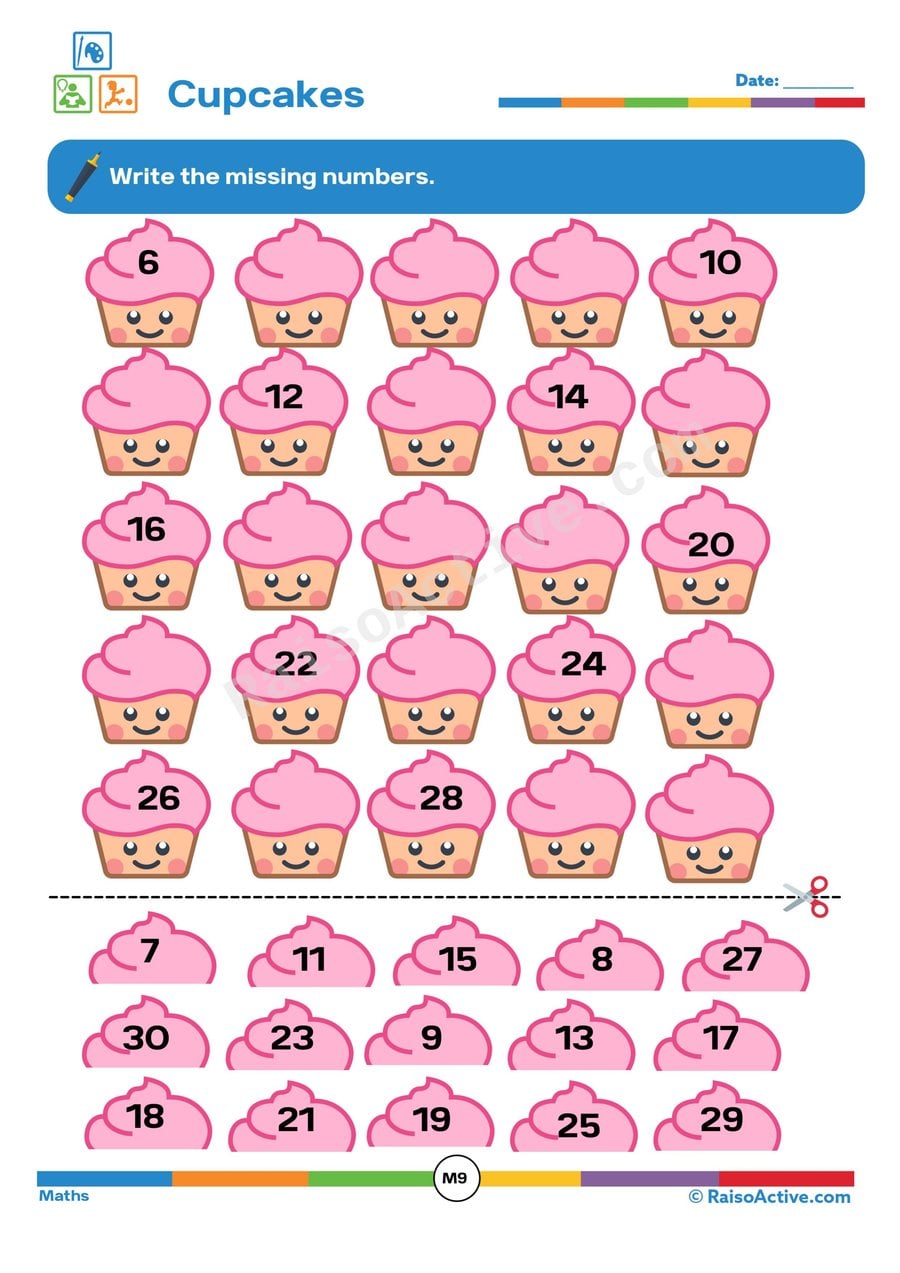
Cupcake Counting Worksheet: Missing Numbers!
Ages 4-6 · Pre-K–KindergartenAges 4-6 · Reception–Year 1Ages 4-6 · LKG–UKGAges 4-6
This worksheet strengthens number sequencing for children ages 4-6 as they study a row of numbered cupcakes and figure out which numbers are missing from the sequence, then write them in. Identifying a gap in a number sequence requires understanding the pattern of counting well enough to predict what's missing, a step beyond simply counting forward.

Days of the Week Cut and Paste Worksheet for Preschoolers
Ages 3-5 · Preschool–Pre-KAges 3-5 · Nursery–ReceptionAges 3-5 · Nursery–LKGAges 3-5
This worksheet builds sequencing skills by asking children to place the seven days of the week in their correct order, a concept that lays the groundwork for understanding calendars, routines, and time. For preschoolers, memorizing a fixed sequence like Sunday through Saturday also strengthens verbal memory and the idea that some things always happen in the same order.

Duckling's Number Path: Connect the Dots Worksheet
Ages 3-5 · Preschool–Pre-KAges 3-5 · Nursery–ReceptionAges 3-5 · Nursery–LKGAges 3-5
Children ages 3-5 practice number sequencing and counting up to 30 as they connect numbered dots in order to draw the duckling's path back to its mother, reinforcing number recognition while completing a satisfying, story-driven picture. Following numbers in strict order without skipping builds the counting fluency children need before tackling addition and more advanced number work.

Learn the Sight Word 'My' - Tracing, Coloring, and More!
Ages 3-5 · Preschool–Pre-KAges 3-5 · Nursery–ReceptionAges 3-5 · Nursery–LKGAges 3-5
This worksheet builds sight-word recognition for the possessive word 'my,' one of the earliest words children use to talk about their own belongings and experiences, through tracing, coloring, a word search, and sentence reading. Because possessive words like 'my' appear in nearly every sentence a young child speaks, mastering it in print helps bridge their spoken vocabulary directly into early reading.
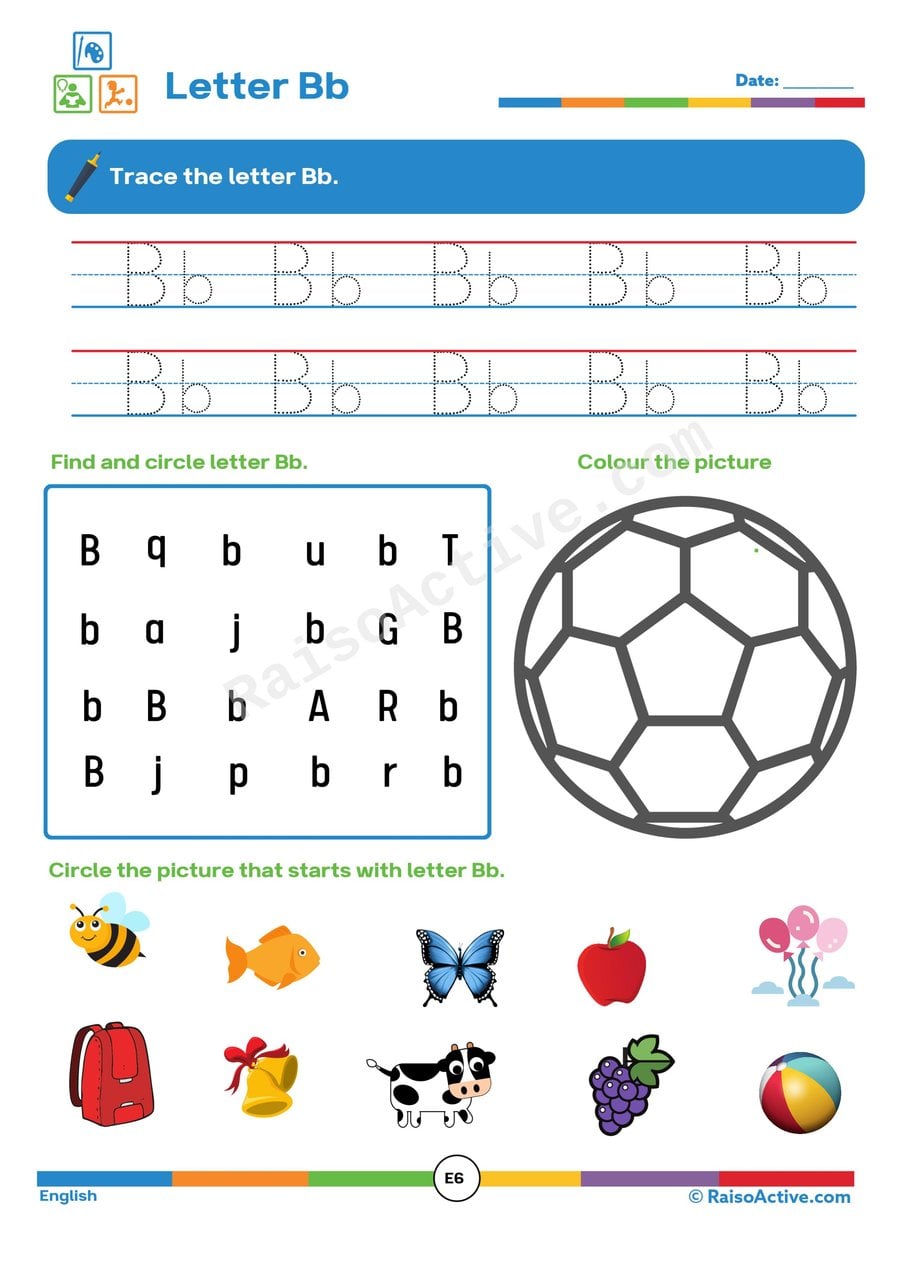
Letter Bb Worksheet: Trace, Find, and Color!
Ages 3-5 · Preschool–Pre-KAges 3-5 · Nursery–ReceptionAges 3-5 · Nursery–LKGAges 3-5
This worksheet builds letter recognition and handwriting readiness as children ages 3-5 trace both uppercase and lowercase Bb, hunt for the letter among a group of other letters, and identify pictures of objects that start with the Bb sound. Practicing a letter across several formats — tracing, spotting, and sound matching — helps cement both its shape and its sound more effectively than tracing alone.
Related worksheets

Transport Sorting Worksheet for Preschoolers
Ages 3-5 · Preschool–Pre-KAges 3-5 · Nursery–ReceptionAges 3-5 · Nursery–LKGAges 3-5
Sorting vehicle pictures into air, road, water, and rail categories teaches children ages 3-5 to classify modes of transportation based on where they travel, building both vocabulary and early categorization reasoning. Cutting and pasting each vehicle into its category also strengthens fine motor precision alongside the sorting task.
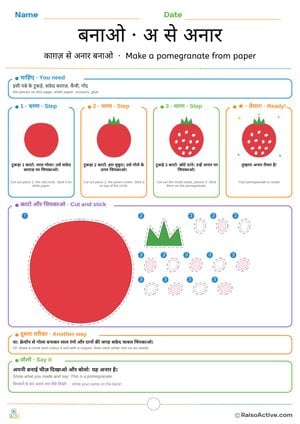
Make a Paper Pomegranate: Hindi Letter अ Craft | बनाओ · अ से अनार
Ages 3-7 · Preschool–Grade 1Ages 3-7 · Nursery–Year 2Ages 3-7 · Nursery–Class 1Ages 3-7
Children cut out the pieces, put them together following three step pictures and make a paper pomegranate. Saying the word अनार as they make it links the sound अ to something they built themselves.

Inside My Brain: Guard Dog and Wise Owl Hand-Brain Activity
Ages 7-10 · Grade 2–Grade 3Ages 7-10 · Year 3–Year 4Ages 7-10 · Class 2–Class 3Ages 7-10
Children meet two story helpers: the guard dog, who keeps us safe fast, and the wise owl, who thinks and chooses. They make a hand model, sort eight thoughts and choose calm tools that help the owl come back.
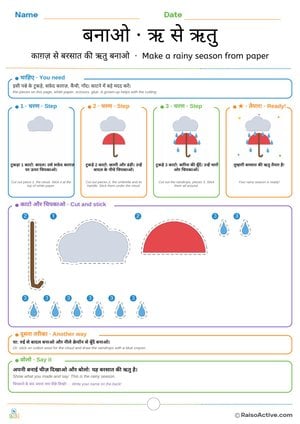
Make a Paper Rainy Season: Hindi Letter ऋ (ri) Cut and Stick Craft | बनाओ · ऋ से ऋतु
Ages 4-7 · Pre-K–Grade 1Ages 4-7 · Reception–Year 2Ages 4-7 · LKG–Class 1Ages 4-7
Children cut out the numbered pieces and stick them in order to make a rainy season scene with a cloud, umbrella and rain, then show it and say a full sentence about it. It links the letter ऋ with a real picture word, ऋतु (season), and practises scissor control and following steps.

Balloon Pattern Matching Worksheet for Preschoolers
Ages 3-5 · Preschool–Pre-KAges 3-5 · Nursery–ReceptionAges 3-5 · Nursery–LKGAges 3-5
Children ages 3-5 build early pattern-recognition skills on this worksheet by studying a sequence of colored balloons and finding the matching set to complete it. Recognizing and continuing a repeating sequence is a foundational pre-math skill that later supports understanding of number patterns, skip counting, and simple algebraic thinking.
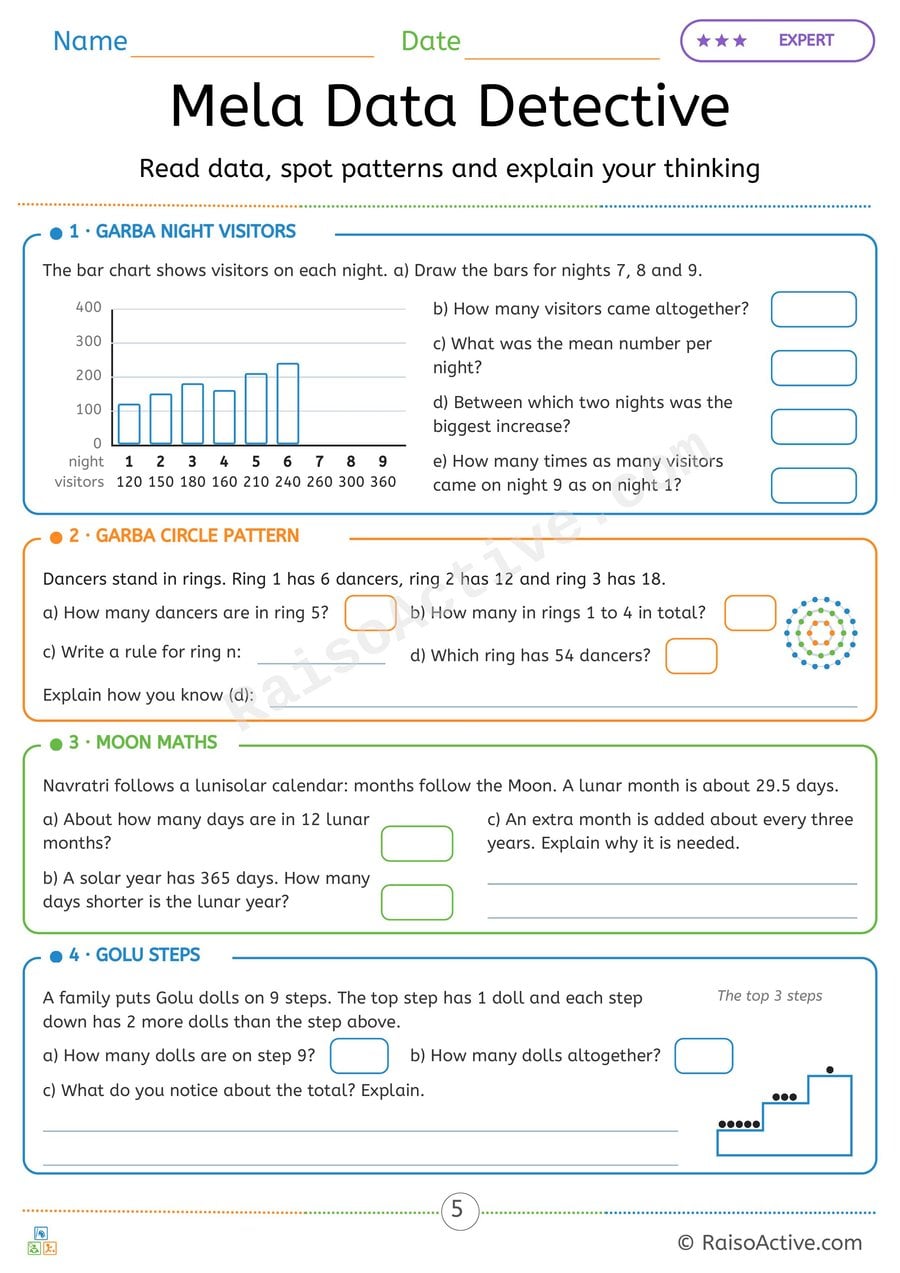
Mela Data Detective: Navratri Bar Chart, Patterns and Moon Maths
Ages 7-11 · Grade 2–Grade 3Ages 7-11 · Year 3–Year 4Ages 7-11 · Class 2–Class 3Ages 7-11
Children complete a bar chart of nine nights of visitors, find the total, the mean and the biggest increase, find and explain the rule for a growing pattern of dancers, compare a lunar year with a solar year, and add the dolls on nine Golu steps to discover a square number.
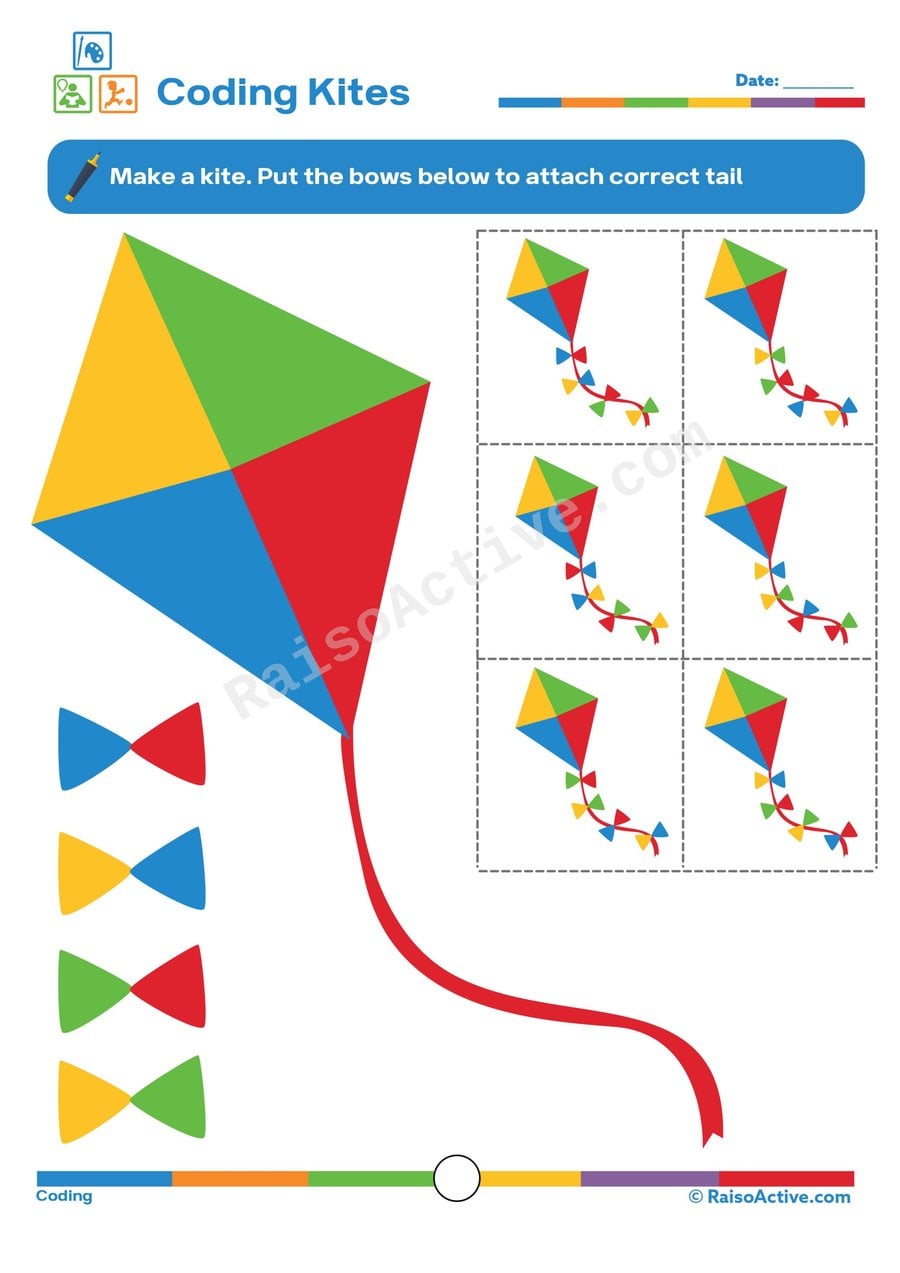
Coding Kites Worksheet: Match the Bows!
Ages 3-5 · Preschool–Pre-KAges 3-5 · Nursery–ReceptionAges 3-5 · Nursery–LKGAges 3-5
This activity sharpens visual observation in children ages 3-5 as they compare color sequences on each kite to a set of loose bows and find the exact match. Careful, systematic comparison — checking each color in order rather than glancing quickly — builds an attention-to-detail habit that transfers directly to early reading and number work.

Logic Grid Puzzle for Kids: Sort by Two Rules
Ages 4-7 · Pre-K–Grade 1Ages 4-7 · Reception–Year 2Ages 4-7 · LKG–Class 1Ages 4-7
Children sort eight numbered objects by two rules at once (big or small, striped or plain) and then use clues in a simple logic grid to work out which child has which pet. This builds classification and deductive reasoning.
Guides for this topic

Age-Appropriate Problem-Solving Activities: Building Critical Thinkers from the Ground Up
Discover fun, age-appropriate problem-solving activities for children ages 1-8. Build critical thinking, logic, and reasoning skills through play-based learning.
Critical Thinking Activities That Actually Work for Young Children: Building Tomorrow's Thinkers Today
Discover proven critical thinking activities for young children. Age-wise logic games, questioning techniques, and hands-on ideas to build thinking skills at home.

Preparing Your Child for a Rapidly Changing World: Essential Skills for Future Success
Discover the essential 21st century skills your child needs for future success. Practical tips on creativity, critical thinking, digital literacy & emotional intelligence for ages 1-8.
Reviews
Every worksheet for ages 3–5, no watermark
Members download the full library of 1,000+ worksheets and every activity pack without watermarks or daily limits. One year costs ₹999 in India or $20 elsewhere.
See membership plansOr download any worksheet free with a watermark (5 a day).