
Parent's Guide: Sight Words, Colors, and Traffic Rules Activities!
This parent-led guide combines three important early-learning areas for children ages 3-5 — sight word recognition, color identification, and basic traffic safety — through a set of hands-on activities using simple household materials. Covering multiple skill areas in one session helps busy families fit varied learning into a single sitting while keeping activities playful and physical rather than worksheet-only.
Part of the pack
Month 4: Learning & Development | Ages 4-5Curriculum
How to use this worksheet
Read through each activity's instructions before starting so you know what materials to gather. Begin with the sight word activity, using it as a warm-up before moving to the color recognition games with pulses, blocks, or other materials. Finish with the traffic rules activities, discussing real road safety scenarios as you go. Let your child lead the pace, spending extra time on whichever activity captures their interest most.
Materials needed
- Pulses
- Bowls
- Blocks or Lego
- Ice cream sticks or straw
- Markers
Extension activities
- •Create flashcards for additional sight words to build on what was practiced.
- •Sort household objects by color and talk about which colors mean what in traffic lights.
- •Practice safe road-crossing habits on an actual walk together, narrating each step out loud.
- •Turn the color-sorting materials into a simple sensory bin for extra hands-on play.
Tips for parents and teachers
Make the activities feel like play rather than lessons, since young children absorb more from hands-on games than from formal instruction. Adapt the pacing to your child's attention span — it's fine to spread the guide's activities across several short sessions instead of one sitting. Praise effort and participation throughout, and follow your child's interest if one activity clearly excites them more than another.

Written by
Hemsweta Jain · Teacher Cheena
MBA and Early Childhood Educator, teaching since 2014 · Founder of RaisoActive, Mumbai
Every RaisoActive worksheet is designed and checked by the founder before publishing.
Published · Last reviewed
Related worksheets

Parent's Guide: Fun Activities for Gross Motor Development and Emotional Learning
This parent guide equips caregivers of children ages 3-5 with activities spanning gross motor skills, emotional expression, family concepts, shape recognition, and calendar awareness, using role play, finger puppets, and simple games. Combining physical movement with emotional vocabulary practice, such as making different facial expressions, helps children build body awareness and feelings vocabulary side by side. Rotating through several distinct activity types in one guide also keeps a young child's attention across a longer play session.

Parent's Guide: Fun Activities for Early Readers and Number Learners!
This parent guide brings together a set of activity ideas that build two foundational skills at once for children ages 3-5: early reading, through short sentences and sight words, and early number sense, through counting, adding, and subtracting within a comfortable range. Rather than a single worksheet task, it gives caregivers a roadmap of small, achievable practice moments that fit naturally into daily routines. Following a guide like this helps parents pace learning appropriately instead of jumping into material that's too advanced too soon.

Parent's Guide: Fun Activities for Early Learning
This parent guide equips caregivers of children ages 3-5 with structured activity ideas around three early-learning concepts: recognizing the days of the week, identifying patterns, and practicing skip counting. Each activity translates an abstract concept into a hands-on or playful format, since young children learn these ideas best through repetition embedded in daily routines rather than worksheets alone. Covering multiple concepts in one guide also gives caregivers flexibility to pick the activity that fits their child's current interest.

Parent's Guide: Fun Revision Activities for Early Learners!
This revision guide pulls together several previously learned concepts — the butterfly life cycle, shadow drawing, simple coding logic, and art and craft skills — giving children ages 3-5 a chance to revisit and strengthen ideas rather than encounter them for the first time. Spaced repetition like this is proven to help young children retain concepts longer than a single exposure. Mixing very different skill types in one guide also keeps the review sessions varied and engaging rather than repetitive.

Parent's Guide: Fun Activities for Early Learners!
This parent's guide bundles several short, hands-on activities that build counting, shape recognition, fine motor control, and instruction-following in children ages 3-5. Rather than a single worksheet, it offers a menu of quick learning moments parents can use throughout the day, which suits the short attention spans typical of this age group. Rotating through different skill areas in one sitting also helps parents see which concepts their child grasps easily and which need more practice.

Parent's Guide: Fun Activities for Early Learning!
This parent's guide gathers a set of adaptable, no-worksheet activities that build early reading, science exploration, and creative thinking for children ages 3-5. Because the activities span different domains — from a family memory book to sink-or-float experiments — this guide supports well-rounded early learning that goes beyond pencil-and-paper practice into hands-on discovery.

Fun Activities for Kids: Puppet Shows, Lemonade, and More!
This parent's guide offers a set of varied hands-on activities for children ages 3-5, including a puppet show, an eye-hand coordination game, and homemade lemonade, that together build sentence framing, listening comprehension, and physical coordination. Combining storytelling, a sensory cooking task, and a physical game keeps learning active and multi-sensory rather than confined to a worksheet.
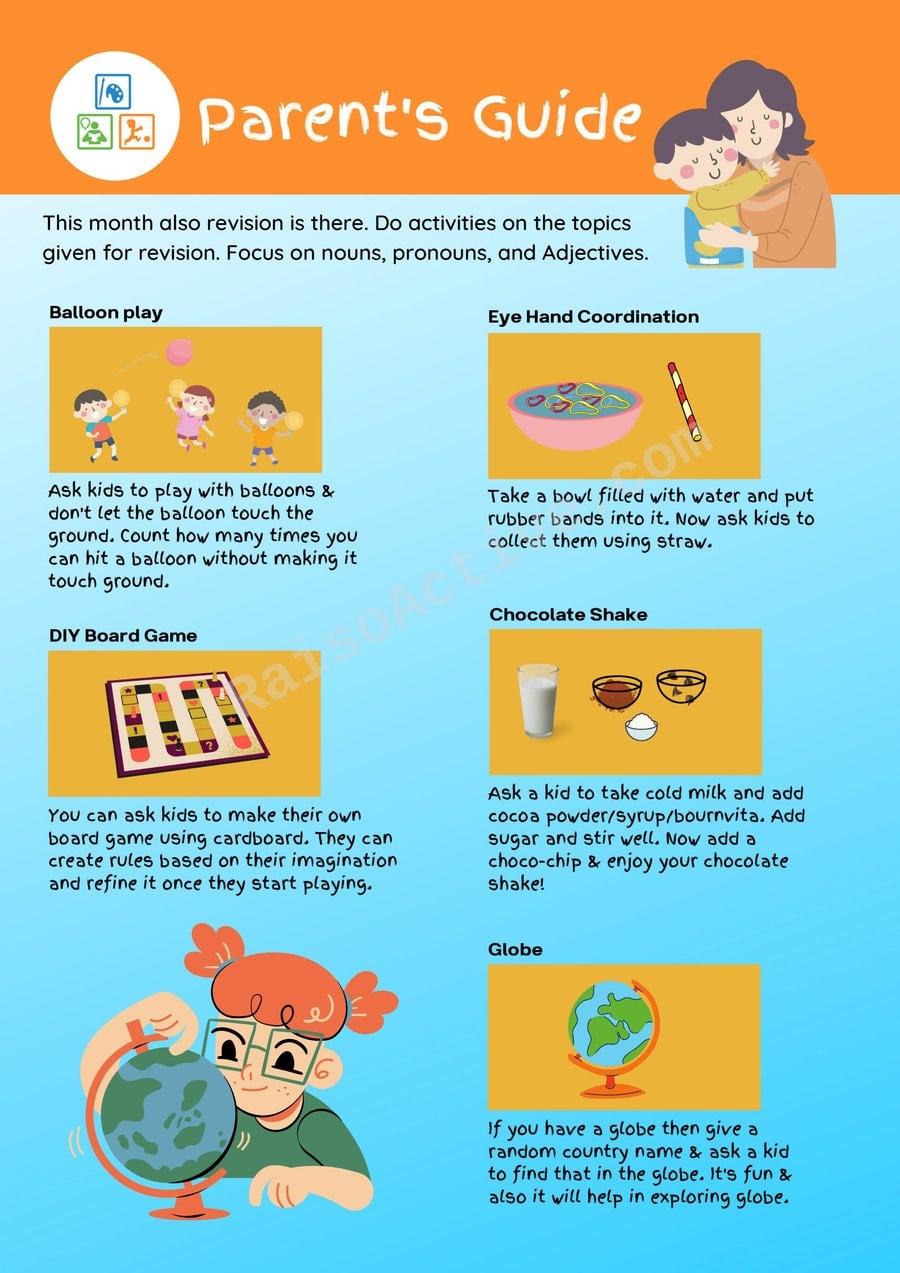
Fun Activities for Early Learners: Parent's Guide
This parent's guide walks through hands-on activities that introduce early grammar concepts — nouns, pronouns, and adjectives — through play rather than worksheets, helping children ages 3-5 absorb language structure naturally before they're ready for formal writing.
Guides for this topic
Sight Words by Age: The First 50 Words and How to Teach Them Without Flashcard Fatigue
Which sight words to teach first and why, the heart-word method, a read-trace-write-find routine, games, and a by-age table of typical sight-word progress.
How to Teach CVC Blending: A Step-by-Step Method That Works in Two Weeks
A step-by-step method for teaching CVC blending, covering continuous sounds, word families, common errors, and a 14-day plan that most children finish reading CVC words.
Phase 2 Phonics at Home: Sound Order, Blending Games, Worksheets
Phase 2 phonics at home: the five sound sets in order, oral blending, tricky words, a two-week routine, common mistakes, and free worksheets.
Reviews
Every worksheet for ages 3–5, no watermark
Members download the full library of 1,000+ worksheets and every activity pack without watermarks or daily limits. One year costs ₹1,000 in India or $20 elsewhere.
See membership plansOr download any worksheet free with a watermark (5 a day).