Parent's Guide: Fun Activities for Kids!
This parent's guide brings together a set of simple, no-prep activities that support early literacy, counting, and sequencing skills for children ages 3-5 outside of a single structured worksheet. Because the activities are designed to be adapted to your child's current interests and skill level, they build flexible thinking and real-world application of skills like counting and sequencing, rather than isolated worksheet practice.

Part of the pack
Month 11: Learning & Development | Ages Up to 4
This is page 3 of the pack. Ages 2-4 · PreschoolAges 2-4 · NurseryAges 2-4

Made for your child
Counting to 10, made for your child
A maths pack with your child's name in it: pictures that explain, practice at three levels, puzzles and story sums about them. Print a new set whenever they finish.
Make a maths packFree preview · free for members
Curriculum
- Phonics - Letter Sounds > Beginning Sounds
How to use this worksheet
Read through the suggested activities and choose one that matches your child's current mood and energy level. Gather any simple household materials the activity calls for before starting, so the momentum isn't lost mid-activity. Walk through the activity together, following the general steps but adjusting the difficulty up or down based on how your child responds. Revisit different activities from the guide on different days to keep practice varied and engaging.
Extension activities
- 1Turn a favorite activity from the guide into a short daily routine, like a five-minute counting game before dinner.
- 2Let your child pick which activity to do first, building their sense of ownership over learning time.
- 3Combine two activities from the guide into one longer play session.
- 4Keep a simple log of which activities your child enjoyed most to revisit them later.

Written by
Hemsweta Jain · Teacher Cheena
MBA and Early Childhood Educator, teaching since 2014 · Founder of RaisoActive, Mumbai
Every RaisoActive worksheet is designed and checked by the founder before publishing.
Published · Last reviewed
More from Month 11: Learning & Development | Ages Up to 4

Help Dad Reach Home! Missing Number Maze Worksheet
Ages 4-6 · Pre-K–KindergartenAges 4-6 · Reception–Year 1Ages 4-6 · LKG–UKGAges 4-6
Filling in missing numbers along a maze path combines number sequencing from 1-20 with the planning skills needed to trace a route from start to finish, giving children ages 4-6 practice in both counting recall and spatial navigation.
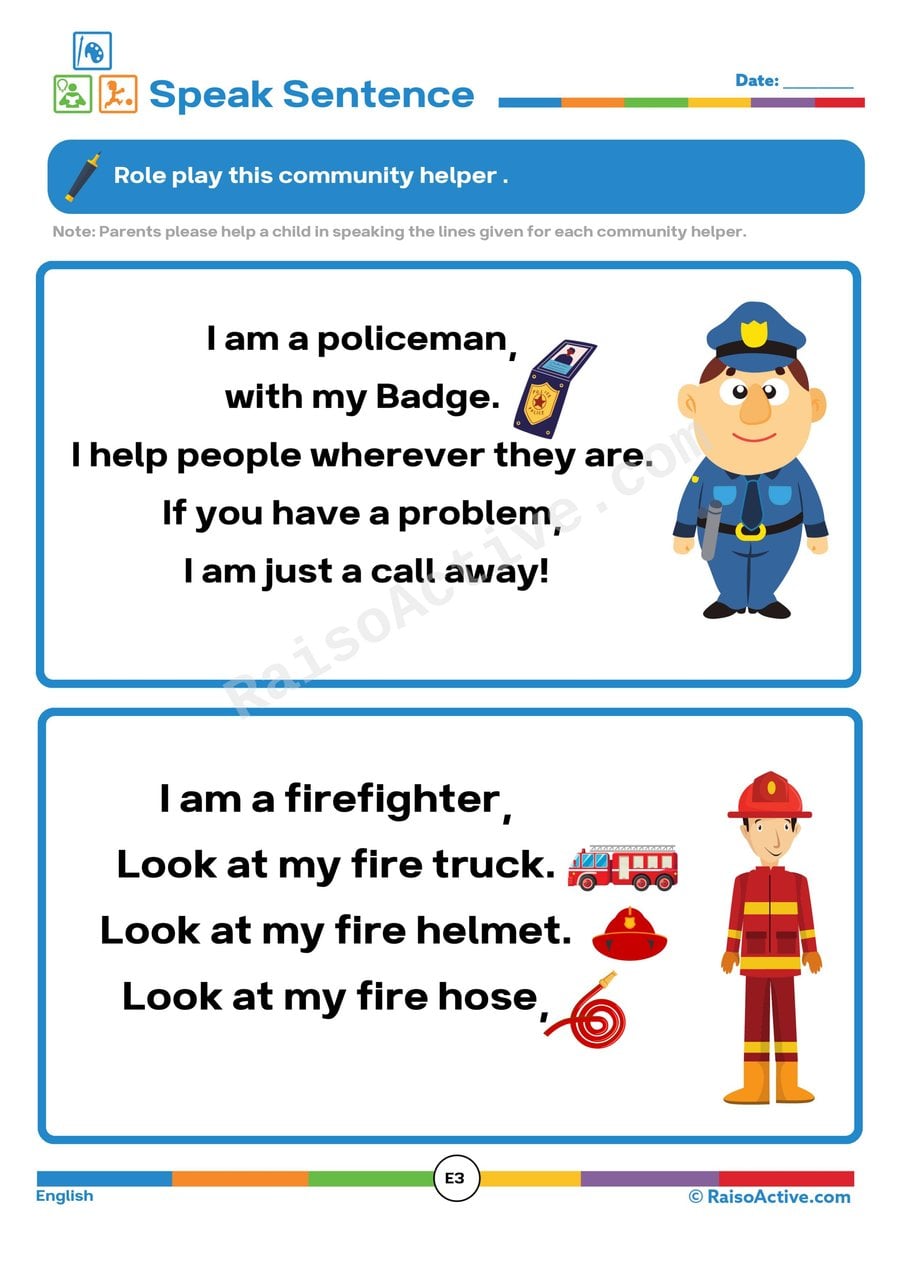
Community Helpers Role Play Worksheet for Kids
Ages 3-5 · Preschool–Pre-KAges 3-5 · Nursery–ReceptionAges 3-5 · Nursery–LKGAges 3-5
This worksheet helps children ages 3-5 learn about community helpers while practicing spoken sentence structure through guided role play. Reading a short scripted sentence aloud and then acting out the role of that helper builds oral language and expressive confidence alongside social studies knowledge, giving children a chance to practice full sentences in a low-pressure, playful context.
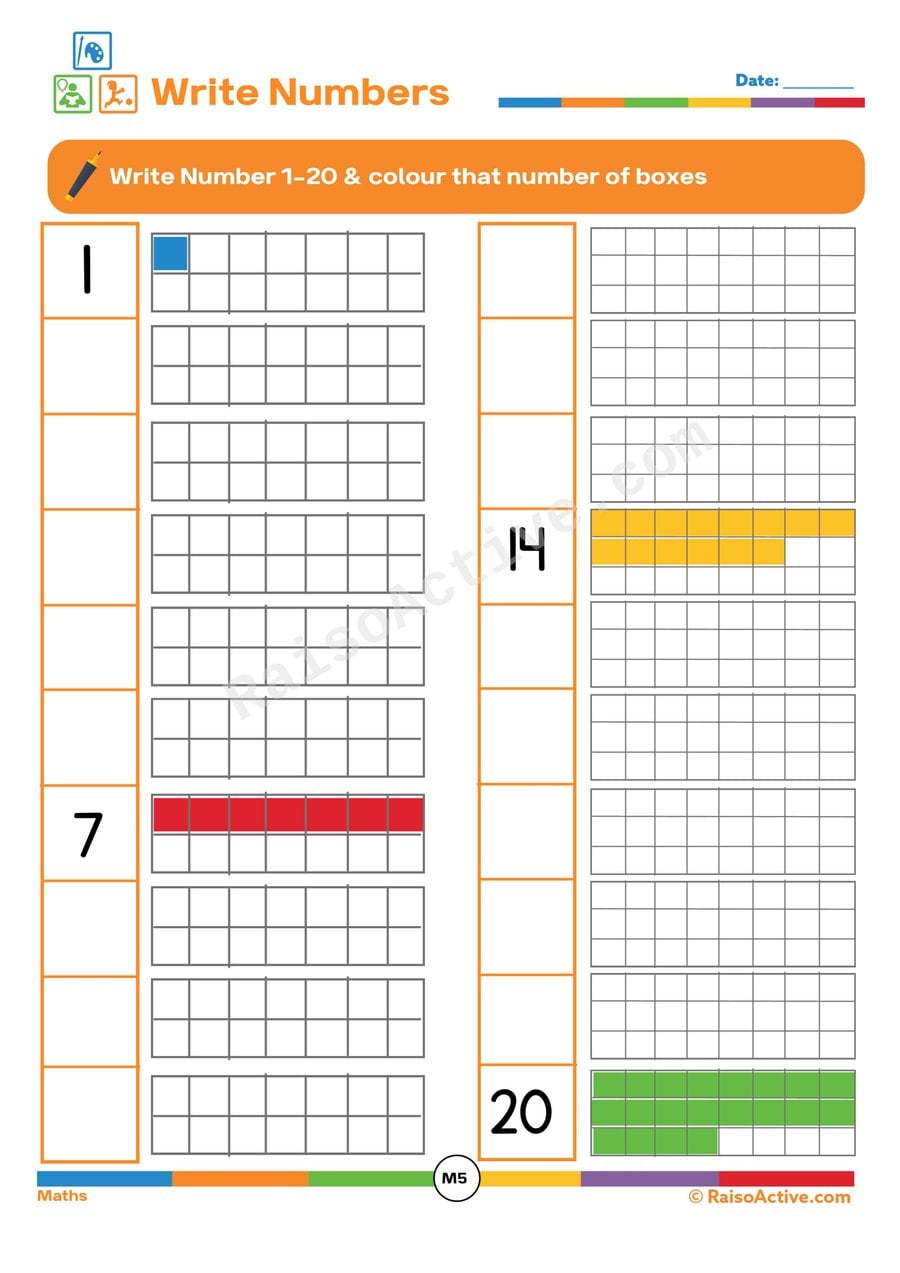
Write and Color Numbers 1-20 Worksheet
Ages 4-6 · Pre-K–KindergartenAges 4-6 · Reception–Year 1Ages 4-6 · LKG–UKGAges 4-6
Children ages 4-6 practice writing numbers from 1 to 20 in sequence while reinforcing quantity recognition by coloring the matching number of boxes for each number, connecting the written numeral to the amount it represents. Extending number writing practice up through 20 supports children moving beyond single digits into the teens and twenties, a range many children find confusing.

Cut and Paste the First Letter: Fun Phonics Worksheet for Preschoolers
Ages 4-5 · Pre-KAges 4-5 · ReceptionAges 4-5 · LKGAges 4-5
Children ages 4-5 practice identifying the beginning sound of a word and matching it to the correct letter, a core early phonics skill, while also building fine motor control through cutting and pasting. Connecting a picture's name to its first letter sound is one of the clearest building blocks toward independent reading.

Before and After Numbers Worksheet for Preschoolers
Ages 3-5 · Preschool–Pre-KAges 3-5 · Nursery–ReceptionAges 3-5 · Nursery–LKGAges 3-5
Identifying which numbers come immediately before or after a given number and physically sorting pictures into place links number sequence recall with the fine motor practice of cutting and pasting, building confidence for children ages 3-5.

Fruit and Vegetable Sorting Worksheet for Preschoolers
Ages 3-5 · Preschool–Pre-KAges 3-5 · Nursery–ReceptionAges 3-5 · Nursery–LKGAges 3-5
This worksheet helps children ages 3-5 practice identifying and categorizing fruits and vegetables by coloring circles next to each pictured food item. Learning to tell fruits and vegetables apart, and eventually name specific ones, builds early categorization skills alongside healthy eating awareness, since recognizing food groups is a foundation for later nutrition education.

Color the Circles: Vocabulary Worksheet for Preschoolers
Ages 3-5 · Preschool–Pre-KAges 3-5 · Nursery–ReceptionAges 3-5 · Nursery–LKGAges 3-5
Matching a chart of letter-color pairings to circles below reinforces alphabet recognition for children ages 3-5 while training them to hold a two-step visual instruction in mind — find the letter, then find its color — while coloring.
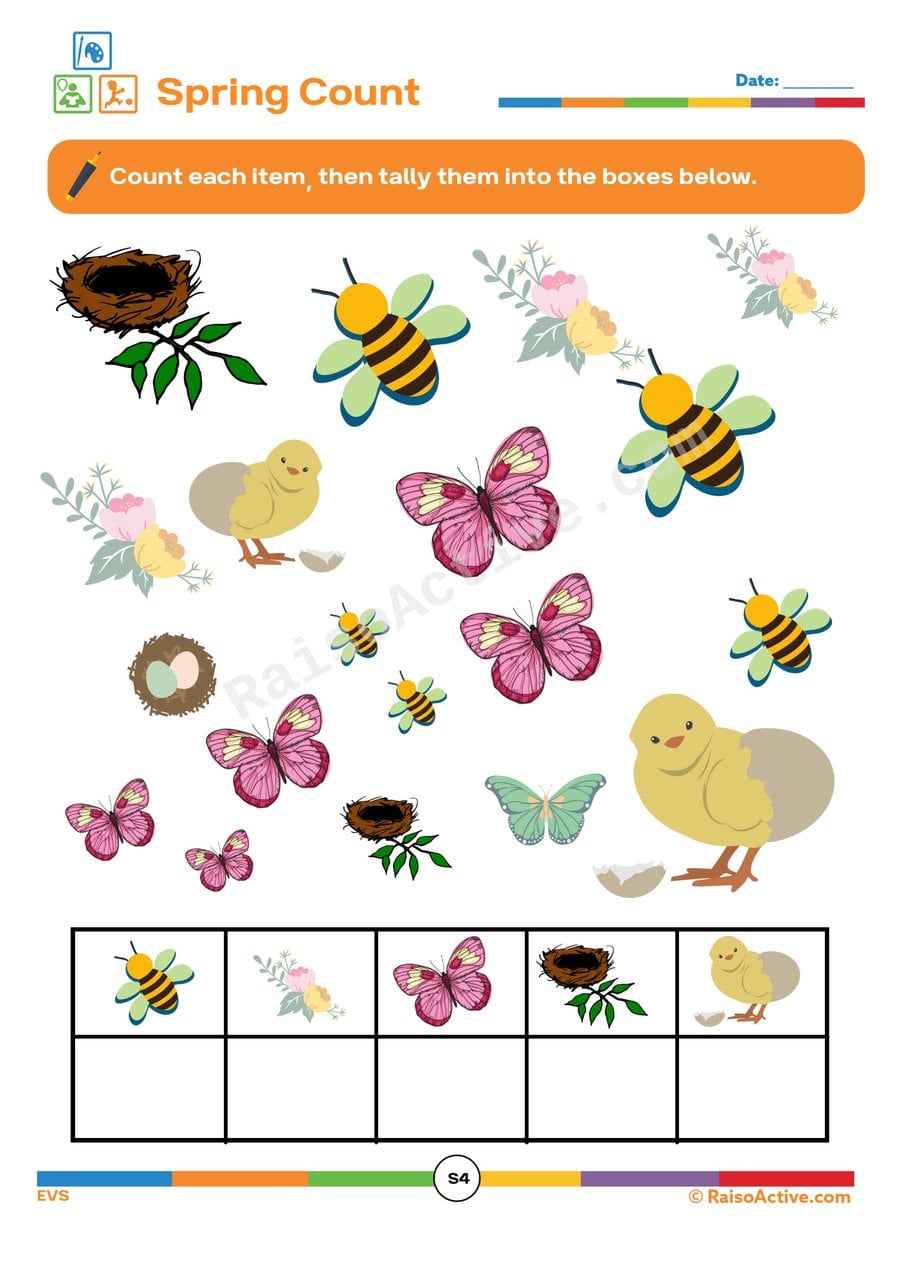
Spring Count: Tally the Spring Items Worksheet
Ages 3-5 · Preschool–Pre-KAges 3-5 · Nursery–ReceptionAges 3-5 · Nursery–LKGAges 3-5
Introduces tally marks as a way of recording a count, teaching children ages 3-5 to count spring-themed objects and represent the total visually in groups of five — an early step toward understanding how numbers can be organized.
Related worksheets
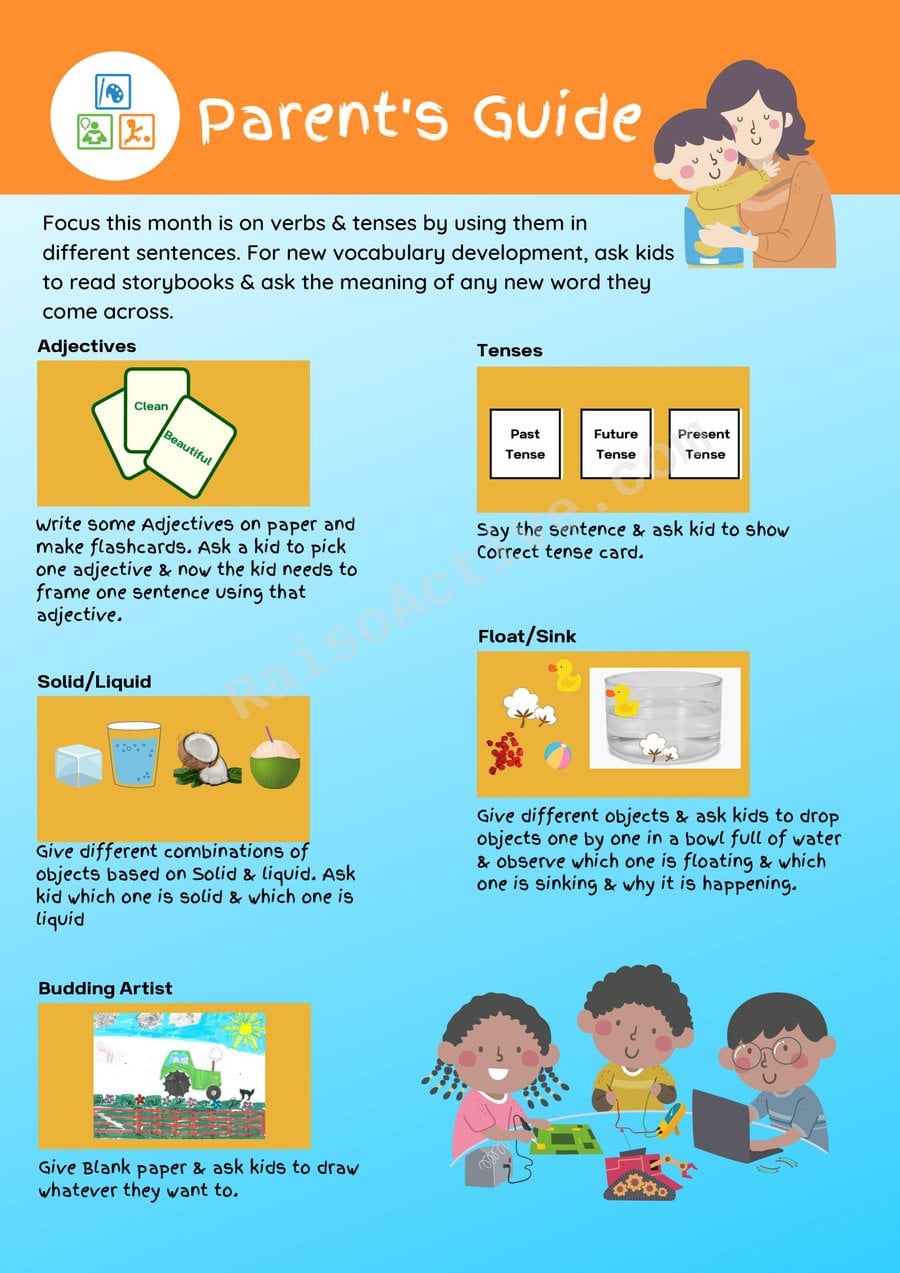
Parent's Guide: Verbs, Tenses, and Vocabulary Fun!
Ages 3-5 · Preschool–Pre-KAges 3-5 · Nursery–ReceptionAges 3-5 · Nursery–LKGAges 3-5
This guide strings together several short language activities - building adjective flashcards, identifying verb tenses, and running a simple sink-or-float experiment - to introduce children ages 3-5 to descriptive vocabulary and the idea that verbs change form depending on when an action happens. The hands-on water experiment doubles as a vocabulary builder, since children practice new describing words like 'floats' and 'sinks' while observing real cause and effect.

Fun Activities for Kids: Puppet Shows, Lemonade, and More!
Ages 3-5 · Preschool–Pre-KAges 3-5 · Nursery–ReceptionAges 3-5 · Nursery–LKGAges 3-5
This parent's guide offers a set of varied hands-on activities for children ages 3-5, including a puppet show, an eye-hand coordination game, and homemade lemonade, that together build sentence framing, listening comprehension, and physical coordination. Combining storytelling, a sensory cooking task, and a physical game keeps learning active and multi-sensory rather than confined to a worksheet.

Parent's Guide: Sight Words, Vowels, and Early Math Activities
Ages 3-5 · Preschool–Pre-KAges 3-5 · Nursery–ReceptionAges 3-5 · Nursery–LKGAges 3-5
This parent's guide combines sight word recognition, vowel puppet play, simple subtraction with blocks, and living-versus-non-living observation, giving children ages 3-5 broad exposure to early literacy, number sense, and basic science reasoning through varied hands-on activities. Because each section targets a different skill, the guide offers something to match whatever your child feels drawn to that day.

Parent's Guide: Fun Activities for Gross Motor Development and Emotional Learning
Ages 3-5 · Preschool–Pre-KAges 3-5 · Nursery–ReceptionAges 3-5 · Nursery–LKGAges 3-5
This parent guide equips caregivers of children ages 3-5 with activities spanning gross motor skills, emotional expression, family concepts, shape recognition, and calendar awareness, using role play, finger puppets, and simple games. Combining physical movement with emotional vocabulary practice, such as making different facial expressions, helps children build body awareness and feelings vocabulary side by side. Rotating through several distinct activity types in one guide also keeps a young child's attention across a longer play session.
Parent's Guide: Fun Activities for Kids!
Ages 3-5 · Preschool–Pre-KAges 3-5 · Nursery–ReceptionAges 3-5 · Nursery–LKGAges 3-5
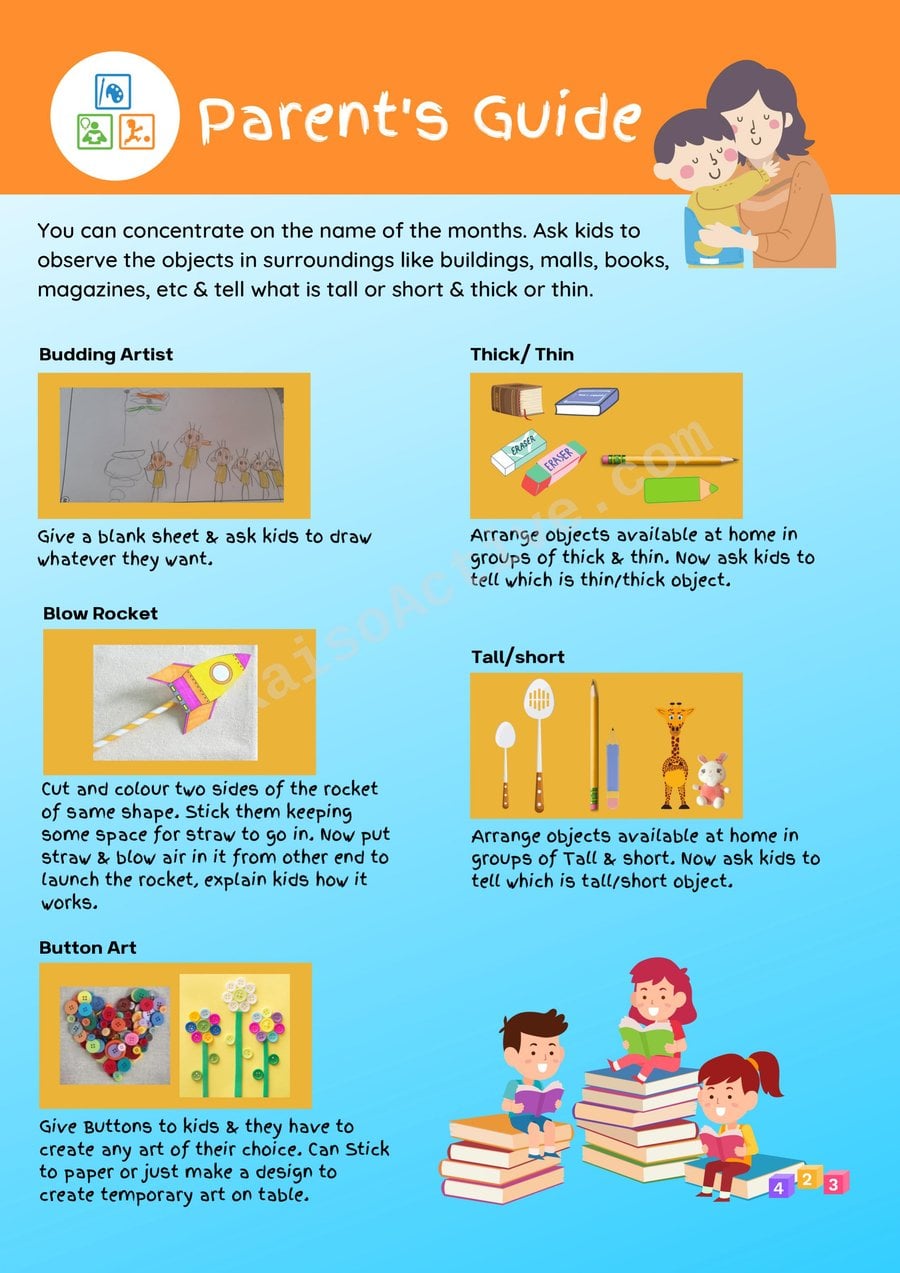
This parent's guide bundles several short activities that build early comparison vocabulary - thick versus thin, tall versus short - alongside fine motor practice with buttons and straws and beginning calendar awareness through talking about the months. For children ages 3-5, comparing sizes verbally is an important pre-math skill, while threading buttons onto straws strengthens the pincer grip needed later for writing. Together these activities give a well-rounded session touching language, math, and motor development.

Parent's Guide: Fun Activities for Early Learners!
Ages 3-5 · Preschool–Pre-KAges 3-5 · Nursery–ReceptionAges 3-5 · Nursery–LKGAges 3-5
This parent's guide bundles several hands-on activities — letter matching, sorting, art, and simple crafts like paper cup animals — that build early literacy, fine motor skills, and creativity for children ages 3-5 through play rather than worksheets.

Fun Parent's Guide: Vocabulary, Phonics, and Animal Activities!
Ages 3-5 · Preschool–Pre-KAges 3-5 · Nursery–ReceptionAges 3-5 · Nursery–LKGAges 3-5
This parent's guide bundles together activities for vocabulary building, phonics practice, and animal-themed learning, giving children ages 3-5 varied exposure to language concepts like left and right, letter-object matching, and number sorting through hands-on play. Because the activities span several skill areas, the guide offers flexibility to match whatever your child is most interested in on a given day.

Parent's Guide: Fun Activities for Early Learning
Ages 3-5 · Preschool–Pre-KAges 3-5 · Nursery–ReceptionAges 3-5 · Nursery–LKGAges 3-5
This parent guide bundles four hands-on activities covering sentence building, subtraction, number comparison, and food sorting, designed for children ages 3-5 to practice early literacy and numeracy through tactile, real-world materials like natural loose parts and playdough. Rotating between language and math tasks in one sitting helps children see connections between counting, comparing, and describing the world around them, rather than treating each subject in isolation.
Guides for this topic

Number Formation Rhymes 0–9 and How to Fix Reversals
Original number formation rhymes for 0–9, the correct stroke order for each digit, why 3, 5 and 7 get reversed most often, and multisensory fixes that work.

Documenting Learning Without Drowning in Data: A Practical Guide for Parents and Teachers
Learn practical ways to document your child's learning without overwhelm. Simple portfolios, observation tips, and printable trackers for ages 1-8.

Coding Activities for Preschoolers: Building Tomorrow's Thinkers Today
Discover 15+ unplugged and screen-based coding activities for preschoolers that build sequencing, logic, and problem-solving skills through play. NEP 2020 aligned.
Reviews
Every worksheet for ages 3–5, no watermark
Members download the full library of 1,000+ worksheets and every activity pack without watermarks or daily limits. One year costs ₹999 in India or $20 elsewhere.
See membership plansOr download any worksheet free with a watermark (5 a day).