Parent's Guide: Verbs, Tenses, and Vocabulary Fun!
This guide strings together several short language activities - building adjective flashcards, identifying verb tenses, and running a simple sink-or-float experiment - to introduce children ages 3-5 to descriptive vocabulary and the idea that verbs change form depending on when an action happens. The hands-on water experiment doubles as a vocabulary builder, since children practice new describing words like 'floats' and 'sinks' while observing real cause and effect.
Part of the pack
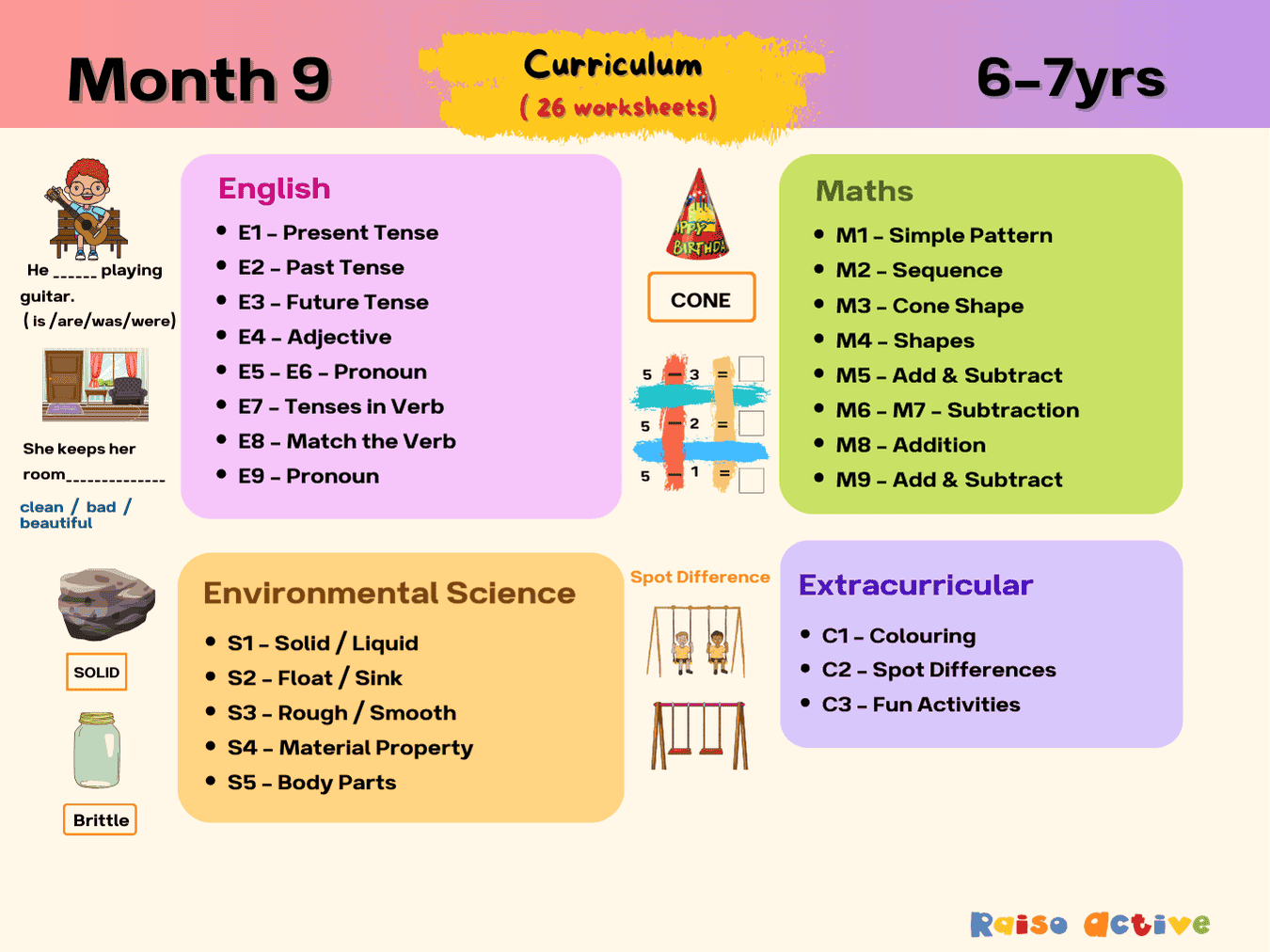
Month 9: Multi-Subject Early Learning | Ages 6-7
This is page 2 of the pack. Ages 6-7 · Grade 1Ages 6-7 · Year 2Ages 6-7 · Class 1Ages 6-7
Made for your child
Spelling practice, made for your child
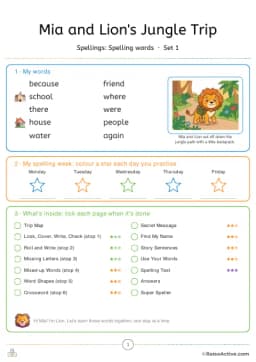
Their own spelling words turned into a pack: trace or look-cover-write-check, roll and write, a secret picture code, a word search, a crossword and a test, with their name in it.
Make a spelling packFree preview · free for members
Or start free: a word search with sight wordsCurriculum
- Grammar > Verb Tenses
How to use this worksheet
Begin with the flashcard activity: write or draw simple adjectives, like 'happy' or 'wet,' onto cards and take turns acting them out or pointing to matching pictures. Move to the tense activity, reading a short list of sentences aloud and asking your child to identify whether each one describes something happening now, that already happened, or that will happen later. Finish with the sink-or-float experiment, filling a bowl with water and letting your child predict, test, and describe whether each object sinks or floats using full sentences like 'The rock sinks.'
Materials needed
- Paper
- Pencils
- Flashcards
- Objects for sinking/floating
- Water bowl
Extension activities
- 1Test five more household objects in the water bowl and keep a simple picture chart of what sinks and what floats.
- 2Act out three adjectives from the flashcards, like 'sleepy' or 'loud,' and have your child guess the word.
- 3Take turns making up silly sentences in the past, present, and future tense about the same object, like a ball.
- 4Read a picture book together and pause to point out any adjectives the author used to describe characters or settings.
- 5Turn the flashcards into a matching memory game by making two of each card and flipping them face down.

Written by
Hemsweta Jain · Teacher Cheena
MBA and Early Childhood Educator, teaching since 2014 · Founder of RaisoActive, Mumbai
Every RaisoActive worksheet is designed and checked by the founder before publishing.
Published · Last reviewed
More from Month 9: Multi-Subject Early Learning | Ages 6-7

Present Tense Worksheet: Fill in the Blanks and Identify Sentences!
Ages 4-6 · Pre-K–KindergartenAges 4-6 · Reception–Year 1Ages 4-6 · LKG–UKGAges 4-6
This worksheet gives children ages 4-6 focused practice with present tense verbs, both producing them correctly in fill-in-the-blank sentences and recognizing them when identifying whether a given sentence is written in the present tense. Distinguishing tense is an important grammar milestone that helps children communicate clearly about what is happening right now versus what already happened, a distinction they're actively sorting out in their own speech at this age.

Subtraction Worksheet: Find the Row with Matching Answers!
Ages 4-6 · Pre-K–KindergartenAges 4-6 · Reception–Year 1Ages 4-6 · LKG–UKGAges 4-6
This worksheet pushes subtraction practice a step further for children ages 4-6 by having them solve several subtraction problems and then compare the answers across different rows to find matches, adding a layer of number-sense reasoning on top of basic calculation. Recognizing that two different subtraction problems can produce the same answer helps children understand that numbers can be reached in more than one way, which is an important early step toward flexible mathematical thinking. This kind of comparison task also builds attention to detail, since a child has to solve every problem accurately before the matching rows can be found.

Cut and Paste Body Parts Worksheet for Preschoolers
Ages 4-6 · Pre-K–KindergartenAges 4-6 · Reception–Year 1Ages 4-6 · LKG–UKGAges 4-6
This worksheet helps children ages 4-6 learn to name and correctly place major body parts by cutting them out and pasting each one onto the right location on a body outline. Physically assembling a body diagram builds body awareness and vocabulary at the same time, while the cutting and gluing sharpens fine motor precision that supports later handwriting.

Possessive Pronouns Worksheet for Kids: Fill in the Blanks!
Ages 4-6 · Pre-K–KindergartenAges 4-6 · Reception–Year 1Ages 4-6 · LKG–UKGAges 4-6
Possessive pronouns like 'his,' 'her,' and 'their' are used constantly in everyday speech, but choosing the right one requires children ages 4-6 to track who is speaking and who owns the object being discussed — a genuinely tricky grammar concept at this age. This fill-in-the-blank worksheet gives focused, sentence-level practice choosing the correct possessive pronoun from a set of options, reinforcing the connection between a pronoun and the person or thing it refers to. Mastering this concept supports clearer, more grammatically accurate speech and writing as children move into more complex sentence construction.

Future Tense Fun: Fill-in-the-Blanks Worksheet for Kids
Ages 4-6 · Pre-K–KindergartenAges 4-6 · Reception–Year 1Ages 4-6 · LKG–UKGAges 4-6
This worksheet introduces children ages 4-6 to the future tense, having them choose and write the correct verb form to complete sentences about things that 'will' happen. Understanding that verbs change to reflect when an action takes place — past, present, or future — is a foundational grammar concept that helps children communicate more precisely as their sentences grow longer and more complex.

Shapes Worksheet: Cut and Paste, Complete the Sequence!
Ages 4-5 · Pre-KAges 4-5 · ReceptionAges 4-5 · LKGAges 4-5
This worksheet combines shape identification with pattern completion, asking children ages 4-5 to cut out and paste shapes into matching boxes and then draw the missing shape needed to finish a simple sequence. Together these tasks build geometric vocabulary, precise cutting and gluing control, and the logical reasoning needed to predict what comes next in a repeating pattern.
Past Tense Verbs Worksheet for Kids
Ages 4-6 · Pre-K–KindergartenAges 4-6 · Reception–Year 1Ages 4-6 · LKG–UKGAges 4-6
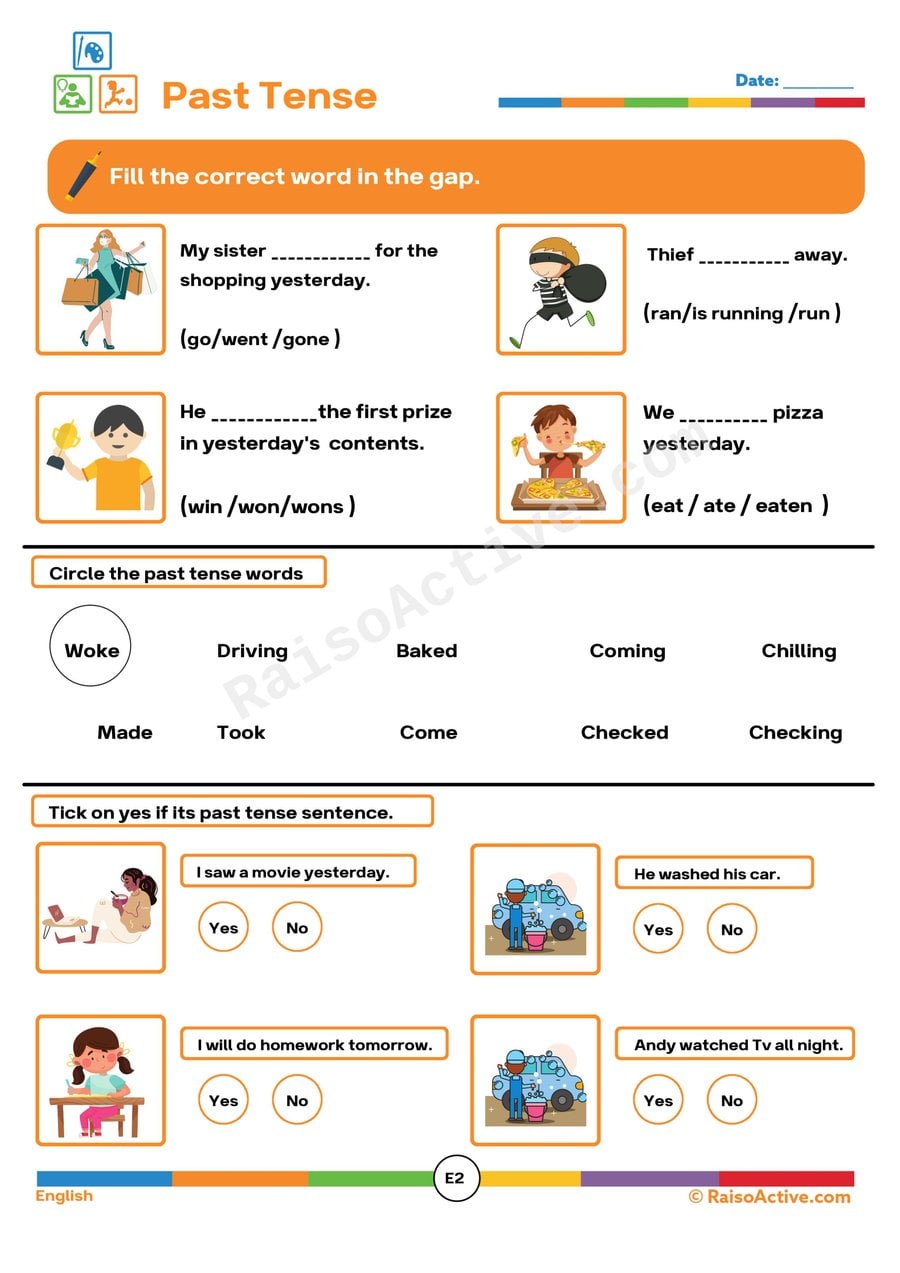
Understanding that verbs change form to show when an action happened is an important grammar concept for children ages 4-6, and this worksheet gives them focused practice recognizing and using past tense verbs in context. Filling in blanks with the correct past tense form, circling past tense words, and judging whether a sentence is already in the past tense all approach the same grammar skill from different angles, which helps solidify the pattern. This kind of grammar awareness supports both clearer spoken language and more accurate writing as children begin composing their own sentences.
Possessive Pronouns Worksheet: Circle and Match!
Ages 3-5 · Preschool–Pre-KAges 3-5 · Nursery–ReceptionAges 3-5 · Nursery–LKGAges 3-5
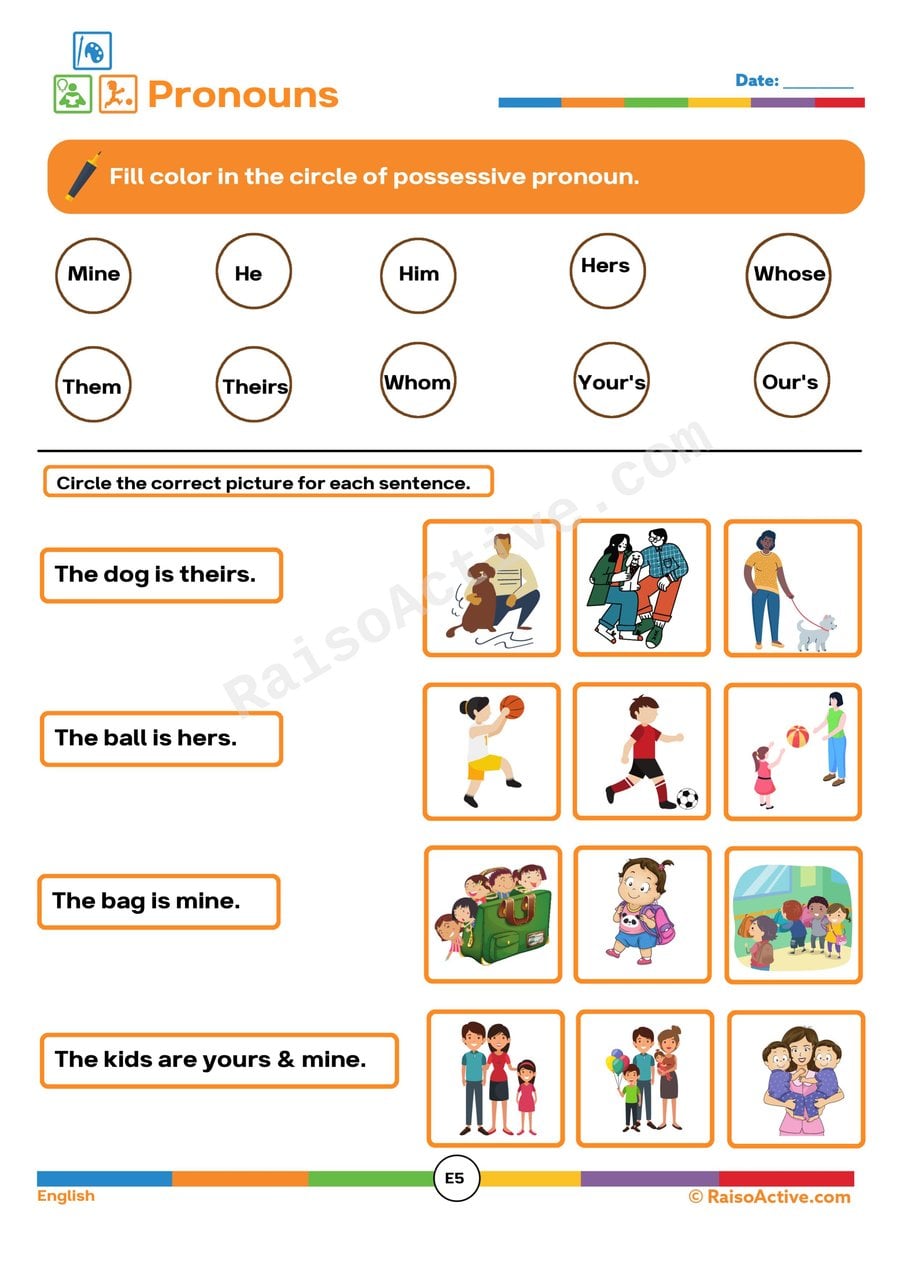
Possessive pronouns like 'mine,' 'hers,' and 'theirs' are an abstract grammar concept for children ages 3-5, since they require understanding that a single word can stand in for a whole phrase about ownership — 'that ball is hers' instead of 'that ball belongs to her.' This worksheet builds early grammar awareness by having children match possessive pronouns to sentences and pictures, giving them concrete visual context for what could otherwise be a confusing abstract idea. Early, low-pressure exposure to pronouns like this supports both oral language development and the sentence-building skills needed for writing later on.
Related worksheets

Parent's Guide: Sentence Framing and Early Literacy Activities
Ages 3-5 · Preschool–Pre-KAges 3-5 · Nursery–ReceptionAges 3-5 · Nursery–LKGAges 3-5
This parent's guide equips families of children ages 3-5 with a toolkit of hands-on activities — sentence framing, letter games, number and money recognition, and before/after sequencing with blocks — that build early literacy and numeracy together rather than in isolation. Framing simple sentences specifically helps children move from single words to connected speech, a critical bridge toward writing their own sentences later.

Parent's Guide: Complex Sentences and Observation Activities Worksheet
Ages 3-5 · Preschool–Pre-KAges 3-5 · Nursery–ReceptionAges 3-5 · Nursery–LKGAges 3-5
This parent guide bundles activities around complex sentence structure, weight and capacity comparison, measuring duration, and demonstrative pronouns ('this,' 'that,' 'these,' 'those'), giving children exposure to several distinct language and science-reasoning skills through short, hands-on games rather than one worksheet. For ages three to five, rotating between grammar and observation-based tasks like this keeps engagement high while covering meaningfully different areas of development.

Fun Activities for Kids: Puppet Shows, Lemonade, and More!
Ages 3-5 · Preschool–Pre-KAges 3-5 · Nursery–ReceptionAges 3-5 · Nursery–LKGAges 3-5
This parent's guide offers a set of varied hands-on activities for children ages 3-5, including a puppet show, an eye-hand coordination game, and homemade lemonade, that together build sentence framing, listening comprehension, and physical coordination. Combining storytelling, a sensory cooking task, and a physical game keeps learning active and multi-sensory rather than confined to a worksheet.

Parent's Guide: Fun Activities for Early Learning!
Ages 3-5 · Preschool–Pre-KAges 3-5 · Nursery–ReceptionAges 3-5 · Nursery–LKGAges 3-5
This parent's guide gathers a set of adaptable, no-worksheet activities that build early reading, science exploration, and creative thinking for children ages 3-5. Because the activities span different domains — from a family memory book to sink-or-float experiments — this guide supports well-rounded early learning that goes beyond pencil-and-paper practice into hands-on discovery.

Parent's Guide: Fun Activities for Storytelling, Addition, and More!
Ages 3-5 · Preschool–Pre-KAges 3-5 · Nursery–ReceptionAges 3-5 · Nursery–LKGAges 3-5
This parent's guide walks through a set of hands-on activities that build storytelling and sequencing through puppet play, early addition through a simple 'addition house,' and sorting skills, giving children ages 3-5 practice across language, number, and reasoning in one sitting. Because the activities are play-based rather than worksheet-based, they let children absorb these concepts through natural exploration.

Parent's Guide: Sight Words, Colors, and Traffic Rules Activities!
Ages 3-5 · Preschool–Pre-KAges 3-5 · Nursery–ReceptionAges 3-5 · Nursery–LKGAges 3-5
This parent-led guide combines three important early-learning areas for children ages 3-5 — sight word recognition, color identification, and basic traffic safety — through a set of hands-on activities using simple household materials. Covering multiple skill areas in one session helps busy families fit varied learning into a single sitting while keeping activities playful and physical rather than worksheet-only.

Parent's Guide: Fun Activities for Verbs, Subtraction, and More!
Ages 3-5 · Preschool–Pre-KAges 3-5 · Nursery–ReceptionAges 3-5 · Nursery–LKGAges 3-5
This parent guide pulls together several early-learning threads — verbs, subtraction, plant life cycles, and 2D shapes — into a single set of hands-on activity suggestions designed for 3-5 year olds, giving you ready-made ways to reinforce classroom or worksheet learning at home without needing to plan lessons yourself. Rather than a single skill, this guide's value is in showing how the same everyday objects (flashcards, fruit, seeds, toys) can support several different concepts across a week of casual, low-pressure practice.

Parent's Guide: Sight Words, Vowels, and Early Math Activities
Ages 3-5 · Preschool–Pre-KAges 3-5 · Nursery–ReceptionAges 3-5 · Nursery–LKGAges 3-5
This parent's guide combines sight word recognition, vowel puppet play, simple subtraction with blocks, and living-versus-non-living observation, giving children ages 3-5 broad exposure to early literacy, number sense, and basic science reasoning through varied hands-on activities. Because each section targets a different skill, the guide offers something to match whatever your child feels drawn to that day.
Reviews
Every worksheet for ages 3–5, no watermark
Members download the full library of 1,000+ worksheets and every activity pack without watermarks or daily limits. One year costs ₹999 in India or $20 elsewhere.
See membership plansOr download any worksheet free with a watermark (5 a day).