Fun Activities for Kids: Puppet Shows, Lemonade, and More!
This parent's guide offers a set of varied hands-on activities for children ages 3-5, including a puppet show, an eye-hand coordination game, and homemade lemonade, that together build sentence framing, listening comprehension, and physical coordination. Combining storytelling, a sensory cooking task, and a physical game keeps learning active and multi-sensory rather than confined to a worksheet.
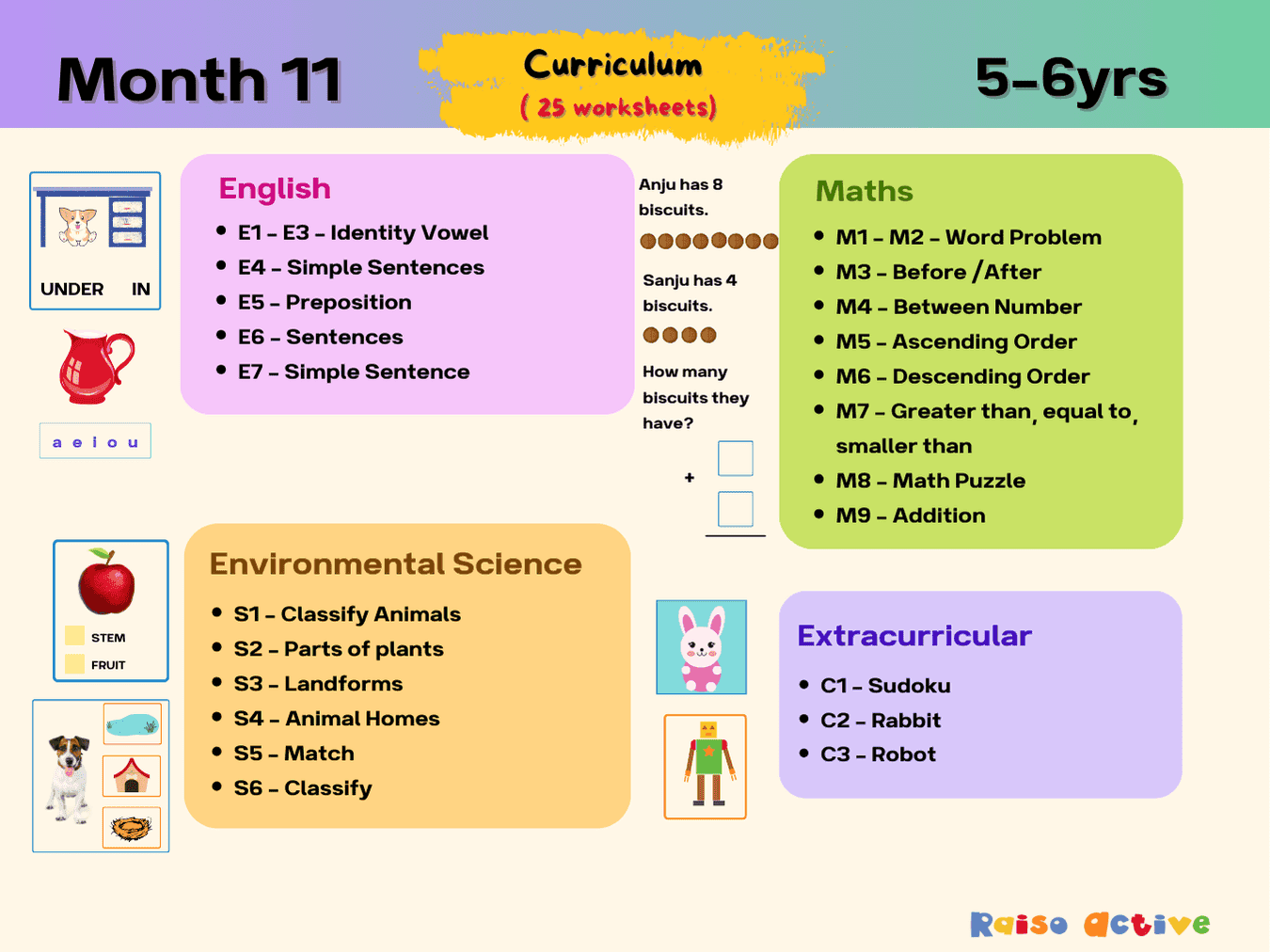
Part of the pack
Month 11: Learning & Development | Ages 5-6
This is page 2 of the pack. Ages 5-6 · KindergartenAges 5-6 · Year 1Ages 5-6 · UKGAges 5-6

Made for your child
A whole activity pack made with their name
60 pages to spot, build, trace and write their own name, plus pages about their favourites, feelings and family. See a free preview with their name.
Make an All About Me packFree preview · free for members
Or start free: a name tracing sheet with their nameCurriculum
- Phonics - Letter Sounds > Beginning Sounds
How to use this worksheet
Read through each activity and gather the simple materials listed, like socks for puppets or lemon and sugar for lemonade. For the puppet show, help your child make a sock puppet and encourage them to narrate a simple story using full sentences. For the eye-hand coordination game, take turns tossing a small ball back and forth, and for the lemonade activity, guide your child through measuring and mixing the ingredients step by step, talking through each part of the process.
Materials needed
- Socks
- Small ball or paper ball
- Water
- Sugar
- Lemon
- Playdough
Extension activities
- 1Add more sock puppet characters and expand the story your child is narrating.
- 2Adjust the amount of sugar or lemon in the lemonade and taste-test the differences together.
- 3Hide small items inside playdough eggs for your child to find and describe.
- 4Practice the ball-tossing game at increasing distances to build coordination further.

Written by
Hemsweta Jain · Teacher Cheena
MBA and Early Childhood Educator, teaching since 2014 · Founder of RaisoActive, Mumbai
Every RaisoActive worksheet is designed and checked by the founder before publishing.
Published · Last reviewed
More from Month 11: Learning & Development | Ages 5-6

Animal Homes Worksheet: Circle the Correct Answer!
Ages 3-5 · Preschool–Pre-KAges 3-5 · Nursery–ReceptionAges 3-5 · Nursery–LKGAges 3-5
Matching an animal to its correct home among three picture choices builds science classification skills for children ages 3-5, introducing the idea that different animals are suited to different environments.

Addition Worksheet for Kids: Add Horizontally and Vertically!
Ages 4-6 · Pre-K–KindergartenAges 4-6 · Reception–Year 1Ages 4-6 · LKG–UKGAges 4-6
Children ages 4-6 practice basic addition by solving problems arranged both horizontally, like '3 + 2 =,' and vertically, in a stacked column format, building flexibility with the two most common ways addition problems appear in early math worksheets and textbooks. Learning both formats now means neither will feel unfamiliar once formal school math introduces them side by side.

Identify Vowels Worksheet: Circle the Correct Vowel!
Ages 4-6 · Pre-K–KindergartenAges 4-6 · Reception–Year 1Ages 4-6 · LKG–UKGAges 4-6
This worksheet sharpens phonemic awareness in children ages 4-6 by having them say a picture's name aloud and isolate which vowel sound — a, e, i, o, or u — appears in the middle. Vowels are the trickiest sounds for early readers to hear clearly since they blend into surrounding consonants, so focused practice like this builds a skill that pays off directly in future decoding and spelling.

Landforms Worksheet: Identify and Label the Pictures!
Ages 3-5 · Preschool–Pre-KAges 3-5 · Nursery–ReceptionAges 3-5 · Nursery–LKGAges 3-5
Writing the correct name for pictures of mountains, rivers, and other landforms from a word bank builds early science vocabulary and spelling practice for children ages 3-5, connecting a visual image to its written word.
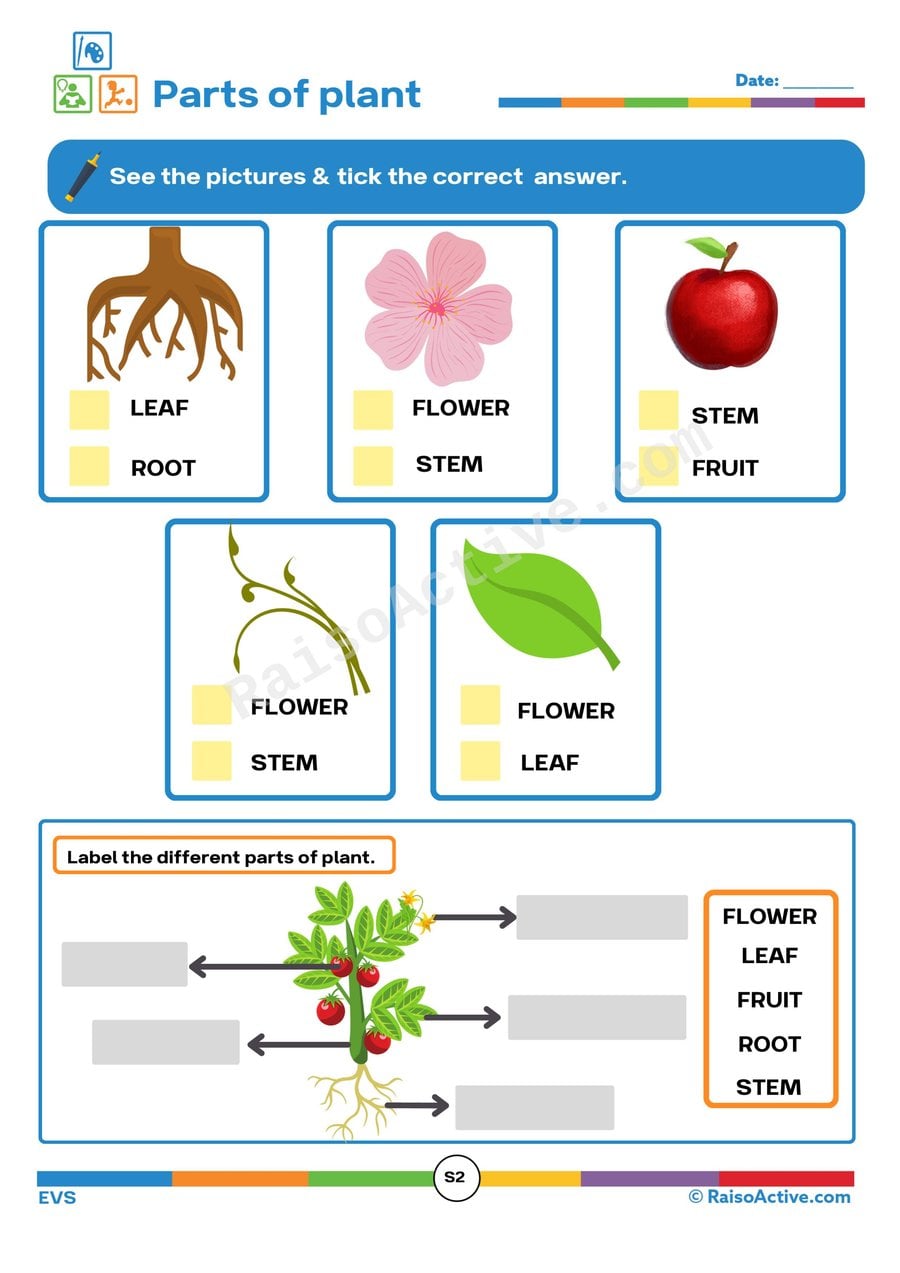
Parts of a Plant Worksheet for Kids
Ages 4-6 · Pre-K–KindergartenAges 4-6 · Reception–Year 1Ages 4-6 · LKG–UKGAges 4-6
This worksheet helps children ages 4-6 identify and label the main parts of a plant — roots, stem, leaves, flower, and fruit — building foundational botany knowledge. Learning to associate each part with its picture and location on a plant diagram develops both vocabulary and an early understanding of plant structure, which supports later lessons on how plants grow and survive.

Cute Rabbit Cut and Paste Worksheet for Preschoolers
Ages 3-5 · Preschool–Pre-KAges 3-5 · Nursery–ReceptionAges 3-5 · Nursery–LKGAges 3-5
Children ages 3-5 practice precise scissor control and gluing as they cut apart separate body-shape pieces and assemble them into a complete rabbit picture, building the fine motor coordination needed for later handwriting. Piecing together separate parts to form a whole also strengthens early spatial reasoning about how shapes fit together.
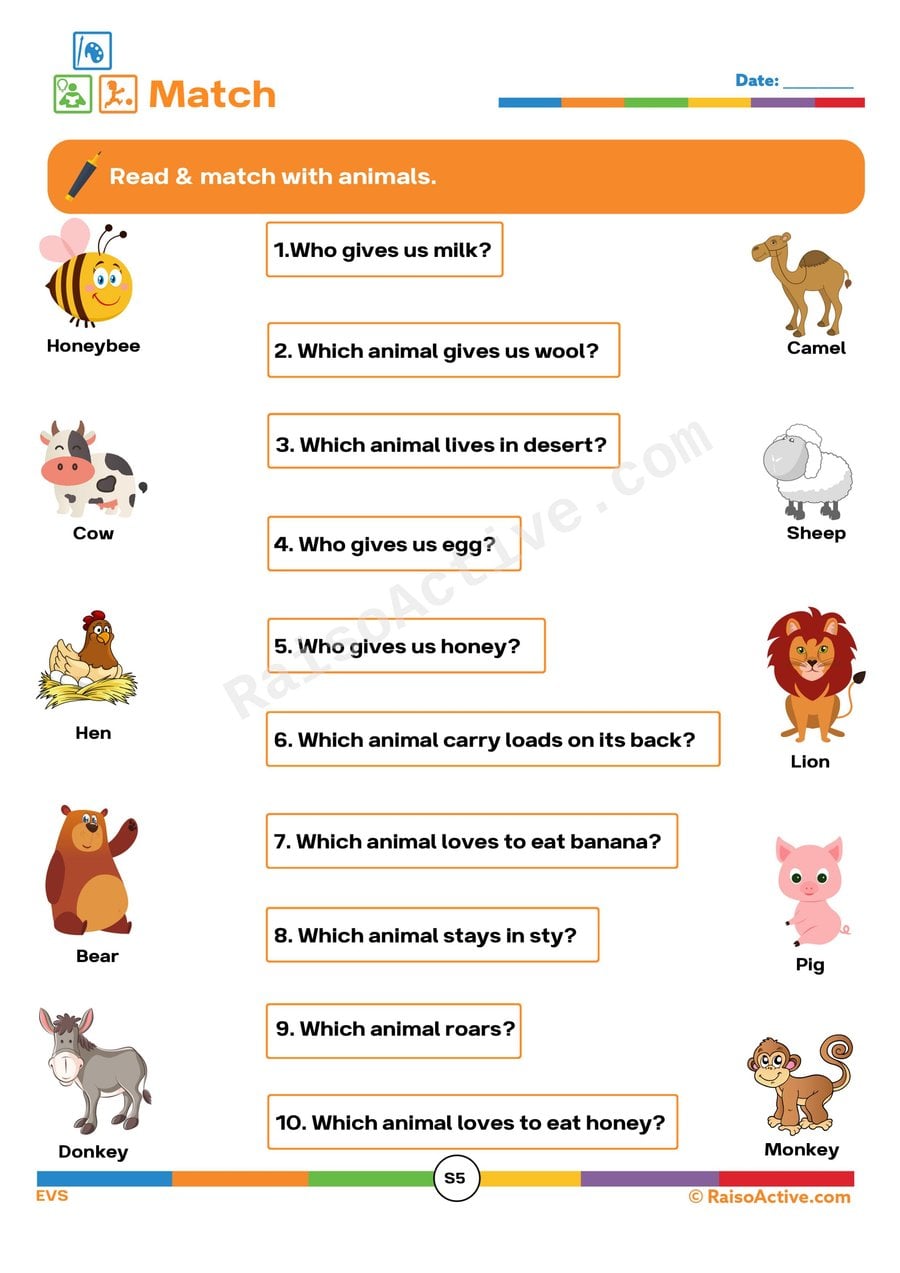
Match the Animals! A Fun Worksheet for Kids
Ages 3-5 · Preschool–Pre-KAges 3-5 · Nursery–ReceptionAges 3-5 · Nursery–LKGAges 3-5
This worksheet helps children ages 3-5 build observation and reasoning skills as they read a simple question or clue about an animal and match it to the correct picture. Rather than matching by appearance alone, children must connect descriptive language to an animal's known characteristics, which strengthens both listening comprehension and early vocabulary about animals.

Vowel Sorting Fun: Identify and Sort Vowels Worksheet
Ages 4-5 · Pre-KAges 4-5 · ReceptionAges 4-5 · LKGAges 4-5
Circling vowels within a word and sorting letters into 'vowels' and 'consonants' columns builds foundational phonics knowledge for children ages 4-5, an essential distinction for later decoding and spelling.
Related worksheets

Parent's Guide: Fun Activities for Blend Words, Addition, and More!
Ages 3-5 · Preschool–Pre-KAges 3-5 · Nursery–ReceptionAges 3-5 · Nursery–LKGAges 3-5
This parent's guide brings together several early-learning skill areas — blend words, addition and subtraction, plant parts, and landforms — into one set of hands-on activities designed for children ages 3-5, giving families a ready toolkit for reinforcing what's covered across the individual worksheets. Rather than another printable page, it offers concrete ways to extend learning through sensory play, flashcards, and conversation, which suits how young children absorb new concepts most naturally. Having a single reference guide also helps parents connect several worksheet topics into one cohesive home-learning routine.

Parent's Guide: Fun Activities for Early Learners!
Ages 3-5 · Preschool–Pre-KAges 3-5 · Nursery–ReceptionAges 3-5 · Nursery–LKGAges 3-5
This parent's guide bundles several short, hands-on activities that build counting, shape recognition, fine motor control, and instruction-following in children ages 3-5. Rather than a single worksheet, it offers a menu of quick learning moments parents can use throughout the day, which suits the short attention spans typical of this age group. Rotating through different skill areas in one sitting also helps parents see which concepts their child grasps easily and which need more practice.

Parent's Guide: Sight Words, Number Order, and Creative Art Activities!
Ages 3-5 · Preschool–Pre-KAges 3-5 · Nursery–ReceptionAges 3-5 · Nursery–LKGAges 3-5
This parent's guide gives families of children ages 3-5 a set of structured activities covering sight word recognition, ascending and descending number order, and open-ended art projects using building blocks. Weaving literacy, math, and creative expression together in one guide reflects how young children actually learn best — through varied, hands-on engagement rather than long stretches of a single skill.
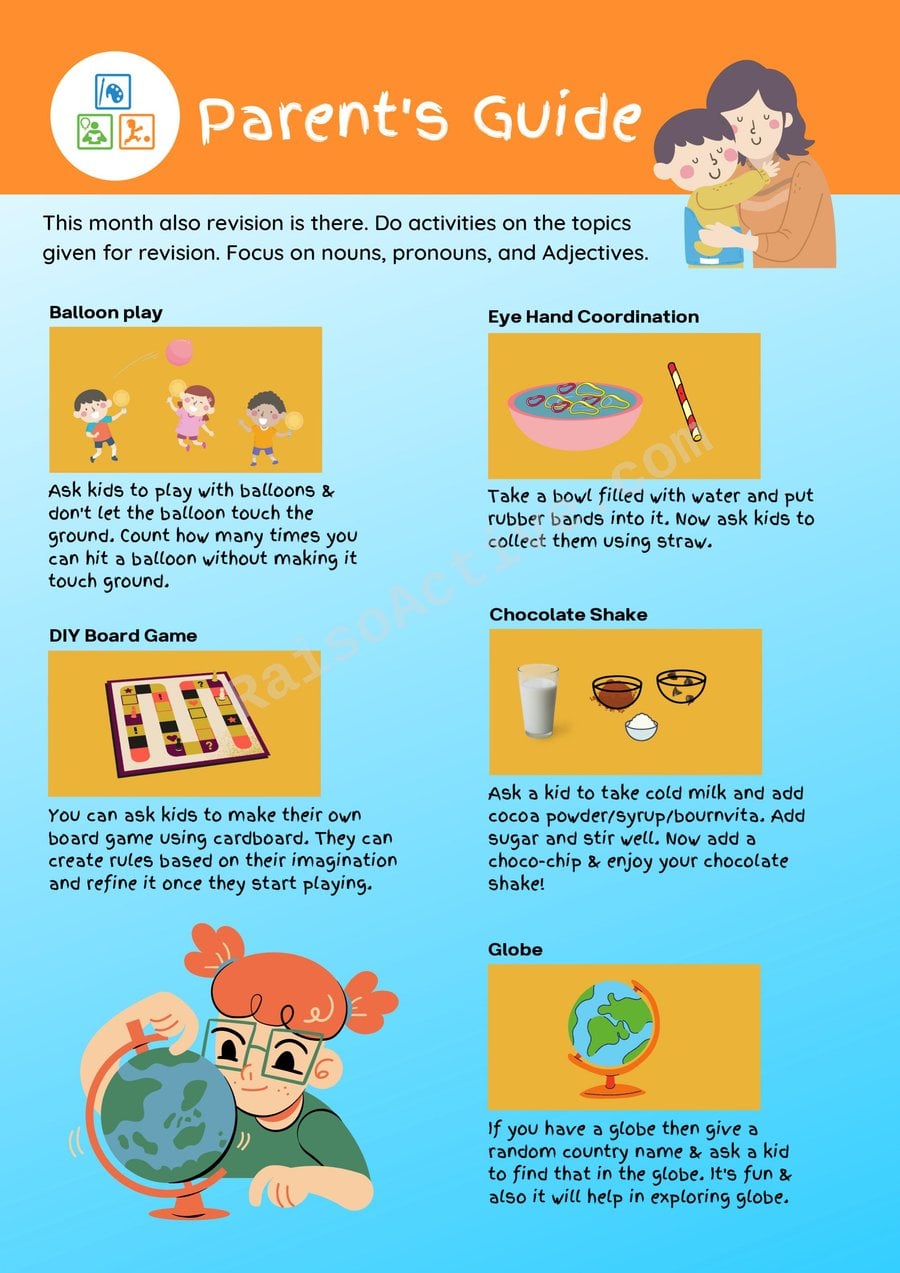
Fun Activities for Early Learners: Parent's Guide
Ages 3-5 · Preschool–Pre-KAges 3-5 · Nursery–ReceptionAges 3-5 · Nursery–LKGAges 3-5
This parent's guide walks through hands-on activities that introduce early grammar concepts — nouns, pronouns, and adjectives — through play rather than worksheets, helping children ages 3-5 absorb language structure naturally before they're ready for formal writing.

Parent's Guide: Fun Activities for Early Learning
Ages 3-5 · Preschool–Pre-KAges 3-5 · Nursery–ReceptionAges 3-5 · Nursery–LKGAges 3-5
This parent guide equips caregivers of children ages 3-5 with structured activity ideas around three early-learning concepts: recognizing the days of the week, identifying patterns, and practicing skip counting. Each activity translates an abstract concept into a hands-on or playful format, since young children learn these ideas best through repetition embedded in daily routines rather than worksheets alone. Covering multiple concepts in one guide also gives caregivers flexibility to pick the activity that fits their child's current interest.
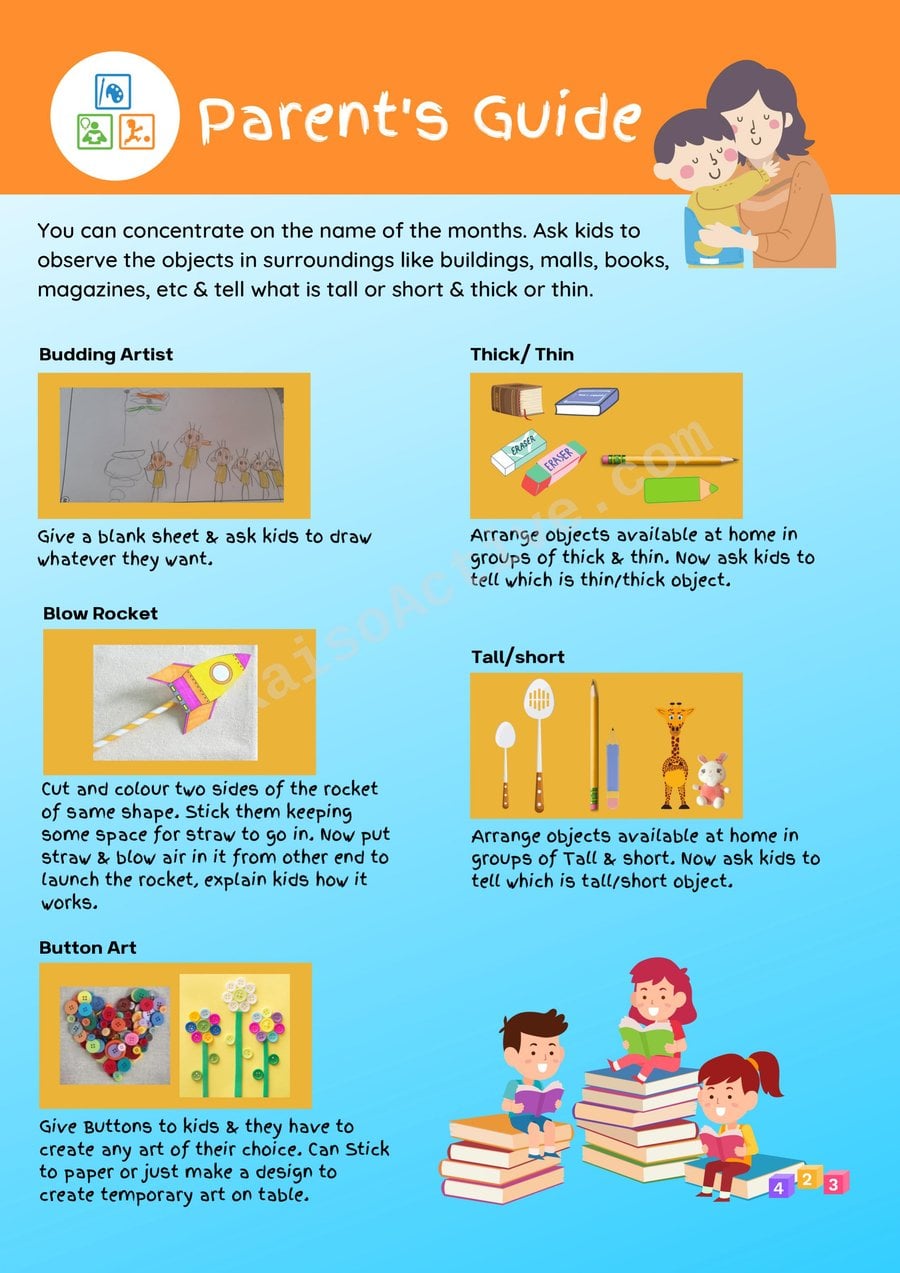
Parent's Guide: Fun Activities for Kids!
Ages 3-5 · Preschool–Pre-KAges 3-5 · Nursery–ReceptionAges 3-5 · Nursery–LKGAges 3-5
This parent's guide bundles several short activities that build early comparison vocabulary - thick versus thin, tall versus short - alongside fine motor practice with buttons and straws and beginning calendar awareness through talking about the months. For children ages 3-5, comparing sizes verbally is an important pre-math skill, while threading buttons onto straws strengthens the pincer grip needed later for writing. Together these activities give a well-rounded session touching language, math, and motor development.
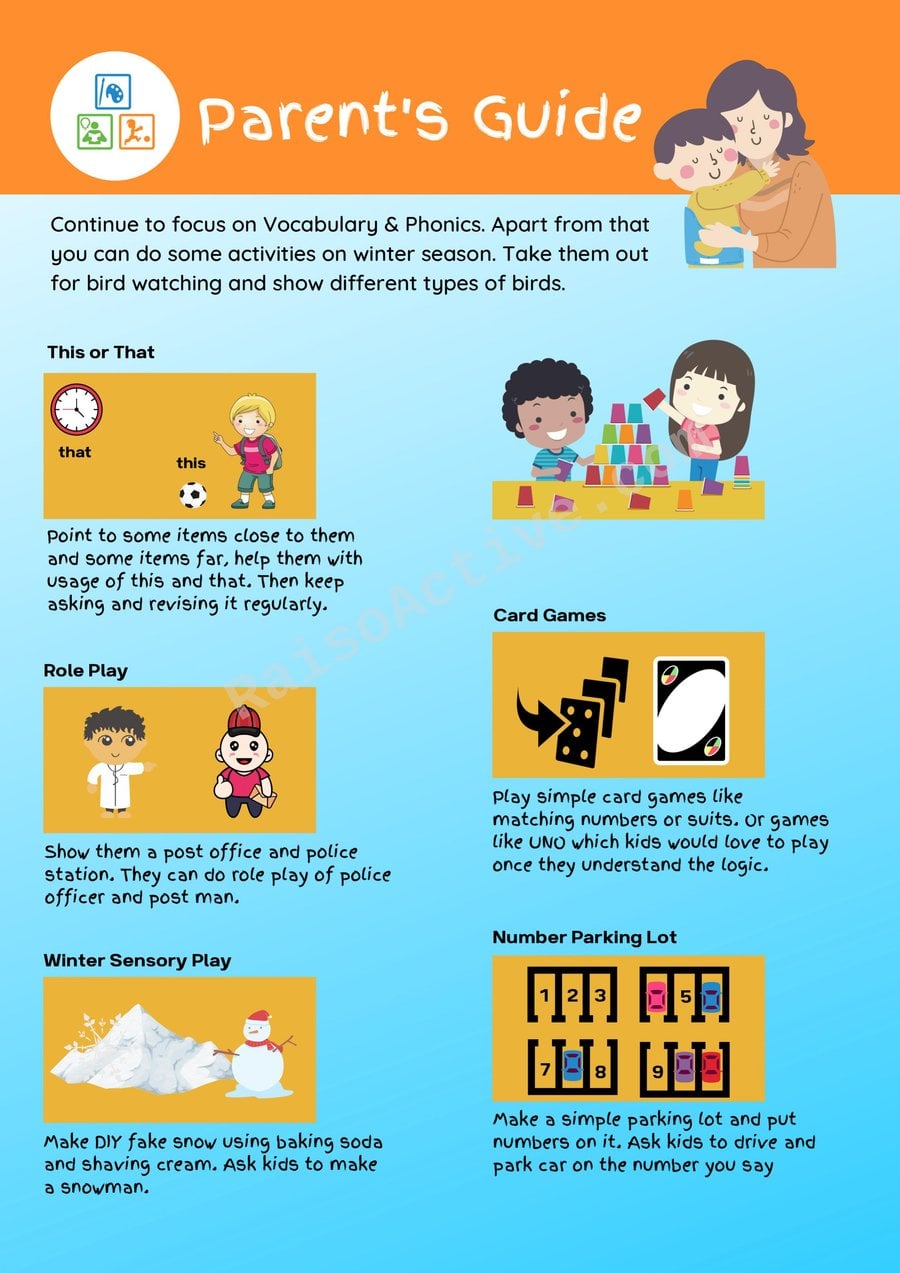
Winter Fun Activities for Kids: Parent's Guide
Ages 3-5 · Preschool–Pre-KAges 3-5 · Nursery–ReceptionAges 3-5 · Nursery–LKGAges 3-5
This parent's guide bundles several short winter-themed activities, from vocabulary games to sensory play, that build language skills, matching ability, and role-play confidence in one seasonal package. For ages 3-5, mixing modalities like talking, sorting, and hands-on sensory exploration keeps engagement high while reinforcing skills across different learning styles.

Parent's Guide: Fun Activities for Early Learning
Ages 3-5 · Preschool–Pre-KAges 3-5 · Nursery–ReceptionAges 3-5 · Nursery–LKGAges 3-5
This parent guide gathers hands-on activities around sentence building, creative art, and basic cooking skills, giving children practice with language, fine motor coordination, and following multi-step directions across very different, engaging contexts. Mixing sensory play like clay and painting with a simple cooking task keeps preschoolers motivated while quietly building vocabulary and sequencing skills.
Guides for this topic

Portfolio Assessment with Young Children: A Comprehensive Guide to Meaningful Documentation
Learn how portfolio assessment captures your child's growth through meaningful documentation. Practical tips, templates, and age-appropriate strategies for ages 1-8.

Age-Appropriate Problem-Solving Activities: Building Critical Thinkers from the Ground Up
Discover fun, age-appropriate problem-solving activities for children ages 1-8. Build critical thinking, logic, and reasoning skills through play-based learning.
Fostering Creativity in Structured Learning: The Perfect Balance for Young Minds
Learn how to blend creativity with structured learning for children ages 1-8. Practical strategies, activities, and printable worksheets for parents and teachers.
Reviews
Every worksheet for ages 3–5, no watermark
Members download the full library of 1,000+ worksheets and every activity pack without watermarks or daily limits. One year costs ₹999 in India or $20 elsewhere.
See membership plansOr download any worksheet free with a watermark (5 a day).