Landforms Worksheet: Identify and Label the Pictures!
Writing the correct name for pictures of mountains, rivers, and other landforms from a word bank builds early science vocabulary and spelling practice for children ages 3-5, connecting a visual image to its written word.
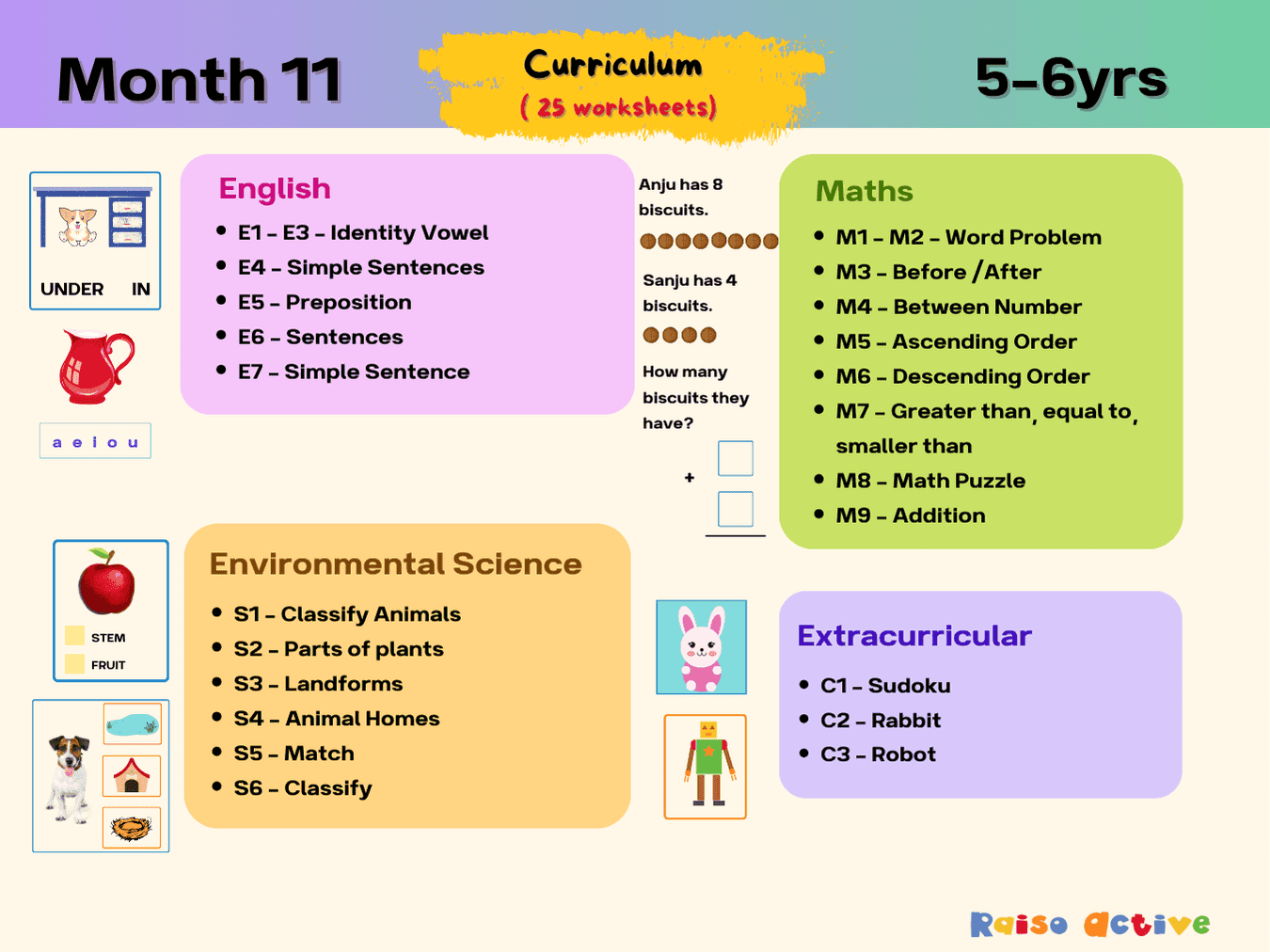
Part of the pack
Month 11: Learning & Development | Ages 5-6
This is page 22 of the pack. Ages 5-6 · KindergartenAges 5-6 · Year 1Ages 5-6 · UKGAges 5-6
Made for your child
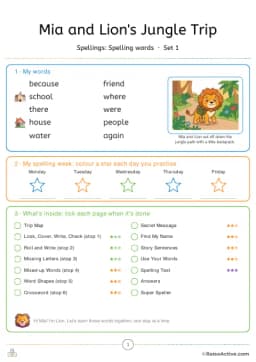
Spelling practice, made for your child
Their own spelling words turned into a pack: trace or look-cover-write-check, roll and write, a secret picture code, a word search, a crossword and a test, with their name in it.
Make a spelling packFree preview · free for members
Or start free: a word search with sight wordsCurriculum
- Earth & Environment > Landforms
How to use this worksheet
Look at the first picture and read the word bank options below it together. Sound out each option and decide which one matches the picture. Have your child write the correct name under the picture, then continue through the remaining landforms, discussing what makes each one unique.
Materials needed
- Pencil
- Eraser
Extension activities
- 1Draw your favorite landform and label it.
- 2Create a diorama of different landforms using clay or craft materials.
- 3Look at photos of real landforms from around the world together.
- 4Take a nature walk and identify any hills, rivers, or other landforms nearby.

Written by
Hemsweta Jain · Teacher Cheena
MBA and Early Childhood Educator, teaching since 2014 · Founder of RaisoActive, Mumbai
Every RaisoActive worksheet is designed and checked by the founder before publishing.
Published · Last reviewed
More from Month 11: Learning & Development | Ages 5-6
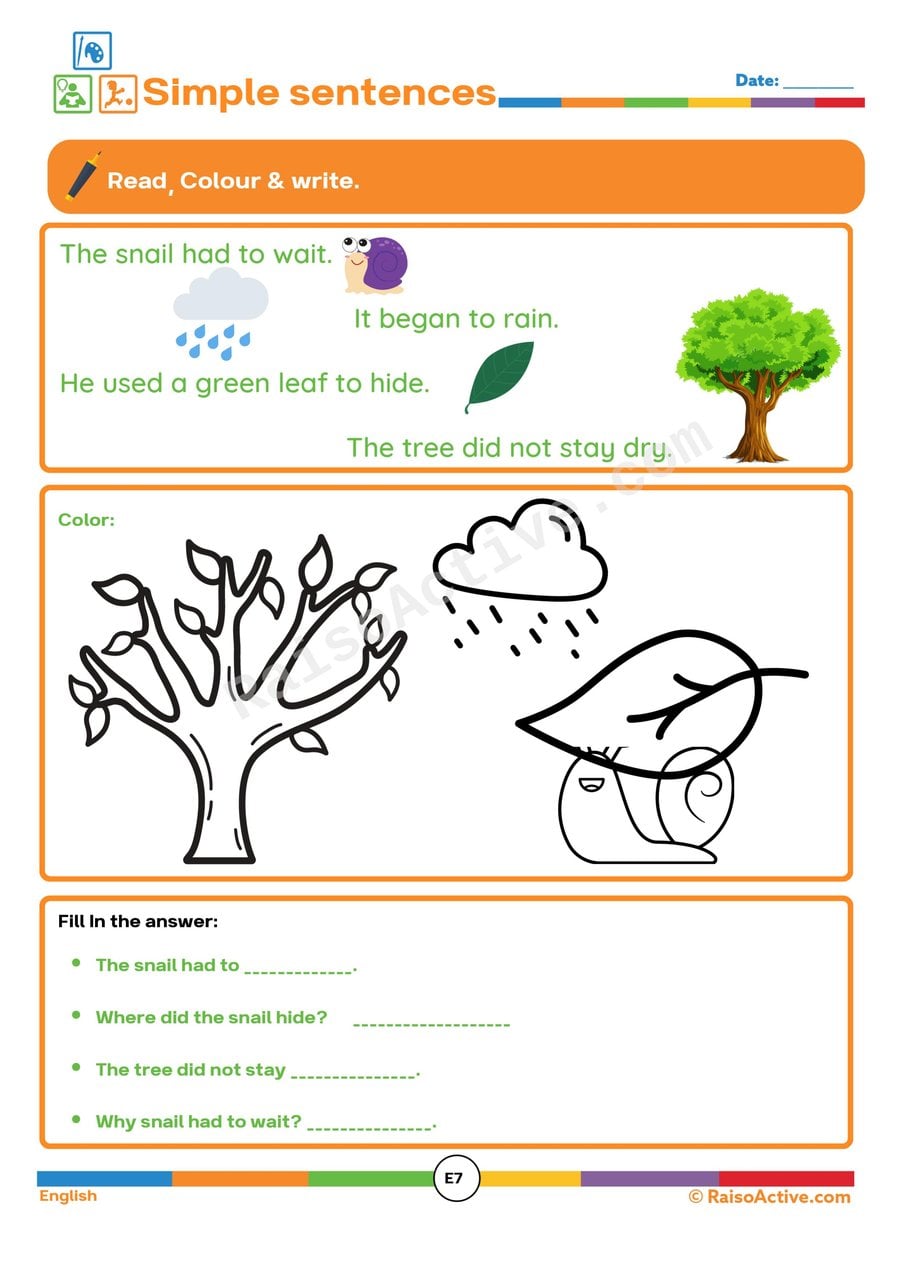
Simple Sentences Worksheet: Read, Color, and Write!
Ages 3-5 · Preschool–Pre-KAges 3-5 · Nursery–ReceptionAges 3-5 · Nursery–LKGAges 3-5
This worksheet combines three literacy skills for children ages 3-5 in one activity: reading short sentences, coloring the pictures that go with them, and filling in a missing word to complete each sentence. Connecting reading, coloring, and writing in a single task reinforces that words carry meaning tied directly to pictures, an important early step toward genuine reading comprehension.

Vowel Sounds Worksheet: Identify and Circle the Correct Vowel!
Ages 4-6 · Pre-K–KindergartenAges 4-6 · Reception–Year 1Ages 4-6 · LKG–UKGAges 4-6
Children ages 4-6 practice identifying vowel sounds within words by looking at a picture, saying its name aloud, and figuring out which vowel they hear, a specific phonics skill that builds toward independent reading and spelling. Isolating the vowel sound in a word is often trickier for children than identifying beginning consonant sounds, making this a meaningful next step in phonics.

Summer Fun: Write Sentences About the Beach! Worksheet
Ages 4-6 · Pre-K–KindergartenAges 4-6 · Reception–Year 1Ages 4-6 · LKG–UKGAges 4-6
Children ages 4-6 practice translating what they observe in a picture into written sentences, a key step in moving from spoken language to independent writing. Describing a beach scene specifically — people swimming, building sandcastles, or playing in the waves — gives children concrete, familiar content to draw on, which makes the jump to writing less intimidating than an open-ended prompt.

Descending Order Balloons Worksheet for Preschoolers
Ages 4-6 · Pre-K–KindergartenAges 4-6 · Reception–Year 1Ages 4-6 · LKG–UKGAges 4-6
This worksheet asks children ages 4-6 to arrange the numbers on a row of balloons from largest to smallest, practicing descending order as a companion skill to the more commonly taught ascending order. Comparing several numbers at once and deciding their relative size builds a flexible sense of number magnitude that supports later skills like rounding and estimation.

Addition Worksheet for Kids: Add Horizontally and Vertically!
Ages 4-6 · Pre-K–KindergartenAges 4-6 · Reception–Year 1Ages 4-6 · LKG–UKGAges 4-6
Children ages 4-6 practice basic addition by solving problems arranged both horizontally, like '3 + 2 =,' and vertically, in a stacked column format, building flexibility with the two most common ways addition problems appear in early math worksheets and textbooks. Learning both formats now means neither will feel unfamiliar once formal school math introduces them side by side.

Vowel Sorting Fun: Identify and Sort Vowels Worksheet
Ages 4-5 · Pre-KAges 4-5 · ReceptionAges 4-5 · LKGAges 4-5
Circling vowels within a word and sorting letters into 'vowels' and 'consonants' columns builds foundational phonics knowledge for children ages 4-5, an essential distinction for later decoding and spelling.

Cute Rabbit Cut and Paste Worksheet for Preschoolers
Ages 3-5 · Preschool–Pre-KAges 3-5 · Nursery–ReceptionAges 3-5 · Nursery–LKGAges 3-5
Children ages 3-5 practice precise scissor control and gluing as they cut apart separate body-shape pieces and assemble them into a complete rabbit picture, building the fine motor coordination needed for later handwriting. Piecing together separate parts to form a whole also strengthens early spatial reasoning about how shapes fit together.

Classify Animals: Cut and Paste Worksheet for Preschoolers
Ages 3-5 · Preschool–Pre-KAges 3-5 · Nursery–ReceptionAges 3-5 · Nursery–LKGAges 3-5
Children ages 3-5 practice classifying animals by their natural habitat, sorting pictures into groups like forest animals and farm animals, building early science reasoning about how different environments support different animals. Combining this classification task with cutting and pasting also strengthens fine motor control.
Related worksheets

Landforms Worksheet: Identify and Circle the Correct Answer!
Ages 4-6 · Pre-K–KindergartenAges 4-6 · Reception–Year 1Ages 4-6 · LKG–UKGAges 4-6
Reading a short description and circling the matching landform picture asks children ages 4-6 to connect written or spoken language directly to a visual feature of the natural world, strengthening both reading comprehension and early geography vocabulary. Because landforms like deserts, hills, and mountains can look somewhat similar in simple illustrations, this task also sharpens careful reading and visual comparison rather than quick guessing. Understanding these terms gives children language to describe landscapes they see in books, on trips, or in nature.

Landforms Worksheet: Identify and Tick the Correct Answer!
Ages 3-5 · Preschool–Pre-KAges 3-5 · Nursery–ReceptionAges 3-5 · Nursery–LKGAges 3-5
Looking at pictures of landforms like volcanoes, glaciers, and islands and choosing the correct name from two options teaches children ages 3-5 early earth science vocabulary while building visual discrimination between different natural features. Because each landform has a distinct silhouette, shape, and texture, children practice careful observation of details, like noticing that a volcano has a cone shape while an island is surrounded by water. This worksheet introduces basic geography concepts in a way that's grounded in pictures rather than abstract explanation.

Landforms Cut and Paste Worksheet for Preschoolers
Ages 3-5 · Preschool–Pre-KAges 3-5 · Nursery–ReceptionAges 3-5 · Nursery–LKGAges 3-5
This worksheet introduces preschoolers to the idea that the Earth's surface takes many different forms — mountains, beaches, islands — and asks them to match a picture of each landform to its name, an early step in geography and classification skills. Sorting pictures by category also reinforces visual discrimination, since children must notice defining features, like water on all sides for an island or a peak for a mountain, rather than relying on color or size alone.

Find and Draw India's Major Rivers Worksheet for Kids
Ages 5-8 · Kindergarten–Grade 2Ages 5-8 · Year 1–Year 3Ages 5-8 · UKG–Class 2Ages 5-8
This activity teaches children ages 5-8 to locate and draw ten of India's major rivers on a blank map, building map-reading skills and geographic memory of the country's physical features. Translating a written list into hand-drawn lines on a map also strengthens the connection between abstract information (a river's name and rough course) and concrete spatial representation.

Landforms Cut and Paste Worksheet for Preschoolers
Ages 3-5 · Preschool–Pre-KAges 3-5 · Nursery–ReceptionAges 3-5 · Nursery–LKGAges 3-5
Sorting pictures into categories like mountains, oceans, and deserts introduces children ages 3-5 to the idea that the Earth's surface has distinct, recognizable features, an early building block of geography and earth science. The cut-and-paste format adds a fine motor challenge on top of the classification task, requiring children to physically separate and place each picture correctly rather than simply pointing. Matching an image to its labeled landform category also builds vocabulary specific to the natural world beyond everyday objects.
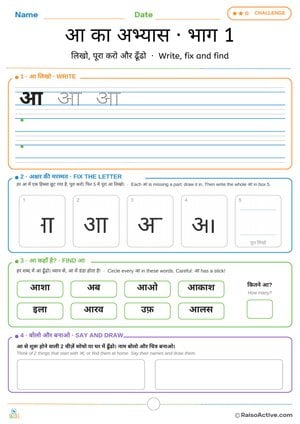
Hindi Letter आ Practice Part 1: Write, Fix and Find | आ का अभ्यास · भाग 1
Ages 3-7 · Preschool–Grade 1Ages 3-7 · Nursery–Year 2Ages 3-7 · Nursery–Class 1Ages 3-7
Children write आ on guide lines, complete four partly drawn letters, circle आ in eight words (while avoiding its look-alike अ), count how many they found, then think of two more words at home that start with आ and draw them.
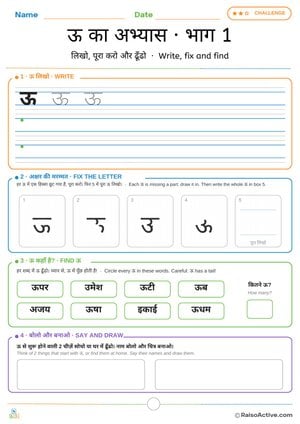
Hindi Letter ऊ Practice Part 1: Write, Fix and Find | ऊ का अभ्यास · भाग 1
Ages 3-7 · Preschool–Grade 1Ages 3-7 · Nursery–Year 2Ages 3-7 · Nursery–Class 1Ages 3-7
Children write ऊ on guide lines, complete four partly drawn letters, circle ऊ in eight words (while avoiding its look-alike उ), count how many they found, then think of two more words at home that start with ऊ and draw them.
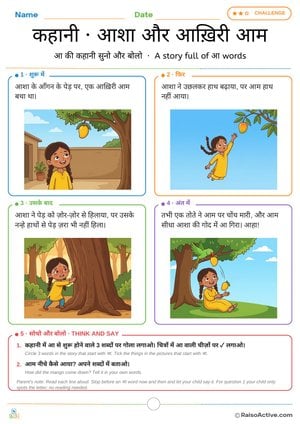
Letter आ Story: Asha and the Last Mango | कहानी आशा और आख़िरी आम
Ages 3-7 · Preschool–Grade 1Ages 3-7 · Nursery–Year 2Ages 3-7 · Nursery–Class 1Ages 3-7
Asha jumps for the last mango on the tree, her hands cannot reach, and a parrot knocks it down into her lap. Children listen, look at the four pictures, spot the words that start with आ and retell what happened in their own words.
Guides for this topic

Sight Words by Age: The First 50 Words and How to Teach Them Without Flashcard Fatigue
Which sight words to teach first and why, the heart-word method, a read-trace-write-find routine, games, and a by-age table of typical sight-word progress.
How to Teach CVC Blending: A Step-by-Step Method That Works in Two Weeks
A step-by-step method for teaching CVC blending, covering continuous sounds, word families, common errors, and a 14-day plan that most children finish reading CVC words.

Documenting Learning Without Drowning in Data: A Practical Guide for Parents and Teachers
Learn practical ways to document your child's learning without overwhelm. Simple portfolios, observation tips, and printable trackers for ages 1-8.
Reviews
Every worksheet for ages 3–5, no watermark
Members download the full library of 1,000+ worksheets and every activity pack without watermarks or daily limits. One year costs ₹999 in India or $20 elsewhere.
See membership plansOr download any worksheet free with a watermark (5 a day).