Simple Sentences Worksheet: Read, Color, and Write!
This worksheet combines three literacy skills for children ages 3-5 in one activity: reading short sentences, coloring the pictures that go with them, and filling in a missing word to complete each sentence. Connecting reading, coloring, and writing in a single task reinforces that words carry meaning tied directly to pictures, an important early step toward genuine reading comprehension.
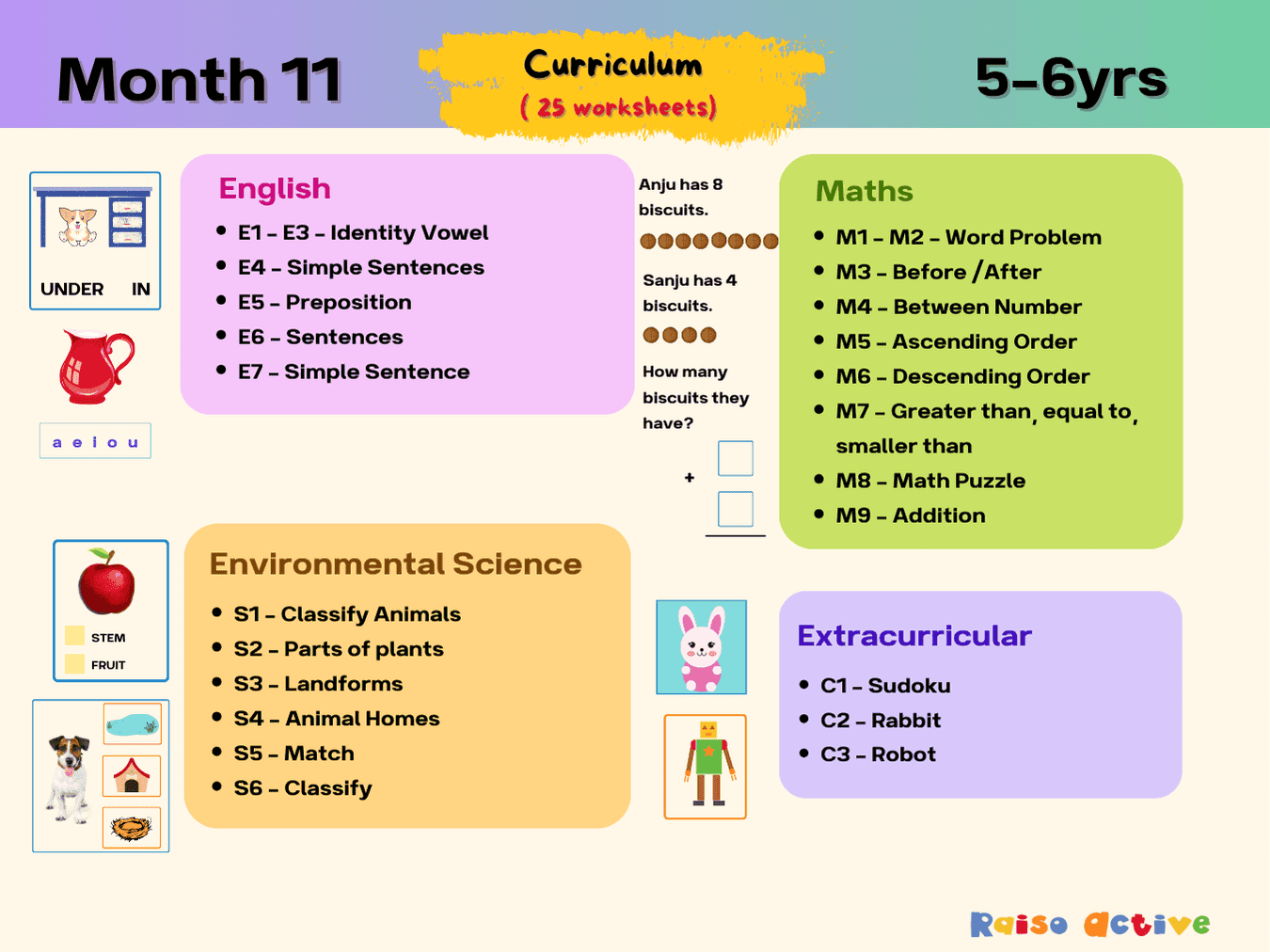
Part of the pack
Month 11: Learning & Development | Ages 5-6
This is page 10 of the pack. Ages 5-6 · KindergartenAges 5-6 · Year 1Ages 5-6 · UKGAges 5-6
Made for your child
Spelling practice, made for your child
Their own spelling words turned into a pack: trace or look-cover-write-check, roll and write, a secret picture code, a word search, a crossword and a test, with their name in it.
Make a spelling packFree preview · free for members
Or start free: a word search with sight wordsCurriculum
- Fluency > Sentence Reading
How to use this worksheet
Read each sentence aloud with your child first, pointing to each word as you say it. Let your child color the accompanying picture, using it as a clue for the missing word in the sentence below. Sound out the missing word together and have your child write it in the blank, then read the completed sentence aloud one more time to check that it makes sense. Work through the sentences one at a time rather than coloring the whole page before doing any writing.
Materials needed
- Pencil
- Crayons or colored pencils
Extension activities
- 1Have your child draw their own picture to match one of the completed sentences.
- 2Ask your child to make up a new simple sentence about the picture, different from the one on the page.
- 3Cover the missing word and see if your child can guess it just from the picture clue.
- 4Create a matching set of picture cards and sentence strips to mix and match at home.

Written by
Hemsweta Jain · Teacher Cheena
MBA and Early Childhood Educator, teaching since 2014 · Founder of RaisoActive, Mumbai
Every RaisoActive worksheet is designed and checked by the founder before publishing.
Published · Last reviewed
More from Month 11: Learning & Development | Ages 5-6
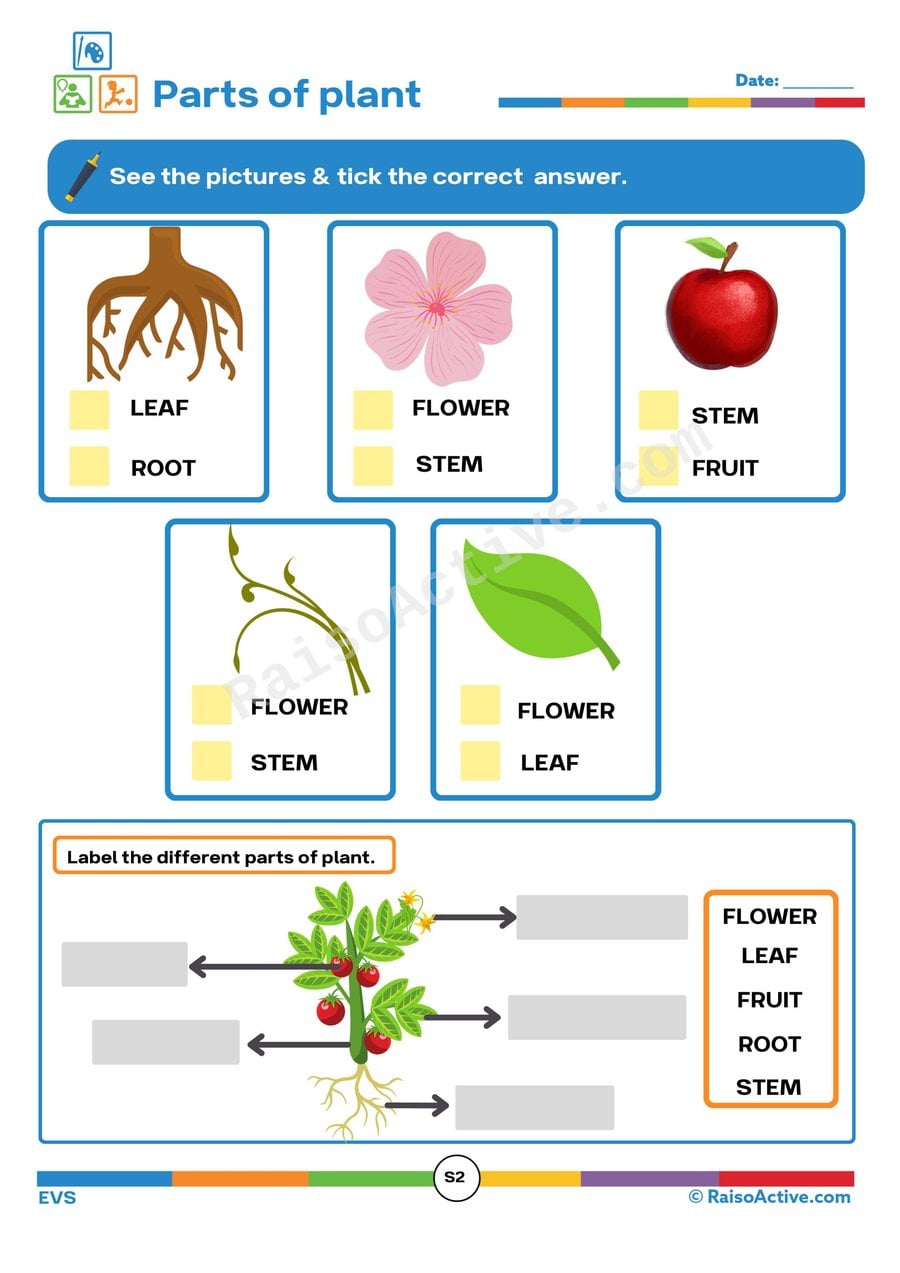
Parts of a Plant Worksheet for Kids
Ages 4-6 · Pre-K–KindergartenAges 4-6 · Reception–Year 1Ages 4-6 · LKG–UKGAges 4-6
This worksheet helps children ages 4-6 identify and label the main parts of a plant — roots, stem, leaves, flower, and fruit — building foundational botany knowledge. Learning to associate each part with its picture and location on a plant diagram develops both vocabulary and an early understanding of plant structure, which supports later lessons on how plants grow and survive.

Fun Activities for Kids: Puppet Shows, Lemonade, and More!
Ages 3-5 · Preschool–Pre-KAges 3-5 · Nursery–ReceptionAges 3-5 · Nursery–LKGAges 3-5
This parent's guide offers a set of varied hands-on activities for children ages 3-5, including a puppet show, an eye-hand coordination game, and homemade lemonade, that together build sentence framing, listening comprehension, and physical coordination. Combining storytelling, a sensory cooking task, and a physical game keeps learning active and multi-sensory rather than confined to a worksheet.

Descending Order Balloons Worksheet for Preschoolers
Ages 4-6 · Pre-K–KindergartenAges 4-6 · Reception–Year 1Ages 4-6 · LKG–UKGAges 4-6
This worksheet asks children ages 4-6 to arrange the numbers on a row of balloons from largest to smallest, practicing descending order as a companion skill to the more commonly taught ascending order. Comparing several numbers at once and deciding their relative size builds a flexible sense of number magnitude that supports later skills like rounding and estimation.

Cute Rabbit Cut and Paste Worksheet for Preschoolers
Ages 3-5 · Preschool–Pre-KAges 3-5 · Nursery–ReceptionAges 3-5 · Nursery–LKGAges 3-5
Children ages 3-5 practice precise scissor control and gluing as they cut apart separate body-shape pieces and assemble them into a complete rabbit picture, building the fine motor coordination needed for later handwriting. Piecing together separate parts to form a whole also strengthens early spatial reasoning about how shapes fit together.

Addition Worksheet for Kids: Add Horizontally and Vertically!
Ages 4-6 · Pre-K–KindergartenAges 4-6 · Reception–Year 1Ages 4-6 · LKG–UKGAges 4-6
Children ages 4-6 practice basic addition by solving problems arranged both horizontally, like '3 + 2 =,' and vertically, in a stacked column format, building flexibility with the two most common ways addition problems appear in early math worksheets and textbooks. Learning both formats now means neither will feel unfamiliar once formal school math introduces them side by side.

Math Puzzle: Cut and Paste Addition and Subtraction Worksheet
Ages 4-6 · Pre-K–KindergartenAges 4-6 · Reception–Year 1Ages 4-6 · LKG–UKGAges 4-6
Solving addition and subtraction problems and matching each answer to its correct puzzle piece builds calculation fluency alongside visual matching skills for children ages 4-6, turning practice into a self-checking puzzle format.

Vowel Sounds Worksheet: Identify and Circle the Correct Vowel!
Ages 4-6 · Pre-K–KindergartenAges 4-6 · Reception–Year 1Ages 4-6 · LKG–UKGAges 4-6
Children ages 4-6 practice identifying vowel sounds within words by looking at a picture, saying its name aloud, and figuring out which vowel they hear, a specific phonics skill that builds toward independent reading and spelling. Isolating the vowel sound in a word is often trickier for children than identifying beginning consonant sounds, making this a meaningful next step in phonics.

Simple Sentences Worksheet: Rewriting Sentences for Early Readers
Ages 4-6 · Pre-K–KindergartenAges 4-6 · Reception–Year 1Ages 4-6 · LKG–UKGAges 4-6
Children ages 4-6 practice sentence construction by rearranging scrambled words into a grammatically correct, meaningful sentence, building an understanding of proper word order in English. This hands-on rearranging task teaches children to recognize where a sentence's subject, action, and details belong, a skill they'll use in all future writing.
Related worksheets
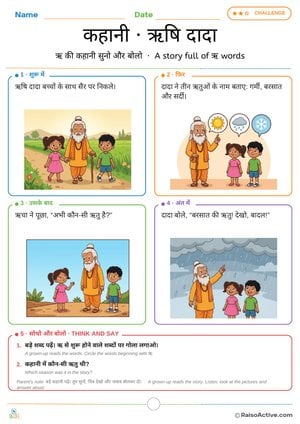
Hindi Story: Rishi Dada and the Three Seasons – Letter ऋ (ri) Sounds | कहानी ऋषि दादा
Ages 3-7 · Preschool–Grade 1Ages 3-7 · Nursery–Year 2Ages 3-7 · Nursery–Class 1Ages 3-7
A four-scene picture story: Rishi Dada takes two children for a walk, names the summer, rainy and winter seasons, and Richa asks which season it is now. Children listen, look at the pictures, spot the ऋ words and answer two think-and-say questions, including which season it was in the story.
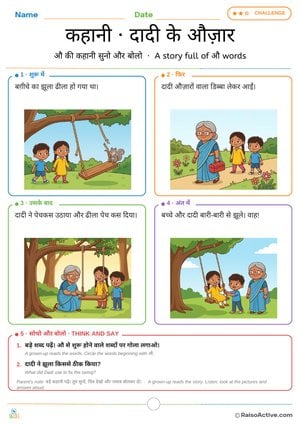
Hindi Story: Dadi ke Aujaar (Grandma's Tools) – Letter औ (au) Sounds | कहानी दादी के औज़ार
Ages 3-7 · Preschool–Grade 1Ages 3-7 · Nursery–Year 2Ages 3-7 · Nursery–Class 1Ages 3-7
A four-scene picture story: The garden swing is loose, Dadi arrives with a box of tools, tightens the screws, and everyone takes turns to swing. Children listen, look at the pictures, spot the औ words and answer two think-and-say questions, including what Dadi used to fix the swing.

Vijayadashami Challenge: Vidyarambham, Dussehra and Calendar Maths
Ages 7-11 · Grade 2–Grade 3Ages 7-11 · Year 3–Year 4Ages 7-11 · Class 2–Class 3Ages 7-11
Children read about Saraswati, Vidyarambham and Dussehra. They time themselves writing letters in a rice tray and draw a bar chart, plan reading a 60-page book with division, remainders and calendar dates, and multiply and use fractions with Ravana figures.
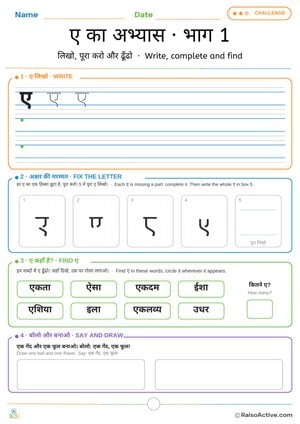
Hindi Letter ए (e) Practice 1: Write, Fix the Letter and Find | ए का अभ्यास · भाग 1
Ages 4-7 · Pre-K–Grade 1Ages 4-7 · Reception–Year 2Ages 4-7 · LKG–Class 1Ages 4-7
A challenge page: write ए between the lines, complete four letters that are each missing a part and then write the whole ए in box 5, find ए in words such as एकता, एकदम, एशिया and एकलव्य, and draw a picture. ए is not the short form of ऐ; the practice page keeps them apart.
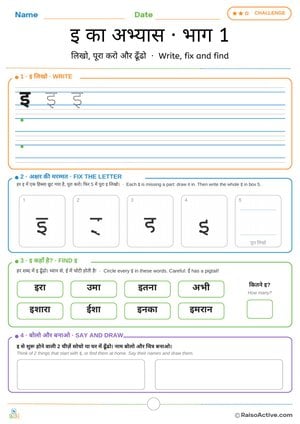
Hindi Letter इ Practice Part 1: Write, Fix and Find | इ का अभ्यास · भाग 1
Ages 3-7 · Preschool–Grade 1Ages 3-7 · Nursery–Year 2Ages 3-7 · Nursery–Class 1Ages 3-7
Children write इ on guide lines, complete four partly drawn letters, circle इ in eight words (while avoiding its look-alike ई), count how many they found, then think of two more words at home that start with इ and draw them.
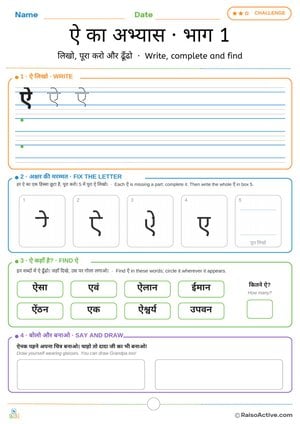
Hindi Letter ऐ (ai) Practice 1: Write, Fix the Letter and Find | ऐ का अभ्यास · भाग 1
Ages 4-7 · Pre-K–Grade 1Ages 4-7 · Reception–Year 2Ages 4-7 · LKG–Class 1Ages 4-7
A challenge page: write ऐ between the lines, complete four letters that are each missing a part and then write the whole ऐ in box 5, find ऐ in words such as ऐसा, ऐलान, ऐंठन and ऐश्वर्य, and draw a picture. ऐ is a different vowel from ए, not a long version of it.
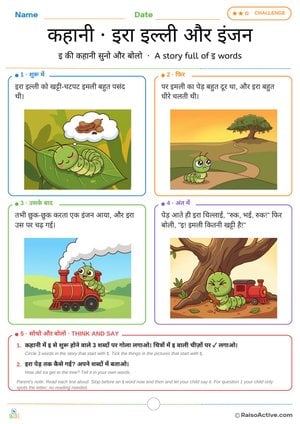
Letter इ Story: Ira Illi and the Engine | कहानी इरा इल्ली और इंजन
Ages 3-7 · Preschool–Grade 1Ages 3-7 · Nursery–Year 2Ages 3-7 · Nursery–Class 1Ages 3-7
Ira the caterpillar loves sour tamarind but the tree is far away, until a chugging engine carries her there. Children listen, look at the four pictures, spot the words that start with इ and retell what happened in their own words.
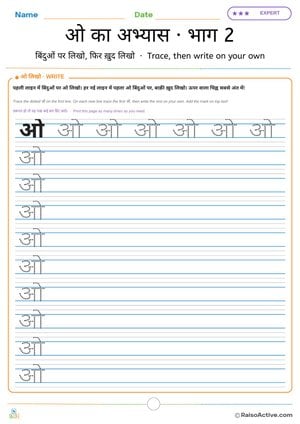
Hindi Letter ओ (o) Practice 2: Trace, then Write on Your Own | ओ का अभ्यास · भाग 2
Ages 5-7 · Kindergarten–Grade 1Ages 5-7 · Year 1–Year 2Ages 5-7 · UKG–Class 1Ages 5-7
An expert page for confident writers: trace the dotted ओ on the first line, then on each new line trace the first ओ and write the rest on your own, adding the mark on top last.
Guides for this topic

Documenting Learning Without Drowning in Data: A Practical Guide for Parents and Teachers
Learn practical ways to document your child's learning without overwhelm. Simple portfolios, observation tips, and printable trackers for ages 1-8.

How to Help Your Child with Letter Reversals: A Complete Guide for Parents and Teachers
Letter reversals are normal until age 7-8. Learn the best multisensory strategies, anchor letter tricks, and activities to help children write b, d, p, and q correctly.
What's the Best Way to Teach Sight Words? A Complete Guide for Parents and Teachers
Discover the most effective methods to teach sight words to young children — flashcards, games, Dolch vs Fry lists, rainbow writing, and how to combine them with phonics.
Reviews
Every worksheet for ages 3–5, no watermark
Members download the full library of 1,000+ worksheets and every activity pack without watermarks or daily limits. One year costs ₹999 in India or $20 elsewhere.
See membership plansOr download any worksheet free with a watermark (5 a day).