Descending Order Balloons Worksheet for Preschoolers
This worksheet asks children ages 4-6 to arrange the numbers on a row of balloons from largest to smallest, practicing descending order as a companion skill to the more commonly taught ascending order. Comparing several numbers at once and deciding their relative size builds a flexible sense of number magnitude that supports later skills like rounding and estimation.
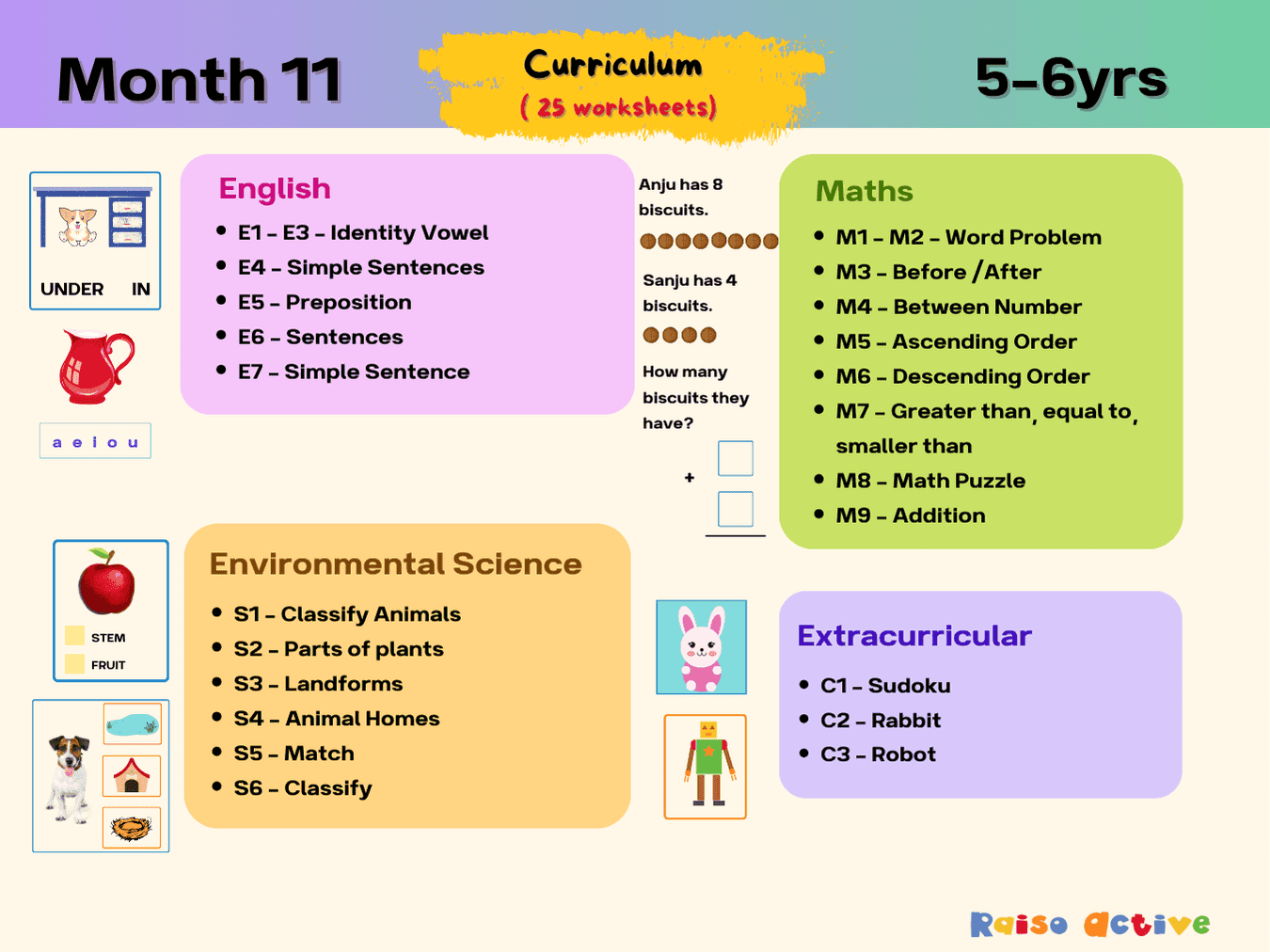
Part of the pack
Month 11: Learning & Development | Ages 5-6
This is page 16 of the pack. Ages 5-6 · KindergartenAges 5-6 · Year 1Ages 5-6 · UKGAges 5-6
Made for your child
Counting to 10, made for your child
A maths pack with your child's name in it: pictures that explain, practice at three levels, puzzles and story sums about them. Print a new set whenever they finish.
Make a maths packFree preview · free for members
Curriculum
- Number Sense > Number Sequencing
How to use this worksheet
Look at the numbers written on the balloons in one row and read them aloud together first. Ask your child which number is the biggest, and have them write it first in the empty spaces, then work down to the smallest number last. Repeat this process for each row of balloons, encouraging your child to double-check their order by reading the finished sequence aloud from largest to smallest before moving on.
Materials needed
- Pencil
- Crayons
Extension activities
- 1Write a set of numbers on sticky notes and have your child physically arrange them from largest to smallest on a table.
- 2Use a stack of building blocks with numbers written on them and order the stack from biggest to smallest number.
- 3Play a card game where each player compares two number cards and says which one is bigger.
- 4Line up family members by height and connect the idea to ordering numbers from biggest to smallest.

Written by
Hemsweta Jain · Teacher Cheena
MBA and Early Childhood Educator, teaching since 2014 · Founder of RaisoActive, Mumbai
Every RaisoActive worksheet is designed and checked by the founder before publishing.
Published · Last reviewed
More from Month 11: Learning & Development | Ages 5-6
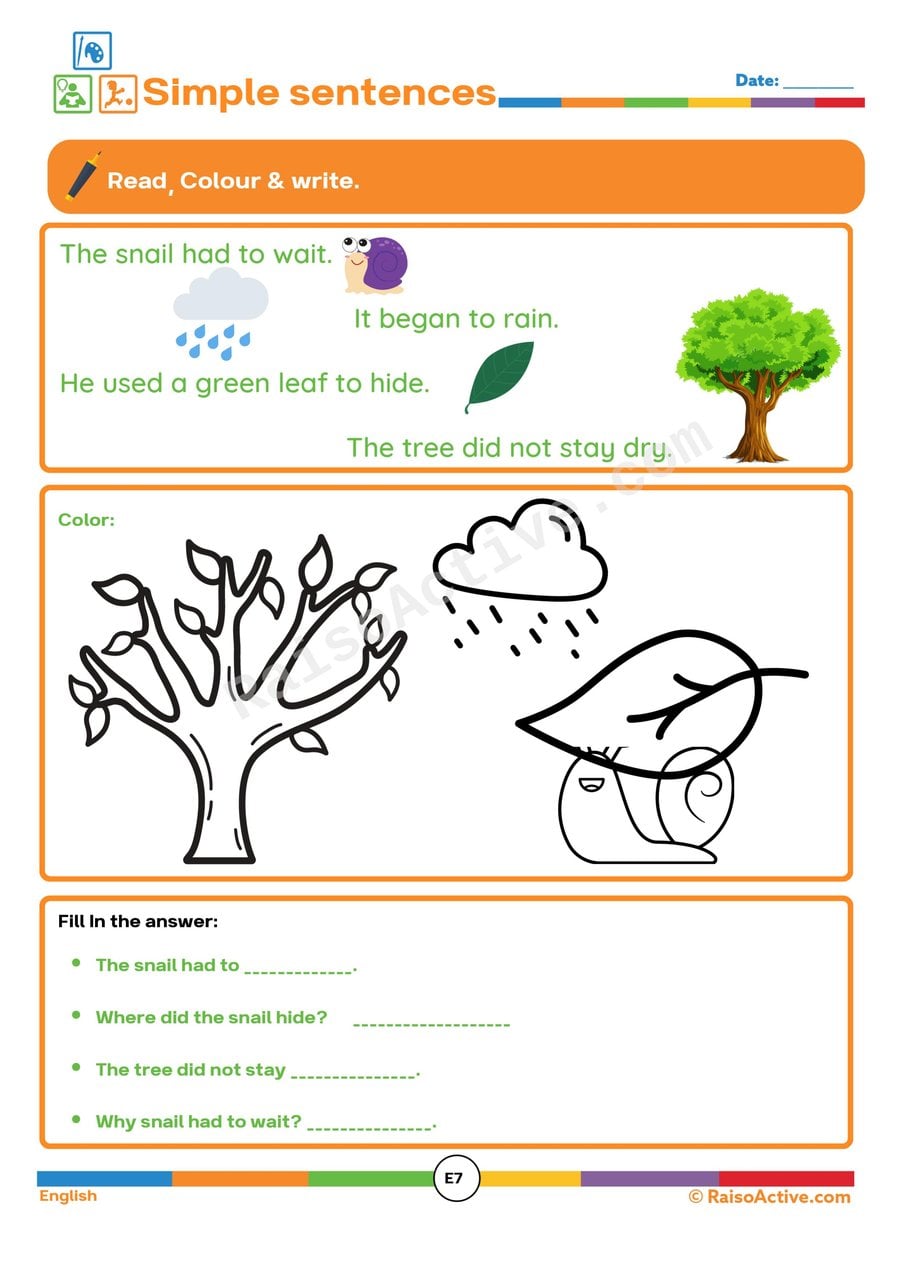
Simple Sentences Worksheet: Read, Color, and Write!
Ages 3-5 · Preschool–Pre-KAges 3-5 · Nursery–ReceptionAges 3-5 · Nursery–LKGAges 3-5
This worksheet combines three literacy skills for children ages 3-5 in one activity: reading short sentences, coloring the pictures that go with them, and filling in a missing word to complete each sentence. Connecting reading, coloring, and writing in a single task reinforces that words carry meaning tied directly to pictures, an important early step toward genuine reading comprehension.
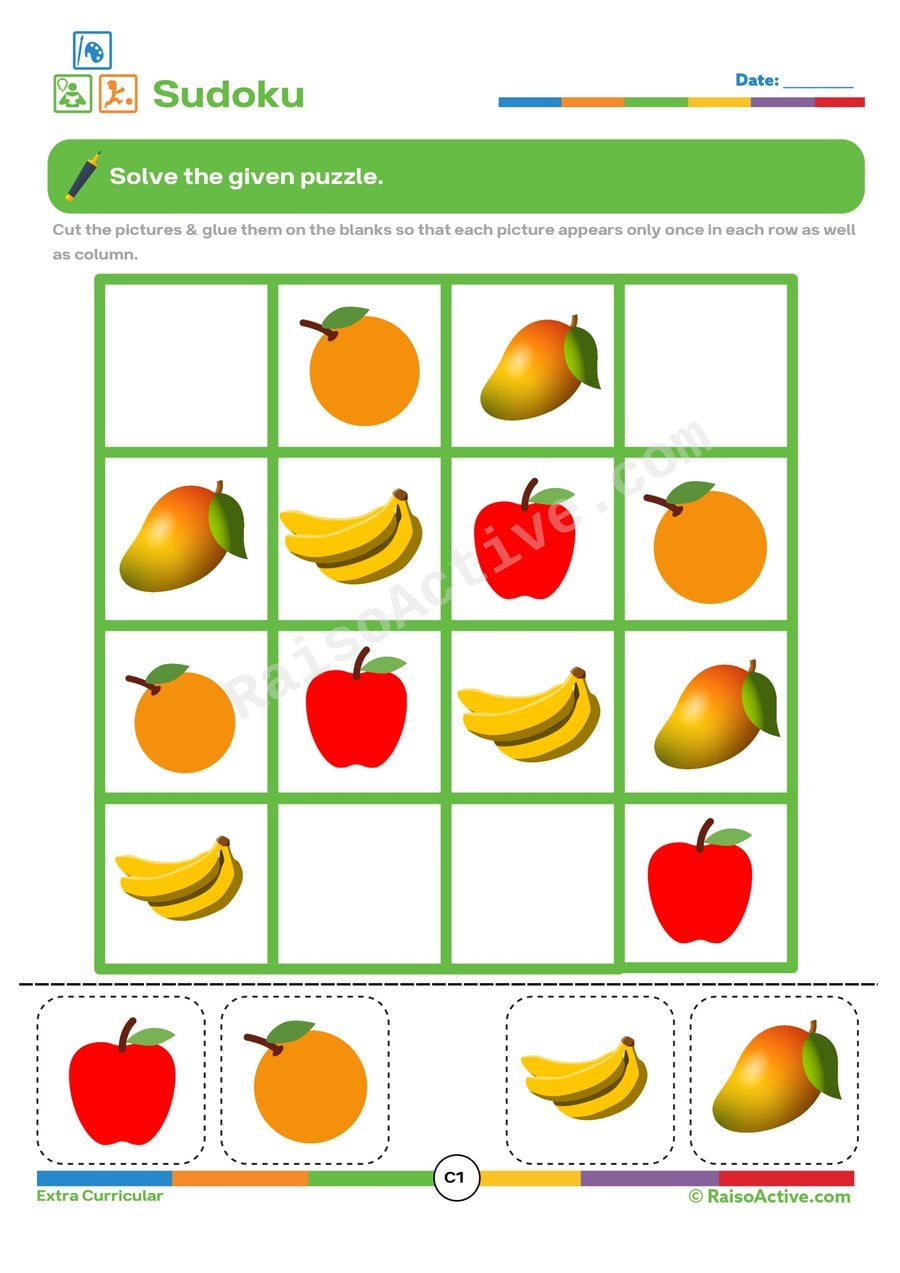
Fruit Sudoku Puzzle Worksheet for Kids
Ages 4-6 · Pre-K–KindergartenAges 4-6 · Reception–Year 1Ages 4-6 · LKG–UKGAges 4-6
Completing a fruit-themed Sudoku grid builds early logical reasoning for children ages 4-6, requiring them to track which fruits are already placed in a row or column and deduce which one is missing — a foundational problem-solving skill.

Shape Robot Cut and Paste Worksheet for Preschoolers
Ages 3-5 · Preschool–Pre-KAges 3-5 · Nursery–ReceptionAges 3-5 · Nursery–LKGAges 3-5
Cutting out shapes and gluing them into place to build a robot reinforces shape recognition alongside fine motor and spatial-assembly skills for children ages 3-5, since each piece must be matched by both its form and its position.

Before and After Numbers Worksheet for Preschoolers
Ages 4-5 · Pre-KAges 4-5 · ReceptionAges 4-5 · LKGAges 4-5
This worksheet builds number sequencing skills in children ages 4-5 by asking them to figure out which number comes immediately before and immediately after a given number. Understanding a number's position relative to its neighbors is an essential precursor to skip counting, addition, and subtraction, since it trains children to think of numbers as an ordered line rather than isolated symbols.

Vowel Sorting Fun: Identify and Sort Vowels Worksheet
Ages 4-5 · Pre-KAges 4-5 · ReceptionAges 4-5 · LKGAges 4-5
Circling vowels within a word and sorting letters into 'vowels' and 'consonants' columns builds foundational phonics knowledge for children ages 4-5, an essential distinction for later decoding and spelling.

Summer Fun: Write Sentences About the Beach! Worksheet
Ages 4-6 · Pre-K–KindergartenAges 4-6 · Reception–Year 1Ages 4-6 · LKG–UKGAges 4-6
Children ages 4-6 practice translating what they observe in a picture into written sentences, a key step in moving from spoken language to independent writing. Describing a beach scene specifically — people swimming, building sandcastles, or playing in the waves — gives children concrete, familiar content to draw on, which makes the jump to writing less intimidating than an open-ended prompt.
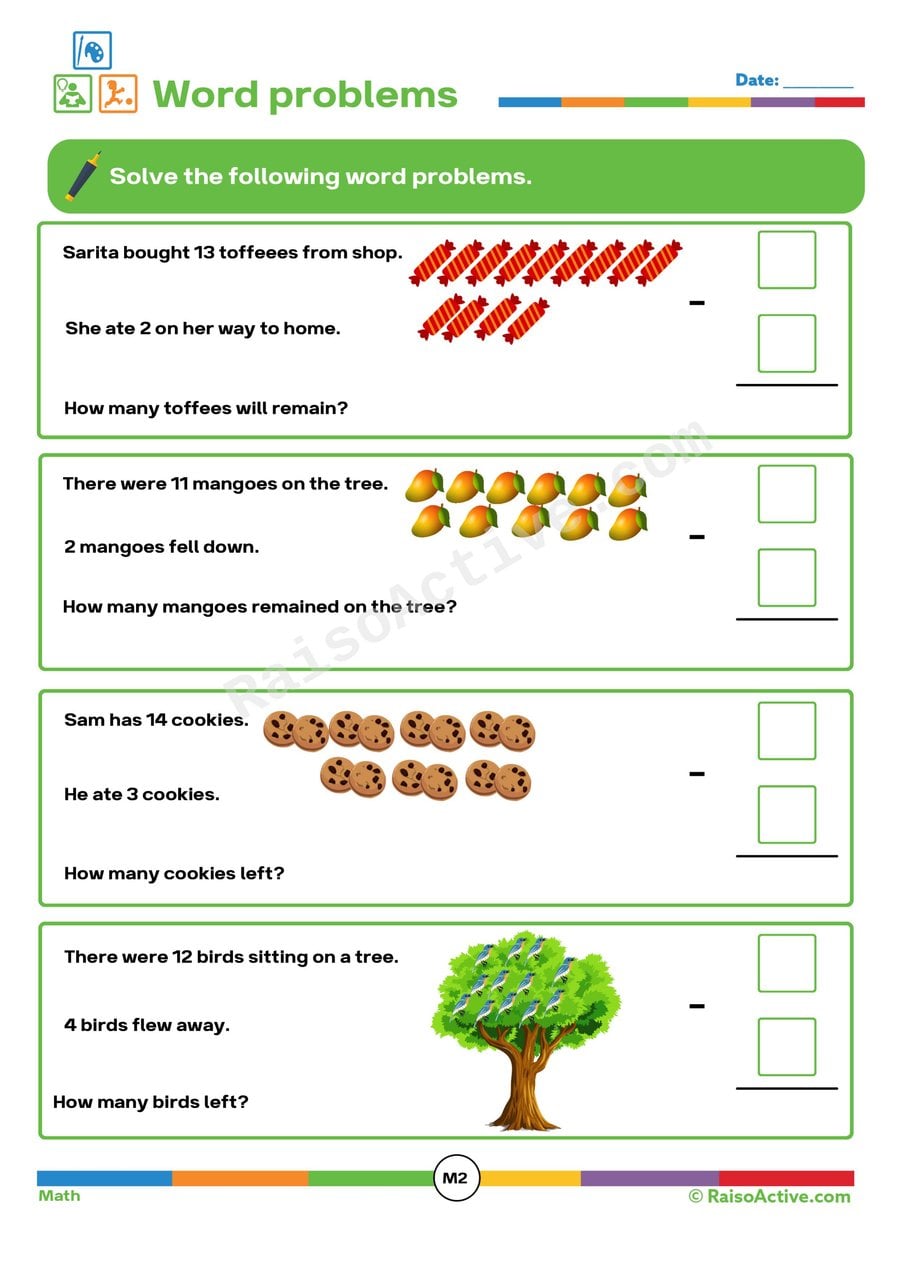
Word Problems Worksheet for Early Learners
Ages 4-6 · Pre-K–KindergartenAges 4-6 · Reception–Year 1Ages 4-6 · LKG–UKGAges 4-6
Children ages 4-6 practice applying subtraction to real-life scenarios by reading short word problems and figuring out how many items remain after some are taken away, connecting basic subtraction facts to reading comprehension. Translating a written story into a subtraction problem is a more advanced skill than solving bare number sentences, since it requires understanding what the story is actually asking.

Animal Homes Worksheet: Circle the Correct Answer!
Ages 3-5 · Preschool–Pre-KAges 3-5 · Nursery–ReceptionAges 3-5 · Nursery–LKGAges 3-5
Matching an animal to its correct home among three picture choices builds science classification skills for children ages 3-5, introducing the idea that different animals are suited to different environments.
Related worksheets
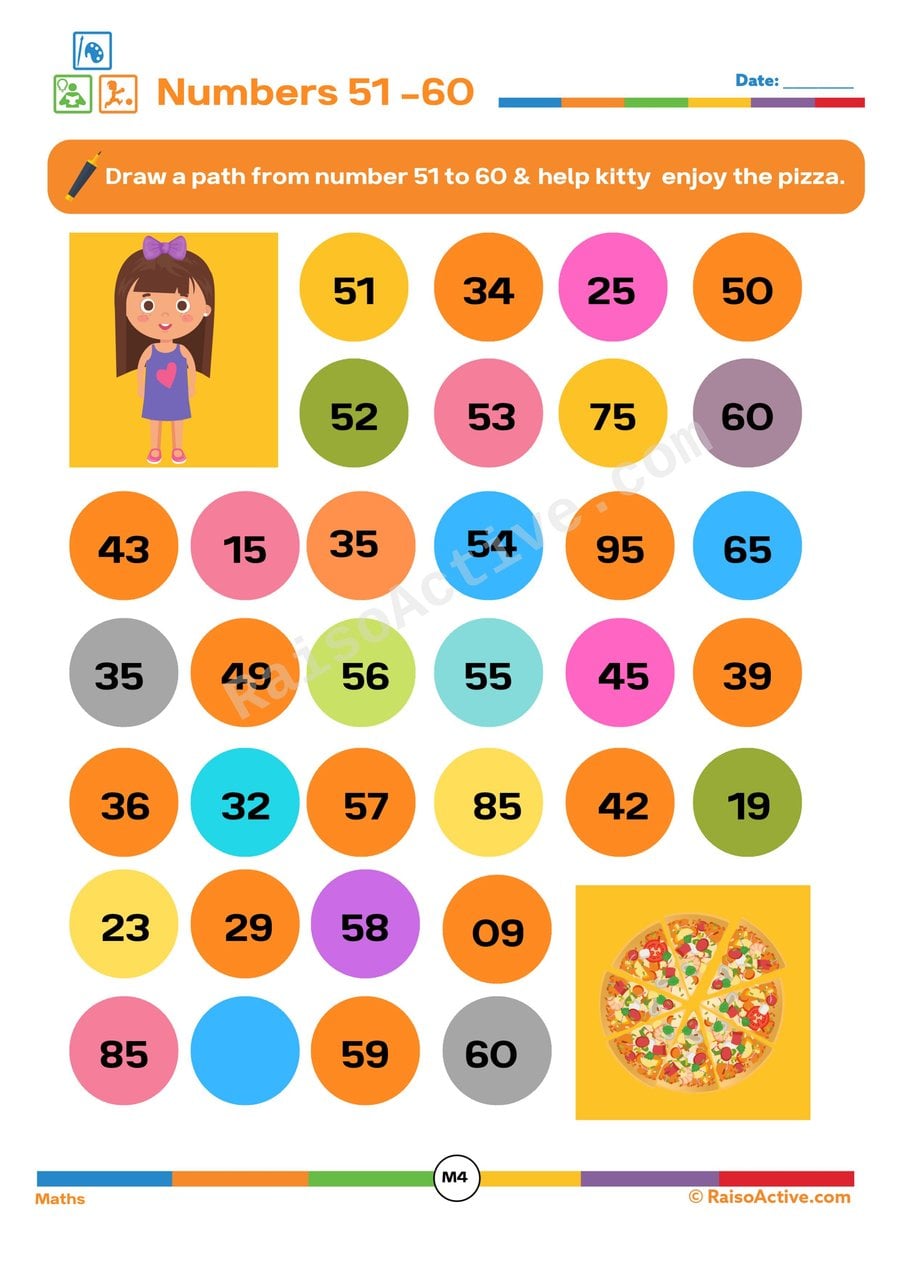
Pizza Path: Numbers 51-60 Worksheet for Kids
Ages 4-5 · Pre-KAges 4-5 · ReceptionAges 4-5 · LKGAges 4-5
Connecting the dots from 51 to 60 in order pushes children ages 4-5 beyond the more familiar 1-20 range, helping them recognize two-digit numbers and understand that counting sequences continue predictably into higher decades. This dot-to-dot format turns number recognition into a rewarding visual payoff, since a hidden pizza picture only appears once every number is found and connected correctly. It's a motivating way to practice number order without it feeling like repetitive drilling.
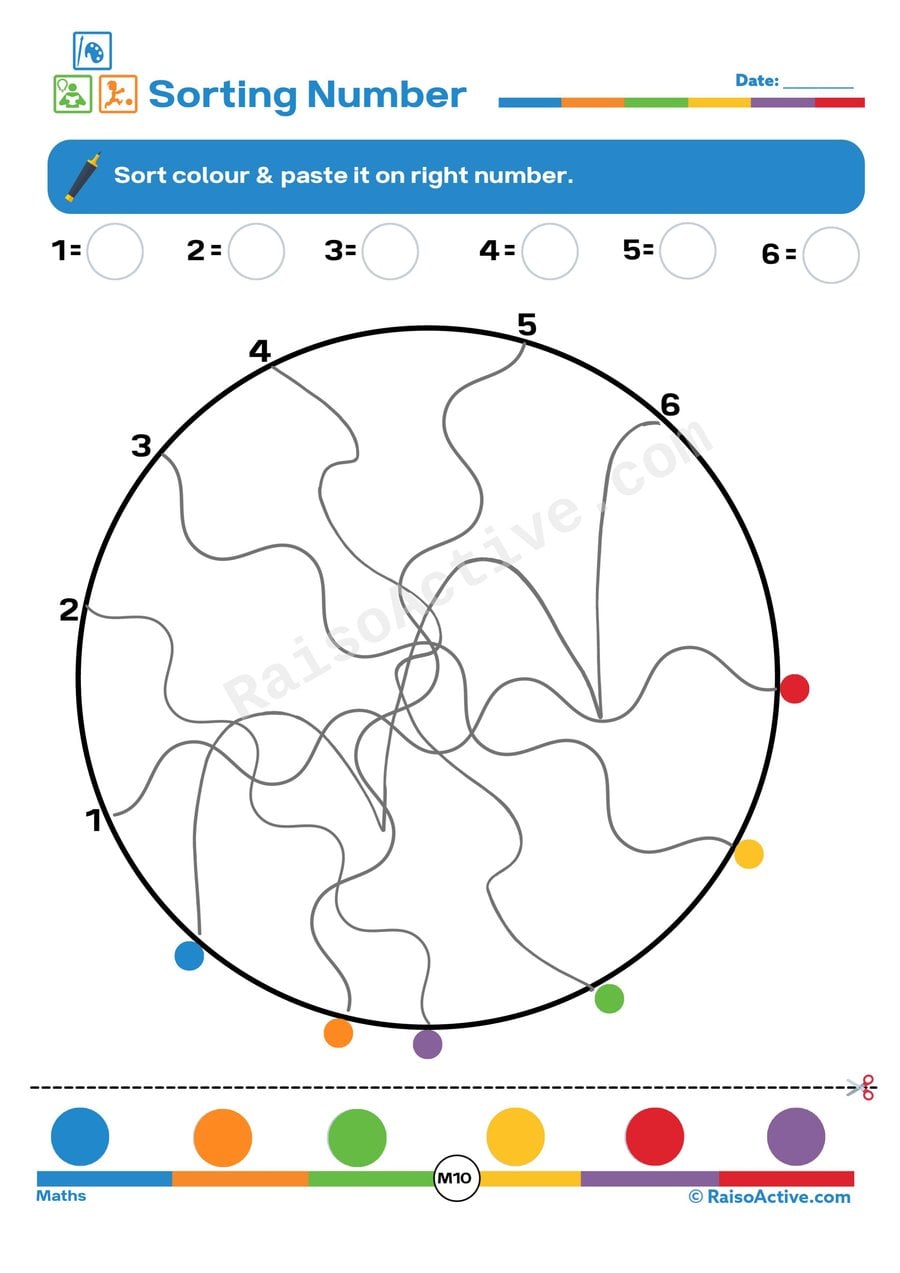
Sorting Numbers Worksheet: Color and Paste!
Ages 3-5 · Preschool–Pre-KAges 3-5 · Nursery–ReceptionAges 3-5 · Nursery–LKGAges 3-5
Children ages 3-5 practice matching quantities to written numerals by counting sets of colored dots and pasting them next to the correct number, reinforcing both counting accuracy and number recognition in a hands-on cut-and-paste format. Sorting by matching color groups to numbers also builds early visual categorization skills.
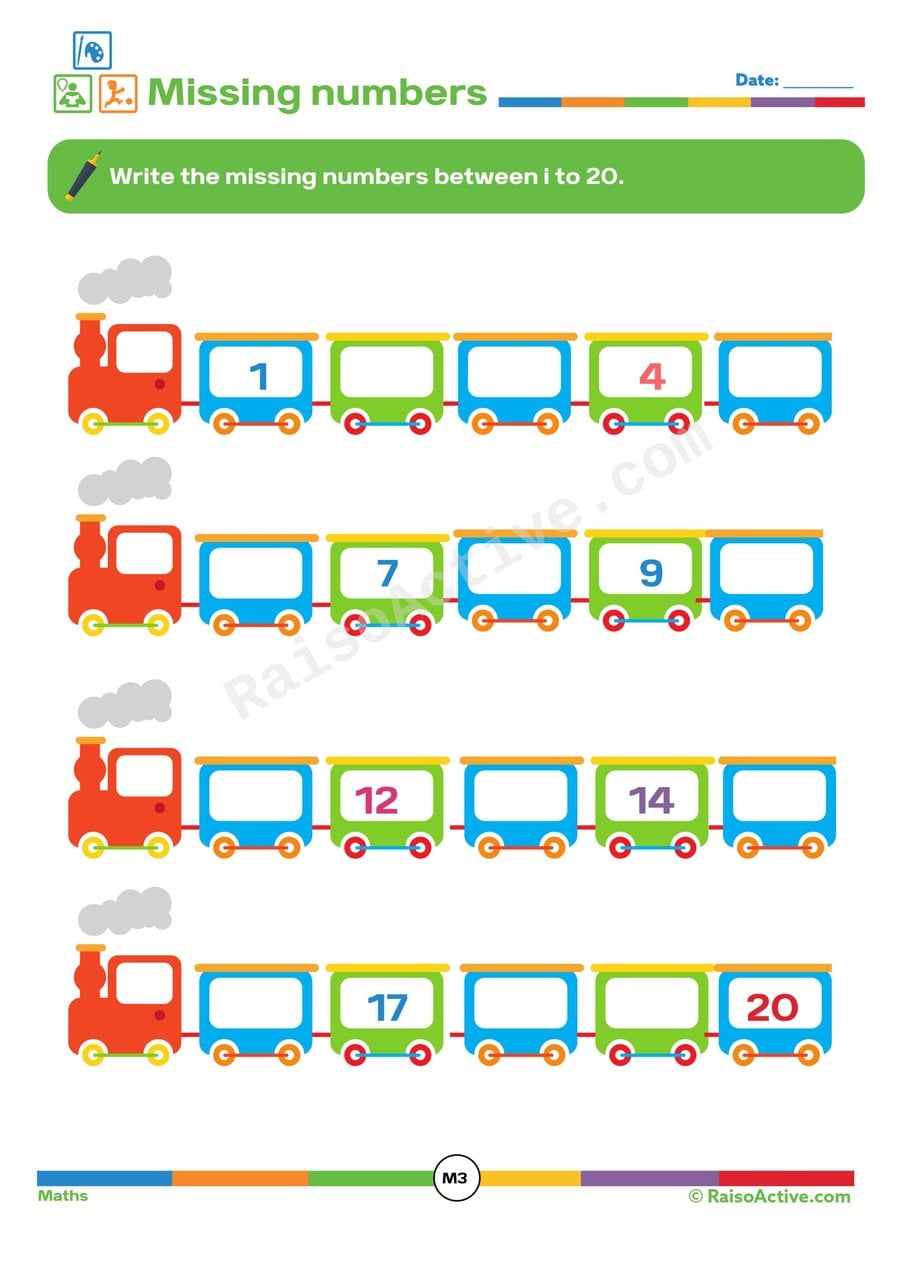
Missing Numbers Train Worksheet: Numbers 1-20
Ages 4-6 · Pre-K–KindergartenAges 4-6 · Reception–Year 1Ages 4-6 · LKG–UKGAges 4-6
This worksheet helps children ages 4-6 practice number recognition and sequencing by filling in missing numbers on a train of cars that counts from 1 to 20, reinforcing that numbers follow a fixed, predictable order. Working with a range this large also builds the stamina and sustained counting skill needed before children move on to skip-counting and simple addition.

Number Path Adventure: Write Numbers 1-20 Worksheet
Ages 4-6 · Pre-K–KindergartenAges 4-6 · Reception–Year 1Ages 4-6 · LKG–UKGAges 4-6
Children ages 4-6 practice writing numerals in correct sequence as they fill in missing numbers along a path of stepping stones from 1 to 20. This strengthens number-order memory and numeral formation together, both needed before a child can count on reliably or recognize number patterns like the teens. Following a winding path also adds a light visual-tracking challenge that keeps attention on the correct next stone.

Before Number Worksheet: Practice Number Sequencing!
Ages 4-6 · Pre-K–KindergartenAges 4-6 · Reception–Year 1Ages 4-6 · LKG–UKGAges 4-6
Practicing 'what comes before' a given number strengthens number sequencing for children ages 4-6, requiring them to think backward through the counting sequence rather than only forward, which is how most early counting practice happens. This backward thinking builds flexibility with numbers that supports later subtraction and number-line reasoning.

Descending Order Fruits Worksheet for Preschoolers
Ages 4-5 · Pre-KAges 4-5 · ReceptionAges 4-5 · LKGAges 4-5
Arranging fruits labeled with numbers from largest to smallest builds descending order recognition for children ages 4-5, reinforcing number comparison skills that complement the more commonly practiced ascending order.

Before and After Numbers Worksheet: Counting Bananas!
Ages 4-5 · Pre-KAges 4-5 · ReceptionAges 4-5 · LKGAges 4-5
Figuring out which number comes immediately before and after a given number strengthens children ages 4-5's understanding of number order and the counting sequence, a concept that's more abstract than simply counting objects one by one. Coloring a matching number of bananas for each answer adds a concrete, visual check, letting children confirm their number sense by physically representing the quantity. This worksheet bridges rote number-sequence memorization with real quantity understanding.
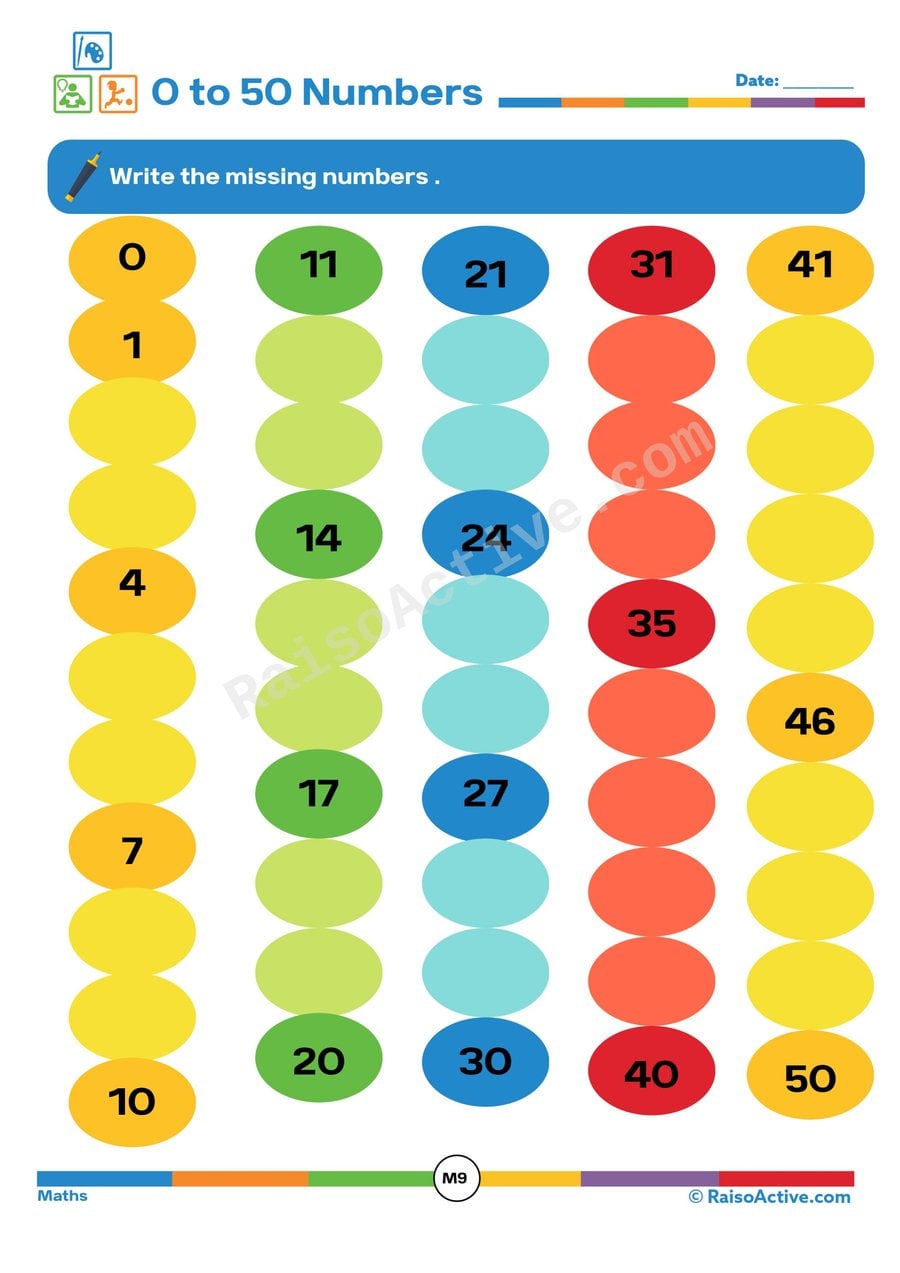
Missing Numbers Worksheet: 0 to 50
Ages 4-5 · Pre-KAges 4-5 · ReceptionAges 4-5 · LKGAges 4-5
Filling in missing numbers across the 0-50 range asks children ages 4-5 to hold a much longer counting sequence in mind than typical 1-20 worksheets, strengthening both number recognition and the pattern sense needed to predict what comes next at any point in the range. This kind of extended practice also introduces children to the way numbers group into decades, like the 20s or 30s, which becomes important for later place-value understanding. Successfully completing a long sequence like this builds real counting stamina and confidence.
Guides for this topic

Number Formation Rhymes 0–9 and How to Fix Reversals
Original number formation rhymes for 0–9, the correct stroke order for each digit, why 3, 5 and 7 get reversed most often, and multisensory fixes that work.

Christmas and Winter Activities That Combine Fun and Learning: Creating Magical Educational Experiences
Discover Christmas and winter activities that combine festive fun with real learning. Crafts, counting, literacy, and printable worksheets for ages 2 to 8 — perfect for home and school.
Age-Appropriate Halloween Learning Activities: Balancing Spooks and Skills for Young Learners
Discover fun, age-appropriate Halloween learning activities for young children. Spooky crafts, counting games, literacy ideas, and printable worksheets for ages 2 to 8.
Reviews
Every worksheet for ages 4–6, no watermark
Members download the full library of 1,000+ worksheets and every activity pack without watermarks or daily limits. One year costs ₹999 in India or $20 elsewhere.
See membership plansOr download any worksheet free with a watermark (5 a day).