Summer Fun: Write Sentences About the Beach! Worksheet
Children ages 4-6 practice translating what they observe in a picture into written sentences, a key step in moving from spoken language to independent writing. Describing a beach scene specifically — people swimming, building sandcastles, or playing in the waves — gives children concrete, familiar content to draw on, which makes the jump to writing less intimidating than an open-ended prompt.
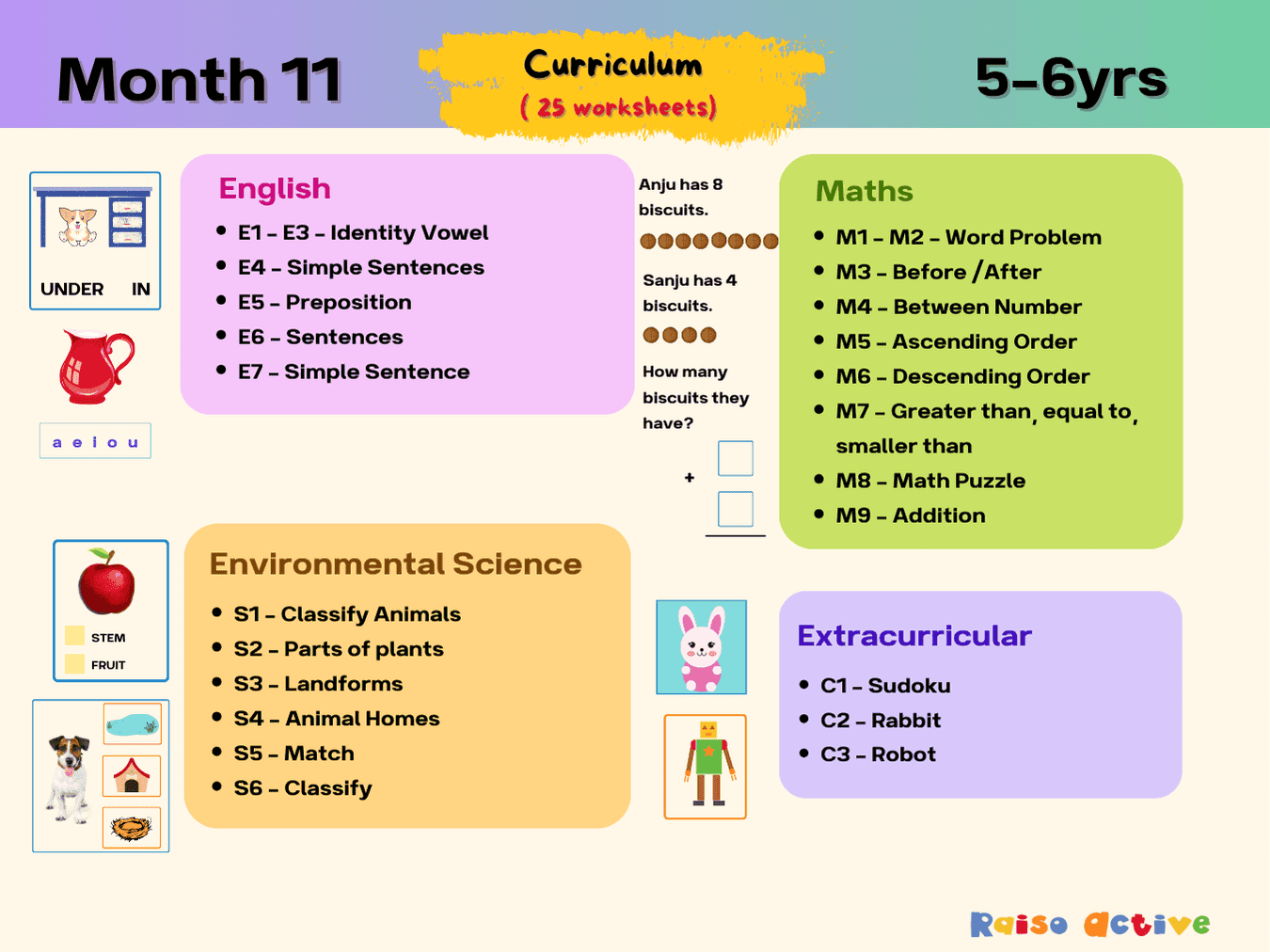
Part of the pack
Month 11: Learning & Development | Ages 5-6
This is page 9 of the pack. Ages 5-6 · KindergartenAges 5-6 · Year 1Ages 5-6 · UKGAges 5-6
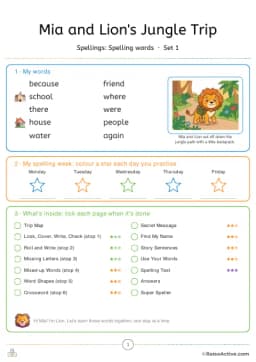
Made for your child
Spelling practice, made for your child
Their own spelling words turned into a pack: trace or look-cover-write-check, roll and write, a secret picture code, a word search, a crossword and a test, with their name in it.
Make a spelling packFree preview · free for members
Or start free: a word search with sight wordsCurriculum
- Fluency > Sentence Building
How to use this worksheet
Start by looking at the beach picture together and asking your child what they notice — who is in the picture and what are they doing? Talk through a few ideas out loud before your child picks one to write about on the first line. Help sound out tricky words together rather than spelling them for your child outright, and encourage a capital letter at the start and a period at the end of each sentence. Repeat the process for each additional line, encouraging a new detail from the picture each time.
Materials needed
- Pencil
- Eraser
Extension activities
- 1Draw your own beach scene and write one sentence describing what's happening in it.
- 2Make up and write a short story about a day at the beach, using the worksheet sentences as a starting point.
- 3Read a picture book set at the beach and compare it to the scene in the worksheet.
- 4Act out beach activities at home — pretend to swim, build a sandcastle, or fly a kite — and describe the action in a sentence afterward.

Written by
Hemsweta Jain · Teacher Cheena
MBA and Early Childhood Educator, teaching since 2014 · Founder of RaisoActive, Mumbai
Every RaisoActive worksheet is designed and checked by the founder before publishing.
Published · Last reviewed
More from Month 11: Learning & Development | Ages 5-6

Preposition Worksheet: Circle the Correct Position!
Ages 3-5 · Preschool–Pre-KAges 3-5 · Nursery–ReceptionAges 3-5 · Nursery–LKGAges 3-5
Children ages 3-5 practice identifying prepositions like 'in,' 'on,' and 'under' by looking at a picture and circling the word that correctly describes where an object is positioned. This builds early spatial vocabulary that children use constantly in everyday communication, from describing where a toy is to following directions.
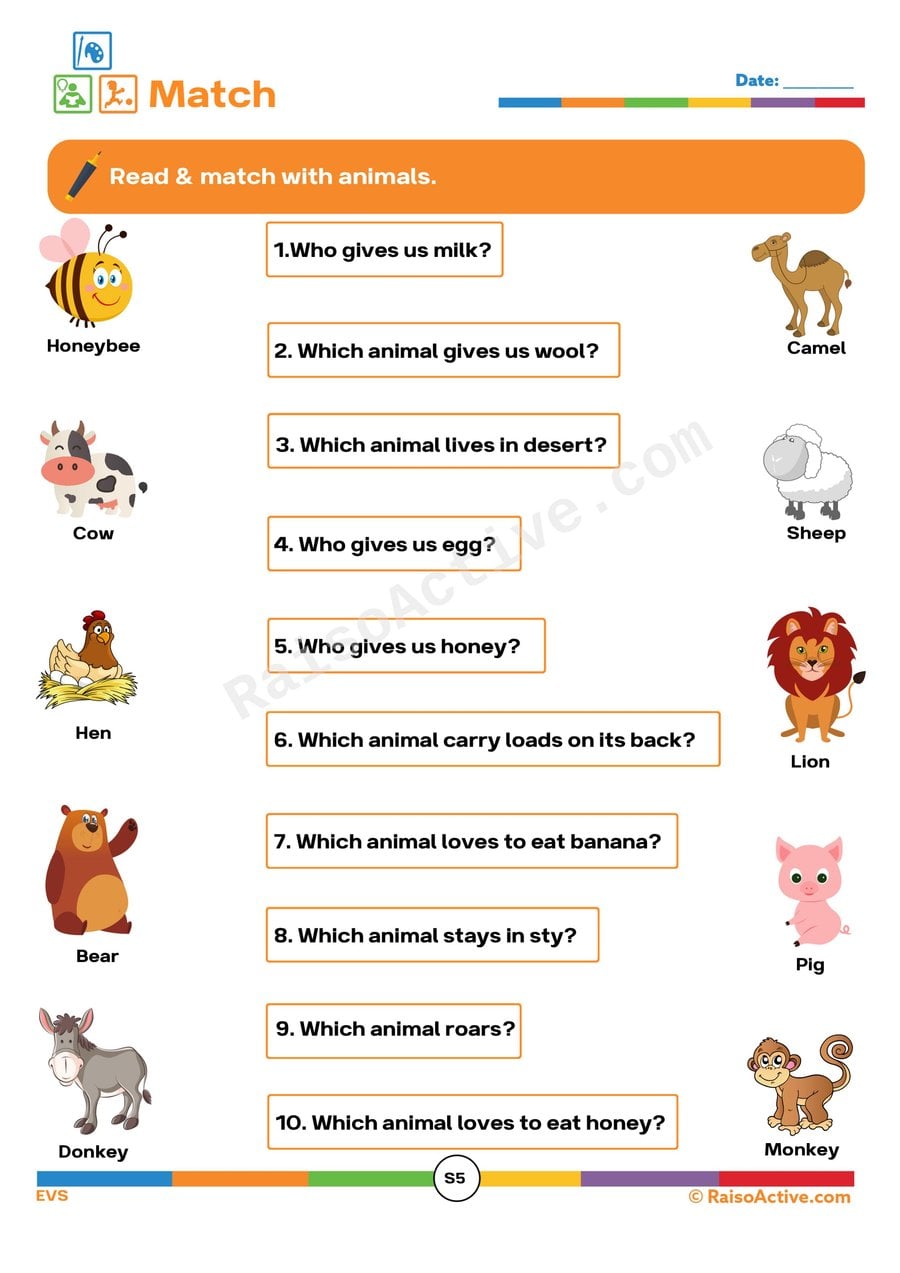
Match the Animals! A Fun Worksheet for Kids
Ages 3-5 · Preschool–Pre-KAges 3-5 · Nursery–ReceptionAges 3-5 · Nursery–LKGAges 3-5
This worksheet helps children ages 3-5 build observation and reasoning skills as they read a simple question or clue about an animal and match it to the correct picture. Rather than matching by appearance alone, children must connect descriptive language to an animal's known characteristics, which strengthens both listening comprehension and early vocabulary about animals.

Comparing Numbers Worksheet: Greater Than, Less Than, and Equal To!
Ages 4-6 · Pre-K–KindergartenAges 4-6 · Reception–Year 1Ages 4-6 · LKG–UKGAges 4-6
Children ages 4-6 learn to compare two numbers and choose the correct symbol — greater than, less than, or equal to — building an essential foundation for later work with inequalities and algebra. Comparing quantities and representing the relationship symbolically is a more abstract skill than simple counting, so this worksheet stretches children just past straightforward number recognition into true numerical reasoning.

Simple Sentences Worksheet: Rewriting Sentences for Early Readers
Ages 4-6 · Pre-K–KindergartenAges 4-6 · Reception–Year 1Ages 4-6 · LKG–UKGAges 4-6
Children ages 4-6 practice sentence construction by rearranging scrambled words into a grammatically correct, meaningful sentence, building an understanding of proper word order in English. This hands-on rearranging task teaches children to recognize where a sentence's subject, action, and details belong, a skill they'll use in all future writing.

Shape Robot Cut and Paste Worksheet for Preschoolers
Ages 3-5 · Preschool–Pre-KAges 3-5 · Nursery–ReceptionAges 3-5 · Nursery–LKGAges 3-5
Cutting out shapes and gluing them into place to build a robot reinforces shape recognition alongside fine motor and spatial-assembly skills for children ages 3-5, since each piece must be matched by both its form and its position.
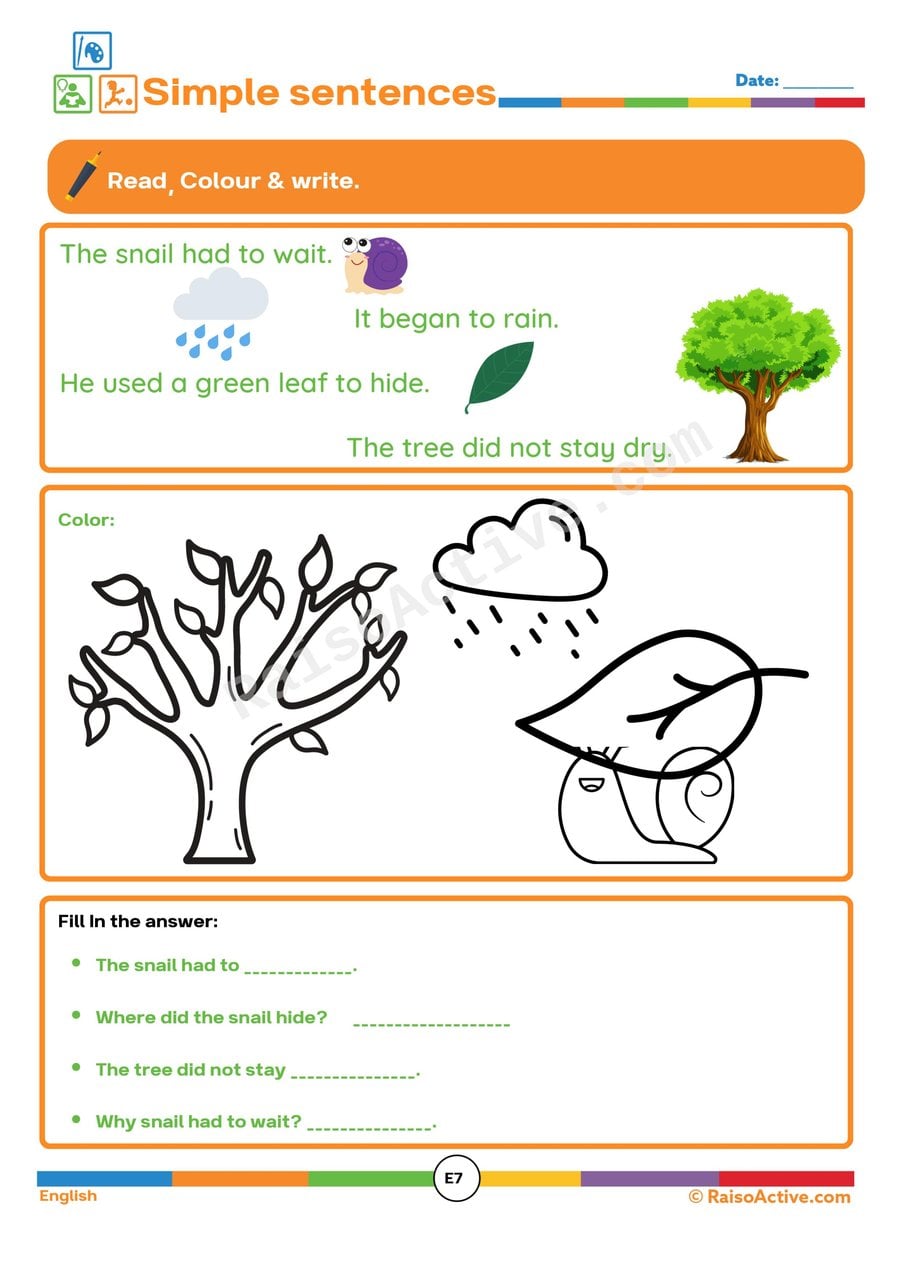
Simple Sentences Worksheet: Read, Color, and Write!
Ages 3-5 · Preschool–Pre-KAges 3-5 · Nursery–ReceptionAges 3-5 · Nursery–LKGAges 3-5
This worksheet combines three literacy skills for children ages 3-5 in one activity: reading short sentences, coloring the pictures that go with them, and filling in a missing word to complete each sentence. Connecting reading, coloring, and writing in a single task reinforces that words carry meaning tied directly to pictures, an important early step toward genuine reading comprehension.

Animal Homes Worksheet: Circle the Correct Answer!
Ages 3-5 · Preschool–Pre-KAges 3-5 · Nursery–ReceptionAges 3-5 · Nursery–LKGAges 3-5
Matching an animal to its correct home among three picture choices builds science classification skills for children ages 3-5, introducing the idea that different animals are suited to different environments.

Math Puzzle: Cut and Paste Addition and Subtraction Worksheet
Ages 4-6 · Pre-K–KindergartenAges 4-6 · Reception–Year 1Ages 4-6 · LKG–UKGAges 4-6
Solving addition and subtraction problems and matching each answer to its correct puzzle piece builds calculation fluency alongside visual matching skills for children ages 4-6, turning practice into a self-checking puzzle format.
Related worksheets

Trace and Write Simple Sentences Worksheet for Preschoolers
Ages 4-5 · Pre-KAges 4-5 · ReceptionAges 4-5 · LKGAges 4-5
Tracing and then writing simple sentences independently helps children ages 4-5 move beyond single-word and letter practice into connected writing, learning that words are separated by spaces and sentences follow a left-to-right flow. This step is an important bridge between early handwriting skills and functional written communication.
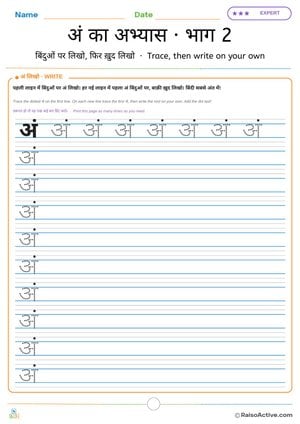
Hindi Letter अं (am) Practice 2: Trace, then Write on Your Own | अं का अभ्यास · भाग 2
Ages 5-7 · Kindergarten–Grade 1Ages 5-7 · Year 1–Year 2Ages 5-7 · UKG–Class 1Ages 5-7
An expert page for confident writers: trace the dotted अं on the first line, then on each new line trace the first अं and write the rest on your own, adding the dot last.
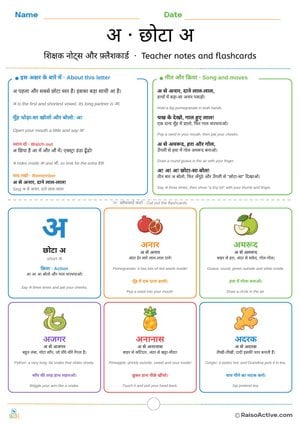
Hindi Letter अ (a) Teacher Notes and Flashcards | अ · छोटा अ
Ages 3-7 · Preschool–Grade 1Ages 3-7 · Nursery–Year 2Ages 3-7 · Nursery–Class 1Ages 3-7
Children meet the short vowel अ with a short note for adults, a song with actions and cut-out flashcards for अनार (pomegranate), अमरूद (guava), अजगर (python), अनानास (pineapple), अदरक (ginger). They hear the sound at the start of real words and link it to a hand action.
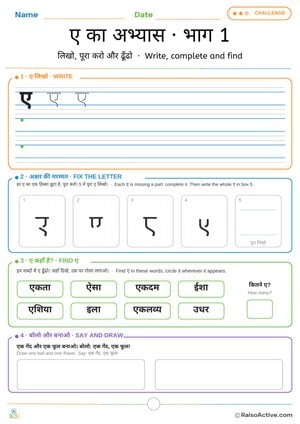
Hindi Letter ए (e) Practice 1: Write, Fix the Letter and Find | ए का अभ्यास · भाग 1
Ages 4-7 · Pre-K–Grade 1Ages 4-7 · Reception–Year 2Ages 4-7 · LKG–Class 1Ages 4-7
A challenge page: write ए between the lines, complete four letters that are each missing a part and then write the whole ए in box 5, find ए in words such as एकता, एकदम, एशिया and एकलव्य, and draw a picture. ए is not the short form of ऐ; the practice page keeps them apart.
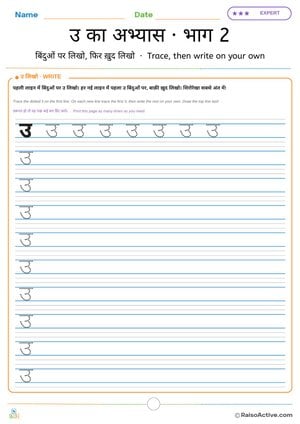
Hindi Letter उ Practice Part 2: Trace and Write on Your Own | उ का अभ्यास · भाग 2
Ages 3-7 · Preschool–Grade 1Ages 3-7 · Nursery–Year 2Ages 3-7 · Nursery–Class 1Ages 3-7
Children build writing fluency by tracing the dotted line उ on the first line and then writing the letter on their own, line after line, as the dotted help fades. The headline (शिरोरेखा) is drawn last, as in Hindi handwriting.
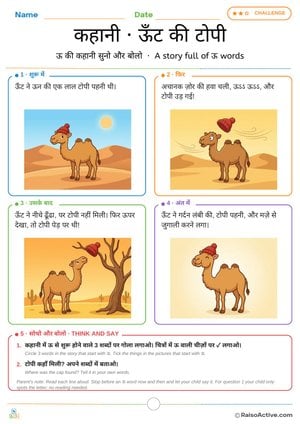
Letter ऊ Story: The Camel's Woolly Cap | कहानी ऊँट की टोपी
Ages 3-7 · Preschool–Grade 1Ages 3-7 · Nursery–Year 2Ages 3-7 · Nursery–Class 1Ages 3-7
A camel's red woolly cap blows away in the desert wind, and he finds it again on a tree. Children listen, look at the four pictures, spot the words that start with ऊ and retell what happened in their own words.
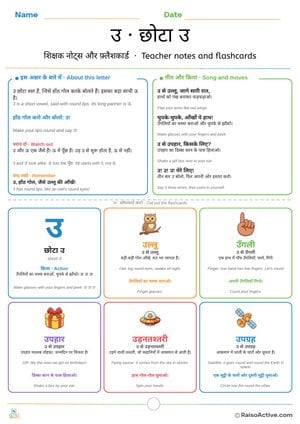
Hindi Letter उ (u) Teacher Notes and Flashcards | उ · छोटा उ
Ages 3-7 · Preschool–Grade 1Ages 3-7 · Nursery–Year 2Ages 3-7 · Nursery–Class 1Ages 3-7
Children meet the short vowel उ with a short note for adults, a song with actions and cut-out flashcards for उल्लू (owl), उँगली (finger), उपहार (gift), उड़नतश्तरी (flying saucer), उपग्रह (satellite). They hear the sound at the start of real words and link it to a hand action.
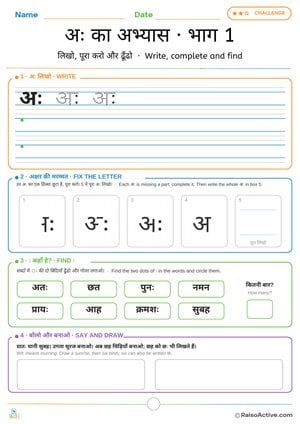
Hindi Visarga अः (ah) Practice 1: Write, Fix the Letter and Find | अः का अभ्यास · भाग 1
Ages 4-7 · Pre-K–Grade 1Ages 4-7 · Reception–Year 2Ages 4-7 · LKG–Class 1Ages 4-7
A challenge page: write अः between the lines, complete four letters each missing a part and write the whole अः in box 5, find the two dots ः in words such as अतः, पुनः, प्रायः and क्रमशः, and draw a sunrise with six birds (छः can also be written छह).
Guides for this topic

Sight Words by Age: The First 50 Words and How to Teach Them Without Flashcard Fatigue
Which sight words to teach first and why, the heart-word method, a read-trace-write-find routine, games, and a by-age table of typical sight-word progress.
How to Teach CVC Blending: A Step-by-Step Method That Works in Two Weeks
A step-by-step method for teaching CVC blending, covering continuous sounds, word families, common errors, and a 14-day plan that most children finish reading CVC words.

Documenting Learning Without Drowning in Data: A Practical Guide for Parents and Teachers
Learn practical ways to document your child's learning without overwhelm. Simple portfolios, observation tips, and printable trackers for ages 1-8.
Reviews
Every worksheet for ages 4–6, no watermark
Members download the full library of 1,000+ worksheets and every activity pack without watermarks or daily limits. One year costs ₹999 in India or $20 elsewhere.
See membership plansOr download any worksheet free with a watermark (5 a day).