Word Problems Worksheet for Early Learners
Children ages 4-6 practice applying subtraction to real-life scenarios by reading short word problems and figuring out how many items remain after some are taken away, connecting basic subtraction facts to reading comprehension. Translating a written story into a subtraction problem is a more advanced skill than solving bare number sentences, since it requires understanding what the story is actually asking.
Part of the pack
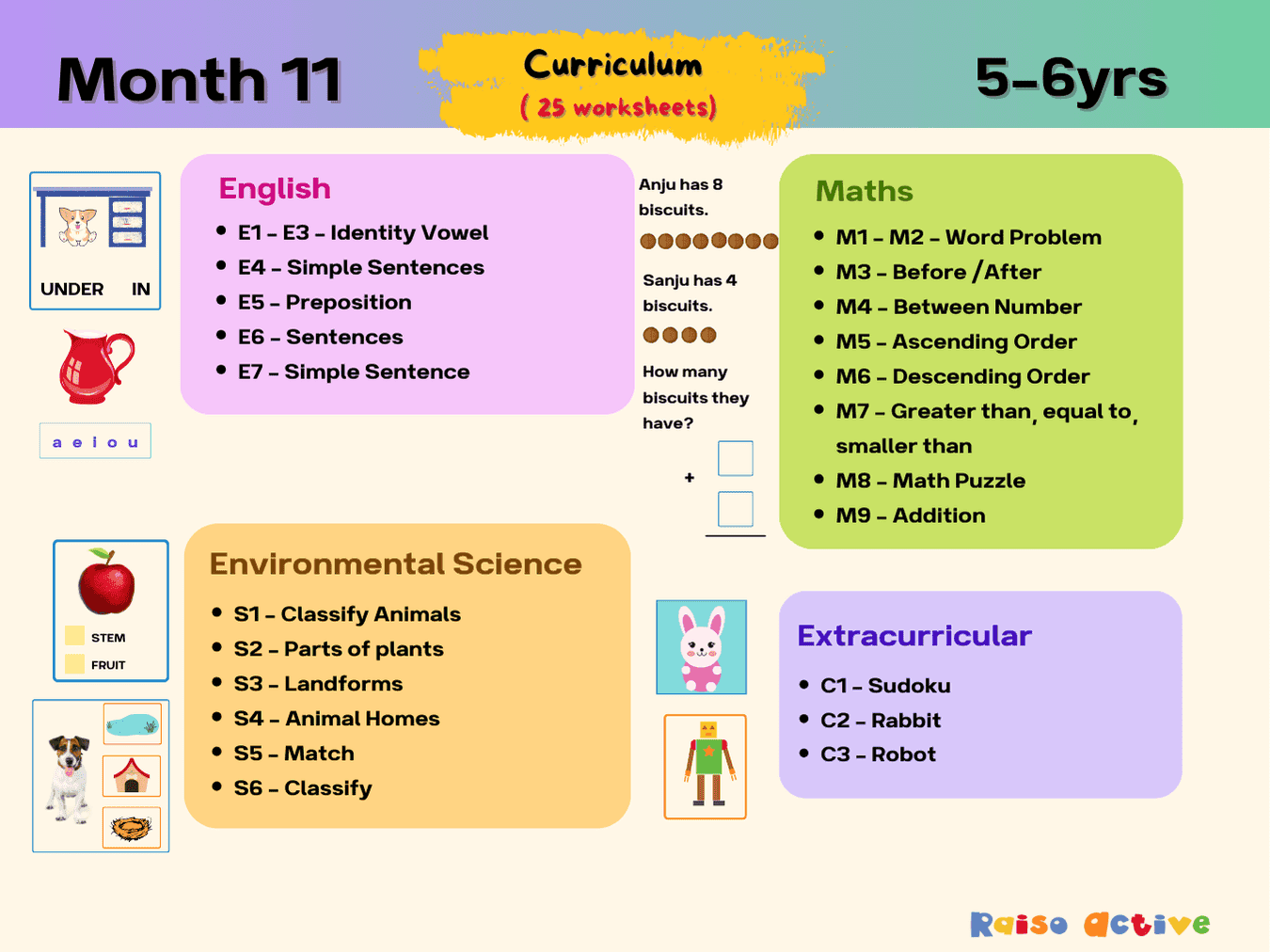
Month 11: Learning & Development | Ages 5-6
This is page 12 of the pack. Ages 5-6 · KindergartenAges 5-6 · Year 1Ages 5-6 · UKGAges 5-6

Made for your child
Taking away within 10, made for your child
A maths pack with your child's name in it: pictures that explain, practice at three levels, puzzles and story sums about them. Print a new set whenever they finish.
Make a maths packFree preview · free for members
Curriculum
- Subtraction > Subtraction Word Problems
How to use this worksheet
Read the first word problem aloud together, identifying the starting number and how many are being taken away. Have your child use the pictures provided to count and cross out the amount being subtracted, helping them visualize the 'taking away' action. Have them write the answer in the solution box, then repeat this process for each remaining word problem, encouraging more independent reading as they gain confidence.
Materials needed
- Pencil
- Eraser
Extension activities
- 1Create your own subtraction word problems using your child's toys or snacks.
- 2Draw a picture representing one of the word problems and cross out the amount being subtracted.
- 3Act out a subtraction story physically, removing real objects from a group to find the difference.
- 4Take turns making up subtraction word problems for each other to solve.

Written by
Hemsweta Jain · Teacher Cheena
MBA and Early Childhood Educator, teaching since 2014 · Founder of RaisoActive, Mumbai
Every RaisoActive worksheet is designed and checked by the founder before publishing.
Published · Last reviewed
More from Month 11: Learning & Development | Ages 5-6

Comparing Numbers Worksheet: Greater Than, Less Than, and Equal To!
Ages 4-6 · Pre-K–KindergartenAges 4-6 · Reception–Year 1Ages 4-6 · LKG–UKGAges 4-6
Children ages 4-6 learn to compare two numbers and choose the correct symbol — greater than, less than, or equal to — building an essential foundation for later work with inequalities and algebra. Comparing quantities and representing the relationship symbolically is a more abstract skill than simple counting, so this worksheet stretches children just past straightforward number recognition into true numerical reasoning.

Simple Sentences Worksheet: Rewriting Sentences for Early Readers
Ages 4-6 · Pre-K–KindergartenAges 4-6 · Reception–Year 1Ages 4-6 · LKG–UKGAges 4-6
Children ages 4-6 practice sentence construction by rearranging scrambled words into a grammatically correct, meaningful sentence, building an understanding of proper word order in English. This hands-on rearranging task teaches children to recognize where a sentence's subject, action, and details belong, a skill they'll use in all future writing.

Summer Fun: Write Sentences About the Beach! Worksheet
Ages 4-6 · Pre-K–KindergartenAges 4-6 · Reception–Year 1Ages 4-6 · LKG–UKGAges 4-6
Children ages 4-6 practice translating what they observe in a picture into written sentences, a key step in moving from spoken language to independent writing. Describing a beach scene specifically — people swimming, building sandcastles, or playing in the waves — gives children concrete, familiar content to draw on, which makes the jump to writing less intimidating than an open-ended prompt.

Addition Worksheet for Kids: Add Horizontally and Vertically!
Ages 4-6 · Pre-K–KindergartenAges 4-6 · Reception–Year 1Ages 4-6 · LKG–UKGAges 4-6
Children ages 4-6 practice basic addition by solving problems arranged both horizontally, like '3 + 2 =,' and vertically, in a stacked column format, building flexibility with the two most common ways addition problems appear in early math worksheets and textbooks. Learning both formats now means neither will feel unfamiliar once formal school math introduces them side by side.

Vowel Sorting Fun: Identify and Sort Vowels Worksheet
Ages 4-5 · Pre-KAges 4-5 · ReceptionAges 4-5 · LKGAges 4-5
Circling vowels within a word and sorting letters into 'vowels' and 'consonants' columns builds foundational phonics knowledge for children ages 4-5, an essential distinction for later decoding and spelling.

Cute Rabbit Cut and Paste Worksheet for Preschoolers
Ages 3-5 · Preschool–Pre-KAges 3-5 · Nursery–ReceptionAges 3-5 · Nursery–LKGAges 3-5
Children ages 3-5 practice precise scissor control and gluing as they cut apart separate body-shape pieces and assemble them into a complete rabbit picture, building the fine motor coordination needed for later handwriting. Piecing together separate parts to form a whole also strengthens early spatial reasoning about how shapes fit together.
Parts of a Plant Worksheet for Kids
Ages 4-6 · Pre-K–KindergartenAges 4-6 · Reception–Year 1Ages 4-6 · LKG–UKGAges 4-6
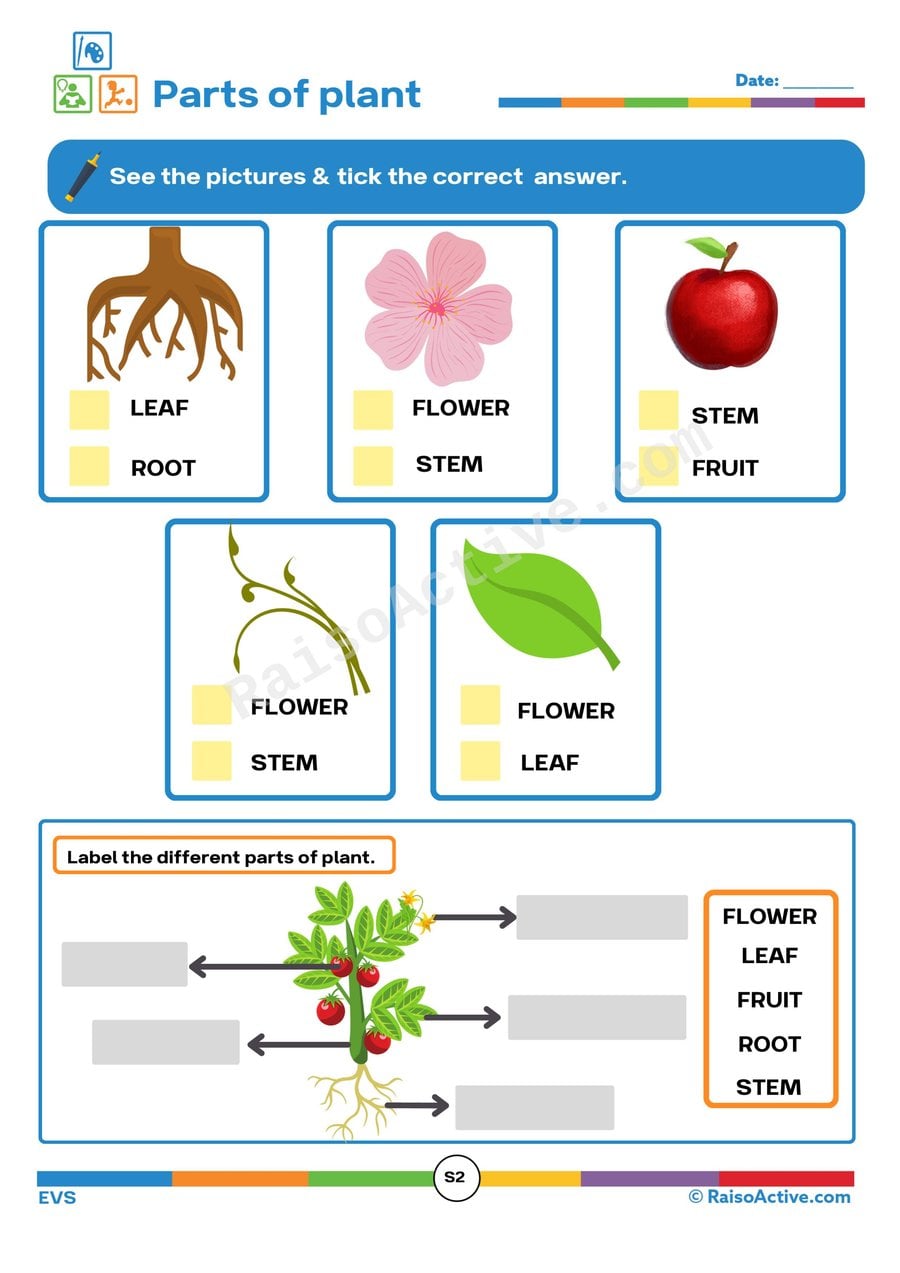
This worksheet helps children ages 4-6 identify and label the main parts of a plant — roots, stem, leaves, flower, and fruit — building foundational botany knowledge. Learning to associate each part with its picture and location on a plant diagram develops both vocabulary and an early understanding of plant structure, which supports later lessons on how plants grow and survive.

Vowel Sounds Worksheet: Identify and Circle the Correct Vowel!
Ages 4-6 · Pre-K–KindergartenAges 4-6 · Reception–Year 1Ages 4-6 · LKG–UKGAges 4-6
Children ages 4-6 practice identifying vowel sounds within words by looking at a picture, saying its name aloud, and figuring out which vowel they hear, a specific phonics skill that builds toward independent reading and spelling. Isolating the vowel sound in a word is often trickier for children than identifying beginning consonant sounds, making this a meaningful next step in phonics.
Related worksheets

Word Problems Worksheet: Practice Subtraction with Fun Pictures!
Ages 4-6 · Pre-K–KindergartenAges 4-6 · Reception–Year 1Ages 4-6 · LKG–UKGAges 4-6
This subtraction word problem worksheet gives children ages 4-6 practice translating a short story into a math equation, using pictures of objects being taken away to make the abstract idea of subtraction concrete. Reading, counting, and subtracting in sequence builds the same problem-solving pathway children will rely on for more advanced word problems later in school. Visual supports, like crossed-out or removed objects in the pictures, help children see subtraction as an action rather than just a symbol.

Phonics Level 3 Long Vowels Certificate of Achievement
Ages 5-7 · Kindergarten–Grade 1Ages 5-7 · Year 1–Year 2Ages 5-7 · UKG–Class 1Ages 5-7
Children celebrate finishing Phonics Level 3 and look back at the five long vowel sounds they can now read: long a, e, i, o and u.

Fall Crossword Puzzle Worksheet for Preschoolers
Ages 3-5 · Preschool–Pre-KAges 3-5 · Nursery–ReceptionAges 3-5 · Nursery–LKGAges 3-5
This fall-themed crossword uses pictures instead of written clues, helping children ages 3-5 connect an image directly to its written word while practicing early letter formation. Counting the boxes in each answer also builds an intuitive sense of word length before formal spelling instruction begins.
Positional Words Worksheet: Near and Far
Ages 3-5 · Preschool–Pre-KAges 3-5 · Nursery–ReceptionAges 3-5 · Nursery–LKGAges 3-5
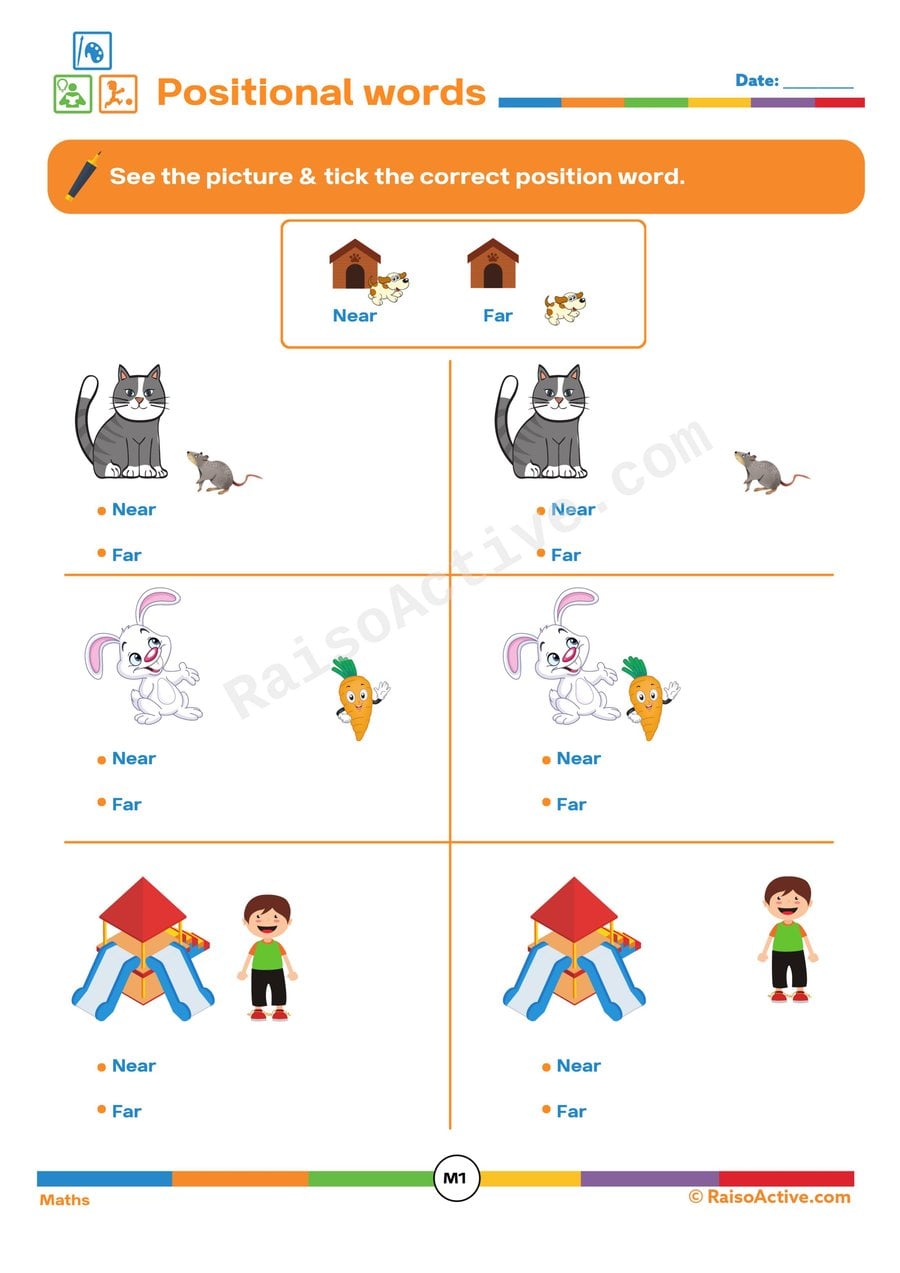
This worksheet introduces children ages 3-5 to the positional concepts of 'near' and 'far,' asking them to look at a picture and tick the word that correctly describes an object's distance from a reference point. Positional vocabulary like this is an important building block for spatial reasoning and later geometry and direction-following skills. Because near and far are relative concepts rather than fixed labels, this practice also builds flexible thinking about how position depends on comparison.

Color the Sight Words: 'She' and 'He' Worksheet for Preschoolers
Ages 3-5 · Preschool–Pre-KAges 3-5 · Nursery–ReceptionAges 3-5 · Nursery–LKGAges 3-5
This worksheet helps children ages 3-5 build instant sight-word recognition for the common pronouns 'she' and 'he' by having them scan a page and color each word according to a color code. Because sight words like these can't be sounded out easily, repeated visual exposure through an engaging coloring task helps children recognize them instantly by shape, which is essential for early reading fluency. Differentiating between two similar short words also sharpens visual discrimination.
Festival Number Crunch: Navratri Multiply, Divide and Money Worksheet
Ages 7-11 · Grade 2–Grade 3Ages 7-11 · Year 3–Year 4Ages 7-11 · Class 2–Class 3Ages 7-11
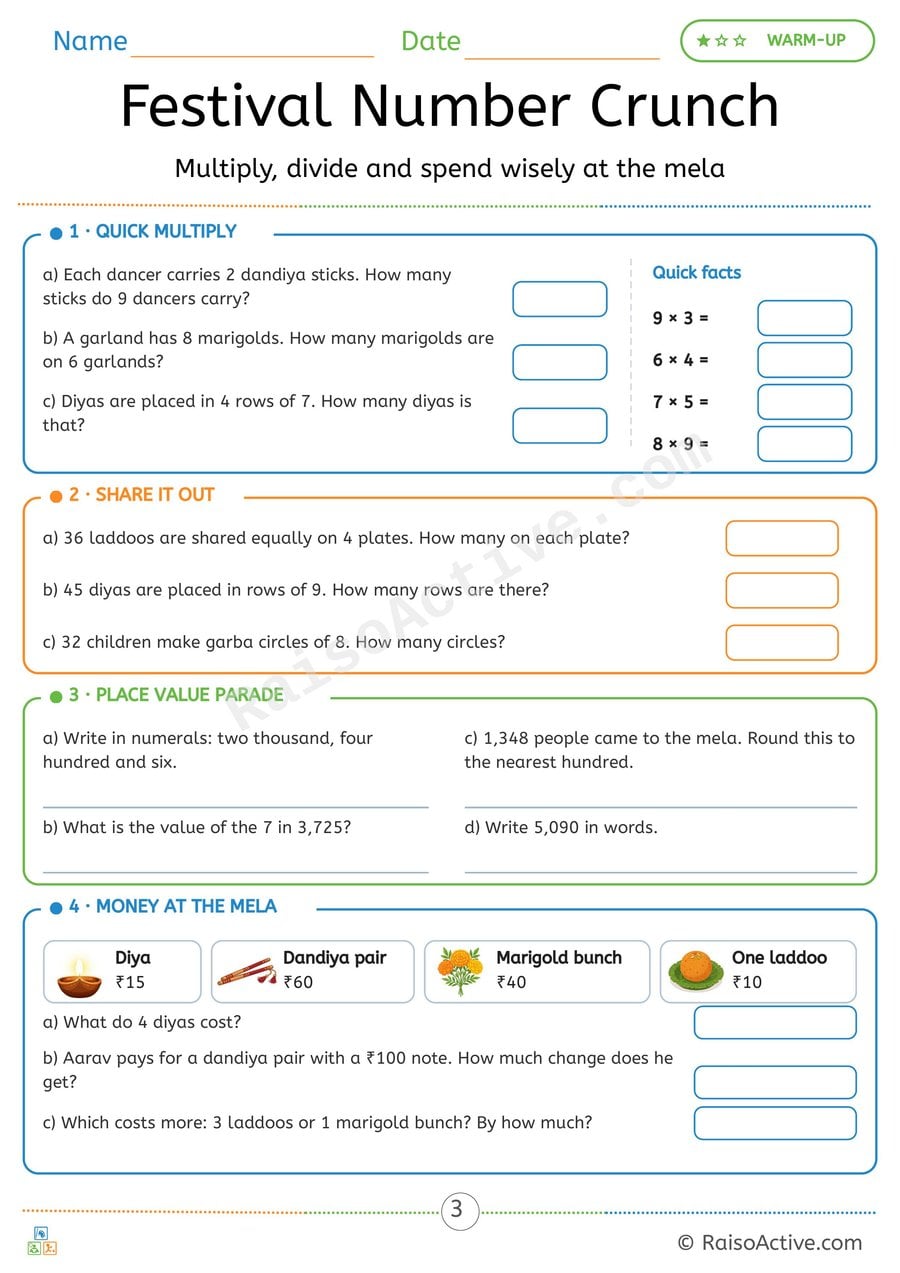
Children solve multiplication and division word problems about dancers, garlands, diyas and laddoos, practise times-table facts, write and round four-digit numbers, and work out costs and change in rupees at a mela stall.

Navratri Garba Number Party: Skip Counting and Story Sums
Ages 4-6 · Pre-K–KindergartenAges 4-6 · Reception–Year 1Ages 4-6 · LKG–UKGAges 4-6
Children count in 2s and 5s, solve short story sums about bangles, dancers and marigold garlands, compare numbers using >, < and =, and work out how many pairs of dancers there are.

Air Balloon Color by Sums Worksheet for Preschoolers
Ages 3-5 · Preschool–Pre-KAges 3-5 · Nursery–ReceptionAges 3-5 · Nursery–LKGAges 3-5
This color-by-sums worksheet combines basic addition practice with color-by-number skills, asking children ages 3-5 to solve simple addition problems within each section of an air balloon and then color that section according to a matching color key. Solving a math problem correctly before coloring turns each section into a small, self-checking task, since an incorrect sum would lead to the wrong color choice. This blend of math and art keeps repetitive addition practice feeling like a creative activity rather than a drill.
Guides for this topic

Documenting Learning Without Drowning in Data: A Practical Guide for Parents and Teachers
Learn practical ways to document your child's learning without overwhelm. Simple portfolios, observation tips, and printable trackers for ages 1-8.

Coding Activities for Preschoolers: Building Tomorrow's Thinkers Today
Discover 15+ unplugged and screen-based coding activities for preschoolers that build sequencing, logic, and problem-solving skills through play. NEP 2020 aligned.
Christmas and Winter Activities That Combine Fun and Learning: Creating Magical Educational Experiences
Discover Christmas and winter activities that combine festive fun with real learning. Crafts, counting, literacy, and printable worksheets for ages 2 to 8 — perfect for home and school.
Reviews
Every worksheet for ages 4–6, no watermark
Members download the full library of 1,000+ worksheets and every activity pack without watermarks or daily limits. One year costs ₹999 in India or $20 elsewhere.
See membership plansOr download any worksheet free with a watermark (5 a day).