Missing Numbers Worksheet: 0 to 50
Filling in missing numbers across the 0-50 range asks children ages 4-5 to hold a much longer counting sequence in mind than typical 1-20 worksheets, strengthening both number recognition and the pattern sense needed to predict what comes next at any point in the range. This kind of extended practice also introduces children to the way numbers group into decades, like the 20s or 30s, which becomes important for later place-value understanding. Successfully completing a long sequence like this builds real counting stamina and confidence.
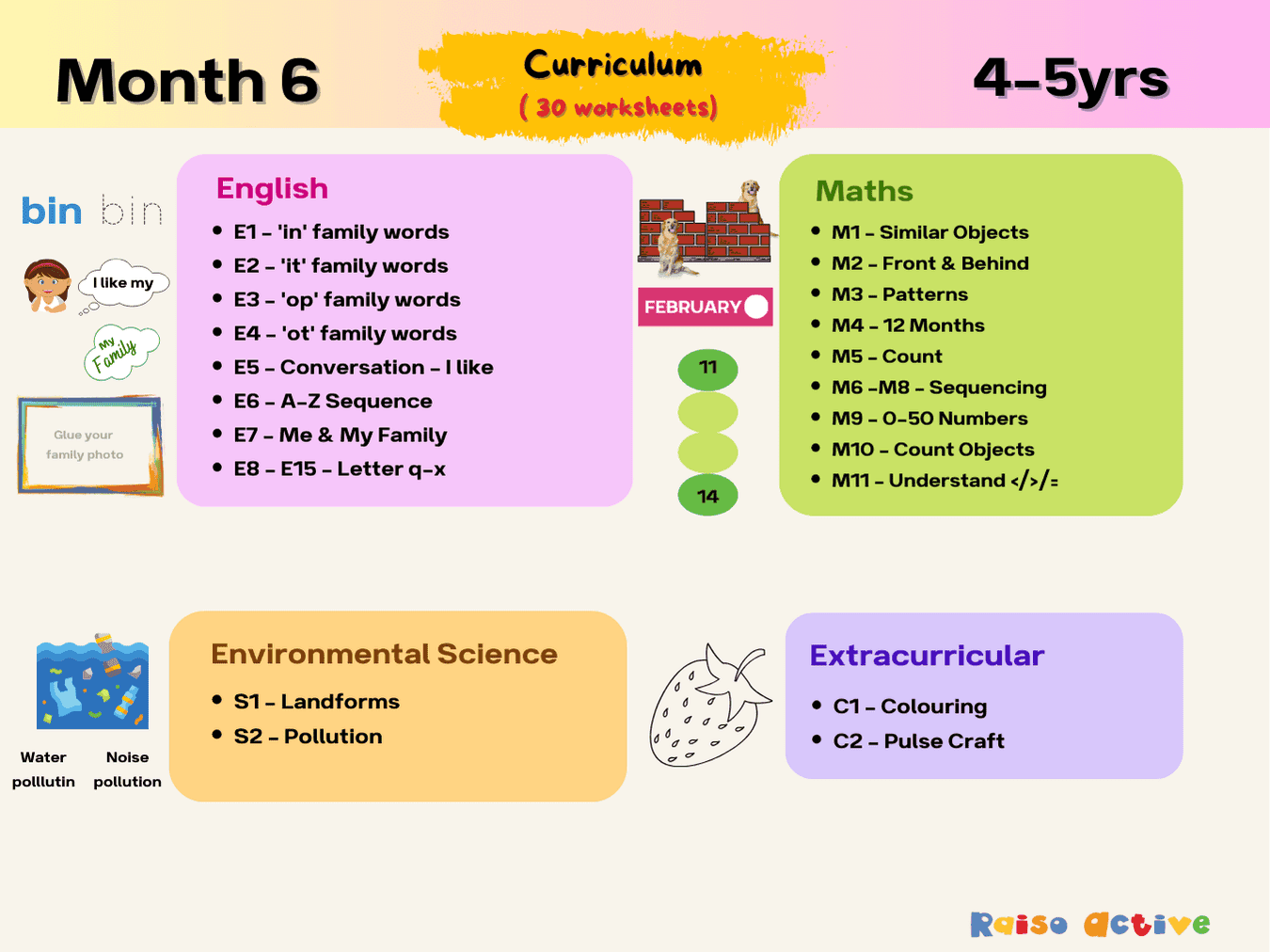
Part of the pack
Month 6: Preschool multi-subject foundational skills | Ages 4-5
This is page 27 of the pack. Ages 4-5 · Pre-KAges 4-5 · ReceptionAges 4-5 · LKGAges 4-5

Made for your child
Counting to 10, made for your child
A maths pack with your child's name in it: pictures that explain, practice at three levels, puzzles and story sums about them. Print a new set whenever they finish.
Make a maths packFree preview · free for members
Curriculum
- Number Sense > Number Sequencing
How to use this worksheet
Look at the number sequence together and identify where the blank spaces appear. Have your child count aloud from the last known number, filling in each missing number as they reach it. Work through the sequence a section at a time rather than all at once, taking a short pause between decades if your child's focus starts to fade. Once complete, read through the whole 0-50 sequence together to check for any errors or reversed digits.
Materials needed
- Pencil
Extension activities
- 1Count everyday objects up to 50, like steps on a walk or toy blocks, to make the range feel concrete.
- 2Build a simple number line from 0-50 together using paper strips or sidewalk chalk.
- 3Play a 'what comes next' guessing game using numbers anywhere in the 0-50 range.
- 4Practice counting by tens up to 50 as a quicker way to navigate the larger number range.
- 5Use a hundred chart to visually locate and discuss any numbers your child found tricky.

Written by
Hemsweta Jain · Teacher Cheena
MBA and Early Childhood Educator, teaching since 2014 · Founder of RaisoActive, Mumbai
Every RaisoActive worksheet is designed and checked by the founder before publishing.
Published · Last reviewed
More from Month 6: Preschool multi-subject foundational skills | Ages 4-5

Parent's Guide: Fun Activities for Early Learning!
Ages 3-5 · Preschool–Pre-KAges 3-5 · Nursery–ReceptionAges 3-5 · Nursery–LKGAges 3-5
This parent's guide compiles a set of short activities spanning early literacy, spatial reasoning, and problem-solving, giving caregivers ready-made ways to build foundational skills through everyday play. For ages 3-5, mixing activity types across one guide, like word games and puzzles, keeps a young child's attention while covering multiple developmental areas in a single session or across a week.

A-Z Letter Sequence Worksheet: Fill in the Missing Letters!
Ages 4-5 · Pre-KAges 4-5 · ReceptionAges 4-5 · LKGAges 4-5
By age 4-5, children move from reciting the alphabet by rote to actually recognizing individual letters out of sequence, and this fill-in-the-blank worksheet tests that deeper knowledge by asking them to supply missing capital letters in a scrambled order. Locating where a gap belongs strengthens letter-order memory and visual letter recognition, both essential precursors to reading and independent writing. It also builds attention to detail, since children must scan neighboring letters to figure out what's missing.
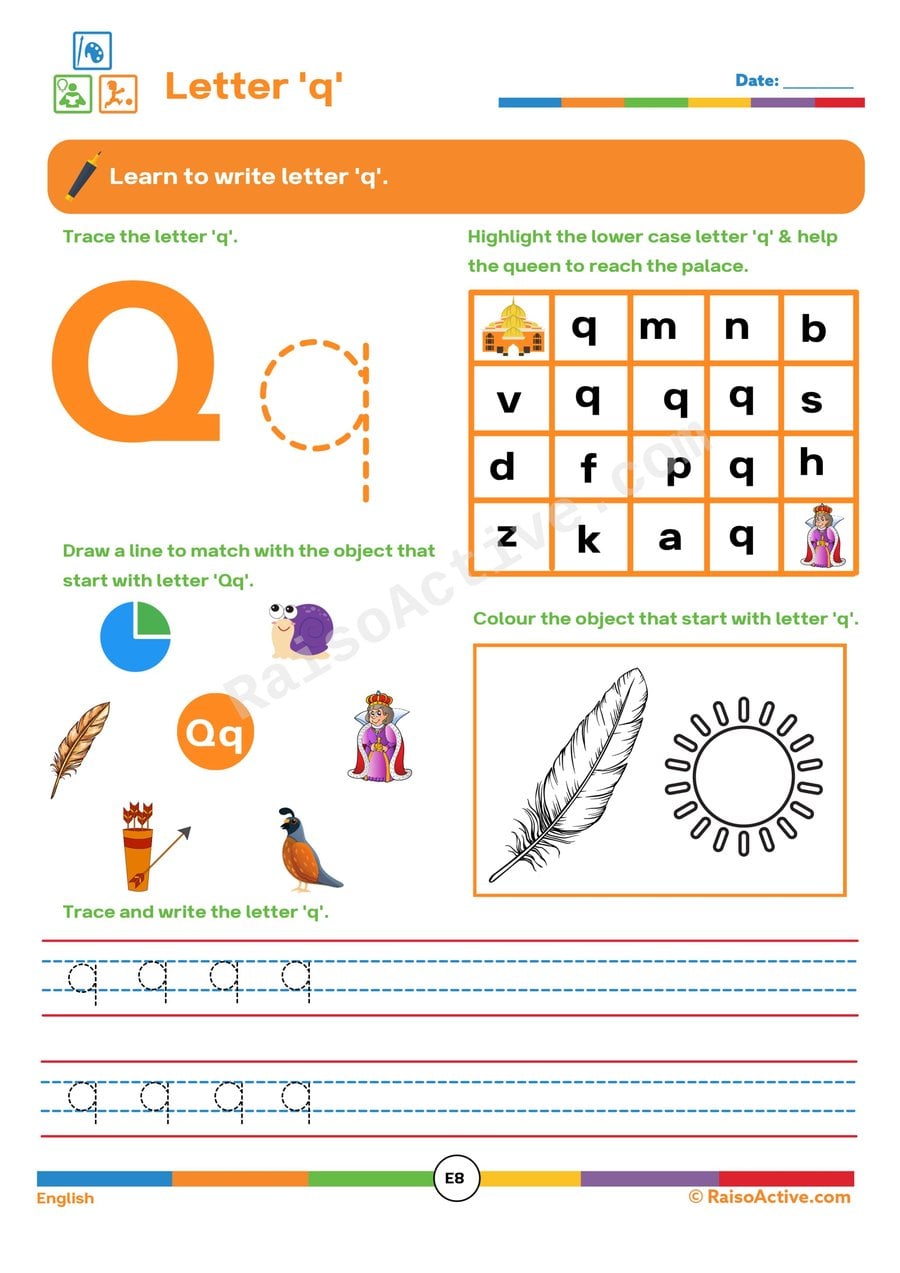
Letter 'q' Worksheet: Trace, Match, and Color!
Ages 3-5 · Preschool–Pre-KAges 3-5 · Nursery–ReceptionAges 3-5 · Nursery–LKGAges 3-5
This worksheet builds letter recognition for 'q' in both its uppercase and lowercase forms for children ages 3-5, a letter that's often trickier than most since it almost always pairs with 'u' and rarely appears alone in early vocabulary. Tracing the letter strengthens the fine motor control for its distinctive tail stroke, while matching and highlighting activities reinforce visual recognition across a busy grid. Helping the queen reach the palace through a simple letter-hunt maze adds a playful, motivating goal to an otherwise repetitive tracing task.

Count and Compare: Fun Math Worksheet for Preschoolers
Ages 3-5 · Preschool–Pre-KAges 3-5 · Nursery–ReceptionAges 3-5 · Nursery–LKGAges 3-5
Counting two groups of objects and then choosing the correct greater-than, less-than, or equal-to symbol introduces children ages 3-5 to comparative reasoning, a step beyond simple counting that asks them to judge relationships between quantities. This worksheet turns an abstract math symbol into something concrete by grounding it in objects they've just counted themselves, rather than presenting the symbol in isolation. Learning to compare quantities this early builds the number sense needed for later addition, subtraction, and general mathematical reasoning.

Count the Owls and Chicks! A Fun Counting Worksheet for Preschoolers
Ages 3-5 · Preschool–Pre-KAges 3-5 · Nursery–ReceptionAges 3-5 · Nursery–LKGAges 3-5
Counting groups of owls and chicks and circling the matching number builds one-to-one correspondence for children ages 3-5, the core skill of touching or pointing to each item exactly once while counting. Working with two different characters in the same activity also teaches children to reset their count for each new group rather than carrying a total over, an easy mistake at this age. This repeated counting-and-matching format across the page builds both accuracy and counting stamina.
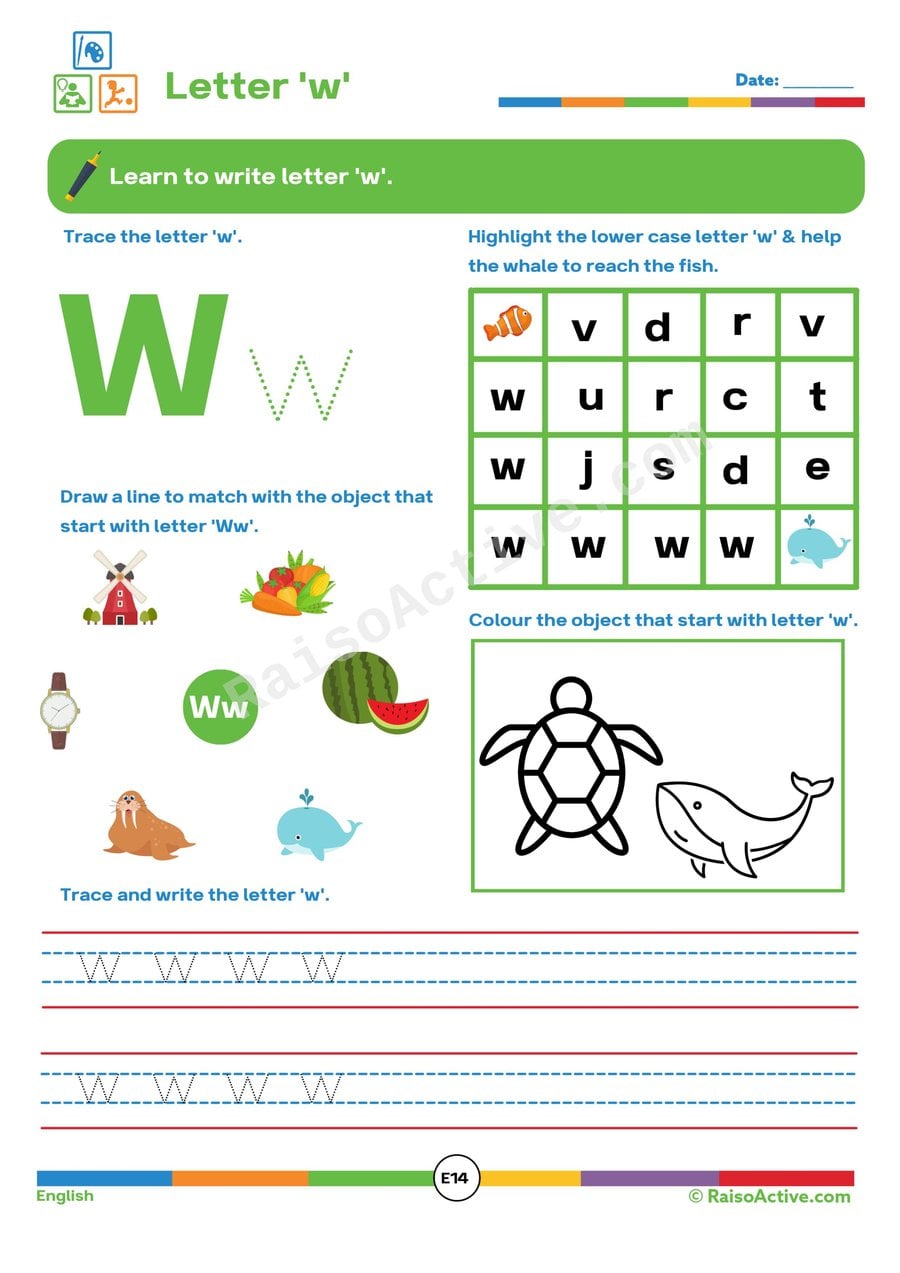
Letter 'w' Worksheet: Trace, Match, and Color!
Ages 3-5 · Preschool–Pre-KAges 3-5 · Nursery–ReceptionAges 3-5 · Nursery–LKGAges 3-5
Tracing, matching, and highlighting the letter 'w' gives children ages 3-5 practice with one of the more visually complex lowercase letters, made up of four connected diagonal strokes rather than a single simple shape. Matching pictures that start with 'w' to the letter reinforces the /w/ sound-to-symbol link, while scanning a letter grid to highlight every 'w' builds visual search skills alongside letter recognition. This combination of tracing, matching, searching, and coloring keeps the practice varied enough to hold a young child's attention across the full page.

In Family Words Worksheet: Read, Trace, and Identify the Pictures!
Ages 3-5 · Preschool–Pre-KAges 3-5 · Nursery–ReceptionAges 3-5 · Nursery–LKGAges 3-5
Reading, tracing, and matching words from the 'in' family — like pin, fin, and win — helps children ages 3-5 notice that changing just the first letter of a word while keeping the same ending creates a whole new word, a key phonics insight called word family recognition. Tracing each word alongside reading it builds handwriting muscle memory at the same time as reading fluency. Circling the picture that matches each traced word also checks true comprehension, not just the ability to sound out letters.
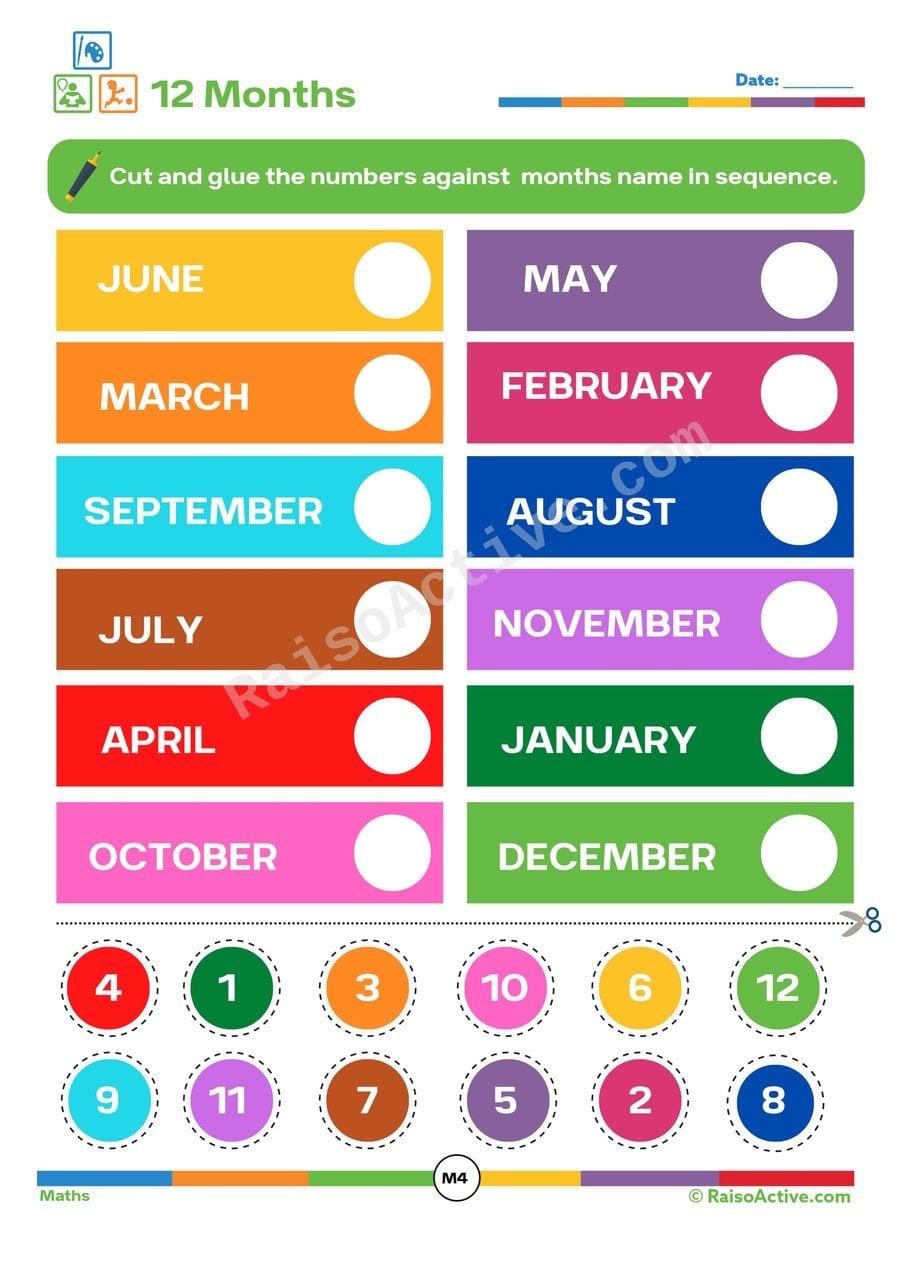
Months of the Year Matching Worksheet for Kids
Ages 4-5 · Pre-KAges 4-5 · ReceptionAges 4-5 · LKGAges 4-5
Matching numbers to month names introduces children ages 4-5 to the idea that the calendar has a fixed, meaningful order, which supports early time-concept development alongside their growing number recognition. This cut-and-paste format adds a fine motor and sequencing challenge, since children must locate the correct number piece among several options before gluing it into place. Learning the months by their order also lays groundwork for talking about birthdays, holidays, and seasons throughout the year.
Related worksheets

Ascending Order Cut and Paste Worksheet for Preschoolers
Ages 4-6 · Pre-K–KindergartenAges 4-6 · Reception–Year 1Ages 4-6 · LKG–UKGAges 4-6
This worksheet teaches children ages 4-6 to arrange numbered animal pictures from smallest to largest, reinforcing the concept of ascending order as a foundational number-sequencing skill. Physically cutting and repositioning each numbered piece, rather than simply writing numbers in order, makes the abstract idea of 'smallest to largest' into something children can manipulate and see. This hands-on approach also builds patience and careful visual comparison.

Before Number Worksheet: Practice Number Sequencing!
Ages 4-6 · Pre-K–KindergartenAges 4-6 · Reception–Year 1Ages 4-6 · LKG–UKGAges 4-6
Practicing 'what comes before' a given number strengthens number sequencing for children ages 4-6, requiring them to think backward through the counting sequence rather than only forward, which is how most early counting practice happens. This backward thinking builds flexibility with numbers that supports later subtraction and number-line reasoning.

Missing Numbers: Ice Cream Fun Worksheet for Kids
Ages 3-5 · Preschool–Pre-KAges 3-5 · Nursery–ReceptionAges 3-5 · Nursery–LKGAges 3-5
This worksheet helps children ages 3-5 practice number sequencing by identifying and writing in the missing numerals within a series of ice cream cones and cars, numbers 1 through 10. Filling in a gap within an otherwise familiar sequence requires children to hold the whole counting order in mind and recognize what number logically belongs in the empty spot, which is more demanding than counting forward from the start each time. The playful ice cream and car theme keeps the repeated number practice visually engaging.

Caterpillar Number Sequencing Worksheet for Preschoolers
Ages 3-5 · Preschool–Pre-KAges 3-5 · Nursery–ReceptionAges 3-5 · Nursery–LKGAges 3-5
This worksheet helps children ages 3-5 practice number recognition and sequencing skills by cutting out numbered circles and arranging them in the correct order to build a caterpillar's body. The hands-on cut-and-paste format adds fine motor practice to the numeracy task, since children must precisely place each circle in its correct spot.
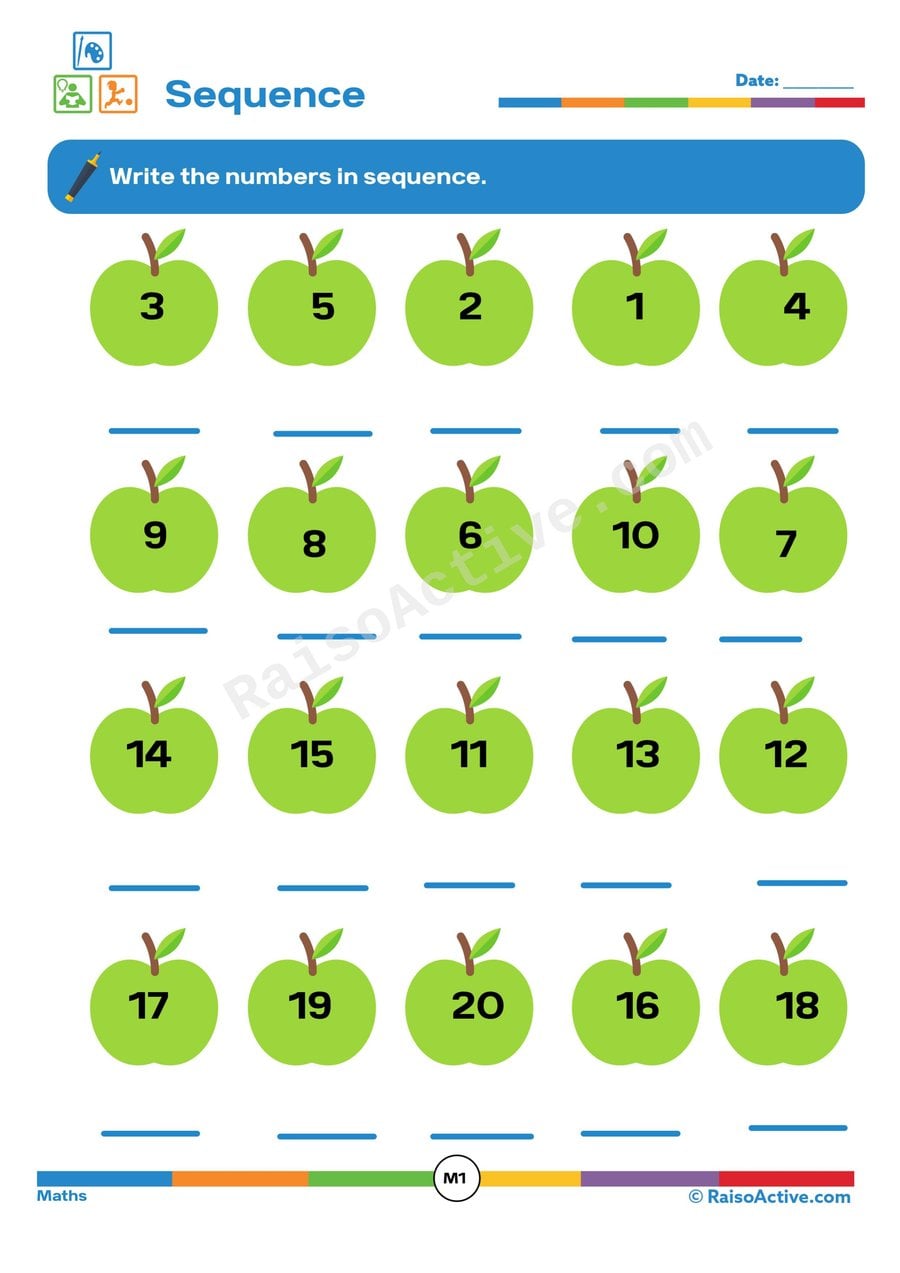
Sequence Fun: Writing Numbers in Order Worksheet
Ages 4-5 · Pre-KAges 4-5 · ReceptionAges 4-5 · LKGAges 4-5
This worksheet helps children ages 4-5 practice writing numbers in the correct sequence, reinforcing both number recognition and the concept that numbers have a fixed, predictable order. Filling in missing numbers along a row of apples also builds the pattern-recognition skills that underlie later skip-counting and place value work.
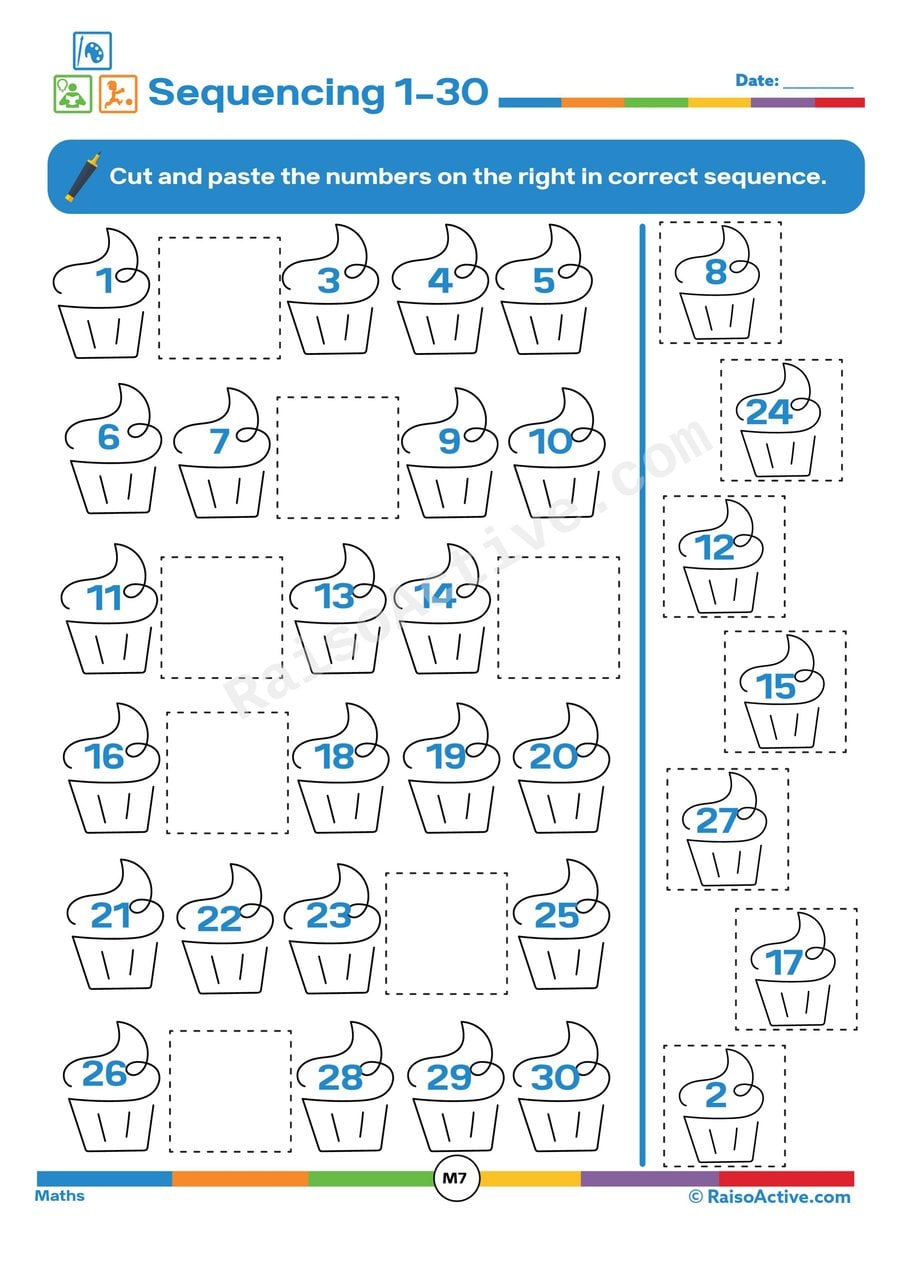
Cupcake Number Sequencing Worksheet 1-30
Ages 4-6 · Pre-K–KindergartenAges 4-6 · Reception–Year 1Ages 4-6 · LKG–UKGAges 4-6
Children ages 4-6 practice number sequencing from 1 to 30 by cutting out numeral pieces and pasting them onto cupcakes in ascending order, reinforcing both number recognition and the logic of 'what comes next' in the counting sequence. This bridges the gap between counting by rote and truly understanding number order, an essential step before children can skip-count or do simple addition.
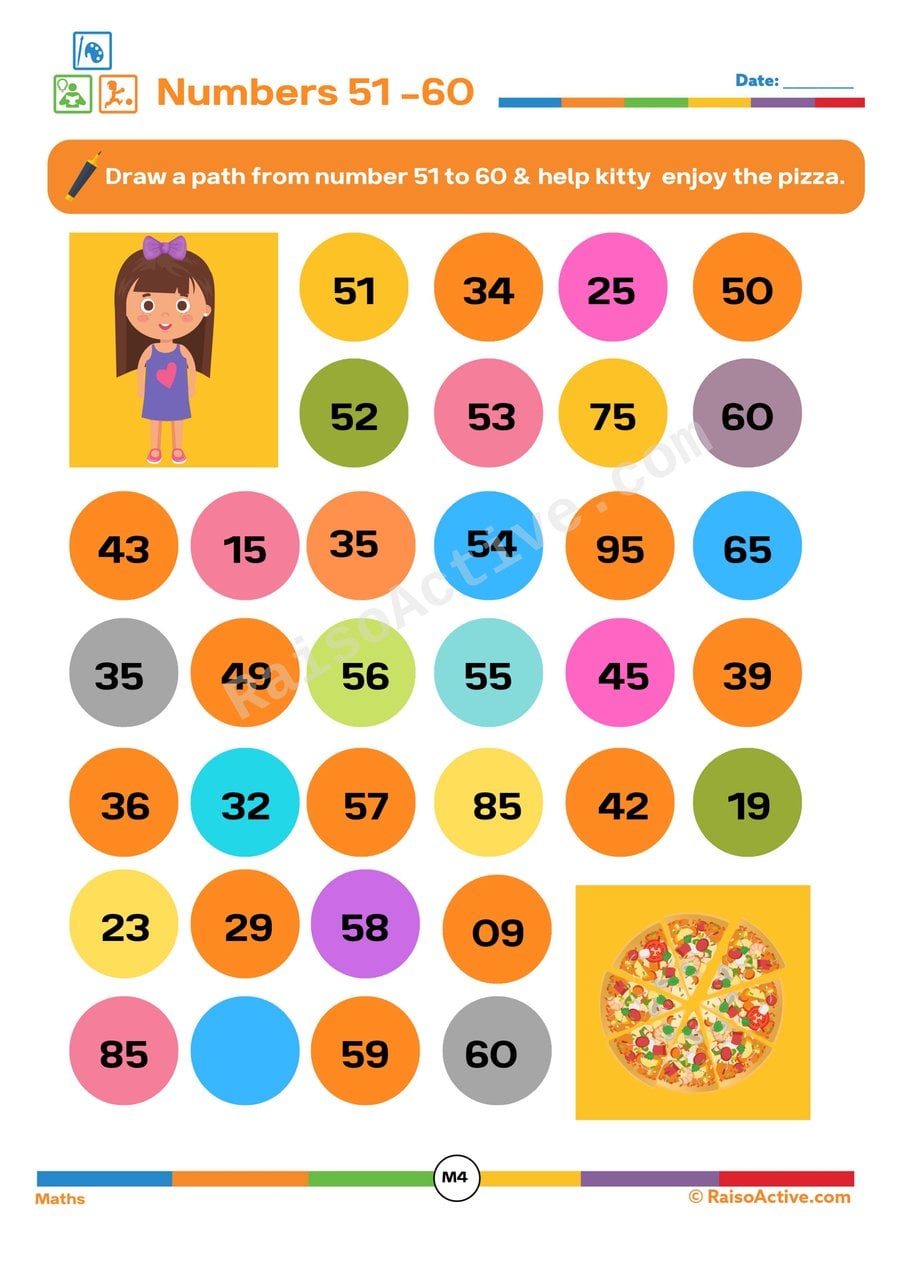
Pizza Path: Numbers 51-60 Worksheet for Kids
Ages 4-5 · Pre-KAges 4-5 · ReceptionAges 4-5 · LKGAges 4-5
Connecting the dots from 51 to 60 in order pushes children ages 4-5 beyond the more familiar 1-20 range, helping them recognize two-digit numbers and understand that counting sequences continue predictably into higher decades. This dot-to-dot format turns number recognition into a rewarding visual payoff, since a hidden pizza picture only appears once every number is found and connected correctly. It's a motivating way to practice number order without it feeling like repetitive drilling.
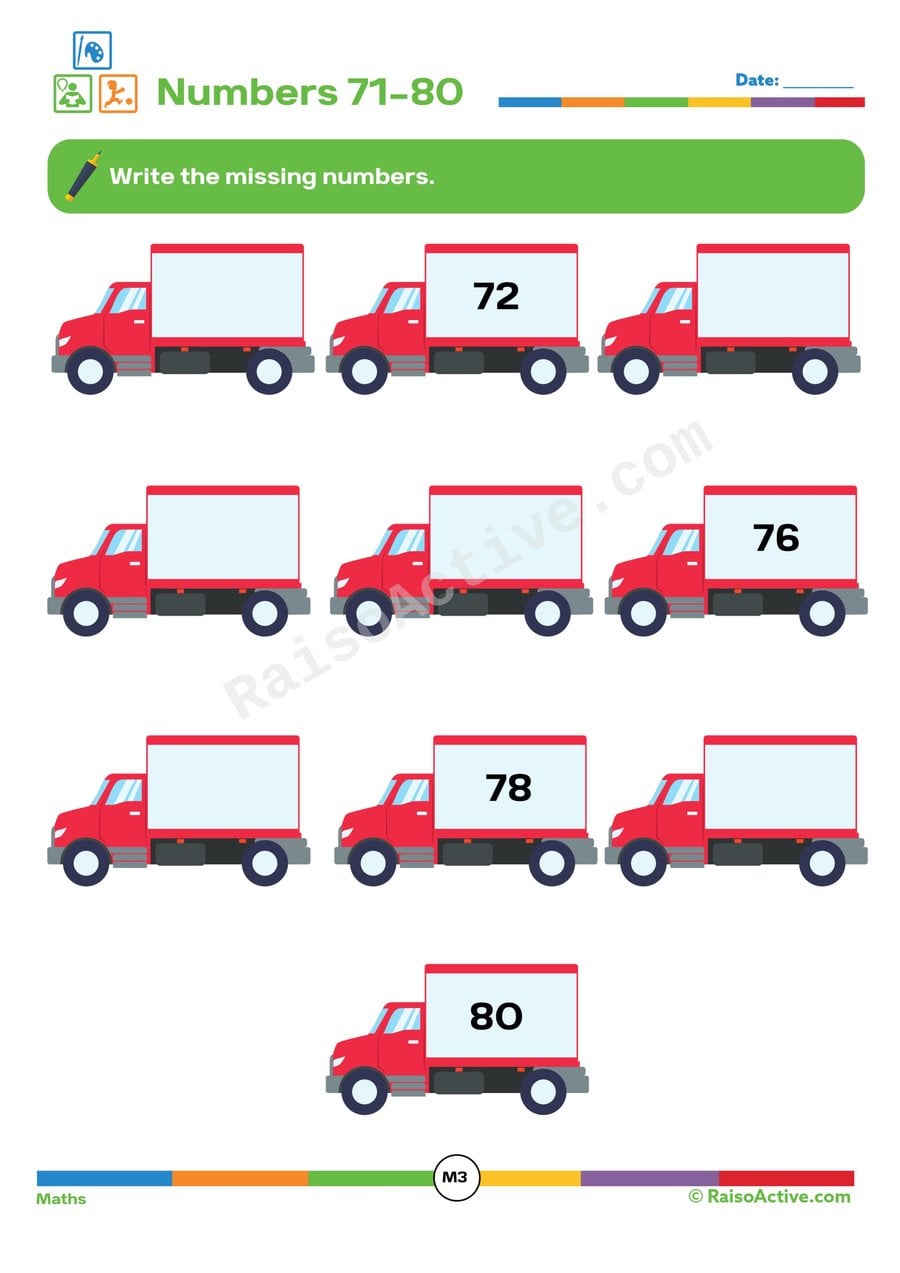
Missing Numbers: Trucks Worksheet for Kids (71-80)
Ages 4-5 · Pre-KAges 4-5 · ReceptionAges 4-5 · LKGAges 4-5
Filling in missing numbers within the 71-to-80 range asks children to hold a mental number sequence steady enough to identify a gap and supply the correct value, a more demanding task than simply counting forward from one. For ages four to five, practicing in this specific decade extends their counting range beyond the more familiar numbers under 50 while the truck theme keeps the task visually engaging.
Guides for this topic

Number Formation Rhymes 0–9 and How to Fix Reversals
Original number formation rhymes for 0–9, the correct stroke order for each digit, why 3, 5 and 7 get reversed most often, and multisensory fixes that work.

Documenting Learning Without Drowning in Data: A Practical Guide for Parents and Teachers
Learn practical ways to document your child's learning without overwhelm. Simple portfolios, observation tips, and printable trackers for ages 1-8.

How to Help Your Child with Letter Reversals: A Complete Guide for Parents and Teachers
Letter reversals are normal until age 7-8. Learn the best multisensory strategies, anchor letter tricks, and activities to help children write b, d, p, and q correctly.
Reviews
Every worksheet for ages 4–5, no watermark
Members download the full library of 1,000+ worksheets and every activity pack without watermarks or daily limits. One year costs ₹999 in India or $20 elsewhere.
See membership plansOr download any worksheet free with a watermark (5 a day).