Cupcake Number Sequencing Worksheet 1-30
Children ages 4-6 practice number sequencing from 1 to 30 by cutting out numeral pieces and pasting them onto cupcakes in ascending order, reinforcing both number recognition and the logic of 'what comes next' in the counting sequence. This bridges the gap between counting by rote and truly understanding number order, an essential step before children can skip-count or do simple addition.
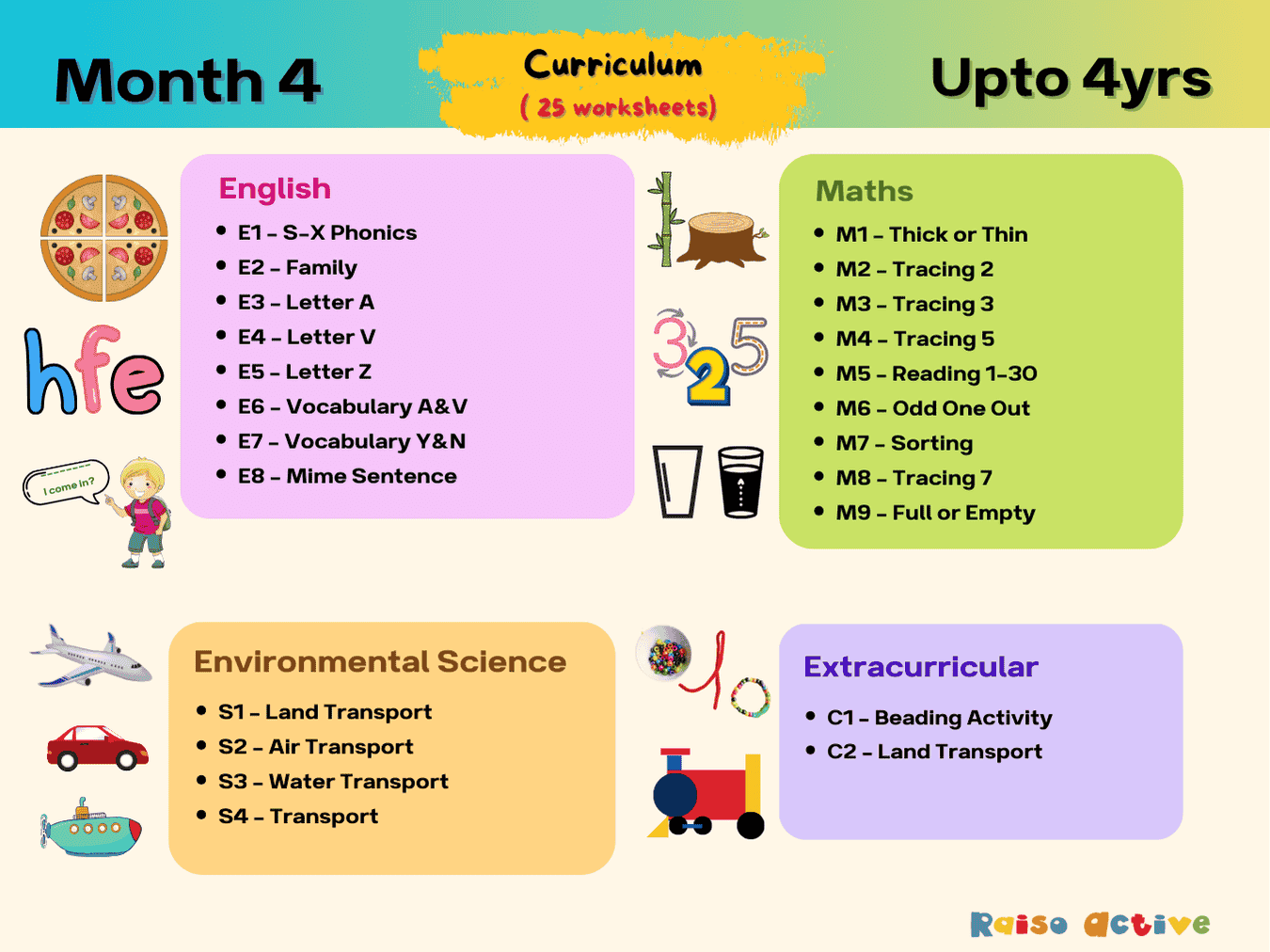
Part of the pack
Month 4: Learning & Development | Ages Up to 4
This is page 18 of the pack. Ages 2-4 · PreschoolAges 2-4 · NurseryAges 2-4

Made for your child
Counting to 10, made for your child
A maths pack with your child's name in it: pictures that explain, practice at three levels, puzzles and story sums about them. Print a new set whenever they finish.
Make a maths packFree preview · free for members
Curriculum
- Number Sense > Number Sequencing
How to use this worksheet
First, have your child cut out each numbered cupcake topper carefully along the lines. Spread the pieces out so all the numbers are visible, then ask your child to find number 1 and place it on the first cupcake without gluing yet. Continue finding and laying out each number in order up to 30, checking the full sequence together before gluing each piece down permanently.
Materials needed
- Scissors
- Glue
- Pencil
Extension activities
- 1Lay out number cards 1-30 out of order and race to put them back in sequence.
- 2Count aloud from 1 to 30 every day during a routine like brushing teeth or a car ride.
- 3Hide numbered cupcake cutouts around the room and have your child collect and sequence them.
- 4Skip a few numbers on purpose and ask your child to spot which ones are missing.

Written by
Hemsweta Jain · Teacher Cheena
MBA and Early Childhood Educator, teaching since 2014 · Founder of RaisoActive, Mumbai
Every RaisoActive worksheet is designed and checked by the founder before publishing.
Published · Last reviewed
More from Month 4: Learning & Development | Ages Up to 4

Letter A Tracing Worksheet: Learn to Write and Color!
Ages 3-5 · Preschool–Pre-KAges 3-5 · Nursery–ReceptionAges 3-5 · Nursery–LKGAges 3-5
Tracing the uppercase letter A builds the fine motor control and stroke memory children ages 3-5 need for handwriting, while coloring pictures that start with A connects the written letter to its spoken sound and familiar objects. Repeating the tracing after the picture activity provides extra reinforcement of correct letter formation.
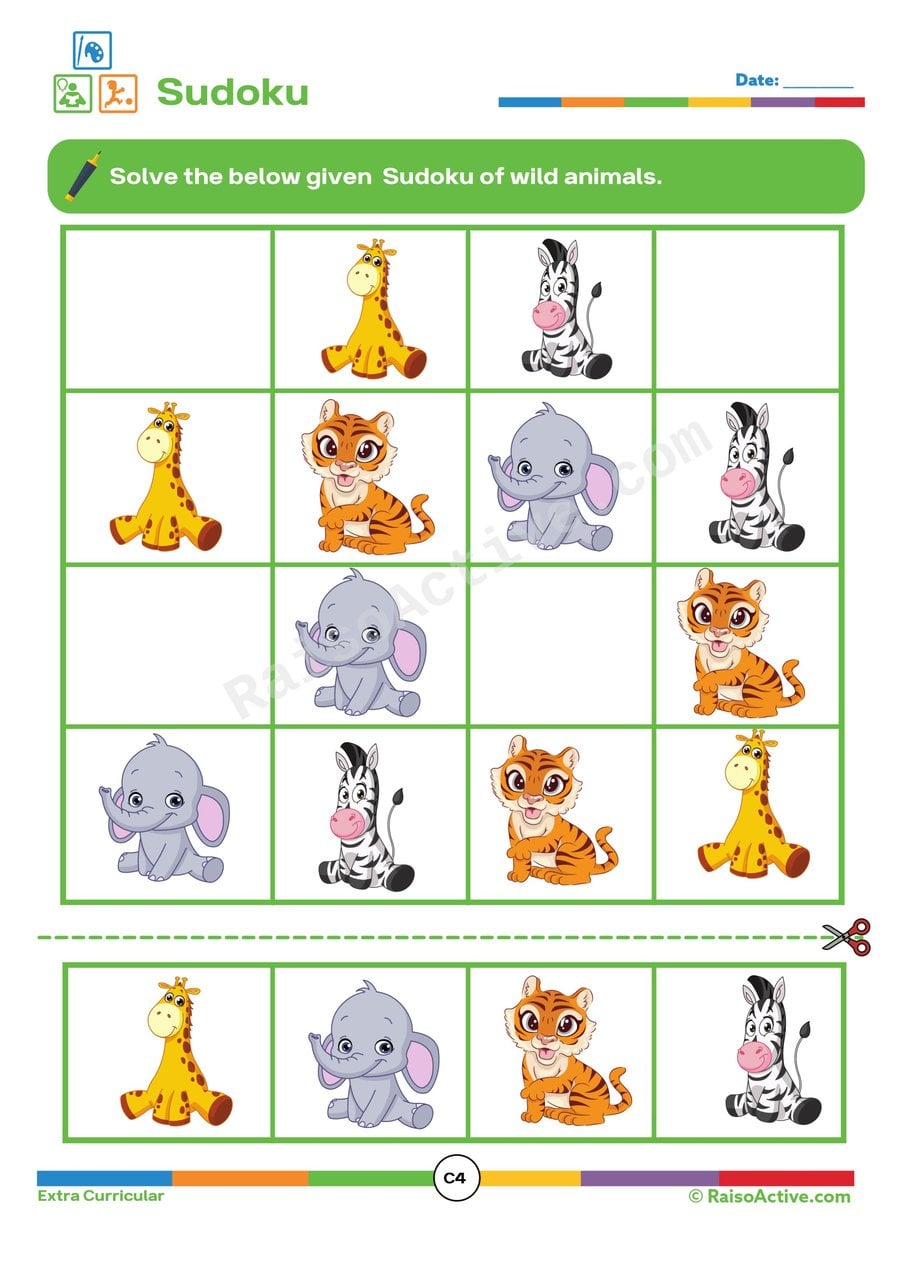
Wild Animals Sudoku Worksheet for Kids
Ages 4-6 · Pre-K–KindergartenAges 4-6 · Reception–Year 1Ages 4-6 · LKG–UKGAges 4-6
Solving a picture sudoku with wild animals introduces children ages 4-6 to early logical reasoning, since each animal can only appear once in every row, column, and small grid, requiring careful process of elimination. This puzzle format builds problem-solving stamina and visual discrimination in a format that feels like play rather than a typical worksheet.

Pattern Power! What Comes Next? Worksheet for Preschoolers
Ages 3-5 · Preschool–Pre-KAges 3-5 · Nursery–ReceptionAges 3-5 · Nursery–LKGAges 3-5
This worksheet builds pattern recognition, an early algebraic thinking skill, as children ages 3-5 study a repeating sequence of shapes, letters, or numbers and figure out what belongs next. Spotting what repeats and predicting what comes after it trains logical reasoning and attention to detail that later transfers directly to math sequences and number patterns.

Fun Parent's Guide: Vocabulary, Phonics, and Animal Activities!
Ages 3-5 · Preschool–Pre-KAges 3-5 · Nursery–ReceptionAges 3-5 · Nursery–LKGAges 3-5
This parent's guide bundles together activities for vocabulary building, phonics practice, and animal-themed learning, giving children ages 3-5 varied exposure to language concepts like left and right, letter-object matching, and number sorting through hands-on play. Because the activities span several skill areas, the guide offers flexibility to match whatever your child is most interested in on a given day.

Farm Animal Fun: Cut and Paste Worksheet for Preschoolers
Ages 3-5 · Preschool–Pre-KAges 3-5 · Nursery–ReceptionAges 3-5 · Nursery–LKGAges 3-5
Coloring, cutting, and pasting farm animals onto a scene teaches children ages 3-5 farm animal vocabulary while giving substantial fine motor practice through careful cutting along lines. Building the completed farm scene also lets children practice spatial placement, deciding where each animal fits within the picture.
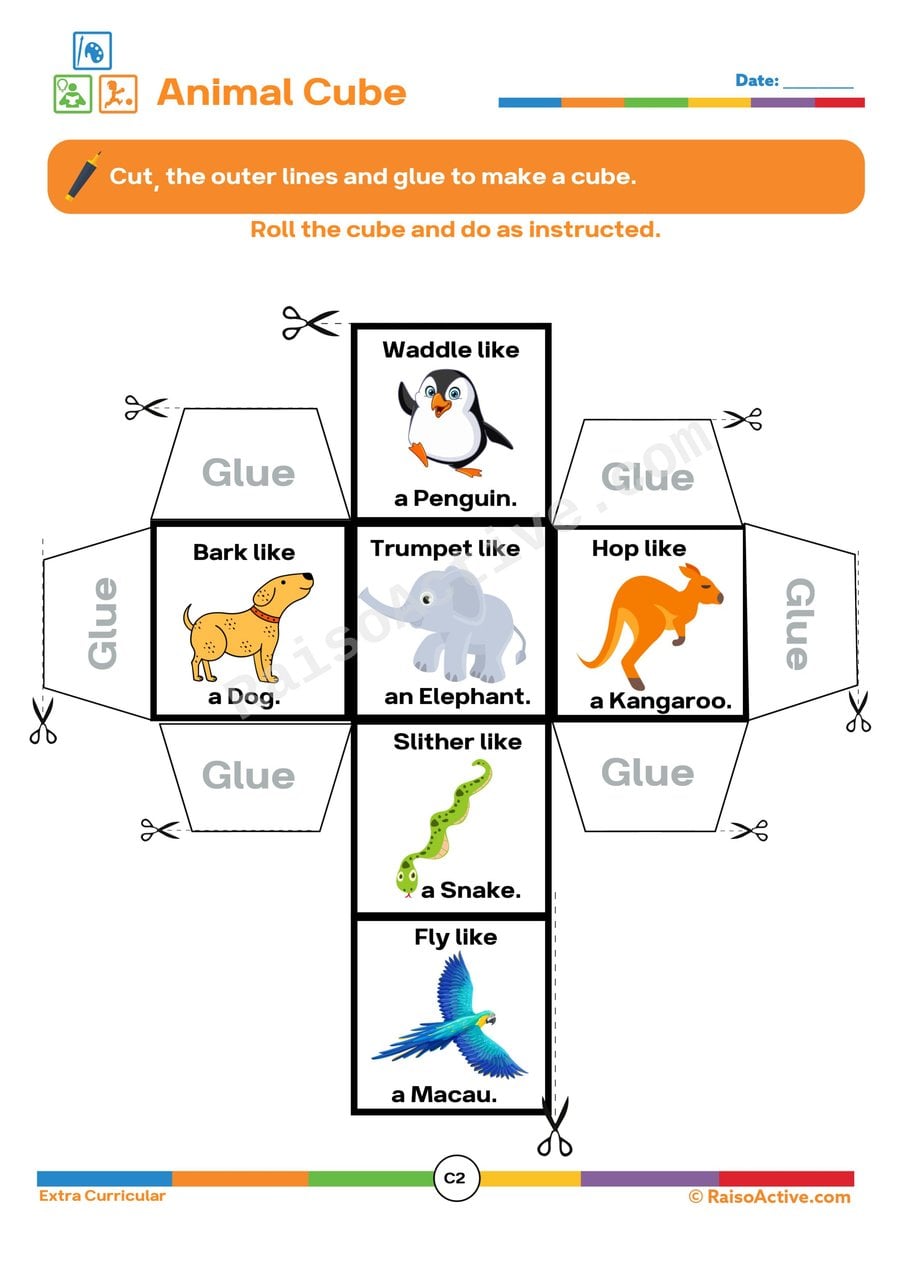
Animal Cube: Cut, Glue, and Learn!
Ages 3-5 · Preschool–Pre-KAges 3-5 · Nursery–ReceptionAges 3-5 · Nursery–LKGAges 3-5
Children ages 3-5 practice following a multi-step assembly sequence as they cut out a net, fold it, and glue the tabs to build a 3D cube featuring different animals, then use it as a game piece to review animal names and sounds. Assembling a flat shape into a 3D object also introduces early spatial reasoning about how 2D shapes fold into 3D forms.

Clean or Dirty Sorting Worksheet for Preschoolers
Ages 3-5 · Preschool–Pre-KAges 3-5 · Nursery–ReceptionAges 3-5 · Nursery–LKGAges 3-5
Sorting pictures into clean and dirty categories teaches children ages 3-5 to make observational judgments and apply reasoning about hygiene, rather than simply naming what they see. Drawing a happy or sad face for each choice also adds an element of emotional expression to what is otherwise a straightforward sorting task.

Old MacDonald Farm Animal Rhyme Cut and Paste Worksheet
Ages 3-5 · Preschool–Pre-KAges 3-5 · Nursery–ReceptionAges 3-5 · Nursery–LKGAges 3-5
This worksheet connects a familiar nursery rhyme to print as children ages 3-5 cut out pictures of farm animals and paste them into the boxes that match the song's lyrics, linking spoken language to sequence and print concepts. Following the song's order while placing pictures also supports early reading comprehension — understanding that a story or song follows events in a specific order.
Related worksheets

Descending Order Snail Puzzle Worksheet for Preschoolers
Ages 3-5 · Preschool–Pre-KAges 3-5 · Nursery–ReceptionAges 3-5 · Nursery–LKGAges 3-5
Arranging cut-out puzzle pieces from the highest number down to the lowest asks children ages 3-5 to apply number order in the reverse direction from typical ascending counting, a genuinely different and more challenging skill than counting up. This descending-order practice deepens overall number sense, since children must compare values rather than just recite a memorized forward sequence. The reveal of a hidden picture once the pieces are correctly ordered adds a rewarding, motivating payoff to an otherwise abstract number task.

Recite Numbers Worksheet: Connect the Dots and Practice Number Sequencing!
Ages 3-5 · Preschool–Pre-KAges 3-5 · Nursery–ReceptionAges 3-5 · Nursery–LKGAges 3-5
Children ages 3-5 practice number sequencing and recitation as they connect numbered dots in order to reveal a hidden picture, reinforcing both number recognition and the ability to count forward smoothly without skipping. Saying each number aloud while connecting it also builds the verbal counting fluency children need before they can count objects accurately.
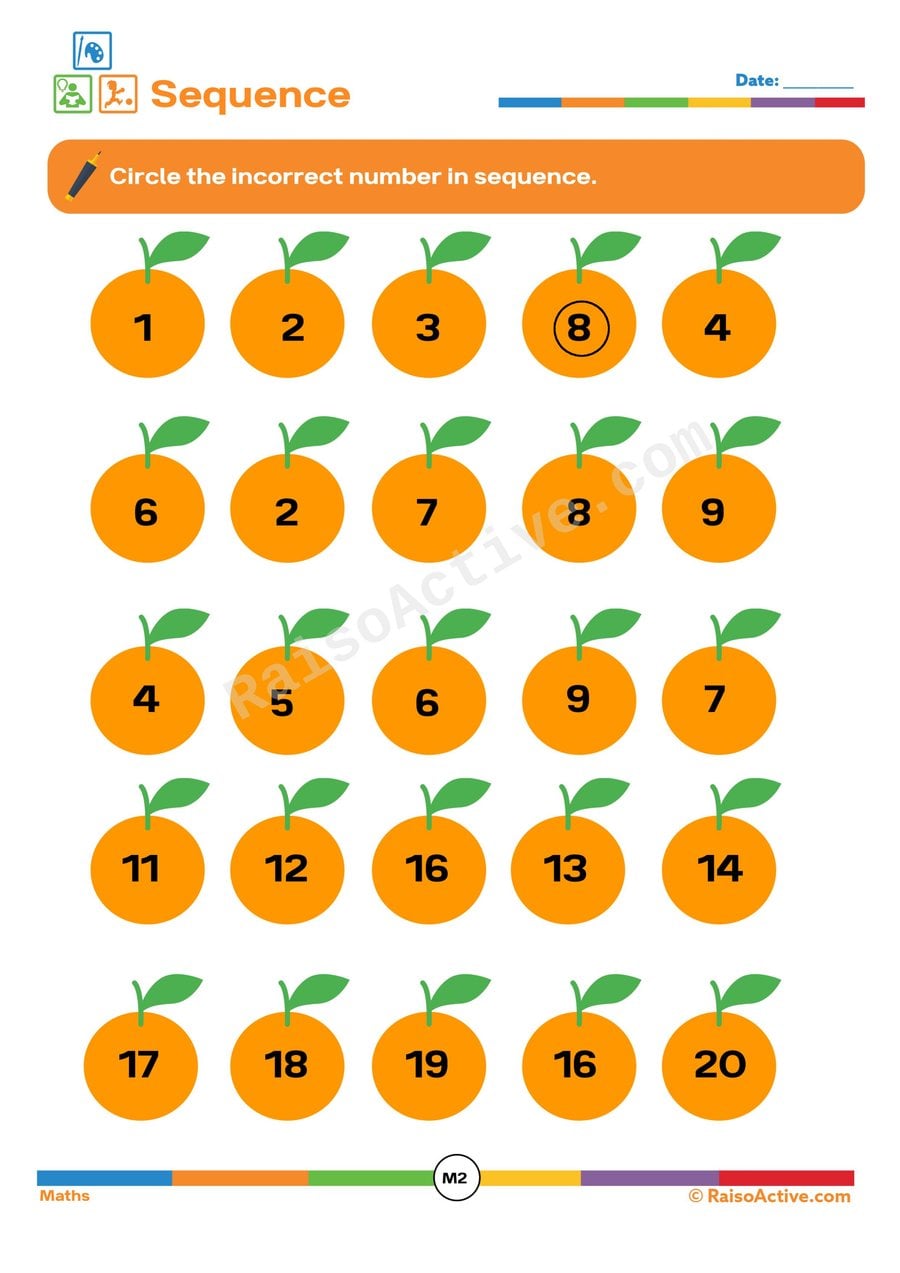
Sequence Worksheet: Find the Incorrect Number!
Ages 4-5 · Pre-KAges 4-5 · ReceptionAges 4-5 · LKGAges 4-5
This worksheet sharpens number pattern recognition by having children scan a row of numbers in sequence and spot the one number that breaks the pattern. For four- and five-year-olds, this kind of 'odd one out' task requires holding the counting sequence in mind while comparing it against what's actually written, building both number sense and early attention to detail.

Before and After Numbers Worksheet: Counting Bananas!
Ages 4-5 · Pre-KAges 4-5 · ReceptionAges 4-5 · LKGAges 4-5
Figuring out which number comes immediately before and after a given number strengthens children ages 4-5's understanding of number order and the counting sequence, a concept that's more abstract than simply counting objects one by one. Coloring a matching number of bananas for each answer adds a concrete, visual check, letting children confirm their number sense by physically representing the quantity. This worksheet bridges rote number-sequence memorization with real quantity understanding.
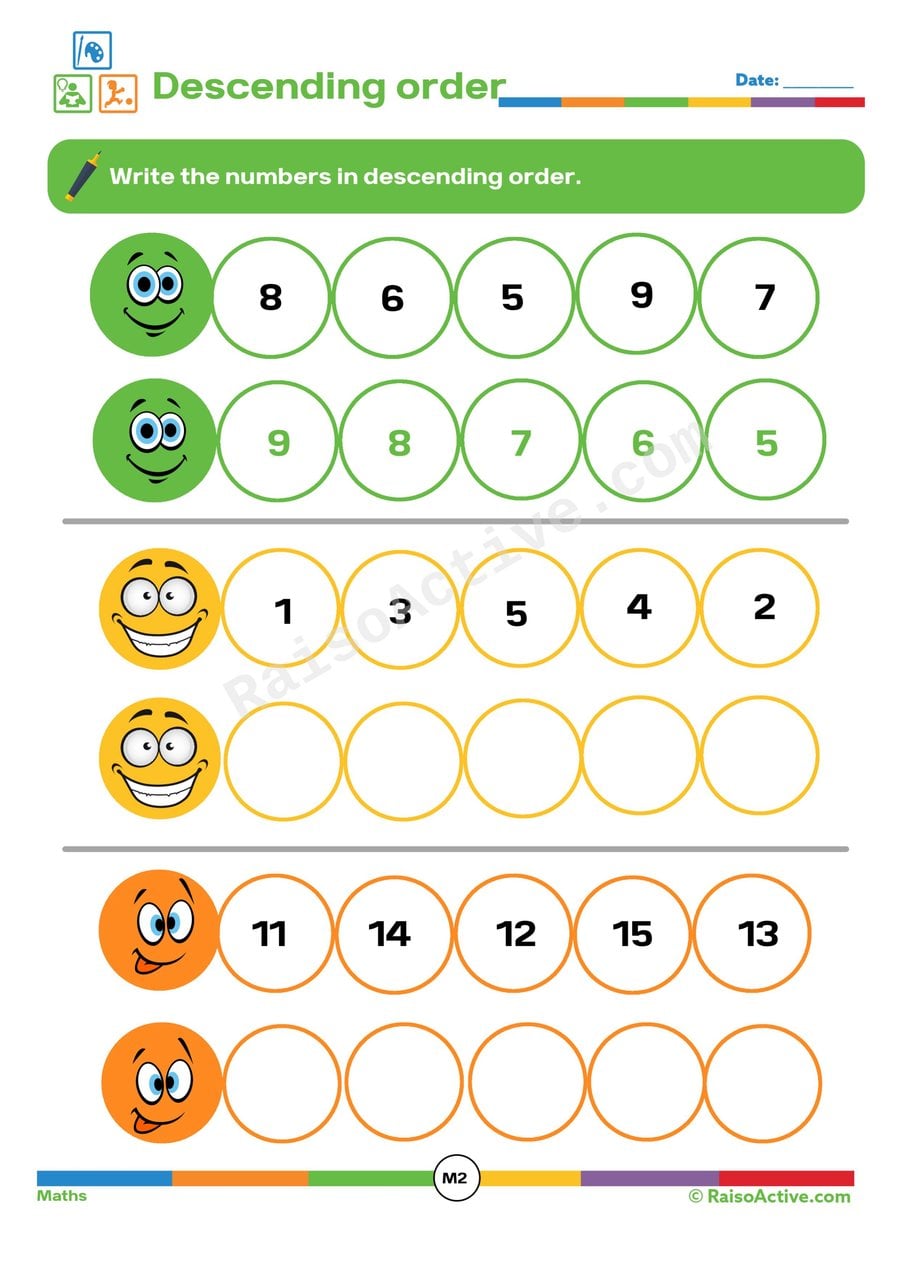
Descending Order Worksheet: Numbers 5-15
Ages 4-5 · Pre-KAges 4-5 · ReceptionAges 4-5 · LKGAges 4-5
Writing numbers in descending order asks 4-5 year olds to hold a full sequence in mind and reverse it — a genuinely different mental task from the more familiar ascending count, since children have to think about 'what comes before' rather than 'what comes after.' Practicing this with numbers 5 through 15 also reinforces number formation and one-to-one number-word correspondence, since each digit has to be written accurately as your child works backward.

Egg Sorting Worksheet: Count and Order the Chicks!
Ages 3-5 · Preschool–Pre-KAges 3-5 · Nursery–ReceptionAges 3-5 · Nursery–LKGAges 3-5
Cutting out and arranging numbered eggs in order builds number sequencing skills for children ages 3-5, requiring them to compare several numbers at once and place them correctly rather than just recognizing a single number in isolation. This hands-on ordering task also reinforces counting fluency, since children benefit from counting aloud as they check their arrangement.

Hopscotch Numbers 1-50 Worksheet: Fill in the Missing Numbers!
Ages 4-6 · Pre-K–KindergartenAges 4-6 · Reception–Year 1Ages 4-6 · LKG–UKGAges 4-6
This hopscotch-themed worksheet gives children ages 4-6 practice filling in missing numbers within the 1-50 range, extending their number sequencing beyond the more commonly rehearsed 1-20 range and building familiarity with two-digit number patterns like the '20s' or '30s.' Framing the numbers as a hopscotch grid connects the paper activity to a familiar physical game, helping children mentally picture themselves counting forward as they move up the grid. This kind of extended-range practice is an important bridge toward comfortable counting to 100.
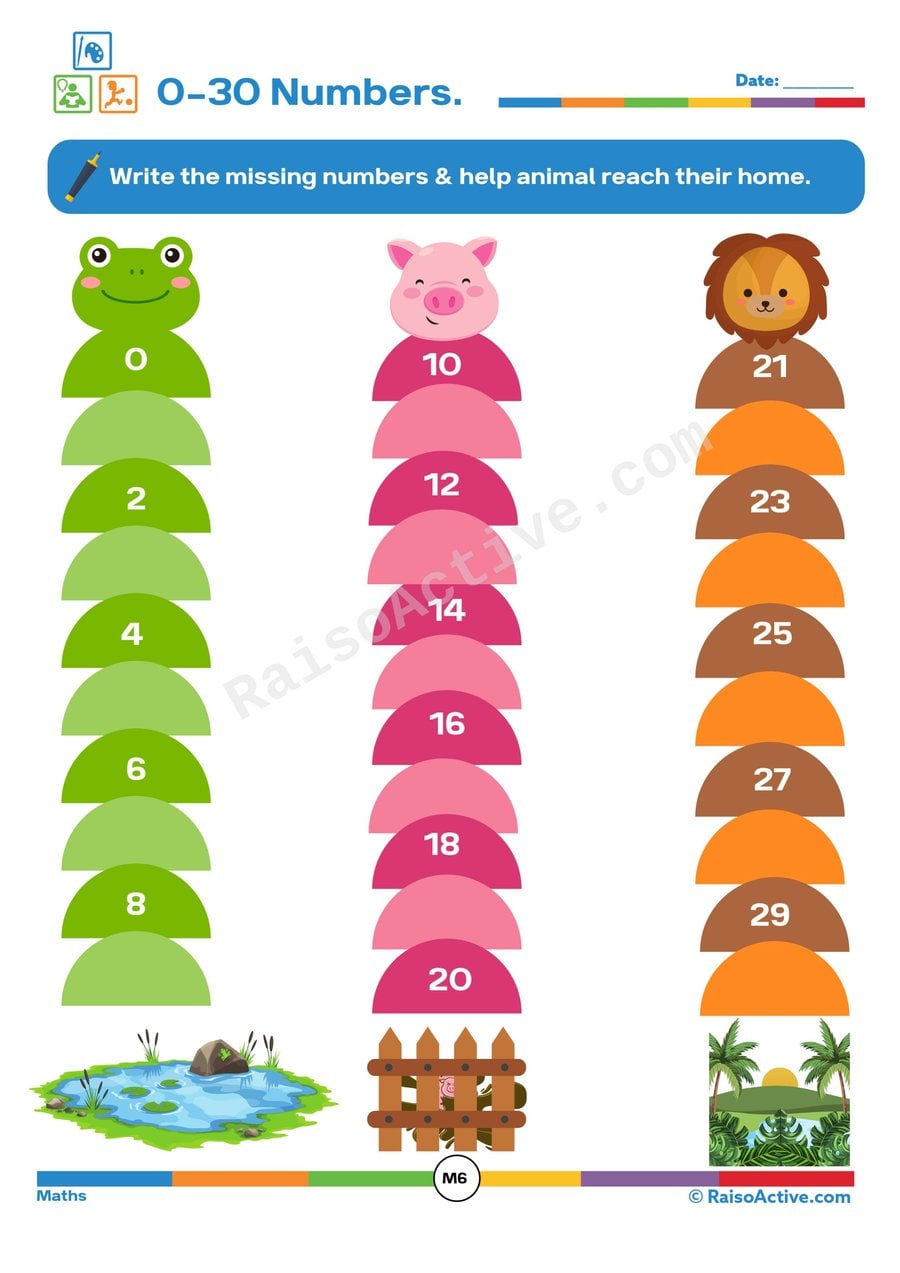
Number Fun: Missing Numbers Worksheet for Kids!
Ages 4-6 · Pre-K–KindergartenAges 4-6 · Reception–Year 1Ages 4-6 · LKG–UKGAges 4-6
Filling in missing numbers from a sequence up to 30 helps children ages 4-6 strengthen number recognition and counting-on, the skill of continuing a sequence without starting over from one each time. Completing the animal path adds a motivating storyline that encourages children to work through the full sequence.
Guides for this topic

Number Formation Rhymes 0–9 and How to Fix Reversals
Original number formation rhymes for 0–9, the correct stroke order for each digit, why 3, 5 and 7 get reversed most often, and multisensory fixes that work.

Christmas and Winter Activities That Combine Fun and Learning: Creating Magical Educational Experiences
Discover Christmas and winter activities that combine festive fun with real learning. Crafts, counting, literacy, and printable worksheets for ages 2 to 8 — perfect for home and school.
Age-Appropriate Halloween Learning Activities: Balancing Spooks and Skills for Young Learners
Discover fun, age-appropriate Halloween learning activities for young children. Spooky crafts, counting games, literacy ideas, and printable worksheets for ages 2 to 8.
Reviews
Every worksheet for ages 4–6, no watermark
Members download the full library of 1,000+ worksheets and every activity pack without watermarks or daily limits. One year costs ₹999 in India or $20 elsewhere.
See membership plansOr download any worksheet free with a watermark (5 a day).