Before and After Numbers Worksheet: Counting Bananas!
Figuring out which number comes immediately before and after a given number strengthens children ages 4-5's understanding of number order and the counting sequence, a concept that's more abstract than simply counting objects one by one. Coloring a matching number of bananas for each answer adds a concrete, visual check, letting children confirm their number sense by physically representing the quantity. This worksheet bridges rote number-sequence memorization with real quantity understanding.

Part of the pack
Month 10: Learning & Development | Ages Up to 4
This is page 13 of the pack. Ages 2-4 · PreschoolAges 2-4 · NurseryAges 2-4
Made for your child
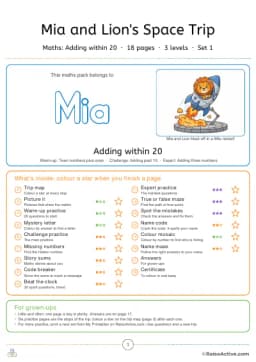
Counting to 10, made for your child
A maths pack with your child's name in it: pictures that explain, practice at three levels, puzzles and story sums about them. Print a new set whenever they finish.
Make a maths packFree preview · free for members
Curriculum
- Number Sense > Number Sequencing
How to use this worksheet
Look at the first given number together and ask your child what number comes right before it, then what number comes right after it, saying the full sequence out loud (for example, 'four, five, six'). Have your child write the before and after numbers in the blank spaces provided. Next, have them count out and color that many bananas to match the number they just wrote, checking that the banana count matches the numeral. Repeat the process for each number sequence on the page, encouraging your child to say the sequence aloud each time before writing.
Materials needed
- Pencil
- Crayons
Extension activities
- 1Practice counting forward and backward out loud in the car or during a walk, stopping at random numbers to ask what comes next.
- 2Use real bananas or banana stickers to build physical number sequences on the table.
- 3Play a 'what comes before and after' game using house numbers or page numbers in a book.
- 4Create a number line on the floor with sticky notes and have your child hop to the number before or after one you call out.
- 5Draw your own fruit and write a new before-and-after number sequence to solve.

Written by
Hemsweta Jain · Teacher Cheena
MBA and Early Childhood Educator, teaching since 2014 · Founder of RaisoActive, Mumbai
Every RaisoActive worksheet is designed and checked by the founder before publishing.
Published · Last reviewed
More from Month 10: Learning & Development | Ages Up to 4

Alphabet Adventures: Complete the Vocabulary Table!
Ages 4-6 · Pre-K–KindergartenAges 4-6 · Reception–Year 1Ages 4-6 · LKG–UKGAges 4-6
This worksheet helps children ages 4-6 strengthen letter-picture-word associations by filling in missing letters, finding matching pictures for each letter, and pasting them into a vocabulary table. Combining letter recall, picture matching, and gluing into one multi-step task pushes children beyond simple letter recognition into actively building and organizing vocabulary, an important step toward independent reading and writing.

Healthy Habits Game: Roll the Dice and Practice Good Manners!
Ages 3-5 · Preschool–Pre-KAges 3-5 · Nursery–ReceptionAges 3-5 · Nursery–LKGAges 3-5
This dice-based board game teaches children ages 3-5 healthy habits and polite social language by combining movement, counting, and speaking practice in one activity. Rolling the dice and counting spaces builds number recognition and one-to-one counting, while landing on speaker icons gives structured practice saying polite phrases like 'please' and 'thank you' out loud. Coloring a smiley or sad face based on the habit shown also reinforces the idea that choices have positive or negative consequences.

Animal's World: Count and Identify Animals Worksheet for Kids
Ages 3-5 · Preschool–Pre-KAges 3-5 · Nursery–ReceptionAges 3-5 · Nursery–LKGAges 3-5
Counting the total number of animals in a picture builds one-to-one correspondence and number-writing practice for children ages 3-5, while circling the food each animal eats adds an early science layer about animal diets and habitats. Combining a counting task with an animal-knowledge task in one worksheet keeps children engaged across two different types of thinking, numerical and factual, within a single page. This variety helps maintain focus better than a single repetitive task might at this age.

Shape Counting Fun: Trace, Color, and Count the Shapes!
Ages 3-5 · Preschool–Pre-KAges 3-5 · Nursery–ReceptionAges 3-5 · Nursery–LKGAges 3-5
Tracing a dotted boat outline builds pencil control in children ages 3-5, while coloring the completed picture adds a creative, low-pressure finishing step. Counting the different shapes that make up the boat afterward connects shape recognition to number writing, since children must identify each shape type, tally how many appear, and record that total in a box. Combining tracing, coloring, and counting into one worksheet gives a well-rounded mix of fine motor and early math practice in a single sitting.
Shape Pattern Worksheet for Preschoolers
Ages 3-5 · Preschool–Pre-KAges 3-5 · Nursery–ReceptionAges 3-5 · Nursery–LKGAges 3-5
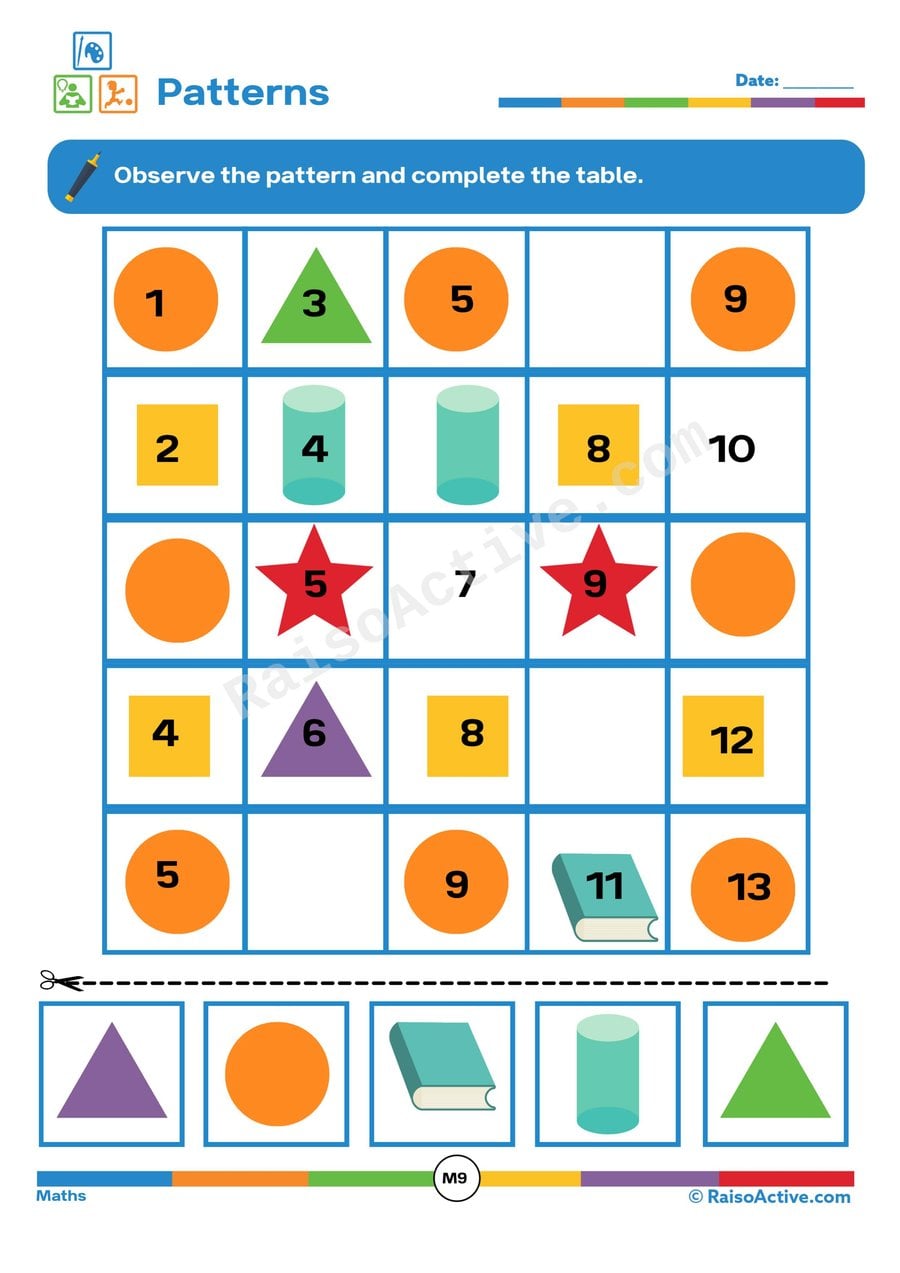
This worksheet asks children ages 3-5 to study a repeating sequence of shapes and continue the pattern by drawing the shape that logically comes next in each row. Extending a pattern rather than just identifying one requires a bit more reasoning than simple recognition, since children must hold the rule in mind and apply it to produce a new correct answer rather than choosing from options.

Sorting Numbers Worksheet: Match the Number to the Picture!
Ages 3-5 · Preschool–Pre-KAges 3-5 · Nursery–ReceptionAges 3-5 · Nursery–LKGAges 3-5
Counting objects in a picture and then pasting that picture next to its matching numeral helps children ages 3-5 connect a written number symbol to an actual quantity, which is the heart of true number sense rather than just numeral naming. Cutting out the picture pieces beforehand also builds scissor control, giving this worksheet a fine motor component alongside the counting practice. The puzzle-piece format adds a satisfying, hands-on element that keeps repetitive counting practice engaging.

Count and Match: Numbers Worksheet for Preschoolers
Ages 3-5 · Preschool–Pre-KAges 3-5 · Nursery–ReceptionAges 3-5 · Nursery–LKGAges 3-5
This worksheet builds number recognition and one-to-one counting in children ages 3-5 by having them count sets of objects and then identify or match the correct numeral. Counting stationery items and circling the matching number reinforces that a numeral represents an exact quantity, not just a symbol to memorize. Matching fruits to candy quantities on a second section adds variety and repeated practice with different object types.

Food Bingo Worksheet: Identify Healthy and Unhealthy Foods!
Ages 3-5 · Preschool–Pre-KAges 3-5 · Nursery–ReceptionAges 3-5 · Nursery–LKGAges 3-5
This bingo-style activity helps children ages 3-5 practice distinguishing healthy foods from unhealthy ones by physically placing tokens on matching pictures, turning nutrition education into an active game rather than a lecture. Scanning the board for matches also reinforces visual search skills similar to those used in matching and memory games. Because bingo requires a full row to win, children stay motivated to keep scanning and comparing even after finding a few matches.
Related worksheets
Ascending Order Worksheet: Cut and Paste Numbers!
Ages 4-6 · Pre-K–KindergartenAges 4-6 · Reception–Year 1Ages 4-6 · LKG–UKGAges 4-6
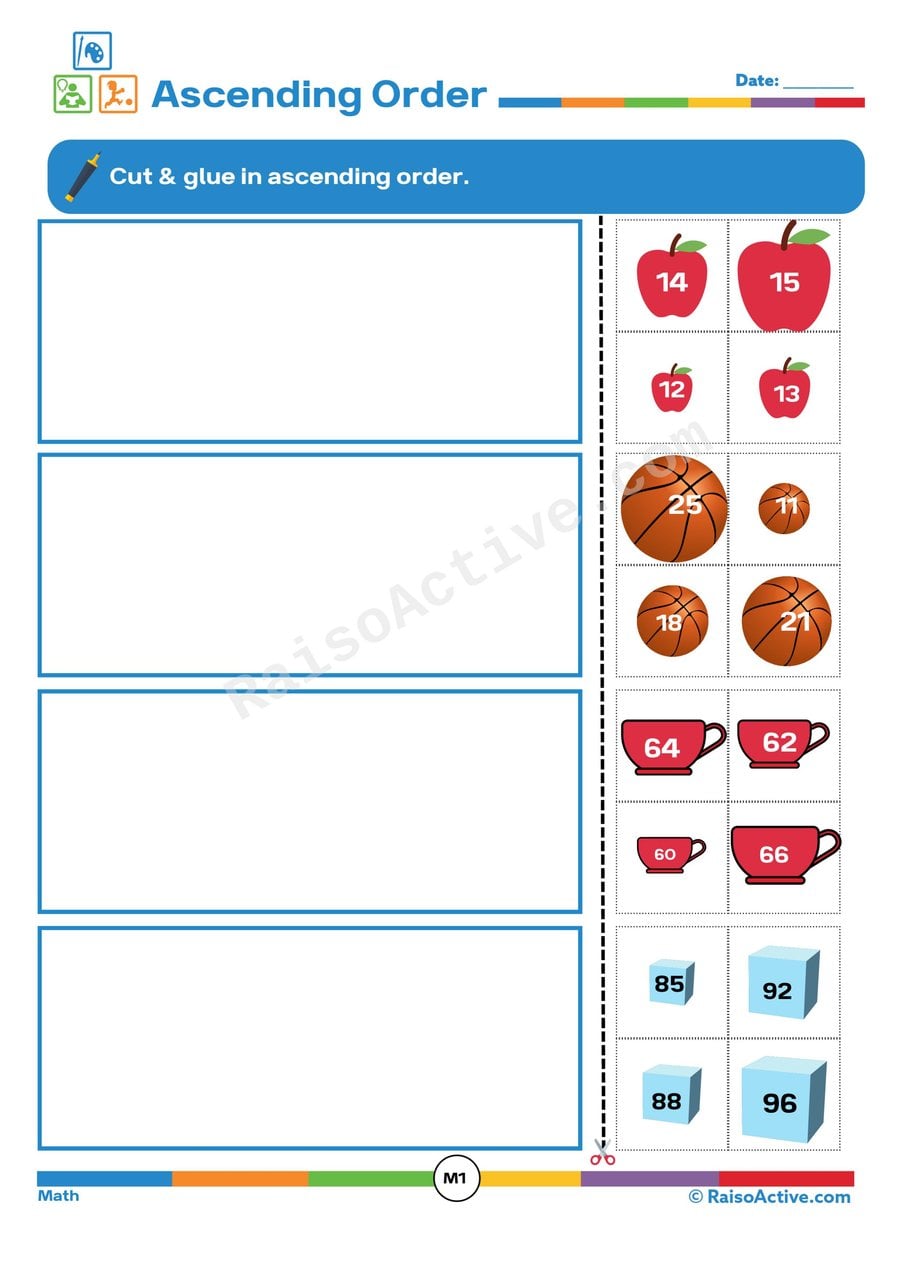
This worksheet has children ages 4-6 physically manipulate number cutouts to arrange them from least to greatest, building both number sequencing and the underlying concept that numbers represent increasing quantity. Because the numbers must be cut, sorted, and glued rather than simply read in order, this activity combines fine motor practice with active number reasoning, requiring children to compare each new number against those already placed.

Descending Order Balloons Worksheet for Preschoolers
Ages 4-6 · Pre-K–KindergartenAges 4-6 · Reception–Year 1Ages 4-6 · LKG–UKGAges 4-6
This worksheet asks children ages 4-6 to arrange the numbers on a row of balloons from largest to smallest, practicing descending order as a companion skill to the more commonly taught ascending order. Comparing several numbers at once and deciding their relative size builds a flexible sense of number magnitude that supports later skills like rounding and estimation.
Alien Maze: Skip Counting by 2s Worksheet
Ages 3-5 · Preschool–Pre-KAges 3-5 · Nursery–ReceptionAges 3-5 · Nursery–LKGAges 3-5
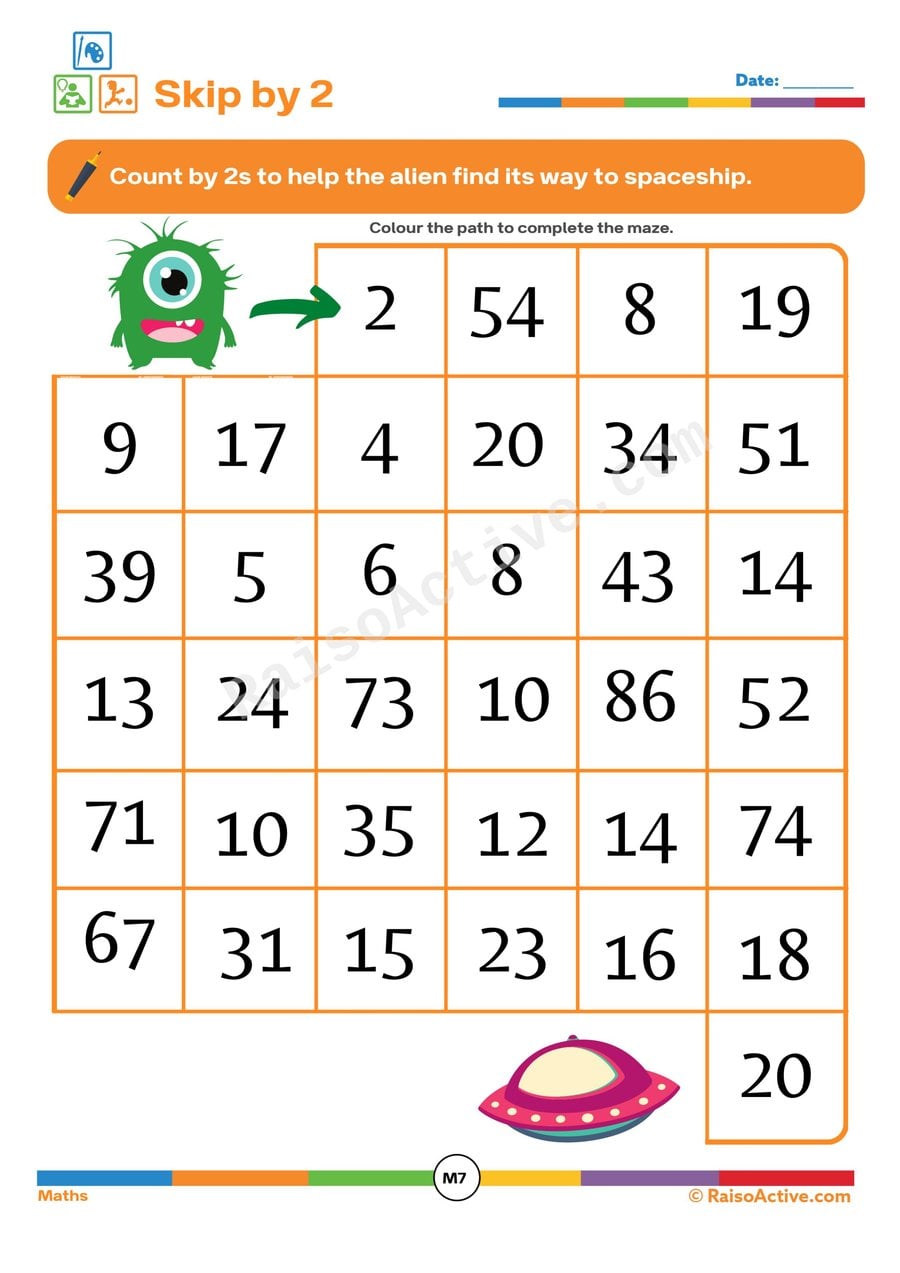
This maze worksheet combines skip counting by 2s with fine motor tracing, requiring children to find and follow the correct numerical path from number 2 up through the sequence to reach the spaceship. For ages 3-5, this pairs a physical, engaging maze format with the numeracy skill of counting by 2s, which lays groundwork for later even-number recognition and faster counting strategies.
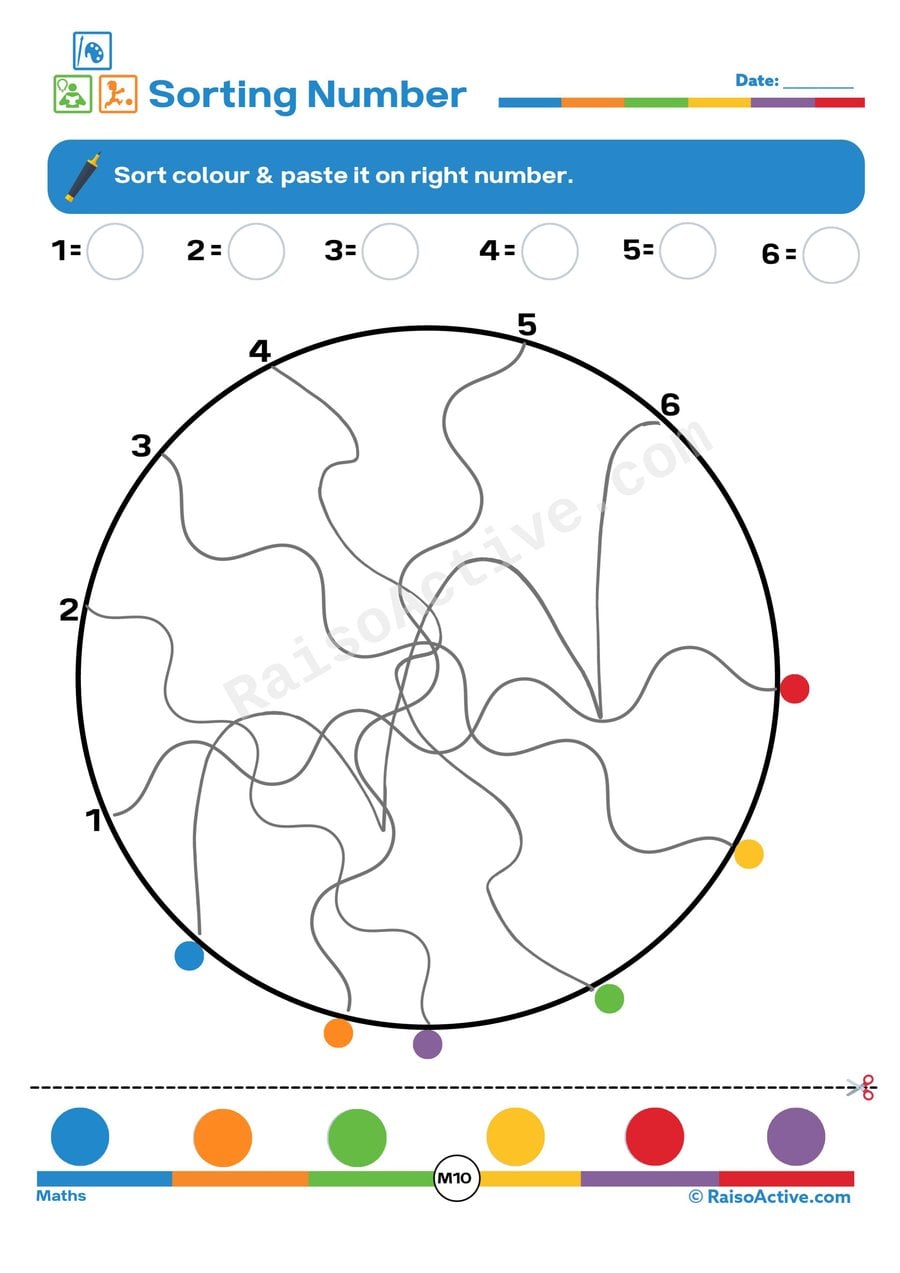
Sorting Numbers Worksheet: Color and Paste!
Ages 3-5 · Preschool–Pre-KAges 3-5 · Nursery–ReceptionAges 3-5 · Nursery–LKGAges 3-5
Children ages 3-5 practice matching quantities to written numerals by counting sets of colored dots and pasting them next to the correct number, reinforcing both counting accuracy and number recognition in a hands-on cut-and-paste format. Sorting by matching color groups to numbers also builds early visual categorization skills.

Sequencing Numbers Train Worksheet for Preschoolers
Ages 4-5 · Pre-KAges 4-5 · ReceptionAges 4-5 · LKGAges 4-5
Writing numbers 0-20 into a sequence of train cars pushes children ages 4-5 to internalize the full early counting range in fixed order, not just recite it aloud, which is a meaningfully different and more durable skill. Filling in the numbers by hand also builds numeral formation alongside sequencing, so children practice both remembering what comes next and writing it correctly. The train-car visual keeps a fairly long numeric range broken into manageable, engaging chunks rather than one intimidating list.

Ascending Order Fun: A Printable Worksheet for Numbers!
Ages 4-6 · Pre-K–KindergartenAges 4-6 · Reception–Year 1Ages 4-6 · LKG–UKGAges 4-6
Arranging numbers from smallest to largest teaches children ages 4-6 to compare quantities and understand relative magnitude, a skill that underlies later work with number lines, place value, and basic operations. It also reinforces number recognition, since children must correctly identify each numeral before they can decide where it belongs in the sequence.

Bee's Number Sequence Adventure: Coloring Numbers 0-50!
Ages 4-6 · Pre-K–KindergartenAges 4-6 · Reception–Year 1Ages 4-6 · LKG–UKGAges 4-6
Children ages 4-6 practice counting and recognizing numbers from 0 to 50 in sequence by coloring each number in order to help a bee find its way to the hive, extending number recognition well beyond the smaller ranges typically practiced at this age. Following a long numerical sequence builds persistence and reinforces counting patterns like the teens, twenties, and thirties.

Descending Order Snail Puzzle Worksheet for Preschoolers
Ages 3-5 · Preschool–Pre-KAges 3-5 · Nursery–ReceptionAges 3-5 · Nursery–LKGAges 3-5
Arranging cut-out puzzle pieces from the highest number down to the lowest asks children ages 3-5 to apply number order in the reverse direction from typical ascending counting, a genuinely different and more challenging skill than counting up. This descending-order practice deepens overall number sense, since children must compare values rather than just recite a memorized forward sequence. The reveal of a hidden picture once the pieces are correctly ordered adds a rewarding, motivating payoff to an otherwise abstract number task.
Guides for this topic

Number Formation Rhymes 0–9 and How to Fix Reversals
Original number formation rhymes for 0–9, the correct stroke order for each digit, why 3, 5 and 7 get reversed most often, and multisensory fixes that work.

Documenting Learning Without Drowning in Data: A Practical Guide for Parents and Teachers
Learn practical ways to document your child's learning without overwhelm. Simple portfolios, observation tips, and printable trackers for ages 1-8.

How to Help Your Child with Letter Reversals: A Complete Guide for Parents and Teachers
Letter reversals are normal until age 7-8. Learn the best multisensory strategies, anchor letter tricks, and activities to help children write b, d, p, and q correctly.
Reviews
Every worksheet for ages 4–5, no watermark
Members download the full library of 1,000+ worksheets and every activity pack without watermarks or daily limits. One year costs ₹999 in India or $20 elsewhere.
See membership plansOr download any worksheet free with a watermark (5 a day).