Healthy Habits Game: Roll the Dice and Practice Good Manners!
This dice-based board game teaches children ages 3-5 healthy habits and polite social language by combining movement, counting, and speaking practice in one activity. Rolling the dice and counting spaces builds number recognition and one-to-one counting, while landing on speaker icons gives structured practice saying polite phrases like 'please' and 'thank you' out loud. Coloring a smiley or sad face based on the habit shown also reinforces the idea that choices have positive or negative consequences.

Part of the pack
Month 10: Learning & Development | Ages Up to 4
This is page 23 of the pack. Ages 2-4 · PreschoolAges 2-4 · NurseryAges 2-4
Curriculum
- Health & Hygiene > Good Habits
How to use this worksheet
Take turns rolling the dice and counting the dots to determine how many spaces to move along the game path. When your child lands on a space with a speaker icon, have them say the polite words shown out loud before continuing. When they land on a space showing a habit, ask them to decide if it's a good or bad habit and color the matching smiley or sad face. Keep playing until everyone reaches the end of the path.
Materials needed
- Dice
- Pencil
- Crayons
Extension activities
- 1Create a poster at home listing the polite words practiced in the game.
- 2Role-play everyday scenarios — like asking for a toy or bumping into someone — using the polite words from the game.
- 3Make your own dice game path with new habits and polite phrases your family wants to practice.
- 4Practice counting dice dots without moving pieces, just to build number fluency.
- 5Keep a sticker chart at home for real-life moments your child uses the polite words.

Written by
Hemsweta Jain · Teacher Cheena
MBA and Early Childhood Educator, teaching since 2014 · Founder of RaisoActive, Mumbai
Every RaisoActive worksheet is designed and checked by the founder before publishing.
Published · Last reviewed
Related worksheets
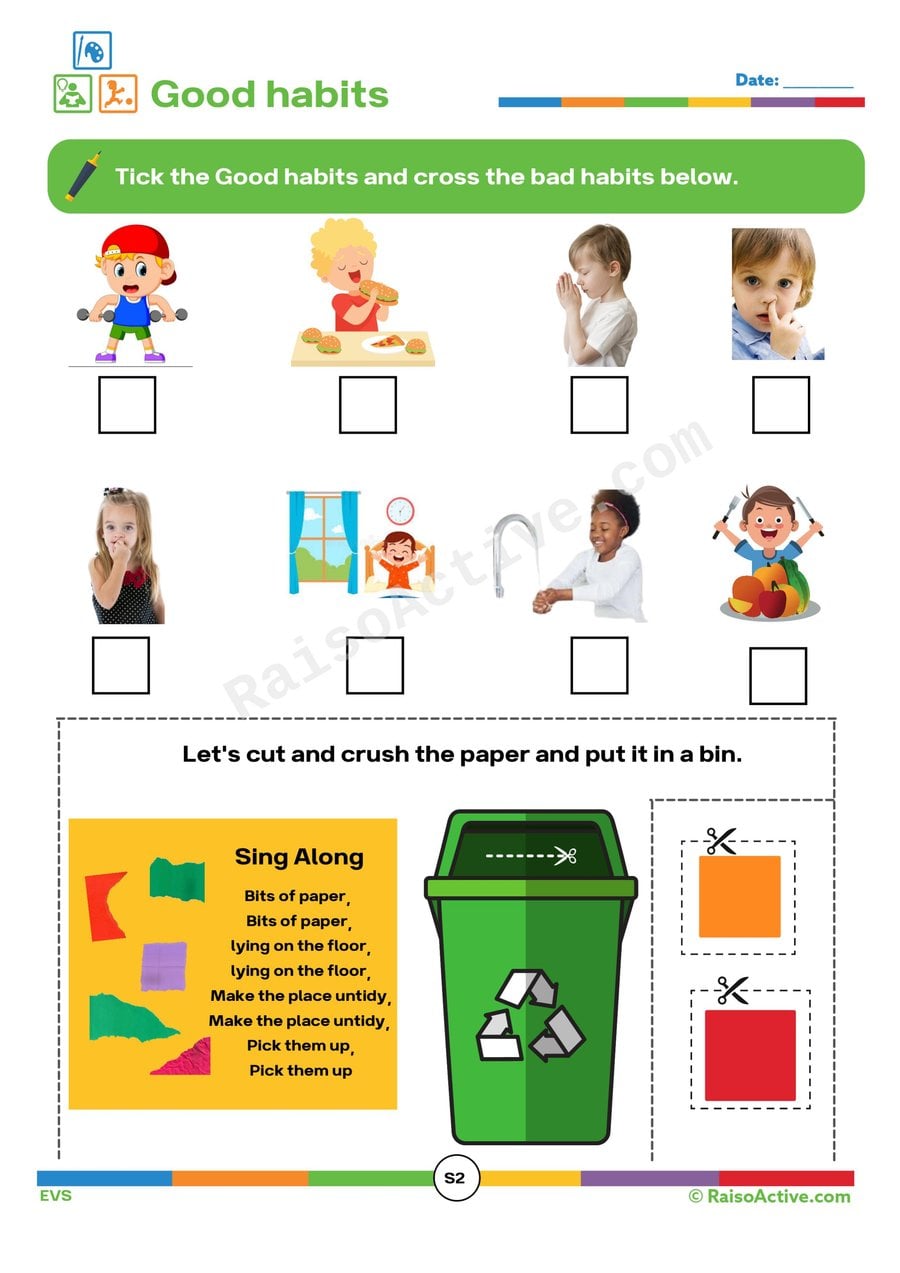
Good Habits Worksheet for Kids: Tick and Cross!
Ages 3-5 · Preschool–Pre-KAges 3-5 · Nursery–ReceptionAges 3-5 · Nursery–LKGAges 3-5
This worksheet helps children ages 3-5 practice evaluating everyday behaviors as good or bad habits using a simple tick-or-cross response system tied to cleanliness and healthy routines. Making a clear judgment call about each pictured scene builds early self-regulation awareness, helping children start to connect specific actions, like washing hands or brushing teeth, with positive outcomes. The tick-and-cross format is a quick, visual way for young children to record a decision without needing to write words.
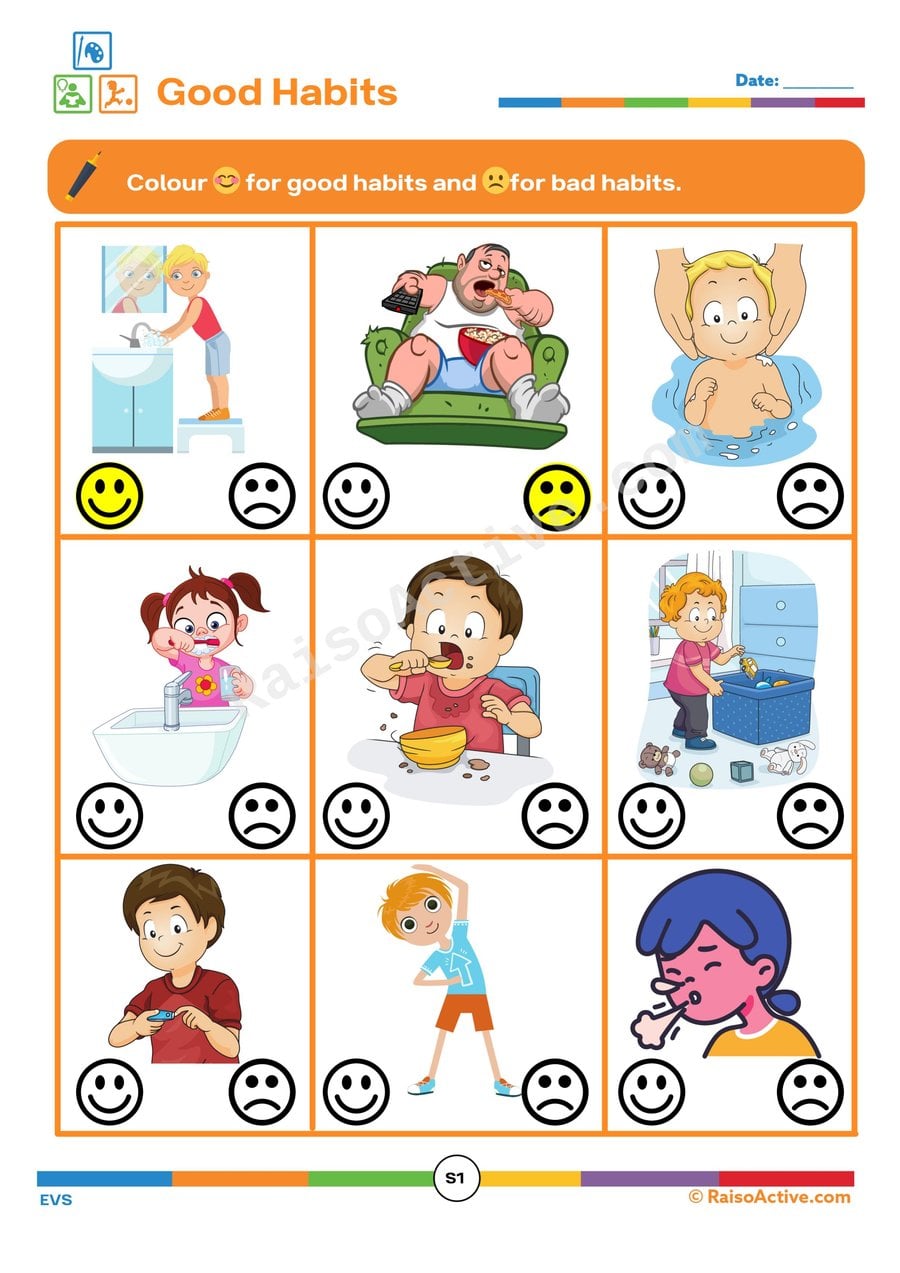
Good Habits Coloring Worksheet for Kids
Ages 3-5 · Preschool–Pre-KAges 3-5 · Nursery–ReceptionAges 3-5 · Nursery–LKGAges 3-5
This coloring activity helps children ages 3-5 practice moral and social reasoning by identifying whether a pictured behavior is a good habit or a bad one, then coloring a smiley face or a sad face to match their judgment. Making this good-or-bad decision for each picture requires children to connect an action to its likely consequence, an early form of the cause-and-effect thinking used in social-emotional learning. The simple color-coded response format also makes the activity accessible even to children who aren't yet writing independently.

Good Habits Worksheet for Kids: Circle the Correct Option!
Ages 3-5 · Preschool–Pre-KAges 3-5 · Nursery–ReceptionAges 3-5 · Nursery–LKGAges 3-5
This worksheet helps children ages 3-5 build early social-emotional judgment by looking at everyday scenes and deciding whether they show a good habit or a bad one. Making this kind of good/bad judgment about behavior, rather than just labeling objects, is an early form of moral and social reasoning that supports self-regulation later on. Using a simple thumbs-up or thumbs-down visual cue makes the abstract idea of 'good habits' concrete and easy to judge.

Healthy Habits Worksheet for Kids: Sorting Activities
Ages 3-5 · Preschool–Pre-KAges 3-5 · Nursery–ReceptionAges 3-5 · Nursery–LKGAges 3-5
This worksheet helps children ages 3-5 build early health literacy by looking at pictures of daily habits, like brushing teeth or eating vegetables, and deciding whether each one is healthy or unhealthy. Making this judgment requires applying general knowledge about wellbeing to a specific picture, which builds reasoning skills alongside foundational health awareness that supports good routines.

Good Habits Worksheet for Kids: Tick Good and Cross Bad!
Ages 3-5 · Preschool–Pre-KAges 3-5 · Nursery–ReceptionAges 3-5 · Nursery–LKGAges 3-5
This worksheet helps children ages 3-5 build early social-emotional understanding by looking at pictures of everyday behaviors and judging whether each one is a good habit or a bad habit. Making this distinction and marking it with a tick or a cross also introduces basic symbolic reasoning, since children must translate a judgment into a specific mark.

Good Habits Worksheet for Kids: Tick the Good Behaviors!
Ages 3-5 · Preschool–Pre-KAges 3-5 · Nursery–ReceptionAges 3-5 · Nursery–LKGAges 3-5
This worksheet helps children ages 3-5 identify and understand good habits and behaviors by looking at pictures paired with short descriptions and deciding which ones show positive actions. Reading or listening to the description alongside the picture also gives early practice connecting written language to real-life behavior.

Clean or Dirty Sorting Worksheet for Preschoolers
Ages 3-5 · Preschool–Pre-KAges 3-5 · Nursery–ReceptionAges 3-5 · Nursery–LKGAges 3-5
Sorting pictures into clean and dirty categories teaches children ages 3-5 to make observational judgments and apply reasoning about hygiene, rather than simply naming what they see. Drawing a happy or sad face for each choice also adds an element of emotional expression to what is otherwise a straightforward sorting task.
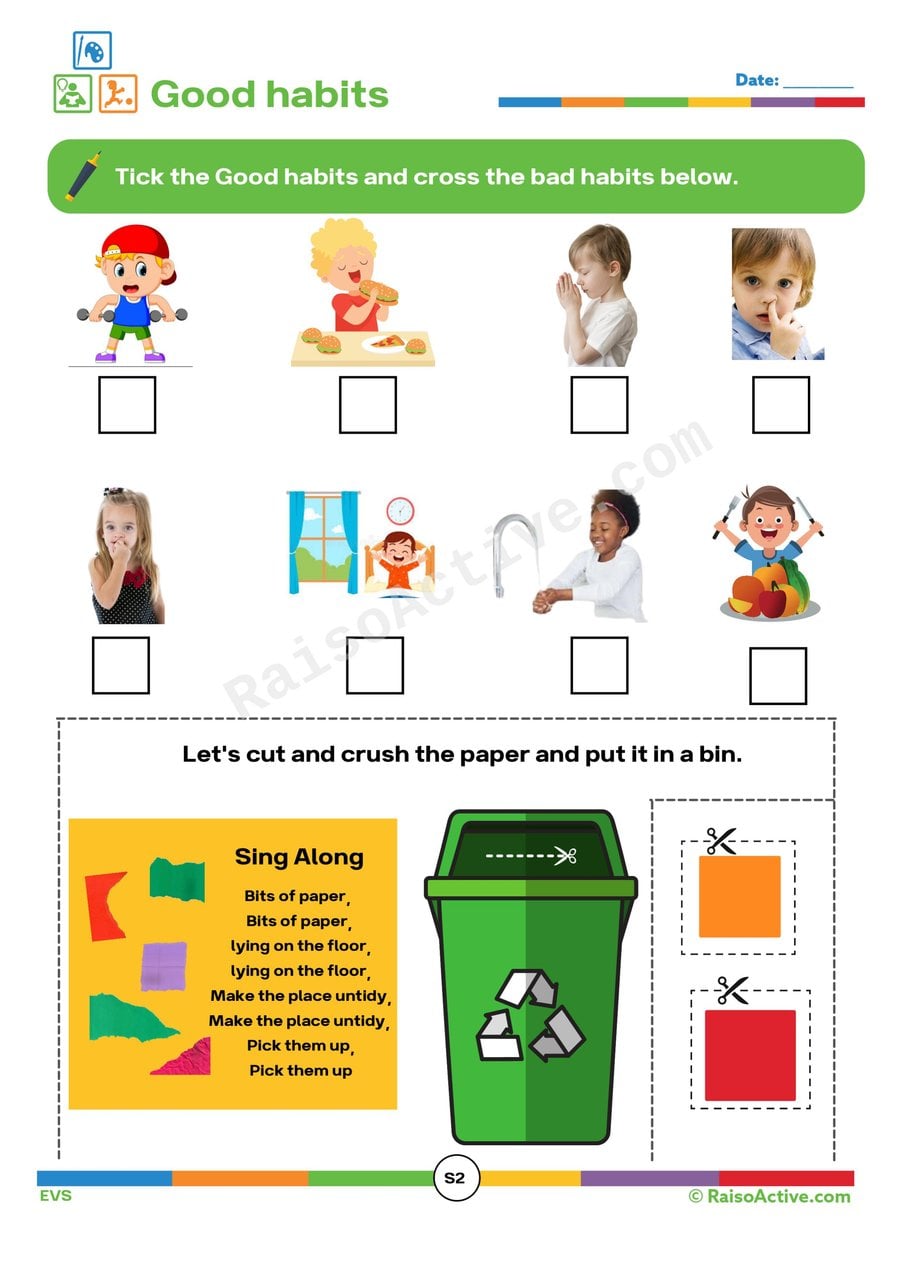
Good Habits Worksheet for Kids: Tick and Cross!
Ages 4-6 · Pre-K–KindergartenAges 4-6 · Reception–Year 1Ages 4-6 · LKG–UKGAges 4-6
Marking each pictured behavior with a tick or a cross asks children ages 4-6 to reason about whether an action is a good habit or a bad one, an early exercise in moral and social reasoning that goes beyond simple right-or-wrong memorization. Using tick and cross symbols also introduces basic symbol literacy, since children need to understand what each mark conventionally represents before they can use it correctly.
Guides for this topic

Age-Appropriate Problem-Solving Activities: Building Critical Thinkers from the Ground Up
Discover fun, age-appropriate problem-solving activities for children ages 1-8. Build critical thinking, logic, and reasoning skills through play-based learning.

Fostering Creativity in Structured Learning: The Perfect Balance for Young Minds
Learn how to blend creativity with structured learning for children ages 1-8. Practical strategies, activities, and printable worksheets for parents and teachers.
Critical Thinking Activities That Actually Work for Young Children: Building Tomorrow's Thinkers Today
Discover proven critical thinking activities for young children. Age-wise logic games, questioning techniques, and hands-on ideas to build thinking skills at home.
Reviews
Every worksheet for ages 3–5, no watermark
Members download the full library of 1,000+ worksheets and every activity pack without watermarks or daily limits. One year costs ₹999 in India or $20 elsewhere.
See membership plansOr download any worksheet free with a watermark (5 a day).