Hidden Numbers Worksheet: Find and Complete the Table!
Searching a busy picture for hidden numbers trains visual scanning and sustained attention in children ages 3-5, since numbers may be tucked into small or unexpected spots within the artwork. Completing the table with the missing numbers afterward reinforces the counting sequence and numeral recognition, requiring children to recall which numbers they've already found and figure out which ones are still missing. Together, the search-and-complete format turns basic number practice into an engaging seek-and-find challenge.

Part of the pack
Month 10: Learning & Development | Ages Up to 4
This is page 17 of the pack. Ages 2-4 · PreschoolAges 2-4 · NurseryAges 2-4
Made for your child
Counting to 10, made for your child
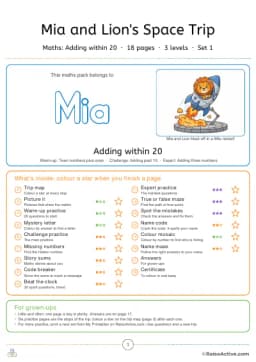
A maths pack with your child's name in it: pictures that explain, practice at three levels, puzzles and story sums about them. Print a new set whenever they finish.
Make a maths packFree preview · free for members
Curriculum
- Number Recognition > Number Tracing 1-10
How to use this worksheet
Look at the picture together and explain that numbers are hidden throughout the scene, then start scanning slowly from one corner of the page to the other. When your child spots a number, have them circle it and say the number out loud before moving on to search for the next one. Once all the hidden numbers are found, look at the table below and figure out together which numbers are still missing from the sequence. Have your child write each missing number in its correct box, checking the full sequence out loud when finished.
Materials needed
- Pencil
- Crayons
Extension activities
- 1Hide number cards or sticky notes around a room and send your child on a real hidden-number hunt.
- 2Create your own picture with hidden numbers drawn into the background for someone else to find.
- 3Practice writing the full number sequence from one to ten (or beyond) on a blank sheet for extra reinforcement.
- 4Use a magnifying glass for extra fun while searching the picture for hidden numbers.
- 5Play a memory game trying to recall the order in which the numbers were found.

Written by
Hemsweta Jain · Teacher Cheena
MBA and Early Childhood Educator, teaching since 2014 · Founder of RaisoActive, Mumbai
Every RaisoActive worksheet is designed and checked by the founder before publishing.
Published · Last reviewed
More from Month 10: Learning & Development | Ages Up to 4

Cotton Bud Flower Craft Worksheet for Preschoolers
Ages 3-5 · Preschool–Pre-KAges 3-5 · Nursery–ReceptionAges 3-5 · Nursery–LKGAges 3-5
This cotton bud craft has children ages 3-5 paste cotton buds around a yellow center to build flower petals, an activity that strengthens the pincer grip and hand control needed for later pencil writing. Because each cotton bud represents one petal, the craft doubles as a counting exercise, giving children practice with one-to-one correspondence while they work. Combining a sensory material like cotton buds with a familiar shape — the flower — makes fine motor practice feel like play rather than drilling.

Parent's Guide: Fun Activities for Early Learners!
Ages 3-5 · Preschool–Pre-KAges 3-5 · Nursery–ReceptionAges 3-5 · Nursery–LKGAges 3-5
This parent's guide bundles several short, hands-on activities that build counting, shape recognition, fine motor control, and instruction-following in children ages 3-5. Rather than a single worksheet, it offers a menu of quick learning moments parents can use throughout the day, which suits the short attention spans typical of this age group. Rotating through different skill areas in one sitting also helps parents see which concepts their child grasps easily and which need more practice.

Alphabet Adventures: Complete the Vocabulary Table!
Ages 4-6 · Pre-K–KindergartenAges 4-6 · Reception–Year 1Ages 4-6 · LKG–UKGAges 4-6
This worksheet helps children ages 4-6 strengthen letter-picture-word associations by filling in missing letters, finding matching pictures for each letter, and pasting them into a vocabulary table. Combining letter recall, picture matching, and gluing into one multi-step task pushes children beyond simple letter recognition into actively building and organizing vocabulary, an important step toward independent reading and writing.

Food Bingo Worksheet: Identify Healthy and Unhealthy Foods!
Ages 3-5 · Preschool–Pre-KAges 3-5 · Nursery–ReceptionAges 3-5 · Nursery–LKGAges 3-5
This bingo-style activity helps children ages 3-5 practice distinguishing healthy foods from unhealthy ones by physically placing tokens on matching pictures, turning nutrition education into an active game rather than a lecture. Scanning the board for matches also reinforces visual search skills similar to those used in matching and memory games. Because bingo requires a full row to win, children stay motivated to keep scanning and comparing even after finding a few matches.

Healthy Habits Game: Roll the Dice and Practice Good Manners!
Ages 3-5 · Preschool–Pre-KAges 3-5 · Nursery–ReceptionAges 3-5 · Nursery–LKGAges 3-5
This dice-based board game teaches children ages 3-5 healthy habits and polite social language by combining movement, counting, and speaking practice in one activity. Rolling the dice and counting spaces builds number recognition and one-to-one counting, while landing on speaker icons gives structured practice saying polite phrases like 'please' and 'thank you' out loud. Coloring a smiley or sad face based on the habit shown also reinforces the idea that choices have positive or negative consequences.

Match the Pictures: Letter Matching Worksheet for Preschoolers
Ages 3-5 · Preschool–Pre-KAges 3-5 · Nursery–ReceptionAges 3-5 · Nursery–LKGAges 3-5
Connecting pictures to their matching letters helps children ages 3-5 build the foundation of phonics, learning that a printed letter represents the beginning sound of a spoken word. Circling the animals that specifically start with the letter B adds a second layer of practice, requiring children to apply that letter-sound knowledge rather than just matching shapes. This two-step approach moves children from simple visual matching toward true letter-sound recognition, a critical pre-reading skill.

Speak Sentences: A Fun Sentence Building Worksheet!
Ages 4-6 · Pre-K–KindergartenAges 4-6 · Reception–Year 1Ages 4-6 · LKG–UKGAges 4-6
Reading a single word on each stair step and turning it into a full spoken sentence helps children ages 4-6 practice expanding a vocabulary word into a grammatically complete thought, an important bridge between word recognition and sentence-level language. The staircase, climb-to-the-top format adds a sense of progress and motivation, encouraging children to keep going even when a particular word is tricky to build a sentence around. This oral sentence-building practice also lays groundwork for later independent sentence writing.

Scarecrow Cut and Paste Worksheet for Preschoolers
Ages 3-5 · Preschool–Pre-KAges 3-5 · Nursery–ReceptionAges 3-5 · Nursery–LKGAges 3-5
This scarecrow-building activity gives children ages 3-5 focused practice in cutting and gluing basic shapes — circles, triangles, rectangles — into place to assemble a recognizable figure. Matching each shape to its correct spot on the scarecrow outline also reinforces spatial reasoning, since children must judge size and orientation before pasting. Naming the shapes aloud as they work connects the craft to early geometry vocabulary rather than treating it as pure art time.
Related worksheets

Number Identification Worksheet: Highlight Numbers 61-70
Ages 4-6 · Pre-K–KindergartenAges 4-6 · Reception–Year 1Ages 4-6 · LKG–UKGAges 4-6
Finding and highlighting the numbers 61 through 70 in sequence within a larger number grid builds visual scanning skills alongside number recognition, since children must search among many similar-looking two-digit numbers to find the correct one in order. For ages four to six, working confidently in this higher number range extends counting fluency well beyond the more commonly practiced numbers up to 20 or 50.

Count and Match: Number Names Worksheet for Preschoolers
Ages 3-5 · Preschool–Pre-KAges 3-5 · Nursery–ReceptionAges 3-5 · Nursery–LKGAges 3-5
Children ages 3-5 practice counting groups of objects and then matching that quantity to both its written numeral and its spelled-out number word, connecting three different representations of the same amount. This triple connection between objects, numerals, and number names builds a deeper, more flexible sense of number than counting alone.

Numeracy Match: Counting and Number Recognition Worksheet
Ages 4-6 · Pre-K–KindergartenAges 4-6 · Reception–Year 1Ages 4-6 · LKG–UKGAges 4-6
Children ages 4-6 strengthen number recognition by matching written numerals to their corresponding word names or quantities, reinforcing that numbers can be represented in more than one way. This kind of numeral-to-word matching deepens number sense beyond simple counting, helping children see the relationship between symbol, word, and quantity. Coloring in their birth date personalizes the practice and connects it to something meaningful in their own life.
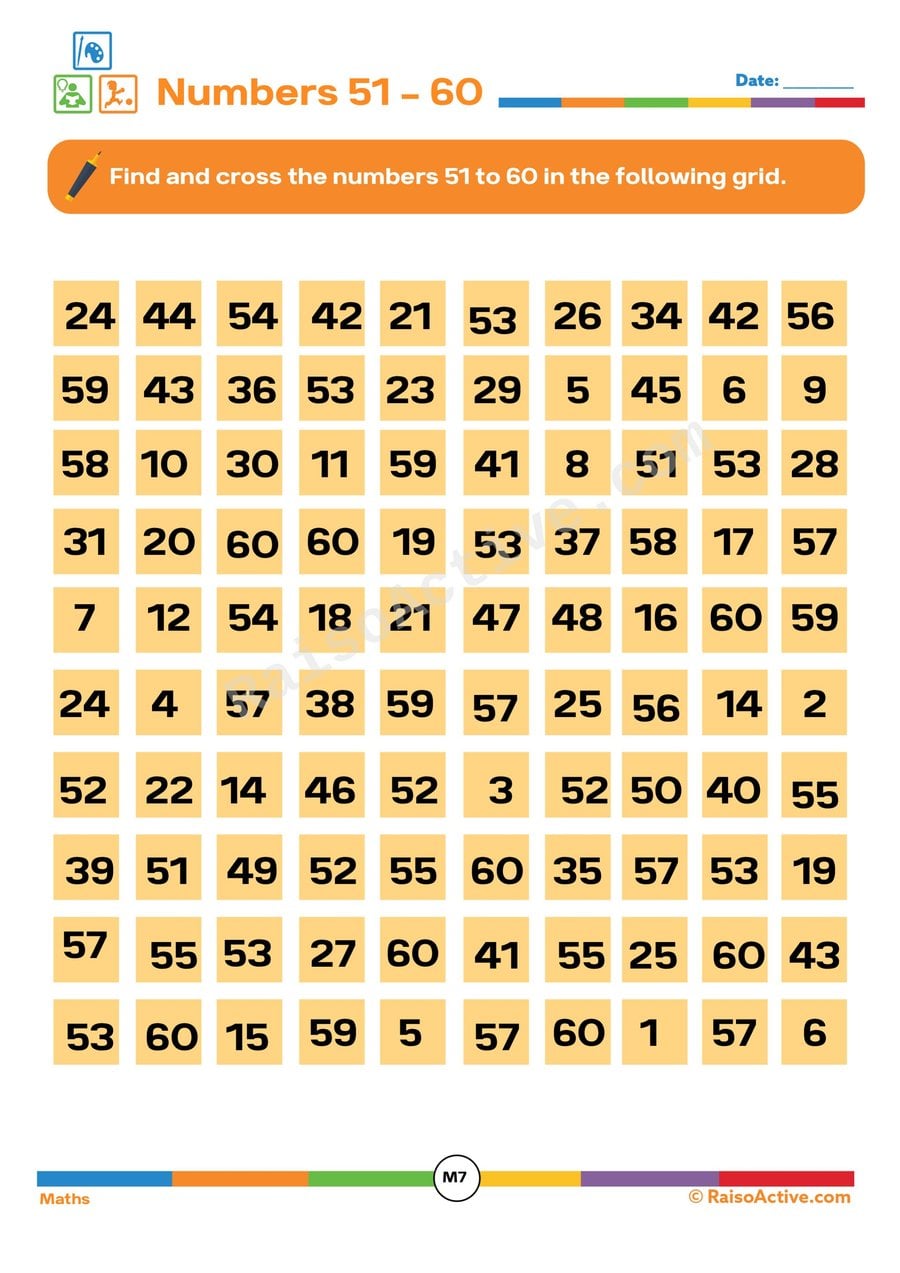
Find and Cross Numbers 51-60 Worksheet
Ages 4-5 · Pre-KAges 4-5 · ReceptionAges 4-5 · LKGAges 4-5
Hunting through a grid of numbers to find and cross out 51 through 60 trains children ages 4-5 to recognize specific two-digit numerals quickly among visually similar distractors, a scanning skill that supports both math fluency and reading readiness. This activity demands sustained visual attention, since the target numbers are scattered randomly rather than in order, unlike a simple sequencing task. It's also a fun, game-like way to reinforce number recognition without it feeling repetitive.

Identify Numbers Worksheet: Matching Numbers and Words
Ages 4-6 · Pre-K–KindergartenAges 4-6 · Reception–Year 1Ages 4-6 · LKG–UKGAges 4-6
This worksheet builds number-word recognition by having children match written number names, like 'seven,' to their corresponding numeral, 7. For four- to six-year-olds, learning to read number words alongside numerals adds an important layer to early numeracy, since numbers appear in both written-word and symbol form in books, signs, and everyday life.

Cut and Paste Number Matching Worksheet: Numbers 31-40
Ages 4-6 · Pre-K–KindergartenAges 4-6 · Reception–Year 1Ages 4-6 · LKG–UKGAges 4-6
Matching number words like thirty-one through forty to their correct numerals teaches children ages 4-6 to recognize larger two-digit numbers by both their written word form and their numeral form, extending number recognition well beyond the more familiar numbers under twenty. Cutting and pasting the matching numeral also reinforces careful visual comparison, since numbers in this range can look similar to one another.
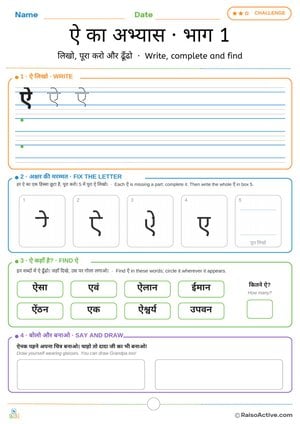
Hindi Letter ऐ (ai) Practice 1: Write, Fix the Letter and Find | ऐ का अभ्यास · भाग 1
Ages 4-7 · Pre-K–Grade 1Ages 4-7 · Reception–Year 2Ages 4-7 · LKG–Class 1Ages 4-7
A challenge page: write ऐ between the lines, complete four letters that are each missing a part and then write the whole ऐ in box 5, find ऐ in words such as ऐसा, ऐलान, ऐंठन and ऐश्वर्य, and draw a picture. ऐ is a different vowel from ए, not a long version of it.
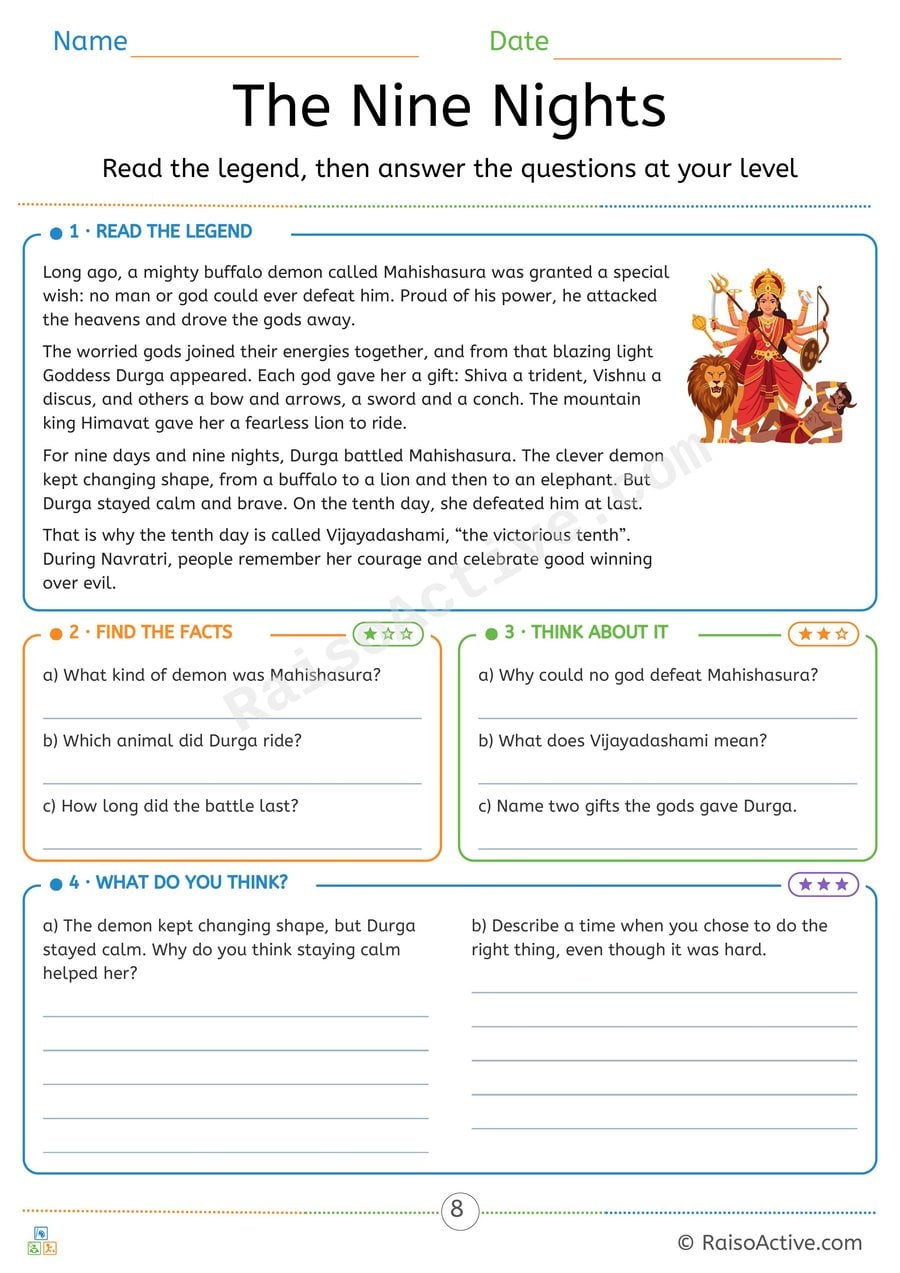
The Nine Nights: Durga and Mahishasura Reading Comprehension
Ages 7-11 · Grade 2–Grade 3Ages 7-11 · Year 3–Year 4Ages 7-11 · Class 2–Class 3Ages 7-11
Children read a retelling of the legend of Durga and Mahishasura, find facts in the text, answer inference questions about why things happened, and write their own opinion about staying calm and doing the right thing.
Guides for this topic

Number Formation Rhymes 0–9 and How to Fix Reversals
Original number formation rhymes for 0–9, the correct stroke order for each digit, why 3, 5 and 7 get reversed most often, and multisensory fixes that work.

Documenting Learning Without Drowning in Data: A Practical Guide for Parents and Teachers
Learn practical ways to document your child's learning without overwhelm. Simple portfolios, observation tips, and printable trackers for ages 1-8.

How to Help Your Child with Letter Reversals: A Complete Guide for Parents and Teachers
Letter reversals are normal until age 7-8. Learn the best multisensory strategies, anchor letter tricks, and activities to help children write b, d, p, and q correctly.
Reviews
Every worksheet for ages 3–5, no watermark
Members download the full library of 1,000+ worksheets and every activity pack without watermarks or daily limits. One year costs ₹999 in India or $20 elsewhere.
See membership plansOr download any worksheet free with a watermark (5 a day).