Speak Sentences: A Fun Sentence Building Worksheet!
Reading a single word on each stair step and turning it into a full spoken sentence helps children ages 4-6 practice expanding a vocabulary word into a grammatically complete thought, an important bridge between word recognition and sentence-level language. The staircase, climb-to-the-top format adds a sense of progress and motivation, encouraging children to keep going even when a particular word is tricky to build a sentence around. This oral sentence-building practice also lays groundwork for later independent sentence writing.

Part of the pack
Month 10: Learning & Development | Ages Up to 4
This is page 6 of the pack. Ages 2-4 · PreschoolAges 2-4 · NurseryAges 2-4
Made for your child
Spelling practice, made for your child
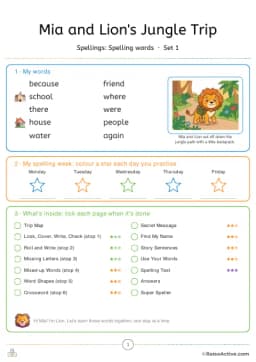
Their own spelling words turned into a pack: trace or look-cover-write-check, roll and write, a secret picture code, a word search, a crossword and a test, with their name in it.
Make a spelling packFree preview · free for members
Or start free: a word search with sight wordsCurriculum
- Fluency > Sentence Building
How to use this worksheet
Read the word on the first stair step together, sounding it out if needed, and ask your child to think of a sentence that uses that word. Have them say the full sentence out loud before moving up to the next step, repeating the process with each new word. If a sentence comes out very short, gently prompt with a question like 'where?' or 'when?' to encourage a fuller sentence. Continue climbing the stairs until your child reaches the top and has spoken a sentence for every word.
Materials needed
- Pencil
- Crayons
Extension activities
- 1Write down one or two of your child's favorite sentences from the activity and read them back together.
- 2Play the game again using new words from a favorite book or a recent family outing.
- 3Turn one spoken sentence into a quick drawing that illustrates what was said.
- 4Take turns making up sillier and longer sentences for the same word to see how creative you can get.
- 5Record your child saying their sentences on a phone or tablet and listen back together.

Written by
Hemsweta Jain · Teacher Cheena
MBA and Early Childhood Educator, teaching since 2014 · Founder of RaisoActive, Mumbai
Every RaisoActive worksheet is designed and checked by the founder before publishing.
Published · Last reviewed
More from Month 10: Learning & Development | Ages Up to 4

Parent's Guide: Fun Activities for Early Learners!
Ages 3-5 · Preschool–Pre-KAges 3-5 · Nursery–ReceptionAges 3-5 · Nursery–LKGAges 3-5
This parent's guide bundles several short, hands-on activities that build counting, shape recognition, fine motor control, and instruction-following in children ages 3-5. Rather than a single worksheet, it offers a menu of quick learning moments parents can use throughout the day, which suits the short attention spans typical of this age group. Rotating through different skill areas in one sitting also helps parents see which concepts their child grasps easily and which need more practice.

Spin the Wheel Activity: Follow Instructions and Perform Actions!
Ages 3-5 · Preschool–Pre-KAges 3-5 · Nursery–ReceptionAges 3-5 · Nursery–LKGAges 3-5
Spinning a homemade wheel and performing whatever action it lands on teaches children ages 3-5 to listen carefully and follow a one-step instruction, a foundational social and self-regulation skill for classroom and group settings. Because the action changes with every spin, children also practice quick physical responses, like jumping, hopping, or spinning, which supports gross motor development. The randomness of the spinner keeps the activity unpredictable and exciting, which helps sustain engagement through repeated rounds.

Cotton Bud Flower Craft Worksheet for Preschoolers
Ages 3-5 · Preschool–Pre-KAges 3-5 · Nursery–ReceptionAges 3-5 · Nursery–LKGAges 3-5
This cotton bud craft has children ages 3-5 paste cotton buds around a yellow center to build flower petals, an activity that strengthens the pincer grip and hand control needed for later pencil writing. Because each cotton bud represents one petal, the craft doubles as a counting exercise, giving children practice with one-to-one correspondence while they work. Combining a sensory material like cotton buds with a familiar shape — the flower — makes fine motor practice feel like play rather than drilling.
Five Senses Dice Activity: Roll and Explore!
Ages 3-5 · Preschool–Pre-KAges 3-5 · Nursery–ReceptionAges 3-5 · Nursery–LKGAges 3-5
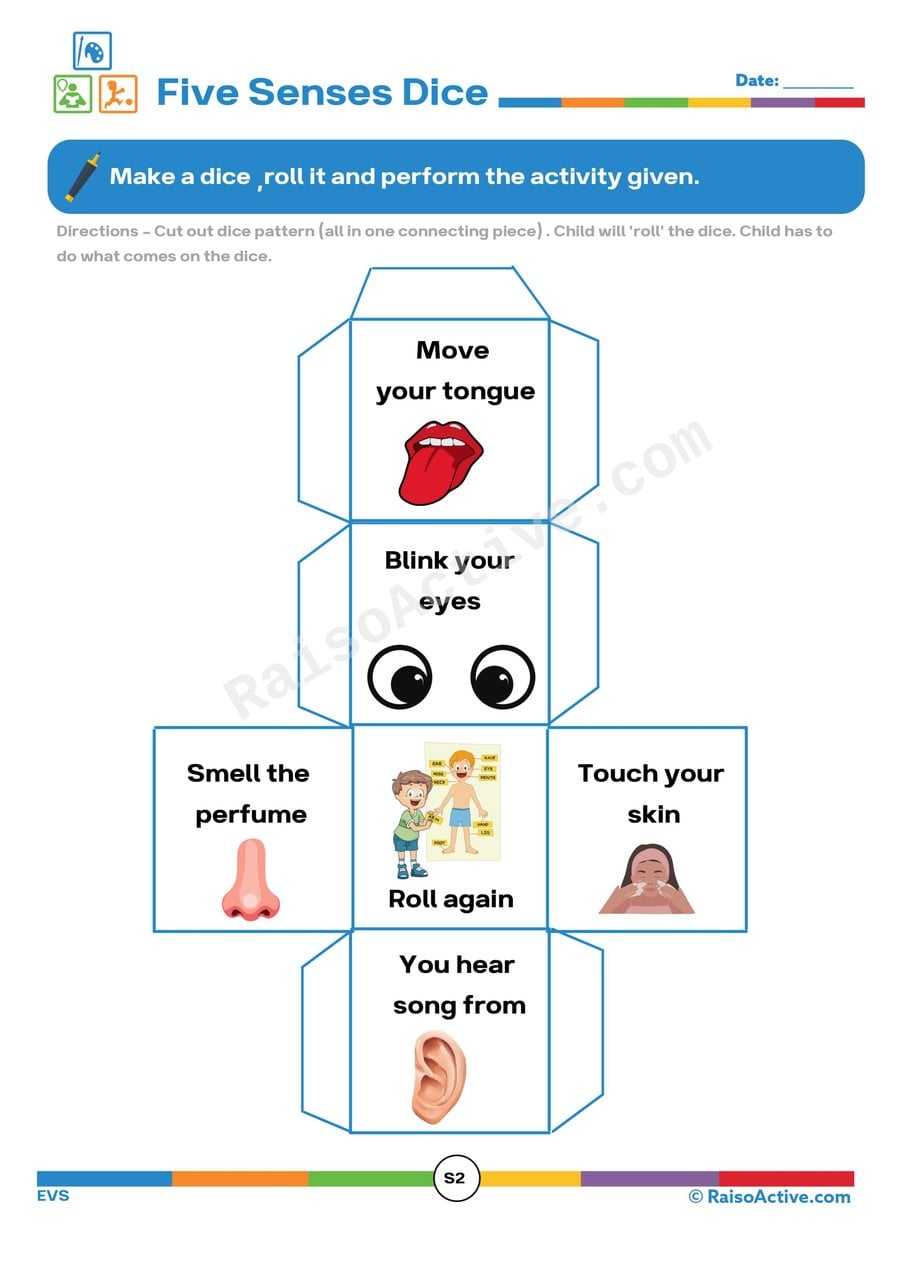
Rolling a homemade dice to trigger sensory activities teaches children ages 3-5 to identify and use each of the five senses — sight, hearing, touch, taste, and smell — through direct hands-on exploration rather than only reading or discussing them. Building and assembling the dice itself also adds a light fine motor and spatial task before the sensory learning even begins.

Count and Match: Numbers Worksheet for Preschoolers
Ages 3-5 · Preschool–Pre-KAges 3-5 · Nursery–ReceptionAges 3-5 · Nursery–LKGAges 3-5
This worksheet builds number recognition and one-to-one counting in children ages 3-5 by having them count sets of objects and then identify or match the correct numeral. Counting stationery items and circling the matching number reinforces that a numeral represents an exact quantity, not just a symbol to memorize. Matching fruits to candy quantities on a second section adds variety and repeated practice with different object types.
Shape Pattern Worksheet for Preschoolers
Ages 3-5 · Preschool–Pre-KAges 3-5 · Nursery–ReceptionAges 3-5 · Nursery–LKGAges 3-5
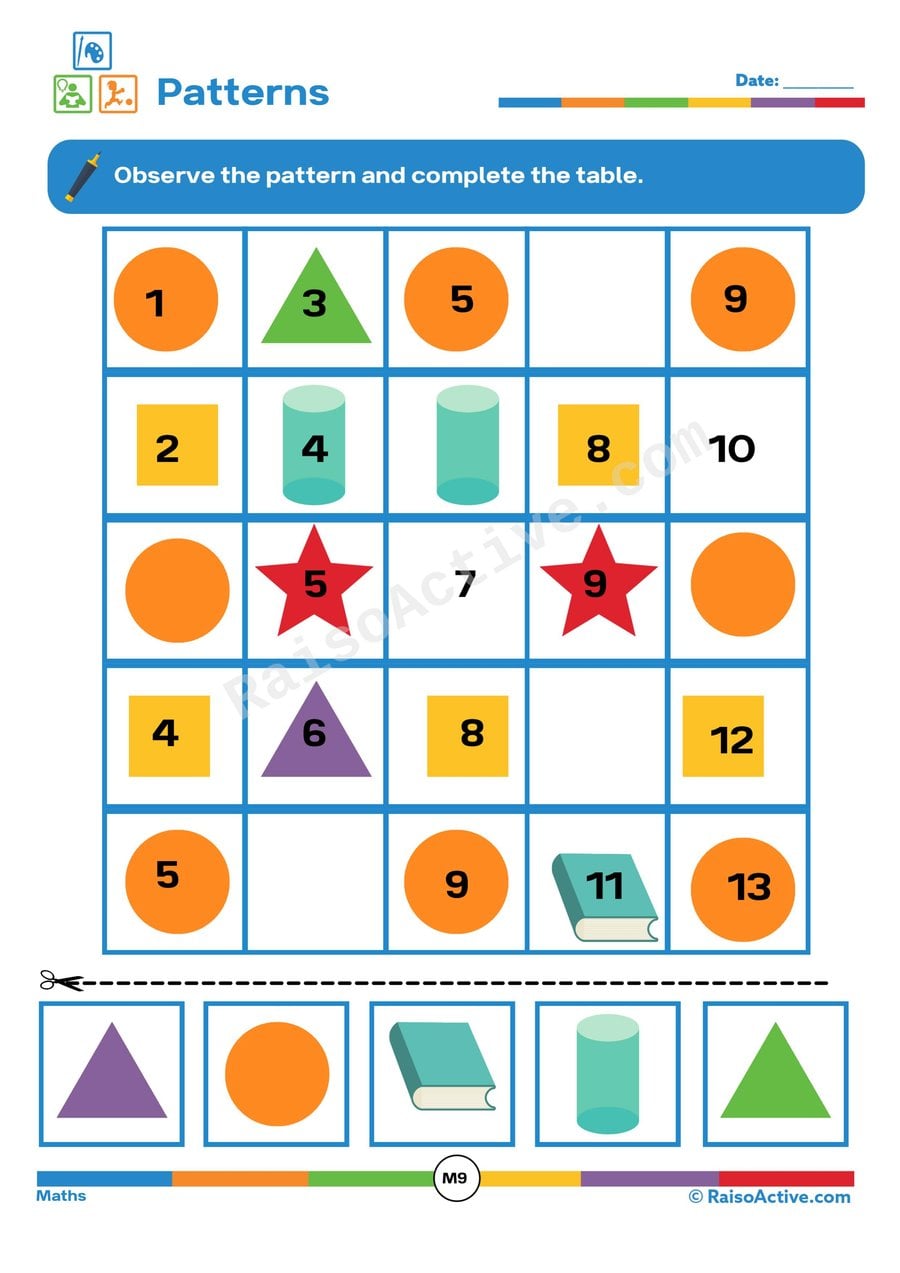
This worksheet asks children ages 3-5 to study a repeating sequence of shapes and continue the pattern by drawing the shape that logically comes next in each row. Extending a pattern rather than just identifying one requires a bit more reasoning than simple recognition, since children must hold the rule in mind and apply it to produce a new correct answer rather than choosing from options.
Full and Empty Worksheet for Preschoolers
Ages 3-5 · Preschool–Pre-KAges 3-5 · Nursery–ReceptionAges 3-5 · Nursery–LKGAges 3-5
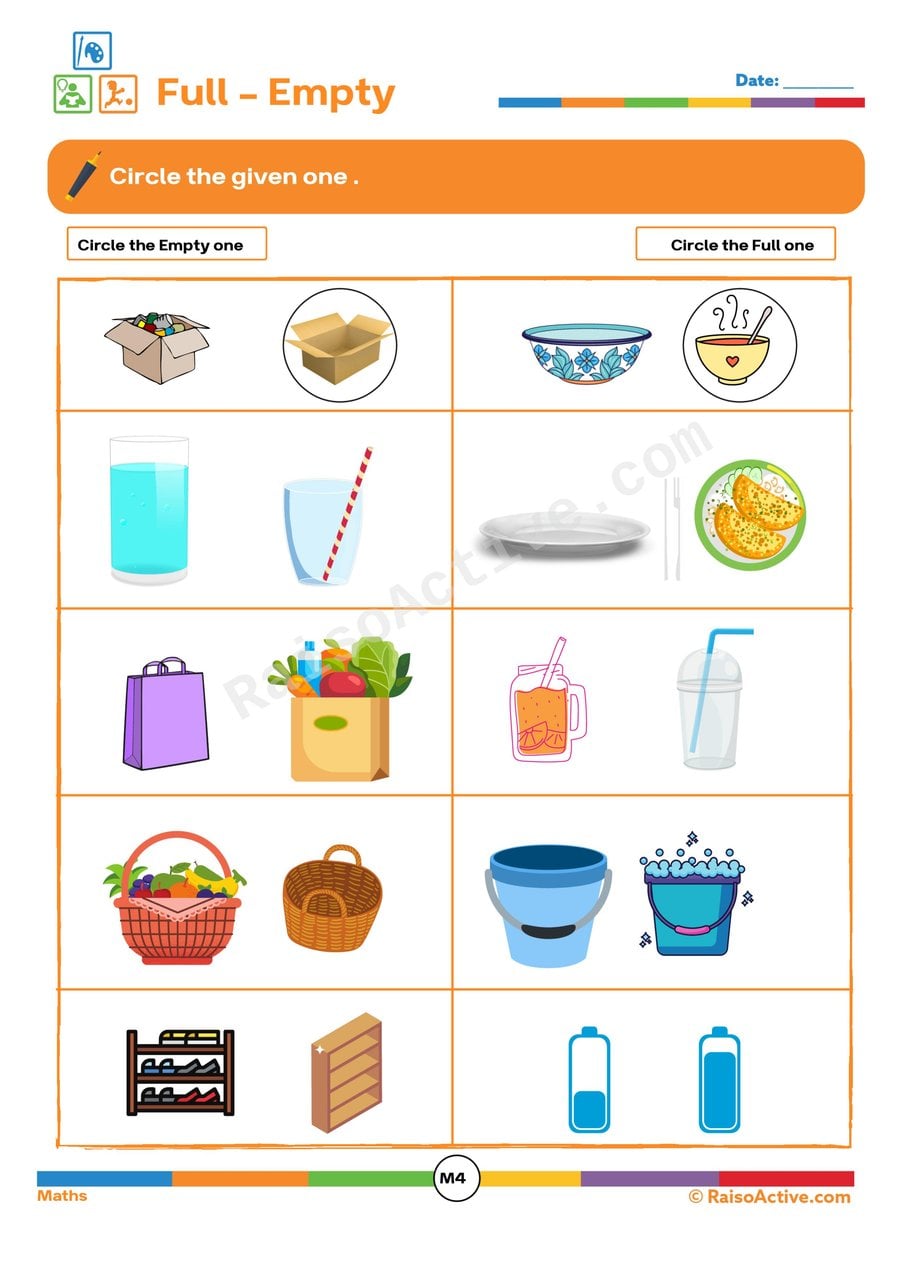
This sorting worksheet introduces children ages 3-5 to the comparative concepts of 'full' and 'empty,' an early measurement idea that lays groundwork for later understanding of quantity and volume. By examining containers and objects at different fill levels, children practice careful visual observation rather than relying on counting alone. Learning to describe amounts in everyday language like full and empty also supports vocabulary development children will use constantly in daily life.

Healthy Habits Game: Roll the Dice and Practice Good Manners!
Ages 3-5 · Preschool–Pre-KAges 3-5 · Nursery–ReceptionAges 3-5 · Nursery–LKGAges 3-5
This dice-based board game teaches children ages 3-5 healthy habits and polite social language by combining movement, counting, and speaking practice in one activity. Rolling the dice and counting spaces builds number recognition and one-to-one counting, while landing on speaker icons gives structured practice saying polite phrases like 'please' and 'thank you' out loud. Coloring a smiley or sad face based on the habit shown also reinforces the idea that choices have positive or negative consequences.
Related worksheets
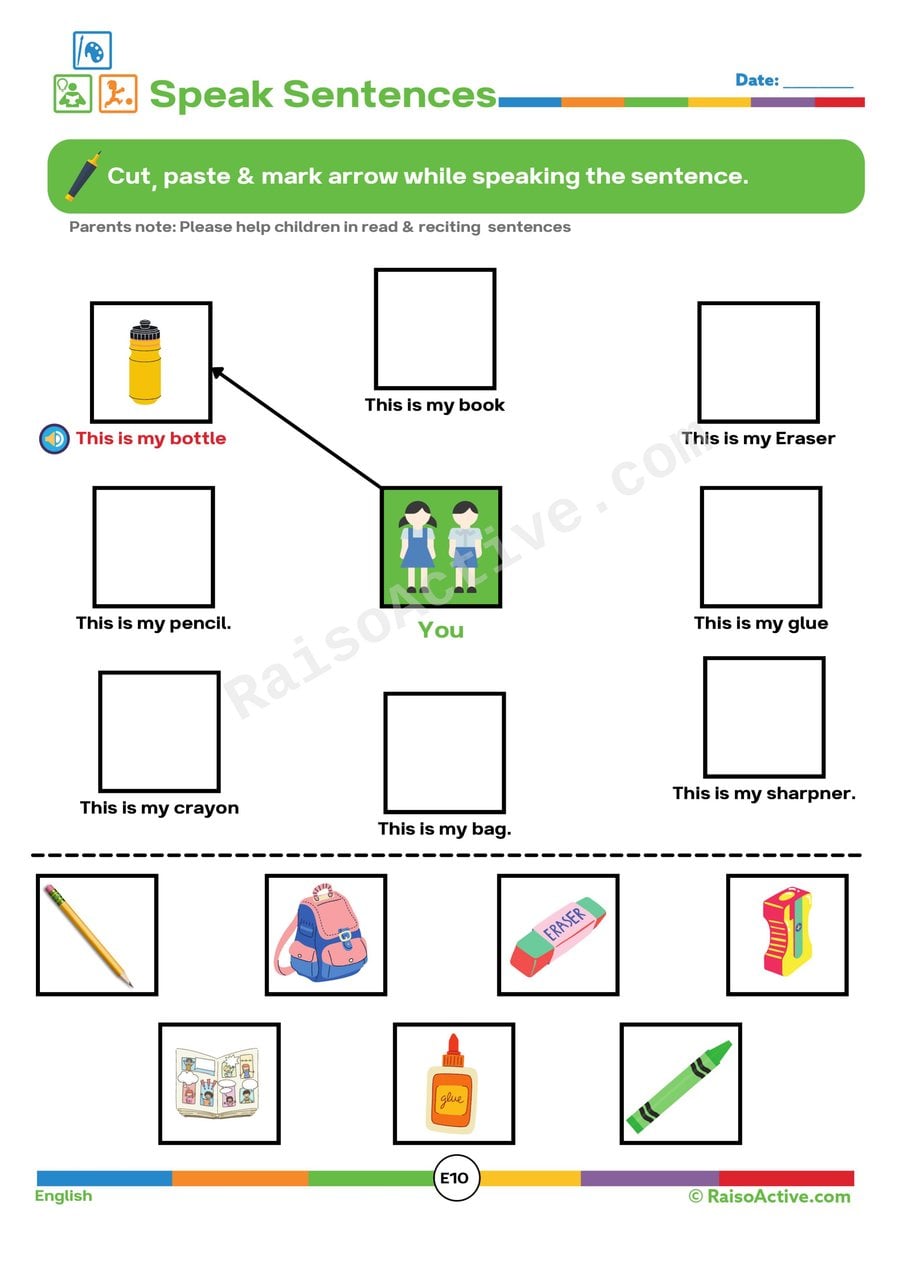
Speak Sentences Worksheet: Cut, Paste, and Match!
Ages 3-5 · Preschool–Pre-KAges 3-5 · Nursery–ReceptionAges 3-5 · Nursery–LKGAges 3-5
Children ages 3-5 practice matching spoken sentence meaning to pictures by cutting out images and pasting them next to the correct simple sentence, building early reading comprehension. This task requires connecting written or read-aloud words to real-world meaning, a critical step before children can read independently for understanding. The cutting and pasting also continues building the fine motor precision needed for handwriting and other classroom tasks.

My Name is: Sentence Building Worksheet for Early Learners
Ages 3-5 · Preschool–Pre-KAges 3-5 · Nursery–ReceptionAges 3-5 · Nursery–LKGAges 3-5
This sentence-building activity asks children ages 3-5 to cut apart puzzle pieces of words and arrange them in the correct order to form a complete sentence, giving hands-on practice with sentence structure before they write full sentences independently. Physically manipulating word pieces lets children experiment with word order and self-correct by reading the sentence aloud, which is more forgiving than committing straight to writing. Copying the assembled sentence onto lines afterward then bridges the gap from arranging words to writing them from scratch.

Sentence Sorting Fun: Speak Sentences with Words! (Ages 3-5)
Ages 3-5 · Preschool–Pre-KAges 3-5 · Nursery–ReceptionAges 3-5 · Nursery–LKGAges 3-5
This worksheet builds oral sentence construction for children ages 3-5 by having them place a cutout Pacman piece on a word and then speak a full sentence using that word aloud. Because the task requires generating spoken language on the spot rather than selecting a pre-written answer, it strengthens expressive vocabulary and sentence-building skills in a playful, low-pressure format.

Capitalization Worksheet: Practice Writing Sentences Correctly!
Ages 4-6 · Pre-K–KindergartenAges 4-6 · Reception–Year 1Ages 4-6 · LKG–UKGAges 4-6
This worksheet teaches children ages 4-6 the rule that sentences begin with a capital letter, along with an introduction to capitalizing proper nouns like names and places. Rewriting sentences correctly, rather than just circling errors, gives children active practice applying the capitalization rule themselves, which builds the habit more effectively than passive correction exercises.

Sentence Building Worksheet: Write Sentences with Given Words!
Ages 4-6 · Pre-K–KindergartenAges 4-6 · Reception–Year 1Ages 4-6 · LKG–UKGAges 4-6
Using given words to build a complete sentence teaches children ages 4-6 how word order creates meaning, an essential step toward reading fluency and independent writing. Practicing this skill also reinforces sentence mechanics like starting with a capital letter and ending with a period, which many children this age are just beginning to apply consistently.

Words Worksheet: Unscramble, Capitalize, and Choose the Best Word!
Ages 4-6 · Pre-K–KindergartenAges 4-6 · Reception–Year 1Ages 4-6 · LKG–UKGAges 4-6
This multi-part worksheet challenges children ages 4-6 to unscramble jumbled letters into real words, identify correctly capitalized sentences, and choose the most fitting word to complete a sentence. Combining these three tasks on one page builds spelling, sentence-level grammar awareness, and vocabulary precision together, pushing children to apply several early literacy skills in a single sitting rather than practicing them in isolation.

Frame the Sentence: Sight Word Fun Worksheet for Preschoolers
Ages 4-5 · Pre-KAges 4-5 · ReceptionAges 4-5 · LKGAges 4-5
Constructing a full sentence from individual sight words is a meaningful step up from recognizing words in isolation, asking children ages 4-5 to understand how words function together to make meaning. This worksheet has children read a small bank of sight words and place them correctly into a sentence frame, which builds both reading comprehension and early grammar sense — understanding that word order matters. Because the words are provided rather than freely written, children can focus entirely on sentence structure without the added challenge of spelling from scratch.

Punctuation Practice Worksheet for Early Learners
Ages 4-6 · Pre-K–KindergartenAges 4-6 · Reception–Year 1Ages 4-6 · LKG–UKGAges 4-6
Children ages 4-6 learn to distinguish between statements and questions by deciding whether each sentence needs a period or a question mark, an early step in understanding how punctuation changes meaning and tone. Recognizing the difference between a question and a statement also supports reading fluency, since readers naturally use rising or falling intonation depending on the punctuation at the end of a sentence.
Guides for this topic

Sight Words by Age: The First 50 Words and How to Teach Them Without Flashcard Fatigue
Which sight words to teach first and why, the heart-word method, a read-trace-write-find routine, games, and a by-age table of typical sight-word progress.
How to Teach CVC Blending: A Step-by-Step Method That Works in Two Weeks
A step-by-step method for teaching CVC blending, covering continuous sounds, word families, common errors, and a 14-day plan that most children finish reading CVC words.

Documenting Learning Without Drowning in Data: A Practical Guide for Parents and Teachers
Learn practical ways to document your child's learning without overwhelm. Simple portfolios, observation tips, and printable trackers for ages 1-8.
Reviews
Every worksheet for ages 4–6, no watermark
Members download the full library of 1,000+ worksheets and every activity pack without watermarks or daily limits. One year costs ₹999 in India or $20 elsewhere.
See membership plansOr download any worksheet free with a watermark (5 a day).