Five Senses Dice Activity: Roll and Explore!
Rolling a homemade dice to trigger sensory activities teaches children ages 3-5 to identify and use each of the five senses — sight, hearing, touch, taste, and smell — through direct hands-on exploration rather than only reading or discussing them. Building and assembling the dice itself also adds a light fine motor and spatial task before the sensory learning even begins.

Part of the pack
Month 10: Learning & Development | Ages Up to 4
This is page 21 of the pack. Ages 2-4 · PreschoolAges 2-4 · NurseryAges 2-4
Curriculum
- My Body > Five Senses Exploration
How to use this worksheet
Help your child cut out the dice pattern along the lines and fold it into a cube, gluing the tabs to hold its shape. Take turns rolling the finished dice and looking at which sense lands face up, then perform that activity together — like closing your eyes to listen for sounds, or touching different textured objects. Talk about what your child noticed each time before rolling again, cycling through all five senses if possible.
Materials needed
- Scissors
- Glue
- Pencil
Extension activities
- 1Create a sensory bin filled with items related to each of the five senses for open-ended exploration.
- 2Go on a nature walk and identify things you can see, hear, smell, and touch along the way.
- 3Play a blindfolded guessing game where your child identifies objects by touch, smell, or sound alone.
- 4Cook or prepare a simple snack together, noticing the smell, taste, and texture at each step.

Written by
Hemsweta Jain · Teacher Cheena
MBA and Early Childhood Educator, teaching since 2014 · Founder of RaisoActive, Mumbai
Every RaisoActive worksheet is designed and checked by the founder before publishing.
Published · Last reviewed
More from Month 10: Learning & Development | Ages Up to 4

Sorting Numbers Worksheet: Match the Number to the Picture!
Ages 3-5 · Preschool–Pre-KAges 3-5 · Nursery–ReceptionAges 3-5 · Nursery–LKGAges 3-5
Counting objects in a picture and then pasting that picture next to its matching numeral helps children ages 3-5 connect a written number symbol to an actual quantity, which is the heart of true number sense rather than just numeral naming. Cutting out the picture pieces beforehand also builds scissor control, giving this worksheet a fine motor component alongside the counting practice. The puzzle-piece format adds a satisfying, hands-on element that keeps repetitive counting practice engaging.

Parent's Guide: Fun Activities for Early Learners!
Ages 3-5 · Preschool–Pre-KAges 3-5 · Nursery–ReceptionAges 3-5 · Nursery–LKGAges 3-5
This parent's guide bundles several short, hands-on activities that build counting, shape recognition, fine motor control, and instruction-following in children ages 3-5. Rather than a single worksheet, it offers a menu of quick learning moments parents can use throughout the day, which suits the short attention spans typical of this age group. Rotating through different skill areas in one sitting also helps parents see which concepts their child grasps easily and which need more practice.
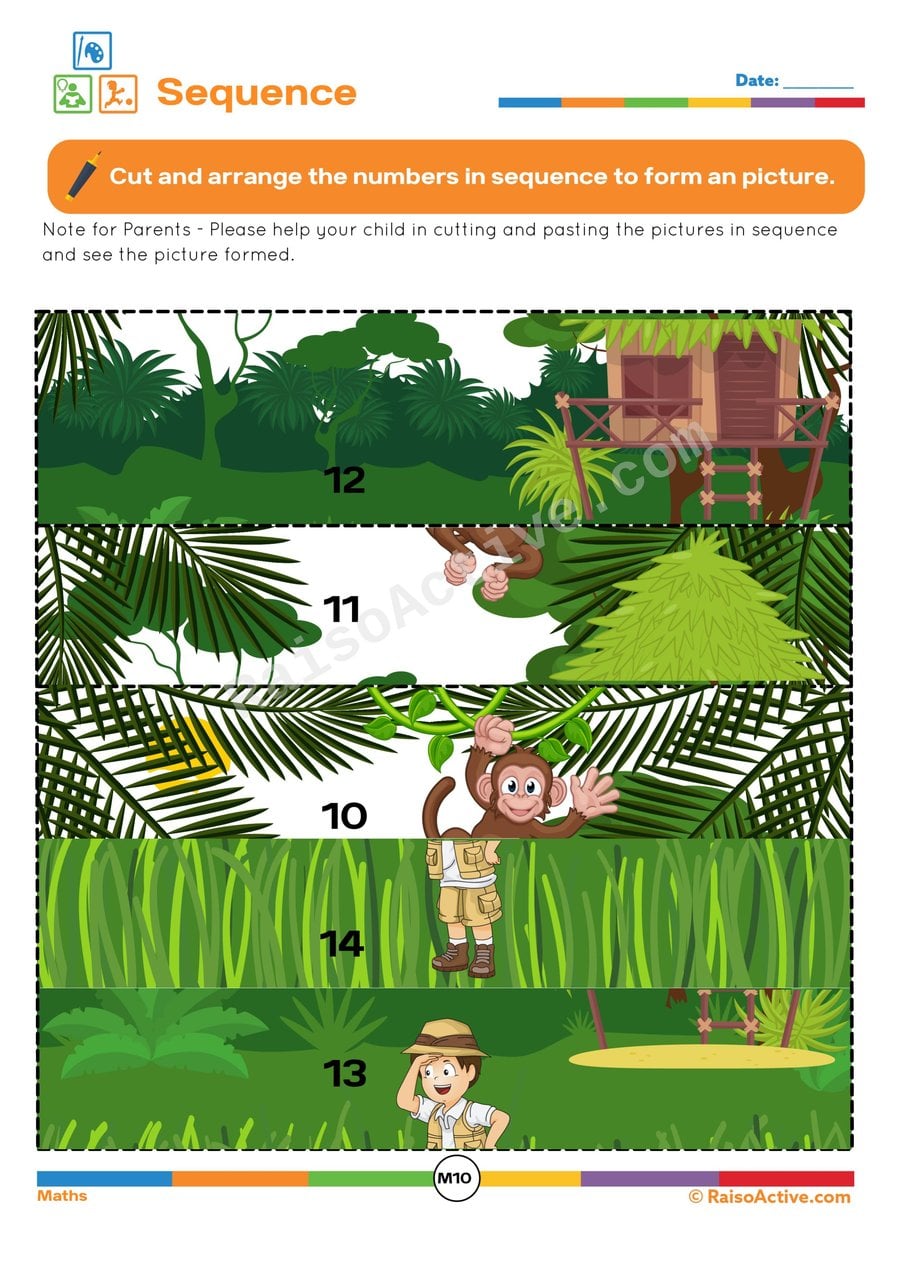
Jungle Adventure Sequence Worksheet for Kids
Ages 3-5 · Preschool–Pre-KAges 3-5 · Nursery–ReceptionAges 3-5 · Nursery–LKGAges 3-5
This cut-and-paste sequencing activity has children ages 3-5 arrange picture strips numbered 10 through 14 in the correct order to reveal a hidden jungle scene, linking number sequencing directly to a satisfying visual reward. Because the reveal only works if every strip is placed correctly, children get immediate, built-in feedback on whether their sequencing is accurate. Practicing numbers in the 10-14 range also pushes counting skills just beyond the more commonly rehearsed 1-10 range.

Alphabet Adventures: Complete the Vocabulary Table!
Ages 4-6 · Pre-K–KindergartenAges 4-6 · Reception–Year 1Ages 4-6 · LKG–UKGAges 4-6
This worksheet helps children ages 4-6 strengthen letter-picture-word associations by filling in missing letters, finding matching pictures for each letter, and pasting them into a vocabulary table. Combining letter recall, picture matching, and gluing into one multi-step task pushes children beyond simple letter recognition into actively building and organizing vocabulary, an important step toward independent reading and writing.

Dinosaur's Missing Numbers Worksheet: Cut and Paste Fun!
Ages 4-6 · Pre-K–KindergartenAges 4-6 · Reception–Year 1Ages 4-6 · LKG–UKGAges 4-6
Children ages 4-6 practice number recognition and sequencing in a playful dinosaur theme, identifying which numbers are missing from a sequence and pasting them into the correct spots on a row of eggs. The dinosaur and egg imagery adds motivation and narrative context to what's otherwise a straightforward but important numeracy task — recognizing numerals and understanding their fixed order.

Hidden Numbers Worksheet: Find and Complete the Table!
Ages 3-5 · Preschool–Pre-KAges 3-5 · Nursery–ReceptionAges 3-5 · Nursery–LKGAges 3-5
Searching a busy picture for hidden numbers trains visual scanning and sustained attention in children ages 3-5, since numbers may be tucked into small or unexpected spots within the artwork. Completing the table with the missing numbers afterward reinforces the counting sequence and numeral recognition, requiring children to recall which numbers they've already found and figure out which ones are still missing. Together, the search-and-complete format turns basic number practice into an engaging seek-and-find challenge.
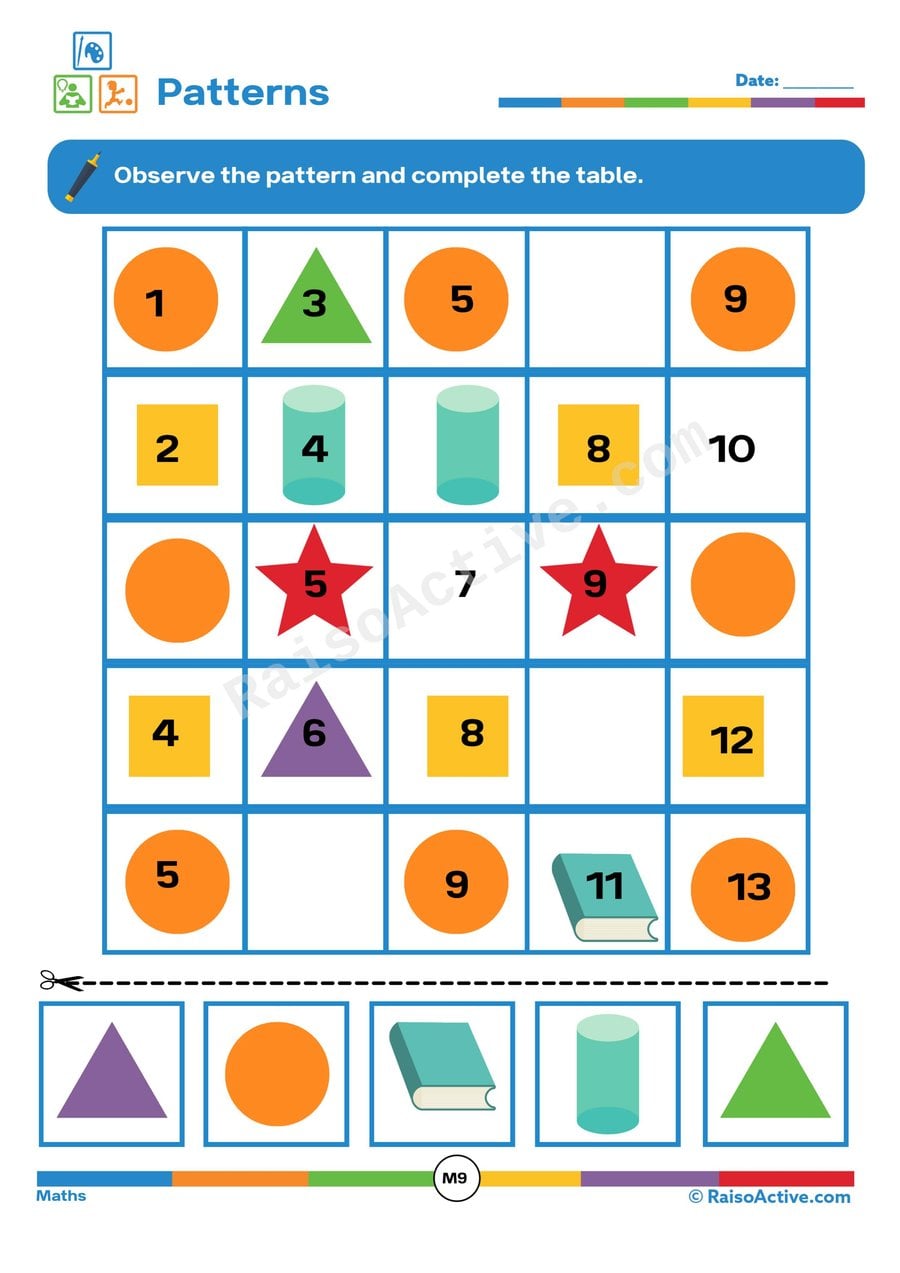
Shape Pattern Worksheet for Preschoolers
Ages 3-5 · Preschool–Pre-KAges 3-5 · Nursery–ReceptionAges 3-5 · Nursery–LKGAges 3-5
This worksheet asks children ages 3-5 to study a repeating sequence of shapes and continue the pattern by drawing the shape that logically comes next in each row. Extending a pattern rather than just identifying one requires a bit more reasoning than simple recognition, since children must hold the rule in mind and apply it to produce a new correct answer rather than choosing from options.
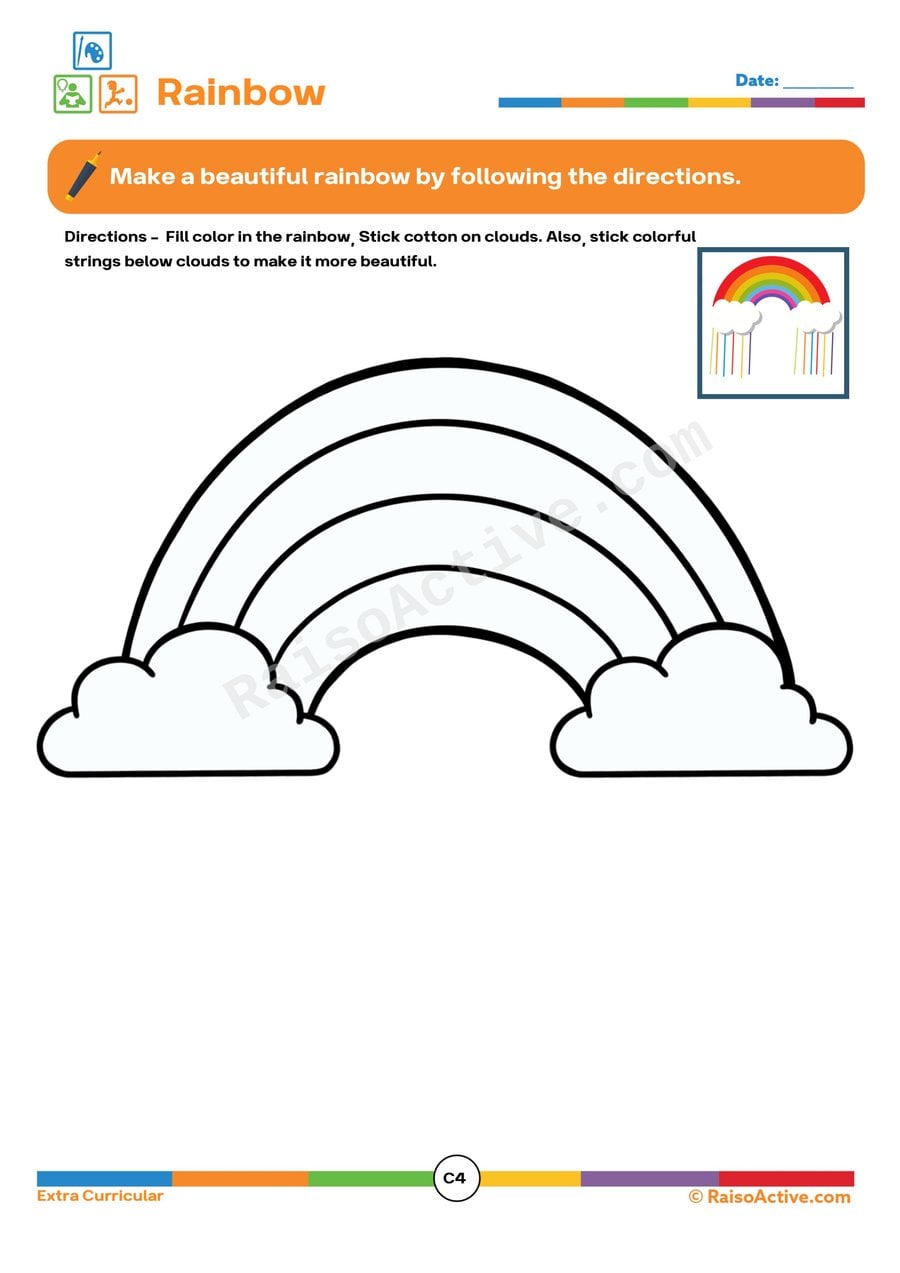
Rainbow Coloring Worksheet for Preschoolers
Ages 3-5 · Preschool–Pre-KAges 3-5 · Nursery–ReceptionAges 3-5 · Nursery–LKGAges 3-5
This multi-sensory worksheet helps children ages 3-5 practice color recognition and sequencing by coloring a rainbow in its correct color order, while also introducing texture through a cotton-ball cloud and string activity. Matching colors to a printed example teaches children to compare and follow a visual model precisely, an important pre-reading skill of left-to-right, top-to-bottom scanning. Adding cotton and string engages a different set of fine motor movements than coloring alone, like pinching and placing.
Related worksheets
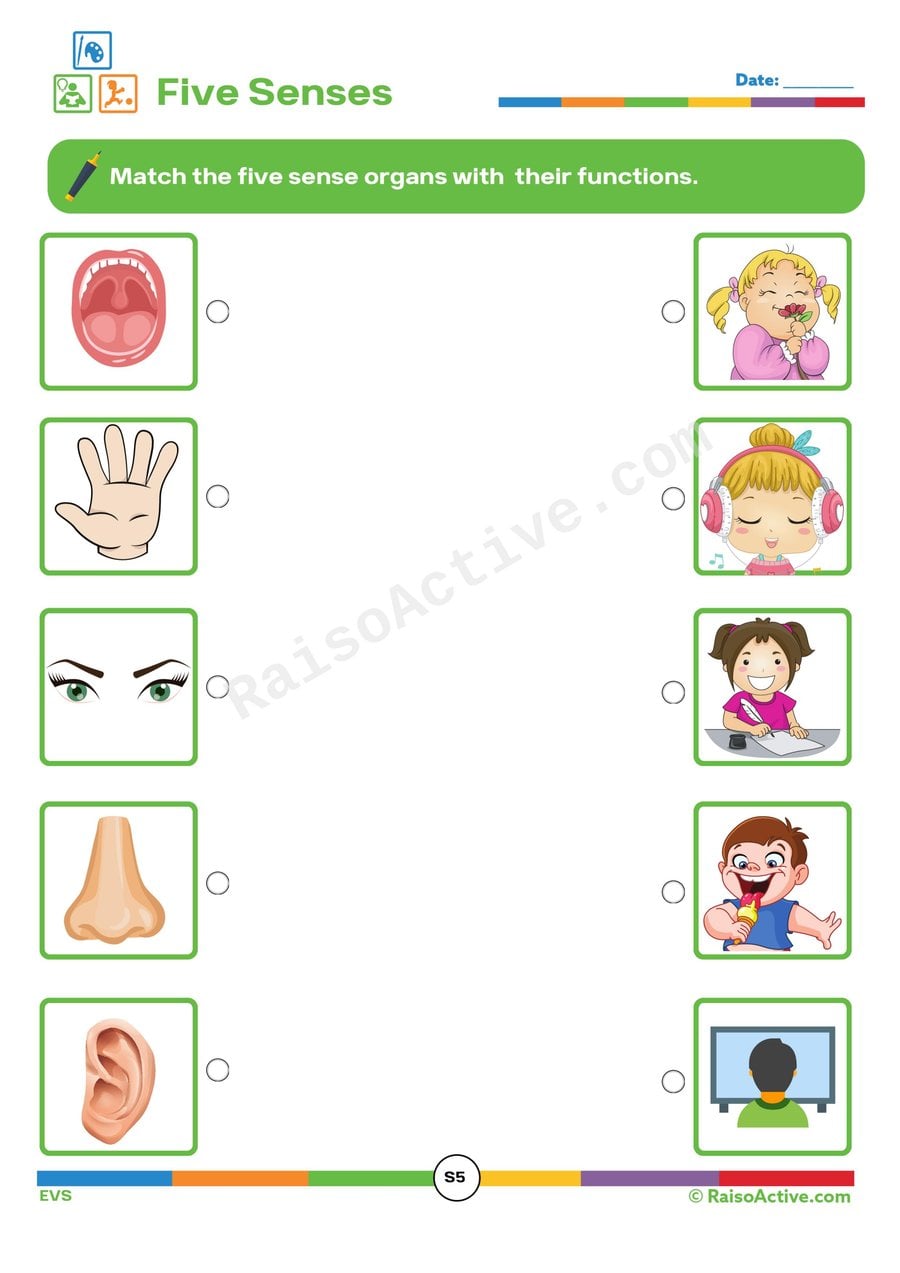
Five Senses Matching Worksheet for Preschoolers
Ages 3-5 · Preschool–Pre-KAges 3-5 · Nursery–ReceptionAges 3-5 · Nursery–LKGAges 3-5
Matching each sense organ, eyes, nose, ears, hands, mouth, to its correct function teaches children the basic science of how their bodies gather information about the world, an early concept in human biology. For ages three to five, connecting a body part to a specific job, eyes for seeing, nose for smelling, also builds descriptive vocabulary they can use to talk about their everyday experiences.

Soap & Pepper Science Experiment Worksheet for Preschoolers
Ages 3-5 · Preschool–Pre-KAges 3-5 · Nursery–ReceptionAges 3-5 · Nursery–LKGAges 3-5
This simple experiment introduces children ages 3-5 to the basic science of surface tension and how soap breaks it, using pepper flakes sprinkled on water as a visual demonstration. Watching the pepper scatter away the instant soap touches the water gives children a concrete, memorable example of cause and effect, an early building block for scientific thinking.

Plant Parts Worksheet: Identify and Label the Parts of a Plant!
Ages 4-6 · Pre-K–KindergartenAges 4-6 · Reception–Year 1Ages 4-6 · LKG–UKGAges 4-6
This worksheet teaches children ages 4-6 to identify and independently label the flower, stem, leaf, and roots of a plant, moving a step beyond simple matching toward recalling vocabulary from memory. Optionally adding pulses or grains to the diagram introduces a tactile, sensory layer that helps reinforce which part is which through touch as well as sight.
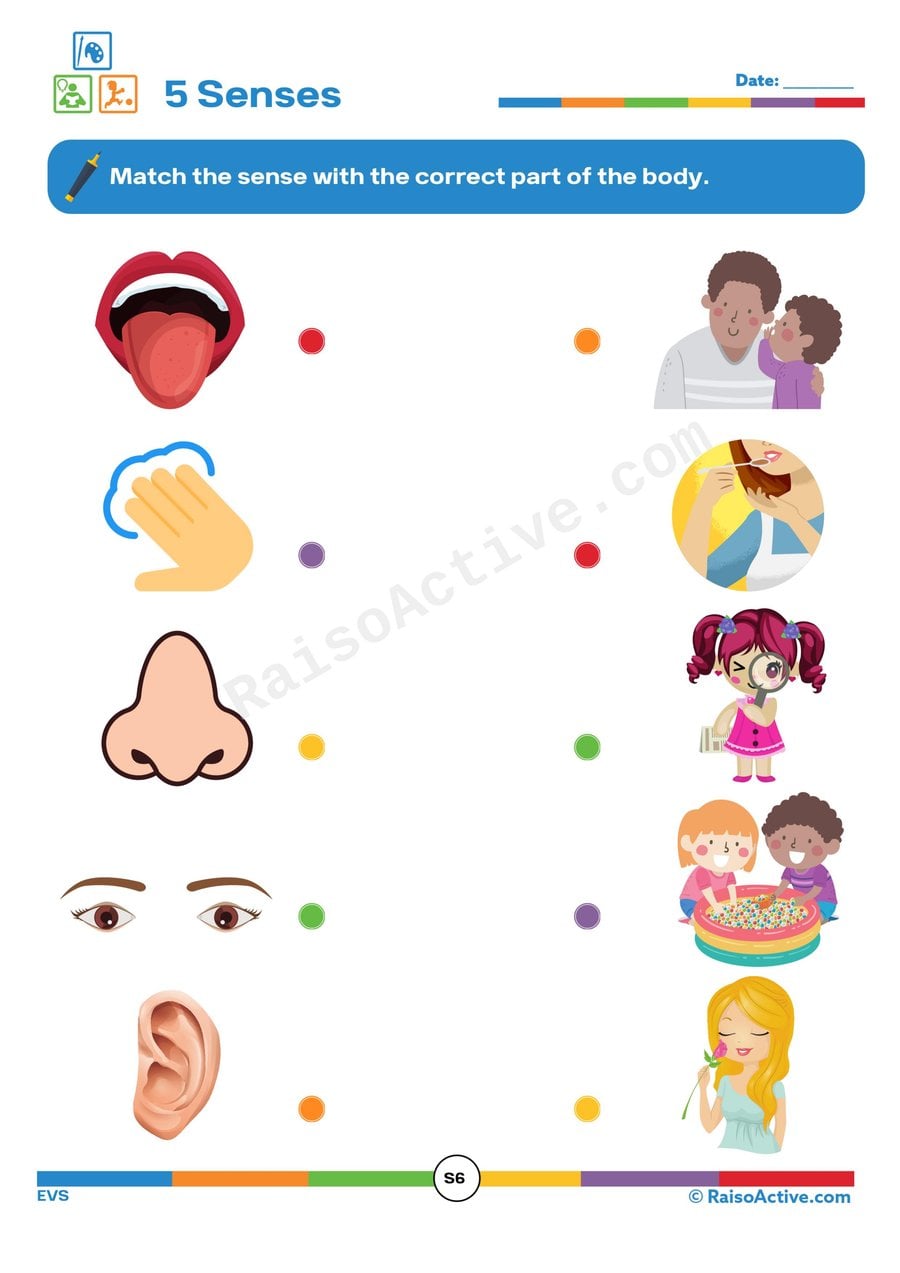
5 Senses Matching Worksheet for Preschoolers
Ages 3-5 · Preschool–Pre-KAges 3-5 · Nursery–ReceptionAges 3-5 · Nursery–LKGAges 3-5
This worksheet introduces children ages 3-5 to the five senses — sight, hearing, smell, taste, and touch — by asking them to match each sense to the body part responsible for it. Understanding that specific body parts are linked to specific senses is an early science concept that builds body awareness and observational vocabulary. Drawing the connecting line for each match also reinforces visual tracking and pencil control.

Taste Bud Sorting Worksheet: Identify and Sort Foods by Taste!
Ages 4-6 · Pre-K–KindergartenAges 4-6 · Reception–Year 1Ages 4-6 · LKG–UKGAges 4-6
This worksheet introduces children ages 4-6 to four basic taste categories — salty, sour, bitter, and sweet — by having them sort pictured foods into the correct group. Beyond taste vocabulary, sorting foods by an invisible property like flavor (rather than an obvious one like color or shape) pushes children to draw on memory and prior experience, building more advanced classification skills.

Soap & Pepper Science Experiment Worksheet for Preschoolers
Ages 3-5 · Preschool–Pre-KAges 3-5 · Nursery–ReceptionAges 3-5 · Nursery–LKGAges 3-5
This hands-on demonstration shows children ages 3-5 how soap disrupts water's surface tension, using floating pepper as a simple, visible indicator of the change. Because the reaction happens instantly and dramatically, it gives young children a strong, memorable first experience with predicting an outcome and then observing whether their prediction was right.
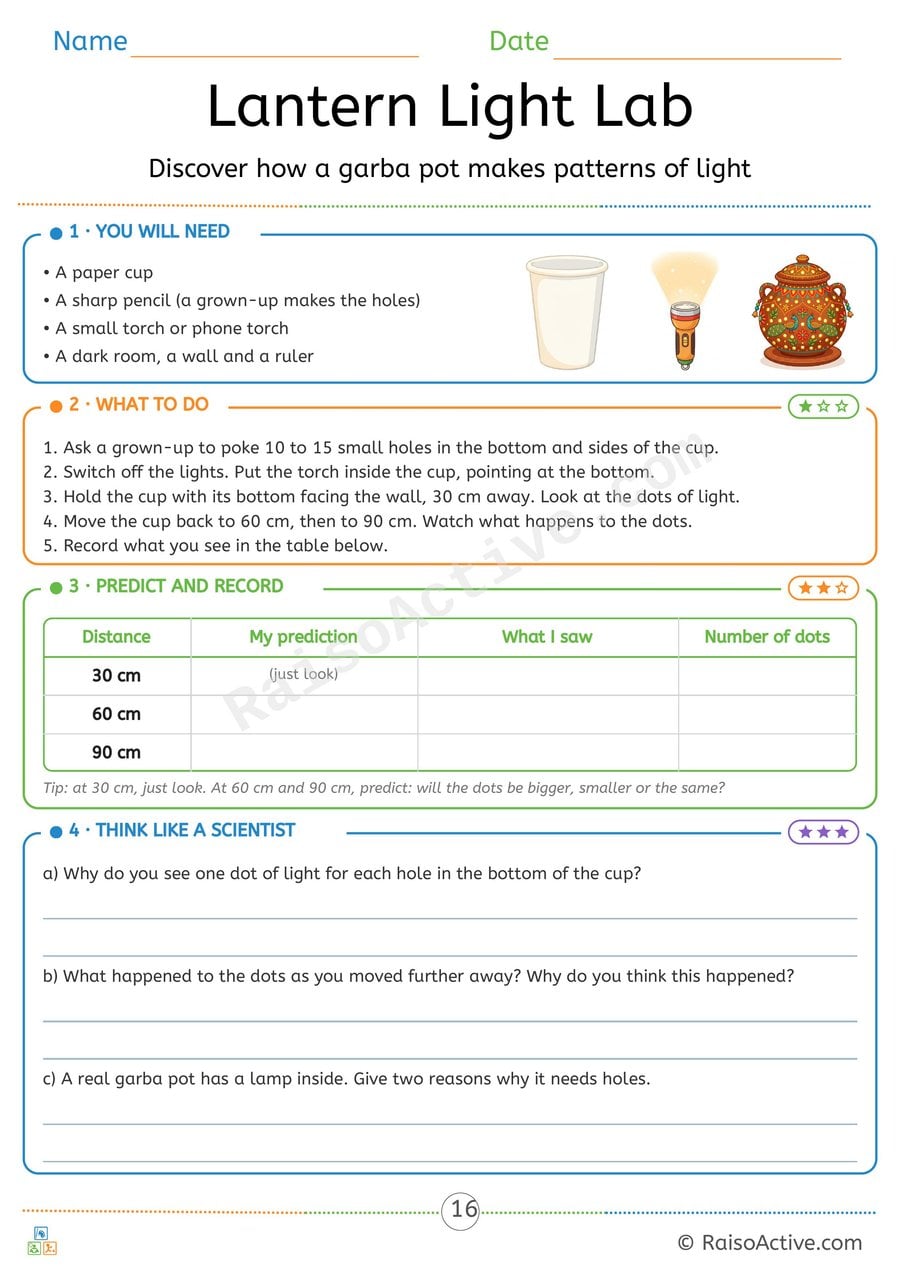
Lantern Light Lab: Navratri Garba Pot Light Experiment
Ages 7-11 · Grade 2–Grade 3Ages 7-11 · Year 3–Year 4Ages 7-11 · Class 2–Class 3Ages 7-11
Children make holes in a paper cup, shine a torch through it and see one spot of light for each hole. They predict and record what happens as they move further from the wall, and explain the results and why a real garba pot needs holes.
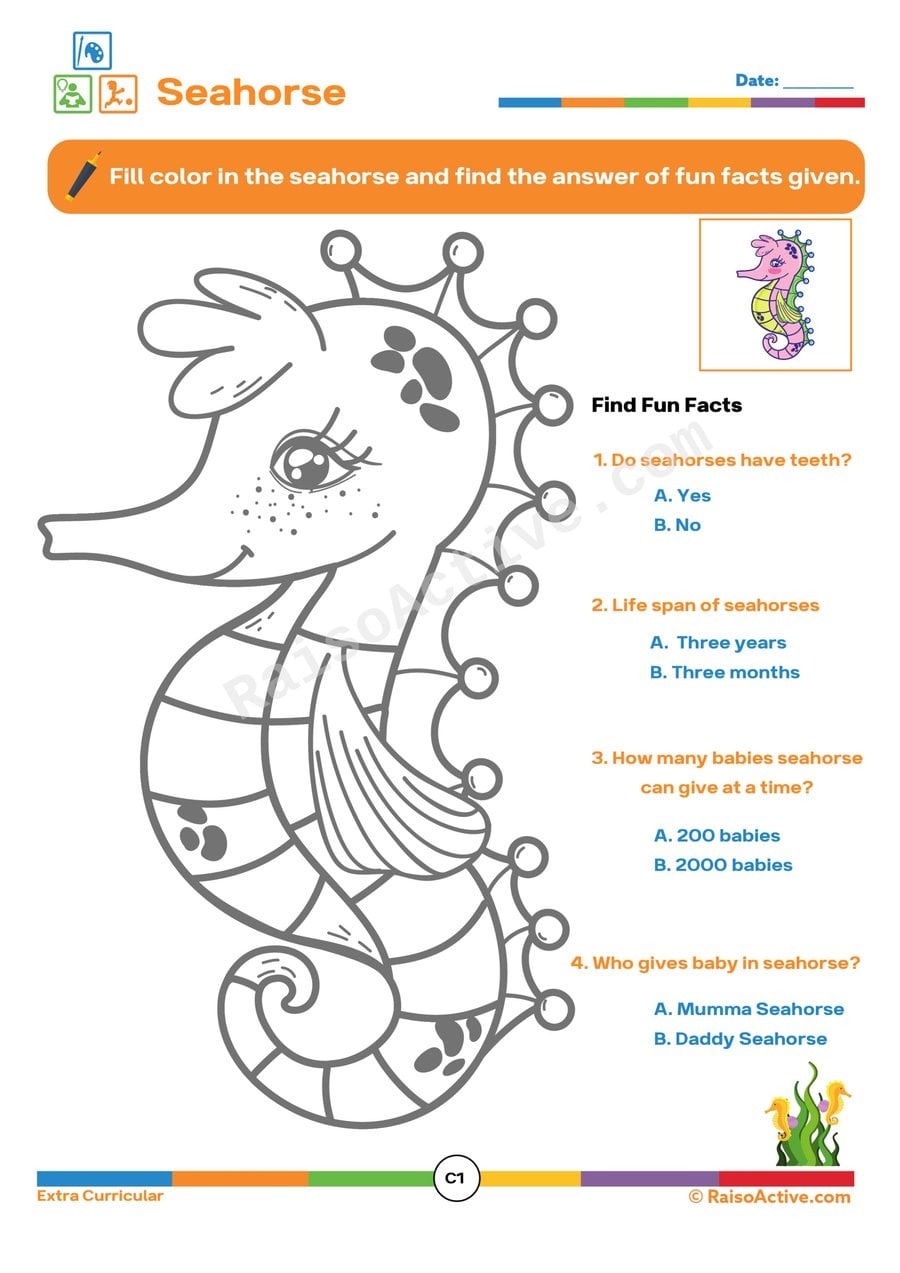
Seahorse Fun Facts Worksheet for Kids
Ages 3-5 · Preschool–Pre-KAges 3-5 · Nursery–ReceptionAges 3-5 · Nursery–LKGAges 3-5
This worksheet combines coloring practice with early reading comprehension by having children ages 3-5 color a seahorse illustration and then answer simple fact-based questions about it by circling the correct choice. Learning specific facts about an unusual sea creature — like that seahorses swim upright or that males carry the eggs — builds background science knowledge that supports later reading comprehension in nonfiction texts. The coloring portion also keeps fine motor practice woven into a subject-focused activity.
Guides for this topic

Age-Appropriate Problem-Solving Activities: Building Critical Thinkers from the Ground Up
Discover fun, age-appropriate problem-solving activities for children ages 1-8. Build critical thinking, logic, and reasoning skills through play-based learning.

Fostering Creativity in Structured Learning: The Perfect Balance for Young Minds
Learn how to blend creativity with structured learning for children ages 1-8. Practical strategies, activities, and printable worksheets for parents and teachers.
Critical Thinking Activities That Actually Work for Young Children: Building Tomorrow's Thinkers Today
Discover proven critical thinking activities for young children. Age-wise logic games, questioning techniques, and hands-on ideas to build thinking skills at home.
Reviews
Every worksheet for ages 3–5, no watermark
Members download the full library of 1,000+ worksheets and every activity pack without watermarks or daily limits. One year costs ₹999 in India or $20 elsewhere.
See membership plansOr download any worksheet free with a watermark (5 a day).