Five Senses Matching Worksheet for Preschoolers
Matching each sense organ, eyes, nose, ears, hands, mouth, to its correct function teaches children the basic science of how their bodies gather information about the world, an early concept in human biology. For ages three to five, connecting a body part to a specific job, eyes for seeing, nose for smelling, also builds descriptive vocabulary they can use to talk about their everyday experiences.
Part of the pack
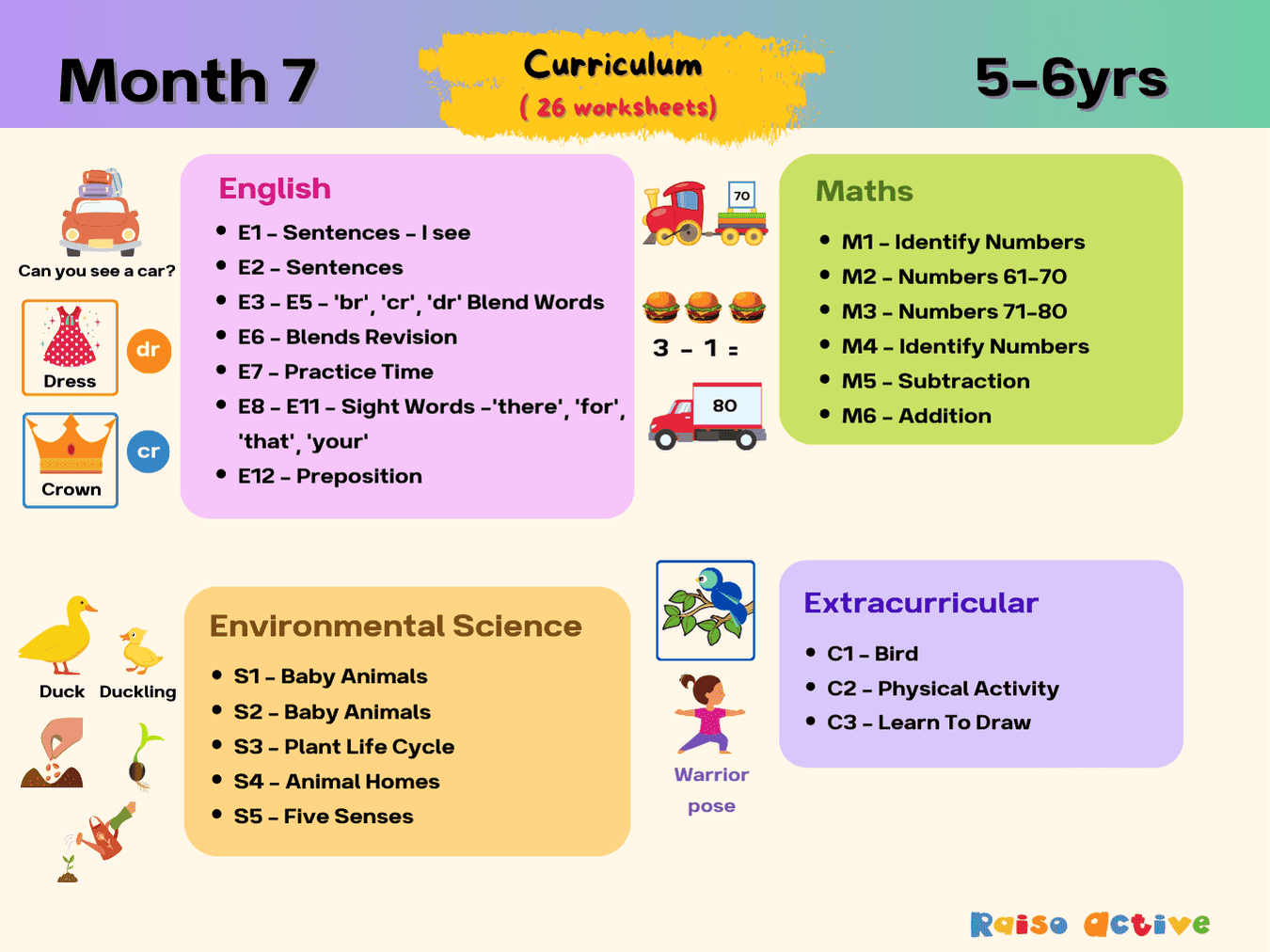
Month 7: Holistic Kindergarten Curriculum | Ages 5-6
This is page 26 of the pack. Ages 5-6 · KindergartenAges 5-6 · Year 1Ages 5-6 · UKGAges 5-6

Made for your child
Counting to 10, made for your child
A maths pack with your child's name in it: pictures that explain, practice at three levels, puzzles and story sums about them. Print a new set whenever they finish.
Make a maths packFree preview · free for members
Curriculum
- My Body > Five Senses
How to use this worksheet
Look at each sense organ pictured on the page together and name it out loud, eyes, nose, ears, hands, mouth. Talk about what each one is used for, asking your child if they already know before revealing the answer. Have your child draw a line connecting each sense organ to the picture showing its matching action or function. Continue through all five senses on the page, and finish by asking your child to demonstrate one sense in action, like closing their eyes to listen carefully.
Materials needed
- Pencil
- Crayons
Extension activities
- 1Discuss other things we can taste, touch, see, smell, and hear that aren't shown on the worksheet.
- 2Draw pictures of things that use each sense, like a flower for smell or a bell for hearing.
- 3Play a blindfolded taste or touch test, guessing familiar foods or objects using only one sense at a time.
- 4Go on a five-senses nature walk, naming one thing you can see, hear, smell, and touch along the way.

Written by
Hemsweta Jain · Teacher Cheena
MBA and Early Childhood Educator, teaching since 2014 · Founder of RaisoActive, Mumbai
Every RaisoActive worksheet is designed and checked by the founder before publishing.
Published · Last reviewed
More from Month 7: Holistic Kindergarten Curriculum | Ages 5-6

Match the Baby Animals Worksheet for Preschoolers
Ages 3-5 · Preschool–Pre-KAges 3-5 · Nursery–ReceptionAges 3-5 · Nursery–LKGAges 3-5
Matching adult animals to their babies teaches children ages 3-5 specific animal vocabulary — like calf, cub, and kit — while sharpening visual comparison skills as they look for physical similarities between the pictures. This kind of pairing task also builds early categorization thinking, since children must recognize that a baby animal, despite looking different from its parent, still belongs to the same animal family.
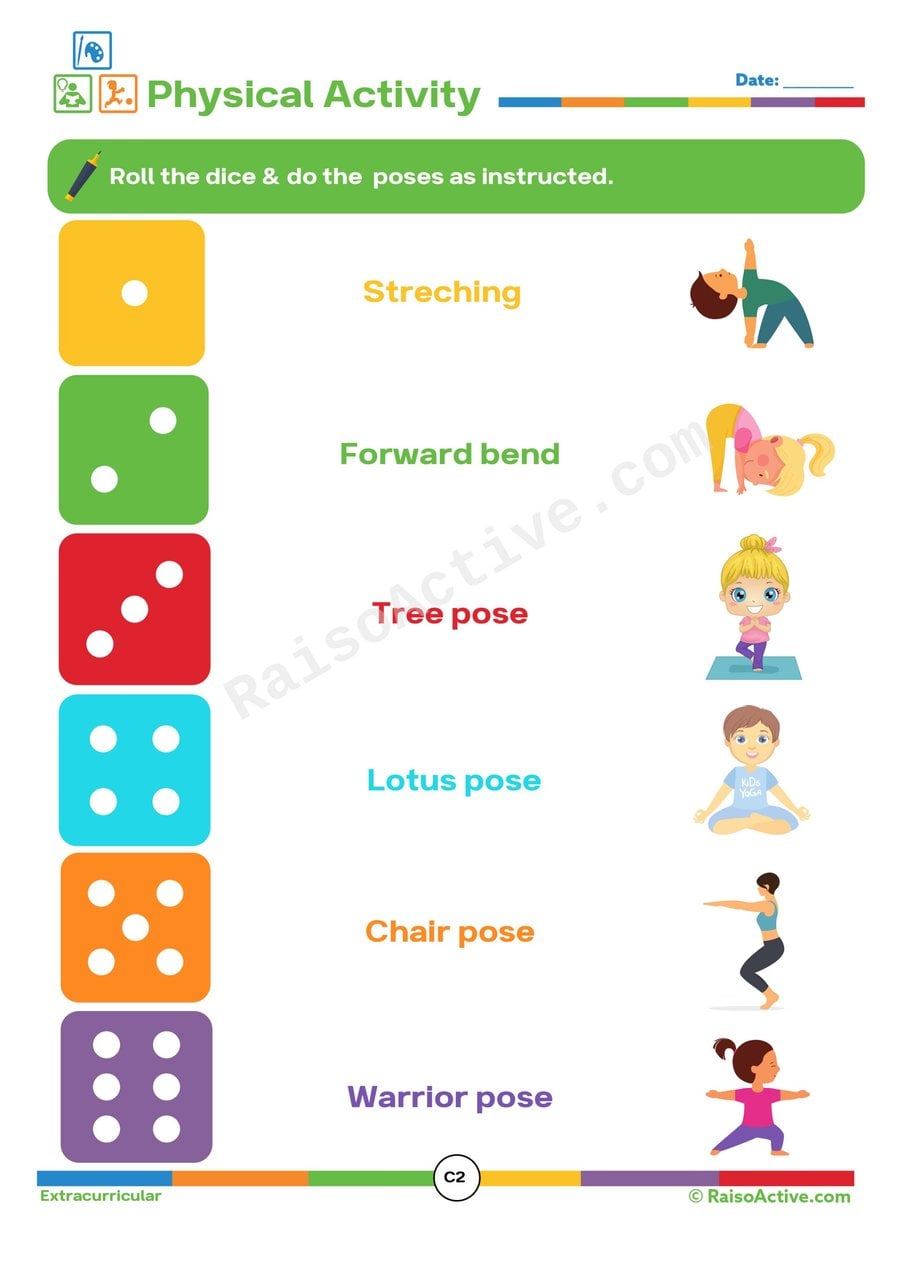
Physical Activity Dice Game: Yoga Poses for Kids!
Ages 3-5 · Preschool–Pre-KAges 3-5 · Nursery–ReceptionAges 3-5 · Nursery–LKGAges 3-5
Rolling a dice and matching the number to a yoga pose introduces children ages 3-5 to basic gross motor movement and body control in a playful, game-based format, while also reinforcing number recognition through the dice roll itself. Practicing simple yoga poses like this builds balance, body awareness, and an early habit of calm, mindful movement.
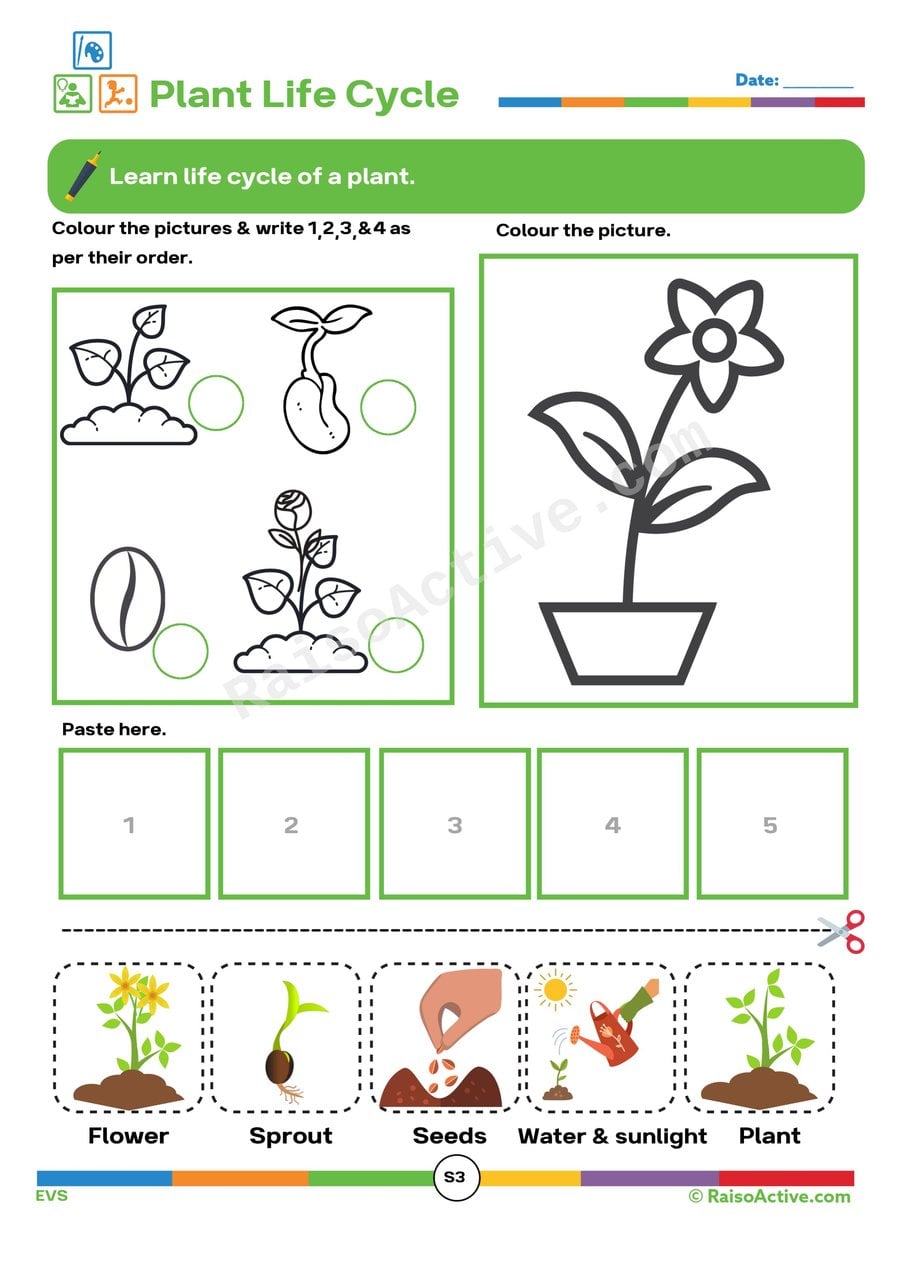
Plant Life Cycle Worksheet: Learn and Color!
Ages 3-5 · Preschool–Pre-KAges 3-5 · Nursery–ReceptionAges 3-5 · Nursery–LKGAges 3-5
Sequencing the stages of a plant's life cycle — from seed to sprout to full-grown flower — introduces children ages 3-5 to the science concept that living things grow and change in a predictable order over time. Numbering the stages before coloring also builds early sequencing and observation skills, since children must look closely at each picture to judge which comes before the next.
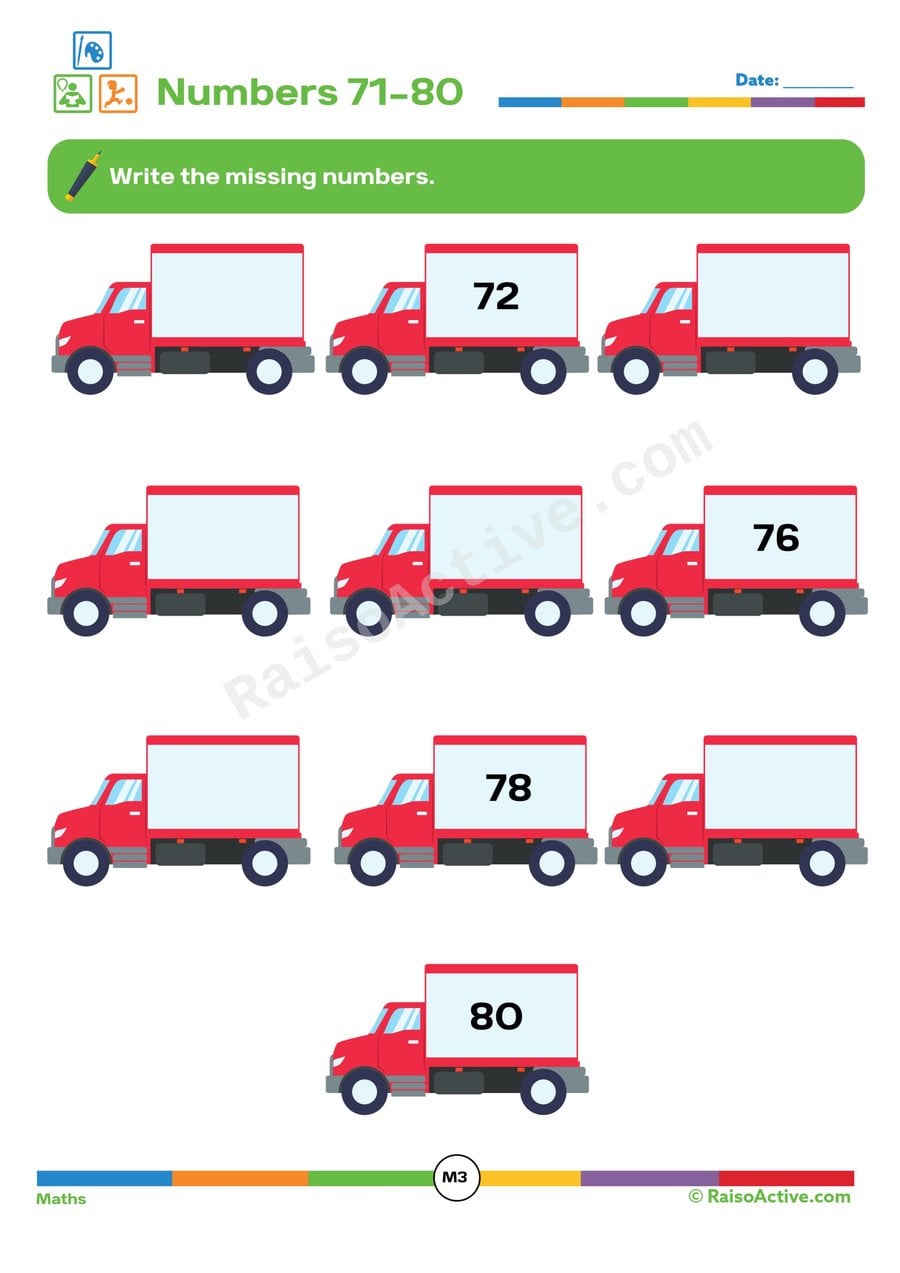
Missing Numbers: Trucks Worksheet for Kids (71-80)
Ages 4-5 · Pre-KAges 4-5 · ReceptionAges 4-5 · LKGAges 4-5
Filling in missing numbers within the 71-to-80 range asks children to hold a mental number sequence steady enough to identify a gap and supply the correct value, a more demanding task than simply counting forward from one. For ages four to five, practicing in this specific decade extends their counting range beyond the more familiar numbers under 50 while the truck theme keeps the task visually engaging.

Sight Word 'There' Worksheet for Preschoolers: Tracing, Coloring, and Sentence Building
Ages 4-5 · Pre-KAges 4-5 · ReceptionAges 4-5 · LKGAges 4-5
Because 'there' can't be decoded using typical phonics rules and is easily confused with the similar-sounding 'their' and 'they're,' children ages 4-5 need repeated, varied exposure to memorize it as a sight word. Practicing it through coloring, tracing, searching, and sentence-building helps move the word from momentary recognition into automatic recall needed for fluent reading.

Animal Homes and Babies: A Parent's Guide Worksheet
Ages 3-5 · Preschool–Pre-KAges 3-5 · Nursery–ReceptionAges 3-5 · Nursery–LKGAges 3-5
This parent's guide combines learning about where animals live and what their babies are called with an observation puzzle and number-identification practice, weaving science vocabulary together with counting and attention-to-detail skills. For ages three to five, connecting an animal to both its home, like a 'den' or 'nest', and its baby's name, like a 'cub' or 'chick', builds a richer, more memorable set of animal facts than either detail alone.

Make Your Own Paper Bird Worksheet for Preschoolers
Ages 3-5 · Preschool–Pre-KAges 3-5 · Nursery–ReceptionAges 3-5 · Nursery–LKGAges 3-5
Cutting out shapes and assembling them into a paper bird helps children ages 3-5 build fine motor control and hand-eye coordination, since aligning several small pieces accurately requires more precision than a single cut-and-paste task. Following a reference image to guide assembly also strengthens visual sequencing and the ability to translate a picture instruction into a physical, step-by-step action.
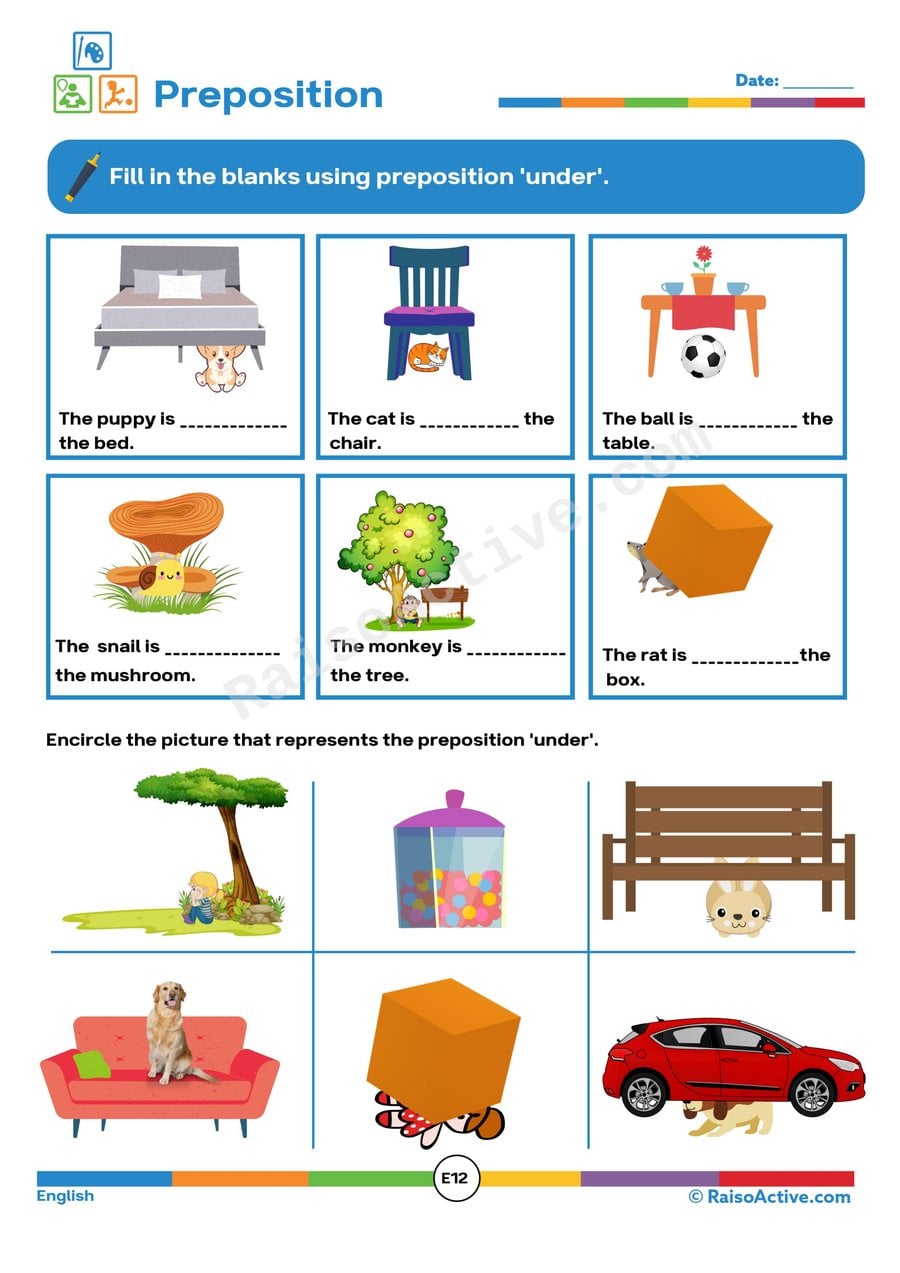
Preposition 'Under' Worksheet: Fun with Placement!
Ages 3-5 · Preschool–Pre-KAges 3-5 · Nursery–ReceptionAges 3-5 · Nursery–LKGAges 3-5
Practicing the preposition 'under' teaches children ages 3-5 to describe spatial relationships between objects, an early grammar concept closely tied to their developing understanding of physical space. Filling in the blank and then identifying pictures that show something under another object reinforces the word's meaning through both language and visual recognition.
Related worksheets

Plant Parts Worksheet: Identify and Label the Parts of a Plant!
Ages 4-6 · Pre-K–KindergartenAges 4-6 · Reception–Year 1Ages 4-6 · LKG–UKGAges 4-6
This worksheet teaches children ages 4-6 to identify and independently label the flower, stem, leaf, and roots of a plant, moving a step beyond simple matching toward recalling vocabulary from memory. Optionally adding pulses or grains to the diagram introduces a tactile, sensory layer that helps reinforce which part is which through touch as well as sight.

Taste Bud Sorting Worksheet: Identify and Sort Foods by Taste!
Ages 4-6 · Pre-K–KindergartenAges 4-6 · Reception–Year 1Ages 4-6 · LKG–UKGAges 4-6
This worksheet introduces children ages 4-6 to four basic taste categories — salty, sour, bitter, and sweet — by having them sort pictured foods into the correct group. Beyond taste vocabulary, sorting foods by an invisible property like flavor (rather than an obvious one like color or shape) pushes children to draw on memory and prior experience, building more advanced classification skills.
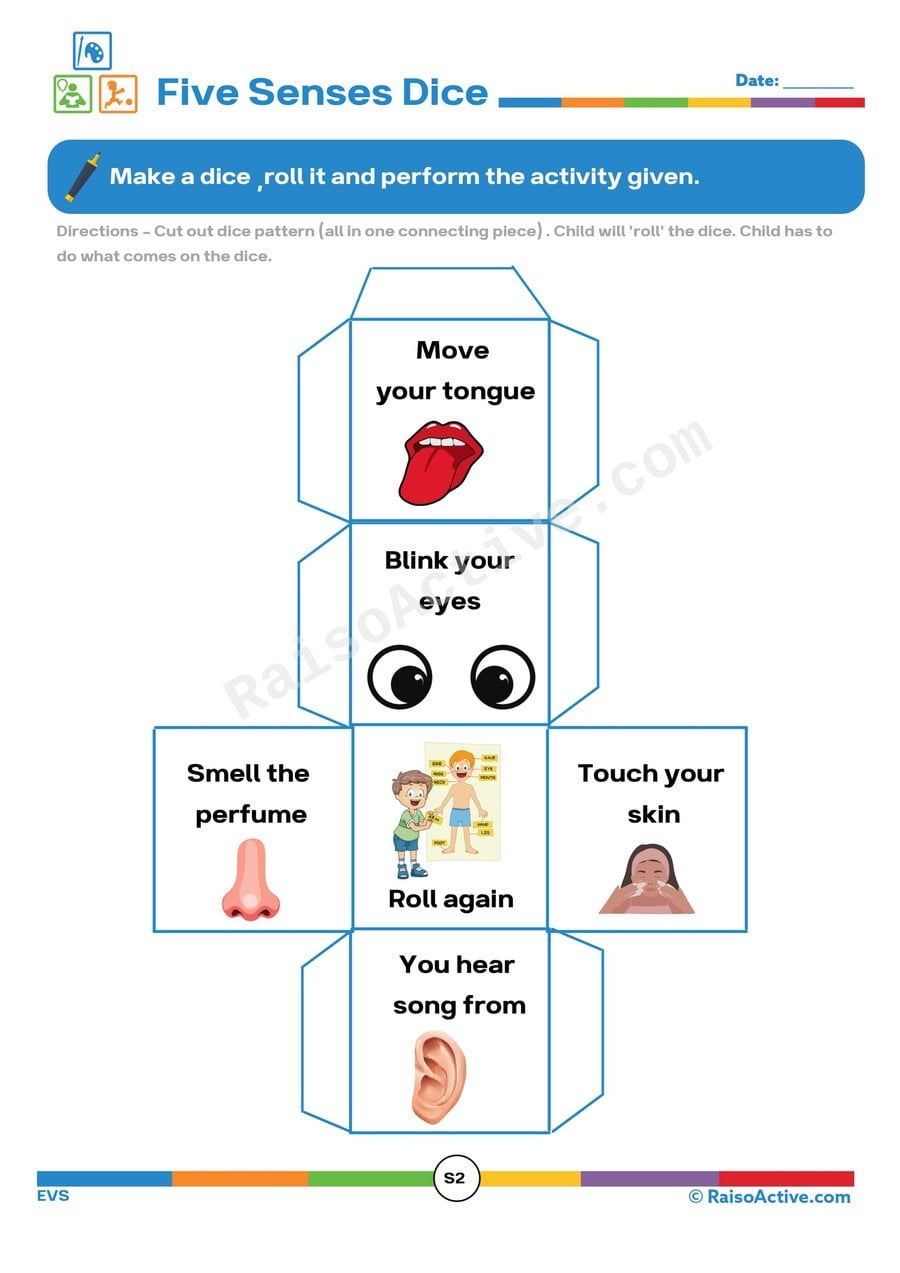
Five Senses Dice Activity: Roll and Explore!
Ages 3-5 · Preschool–Pre-KAges 3-5 · Nursery–ReceptionAges 3-5 · Nursery–LKGAges 3-5
Rolling a homemade dice to trigger sensory activities teaches children ages 3-5 to identify and use each of the five senses — sight, hearing, touch, taste, and smell — through direct hands-on exploration rather than only reading or discussing them. Building and assembling the dice itself also adds a light fine motor and spatial task before the sensory learning even begins.

Soap & Pepper Science Experiment Worksheet for Preschoolers
Ages 3-5 · Preschool–Pre-KAges 3-5 · Nursery–ReceptionAges 3-5 · Nursery–LKGAges 3-5
This hands-on demonstration shows children ages 3-5 how soap disrupts water's surface tension, using floating pepper as a simple, visible indicator of the change. Because the reaction happens instantly and dramatically, it gives young children a strong, memorable first experience with predicting an outcome and then observing whether their prediction was right.
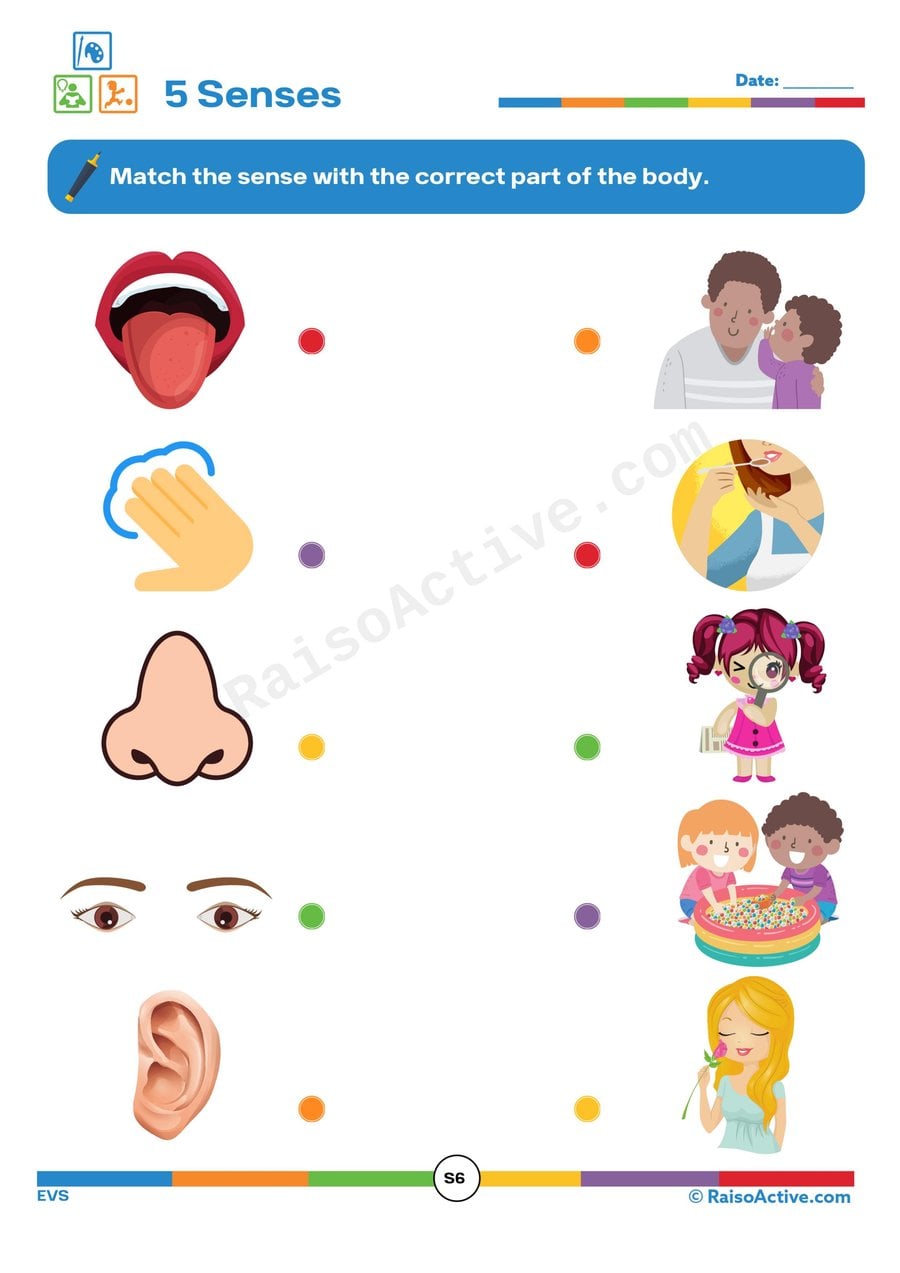
5 Senses Matching Worksheet for Preschoolers
Ages 3-5 · Preschool–Pre-KAges 3-5 · Nursery–ReceptionAges 3-5 · Nursery–LKGAges 3-5
This worksheet introduces children ages 3-5 to the five senses — sight, hearing, smell, taste, and touch — by asking them to match each sense to the body part responsible for it. Understanding that specific body parts are linked to specific senses is an early science concept that builds body awareness and observational vocabulary. Drawing the connecting line for each match also reinforces visual tracking and pencil control.

Soap & Pepper Science Experiment Worksheet for Preschoolers
Ages 3-5 · Preschool–Pre-KAges 3-5 · Nursery–ReceptionAges 3-5 · Nursery–LKGAges 3-5
This simple experiment introduces children ages 3-5 to the basic science of surface tension and how soap breaks it, using pepper flakes sprinkled on water as a visual demonstration. Watching the pepper scatter away the instant soap touches the water gives children a concrete, memorable example of cause and effect, an early building block for scientific thinking.
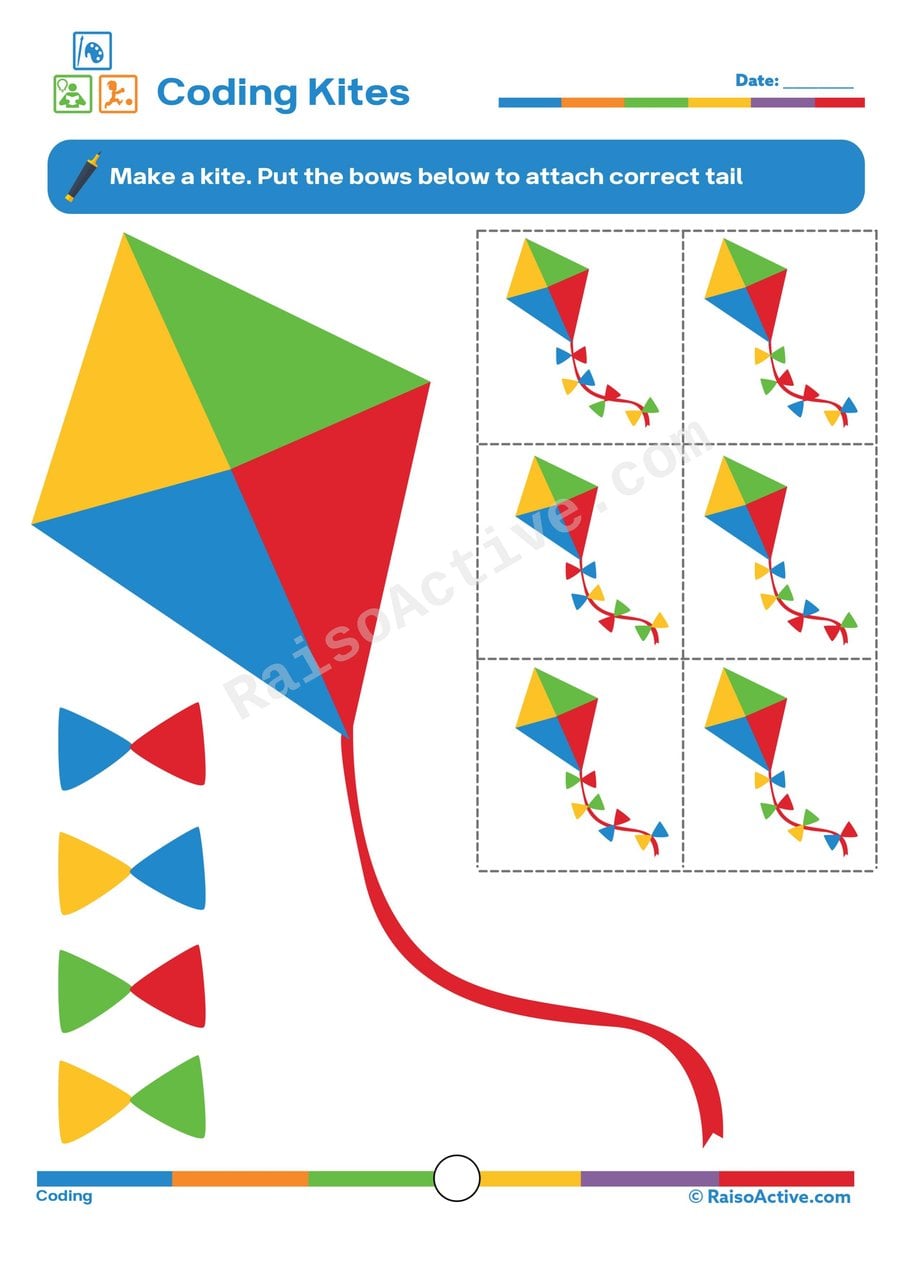
Coding Kites Worksheet: Match the Bows!
Ages 3-5 · Preschool–Pre-KAges 3-5 · Nursery–ReceptionAges 3-5 · Nursery–LKGAges 3-5
By matching each colorful bow to the kite sharing its color pattern, children ages 3-5 practice visual pattern recognition — an early form of the same logical sequencing used in beginner coding concepts. Cutting, matching, and gluing the correct bow also reinforces color-word vocabulary and precise hand-eye coordination.

Navratri Colour Hunt: Colour Words, Matching and Bangles
Ages 4-6 · Pre-K–KindergartenAges 4-6 · Reception–Year 1Ages 4-6 · LKG–UKGAges 4-6
Children read colour words, colour bangles to match, count how many of each colour, match everyday things to their colours and find colours around the home.
Guides for this topic

Best Worksheets for 3-Year-Olds: What Works and What to Avoid
What works on worksheets for 3-year-olds: short sessions, crayons, tracing lines, matching, cutting, a free weekly plan, and signs one is too advanced.

Age-Appropriate Problem-Solving Activities: Building Critical Thinkers from the Ground Up
Discover fun, age-appropriate problem-solving activities for children ages 1-8. Build critical thinking, logic, and reasoning skills through play-based learning.
Critical Thinking Activities That Actually Work for Young Children: Building Tomorrow's Thinkers Today
Discover proven critical thinking activities for young children. Age-wise logic games, questioning techniques, and hands-on ideas to build thinking skills at home.
Reviews
Every worksheet for ages 3–5, no watermark
Members download the full library of 1,000+ worksheets and every activity pack without watermarks or daily limits. One year costs ₹999 in India or $20 elsewhere.
See membership plansOr download any worksheet free with a watermark (5 a day).