
Match the Baby Animals Worksheet for Preschoolers
Matching adult animals to their babies teaches children ages 3-5 specific animal vocabulary — like calf, cub, and kit — while sharpening visual comparison skills as they look for physical similarities between the pictures. This kind of pairing task also builds early categorization thinking, since children must recognize that a baby animal, despite looking different from its parent, still belongs to the same animal family.
Part of the pack
Month 7: Holistic Kindergarten Curriculum | Ages 5-6Curriculum
How to use this worksheet
Look over all the adult animals on the left side of the page and the baby animals on the right, naming each one together first. Ask your child to study one adult animal and think about which baby might belong to it, using clues like color or body shape. Have them draw a line connecting the adult to its correct baby using a pencil or crayon. Continue matching each remaining pair, then go back through the finished lines together, saying both animal names out loud for each connection.
Materials needed
- Pencil
- Crayons
Extension activities
- •Look up pictures or videos of a few baby animals from the worksheet and talk about how they change as they grow.
- •Play an animal sound matching game, making the adult sound and then the baby sound for each animal pair.
- •Have your child draw their favorite animal alongside its baby version.
- •Read a picture book about baby animals and pause to name each baby using its correct term.
- •Visit a farm, zoo, or petting zoo and point out real adult-and-baby animal pairs if possible.
Tips for parents and teachers
Many baby animal names are irregular and unfamiliar, like 'foal' or 'joey,' so say each one clearly and repeat it a few times rather than expecting instant recall. If lines get crossed or messy, let your child use a finger to trace the match first before committing to pencil. Praise their reasoning when they guess a match based on visual clues, even if the specific animal name isn't yet memorized.

Written by
Hemsweta Jain · Teacher Cheena
MBA and Early Childhood Educator, teaching since 2014 · Founder of RaisoActive, Mumbai
Every RaisoActive worksheet is designed and checked by the founder before publishing.
Published · Last reviewed
Related worksheets

Animal Babies Tracing Worksheet: Help the Babies Find Their Mothers!
This tracing worksheet has children ages 3-5 trace dotted lines to connect each baby animal to its correct mother, combining pencil control practice with early science knowledge about animal families. Learning which baby belongs to which adult animal — like a calf to a cow, or a cub to a lion — builds vocabulary and categorization skills that go beyond the tracing itself. Because the correct line only makes sense if the child recognizes the right animal pairing first, this activity blends fine motor practice with genuine content knowledge.

Animal Identification Worksheet for Preschoolers: Color the Correct Animal!
Reading or listening to a simple question and then coloring the animal that answers it correctly builds listening comprehension and animal knowledge in children ages 3-5, requiring them to match a spoken clue to the right picture rather than just naming animals they already recognize. This task strengthens the ability to process a question, consider several possible answers, and select the correct one, an early form of reasoning that supports later reading comprehension. The coloring step at the end also adds a satisfying creative reward for correctly identifying each animal.

Domestic vs. Wild Animals Sorting Worksheet for Preschoolers
Sorting animal pictures into domestic and wild categories teaches children ages 3-5 early classification skills, requiring them to consider a shared trait, like whether an animal lives with humans or in the wild, rather than just naming individual animals. This kind of categorization is a foundational science and logical-thinking skill, since sorting by an abstract rule is more advanced than simply identifying objects one at a time. Cutting and gluing the animals into their correct groups also adds fine motor practice to the sorting task.
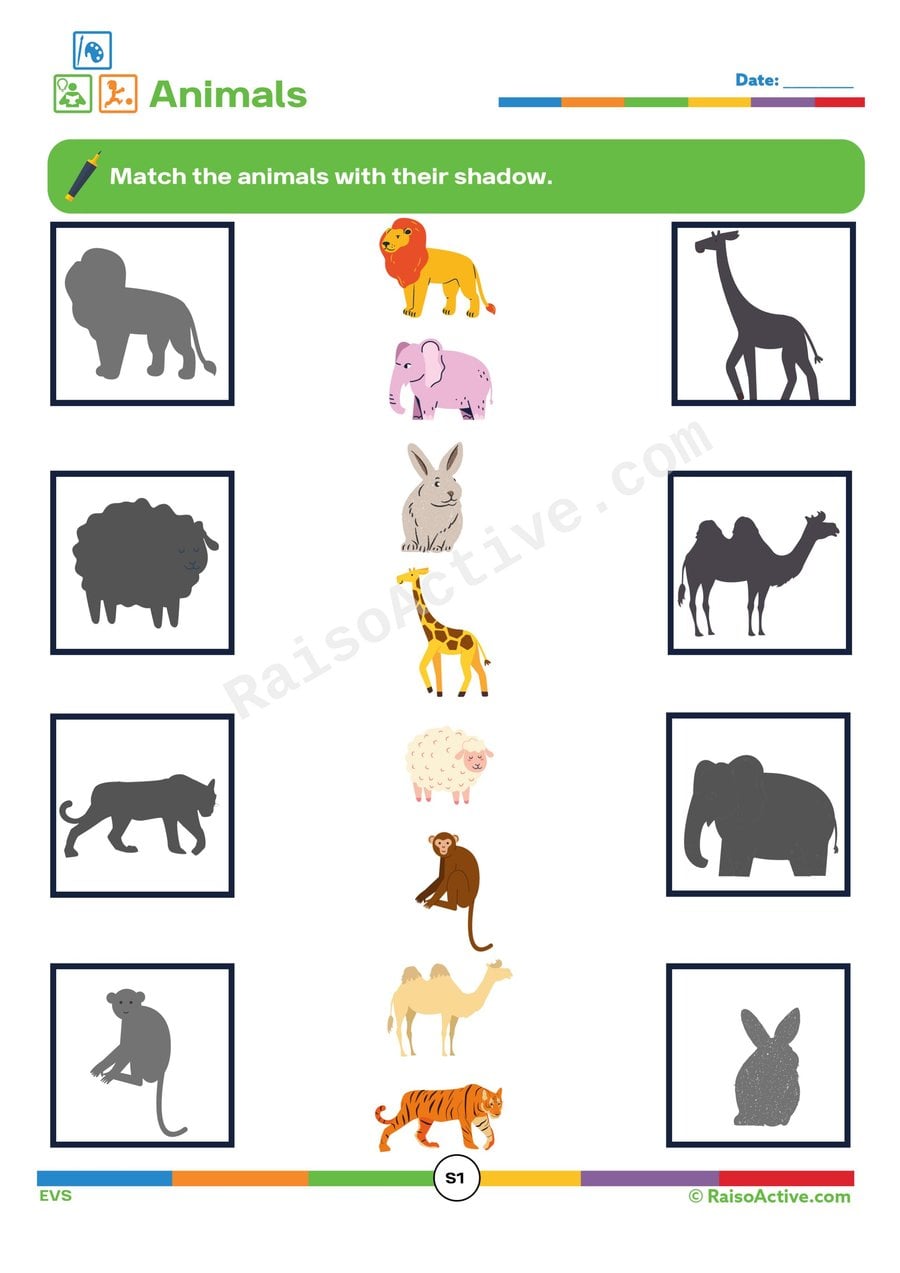
Animal Shadow Match Worksheet for Preschoolers
This worksheet builds visual discrimination skills for children ages 3-5 by having them match each animal to its correct silhouette or shadow shape. Because a shadow strips away color and detail, leaving only outline and proportion, this task requires more careful visual analysis than typical picture matching, sharpening the kind of attention to shape and form that supports later letter and word recognition.
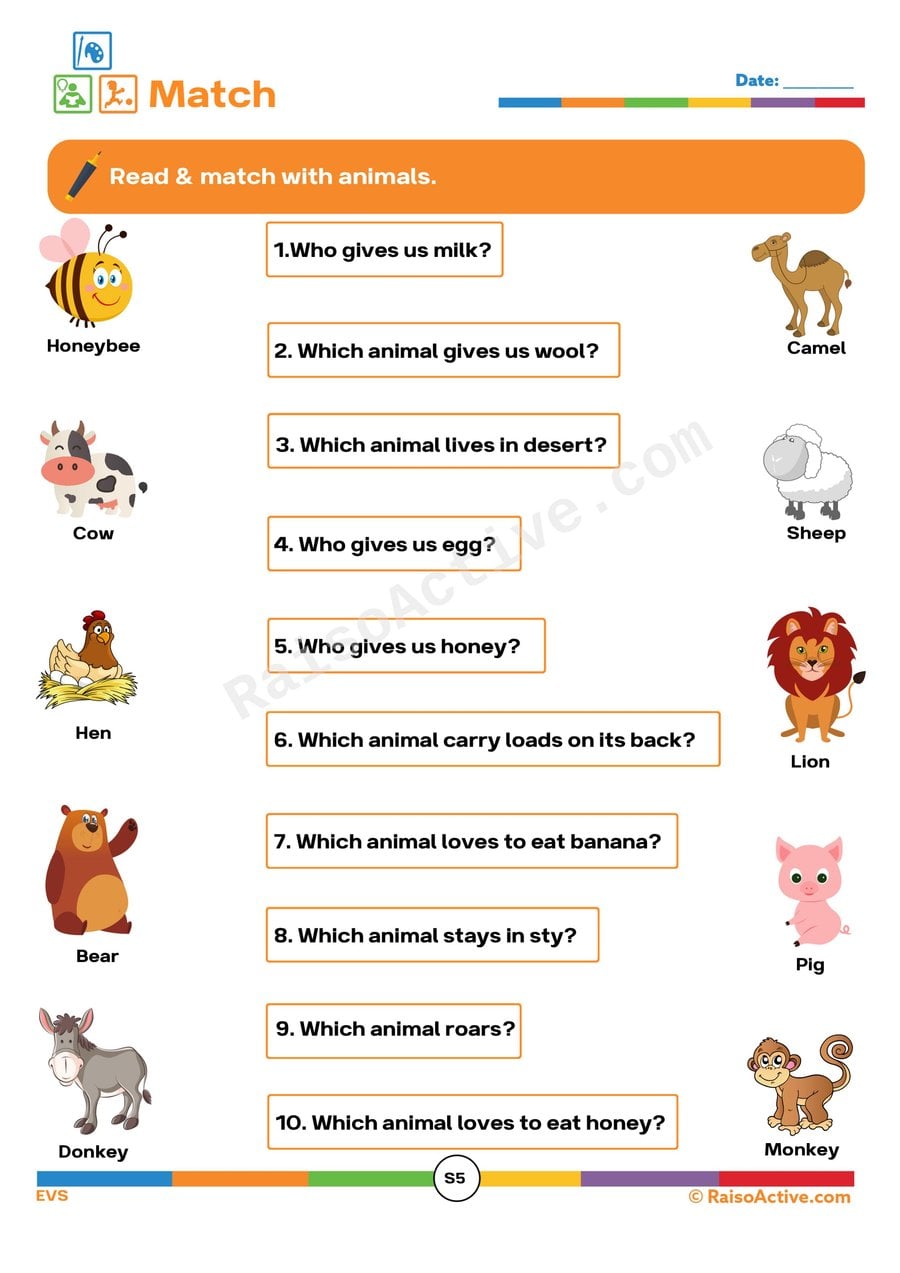
Match the Animals! A Fun Worksheet for Kids
This worksheet helps children ages 3-5 build observation and reasoning skills as they read a simple question or clue about an animal and match it to the correct picture. Rather than matching by appearance alone, children must connect descriptive language to an animal's known characteristics, which strengthens both listening comprehension and early vocabulary about animals.
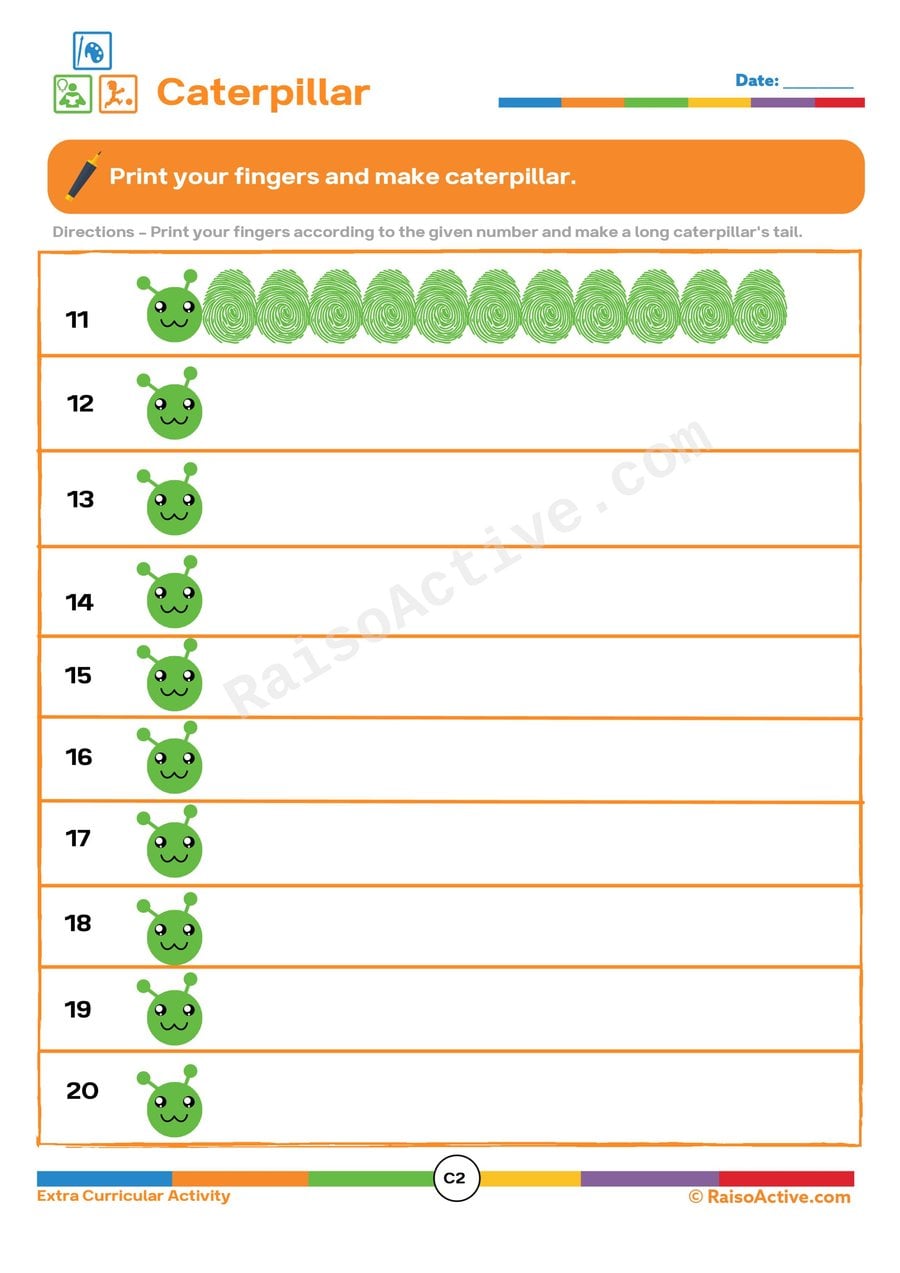
Caterpillar Fingerprint Fun Worksheet for Kids
This worksheet helps children ages 3-5 practice following numbered instructions and develop fine motor control by creating a caterpillar's body using their own fingerprints in a specific sequence. Beyond the sensory fun of fingerprint art, this activity builds counting skills as each segment requires a specific number of prints, along with the careful hand control needed to place each fingerprint deliberately rather than randomly.
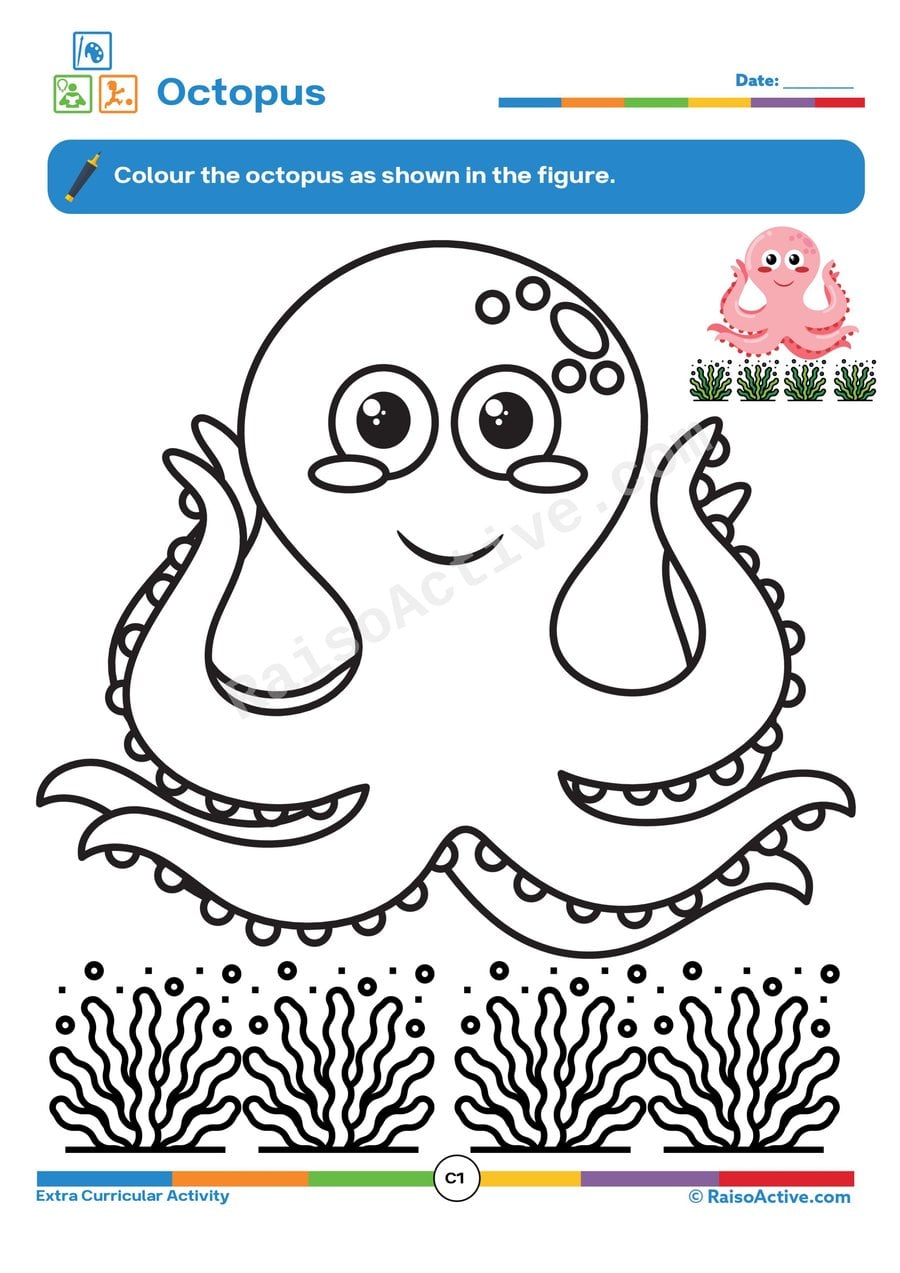
Color the Octopus Worksheet for Preschoolers
Children ages 3-5 practice fine motor control and following a color example by coloring a detailed octopus picture, strengthening the hand control and attention needed for later writing tasks. Matching a model image also builds visual observation skills as they compare their work to the example provided.

Wild Animals Cut and Paste Worksheet for Preschoolers
Children ages 3-5 practice fine motor cutting and pasting skills while learning to recognize wild animals such as lions, tigers, or elephants that live in jungle habitats rather than around a home. This builds early classification knowledge about animal habitats alongside hands-on scissor practice.
Guides for this topic
Best Worksheets for 3-Year-Olds: What Works and What to Avoid
What works on worksheets for 3-year-olds: short sessions, crayons, tracing lines, matching, cutting, a free weekly plan, and signs one is too advanced.
Age-Appropriate Problem-Solving Activities: Building Critical Thinkers from the Ground Up
Discover fun, age-appropriate problem-solving activities for children ages 1-8. Build critical thinking, logic, and reasoning skills through play-based learning.
Critical Thinking Activities That Actually Work for Young Children: Building Tomorrow's Thinkers Today
Discover proven critical thinking activities for young children. Age-wise logic games, questioning techniques, and hands-on ideas to build thinking skills at home.
Reviews
Every worksheet for ages 3–5, no watermark
Members download the full library of 1,000+ worksheets and every activity pack without watermarks or daily limits. One year costs ₹1,000 in India or $20 elsewhere.
See membership plansOr download any worksheet free with a watermark (5 a day).