Wild Animals Cut and Paste Worksheet for Preschoolers
Children ages 3-5 practice fine motor cutting and pasting skills while learning to recognize wild animals such as lions, tigers, or elephants that live in jungle habitats rather than around a home. This builds early classification knowledge about animal habitats alongside hands-on scissor practice.

Part of the pack
Month 12: Learning & Development | Ages Up to 4
This is page 25 of the pack. Ages 2-4 · PreschoolAges 2-4 · NurseryAges 2-4
Curriculum
- Living Things - Animals > Animals & Habitats
How to use this worksheet
Have your child cut out each wild animal picture at the bottom of the page, assisting with tricky curves as needed. Talk about each animal together, naming it and discussing what it eats or how it moves. Have your child glue each animal into the jungle scene at the top of the page, encouraging them to say the animal's name and sound as they paste it into place.
Materials needed
- Scissors
- Glue
- Pencil
Extension activities
- 1Have your child name each animal and describe where in the wild it actually lives.
- 2Draw your own jungle scene and add even more wild animals to it.
- 3Look at a picture book or documentary clip about jungle animals and talk about what you notice.
- 4Play an animal-sounds guessing game, mimicking a wild animal for your child to identify.

Written by
Hemsweta Jain · Teacher Cheena
MBA and Early Childhood Educator, teaching since 2014 · Founder of RaisoActive, Mumbai
Every RaisoActive worksheet is designed and checked by the founder before publishing.
Published · Last reviewed
More from Month 12: Learning & Development | Ages Up to 4

Parent's Guide: Fun Activities for Early Learners!
Ages 3-5 · Preschool–Pre-KAges 3-5 · Nursery–ReceptionAges 3-5 · Nursery–LKGAges 3-5
This parent's guide bundles several hands-on activities — letter matching, sorting, art, and simple crafts like paper cup animals — that build early literacy, fine motor skills, and creativity for children ages 3-5 through play rather than worksheets.

Froggy Skip Counting Worksheet: Practice Number Patterns!
Ages 4-6 · Pre-K–KindergartenAges 4-6 · Reception–Year 1Ages 4-6 · LKG–UKGAges 4-6
This worksheet introduces children ages 4-6 to skip counting — counting forward by a number other than one, such as by 2s or 5s — using a playful frog theme to keep the repetitive number pattern engaging. Recognizing and continuing a skip-counting sequence builds early number pattern awareness, a skill that later supports multiplication, telling time, and counting money.

Traffic Signals Cut and Paste Worksheet for Preschoolers
Ages 3-5 · Preschool–Pre-KAges 3-5 · Nursery–ReceptionAges 3-5 · Nursery–LKGAges 3-5
Children ages 3-5 learn to recognize red, yellow, and green traffic signals and connect each color to its meaning, an early road-safety skill that also reinforces color recognition and matching. Understanding what each signal means builds real-world safety awareness they'll use as pedestrians and passengers.

Community Helpers Cut and Paste Worksheet for Kids
Ages 3-5 · Preschool–Pre-KAges 3-5 · Nursery–ReceptionAges 3-5 · Nursery–LKGAges 3-5
This cut-and-paste worksheet helps children ages 3-5 connect community helpers, such as a firefighter or doctor, to the tools and equipment each one uses in their job. Handling scissors to cut out small pictures and precisely placing them in the correct box builds fine motor control and hand-eye coordination, while the matching task itself deepens understanding of community roles and how people help one another.

Fun Phonics Worksheet: Matching Uppercase and Lowercase Letters!
Ages 3-5 · Preschool–Pre-KAges 3-5 · Nursery–ReceptionAges 3-5 · Nursery–LKGAges 3-5
This matching worksheet teaches children ages 3-5 to recognize that uppercase and lowercase versions of the same letter — like S and s — represent one letter despite looking different, a concept that trips up many early readers. Drawing a line between the four matching pairs builds visual discrimination and letter-form memory, while the follow-up task of circling pictures that start with 'C' adds practice connecting a letter to its sound.
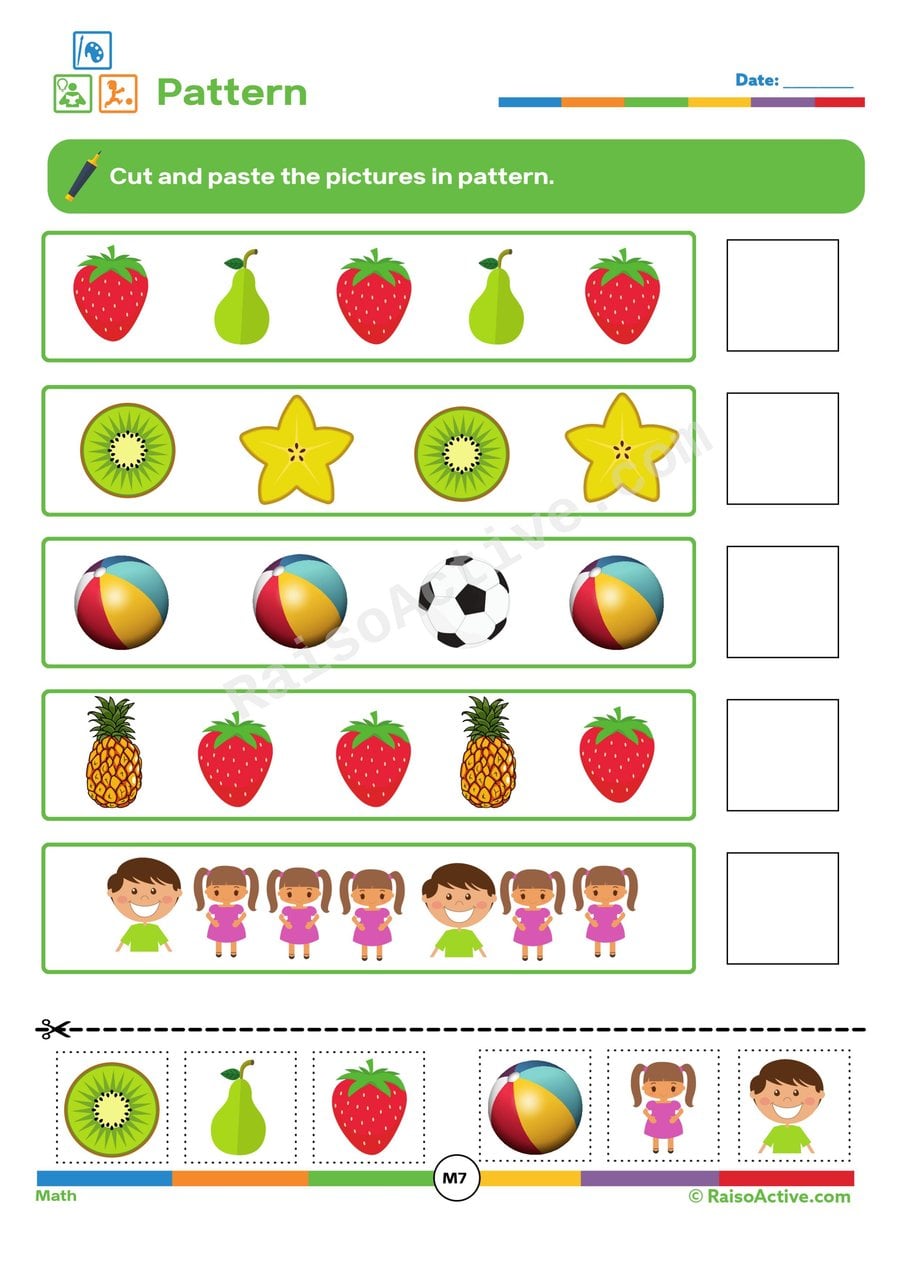
Fruit and Friends Pattern Worksheet
Ages 3-5 · Preschool–Pre-KAges 3-5 · Nursery–ReceptionAges 3-5 · Nursery–LKGAges 3-5
Identifying a repeating sequence of fruits or characters and choosing the correct picture to continue it builds pattern-recognition skills for children ages 3-5, an early form of logical reasoning that connects directly to later math concepts like skip counting.

Many vs. Few: Object Counting Worksheet for Preschoolers
Ages 3-5 · Preschool–Pre-KAges 3-5 · Nursery–ReceptionAges 3-5 · Nursery–LKGAges 3-5
This worksheet builds early quantity comparison skills as children ages 3-5 look at groups of objects and decide whether each group shows 'many' or 'few.' Beyond simple counting, this task develops relative reasoning — understanding that quantity is judged by comparison, not just a fixed number — which lays groundwork for later concepts like greater than and less than. Circling the correct group also reinforces visual scanning and attention to detail.

Living or Non-Living? A Fun Sorting Worksheet for Preschoolers
Ages 3-5 · Preschool–Pre-KAges 3-5 · Nursery–ReceptionAges 3-5 · Nursery–LKGAges 3-5
This sorting worksheet introduces children ages 3-5 to one of science's foundational classification concepts: distinguishing living things from non-living things. Deciding whether to tick or cross each picture pushes children to apply criteria — does it grow, move, breathe, or need food — rather than sort by appearance alone, an early form of scientific reasoning. This distinction also builds vocabulary they'll use throughout later nature and biology topics.
Related worksheets

Wild or Domestic? Animal Sorting Worksheet for Preschoolers
Ages 3-5 · Preschool–Pre-KAges 3-5 · Nursery–ReceptionAges 3-5 · Nursery–LKGAges 3-5
This worksheet helps children ages 3-5 learn to differentiate between wild and domestic animals by looking closely at each picture and deciding where the animal lives and how it relates to people. Sorting animals into these two categories builds early classification skills, an important foundation for later scientific thinking.

Match the Baby Animals Worksheet for Preschoolers
Ages 3-5 · Preschool–Pre-KAges 3-5 · Nursery–ReceptionAges 3-5 · Nursery–LKGAges 3-5
Matching adult animals to their babies teaches children ages 3-5 specific animal vocabulary — like calf, cub, and kit — while sharpening visual comparison skills as they look for physical similarities between the pictures. This kind of pairing task also builds early categorization thinking, since children must recognize that a baby animal, despite looking different from its parent, still belongs to the same animal family.
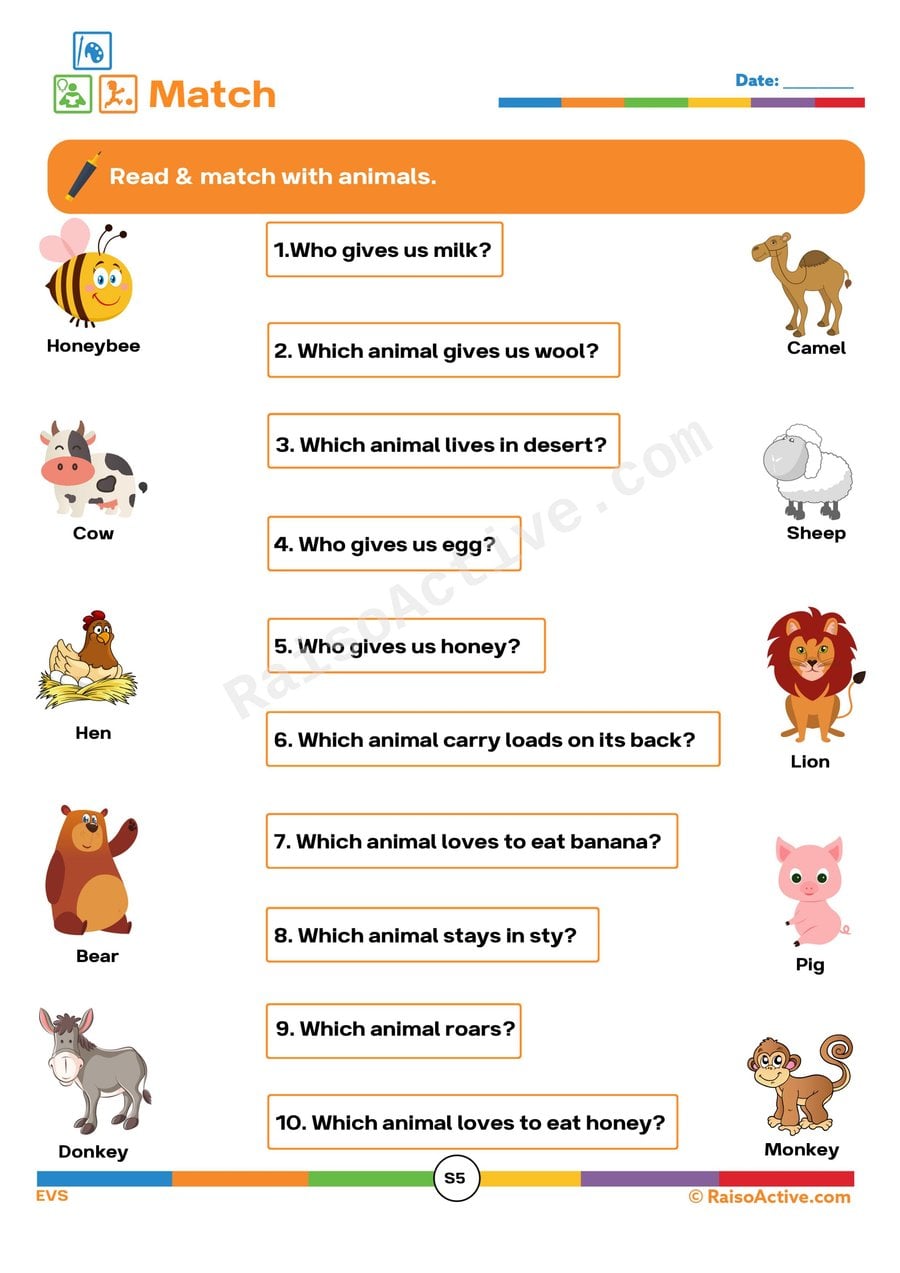
Match the Animals! A Fun Worksheet for Kids
Ages 3-5 · Preschool–Pre-KAges 3-5 · Nursery–ReceptionAges 3-5 · Nursery–LKGAges 3-5
This worksheet helps children ages 3-5 build observation and reasoning skills as they read a simple question or clue about an animal and match it to the correct picture. Rather than matching by appearance alone, children must connect descriptive language to an animal's known characteristics, which strengthens both listening comprehension and early vocabulary about animals.

Animal Maze Adventure: Help the Animals Find Their Food!
Ages 3-5 · Preschool–Pre-KAges 3-5 · Nursery–ReceptionAges 3-5 · Nursery–LKGAges 3-5
This worksheet helps children ages 3-5 develop problem-solving skills and visual discrimination by guiding different animals through mazes to reach their favorite food, requiring them to scan ahead and choose the correct path before committing to a route. Matching each animal to a food that makes sense for it also builds early general knowledge about what different animals eat.

Animal Babies Tracing Worksheet: Help the Babies Find Their Mothers!
Ages 3-5 · Preschool–Pre-KAges 3-5 · Nursery–ReceptionAges 3-5 · Nursery–LKGAges 3-5
This tracing worksheet sharpens fine motor skills and hand-eye coordination as children carefully follow the dotted lines. It helps them develop the controlled pencil movements essential for pre-writing while reinforcing visual discrimination to match baby animals with their mothers. Children also expand their vocabulary by identifying different animal families and their offspring.

Domestic vs. Wild Animals Sorting Worksheet for Preschoolers
Ages 3-5 · Preschool–Pre-KAges 3-5 · Nursery–ReceptionAges 3-5 · Nursery–LKGAges 3-5
Sorting animal pictures into domestic and wild categories teaches children ages 3-5 early classification skills, requiring them to consider a shared trait, like whether an animal lives with humans or in the wild, rather than just naming individual animals. This kind of categorization is a foundational science and logical-thinking skill, since sorting by an abstract rule is more advanced than simply identifying objects one at a time. Cutting and gluing the animals into their correct groups also adds fine motor practice to the sorting task.
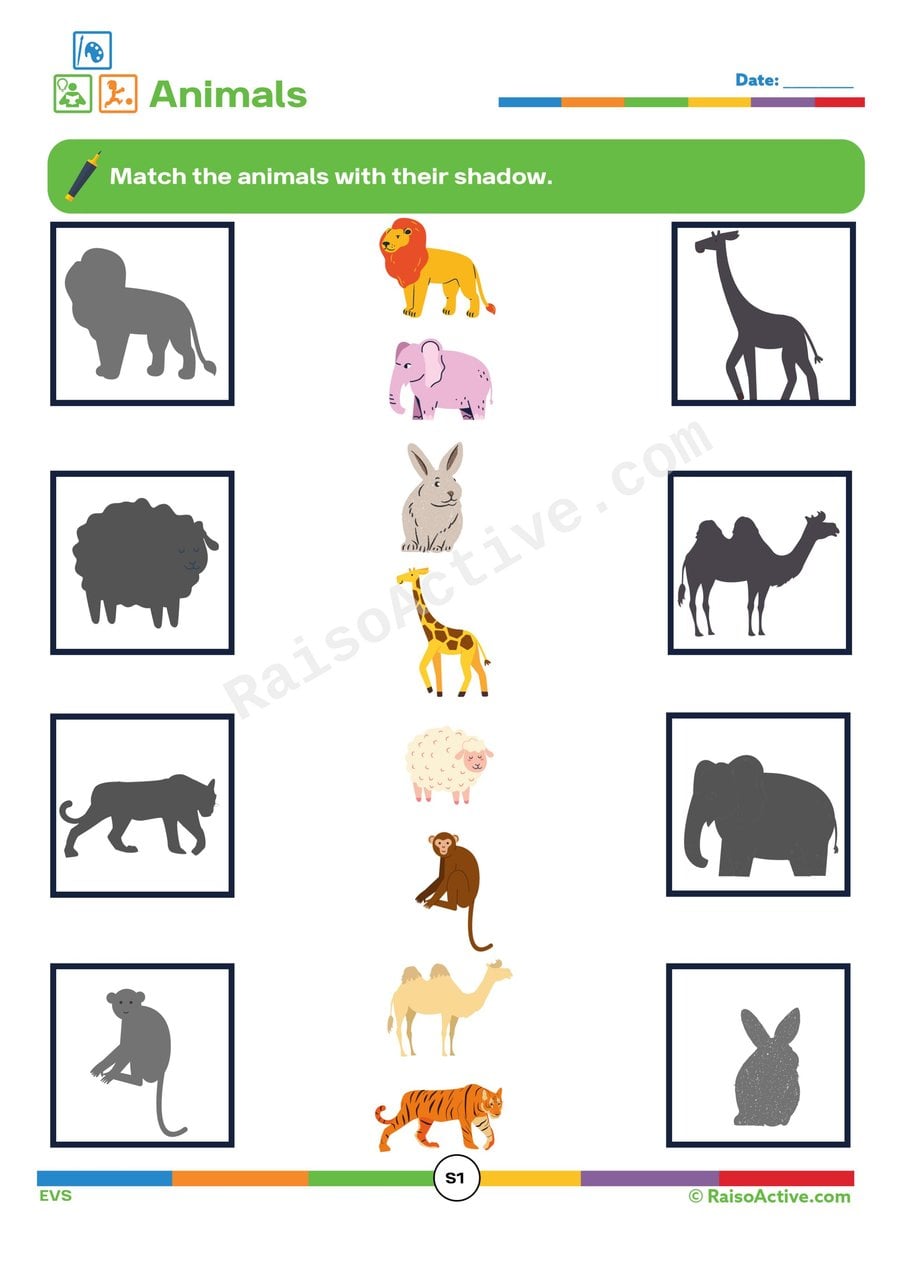
Animal Shadow Match Worksheet for Preschoolers
Ages 3-5 · Preschool–Pre-KAges 3-5 · Nursery–ReceptionAges 3-5 · Nursery–LKGAges 3-5
This worksheet builds visual discrimination skills for children ages 3-5 by having them match each animal to its correct silhouette or shadow shape. Because a shadow strips away color and detail, leaving only outline and proportion, this task requires more careful visual analysis than typical picture matching, sharpening the kind of attention to shape and form that supports later letter and word recognition.

Animal Identification Worksheet for Preschoolers: Color the Correct Animal!
Ages 3-5 · Preschool–Pre-KAges 3-5 · Nursery–ReceptionAges 3-5 · Nursery–LKGAges 3-5
Reading or listening to a simple question and then coloring the animal that answers it correctly builds listening comprehension and animal knowledge in children ages 3-5, requiring them to match a spoken clue to the right picture rather than just naming animals they already recognize. This task strengthens the ability to process a question, consider several possible answers, and select the correct one, an early form of reasoning that supports later reading comprehension. The coloring step at the end also adds a satisfying creative reward for correctly identifying each animal.
Guides for this topic

Age-Appropriate Problem-Solving Activities: Building Critical Thinkers from the Ground Up
Discover fun, age-appropriate problem-solving activities for children ages 1-8. Build critical thinking, logic, and reasoning skills through play-based learning.

Christmas and Winter Activities That Combine Fun and Learning: Creating Magical Educational Experiences
Discover Christmas and winter activities that combine festive fun with real learning. Crafts, counting, literacy, and printable worksheets for ages 2 to 8 — perfect for home and school.

Creating Engaging Themed Learning Units for Young Children: A Complete Guide to Integrated Learning
Discover how to create engaging themed learning units for young children that integrate literacy, maths, science, and art — with practical examples and free worksheets.
Reviews
Every worksheet for ages 3–5, no watermark
Members download the full library of 1,000+ worksheets and every activity pack without watermarks or daily limits. One year costs ₹999 in India or $20 elsewhere.
See membership plansOr download any worksheet free with a watermark (5 a day).