Domestic vs. Wild Animals Sorting Worksheet for Preschoolers
Sorting animal pictures into domestic and wild categories teaches children ages 3-5 early classification skills, requiring them to consider a shared trait, like whether an animal lives with humans or in the wild, rather than just naming individual animals. This kind of categorization is a foundational science and logical-thinking skill, since sorting by an abstract rule is more advanced than simply identifying objects one at a time. Cutting and gluing the animals into their correct groups also adds fine motor practice to the sorting task.
Part of the pack
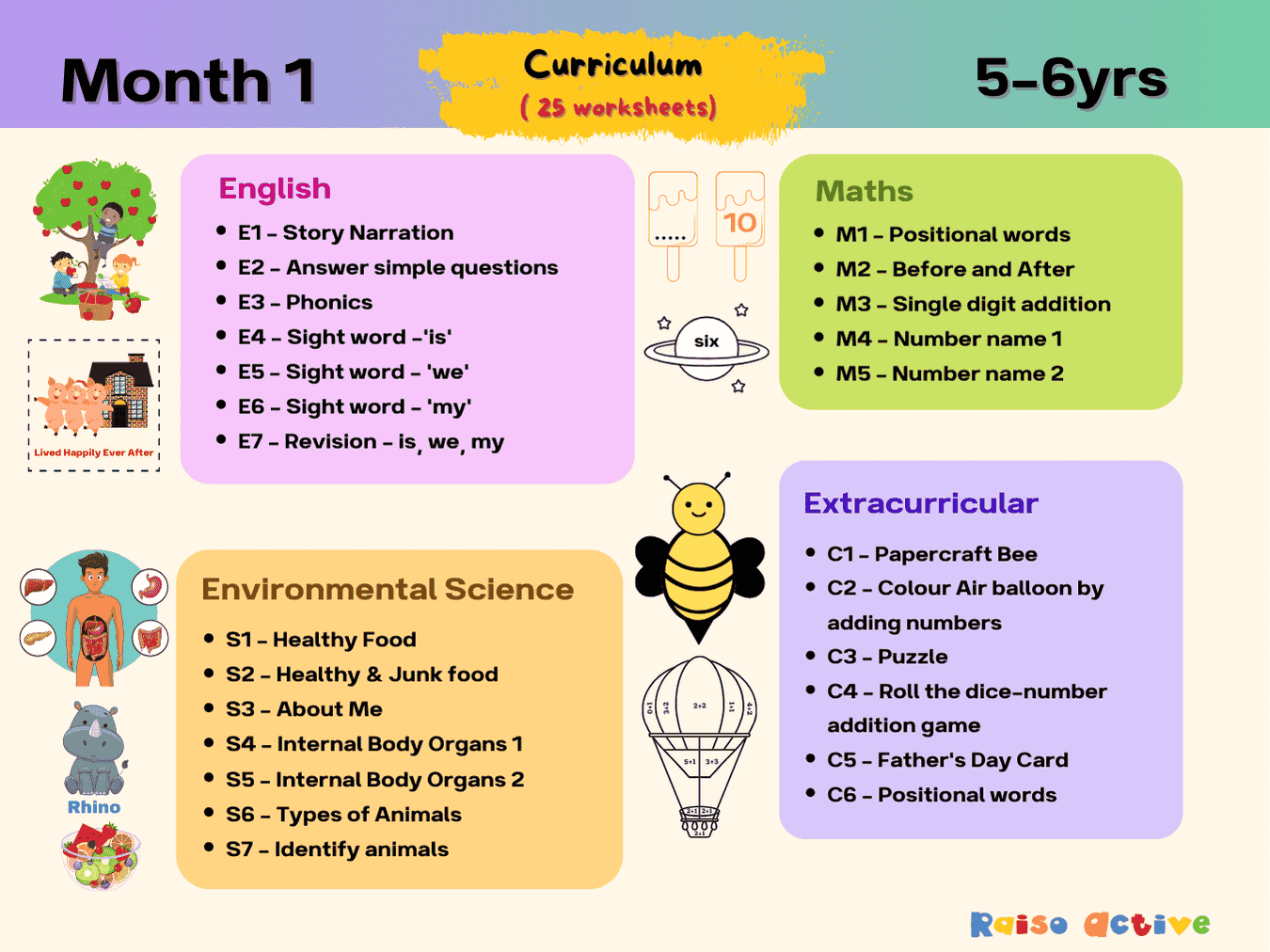
Month 1: Learning & Development | Ages 5-6
This is page 21 of the pack. Ages 5-6 · KindergartenAges 5-6 · Year 1Ages 5-6 · UKGAges 5-6
Made for your child
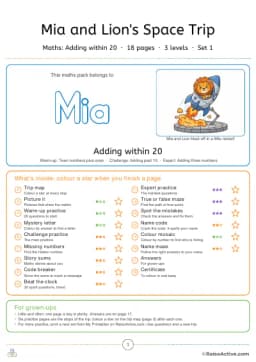
Counting to 10, made for your child
A maths pack with your child's name in it: pictures that explain, practice at three levels, puzzles and story sums about them. Print a new set whenever they finish.
Make a maths packFree preview · free for members
Curriculum
- Living Things - Animals > Animals & Habitats
How to use this worksheet
Have your child cut out the animal pictures at the bottom of the page and set them in a loose pile. Look at the two labeled boxes together, Domestic Animals and Wild Animals, and talk about what each category means using an example your child already knows. Ask your child to pick up one animal at a time, decide which category it belongs to, and glue it into the correct box. Continue until every animal has been sorted, then review both groups together and talk about why each animal was placed where it was.
Materials needed
- Scissors
- Glue
- Pencil
Extension activities
- 1Visit a farm or petting zoo to see domestic animals up close and compare them to pictures of wild animals.
- 2Sort toy animals at home into domestic and wild piles using the same categories.
- 3Draw and label one new domestic animal and one new wild animal not shown on the worksheet.
- 4Read a book that features both wild and domestic animals and pause to sort the characters as you go.
- 5Talk about what domestic animals need from people, like food and shelter, compared to how wild animals survive on their own.

Written by
Hemsweta Jain · Teacher Cheena
MBA and Early Childhood Educator, teaching since 2014 · Founder of RaisoActive, Mumbai
Every RaisoActive worksheet is designed and checked by the founder before publishing.
Published · Last reviewed
More from Month 1: Learning & Development | Ages 5-6

Apple Picking Fun: A Reading Comprehension Worksheet for Kids
Ages 4-6 · Pre-K–KindergartenAges 4-6 · Reception–Year 1Ages 4-6 · LKG–UKGAges 4-6
This worksheet builds early reading comprehension skills in children ages 4-6 by having them read a short story about apple picking and then answer simple questions that check their understanding of what happened. Answering questions after reading, rather than just decoding words, pushes children to hold the story's meaning in mind and recall specific details, a critical skill for all future reading. Coloring an apple afterward gives a relaxing, creative close to the comprehension task.

Air Balloon Color by Sums Worksheet for Preschoolers
Ages 3-5 · Preschool–Pre-KAges 3-5 · Nursery–ReceptionAges 3-5 · Nursery–LKGAges 3-5
This color-by-sums worksheet combines basic addition practice with color-by-number skills, asking children ages 3-5 to solve simple addition problems within each section of an air balloon and then color that section according to a matching color key. Solving a math problem correctly before coloring turns each section into a small, self-checking task, since an incorrect sum would lead to the wrong color choice. This blend of math and art keeps repetitive addition practice feeling like a creative activity rather than a drill.
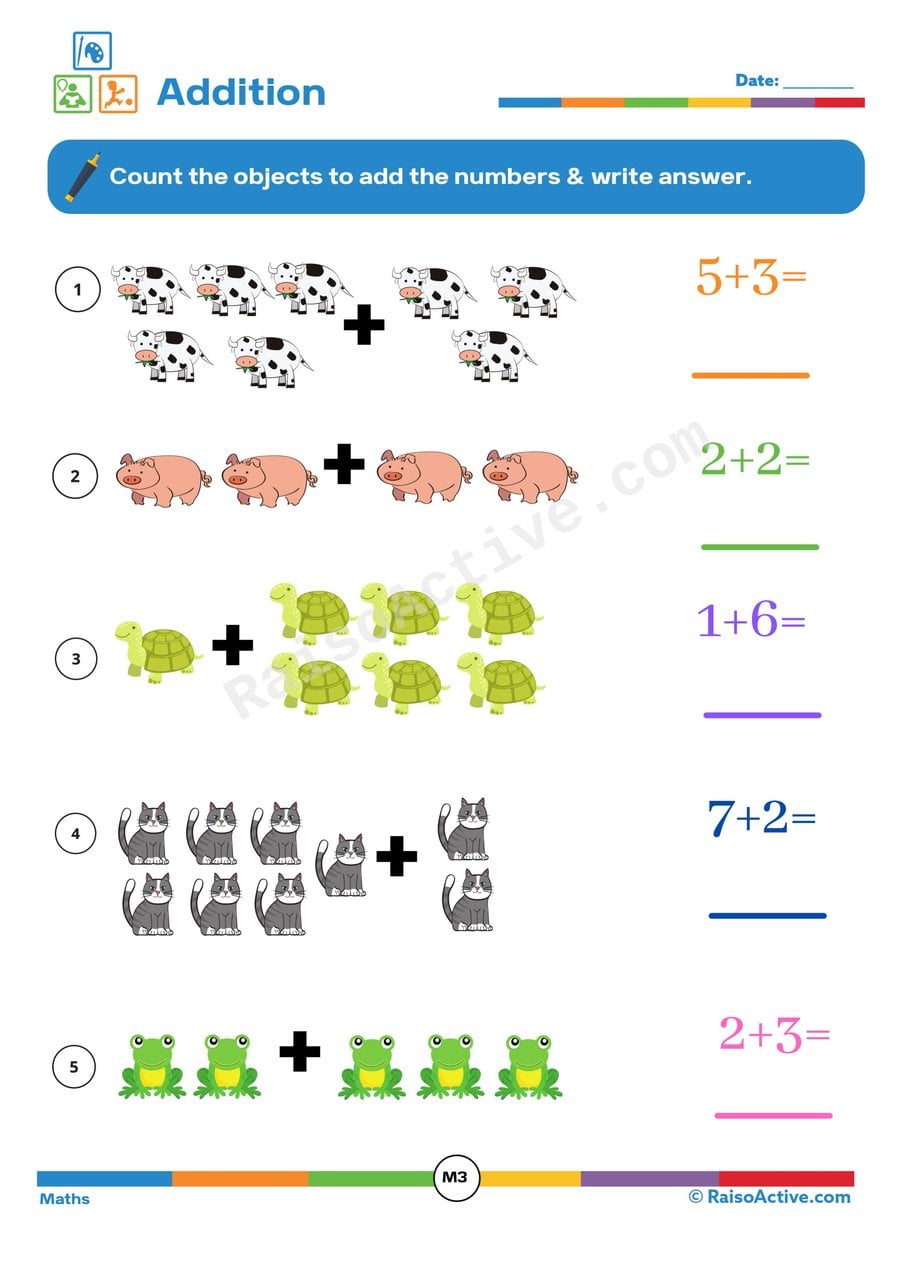
Addition Worksheet: Count and Add Objects!
Ages 4-6 · Pre-K–KindergartenAges 4-6 · Reception–Year 1Ages 4-6 · LKG–UKGAges 4-6
Counting two groups of pictured objects and writing their combined total introduces children ages 4-6 to addition as a concrete, visual process before they work with numbers alone. Because the objects are drawn out rather than represented only by digits, children can physically point and count to verify their answer, building confidence in early math reasoning. Repeated practice with this picture-based format helps children internalize what a plus sign means before they're expected to solve equations without visual support.
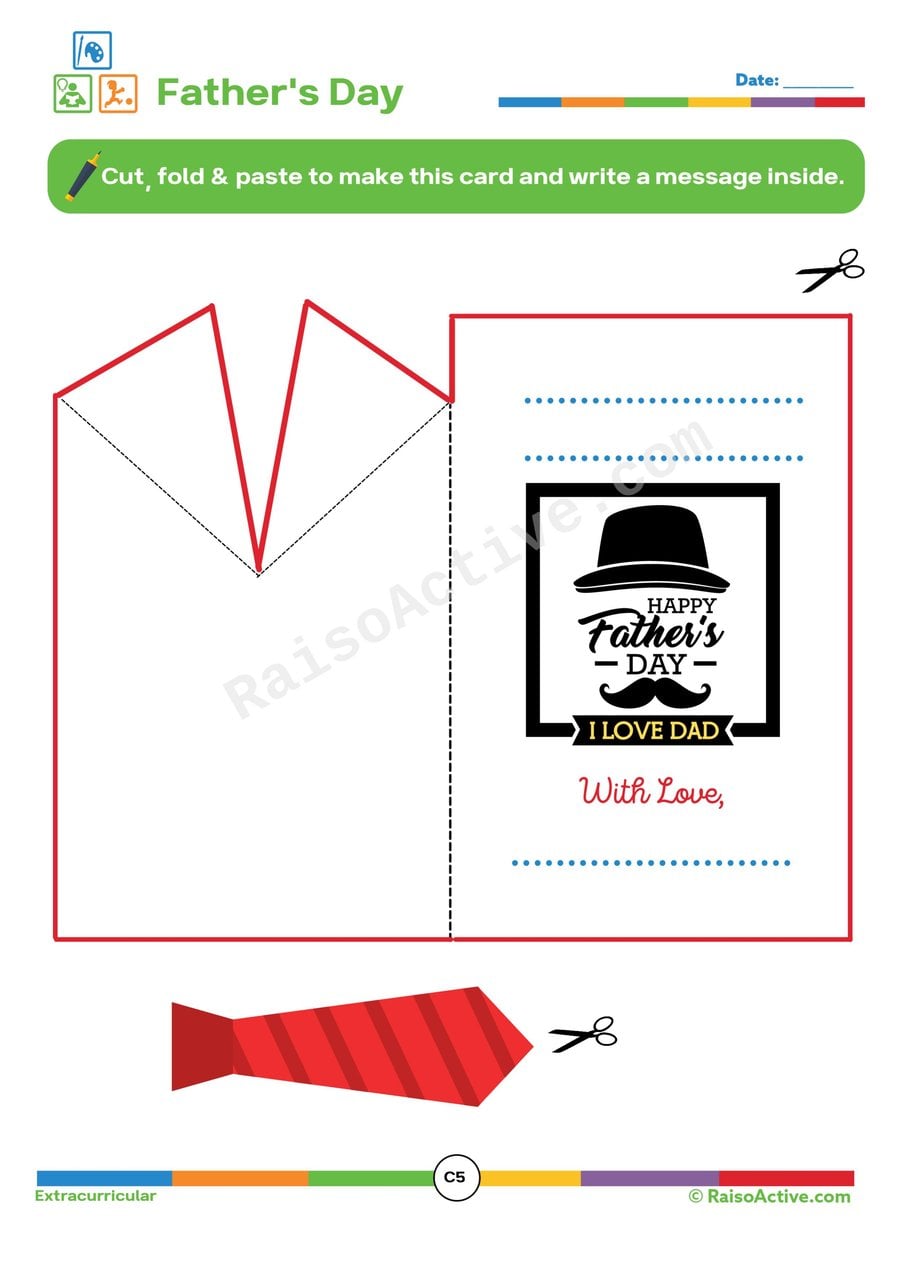
Father's Day Card Craft: Cut, Fold, and Paste!
Ages 3-5 · Preschool–Pre-KAges 3-5 · Nursery–ReceptionAges 3-5 · Nursery–LKGAges 3-5
This Father's Day card craft gives children ages 3-5 focused practice with three distinct fine motor actions in sequence — cutting along a line, folding paper neatly in half, and pasting a small piece precisely in place. Sequencing multiple craft steps in the right order also builds early executive-function skills like following multi-step directions. The personal, gift-making purpose adds meaning and motivation that keeps young children engaged through each step.

Missing Numbers: Ice Cream Fun Worksheet for Kids
Ages 3-5 · Preschool–Pre-KAges 3-5 · Nursery–ReceptionAges 3-5 · Nursery–LKGAges 3-5
This worksheet helps children ages 3-5 practice number sequencing by identifying and writing in the missing numerals within a series of ice cream cones and cars, numbers 1 through 10. Filling in a gap within an otherwise familiar sequence requires children to hold the whole counting order in mind and recognize what number logically belongs in the empty spot, which is more demanding than counting forward from the start each time. The playful ice cream and car theme keeps the repeated number practice visually engaging.

Healthy Eating Worksheet: Fruit Salad and Vegetable Soup!
Ages 3-5 · Preschool–Pre-KAges 3-5 · Nursery–ReceptionAges 3-5 · Nursery–LKGAges 3-5
This matching worksheet helps children ages 3-5 build food vocabulary by identifying pictures of fruits and vegetables and sorting them into the correct category — fruit salad ingredients or vegetable soup ingredients. Learning to classify foods by type, not just by whether they're healthy, supports early categorization skills that apply across many other subjects, from animals to shapes. The cooking-themed framing also connects the sorting task to a familiar, everyday context children may have experienced at home.
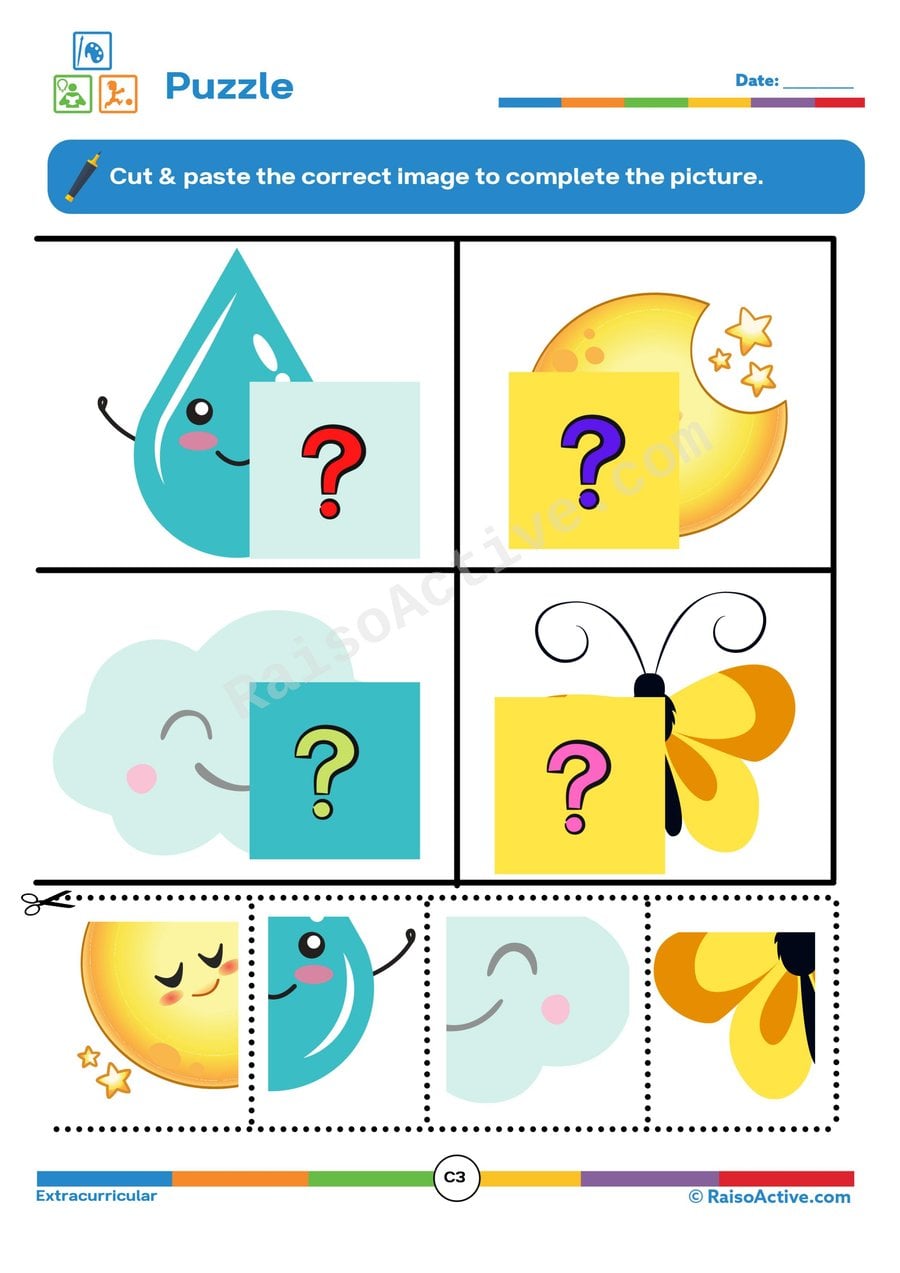
Cut and Paste Puzzle: Complete the Pictures!
Ages 3-5 · Preschool–Pre-KAges 3-5 · Nursery–ReceptionAges 3-5 · Nursery–LKGAges 3-5
This cut-and-paste puzzle challenges children ages 3-5 to visually compare cut-out image pieces to the gaps in a larger picture, strengthening visual discrimination and problem-solving as they figure out which piece fits where. Because more than one cut-out may look similar at a glance, children must attend closely to small details like color, shape, and orientation before gluing. This close visual comparison builds the same attention-to-detail skills used later in reading, where small differences between letters and words matter.

Learn the Sight Word 'My' - Tracing, Writing, and Matching Worksheet
Ages 3-5 · Preschool–Pre-KAges 3-5 · Nursery–ReceptionAges 3-5 · Nursery–LKGAges 3-5
This worksheet builds sight-word fluency for the word 'my' in children ages 3-5 through a combination of tracing, independent writing, fill-in-the-blank sentences, and a matching activity. Working with the same word across several different formats helps cement recognition, since 'my' is a high-frequency word that appears constantly in early reading material but doesn't follow simple phonics patterns. The matching component adds a visual-recognition check to confirm the word sticks even without tracing cues.
Related worksheets

The Hungry Ant: Fruit Matching Worksheet for Kids
Ages 3-5 · Preschool–Pre-KAges 3-5 · Nursery–ReceptionAges 3-5 · Nursery–LKGAges 3-5
Cutting out fruit pictures and matching them to an ant's trail builds scissor control in children ages 3-5 while also reinforcing counting and fruit vocabulary as they sort or count pieces before gluing. The hungry ant theme gives the matching task a simple narrative reason, finding food for the ant, which tends to hold young children's attention better than an unconnected matching exercise.

Bengal Tiger Cut and Paste Worksheet for Preschoolers
Ages 3-5 · Preschool–Pre-KAges 3-5 · Nursery–ReceptionAges 3-5 · Nursery–LKGAges 3-5
Cutting apart and reordering picture strips to rebuild a Bengal tiger image teaches children ages 3-5 to follow multi-step directions while practicing scissor control and sequencing at the same time. Because the final picture only makes sense when the strips are arranged correctly, this activity also builds visual-spatial reasoning as children compare each piece to figure out where it belongs.

Match the Baby Animals Worksheet for Preschoolers
Ages 3-5 · Preschool–Pre-KAges 3-5 · Nursery–ReceptionAges 3-5 · Nursery–LKGAges 3-5
Matching adult animals to their babies teaches children ages 3-5 specific animal vocabulary — like calf, cub, and kit — while sharpening visual comparison skills as they look for physical similarities between the pictures. This kind of pairing task also builds early categorization thinking, since children must recognize that a baby animal, despite looking different from its parent, still belongs to the same animal family.

Animal Sounds Matching Worksheet for Preschoolers
Ages 3-5 · Preschool–Pre-KAges 3-5 · Nursery–ReceptionAges 3-5 · Nursery–LKGAges 3-5
This worksheet builds vocabulary and auditory memory by asking children to match each animal picture to the sound it makes, such as connecting a cow to 'moo' or a duck to 'quack.' For three- to five-year-olds, linking an animal's appearance to its sound strengthens both early science knowledge and the kind of associative memory that supports vocabulary growth.
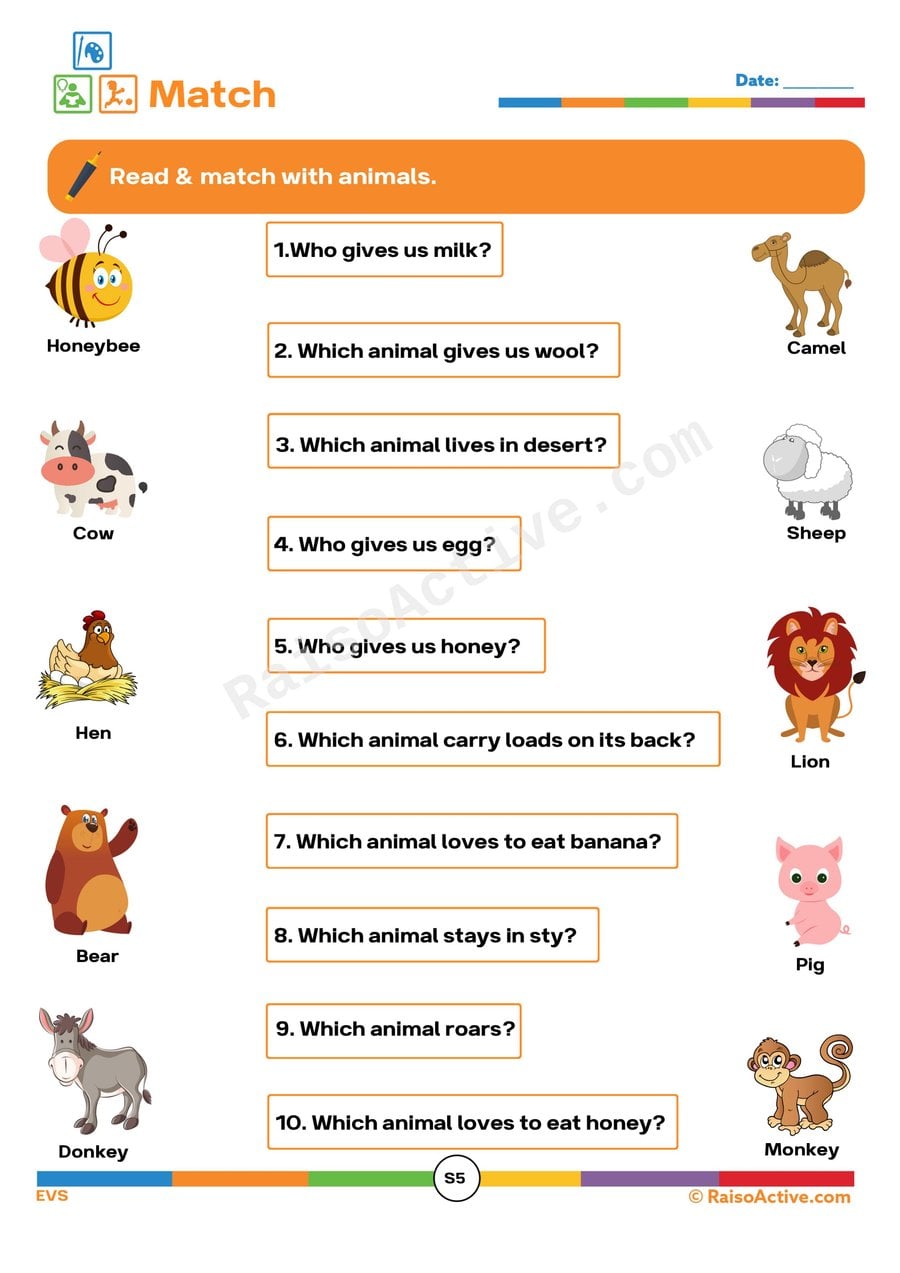
Match the Animals! A Fun Worksheet for Kids
Ages 3-5 · Preschool–Pre-KAges 3-5 · Nursery–ReceptionAges 3-5 · Nursery–LKGAges 3-5
This worksheet helps children ages 3-5 build observation and reasoning skills as they read a simple question or clue about an animal and match it to the correct picture. Rather than matching by appearance alone, children must connect descriptive language to an animal's known characteristics, which strengthens both listening comprehension and early vocabulary about animals.
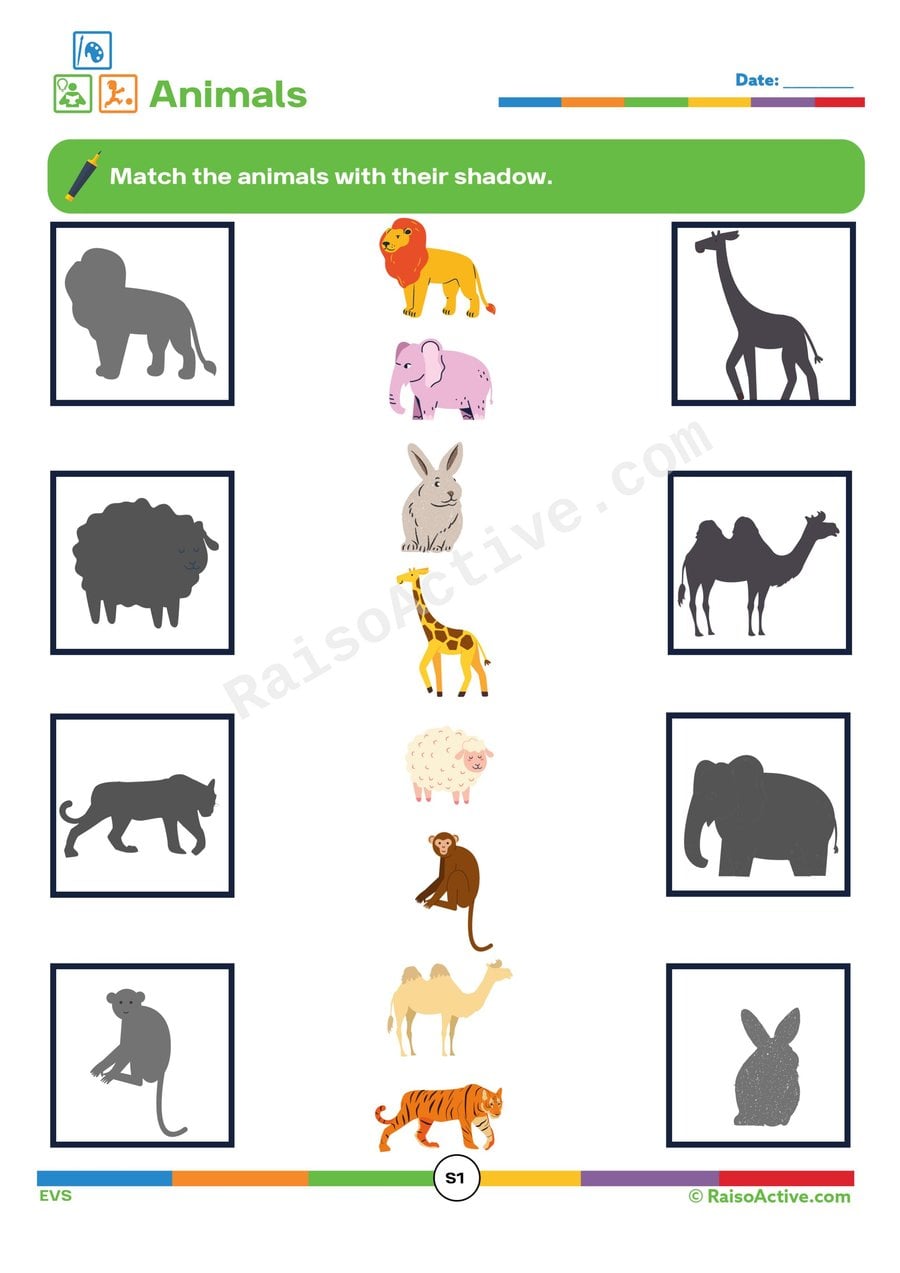
Animal Shadow Match Worksheet for Preschoolers
Ages 3-5 · Preschool–Pre-KAges 3-5 · Nursery–ReceptionAges 3-5 · Nursery–LKGAges 3-5
This worksheet builds visual discrimination skills for children ages 3-5 by having them match each animal to its correct silhouette or shadow shape. Because a shadow strips away color and detail, leaving only outline and proportion, this task requires more careful visual analysis than typical picture matching, sharpening the kind of attention to shape and form that supports later letter and word recognition.

Animal Babies Tracing Worksheet: Help the Babies Find Their Mothers!
Ages 3-5 · Preschool–Pre-KAges 3-5 · Nursery–ReceptionAges 3-5 · Nursery–LKGAges 3-5
This tracing worksheet has children ages 3-5 trace dotted lines to connect each baby animal to its correct mother, combining pencil control practice with early science knowledge about animal families. Learning which baby belongs to which adult animal — like a calf to a cow, or a cub to a lion — builds vocabulary and categorization skills that go beyond the tracing itself. Because the correct line only makes sense if the child recognizes the right animal pairing first, this activity blends fine motor practice with genuine content knowledge.

Match the Baby Animals Worksheet for Preschoolers
Ages 3-5 · Preschool–Pre-KAges 3-5 · Nursery–ReceptionAges 3-5 · Nursery–LKGAges 3-5
Connecting adult animals to their babies builds specific vocabulary for children ages 3-5, like puppy, kitten, and fawn, while training visual comparison skills as they look for matching features between each pair. This activity also introduces the early biology concept that offspring, though smaller and sometimes differently colored, belong to the same animal family as their parent.
Guides for this topic

Age-Appropriate Problem-Solving Activities: Building Critical Thinkers from the Ground Up
Discover fun, age-appropriate problem-solving activities for children ages 1-8. Build critical thinking, logic, and reasoning skills through play-based learning.
Critical Thinking Activities That Actually Work for Young Children: Building Tomorrow's Thinkers Today
Discover proven critical thinking activities for young children. Age-wise logic games, questioning techniques, and hands-on ideas to build thinking skills at home.

Preparing Your Child for a Rapidly Changing World: Essential Skills for Future Success
Discover the essential 21st century skills your child needs for future success. Practical tips on creativity, critical thinking, digital literacy & emotional intelligence for ages 1-8.
Reviews
Every worksheet for ages 3–5, no watermark
Members download the full library of 1,000+ worksheets and every activity pack without watermarks or daily limits. One year costs ₹999 in India or $20 elsewhere.
See membership plansOr download any worksheet free with a watermark (5 a day).