Missing Numbers: Ice Cream Fun Worksheet for Kids
This worksheet helps children ages 3-5 practice number sequencing by identifying and writing in the missing numerals within a series of ice cream cones and cars, numbers 1 through 10. Filling in a gap within an otherwise familiar sequence requires children to hold the whole counting order in mind and recognize what number logically belongs in the empty spot, which is more demanding than counting forward from the start each time. The playful ice cream and car theme keeps the repeated number practice visually engaging.
Part of the pack
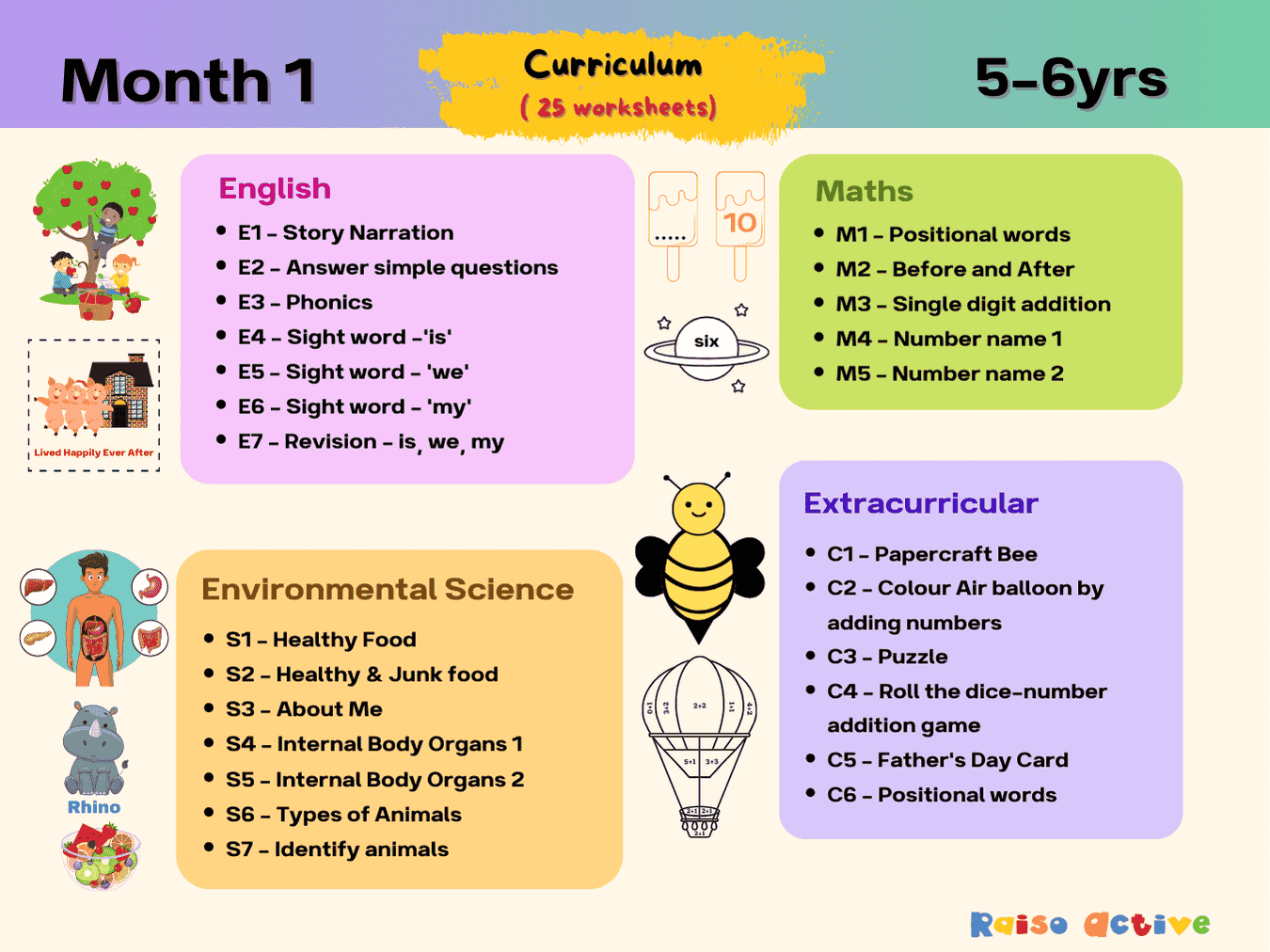
Month 1: Learning & Development | Ages 5-6
This is page 12 of the pack. Ages 5-6 · KindergartenAges 5-6 · Year 1Ages 5-6 · UKGAges 5-6
Made for your child
Counting to 10, made for your child
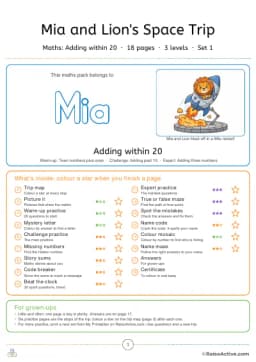
A maths pack with your child's name in it: pictures that explain, practice at three levels, puzzles and story sums about them. Print a new set whenever they finish.
Make a maths packFree preview · free for members
Curriculum
- Number Sense > Number Sequencing
How to use this worksheet
Look at the first row of ice cream cones together and count the numbers that are already filled in aloud, noticing where a cone is blank. Ask your child what number should go in the missing cone based on the counting sequence. Have your child write that missing number in the blank space using a pencil. Repeat the same process for each remaining row of ice cream cones, then move on to the car section and fill in its missing numbers the same way.
Materials needed
- Pencil
- Eraser
Extension activities
- 1Count real-life objects (toys, snacks) from 1 to 10.
- 2Draw and color your own ice cream cones with numbers.
- 3Play a missing-number game verbally, counting aloud and skipping one number for your child to catch.
- 4Make a simple number line on paper with a few numbers covered by sticky notes to guess.
- 5Practice counting forward and backward from 1 to 10 using fingers.

Written by
Hemsweta Jain · Teacher Cheena
MBA and Early Childhood Educator, teaching since 2014 · Founder of RaisoActive, Mumbai
Every RaisoActive worksheet is designed and checked by the founder before publishing.
Published · Last reviewed
More from Month 1: Learning & Development | Ages 5-6

Fun Activities for Kids: Parent's Guide to Learning Through Play
Ages 3-5 · Preschool–Pre-KAges 3-5 · Nursery–ReceptionAges 3-5 · Nursery–LKGAges 3-5
This parent's guide gives caregivers of children ages 3-5 a set of play-based activities focused on phonics and sentence-building, translating early literacy concepts into hands-on games rather than seated worksheet time. Learning through play, such as storytelling or naming body parts during movement, helps young children absorb language concepts without the pressure of a formal lesson. Covering both phonics and sentence-building in one guide gives caregivers flexibility to match the activity to their child's mood and energy level.
Positional Words Worksheet: Before, You, and After!
Ages 3-5 · Preschool–Pre-KAges 3-5 · Nursery–ReceptionAges 3-5 · Nursery–LKGAges 3-5
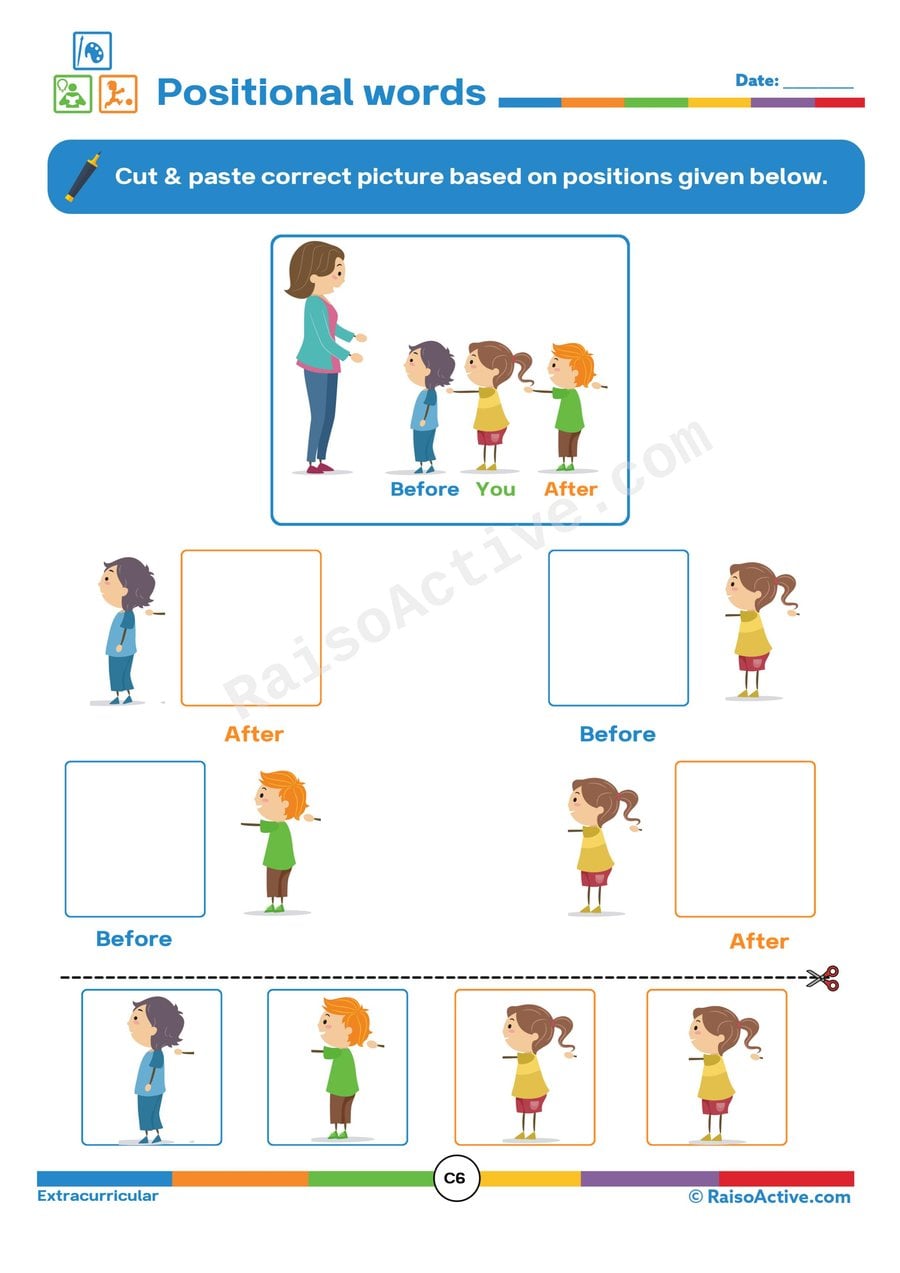
This cut-and-paste worksheet teaches children ages 3-5 to apply the positional words 'before' and 'after' to a sequence of objects or people, connecting an abstract language concept to a visual, hands-on task. Understanding order words like these is an important building block for later skills such as retelling stories in sequence and understanding time concepts like yesterday and tomorrow. Choosing and placing the correct picture also reinforces careful listening and following two-step directions.
About Me Worksheet: Learn About Yourself!
Ages 3-5 · Preschool–Pre-KAges 3-5 · Nursery–ReceptionAges 3-5 · Nursery–LKGAges 3-5
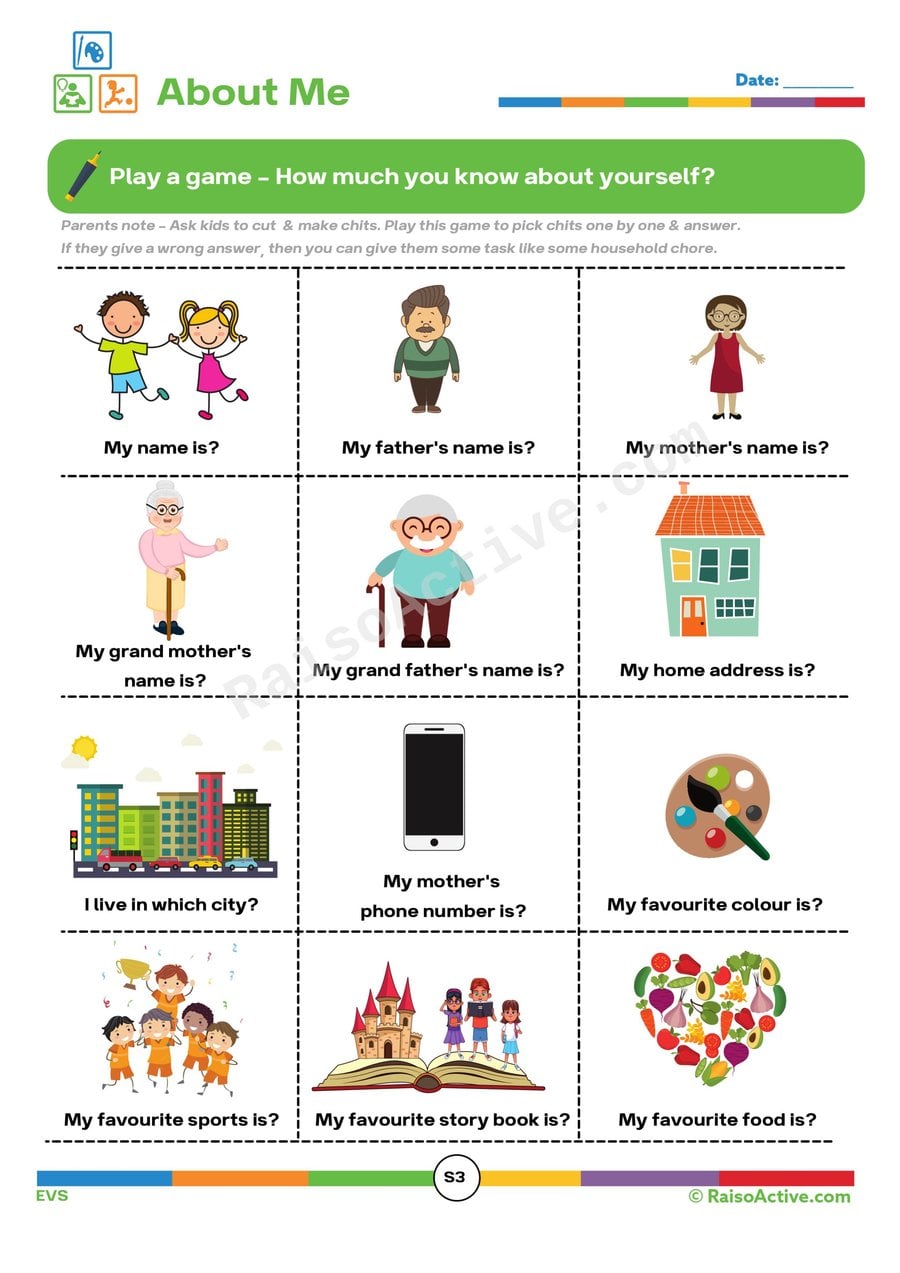
This 'About Me' worksheet helps children ages 3-5 build self-awareness and early identity vocabulary by prompting them to describe their name, family, favorites, and feelings. Putting personal facts into words or pictures strengthens expressive language and gives children practice sharing information about themselves in a structured way. It's also a gentle first step into autobiographical writing, well before children can spell full sentences.
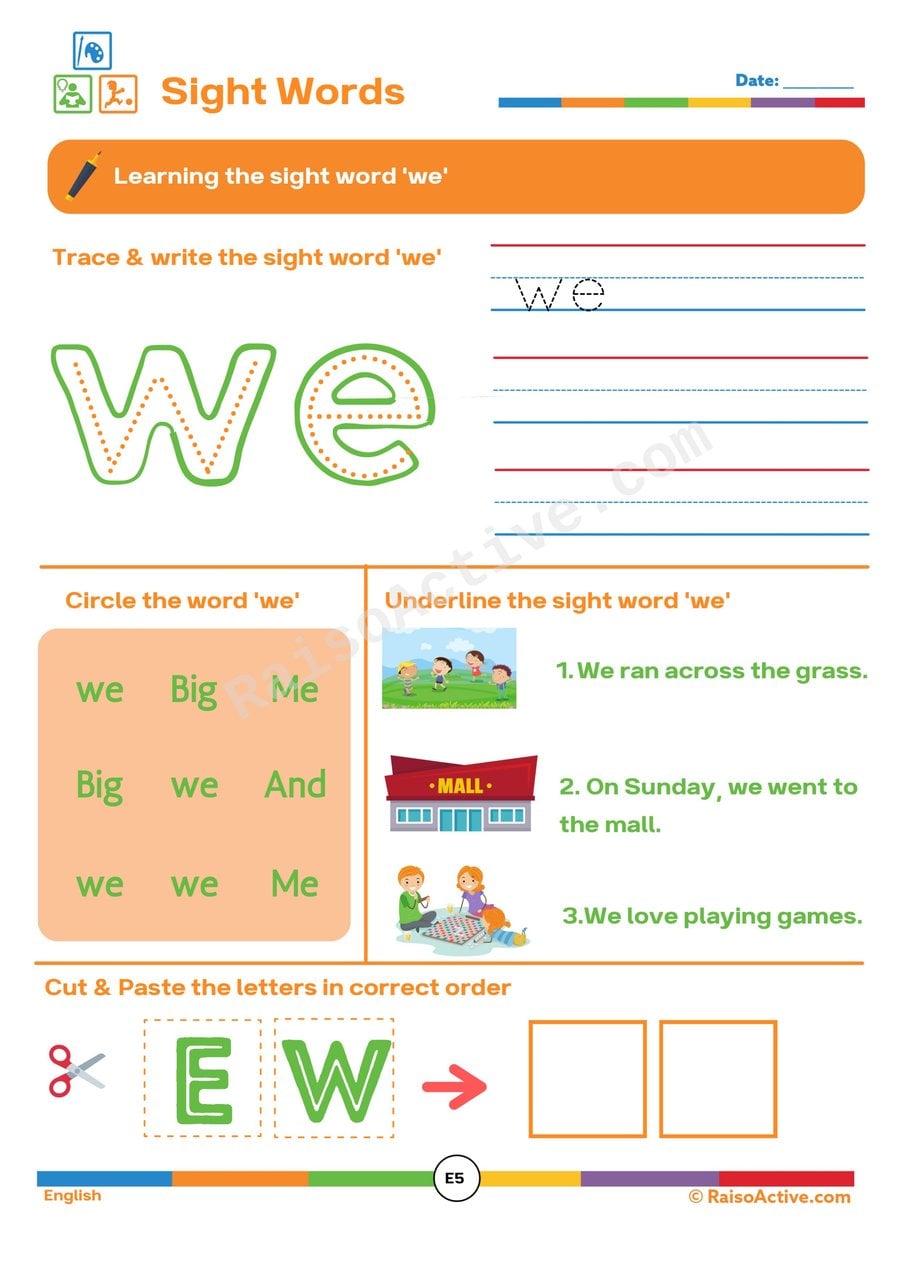
Sight Word 'We' Worksheet: Trace, Write, and Find!
Ages 3-5 · Preschool–Pre-KAges 3-5 · Nursery–ReceptionAges 3-5 · Nursery–LKGAges 3-5
This worksheet builds deep familiarity with the sight word 'we' in children ages 3-5 through four different practice formats — tracing, independent writing, circling, and finding the word within sentences — layered onto a single page. Repeating the same word across so many formats in one sitting is specifically designed to move 'we' from a word your child sounds out each time into one they recognize instantly on sight.

Healthy Eating Worksheet: Fruit Salad and Vegetable Soup!
Ages 3-5 · Preschool–Pre-KAges 3-5 · Nursery–ReceptionAges 3-5 · Nursery–LKGAges 3-5
This matching worksheet helps children ages 3-5 build food vocabulary by identifying pictures of fruits and vegetables and sorting them into the correct category — fruit salad ingredients or vegetable soup ingredients. Learning to classify foods by type, not just by whether they're healthy, supports early categorization skills that apply across many other subjects, from animals to shapes. The cooking-themed framing also connects the sorting task to a familiar, everyday context children may have experienced at home.

Phonics Fun: Matching Letters and Words Worksheet for Preschoolers
Ages 4-5 · Pre-KAges 4-5 · ReceptionAges 4-5 · LKGAges 4-5
Identifying the beginning sound of a pictured word and writing the matching letter teaches children ages 4-5 phonemic awareness, the ability to isolate individual sounds within spoken words, which is one of the strongest predictors of future reading success. Saying each word aloud after writing the letter reinforces the connection between the printed letter and its spoken sound, closing the loop between listening, writing, and speaking. This worksheet moves children from simply recognizing letters to actively applying letter-sound knowledge, a more advanced early literacy skill.

The Three Little Pigs Storytelling Worksheet for Preschoolers
Ages 3-5 · Preschool–Pre-KAges 3-5 · Nursery–ReceptionAges 3-5 · Nursery–LKGAges 3-5
This storytelling worksheet helps children ages 3-5 practice narrative sequencing and oral language skills by retelling the classic tale of the Three Little Pigs in their own words, using picture prompts as a guide. Putting a familiar story into their own sentences builds comprehension and expressive vocabulary far more actively than just listening to the story read aloud. The cut-and-paste sequencing option adds a second layer of practice with story order.

Domestic vs. Wild Animals Sorting Worksheet for Preschoolers
Ages 3-5 · Preschool–Pre-KAges 3-5 · Nursery–ReceptionAges 3-5 · Nursery–LKGAges 3-5
Sorting animal pictures into domestic and wild categories teaches children ages 3-5 early classification skills, requiring them to consider a shared trait, like whether an animal lives with humans or in the wild, rather than just naming individual animals. This kind of categorization is a foundational science and logical-thinking skill, since sorting by an abstract rule is more advanced than simply identifying objects one at a time. Cutting and gluing the animals into their correct groups also adds fine motor practice to the sorting task.
Related worksheets

Beehive Number Fun: Missing Numbers 0-30 Worksheet
Ages 4-6 · Pre-K–KindergartenAges 4-6 · Reception–Year 1Ages 4-6 · LKG–UKGAges 4-6
Filling in missing numbers along a beehive path gives 4-6 year olds practice with the full 0-30 number sequence, a meaningful stretch beyond the more common 1-10 or 1-20 ranges seen in earlier counting worksheets. Because the missing numbers are scattered rather than all at the end, your child has to actually understand what number comes next at multiple points in the sequence, rather than simply continuing a count from a known starting point.
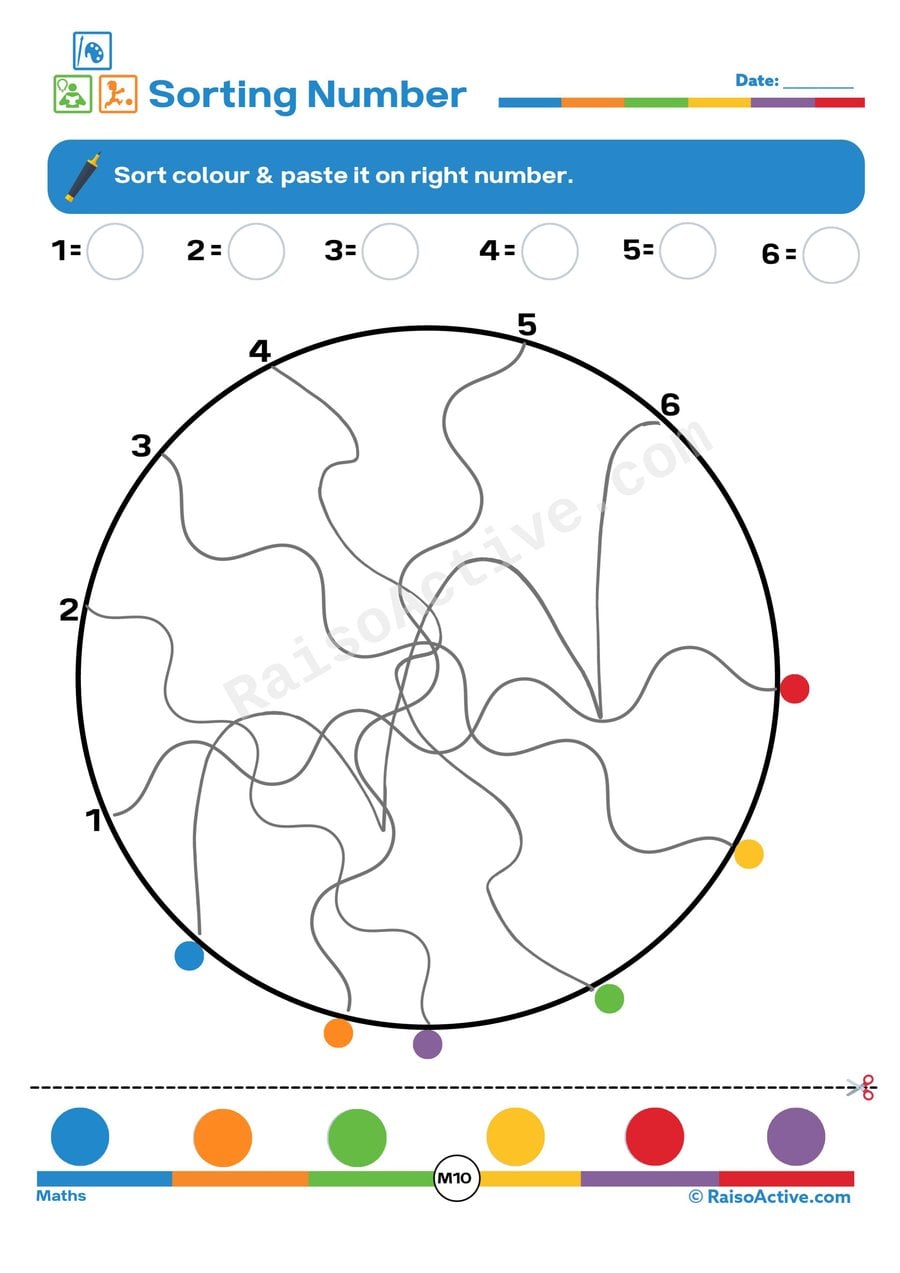
Sorting Numbers Worksheet: Color and Paste!
Ages 3-5 · Preschool–Pre-KAges 3-5 · Nursery–ReceptionAges 3-5 · Nursery–LKGAges 3-5
Children ages 3-5 practice matching quantities to written numerals by counting sets of colored dots and pasting them next to the correct number, reinforcing both counting accuracy and number recognition in a hands-on cut-and-paste format. Sorting by matching color groups to numbers also builds early visual categorization skills.

Sequencing Numbers Train Worksheet for Preschoolers
Ages 4-5 · Pre-KAges 4-5 · ReceptionAges 4-5 · LKGAges 4-5
This train-themed worksheet asks children ages 4-5 to fill in missing numbers within a given sequence, which builds a much deeper number sense than simply counting from one — they must recognize what number comes before or after a given value anywhere in the run. Practicing sequencing this way strengthens working memory and prepares children for later mental math skills like skip counting and addition. The train-car format also keeps the abstract task of ordering numbers visually organized and engaging.

Before and After Numbers Worksheet for Preschoolers
Ages 3-5 · Preschool–Pre-KAges 3-5 · Nursery–ReceptionAges 3-5 · Nursery–LKGAges 3-5
Identifying which numbers come immediately before or after a given number and physically sorting pictures into place links number sequence recall with the fine motor practice of cutting and pasting, building confidence for children ages 3-5.

Descending Order Fruits Worksheet for Preschoolers
Ages 4-5 · Pre-KAges 4-5 · ReceptionAges 4-5 · LKGAges 4-5
Arranging fruits labeled with numbers from largest to smallest builds descending order recognition for children ages 4-5, reinforcing number comparison skills that complement the more commonly practiced ascending order.
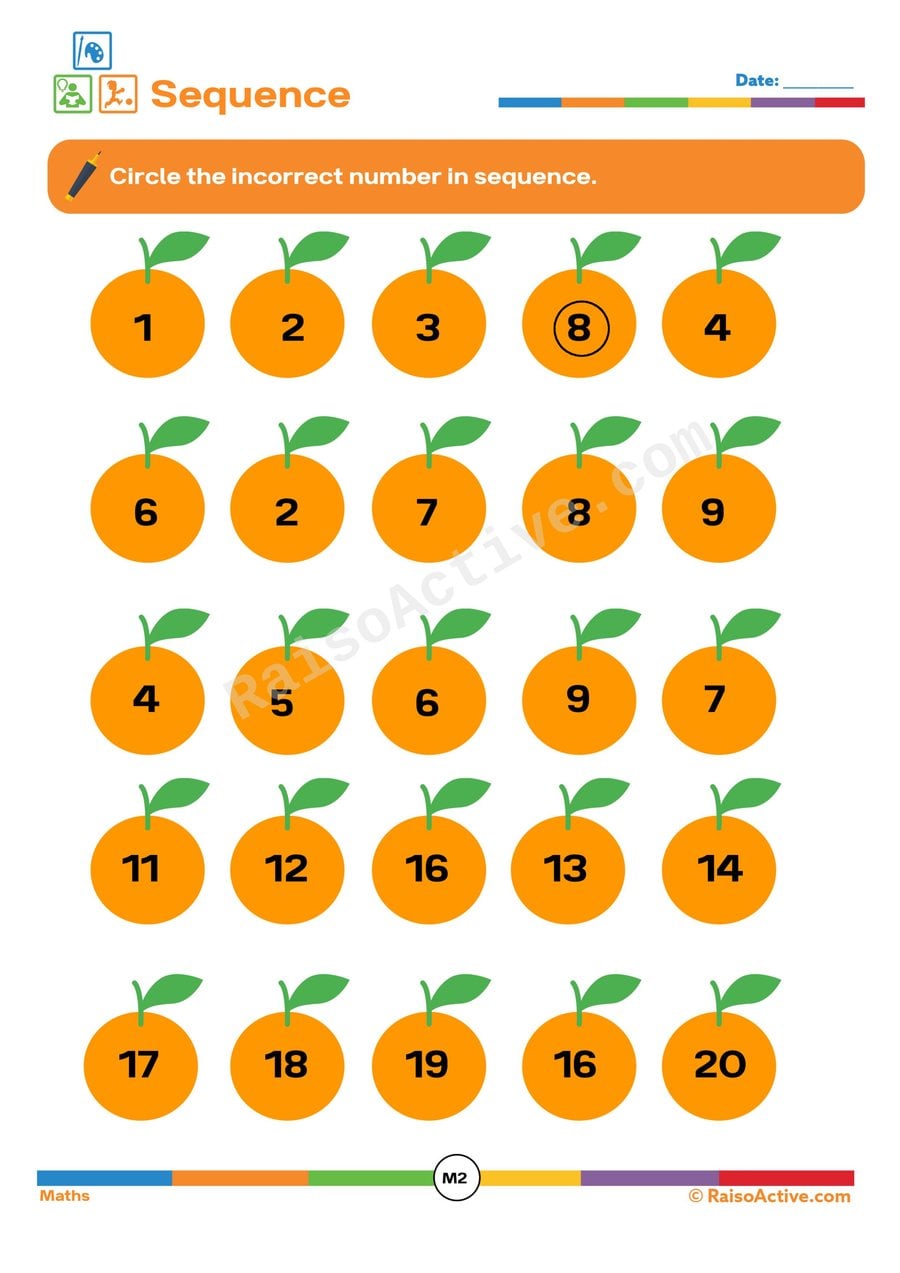
Sequence Worksheet: Find the Incorrect Number!
Ages 4-5 · Pre-KAges 4-5 · ReceptionAges 4-5 · LKGAges 4-5
This worksheet sharpens number pattern recognition by having children scan a row of numbers in sequence and spot the one number that breaks the pattern. For four- and five-year-olds, this kind of 'odd one out' task requires holding the counting sequence in mind while comparing it against what's actually written, building both number sense and early attention to detail.

Ascending Order Cut and Paste Worksheet for Preschoolers
Ages 4-6 · Pre-K–KindergartenAges 4-6 · Reception–Year 1Ages 4-6 · LKG–UKGAges 4-6
This worksheet teaches children ages 4-6 to arrange numbered animal pictures from smallest to largest, reinforcing the concept of ascending order as a foundational number-sequencing skill. Physically cutting and repositioning each numbered piece, rather than simply writing numbers in order, makes the abstract idea of 'smallest to largest' into something children can manipulate and see. This hands-on approach also builds patience and careful visual comparison.

Egg Sorting Worksheet: Count and Order the Chicks!
Ages 3-5 · Preschool–Pre-KAges 3-5 · Nursery–ReceptionAges 3-5 · Nursery–LKGAges 3-5
Cutting out and arranging numbered eggs in order builds number sequencing skills for children ages 3-5, requiring them to compare several numbers at once and place them correctly rather than just recognizing a single number in isolation. This hands-on ordering task also reinforces counting fluency, since children benefit from counting aloud as they check their arrangement.
Guides for this topic

Number Formation Rhymes 0–9 and How to Fix Reversals
Original number formation rhymes for 0–9, the correct stroke order for each digit, why 3, 5 and 7 get reversed most often, and multisensory fixes that work.

Documenting Learning Without Drowning in Data: A Practical Guide for Parents and Teachers
Learn practical ways to document your child's learning without overwhelm. Simple portfolios, observation tips, and printable trackers for ages 1-8.

How to Help Your Child with Letter Reversals: A Complete Guide for Parents and Teachers
Letter reversals are normal until age 7-8. Learn the best multisensory strategies, anchor letter tricks, and activities to help children write b, d, p, and q correctly.
Reviews
Every worksheet for ages 3–5, no watermark
Members download the full library of 1,000+ worksheets and every activity pack without watermarks or daily limits. One year costs ₹999 in India or $20 elsewhere.
See membership plansOr download any worksheet free with a watermark (5 a day).