Sequencing Numbers Train Worksheet for Preschoolers
This train-themed worksheet asks children ages 4-5 to fill in missing numbers within a given sequence, which builds a much deeper number sense than simply counting from one — they must recognize what number comes before or after a given value anywhere in the run. Practicing sequencing this way strengthens working memory and prepares children for later mental math skills like skip counting and addition. The train-car format also keeps the abstract task of ordering numbers visually organized and engaging.
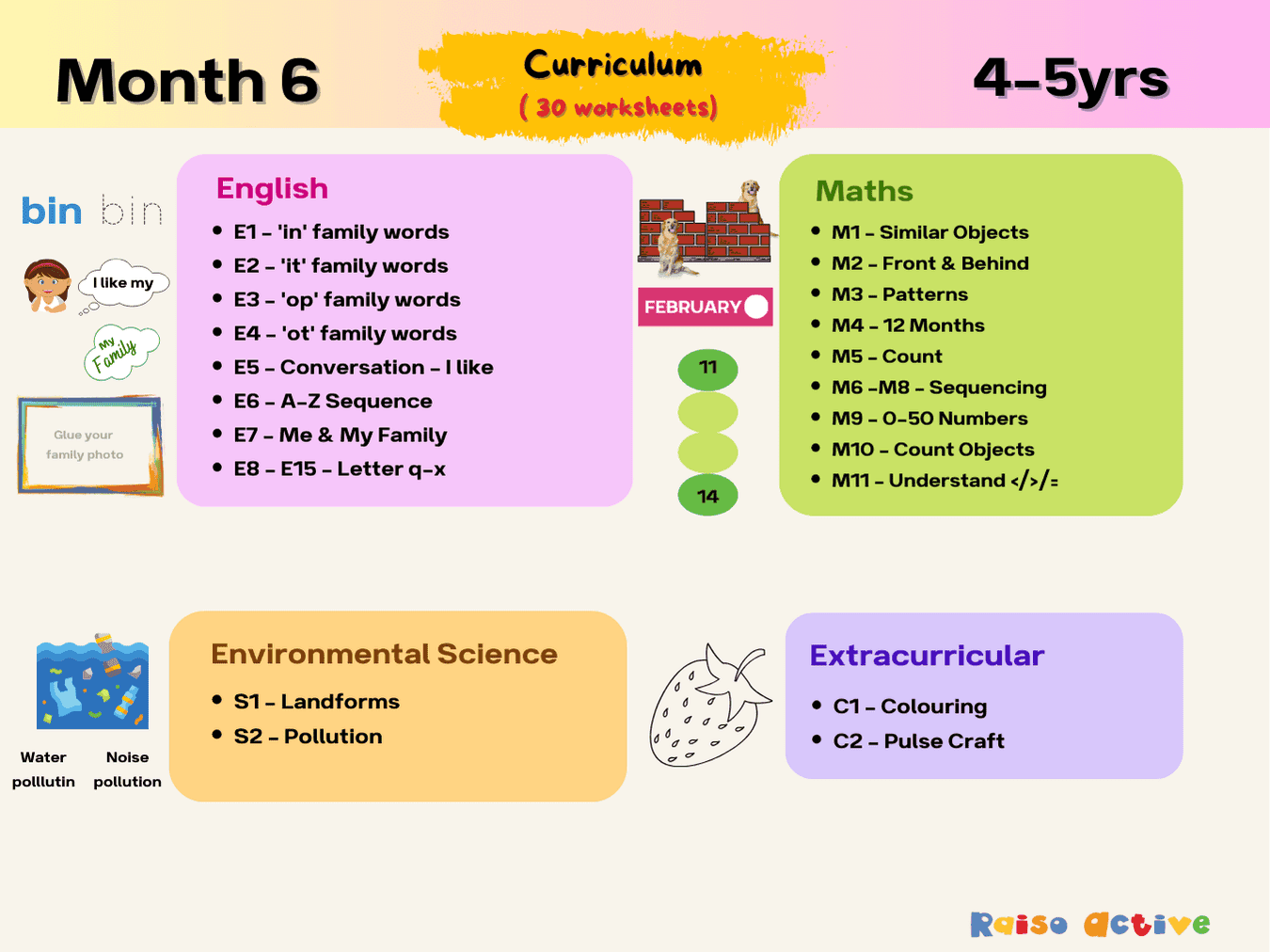
Part of the pack
Month 6: Preschool multi-subject foundational skills | Ages 4-5
This is page 25 of the pack. Ages 4-5 · Pre-KAges 4-5 · ReceptionAges 4-5 · LKGAges 4-5

Made for your child
Counting to 10, made for your child
A maths pack with your child's name in it: pictures that explain, practice at three levels, puzzles and story sums about them. Print a new set whenever they finish.
Make a maths packFree preview · free for members
Curriculum
- Number Sense > Number Sequencing
How to use this worksheet
Look at the first train together and read aloud the numbers already written in the cars, noticing which cars are left blank. Have your child count forward from the last known number, saying each number out loud, until they reach a blank car, then write that number in. Continue across the whole train, checking that the completed sequence counts smoothly from start to end without skips or repeats. Repeat with the remaining trains on the page, encouraging your child to work a little more independently each time.
Materials needed
- Pencil
- Eraser
Extension activities
- 1Build a train out of blocks or cardboard boxes, numbering each car and mixing up the order for your child to fix.
- 2Play a 'missing number' game verbally: say a short sequence aloud and leave a gap for your child to fill in.
- 3Use number cards to build sequences on the floor, removing one card at a time for your child to identify.
- 4Count everyday objects like stairs or toy cars aloud, pausing partway to ask 'what number comes next?'
- 5Draw your own train on paper and let your child invent their own number sequence to write in the cars.

Written by
Hemsweta Jain · Teacher Cheena
MBA and Early Childhood Educator, teaching since 2014 · Founder of RaisoActive, Mumbai
Every RaisoActive worksheet is designed and checked by the founder before publishing.
Published · Last reviewed
More from Month 6: Preschool multi-subject foundational skills | Ages 4-5

What Do You Like? Conversation Worksheet for Kids
Ages 3-5 · Preschool–Pre-KAges 3-5 · Nursery–ReceptionAges 3-5 · Nursery–LKGAges 3-5
Ages 3-5 are learning to move from single words to full thoughts, and this 'What Do You Like?' worksheet gives them structured practice putting a preference into words. Looking at a picture prompt and answering 'I like...' builds expressive vocabulary and the confidence to speak up in a group, both key pre-literacy and social-emotional milestones at this age. It also introduces the back-and-forth rhythm of real conversation rather than just naming objects.
My Family Worksheet: Fun Activities for Kids!
Ages 3-5 · Preschool–Pre-KAges 3-5 · Nursery–ReceptionAges 3-5 · Nursery–LKGAges 3-5
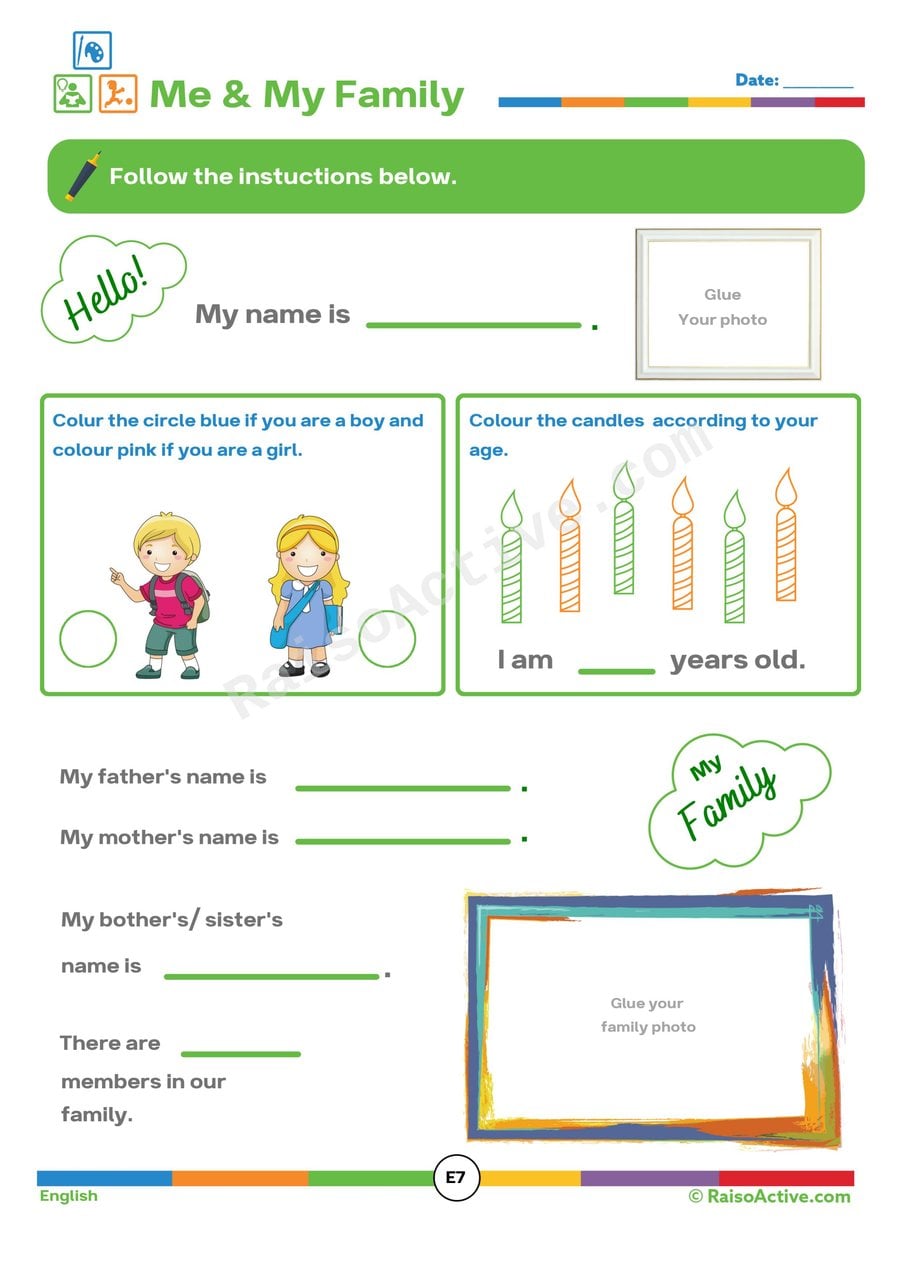
This worksheet builds early writing and self-expression skills by having children fill in personal information about themselves and their family members, along with a color-the-candles activity representing their age. For ages 3-5, writing about their own family in a structured but personal format helps children practice functional writing while reinforcing their sense of identity and belonging.

Letter 't' Tracing and Matching Worksheet for Preschoolers
Ages 3-5 · Preschool–Pre-KAges 3-5 · Nursery–ReceptionAges 3-5 · Nursery–LKGAges 3-5
Tracing, matching, and writing the letter 't' gives children ages 3-5 repeated exposure to one of the more frequent letters in early reading vocabulary, building both the motor memory for its cross-stroke shape and the sound-to-symbol connection for its sharp /t/ sound. Matching pictures that start with 't' to the letter itself reinforces that recognition beyond just the written form, connecting it to real objects and words. This kind of combined tracing-and-matching practice suits how young children learn best: through repetition across slightly different tasks.

Parent's Guide: Fun Activities for Early Learning!
Ages 3-5 · Preschool–Pre-KAges 3-5 · Nursery–ReceptionAges 3-5 · Nursery–LKGAges 3-5
This parent's guide compiles a set of short activities spanning early literacy, spatial reasoning, and problem-solving, giving caregivers ready-made ways to build foundational skills through everyday play. For ages 3-5, mixing activity types across one guide, like word games and puzzles, keeps a young child's attention while covering multiple developmental areas in a single session or across a week.

Coloring Fun: Decode and Color the Butterfly and Flowers!
Ages 3-5 · Preschool–Pre-KAges 3-5 · Nursery–ReceptionAges 3-5 · Nursery–LKGAges 3-5
This color-by-number worksheet builds number recognition and one-to-one correspondence as children match numbers written in each section to a color key, then color the picture accordingly. For ages 3-5, this activity blends math practice with fine motor coloring skills, requiring sustained attention to keep track of which number belongs to which color across many small sections.

Color the Fruits Worksheet: Watermelon and Strawberry Fun!
Ages 3-5 · Preschool–Pre-KAges 3-5 · Nursery–ReceptionAges 3-5 · Nursery–LKGAges 3-5
Coloring a watermelon and a strawberry using specific colors in a specific order teaches children ages 3-5 to follow multi-step visual instructions rather than coloring freely, a skill that transfers directly to following classroom directions later on. Staying within the lines of curved fruit shapes also strengthens the fine motor control needed for handwriting, since the small hand movements required are similar. Observing and replicating real fruit coloring, like the red flesh and green rind of a watermelon, builds early observational skills too.

A-Z Letter Sequence Worksheet: Fill in the Missing Letters!
Ages 4-5 · Pre-KAges 4-5 · ReceptionAges 4-5 · LKGAges 4-5
By age 4-5, children move from reciting the alphabet by rote to actually recognizing individual letters out of sequence, and this fill-in-the-blank worksheet tests that deeper knowledge by asking them to supply missing capital letters in a scrambled order. Locating where a gap belongs strengthens letter-order memory and visual letter recognition, both essential precursors to reading and independent writing. It also builds attention to detail, since children must scan neighboring letters to figure out what's missing.

Complete the Pattern: Cut and Paste Worksheet for Preschoolers
Ages 3-5 · Preschool–Pre-KAges 3-5 · Nursery–ReceptionAges 3-5 · Nursery–LKGAges 3-5
Completing a simple visual pattern by cutting and pasting the next correct picture asks children ages 3-5 to notice a repeating rule, such as circle-square-circle-square, and predict what logically comes next — an early and important building block of mathematical and logical thinking. This skill underlies later concepts in math, coding, and even music, all of which rely on recognizing and extending sequences. The cut-and-paste format adds a fine motor and decision-making layer, since children must select the correct piece from several options rather than simply pointing to an answer.
Related worksheets

Bee's Number Sequence Adventure: Coloring Numbers 0-50!
Ages 4-6 · Pre-K–KindergartenAges 4-6 · Reception–Year 1Ages 4-6 · LKG–UKGAges 4-6
Children ages 4-6 practice counting and recognizing numbers from 0 to 50 in sequence by coloring each number in order to help a bee find its way to the hive, extending number recognition well beyond the smaller ranges typically practiced at this age. Following a long numerical sequence builds persistence and reinforces counting patterns like the teens, twenties, and thirties.

Egg Sorting Worksheet: Count and Order the Chicks!
Ages 3-5 · Preschool–Pre-KAges 3-5 · Nursery–ReceptionAges 3-5 · Nursery–LKGAges 3-5
Cutting out and arranging numbered eggs in order builds number sequencing skills for children ages 3-5, requiring them to compare several numbers at once and place them correctly rather than just recognizing a single number in isolation. This hands-on ordering task also reinforces counting fluency, since children benefit from counting aloud as they check their arrangement.

Before and After Numbers Worksheet for Preschoolers
Ages 4-5 · Pre-KAges 4-5 · ReceptionAges 4-5 · LKGAges 4-5
This worksheet builds number sequencing skills in children ages 4-5 by asking them to figure out which number comes immediately before and immediately after a given number. Understanding a number's position relative to its neighbors is an essential precursor to skip counting, addition, and subtraction, since it trains children to think of numbers as an ordered line rather than isolated symbols.

Beehive Number Fun: Missing Numbers 0-30 Worksheet
Ages 4-6 · Pre-K–KindergartenAges 4-6 · Reception–Year 1Ages 4-6 · LKG–UKGAges 4-6
Filling in missing numbers along a beehive path gives 4-6 year olds practice with the full 0-30 number sequence, a meaningful stretch beyond the more common 1-10 or 1-20 ranges seen in earlier counting worksheets. Because the missing numbers are scattered rather than all at the end, your child has to actually understand what number comes next at multiple points in the sequence, rather than simply continuing a count from a known starting point.

Number Apple Cut and Paste Worksheet: Ordering Numbers 71-80
Ages 4-6 · Pre-K–KindergartenAges 4-6 · Reception–Year 1Ages 4-6 · LKG–UKGAges 4-6
Ordering the numbers 71 through 80 pushes children ages 4-6 past small, familiar quantities and into two-digit sequencing, reinforcing that the tens digit stays constant while the ones digit climbs steadily. The cut-and-paste apple format also demands visual number recognition under pressure, since children must tell 74 from 47 or 78 apart from similar-looking numbers before placing each piece correctly.
Cupcake Number Sequencing Worksheet 1-30
Ages 4-6 · Pre-K–KindergartenAges 4-6 · Reception–Year 1Ages 4-6 · LKG–UKGAges 4-6
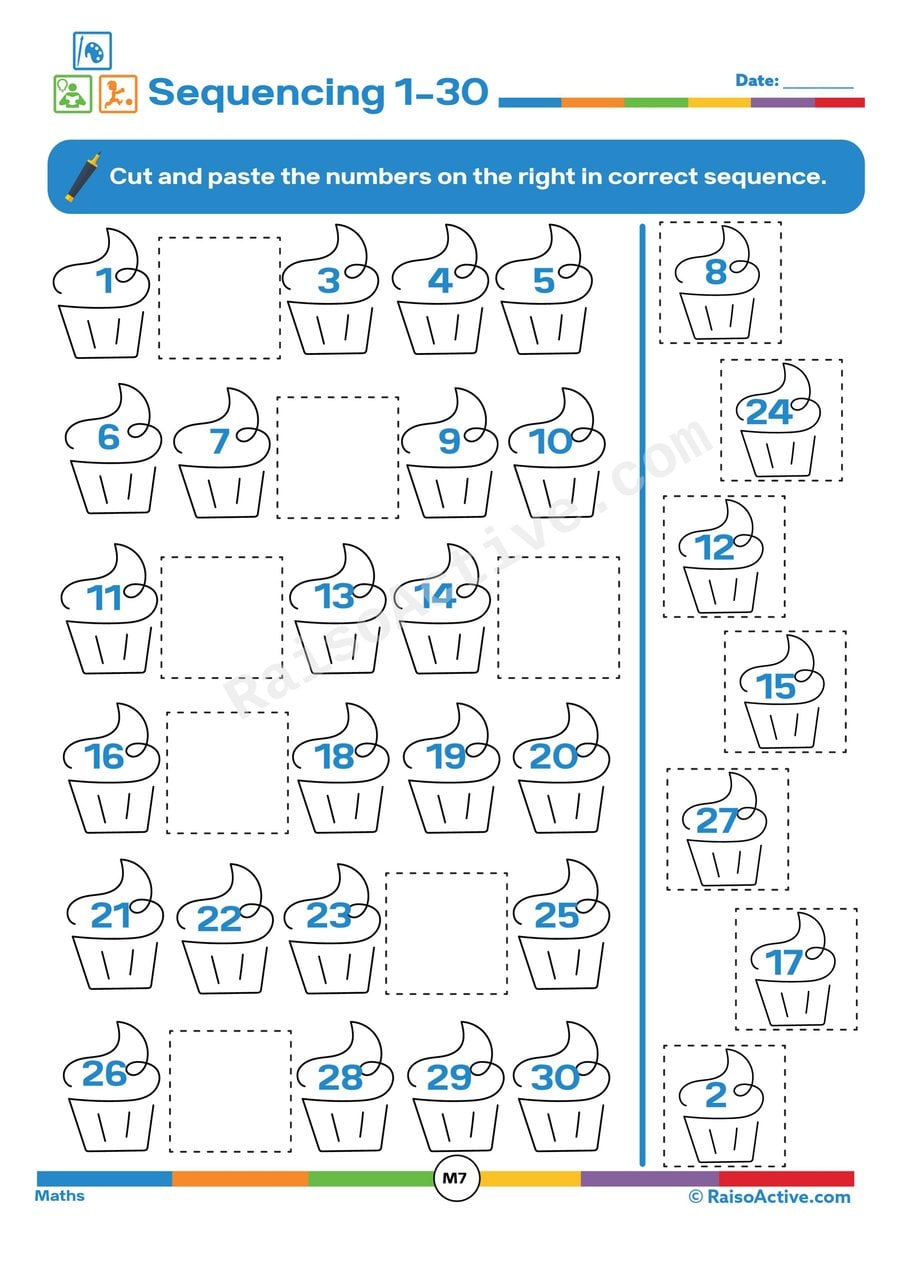
Children ages 4-6 practice number sequencing from 1 to 30 by cutting out numeral pieces and pasting them onto cupcakes in ascending order, reinforcing both number recognition and the logic of 'what comes next' in the counting sequence. This bridges the gap between counting by rote and truly understanding number order, an essential step before children can skip-count or do simple addition.

Duckling's Number Path: Connect the Dots Worksheet
Ages 3-5 · Preschool–Pre-KAges 3-5 · Nursery–ReceptionAges 3-5 · Nursery–LKGAges 3-5
Children ages 3-5 practice number sequencing and counting up to 30 as they connect numbered dots in order to draw the duckling's path back to its mother, reinforcing number recognition while completing a satisfying, story-driven picture. Following numbers in strict order without skipping builds the counting fluency children need before tackling addition and more advanced number work.
Descending Order Worksheet: Numbers 31-99
Ages 4-6 · Pre-K–KindergartenAges 4-6 · Reception–Year 1Ages 4-6 · LKG–UKGAges 4-6
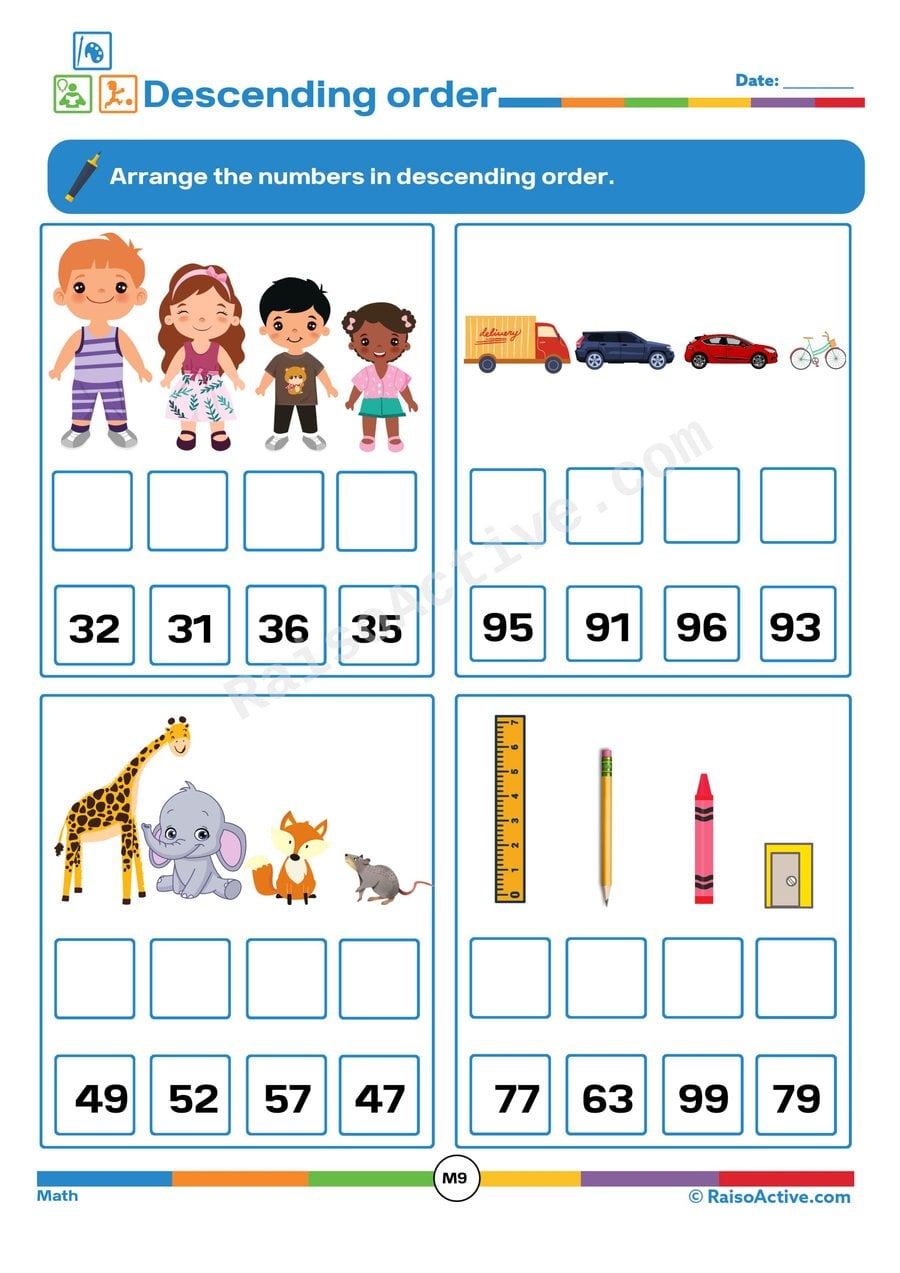
This worksheet extends number-sequencing skills for children ages 4-6 into the two-digit range of 31 to 99, asking them to arrange given numbers from largest to smallest. Working with larger numbers requires understanding that the tens digit generally determines size first, an important step toward place-value thinking. Practicing descending order, which is less intuitive than counting up, also strengthens flexible number sense.
Guides for this topic

Number Formation Rhymes 0–9 and How to Fix Reversals
Original number formation rhymes for 0–9, the correct stroke order for each digit, why 3, 5 and 7 get reversed most often, and multisensory fixes that work.

Coding Activities for Preschoolers: Building Tomorrow's Thinkers Today
Discover 15+ unplugged and screen-based coding activities for preschoolers that build sequencing, logic, and problem-solving skills through play. NEP 2020 aligned.

What's the Best Alternative to ABCmouse? A Complete Parent's Guide to Free and Affordable Educational Apps
ABCmouse runs ~Rs 4,000-5,000/year with US spellings and curriculum. Compare free & affordable Indian-friendly apps like Khan Academy Kids and DIKSHA.
Reviews
Every worksheet for ages 4–5, no watermark
Members download the full library of 1,000+ worksheets and every activity pack without watermarks or daily limits. One year costs ₹999 in India or $20 elsewhere.
See membership plansOr download any worksheet free with a watermark (5 a day).