Before and After Numbers Worksheet for Preschoolers
This worksheet builds number sequencing skills in children ages 4-5 by asking them to figure out which number comes immediately before and immediately after a given number. Understanding a number's position relative to its neighbors is an essential precursor to skip counting, addition, and subtraction, since it trains children to think of numbers as an ordered line rather than isolated symbols.
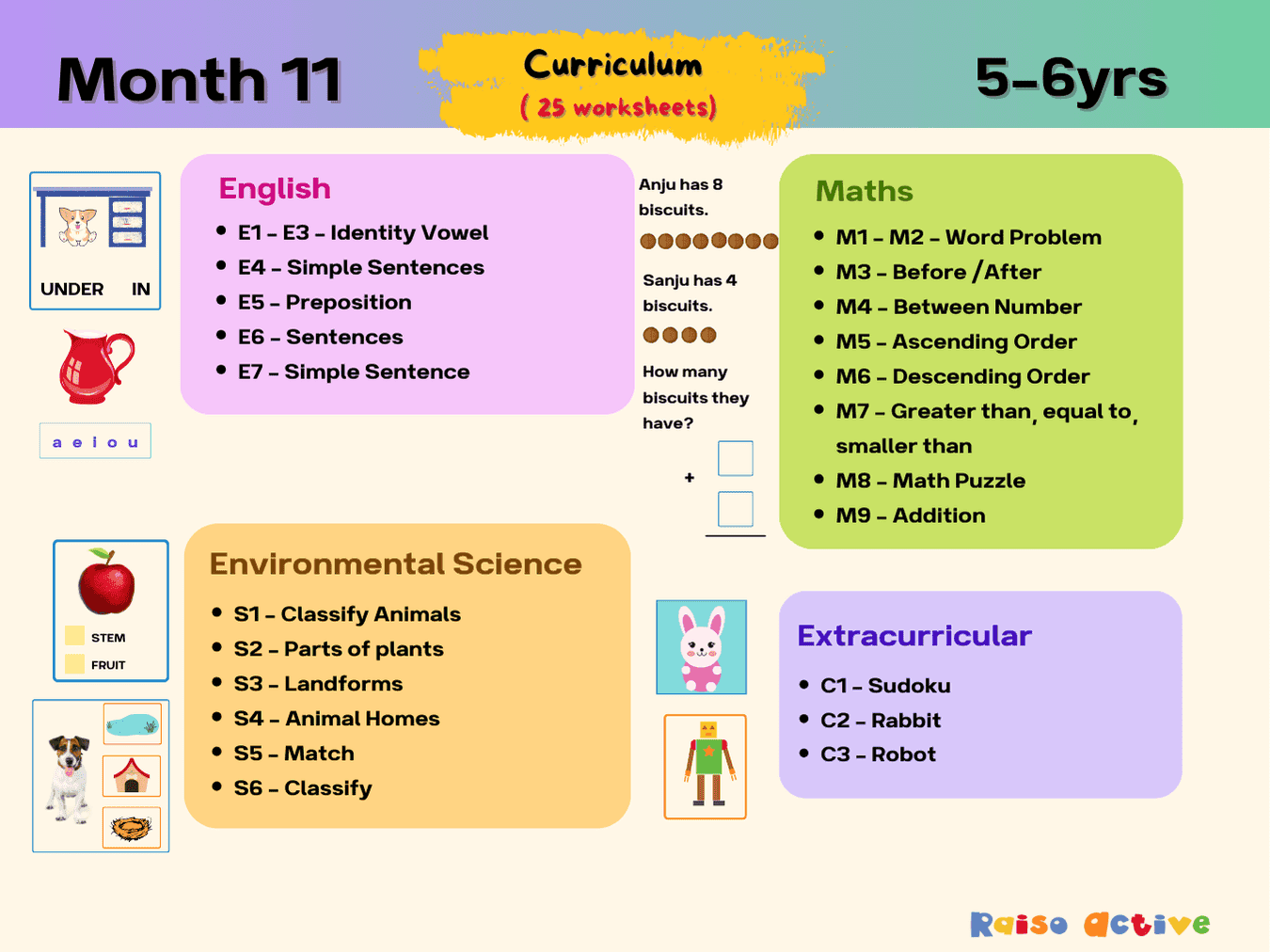
Part of the pack
Month 11: Learning & Development | Ages 5-6
This is page 13 of the pack. Ages 5-6 · KindergartenAges 5-6 · Year 1Ages 5-6 · UKGAges 5-6

Made for your child
Counting to 10, made for your child
A maths pack with your child's name in it: pictures that explain, practice at three levels, puzzles and story sums about them. Print a new set whenever they finish.
Make a maths packFree preview · free for members
Curriculum
- Number Sense > Number Sequencing
How to use this worksheet
Look at the number in the middle of each set together and have your child count out loud from one up to that number, which helps them find what comes right before it. Ask 'What number comes just before this one?' and have your child write it in the blank space, then repeat the process asking what comes just after. Work through several sets this way before letting your child try a set independently, checking their answers together afterward.
Materials needed
- Pencil
- Eraser
Extension activities
- 1Have your child create their own before-and-after number problems for you to solve.
- 2Use blocks, beads, or buttons lined up in a row and ask your child to point to what's before and after a chosen number.
- 3Play a number line hopscotch game outside, calling out numbers and asking what comes next.
- 4Look at house numbers or page numbers in a book and identify the number that comes before or after.

Written by
Hemsweta Jain · Teacher Cheena
MBA and Early Childhood Educator, teaching since 2014 · Founder of RaisoActive, Mumbai
Every RaisoActive worksheet is designed and checked by the founder before publishing.
Published · Last reviewed
More from Month 11: Learning & Development | Ages 5-6

Simple Sentences Worksheet: Rewriting Sentences for Early Readers
Ages 4-6 · Pre-K–KindergartenAges 4-6 · Reception–Year 1Ages 4-6 · LKG–UKGAges 4-6
Children ages 4-6 practice sentence construction by rearranging scrambled words into a grammatically correct, meaningful sentence, building an understanding of proper word order in English. This hands-on rearranging task teaches children to recognize where a sentence's subject, action, and details belong, a skill they'll use in all future writing.
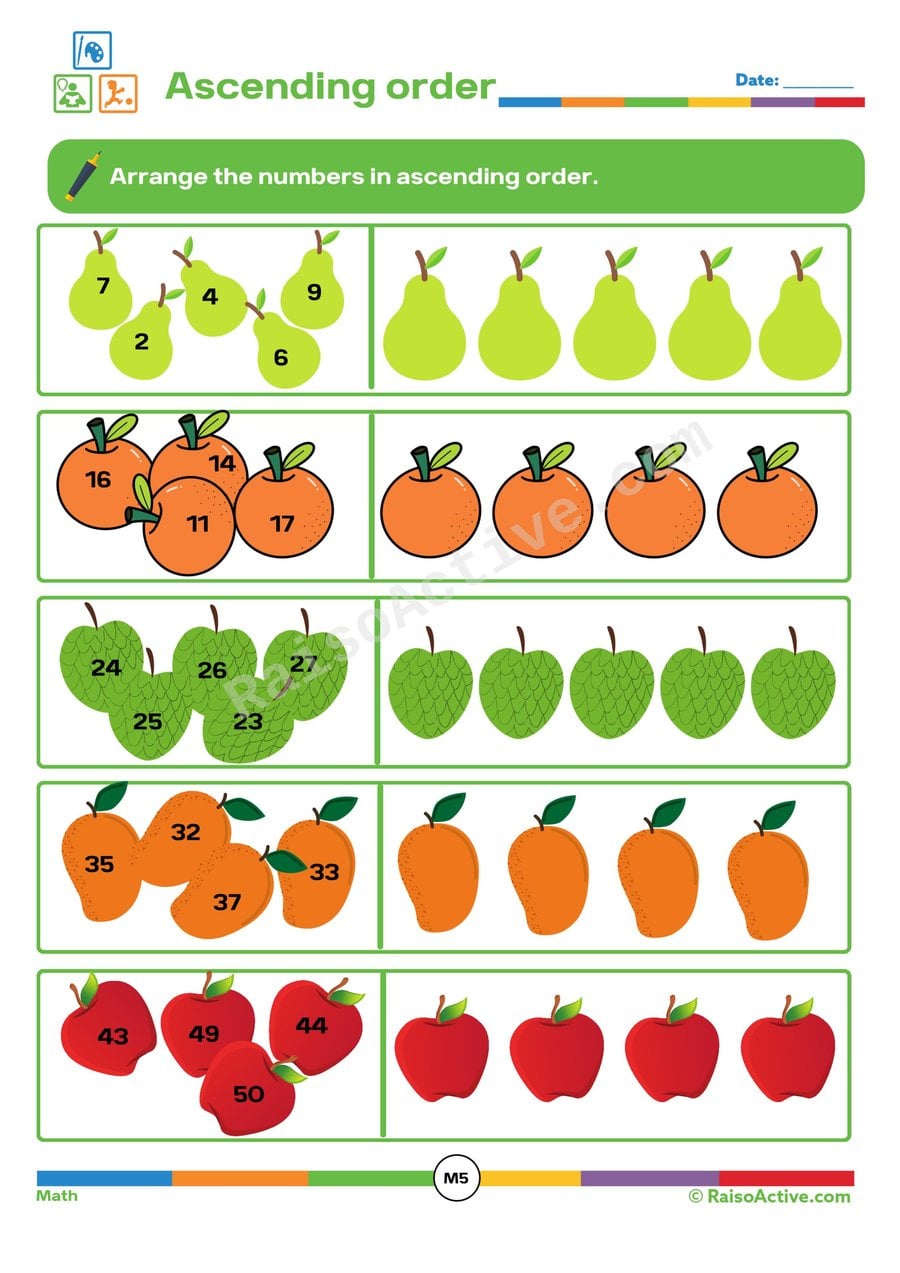
Ascending Order Worksheet: Fruit Fun!
Ages 4-6 · Pre-K–KindergartenAges 4-6 · Reception–Year 1Ages 4-6 · LKG–UKGAges 4-6
Arranging numbers on groups of fruit from smallest to largest teaches children ages 4-6 to compare quantities and understand ascending order, a core numeracy skill that supports later work with number lines and place value.

Landforms Worksheet: Identify and Label the Pictures!
Ages 3-5 · Preschool–Pre-KAges 3-5 · Nursery–ReceptionAges 3-5 · Nursery–LKGAges 3-5
Writing the correct name for pictures of mountains, rivers, and other landforms from a word bank builds early science vocabulary and spelling practice for children ages 3-5, connecting a visual image to its written word.

Comparing Numbers Worksheet: Greater Than, Less Than, and Equal To!
Ages 4-6 · Pre-K–KindergartenAges 4-6 · Reception–Year 1Ages 4-6 · LKG–UKGAges 4-6
Children ages 4-6 learn to compare two numbers and choose the correct symbol — greater than, less than, or equal to — building an essential foundation for later work with inequalities and algebra. Comparing quantities and representing the relationship symbolically is a more abstract skill than simple counting, so this worksheet stretches children just past straightforward number recognition into true numerical reasoning.
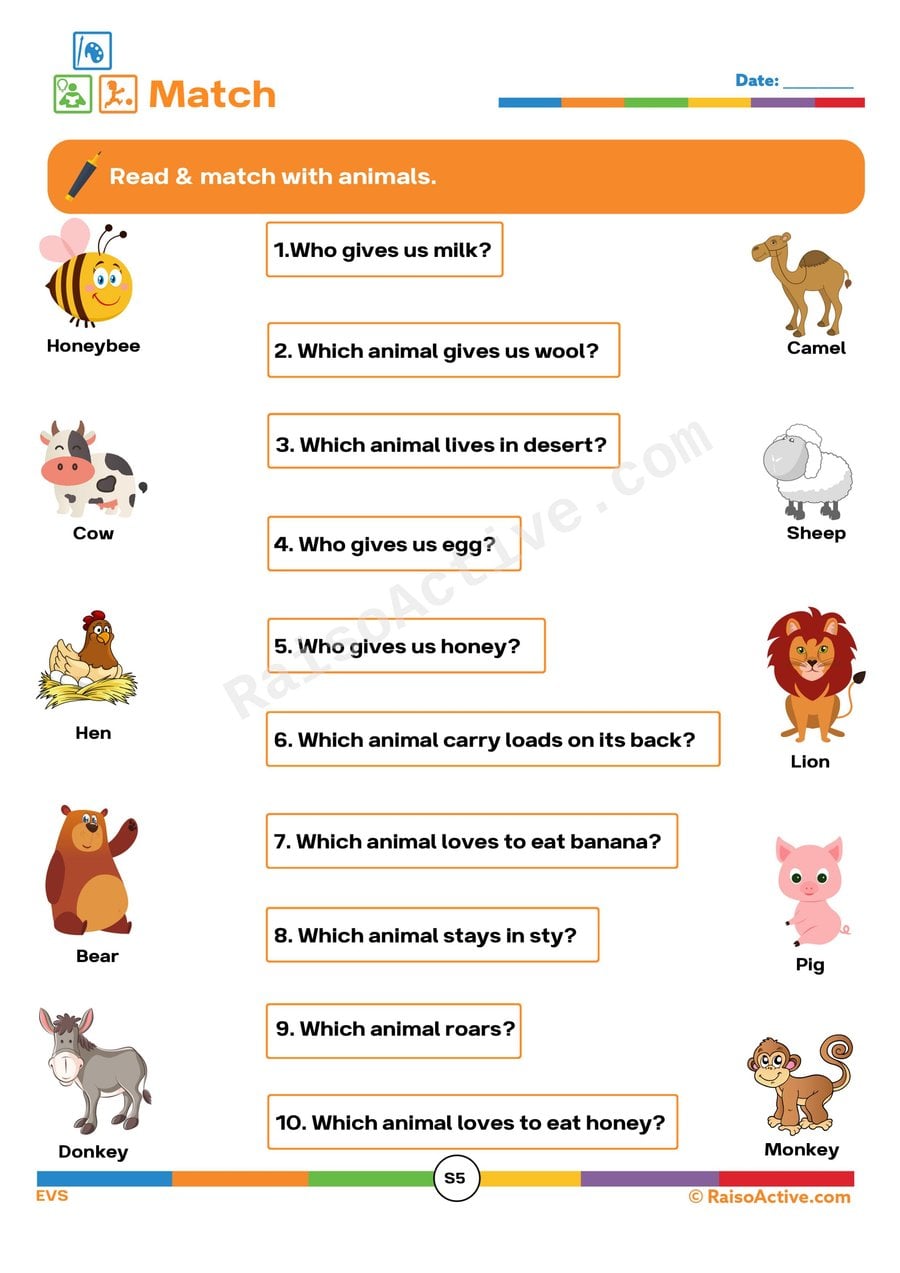
Match the Animals! A Fun Worksheet for Kids
Ages 3-5 · Preschool–Pre-KAges 3-5 · Nursery–ReceptionAges 3-5 · Nursery–LKGAges 3-5
This worksheet helps children ages 3-5 build observation and reasoning skills as they read a simple question or clue about an animal and match it to the correct picture. Rather than matching by appearance alone, children must connect descriptive language to an animal's known characteristics, which strengthens both listening comprehension and early vocabulary about animals.

Classify Animals: Sorting Worksheet for Preschoolers
Ages 3-5 · Preschool–Pre-KAges 3-5 · Nursery–ReceptionAges 3-5 · Nursery–LKGAges 3-5
Deciding which category — birds, fish, insects, or reptiles — each animal belongs to builds classification thinking for children ages 3-5, an early scientific skill of grouping things by shared characteristics.

Math Puzzle: Cut and Paste Addition and Subtraction Worksheet
Ages 4-6 · Pre-K–KindergartenAges 4-6 · Reception–Year 1Ages 4-6 · LKG–UKGAges 4-6
Solving addition and subtraction problems and matching each answer to its correct puzzle piece builds calculation fluency alongside visual matching skills for children ages 4-6, turning practice into a self-checking puzzle format.

Classify Animals: Cut and Paste Worksheet for Preschoolers
Ages 3-5 · Preschool–Pre-KAges 3-5 · Nursery–ReceptionAges 3-5 · Nursery–LKGAges 3-5
Children ages 3-5 practice classifying animals by their natural habitat, sorting pictures into groups like forest animals and farm animals, building early science reasoning about how different environments support different animals. Combining this classification task with cutting and pasting also strengthens fine motor control.
Related worksheets

Number Sequencing Worksheet: Practice Counting and Ordering Numbers!
Ages 4-5 · Pre-KAges 4-5 · ReceptionAges 4-5 · LKGAges 4-5
This worksheet gives children ages 4-5 focused practice writing numerals in order by filling in the missing numbers within several different counting sequences. Unlike simple counting aloud, writing each numeral by hand forces children to connect the spoken number word to its correct written symbol, reinforcing both number recognition and early handwriting control.
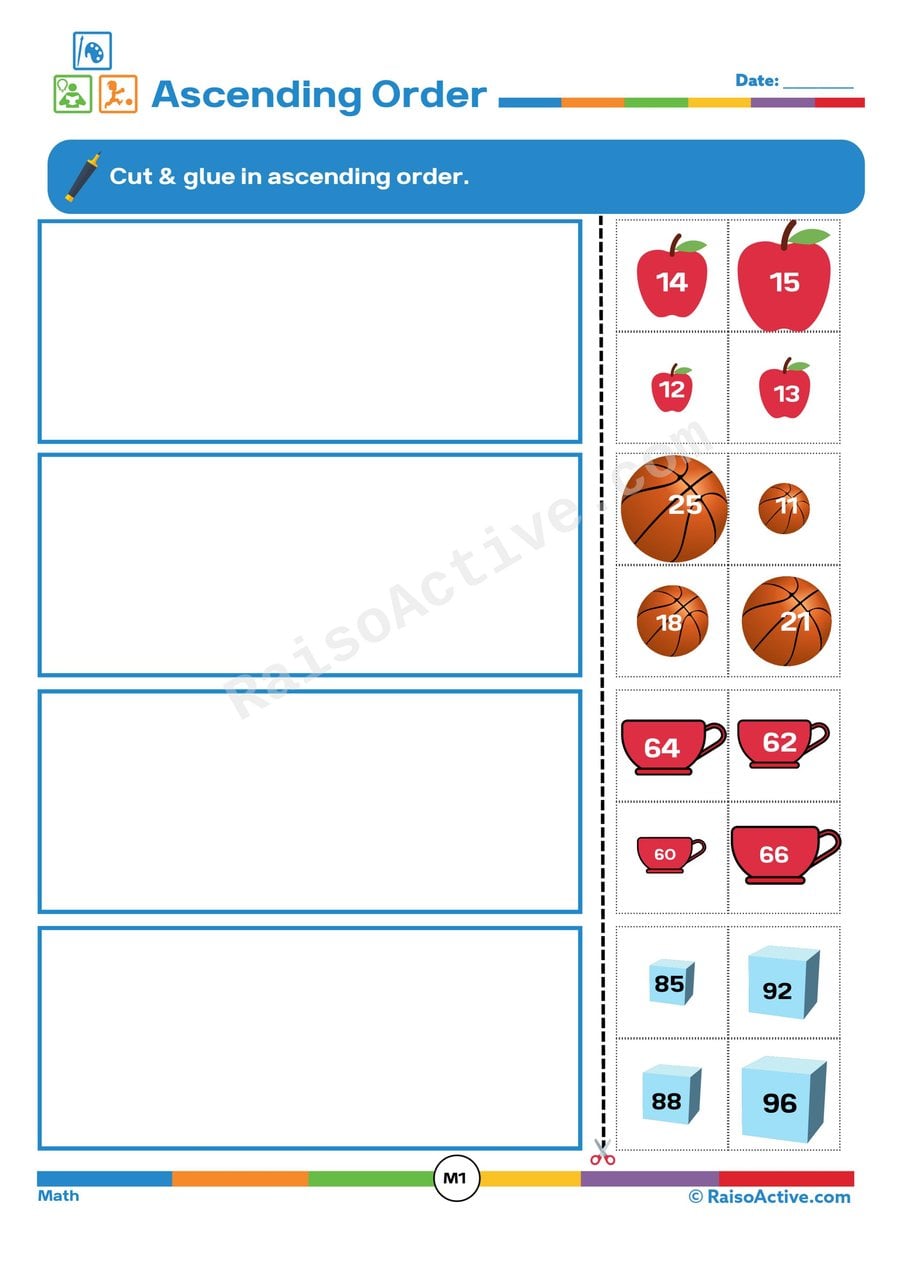
Ascending Order Worksheet: Cut and Paste Numbers!
Ages 4-6 · Pre-K–KindergartenAges 4-6 · Reception–Year 1Ages 4-6 · LKG–UKGAges 4-6
This worksheet has children ages 4-6 physically manipulate number cutouts to arrange them from least to greatest, building both number sequencing and the underlying concept that numbers represent increasing quantity. Because the numbers must be cut, sorted, and glued rather than simply read in order, this activity combines fine motor practice with active number reasoning, requiring children to compare each new number against those already placed.

Space Adventure: Reading Numbers 1-40 Worksheet for Kids
Ages 4-5 · Pre-KAges 4-5 · ReceptionAges 4-5 · LKGAges 4-5
This worksheet strengthens number recognition across a wider range, 1 to 40, by having children read numbers that are partially hidden and identify them without a visual count to rely on. For ages 4-5, recognizing two-digit numbers by sight, rather than only counting objects, marks an important step toward more advanced number sense and eventual mental math.

Egg Sorting Worksheet: Count and Order the Chicks!
Ages 3-5 · Preschool–Pre-KAges 3-5 · Nursery–ReceptionAges 3-5 · Nursery–LKGAges 3-5
Cutting out and arranging numbered eggs in order builds number sequencing skills for children ages 3-5, requiring them to compare several numbers at once and place them correctly rather than just recognizing a single number in isolation. This hands-on ordering task also reinforces counting fluency, since children benefit from counting aloud as they check their arrangement.

Ascending Order Fun: A Printable Worksheet for Numbers!
Ages 4-6 · Pre-K–KindergartenAges 4-6 · Reception–Year 1Ages 4-6 · LKG–UKGAges 4-6
Arranging numbers from smallest to largest teaches children ages 4-6 to compare quantities and understand relative magnitude, a skill that underlies later work with number lines, place value, and basic operations. It also reinforces number recognition, since children must correctly identify each numeral before they can decide where it belongs in the sequence.
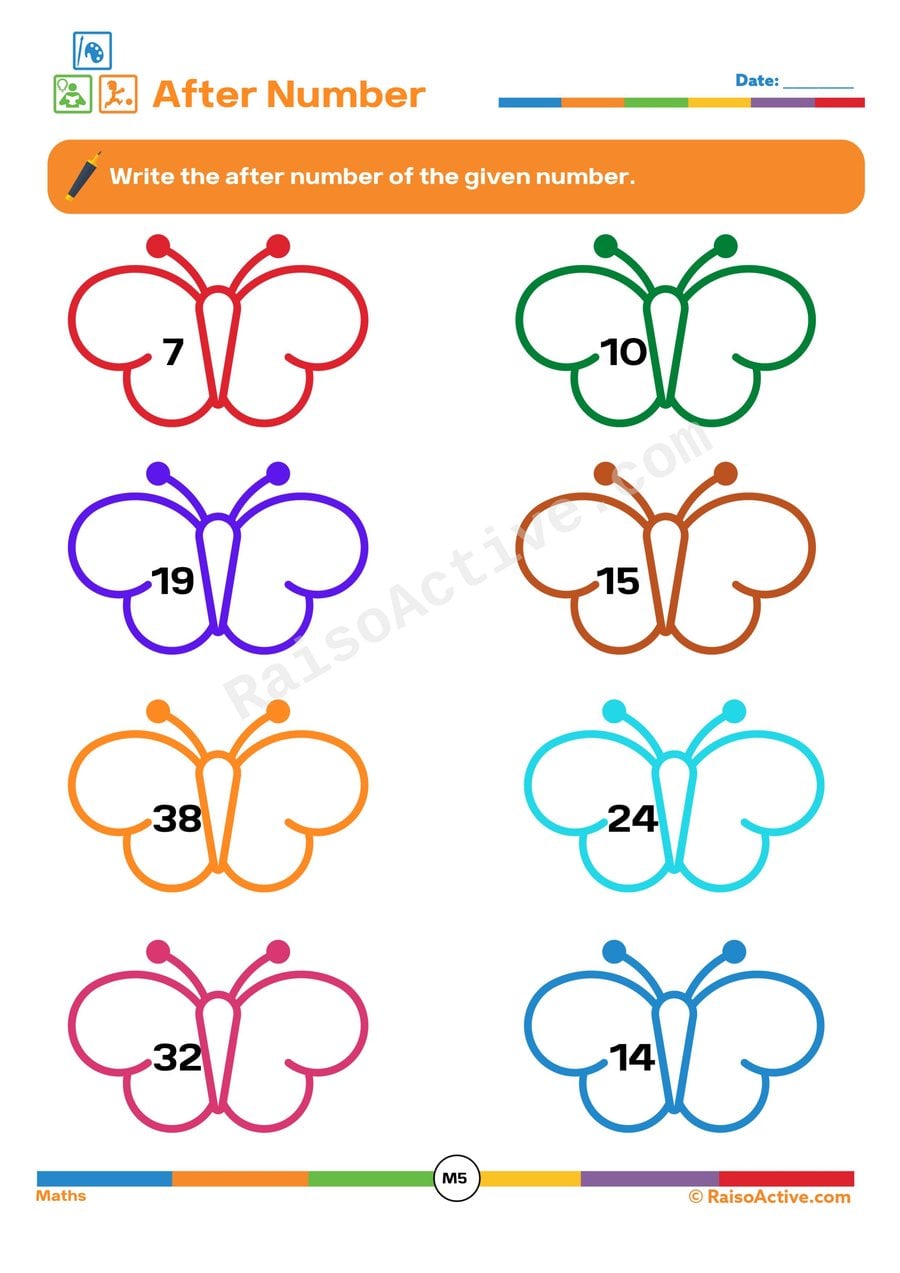
After Number Worksheet: Butterfly Fun!
Ages 4-6 · Pre-K–KindergartenAges 4-6 · Reception–Year 1Ages 4-6 · LKG–UKGAges 4-6
This worksheet targets a specific early-numeracy milestone: understanding that every number has a number that comes immediately after it in sequence. For ages 4-6, practicing 'what comes next' strengthens the mental number line children rely on for later addition, since knowing that 7 comes after 6 is the foundation of counting on.
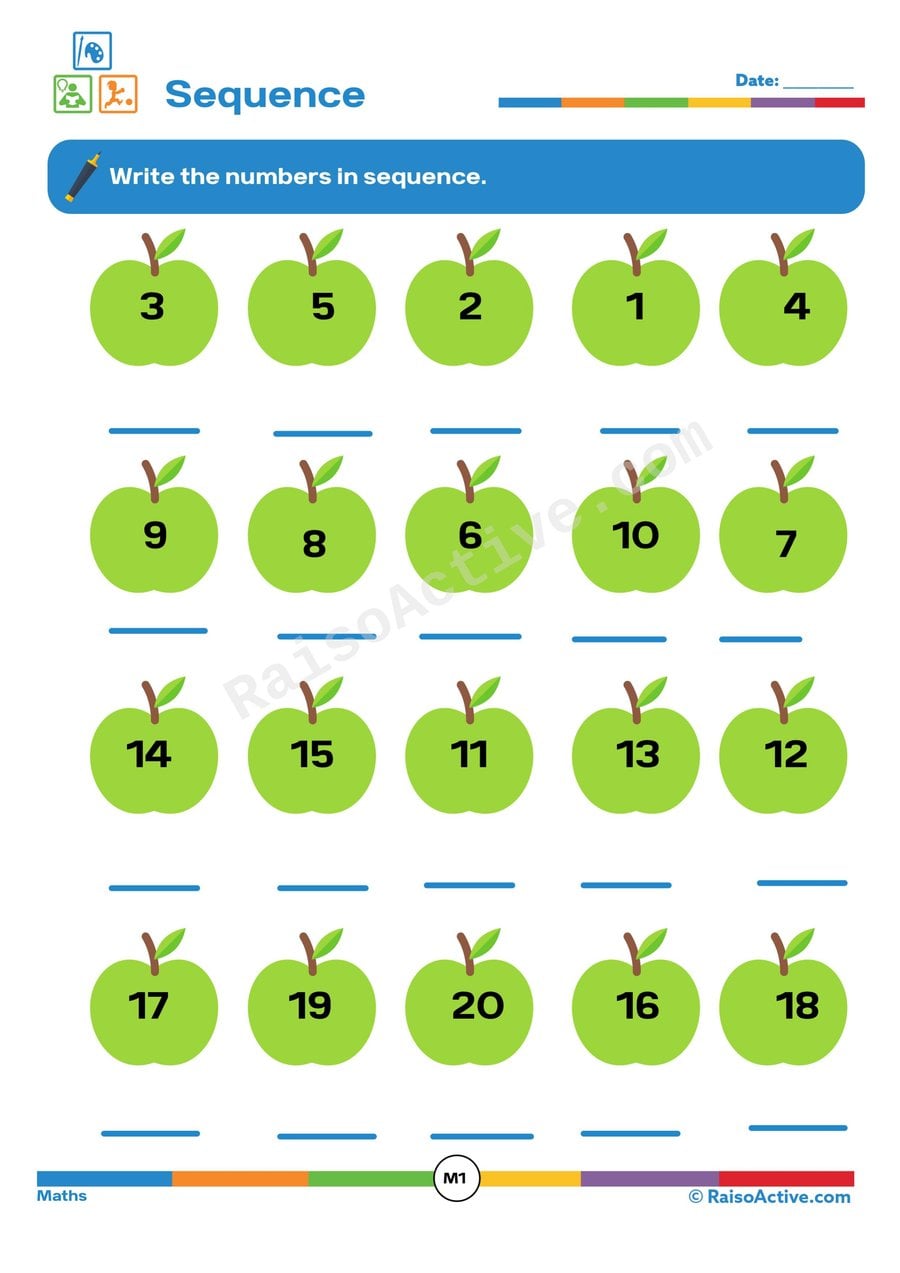
Sequence Fun: Writing Numbers in Order Worksheet
Ages 4-5 · Pre-KAges 4-5 · ReceptionAges 4-5 · LKGAges 4-5
This worksheet helps children ages 4-5 practice writing numbers in the correct sequence, reinforcing both number recognition and the concept that numbers have a fixed, predictable order. Filling in missing numbers along a row of apples also builds the pattern-recognition skills that underlie later skip-counting and place value work.
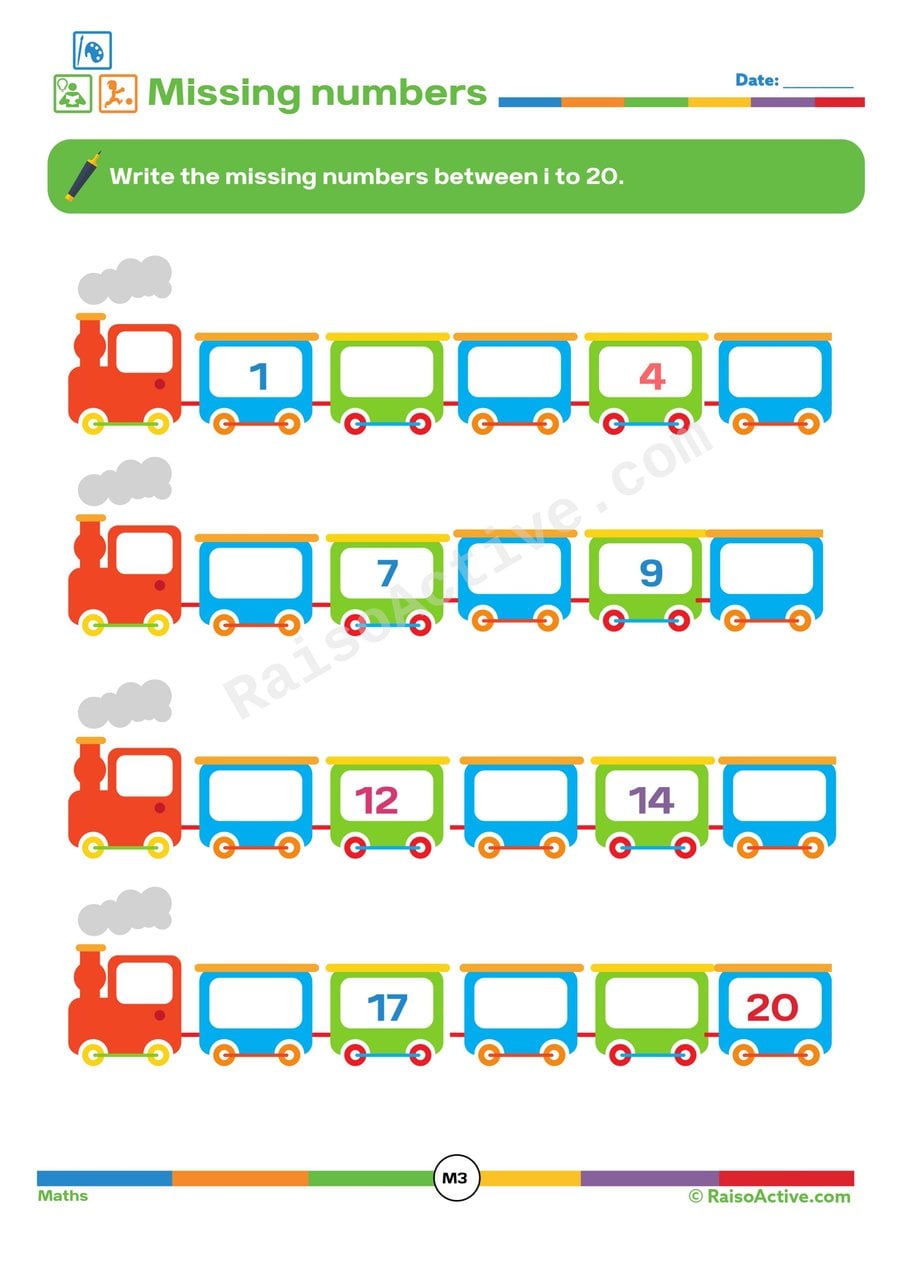
Missing Numbers Train Worksheet: Numbers 1-20
Ages 4-6 · Pre-K–KindergartenAges 4-6 · Reception–Year 1Ages 4-6 · LKG–UKGAges 4-6
This worksheet helps children ages 4-6 practice number recognition and sequencing by filling in missing numbers on a train of cars that counts from 1 to 20, reinforcing that numbers follow a fixed, predictable order. Working with a range this large also builds the stamina and sustained counting skill needed before children move on to skip-counting and simple addition.
Guides for this topic

Number Formation Rhymes 0–9 and How to Fix Reversals
Original number formation rhymes for 0–9, the correct stroke order for each digit, why 3, 5 and 7 get reversed most often, and multisensory fixes that work.

Documenting Learning Without Drowning in Data: A Practical Guide for Parents and Teachers
Learn practical ways to document your child's learning without overwhelm. Simple portfolios, observation tips, and printable trackers for ages 1-8.

How to Help Your Child with Letter Reversals: A Complete Guide for Parents and Teachers
Letter reversals are normal until age 7-8. Learn the best multisensory strategies, anchor letter tricks, and activities to help children write b, d, p, and q correctly.
Reviews
Every worksheet for ages 4–5, no watermark
Members download the full library of 1,000+ worksheets and every activity pack without watermarks or daily limits. One year costs ₹999 in India or $20 elsewhere.
See membership plansOr download any worksheet free with a watermark (5 a day).